© 2011 The McGraw-Hill Companies, Inc. All rights reserved
Chapter 2: Text
© 2011 The McGraw-Hill Companies, Inc. All rights reserved
Overview
•  Importance of text in a multimedia
presentation
•  Understanding fonts and typefaces
•  Using text elements in a multimedia
presentation
•  Computers and text
•  Font editing and design tools
•  Multimedia and hypertext
© 2011 The McGraw-Hill Companies, Inc. All rights reserved
Importance of Text
in a Multimedia Presentation
•  Words and symbols in any form, spoken or
written, are the most common means of
communication.
•  Text is a vital element of multimedia menus,
navigation systems, and content.
© 2011 The McGraw-Hill Companies, Inc. All rights reserved
Importance of Text
in a Multimedia Presentation (continued)
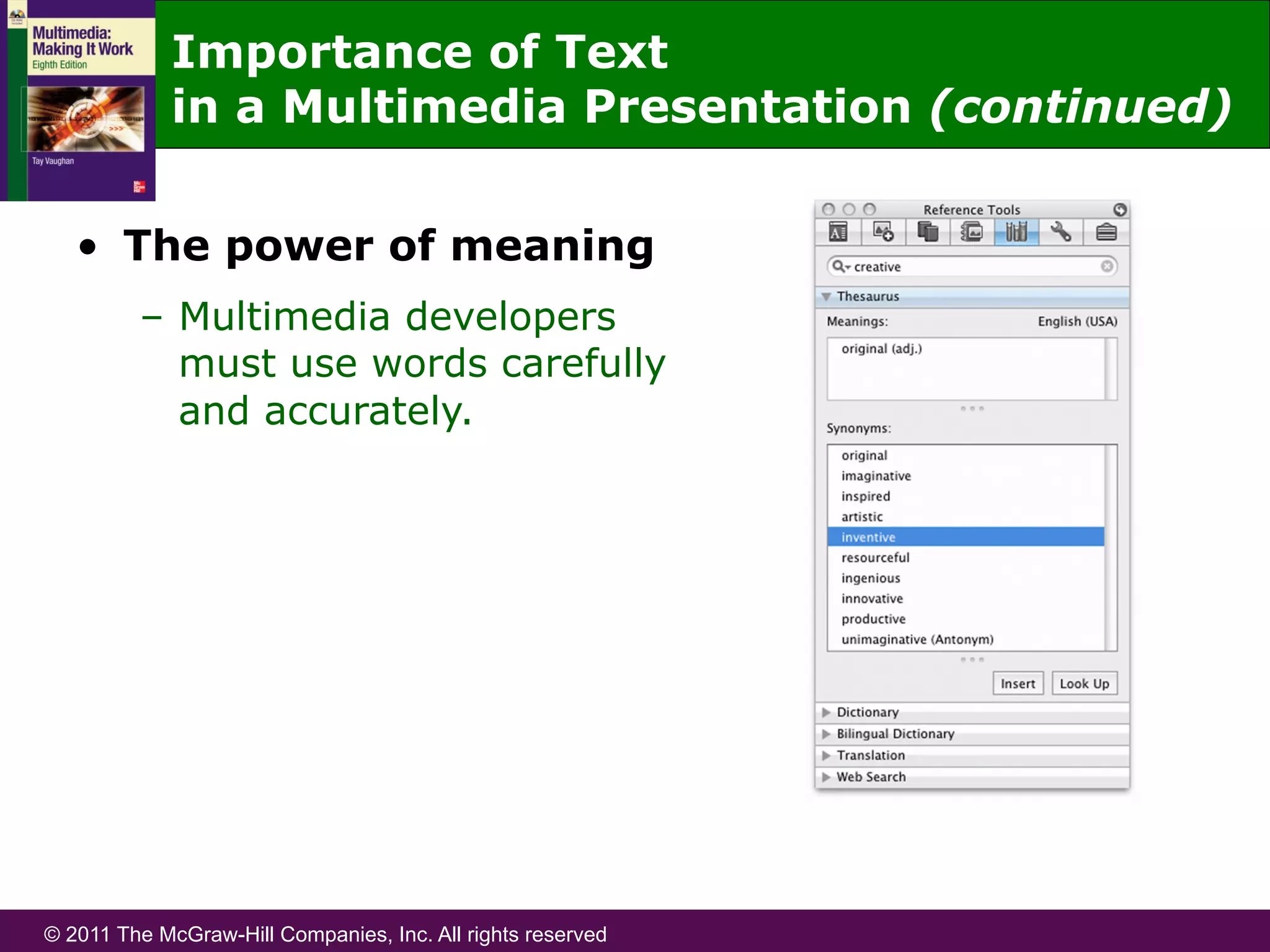
•  The power of meaning
–  Multimedia developers
must use words carefully
and accurately.
© 2011 The McGraw-Hill Companies, Inc. All rights reserved
•  Factors affecting legibility of text:
–  Size
–  Background and foreground colors
–  Style
–  Leading
Importance of Text
in a Multimedia Presentation (continued)
© 2011 The McGraw-Hill Companies, Inc. All rights reserved
Understanding Fonts and Typefaces
•  A typeface is a family of graphic characters,
often with many type sizes and styles.
•  A font is a collection of characters of a single
size and style belonging to a particular
typeface family.
© 2011 The McGraw-Hill Companies, Inc. All rights reserved
Understanding Fonts and Typefaces
(continued)
•  The study of fonts and typefaces includes
the following:
–  Font styles
–  Font sizes
–  Cases
–  Serif versus sans serif
© 2011 The McGraw-Hill Companies, Inc. All rights reserved
•  Font styles include:
–  Boldface
–  Italic
–  Underlining
–  Outlining
Understanding Fonts and Typefaces
(continued)
© 2011 The McGraw-Hill Companies, Inc. All rights reserved
•  Font sizes
–  Font size is measured in points.
–  Character metrics are the general measurements
applied to individual characters.
–  Kerning is the spacing between character pairs.
–  Leading is the space between lines.
Understanding Fonts and Typefaces
(continued)
© 2011 The McGraw-Hill Companies, Inc. All rights reserved
•  Cases
–  A capitalized letter is referred to as uppercase,
while a small letter is referred to as lowercase.
–  Placing an uppercase letter in the middle of a
word is referred to as an intercap.
Understanding Fonts and Typefaces
(continued)
© 2011 The McGraw-Hill Companies, Inc. All rights reserved
•  Serif versus sans serif
–  A serif is the little decoration at the end of a
letter stroke.
–  Serif fonts are used for body text.
–  Sans serif fonts do not have a serif at the end
of a letter stroke.
–  These fonts are used for headlines and bold
statements.
Understanding Fonts and Typefaces
(continued)
© 2011 The McGraw-Hill Companies, Inc. All rights reserved
Using Text Elements
in a Multimedia Presentation
•  The text elements used in multimedia are:
–  Menus for navigation
–  Interactive buttons
–  Fields for reading
–  HTML documents
–  Symbols and icons
© 2011 The McGraw-Hill Companies, Inc. All rights reserved
•  Choosing text fonts
–  Consider legibility and readability.
–  Avoid too many faces.
–  Use color purposefully.
Using Text Elements
in a Multimedia Presentation (continued)
© 2011 The McGraw-Hill Companies, Inc. All rights reserved
•  Choosing text fonts
–  Use anti-aliased text.
–  Use drop caps and initial
caps for accent.
–  Minimize centered text.
–  Use white space.
–  Use animated text to
grab attention.
Using Text Elements
in a Multimedia Presentation (continued)
© 2011 The McGraw-Hill Companies, Inc. All rights reserved
•  Symbols and icons
–  Symbols are concentrated text in the form
of stand-alone graphic constructs.
–  They are used to convey meaningful messages.
Using Text Elements
in a Multimedia Presentation (continued)
© 2011 The McGraw-Hill Companies, Inc. All rights reserved
•  Symbols and icons
–  Symbols used to convey human emotions
are called emoticons.
–  Icons are symbolic representations
of objects and processes.
Using Text Elements
in a Multimedia Presentation (continued)
© 2011 The McGraw-Hill Companies, Inc. All rights reserved
•  Menus for navigation
–  A user navigates through content using
a menu.
–  A simple menu consists of a text list of topics.
Using Text Elements
in a Multimedia Presentation (continued)
© 2011 The McGraw-Hill Companies, Inc. All rights reserved
•  Interactive buttons
–  A button is a clickable object that executes a
command when activated.
–  Users can create their own buttons from bitmaps
and graphics.
–  The design and labeling of the buttons should be
treated as an industrial art project.
Using Text Elements
in a Multimedia Presentation (continued)
© 2011 The McGraw-Hill Companies, Inc. All rights reserved
•  Fields for reading
–  Reading a hard copy is easier and faster than
reading from the computer screen.
–  A document can be printed in one of two
orientations: portrait or landscape.
Using Text Elements
in a Multimedia Presentation (continued)
© 2011 The McGraw-Hill Companies, Inc. All rights reserved
•  Fields for reading (continued)
–  The taller-than-wide orientation used for printing
documents is called portrait.
–  The wider-than-tall orientation that is normal to
monitors is called landscape.
Using Text Elements
in a Multimedia Presentation (continued)
© 2011 The McGraw-Hill Companies, Inc. All rights reserved
•  HTML documents
–  HTML stands for Hypertext Markup Language.
–  HTML documents are marked using tags.
Using Text Elements
in a Multimedia Presentation (continued)
© 2011 The McGraw-Hill Companies, Inc. All rights reserved
•  HTML documents (continued)
–  An advanced form of HTML is DHTML.
–  DHTML stands for Dynamic Hypertext Markup
Language.
–  DHTML uses Cascading Style Sheets (CSS).
Using Text Elements
in a Multimedia Presentation (continued)
© 2011 The McGraw-Hill Companies, Inc. All rights reserved
•  Some of the commonly used tags are:
–  The <B> tag for making text boldfaced
–  The <OL> tag for creating an ordered list
–  The <IMG> tag for inserting images
Using Text Elements
in a Multimedia Presentation (continued)
© 2011 The McGraw-Hill Companies, Inc. All rights reserved
Computers and Text
•  The font wars
•  Character sets
© 2011 The McGraw-Hill Companies, Inc. All rights reserved
Computers and Text (continued)
•  The font wars
–  PostScript
–  TrueType
–  OpenType
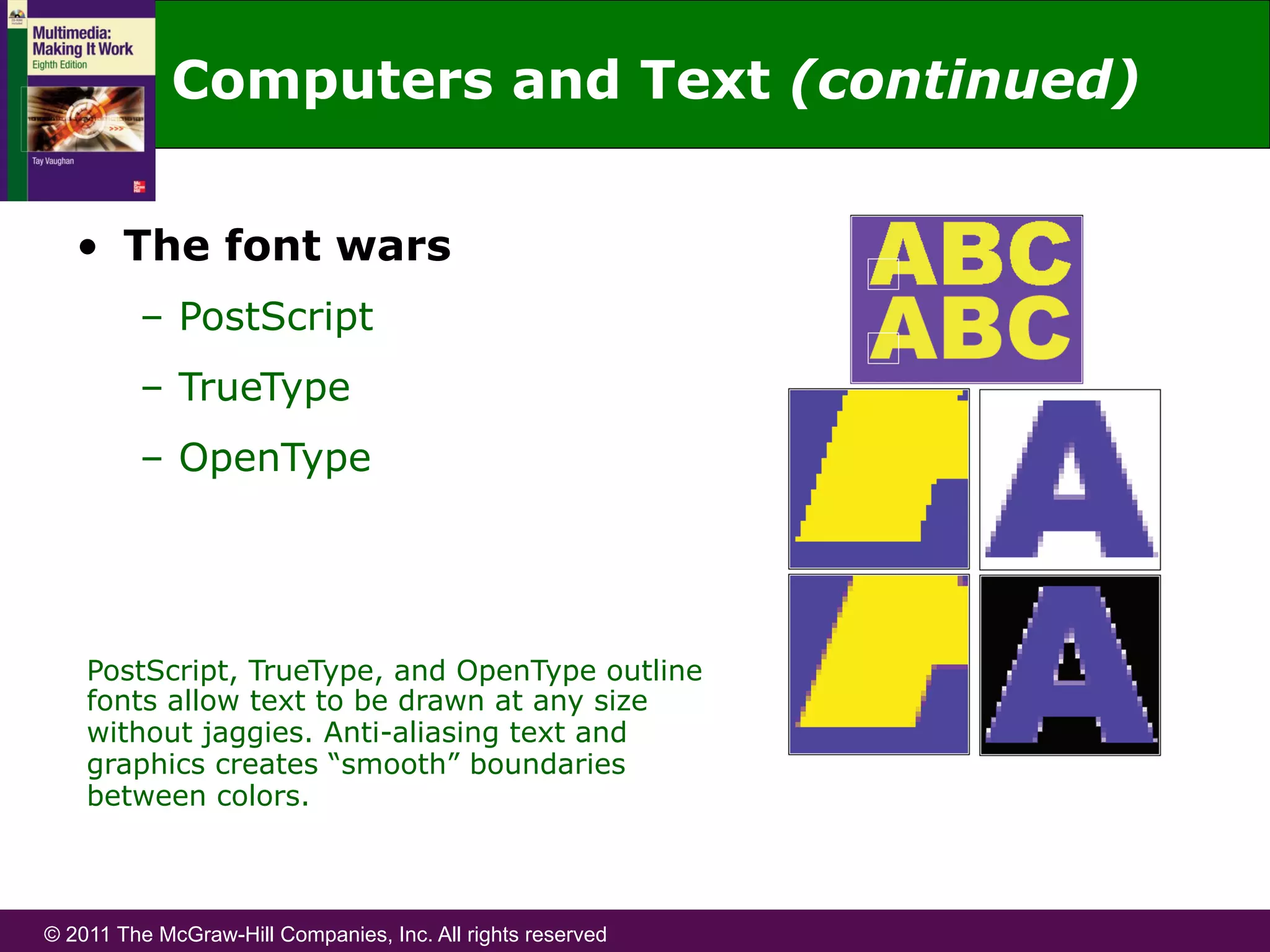
PostScript, TrueType, and OpenType outline
fonts allow text to be drawn at any size
without jaggies. Anti-aliasing text and
graphics creates “smooth” boundaries
between colors.
© 2011 The McGraw-Hill Companies, Inc. All rights reserved
•  PostScript
–  PostScript is a method of describing an image
in terms of mathematical constructs.
–  PostScript characters are scalable and can be
drawn much faster.
–  The two types of PostScript fonts are Type 3
and Type 1.
Computers and Text (continued)
© 2011 The McGraw-Hill Companies, Inc. All rights reserved
•  TrueType
–  Apple and Microsoft developed the TrueType
methodology.
–  TrueType is a system of scalable outline fonts
and can draw characters at low resolution.
Computers and Text (continued)
© 2011 The McGraw-Hill Companies, Inc. All rights reserved
•  OpenType
–  Adobe and Microsoft developed OpenType, now the
international standard.
–  It incorporates the best features of PostScript and
TrueType.
Computers and Text (continued)
© 2011 The McGraw-Hill Companies, Inc. All rights reserved
•  Character sets
–  The American Standard Code for Information
Interchange (ASCII) is a 7-bit coding system.
–  The extended character set is commonly filled
with ANSI standard characters.
–  The ISO-Latin-1 character set is used while
programming the text of HTML pages.
Computers and Text (continued)
© 2011 The McGraw-Hill Companies, Inc. All rights reserved
•  Character sets (continued)
–  Unicode is a 16-bit architecture for multilingual text
and character encoding.
–  The shared symbols of each character set are
unified into collections of symbols called scripts.
Computers and Text (continued)
© 2011 The McGraw-Hill Companies, Inc. All rights reserved
•  Mapping across platforms
–  Fonts and characters are not cross-platform
compatible.
–  They must be mapped to the other machine using
font substitution.
Computers and Text (continued)
© 2011 The McGraw-Hill Companies, Inc. All rights reserved
Font Editing and Design Tools
•  FontLab, Ltd.
•  Creating attractive texts
© 2011 The McGraw-Hill Companies, Inc. All rights reserved
Font Editing and Design Tools
(continued)
•  Fontographer
–  Fontographer is a specialized graphics editor.
–  It is compatible with both Macintosh and Windows
platforms.
–  It can be used to develop PostScript, TrueType, and
OpenType fonts.
–  It can also modify existing typefaces and
incorporate PostScript artwork.
© 2011 The McGraw-Hill Companies, Inc. All rights reserved
Multimedia and Hypertext
•  Multimedia
•  Hypertext systems
•  Using hypertext systems
•  Searching for words
•  Hypermedia structures
•  Hypertext tools
© 2011 The McGraw-Hill Companies, Inc. All rights reserved
Multimedia and Hypertext
(continued)
•  Multimedia
–  Multimedia is defined as the combination of text,
graphics, and audio elements into a single
presentation.
–  When the user assumes control over the
presentation, it is called interactive multimedia.
–  Interactive multimedia becomes hypermedia when
a structure of linked elements is provided to the
user for navigation and interaction.
© 2011 The McGraw-Hill Companies, Inc. All rights reserved
•  Hypertext systems
–  Hypertext is defined as the organized cross-linking
of words, images, and other Web elements.
–  A system in which words are keyed or indexed to
other words is referred to as a hypertext system.
–  A hypertext system enables the user to navigate
through text in a non-linear way.
Multimedia and Hypertext
(continued)
© 2011 The McGraw-Hill Companies, Inc. All rights reserved
•  Using hypertext systems
–  Information management and hypertext programs
present electronic text, images, and other elements
in a database fashion.
–  Software robots visit web pages and index entire
web sites.
Multimedia and Hypertext
(continued)
© 2011 The McGraw-Hill Companies, Inc. All rights reserved
•  Using hypertext systems (continued)
–  Hypertext databases make use of proprietary
indexing systems.
–  Server-based hypertext and database engines are
widely available.
Multimedia and Hypertext
(continued)
© 2011 The McGraw-Hill Companies, Inc. All rights reserved
•  Typical methods for word searching in
hypermedia systems are:
–  Categorical search
–  Word relationship
–  Adjacency
–  Alternates
–  Association
Multimedia and Hypertext
(continued)
© 2011 The McGraw-Hill Companies, Inc. All rights reserved
•  Typical methods for word searching in
hypermedia systems are (continued):
–  Negation
–  Truncation
–  Intermediate words
–  Frequency
Multimedia and Hypertext
(continued)
© 2011 The McGraw-Hill Companies, Inc. All rights reserved
•  Hypermedia structures
–  Links
–  Nodes
–  Anchors
–  Navigating hypermedia structures
Multimedia and Hypertext
(continued)
© 2011 The McGraw-Hill Companies, Inc. All rights reserved
•  Links
–  Links are connections between conceptual
elements.
–  Links are the navigation pathways and menus.
Multimedia and Hypertext
(continued)
© 2011 The McGraw-Hill Companies, Inc. All rights reserved
•  Nodes
–  Nodes are accessible topics, documents, messages,
and content elements.
–  Nodes and links form the backbone of a knowledge
access system.
Multimedia and Hypertext
(continued)
© 2011 The McGraw-Hill Companies, Inc. All rights reserved
•  Anchors
–  An anchor is defined as the reference from one
document to another document, image, sound,
or file on the Web.
–  The source node linked to the anchor is referred
to as a link anchor.
–  The destination node linked to the anchor
is referred to as a link end.
Multimedia and Hypertext
(continued)
© 2011 The McGraw-Hill Companies, Inc. All rights reserved
•  Navigating hypermedia structures
–  The simplest way to navigate hypermedia
structures is via buttons.
–  Location markers must be provided to make
navigation user-friendly.
Multimedia and Hypertext
(continued)
© 2011 The McGraw-Hill Companies, Inc. All rights reserved
•  Two functions common to most hypermedia
text management systems are building
(authoring) and reading.
Multimedia and Hypertext
(continued)
© 2011 The McGraw-Hill Companies, Inc. All rights reserved
•  The functions of a builder are:
–  Creating links
–  Identifying nodes
–  Generating an index of words
Multimedia and Hypertext
(continued)
© 2011 The McGraw-Hill Companies, Inc. All rights reserved
•  Hypertext systems are used for:
–  Electronic publishing and reference works
–  Technical documentation
–  Educational courseware
–  Interactive kiosks
–  Electronic catalogs
Multimedia and Hypertext
(continued)
© 2011 The McGraw-Hill Companies, Inc. All rights reserved
Summary
•  Text is one of the most important
elements of multimedia.
•  The standard document format used
for web pages is called HTML.
•  Dynamic HTML uses Cascading Style Sheets
(CSS) for greater control over design.
© 2011 The McGraw-Hill Companies, Inc. All rights reserved
Summary (continued)
•  Multimedia is the combination of text
graphics, and audio elements into
a single presentation.
•  A hypertext system enables the user to
navigate through text in a non-linear way.

Chapter 2

  • 1.
    © 2011 TheMcGraw-Hill Companies, Inc. All rights reserved Chapter 2: Text
  • 2.
    © 2011 TheMcGraw-Hill Companies, Inc. All rights reserved Overview •  Importance of text in a multimedia presentation •  Understanding fonts and typefaces •  Using text elements in a multimedia presentation •  Computers and text •  Font editing and design tools •  Multimedia and hypertext
  • 3.
    © 2011 TheMcGraw-Hill Companies, Inc. All rights reserved Importance of Text in a Multimedia Presentation •  Words and symbols in any form, spoken or written, are the most common means of communication. •  Text is a vital element of multimedia menus, navigation systems, and content.
  • 4.
    © 2011 TheMcGraw-Hill Companies, Inc. All rights reserved Importance of Text in a Multimedia Presentation (continued) •  The power of meaning –  Multimedia developers must use words carefully and accurately.
  • 5.
    © 2011 TheMcGraw-Hill Companies, Inc. All rights reserved •  Factors affecting legibility of text: –  Size –  Background and foreground colors –  Style –  Leading Importance of Text in a Multimedia Presentation (continued)
  • 6.
    © 2011 TheMcGraw-Hill Companies, Inc. All rights reserved Understanding Fonts and Typefaces •  A typeface is a family of graphic characters, often with many type sizes and styles. •  A font is a collection of characters of a single size and style belonging to a particular typeface family.
  • 7.
    © 2011 TheMcGraw-Hill Companies, Inc. All rights reserved Understanding Fonts and Typefaces (continued) •  The study of fonts and typefaces includes the following: –  Font styles –  Font sizes –  Cases –  Serif versus sans serif
  • 8.
    © 2011 TheMcGraw-Hill Companies, Inc. All rights reserved •  Font styles include: –  Boldface –  Italic –  Underlining –  Outlining Understanding Fonts and Typefaces (continued)
  • 9.
    © 2011 TheMcGraw-Hill Companies, Inc. All rights reserved •  Font sizes –  Font size is measured in points. –  Character metrics are the general measurements applied to individual characters. –  Kerning is the spacing between character pairs. –  Leading is the space between lines. Understanding Fonts and Typefaces (continued)
  • 10.
    © 2011 TheMcGraw-Hill Companies, Inc. All rights reserved •  Cases –  A capitalized letter is referred to as uppercase, while a small letter is referred to as lowercase. –  Placing an uppercase letter in the middle of a word is referred to as an intercap. Understanding Fonts and Typefaces (continued)
  • 11.
    © 2011 TheMcGraw-Hill Companies, Inc. All rights reserved •  Serif versus sans serif –  A serif is the little decoration at the end of a letter stroke. –  Serif fonts are used for body text. –  Sans serif fonts do not have a serif at the end of a letter stroke. –  These fonts are used for headlines and bold statements. Understanding Fonts and Typefaces (continued)
  • 12.
    © 2011 TheMcGraw-Hill Companies, Inc. All rights reserved Using Text Elements in a Multimedia Presentation •  The text elements used in multimedia are: –  Menus for navigation –  Interactive buttons –  Fields for reading –  HTML documents –  Symbols and icons
  • 13.
    © 2011 TheMcGraw-Hill Companies, Inc. All rights reserved •  Choosing text fonts –  Consider legibility and readability. –  Avoid too many faces. –  Use color purposefully. Using Text Elements in a Multimedia Presentation (continued)
  • 14.
    © 2011 TheMcGraw-Hill Companies, Inc. All rights reserved •  Choosing text fonts –  Use anti-aliased text. –  Use drop caps and initial caps for accent. –  Minimize centered text. –  Use white space. –  Use animated text to grab attention. Using Text Elements in a Multimedia Presentation (continued)
  • 15.
    © 2011 TheMcGraw-Hill Companies, Inc. All rights reserved •  Symbols and icons –  Symbols are concentrated text in the form of stand-alone graphic constructs. –  They are used to convey meaningful messages. Using Text Elements in a Multimedia Presentation (continued)
  • 16.
    © 2011 TheMcGraw-Hill Companies, Inc. All rights reserved •  Symbols and icons –  Symbols used to convey human emotions are called emoticons. –  Icons are symbolic representations of objects and processes. Using Text Elements in a Multimedia Presentation (continued)
  • 17.
    © 2011 TheMcGraw-Hill Companies, Inc. All rights reserved •  Menus for navigation –  A user navigates through content using a menu. –  A simple menu consists of a text list of topics. Using Text Elements in a Multimedia Presentation (continued)
  • 18.
    © 2011 TheMcGraw-Hill Companies, Inc. All rights reserved •  Interactive buttons –  A button is a clickable object that executes a command when activated. –  Users can create their own buttons from bitmaps and graphics. –  The design and labeling of the buttons should be treated as an industrial art project. Using Text Elements in a Multimedia Presentation (continued)
  • 19.
    © 2011 TheMcGraw-Hill Companies, Inc. All rights reserved •  Fields for reading –  Reading a hard copy is easier and faster than reading from the computer screen. –  A document can be printed in one of two orientations: portrait or landscape. Using Text Elements in a Multimedia Presentation (continued)
  • 20.
    © 2011 TheMcGraw-Hill Companies, Inc. All rights reserved •  Fields for reading (continued) –  The taller-than-wide orientation used for printing documents is called portrait. –  The wider-than-tall orientation that is normal to monitors is called landscape. Using Text Elements in a Multimedia Presentation (continued)
  • 21.
    © 2011 TheMcGraw-Hill Companies, Inc. All rights reserved •  HTML documents –  HTML stands for Hypertext Markup Language. –  HTML documents are marked using tags. Using Text Elements in a Multimedia Presentation (continued)
  • 22.
    © 2011 TheMcGraw-Hill Companies, Inc. All rights reserved •  HTML documents (continued) –  An advanced form of HTML is DHTML. –  DHTML stands for Dynamic Hypertext Markup Language. –  DHTML uses Cascading Style Sheets (CSS). Using Text Elements in a Multimedia Presentation (continued)
  • 23.
    © 2011 TheMcGraw-Hill Companies, Inc. All rights reserved •  Some of the commonly used tags are: –  The <B> tag for making text boldfaced –  The <OL> tag for creating an ordered list –  The <IMG> tag for inserting images Using Text Elements in a Multimedia Presentation (continued)
  • 24.
    © 2011 TheMcGraw-Hill Companies, Inc. All rights reserved Computers and Text •  The font wars •  Character sets
  • 25.
    © 2011 TheMcGraw-Hill Companies, Inc. All rights reserved Computers and Text (continued) •  The font wars –  PostScript –  TrueType –  OpenType PostScript, TrueType, and OpenType outline fonts allow text to be drawn at any size without jaggies. Anti-aliasing text and graphics creates “smooth” boundaries between colors.
  • 26.
    © 2011 TheMcGraw-Hill Companies, Inc. All rights reserved •  PostScript –  PostScript is a method of describing an image in terms of mathematical constructs. –  PostScript characters are scalable and can be drawn much faster. –  The two types of PostScript fonts are Type 3 and Type 1. Computers and Text (continued)
  • 27.
    © 2011 TheMcGraw-Hill Companies, Inc. All rights reserved •  TrueType –  Apple and Microsoft developed the TrueType methodology. –  TrueType is a system of scalable outline fonts and can draw characters at low resolution. Computers and Text (continued)
  • 28.
    © 2011 TheMcGraw-Hill Companies, Inc. All rights reserved •  OpenType –  Adobe and Microsoft developed OpenType, now the international standard. –  It incorporates the best features of PostScript and TrueType. Computers and Text (continued)
  • 29.
    © 2011 TheMcGraw-Hill Companies, Inc. All rights reserved •  Character sets –  The American Standard Code for Information Interchange (ASCII) is a 7-bit coding system. –  The extended character set is commonly filled with ANSI standard characters. –  The ISO-Latin-1 character set is used while programming the text of HTML pages. Computers and Text (continued)
  • 30.
    © 2011 TheMcGraw-Hill Companies, Inc. All rights reserved •  Character sets (continued) –  Unicode is a 16-bit architecture for multilingual text and character encoding. –  The shared symbols of each character set are unified into collections of symbols called scripts. Computers and Text (continued)
  • 31.
    © 2011 TheMcGraw-Hill Companies, Inc. All rights reserved •  Mapping across platforms –  Fonts and characters are not cross-platform compatible. –  They must be mapped to the other machine using font substitution. Computers and Text (continued)
  • 32.
    © 2011 TheMcGraw-Hill Companies, Inc. All rights reserved Font Editing and Design Tools •  FontLab, Ltd. •  Creating attractive texts
  • 33.
    © 2011 TheMcGraw-Hill Companies, Inc. All rights reserved Font Editing and Design Tools (continued) •  Fontographer –  Fontographer is a specialized graphics editor. –  It is compatible with both Macintosh and Windows platforms. –  It can be used to develop PostScript, TrueType, and OpenType fonts. –  It can also modify existing typefaces and incorporate PostScript artwork.
  • 34.
    © 2011 TheMcGraw-Hill Companies, Inc. All rights reserved Multimedia and Hypertext •  Multimedia •  Hypertext systems •  Using hypertext systems •  Searching for words •  Hypermedia structures •  Hypertext tools
  • 35.
    © 2011 TheMcGraw-Hill Companies, Inc. All rights reserved Multimedia and Hypertext (continued) •  Multimedia –  Multimedia is defined as the combination of text, graphics, and audio elements into a single presentation. –  When the user assumes control over the presentation, it is called interactive multimedia. –  Interactive multimedia becomes hypermedia when a structure of linked elements is provided to the user for navigation and interaction.
  • 36.
    © 2011 TheMcGraw-Hill Companies, Inc. All rights reserved •  Hypertext systems –  Hypertext is defined as the organized cross-linking of words, images, and other Web elements. –  A system in which words are keyed or indexed to other words is referred to as a hypertext system. –  A hypertext system enables the user to navigate through text in a non-linear way. Multimedia and Hypertext (continued)
  • 37.
    © 2011 TheMcGraw-Hill Companies, Inc. All rights reserved •  Using hypertext systems –  Information management and hypertext programs present electronic text, images, and other elements in a database fashion. –  Software robots visit web pages and index entire web sites. Multimedia and Hypertext (continued)
  • 38.
    © 2011 TheMcGraw-Hill Companies, Inc. All rights reserved •  Using hypertext systems (continued) –  Hypertext databases make use of proprietary indexing systems. –  Server-based hypertext and database engines are widely available. Multimedia and Hypertext (continued)
  • 39.
    © 2011 TheMcGraw-Hill Companies, Inc. All rights reserved •  Typical methods for word searching in hypermedia systems are: –  Categorical search –  Word relationship –  Adjacency –  Alternates –  Association Multimedia and Hypertext (continued)
  • 40.
    © 2011 TheMcGraw-Hill Companies, Inc. All rights reserved •  Typical methods for word searching in hypermedia systems are (continued): –  Negation –  Truncation –  Intermediate words –  Frequency Multimedia and Hypertext (continued)
  • 41.
    © 2011 TheMcGraw-Hill Companies, Inc. All rights reserved •  Hypermedia structures –  Links –  Nodes –  Anchors –  Navigating hypermedia structures Multimedia and Hypertext (continued)
  • 42.
    © 2011 TheMcGraw-Hill Companies, Inc. All rights reserved •  Links –  Links are connections between conceptual elements. –  Links are the navigation pathways and menus. Multimedia and Hypertext (continued)
  • 43.
    © 2011 TheMcGraw-Hill Companies, Inc. All rights reserved •  Nodes –  Nodes are accessible topics, documents, messages, and content elements. –  Nodes and links form the backbone of a knowledge access system. Multimedia and Hypertext (continued)
  • 44.
    © 2011 TheMcGraw-Hill Companies, Inc. All rights reserved •  Anchors –  An anchor is defined as the reference from one document to another document, image, sound, or file on the Web. –  The source node linked to the anchor is referred to as a link anchor. –  The destination node linked to the anchor is referred to as a link end. Multimedia and Hypertext (continued)
  • 45.
    © 2011 TheMcGraw-Hill Companies, Inc. All rights reserved •  Navigating hypermedia structures –  The simplest way to navigate hypermedia structures is via buttons. –  Location markers must be provided to make navigation user-friendly. Multimedia and Hypertext (continued)
  • 46.
    © 2011 TheMcGraw-Hill Companies, Inc. All rights reserved •  Two functions common to most hypermedia text management systems are building (authoring) and reading. Multimedia and Hypertext (continued)
  • 47.
    © 2011 TheMcGraw-Hill Companies, Inc. All rights reserved •  The functions of a builder are: –  Creating links –  Identifying nodes –  Generating an index of words Multimedia and Hypertext (continued)
  • 48.
    © 2011 TheMcGraw-Hill Companies, Inc. All rights reserved •  Hypertext systems are used for: –  Electronic publishing and reference works –  Technical documentation –  Educational courseware –  Interactive kiosks –  Electronic catalogs Multimedia and Hypertext (continued)
  • 49.
    © 2011 TheMcGraw-Hill Companies, Inc. All rights reserved Summary •  Text is one of the most important elements of multimedia. •  The standard document format used for web pages is called HTML. •  Dynamic HTML uses Cascading Style Sheets (CSS) for greater control over design.
  • 50.
    © 2011 TheMcGraw-Hill Companies, Inc. All rights reserved Summary (continued) •  Multimedia is the combination of text graphics, and audio elements into a single presentation. •  A hypertext system enables the user to navigate through text in a non-linear way.