Preserving the Animal Kingdom
Ecology
- is the study of the
relationships of organisms
to their environment and
to other organism.
ANIMALS AND THEIR ABIOTIC
ENVIRONMENT
 Habitat – environment
 biotic – all living
 abiotic – nonliving
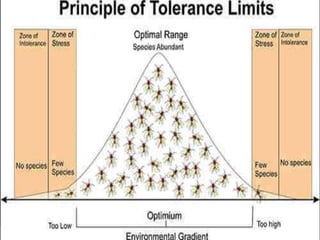
 Tolerance range – animals live within a certain
range of values
 Range of optimum – a certain range of
values within the tolerance range
 Limiting factor – out of an animals tolerance
range
 Taxis – animal’s response to an abiotic factor
 phototaxis – respond to light
Energy
- ability to do work
 Heterotrophic
- other feeder
 Autotrophic
- organism carry on photosynthesis or
other carbon – fixing activities that supply their
food source
 Energy budget
-total energy intake and a description of
how that energy is used and lost
Temperature
- influences the rates of chemical
reactions in animal cells ( metabolic
rate ) and affects the animal’s overall
activity.
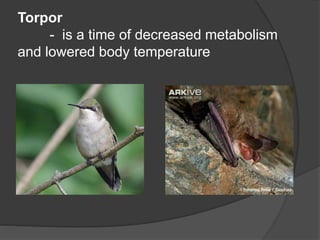
Torpor
- is a time of decreased metabolism
and lowered body temperature
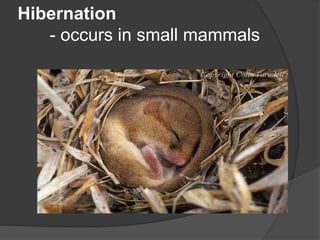
Hibernation
- occurs in small mammals
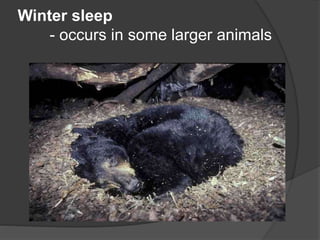
Winter sleep
- occurs in some larger animals
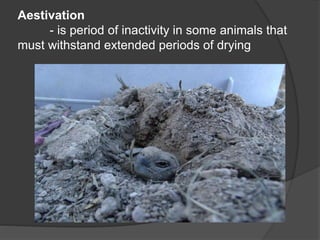
Aestivation
- is period of inactivity in some animals that
must withstand extended periods of drying
Other Abiotic Factors
Moisture
light
Geology and soil
Populations
- groups of individuals of the same species
that occupy a given area at the same time and
have unique attributes.
POPULATION GROWTH
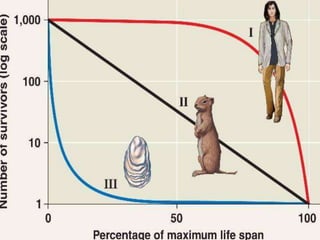
 Type 1 (convex)
- survive to an old age , then die rapidly
 Type 2 (diagonal)
- have constant probability of death
throughout their lives
 Type 3 (concave)
- experience very high juvenile mortality
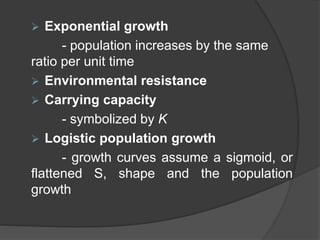
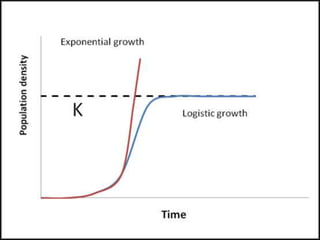
 Exponential growth
- population increases by the same
ratio per unit time
 Environmental resistance
 Carrying capacity
- symbolized by K
 Logistic population growth
- growth curves assume a sigmoid, or
flattened S, shape and the population
growth
POPULATION REGULATION
- the conditions that an animal must meet to
survive are unique for every species.
Population Density
 Density – independent factors
- influence the number of animals in a
population without regard to the number of
individuals
 Density – dependent factors
- more severe when population density is
high ( or sometimes very low ) than they are at
other densities.
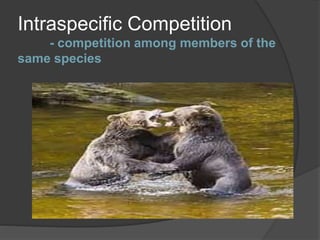
Intraspecific Competition
- competition among members of the
same species
INTERSPECIFIC INTERACTIONS
 Herbivory and predation
 Interspecific competition
 Coevolution
 Symbiosis
- competition among members of the
same species
Intraspecific Competition
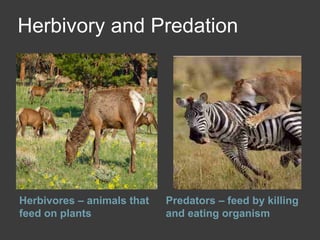
Herbivory and Predation
Herbivores – animals that
feed on plants
Predators – feed by killing
and eating organism
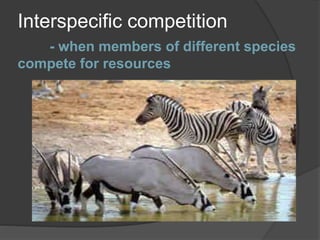
- when members of different species
compete for resources
Interspecific competition
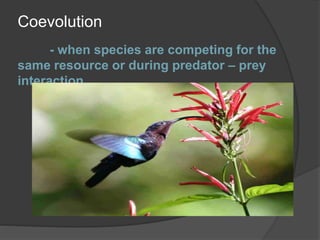
- when species are competing for the
same resource or during predator – prey
interaction
Coevolution
symbiosis
- arising through coevolution come
from two different species living in
continuing, intimate associations
*Parasitism
*Commensalism
*Mutualism
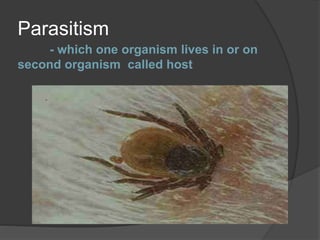
- which one organism lives in or on
second organism called host
Parasitism
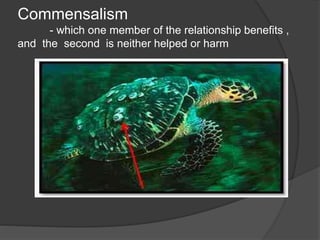
Commensalism
- which one member of the relationship benefits ,
and the second is neither helped or harm
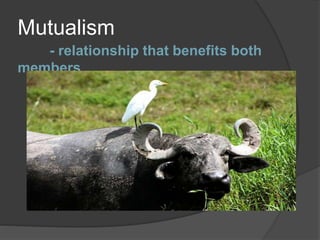
- relationship that benefits both
members
Mutualism
Other Interspecific Adaptations
 Camouflage
- occurs when animal’s patterns help hide the
animal
 Cryptic coloration
 Countershading
*Aposematic coloration
-when an animal shows to the predator their
condition by conspicuous coloration.
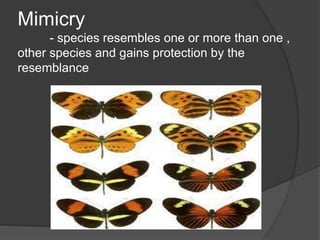
 Mimicry
- when species resembles one, or sometimes
more than one, other species and gains protection by
the resemblance
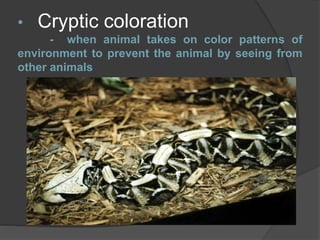
- when animal takes on color patterns of
environment to prevent the animal by seeing from
other animals
• Cryptic coloration
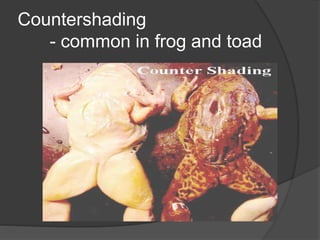
Countershading
- common in frog and toad
Mimicry
- species resembles one or more than one ,
other species and gains protection by the
resemblance
Communities
- all populations living in an area
 Dominant species
- species that are responsible for
establishing community characteristic
 Community (species) diversity/richness
- characterized by the variety of species
contain.
THE ECOLOGICAL NICHE
- includes all the attributes of an animal’s
lifestyle
Community Stability
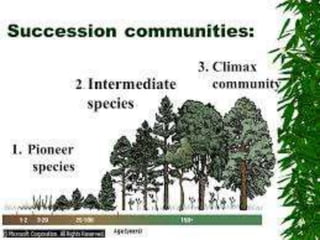
 Succession
-a process by which the dominant members
of the community change a community in
predictable ways
 Pioneer community
- the first community to become established
in an area.
 Seral stage
 Sere
 Climax community
- usually have complex structure and high
species diversity
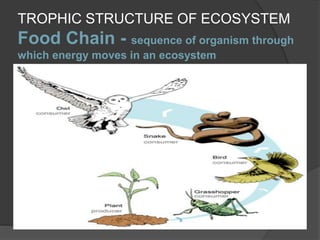
Food Chain - sequence of organism through
which energy moves in an ecosystem
TROPHIC STRUCTURE OF ECOSYSTEM
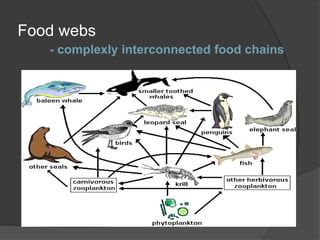
- complexly interconnected food chains
Food webs
*BIOGEOCHEMICAL CYCLES
Cycling within Ecosystem
 The flow of chemical elements and compounds
between living organisms and the physical
environment.
ECOLOGICAL PROBLEMS
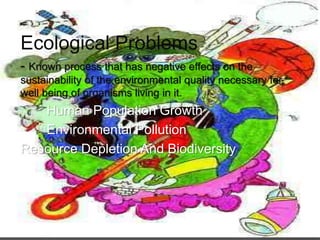
Ecological Problems
- Known process that has negative effects on the
sustainability of the environmental quality necessary for
well being of organisms living in it.
Human Population Growth
Environmental Pollution
Resource Depletion And Biodiversity
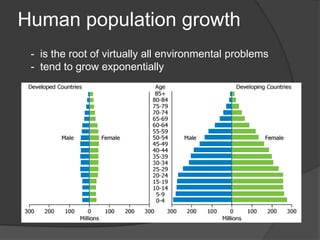
Human population growth
- is the root of virtually all environmental problems
- tend to grow exponentially
Environmental Pollution
 defined as the undesirable change in
physical, chemical and biological
characteristics of our air, land and water
Classification of environmental pollution
 Pollution can be broadly classified
according to the components of
environment that are polluted.
1. Air Pollution
 any imbalance in the ratio of oxygen, carbon
dioxide and nitrogen.
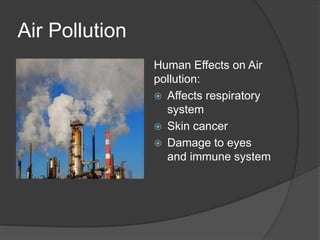
Air Pollution
Human Effects on Air
pollution:
 Affects respiratory
system
 Skin cancer
 Damage to eyes
and immune system
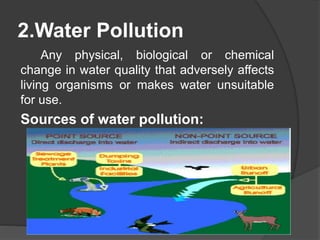
2.Water Pollution
Any physical, biological or chemical
change in water quality that adversely affects
living organisms or makes water unsuitable
for use.
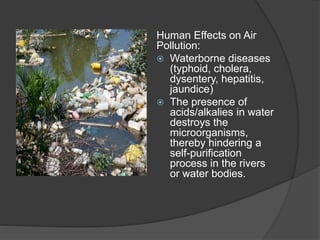
Sources of water pollution:
Human Effects on Air
Pollution:
 Waterborne diseases
(typhoid, cholera,
dysentery, hepatitis,
jaundice)
 The presence of
acids/alkalies in water
destroys the
microorganisms,
thereby hindering a
self-purification
process in the rivers
or water bodies.
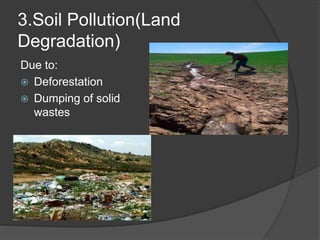
3.Soil Pollution(Land
Degradation)
Due to:
 Deforestation
 Dumping of solid
wastes
RESOURCE DEPLETION AND
BIODIVERSITY
 Biodiversity
- the variety of living organisms in an
ecosystem
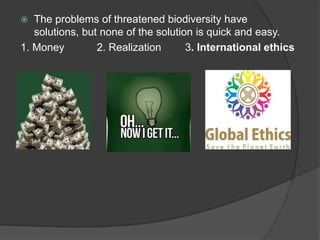
 The problems of threatened biodiversity have
solutions, but none of the solution is quick and easy.
1. Money 2. Realization 3. International ethics