Ecology
WHAT IS ECOLOGY?
Ecology- the scientific study of
interactions between organisms
and their environments, focusing
on energy transfer
Ecology is a science of relationships
WHAT DO YOU MEAN BY ENVIRONMENT?
The environment is made
up of two factors:
• Biotic factors- all living
organisms inhabiting the
Earth
• Abiotic factors- nonliving
parts of the environment
(i.e. temperature, soil,
light, moisture, air
currents)
Organism
Population
Community
Biosphere
Ecosystem
Organism - any unicellular or
multicellular form exhibiting all of the
characteristics of life, an individual.
•The lowest level of organization
POPULATION
 a group of organisms of
one species living in the
same place at the same
time that interbreed
Produce fertile offspring
Compete with each other
for resources (food,
mates, shelter, etc.)
Community - several interacting
populations that inhabit a common
environment and are interdependent.
Ecosystem - populations in a
community and the abiotic factors
with which they interact (ex.
marine, terrestrial)
Biosphere - life supporting portions
of Earth composed of air, land,
fresh water, and salt water.
•The highest level of organization
Habitat vs. Niche
Niche - the role a species plays in
a community; its total way of life
Habitat- the place in which an
organism lives out its life
Habitat vs. Niche
A niche is determined by the
tolerance limitations of an
organism, or a limiting factor.
Limiting factor- any biotic or
abiotic factor that restricts the
existence of organisms in a
specific environment.
Examples of limiting factors -
•Amount of water
•Amount of food
•Temperature
•Amount of space
•Availability of mates
Habitat vs. Niche
Feeding Relationships
• There are 3 main types of feeding
relationships
1. Producer - Consumer
2. Predator - Prey
3. Parasite - Host
Feeding Relationships
Producer- all
autotrophs (plants),
they trap energy
from the sun
• Bottom of the food
chain
Feeding Relationships
Consumer- all heterotrophs: they
ingest food containing the sun’s
energy
Herbivores
Carnivores
Omnivores
Decomposers
Feeding Relationships
CONSUMERS
1. Primary consumers
• Eat plants
• Herbivores
• Secondary, tertiary
… consumers
• Prey animals
• Carnivores
Feeding Relationships
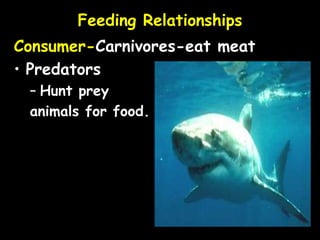
Consumer-Carnivores-eat meat
• Predators
– Hunt prey
animals for food.
Feeding Relationships
Consumer- Carnivores- eat meat
• Scavengers
– Feed on carrion,
dead animals
Feeding Relationships
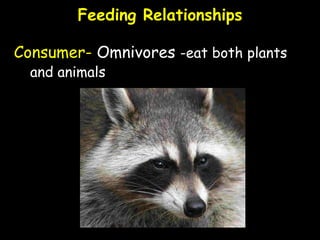
Consumer- Omnivores -eat both plants
and animals
Feeding Relationships
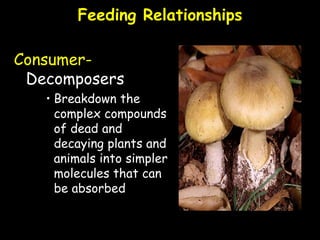
Consumer-
Decomposers
• Breakdown the
complex compounds
of dead and
decaying plants and
animals into simpler
molecules that can
be absorbed
Symbiotic Relationships
Symbiosis- two species living together
3 Types of
symbiosis:
1. Commensalism
2. Parasitism
3. Mutualism
Symbiotic Relationships
Commensalism-
one species benefits
and the other is
neither harmed nor
helped
Ex. orchids on a tree
Epiphytes: A plant, such as a tropical
orchid or a bromeliad, that grows on another
plant upon which it depends for mechanical
support but not for nutrients. Also called
xerophyte, air plant.
Symbiotic Relationships
Commensalism-
one species benefits
and the other is
neither harmed nor
helped
Ex. polar bears and
cyanobacteria
Symbiotic Relationships
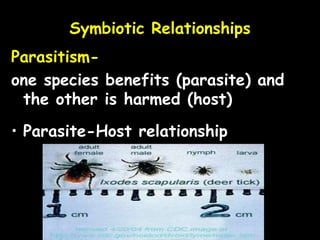
Parasitism-
one species benefits (parasite) and
the other is harmed (host)
• Parasite-Host relationship
Symbiotic Relationships
Parasitism- parasite-host
Ex. lampreys,
leeches, fleas,
ticks, tapeworm
Symbiotic Relationships
Mutualism-
beneficial to
both species
Ex. cleaning birds
and cleaner
shrimp
Symbiotic Relationships
Mutualism-
beneficial to both species
Ex. lichen
Type of
relationship
Species
harmed
Species
benefits
Species
neutral
Commensalism
Parasitism
Mutualism
= 1 species
Trophic Levels
• Each link in a food chain is known
as a trophic level.
• Trophic levels represent a feeding
step in the transfer of energy
and matter in an ecosystem.
Trophic Levels
Biomass- the amount of organic matter
comprising a group of organisms in a
habitat.
• As you move up a food chain, both
available energy and biomass
decrease.
• Energy is transferred upwards but is
diminished with each transfer.
Trophic Levels
Producers- Autotrophs
Primary consumers- Herbivores
Secondary consumers-
small carnivores
Tertiary
consumers- top
carnivores
E
N
E
R
G
Y
Trophic Levels
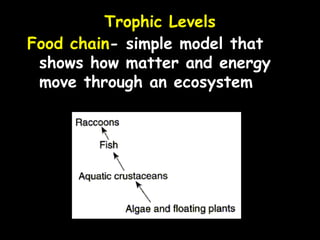
Food chain- simple model that
shows how matter and energy
move through an ecosystem
Trophic Levels
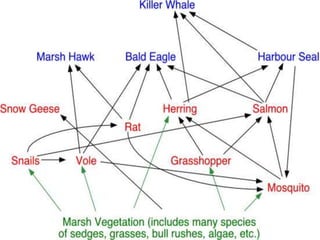
Food web- shows all possible
feeding relationships in a
community at each trophic level
• Represents a network of
interconnected food chains
Food chain Food web
(just 1 path of energy) (all possible energy paths)
Nutrient Cycles
Cycling maintains homeostasis
(balance) in the environment.
•3 cycles to investigate:
1. Water cycle
2. Carbon cycle
3. Nitrogen cycle
Water cycle-
•Evaporation, transpiration,
condensation, precipitation
Water cycle-
Carbon cycle-
•Photosynthesis and respiration
cycle carbon and oxygen through
the environment.
Carbon cycle-
Nitrogen cycle-
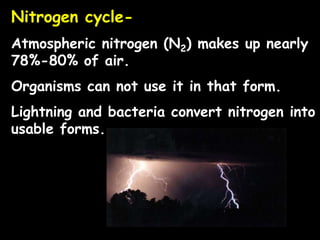
Atmospheric nitrogen (N2) makes up nearly
78%-80% of air.
Organisms can not use it in that form.
Lightning and bacteria convert nitrogen into
usable forms.
Nitrogen cycle-
Only in certain bacteria and industrial
technologies can fix nitrogen.
Nitrogen fixation-convert atmospheric
nitrogen (N2) into ammonium (NH4
+)
which can be used to make organic
compounds like amino acids.
N2 NH4
+
Nitrogen cycle-
Nitrogen-fixing
bacteria:
Some live in a
symbiotic
relationship with
plants of the legume
family (e.g.,
soybeans, clover,
peanuts).
Nitrogen cycle-
•Some nitrogen-fixing bacteria live
free in the soil.
•Nitrogen-fixing cyanobacteria are
essential to maintaining the fertility
of semi-aquatic environments like rice
paddies.
Atmospheric
nitrogen
Lightning
Nitrogen
fixing bacteria
Ammonium Nitrification
by bacteria
Nitrites Nitrates
Denitrification
by bacteria
Plants
Animals
Decomposers
Nitrogen Cycle
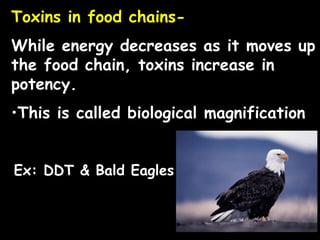
Toxins in food chains-
While energy decreases as it moves up
the food chain, toxins increase in
potency.
•This is called biological magnification
Ex: DDT & Bald Eagles

ecology good.ppt