BIODIVERSITY
   BASICS
What is Biodiversity?


Biological Diversity is the incredible
variety of life on Earth - its genes, its
     species, and its ecosystems.
3 LEVELS OF BIODIVERSITY
     Genetic                Species               Ecosystem
• genes are the      • more than1.7 million • is the combined
    building blocks    species have been        physical and bio-
    of heredity        named to date but        logical components
                       likely more than 10      of an environment
• 1 gene can           million exist!
                                               • they build slowly,
    lengthen a life-                             over millions of
    span, or create   • total # of species in    years
    a race of giants    a certain ecosystem
                        is known as           • Area counts: large
 • genetic variation                            ecosystems are
                        species richness
   allows adaptation                            more diverse an
   to a changing                                and complex than
   environment                                  small ones
Genetic diversity is created by interbreeding
  among different populations. It is vital for
   disease resistance and species resilience.
                                   resilience
    Genetic diversity is maintained through
     connections between habitats such as
greenways, riparian areas and wildlife corridors.
Habitat Fragmentation Affects Biological Diversity


Intact Ecosystem
Habitat Fragmentation Affects Biological Diversity


Fragmented Ecosystem

 Intact Ecosystem
Interior Habitat is Highly Valuable


• Many native species need large tracts of interior habitat and
  completely avoid edge habitat.

• Edge habitat greatly increases with increased fragmentation

• Many established parks are too small for interior species and some
  small patches of habitat may contain all edge and no interior
Wildlife Corridors Connect Fragmented Areas


                                 Strip of habitat makes it possible for
                             wildlife to travel more safely between
                          “islands” of habitat.
                 Wildlife corridors increase the ecological
              value of isolated and fragmented habitat.
Riparian vegetation acts as a wildlife corridor,
    allowing migration of species between
        fragmented patches of habitat.
BC is the most
             biodiverse province
                  in Canada


BC has 16 different
major ecosystem types
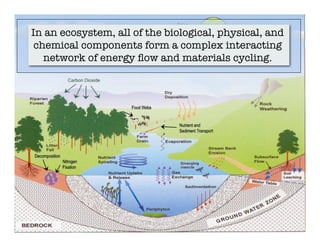
In an ecosystem, all of the biological, physical, and
 chemical components form a complex interacting
   network of energy flow and materials cycling.
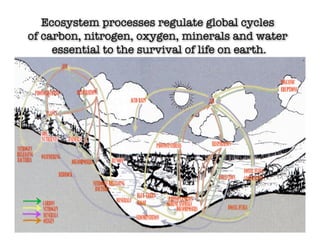
Ecosystem processes regulate global cycles
of carbon, nitrogen, oxygen, minerals and water
     essential to the survival of life on earth.
ECOSYSTEMS: Essential for all Life

   They Give:
• water
• food (food webs)
• habitat
• fuel
• soil
• construction
  materials
• fiber
• medicines
• jobs in forestry
  agriculture, parks
  fishing and tourism
ECOSYSTEMS: Essential for all Life

   They Give:             They Do:
• water                 • recycle nutrients
• food (food webs)      • clean the air
• habitat               • produce oxygen
• fuel                  • purify water
• soil                  • mitigate floods
• construction          • control erosion
  materials             • detoxify soils
• fiber                 • provide shade
• medicines             • moderate climate
• jobs in forestry      • pollination
  agriculture, parks    • convert solar energy
  fishing and tourism   • protect against
                          harmful cosmic rays
ECOSYSTEMS: Essential for all Life

   They Give:              They Do:                  They Are:
• water                 • recycle nutrients    • aesthetically
• food (food webs)      • clean the air          pleasing
• habitat               • produce oxygen       • source of intellect-
• fuel                  • purify water           ual stimulation
• soil                  • mitigate floods      • a sense of place
• construction          • control erosion      • recreation places
  materials             • detoxify soils       • intrinsically valuable
• fiber                 • provide shade        • irreplaceable
• medicines             • moderate climate
• jobs in forestry      • pollination
  agriculture, parks    • convert solar energy
  fishing and tourism   • protect against
                          harmful cosmic rays
ECOSYSTEM SERVICES
We Use NOW - But Pay WHEN?
ECOSYSTEM SERVICES
We Use NOW - But Pay WHEN?

   Are Ecosystem Services FREE?
ECOSYSTEM SERVICES
We Use NOW - But Pay WHEN?

    Are Ecosystem Services FREE?
Can we put a COST on nature’s services?
ECOSYSTEM SERVICES
We Use NOW - But Pay WHEN?

    Are Ecosystem Services FREE?
Can we put a COST on nature’s services?
      Could we AFFORD them?
ECOSYSTEM SERVICES
We Use NOW - But Pay WHEN?

Robert Costanza (professor at University of
 Maryland) estimated the value of nature’s
           “free” services to be:
         $33 trillion /YEAR!
  In that same year, he estimated the GNP
of the earth to be only $18 trillion / year
ECOSYSTEM SERVICES
We Use NOW - But Pay WHEN?


  Our current economic systems
    do NOT account for the
    VALUE and USEFULNESS
  of ecosystems and biodiversity
THREATS TO BIODIVERSITY

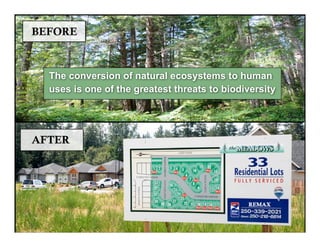
• ECOSYSTEM CONVERSION
The conversion of natural ecosystems to human
uses is one of the greatest threats to biodiversity
THREATS TO BIODIVERSITY

• ECOSYSTEM CONVERSION
• ECOSYSTEM FRAGMENTATION
Fragmentation converts intact ecosystems
to patches of isolated habitat
THREATS TO BIODIVERSITY

• ECOSYSTEM CONVERSION
• ECOSYSTEM FRAGMENTATION
• INTRODUCED SPECIES
Introduced Species can displace
  native species or out-compete
    them for food and habitat
THREATS TO BIODIVERSITY

• ECOSYSTEM CONVERSION
• ECOSYSTEM FRAGMENTATION
• INTRODUCED SPECIES
• CONTAMINATION/POLLUTION
THREATS TO BIODIVERSITY

• ECOSYSTEM CONVERSION
• ECOSYSTEM FRAGMENTATION
• INTRODUCED SPECIES
• CONTAMINATION/POLLUTION

• OVER-EXPLOITATION
Wordwide Depletion of Commercial Fisheries
THREATS TO BIODIVERSITY

• ECOSYSTEM CONVERSION
• ECOSYSTEM FRAGMENTATION
• INTRODUCED SPECIES
• CONTAMINATION/POLLUTION

• OVER-EXPLOITATION
• CLIMATE CHANGE
Many species will not be able
    to adapt fast enough
 to changing environmental
  conditions and will face
    imminent extinction
B.C is the most biodiverse province
  in Canada. It’s biodiversity is
    globally significant because
    of its variety and integrity.
Ecosystem conversion due to development
  and agriculture, and degradation from
  the forest, oil and gas industries, and
 transportation corridors, has seriously
       impacted B.C’s biodiversity.
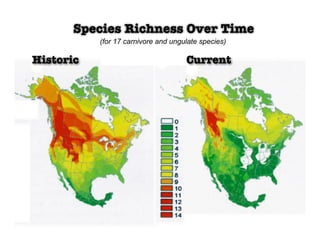
Species Richness Over Time
           (for 17 carnivore and ungulate species)

Historic                             Current
Failure to protect ecosystems leads to…

 • loss of topsoil
 • erosion, flooding, drought
 •ground water contamination
 • loss of pollinators
 • reduced air and water quality
 • extinction of species.
Maintaining the integrity of
natural systems is the best way
  to protect biodiversity in all
           its forms:
genetic, species and ecosystems.
Comox Valley Conservation Strategy
           embraces the
    precautionary principle
     as a vital foundation of its
 regional conservation framework.
The Precautionary Principle:
 “If an activity may cause harm
to the public or the environment,
lack of full scientific certainty or
 consensus should not postpone
  measures to prevent damage
         from occurring.”
For more information on the
Comox Valley Conservation Strategy:
www.cvconservationstrategy.org

Biodiversity Basics

  • 1.
  • 3.
  • 4.
    What is Biodiversity? BiologicalDiversity is the incredible variety of life on Earth - its genes, its species, and its ecosystems.
  • 5.
    3 LEVELS OFBIODIVERSITY
  • 6.
    3 LEVELS OFBIODIVERSITY Genetic Species Ecosystem • genes are the • more than1.7 million • is the combined building blocks species have been physical and bio- of heredity named to date but logical components likely more than 10 of an environment • 1 gene can million exist! • they build slowly, lengthen a life- over millions of span, or create • total # of species in years a race of giants a certain ecosystem is known as • Area counts: large • genetic variation ecosystems are species richness allows adaptation more diverse an to a changing and complex than environment small ones
  • 7.
    Genetic diversity iscreated by interbreeding among different populations. It is vital for disease resistance and species resilience. resilience Genetic diversity is maintained through connections between habitats such as greenways, riparian areas and wildlife corridors.
  • 8.
    Habitat Fragmentation AffectsBiological Diversity Intact Ecosystem
  • 9.
    Habitat Fragmentation AffectsBiological Diversity Fragmented Ecosystem Intact Ecosystem
  • 10.
    Interior Habitat isHighly Valuable • Many native species need large tracts of interior habitat and completely avoid edge habitat. • Edge habitat greatly increases with increased fragmentation • Many established parks are too small for interior species and some small patches of habitat may contain all edge and no interior
  • 11.
    Wildlife Corridors ConnectFragmented Areas Strip of habitat makes it possible for wildlife to travel more safely between “islands” of habitat. Wildlife corridors increase the ecological value of isolated and fragmented habitat.
  • 12.
    Riparian vegetation actsas a wildlife corridor, allowing migration of species between fragmented patches of habitat.
  • 13.
    BC is themost biodiverse province in Canada BC has 16 different major ecosystem types
  • 14.
    In an ecosystem,all of the biological, physical, and chemical components form a complex interacting network of energy flow and materials cycling.
  • 15.
    Ecosystem processes regulateglobal cycles of carbon, nitrogen, oxygen, minerals and water essential to the survival of life on earth.
  • 16.
  • 17.
    ECOSYSTEMS: Essential forall Life They Give: • water • food (food webs) • habitat • fuel • soil • construction materials • fiber • medicines • jobs in forestry agriculture, parks fishing and tourism
  • 18.
    ECOSYSTEMS: Essential forall Life They Give: They Do: • water • recycle nutrients • food (food webs) • clean the air • habitat • produce oxygen • fuel • purify water • soil • mitigate floods • construction • control erosion materials • detoxify soils • fiber • provide shade • medicines • moderate climate • jobs in forestry • pollination agriculture, parks • convert solar energy fishing and tourism • protect against harmful cosmic rays
  • 19.
    ECOSYSTEMS: Essential forall Life They Give: They Do: They Are: • water • recycle nutrients • aesthetically • food (food webs) • clean the air pleasing • habitat • produce oxygen • source of intellect- • fuel • purify water ual stimulation • soil • mitigate floods • a sense of place • construction • control erosion • recreation places materials • detoxify soils • intrinsically valuable • fiber • provide shade • irreplaceable • medicines • moderate climate • jobs in forestry • pollination agriculture, parks • convert solar energy fishing and tourism • protect against harmful cosmic rays
  • 20.
    ECOSYSTEM SERVICES We UseNOW - But Pay WHEN?
  • 21.
    ECOSYSTEM SERVICES We UseNOW - But Pay WHEN? Are Ecosystem Services FREE?
  • 22.
    ECOSYSTEM SERVICES We UseNOW - But Pay WHEN? Are Ecosystem Services FREE? Can we put a COST on nature’s services?
  • 23.
    ECOSYSTEM SERVICES We UseNOW - But Pay WHEN? Are Ecosystem Services FREE? Can we put a COST on nature’s services? Could we AFFORD them?
  • 24.
    ECOSYSTEM SERVICES We UseNOW - But Pay WHEN? Robert Costanza (professor at University of Maryland) estimated the value of nature’s “free” services to be: $33 trillion /YEAR! In that same year, he estimated the GNP of the earth to be only $18 trillion / year
  • 25.
    ECOSYSTEM SERVICES We UseNOW - But Pay WHEN? Our current economic systems do NOT account for the VALUE and USEFULNESS of ecosystems and biodiversity
  • 26.
  • 27.
    THREATS TO BIODIVERSITY •ECOSYSTEM CONVERSION
  • 28.
    The conversion ofnatural ecosystems to human uses is one of the greatest threats to biodiversity
  • 29.
    THREATS TO BIODIVERSITY •ECOSYSTEM CONVERSION • ECOSYSTEM FRAGMENTATION
  • 30.
    Fragmentation converts intactecosystems to patches of isolated habitat
  • 31.
    THREATS TO BIODIVERSITY •ECOSYSTEM CONVERSION • ECOSYSTEM FRAGMENTATION • INTRODUCED SPECIES
  • 32.
    Introduced Species candisplace native species or out-compete them for food and habitat
  • 33.
    THREATS TO BIODIVERSITY •ECOSYSTEM CONVERSION • ECOSYSTEM FRAGMENTATION • INTRODUCED SPECIES • CONTAMINATION/POLLUTION
  • 35.
    THREATS TO BIODIVERSITY •ECOSYSTEM CONVERSION • ECOSYSTEM FRAGMENTATION • INTRODUCED SPECIES • CONTAMINATION/POLLUTION • OVER-EXPLOITATION
  • 36.
    Wordwide Depletion ofCommercial Fisheries
  • 37.
    THREATS TO BIODIVERSITY •ECOSYSTEM CONVERSION • ECOSYSTEM FRAGMENTATION • INTRODUCED SPECIES • CONTAMINATION/POLLUTION • OVER-EXPLOITATION • CLIMATE CHANGE
  • 39.
    Many species willnot be able to adapt fast enough to changing environmental conditions and will face imminent extinction
  • 41.
    B.C is themost biodiverse province in Canada. It’s biodiversity is globally significant because of its variety and integrity.
  • 42.
    Ecosystem conversion dueto development and agriculture, and degradation from the forest, oil and gas industries, and transportation corridors, has seriously impacted B.C’s biodiversity.
  • 43.
    Species Richness OverTime (for 17 carnivore and ungulate species) Historic Current
  • 45.
    Failure to protectecosystems leads to… • loss of topsoil • erosion, flooding, drought •ground water contamination • loss of pollinators • reduced air and water quality • extinction of species.
  • 46.
    Maintaining the integrityof natural systems is the best way to protect biodiversity in all its forms: genetic, species and ecosystems.
  • 48.
    Comox Valley ConservationStrategy embraces the precautionary principle as a vital foundation of its regional conservation framework.
  • 49.
    The Precautionary Principle: “If an activity may cause harm to the public or the environment, lack of full scientific certainty or consensus should not postpone measures to prevent damage from occurring.”
  • 50.
    For more informationon the Comox Valley Conservation Strategy: www.cvconservationstrategy.org