























Federalism Dr. Topher Rice
True   or   False : Federalism is a political system in which the national government determines the powers states are given.
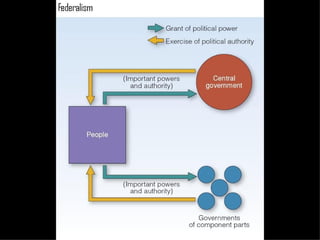
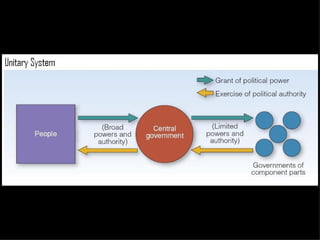
Federalism   A system of government under which significant government powers are divided between the central government and smaller governmental units.
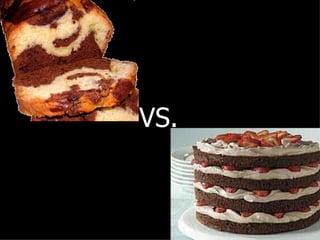
VS.
American Federalism:  A multiplicity of governing levels and units
1
50
1000’s
All of these governments are related to each other in a particular way.
federal  system


Federalism   A Key Structural Characteristic of American Government
Tends to prevent fully unified, disciplined parties
 
Limits actions of Congress and the President (10 th  Amendment).
Allows a diversity of policies to be pursued in different states, regions
The advantages of federalism include: innovation and experimentation in public policy through the existence of differing laws across states. a diversity of needs may be met. government is kept close to the people. all of these choices.
Advantages of Federalism Diversity of Needs can be met. Closeness to the people. Innovation and experimentation.
The disadvantages of federalism include all of the following EXCEPT: Simplicity Lack of national standards Low visibility and lack of popular control Lack of uniformity in rules and programs
Disadvantages of Federalism Lack of national standards Low visibility and lack of popular control Lack of uniformity in rules and programs
2
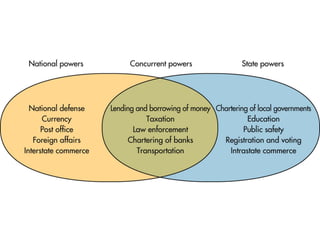
Power expressly given to the states, as well as to the national government.
 
States have (had) important roles in shaping  the national government.
How Federalism is Embodied in  the Constitution Constitution makes central government supreme in certain matters,  BUT makes clear state governments have independent powers. Supremacy Clause  Article I, Section 8 Tenth Amendment (Reservation Clause)
State Roles in National Government
State governments play central part in amending the Constitution.
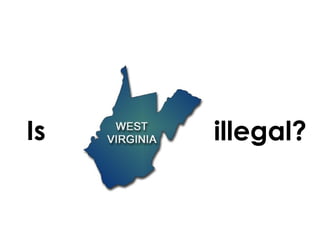
Is illegal?
Dual Federalism
Limited national power by claiming that states retained certain powers that could not be regulated through national action.
“National power  STOPS  at the state border.”
Decline of Dual Federalism
 
 
Doctrine of Incorporation
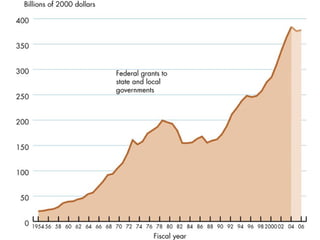
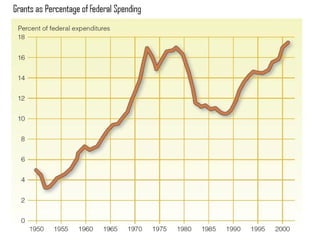
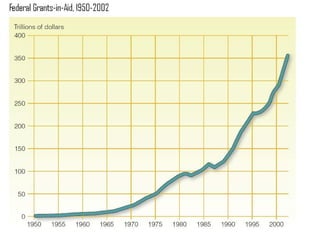
Rise of Fiscal Federalism
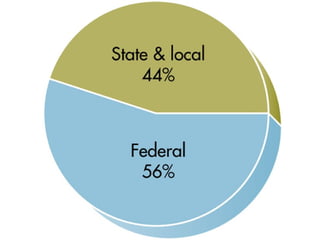
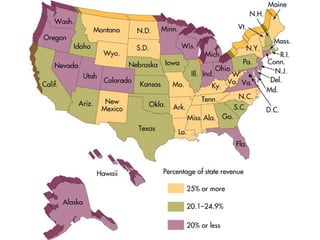
Fiscal Federalism the expenditure of federal funds on programs run in part through state and local governments.
Rise of Fiscal Federalism Johnson’s Great Society Increased Federal spending made possible by: 16th Amendment (1913) Glass-Steagall Act (1932) Abandonment of the gold standard (Nixon) Grant-in-Aid


Federal grants which not only provide money for defined areas of activity, but also designate how the programs are to be carried out, are called: block grants. grants-in-aid. all federal grants specify how states are to carry out the programs funded. categorical grants.
2
Categorical Grants
Block Grants
The idea that power should be shifted away from the national government and back into the hands of the states is known as ________. devolution new federalism evolution of state power dual federalism
Devolution the idea that American federalism will be improved by a shift in authority from the Federal government to the state and local governments.
Reasons? Republican revolution of 1994. Judicial States-Rights Philosophy.
Consequences of  Federalism High degree of complexity in policy-making, policy implementation  Permits diversity of responses, allows experimentation @ state, local levels Entails substantial inequality of certain kinds Difficulty/impossibility of carrying out certain kinds of policies, protections at local level, or that cross state lines.
How Federalism Promotes Democracy Permits state governments to counterbalance actions of the national government. Allows people in each state/community to do what their own majorities prefer.
How Federalism Hinders Democracy Responsibility blurred, hard to assign credit or blame. Democratic processes may not work as well at the state level as at the national level.

Federalism

  • 1.
  • 2.
    True or False : Federalism is a political system in which the national government determines the powers states are given.
  • 3.
    Federalism A system of government under which significant government powers are divided between the central government and smaller governmental units.
  • 4.
  • 5.
    American Federalism: A multiplicity of governing levels and units
  • 6.
  • 7.
  • 8.
  • 9.
    All of thesegovernments are related to each other in a particular way.
  • 10.
  • 11.
  • 12.
  • 13.
  • 14.
    Federalism A Key Structural Characteristic of American Government
  • 15.
    Tends to preventfully unified, disciplined parties
  • 16.
  • 17.
    Limits actions ofCongress and the President (10 th Amendment).
  • 18.
    Allows a diversityof policies to be pursued in different states, regions
  • 19.
    The advantages offederalism include: innovation and experimentation in public policy through the existence of differing laws across states. a diversity of needs may be met. government is kept close to the people. all of these choices.
  • 20.
    Advantages of FederalismDiversity of Needs can be met. Closeness to the people. Innovation and experimentation.
  • 21.
    Advantages of FederalismDiversity of Needs can be met. Closeness to the people. Innovation and experimentation.
  • 22.
    Advantages of FederalismDiversity of Needs can be met. Closeness to the people. Innovation and experimentation.
  • 23.
    The disadvantages offederalism include all of the following EXCEPT: Simplicity Lack of national standards Low visibility and lack of popular control Lack of uniformity in rules and programs
  • 24.
    Disadvantages of FederalismLack of national standards Low visibility and lack of popular control Lack of uniformity in rules and programs
  • 25.
    Disadvantages of FederalismLack of national standards Low visibility and lack of popular control Lack of uniformity in rules and programs
  • 26.
    Disadvantages of FederalismLack of national standards Low visibility and lack of popular control Lack of uniformity in rules and programs
  • 27.
  • 28.
    Power expressly givento the states, as well as to the national government.
  • 29.
  • 30.
    States have (had)important roles in shaping the national government.
  • 31.
    How Federalism isEmbodied in the Constitution Constitution makes central government supreme in certain matters, BUT makes clear state governments have independent powers. Supremacy Clause Article I, Section 8 Tenth Amendment (Reservation Clause)
  • 32.
    How Federalism isEmbodied in the Constitution Constitution makes central government supreme in certain matters, BUT makes clear state governments have independent powers. Supremacy Clause Article I, Section 8 Tenth Amendment (Reservation Clause)
  • 33.
    How Federalism isEmbodied in the Constitution Constitution makes central government supreme in certain matters, BUT makes clear state governments have independent powers. Supremacy Clause Article I, Section 8 Tenth Amendment (Reservation Clause)
  • 34.
    How Federalism isEmbodied in the Constitution Constitution makes central government supreme in certain matters, BUT makes clear state governments have independent powers. Supremacy Clause Article I, Section 8 Tenth Amendment (Reservation Clause)
  • 35.
    How Federalism isEmbodied in the Constitution Constitution makes central government supreme in certain matters, BUT makes clear state governments have independent powers. Supremacy Clause Article I, Section 8 Tenth Amendment (Reservation Clause)
  • 36.
    State Roles inNational Government
  • 37.
    State governments playcentral part in amending the Constitution.
  • 38.
  • 39.
  • 40.
    Limited national powerby claiming that states retained certain powers that could not be regulated through national action.
  • 41.
    “National power STOPS at the state border.”
  • 42.
    Decline of DualFederalism
  • 43.
  • 44.
  • 45.
  • 46.
    Rise of FiscalFederalism
  • 47.
    Fiscal Federalism theexpenditure of federal funds on programs run in part through state and local governments.
  • 48.
    Rise of FiscalFederalism Johnson’s Great Society Increased Federal spending made possible by: 16th Amendment (1913) Glass-Steagall Act (1932) Abandonment of the gold standard (Nixon) Grant-in-Aid
  • 49.
    Rise of FiscalFederalism Johnson’s Great Society Increased Federal spending made possible by: 16th Amendment (1913) Glass-Steagall Act (1932) Abandonment of the gold standard (Nixon) Grant-in-Aid
  • 50.
    Rise of FiscalFederalism Johnson’s Great Society Increased Federal spending made possible by: 16th Amendment (1913) Glass-Steagall Act (1932) Abandonment of the gold standard (Nixon) Grant-in-Aid
  • 51.
    Rise of FiscalFederalism Johnson’s Great Society Increased Federal spending made possible by: 16th Amendment (1913) Glass-Steagall Act (1932) Abandonment of the gold standard (Nixon) Grant-in-Aid
  • 52.
    Rise of FiscalFederalism Johnson’s Great Society Increased Federal spending made possible by: 16th Amendment (1913) Glass-Steagall Act (1932) Abandonment of the gold standard (Nixon) Grant-in-Aid
  • 53.
    Rise of FiscalFederalism Johnson’s Great Society Increased Federal spending made possible by: 16th Amendment (1913) Glass-Steagall Act (1932) Abandonment of the gold standard (Nixon) Grant-in-Aid
  • 54.
  • 55.
  • 56.
  • 57.
  • 58.
  • 59.
    Federal grants whichnot only provide money for defined areas of activity, but also designate how the programs are to be carried out, are called: block grants. grants-in-aid. all federal grants specify how states are to carry out the programs funded. categorical grants.
  • 60.
  • 61.
  • 62.
  • 63.
    The idea thatpower should be shifted away from the national government and back into the hands of the states is known as ________. devolution new federalism evolution of state power dual federalism
  • 64.
    Devolution the ideathat American federalism will be improved by a shift in authority from the Federal government to the state and local governments.
  • 65.
    Reasons? Republican revolutionof 1994. Judicial States-Rights Philosophy.
  • 66.
    Reasons? Republican revolutionof 1994. Judicial States-Rights Philosophy.
  • 67.
    Consequences of Federalism High degree of complexity in policy-making, policy implementation Permits diversity of responses, allows experimentation @ state, local levels Entails substantial inequality of certain kinds Difficulty/impossibility of carrying out certain kinds of policies, protections at local level, or that cross state lines.
  • 68.
    Consequences of Federalism High degree of complexity in policy-making, policy implementation Permits diversity of responses, allows experimentation @ state, local levels Entails substantial inequality of certain kinds Difficulty/impossibility of carrying out certain kinds of policies, protections at local level, or that cross state lines.
  • 69.
    Consequences of Federalism High degree of complexity in policy-making, policy implementation Permits diversity of responses, allows experimentation @ state, local levels Entails substantial inequality of certain kinds Difficulty/impossibility of carrying out certain kinds of policies, protections at local level, or that cross state lines.
  • 70.
    Consequences of Federalism High degree of complexity in policy-making, policy implementation Permits diversity of responses, allows experimentation @ state, local levels Entails substantial inequality of certain kinds Difficulty/impossibility of carrying out certain kinds of policies, protections at local level, or that cross state lines.
  • 71.
    How Federalism PromotesDemocracy Permits state governments to counterbalance actions of the national government. Allows people in each state/community to do what their own majorities prefer.
  • 72.
    How Federalism PromotesDemocracy Permits state governments to counterbalance actions of the national government. Allows people in each state/community to do what their own majorities prefer.
  • 73.
    How Federalism HindersDemocracy Responsibility blurred, hard to assign credit or blame. Democratic processes may not work as well at the state level as at the national level.
  • 74.
    How Federalism HindersDemocracy Responsibility blurred, hard to assign credit or blame. Democratic processes may not work as well at the state level as at the national level.