Chapter 23
Protection, Support, and
Movement
Protection: Integumentary
System
Integument - is the external
covering of an animal. It
protects the animal from
mechanical and chemical
injury and invasion by
microorganism.
THE INTEGUMENTARY
SYSTEM OF INVERTEBRATES
Single-celled protozoa
- Plasma membrane
Paramecium
- Pellicle (a thick protein coat)
 Multicellular invertebrates
- Epidermis (the outer layer)
 Some invertebrates
- Cuticles (thin and elastic/,thick and rigid)
 Cnidarian (corals)
- Mucus glands
 Parasitic flukes and tapeworms
- Tegument
 Nematodes and annelids
- Epidermis
 Echinoderms
- thin, ciliated epidermis
 Arthropods
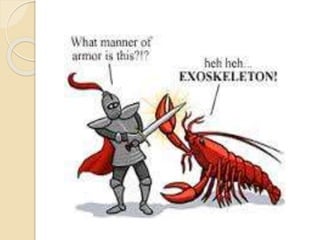
- exoskeleton
Integument of crustacean
Integument of vertebrates
THE INTEGUMENTARY
SYSTEM OF VERTEBRATES
 Skin - is the vertebrate integument
- largest organ
Skin has 2 main layers:
 Dermis
– is the connective tissue meshwork of
collagenous, reticular, and elastic fibers
beneath the epidermis.
Hypodermis
– consisting tissue, adipose tissue, and
nerve endings, separates the skin from
deeper tissue.
The Skin of Cartilaginous
Fishes
 Multilayered and contains mucous
and sensory cells.
 The dermis contains bone in the form
of small placoid scales called
denticles
 Cartilaginous fishes grow throughout
life, the skin area also increases.
 New denticles are produced to
maintain enough of these protective
structures at the skin surface.
The Skin of Bony Fishes
 Contains scales compose of dermal bone.
 Scales are not shed, they grow at the margins
and over the lower surface.
 Permeable and function in gas exchange.
 The dermis is richly supplied with capillary
beds to facilitate its use in respiration.
 The Epidermis also contains many mucous
glands.
 Mucus production helps prevent bacterial and
fungal infections and its reduces friction as fish
swims.
The Skin of Amphibians
 Consists of stratified epidermis and a
dermis containing mucous and serous
gland plus pigmentation cells.
 Amphibians are transitional between
aquatic and terrestial vertebrates.
 Three problems associated with
terrestial environments are :
desiccation, the damaging effects of
ultraviolet light, and physical abrasion.
 During amphibian evolution, keratin
production increased in the outer layer of the
skin cells.
 Keratin is a tough, impermeable protein that
protects the skin in the physically abrasive
rigorous terrestial environment.
 The mucus that mucous glands produce helps
prevent desiccation, facilitates gas exchange
when the skin is used as respiratory organ,
and makes the body slimy which facilitates
escape from predators.
 Within the dermis of some amphibians are
poison glands that produce an unpleasant-
tasting or toxic fluid that acts as a predator
The Skin of Reptiles
 Reflects their greater commitment to a
terrestrial existence.
 The outer layer of epidermis (stratum
corneum) is thick, lacks glands, and is
modified into keratinized scales, scutes (thick
scales)
 The thick, keratinized layer resists abrasion,
inhibits dehydration, and protects like a suit of
armor.
 During shedding or molting of the skin of
many reptiles, the outer layer separates from
newly formed epidermis.
 Diffusion of fluid between the layers aids this
separation.
The Skin of Birds
 Shows typically reptilian features with
no epidermal glands.
 The epidermis is usually thin and only
two or three cell layers thick.
 The most prominent part of the
epidermis are the feathers.
 Air spaces that are part of avian
respiratory system extend into the
dermis.
 Feather position is important in thermal
regulation, flying, and behavior.
The Skin of Mammals
The notable features of mammalian skin
are:
Hair
Epidermal glands
Cornified epidermis
Dermis
Keratinized cells make up the outer
layer, called the stratum corneum.
The thickest potion of mammalian
skin is composed of dermis which
contains:
Blood vessels
Lymphatic vessels
Nerve endings
Hair follicles
Small muscles
glands
In humans
 The skin regulates body temperature by
opening and closing sweat pores and
perspiring or sweating.
 The skin screens out excessive harmful
ultraviolet rays from the sun
 The skin also an important sense organ,
containing sensory receptors for heat,
cold, touch, pressure, and pain.
 The skin of humans and other mammals
contains several types of glands.
 Sudoriferous glands
- are distributed over most of the
human body surface.
- secrete sweat by a process called
perspiration.
 Perspiration - helps to regulate body
temperature and maintain homeostasis.
In some animals, certain sweat glands
also produce pheromones.
 Pheromones - chemical that animal
secretes and that communicate with
other members the same species to
elicit certain behavioral responses.
 Sebaceous (oil) glands
- are simple glands connected to
hair follicles in the dermis.
- they lubricate and protect by
secreting sebum.
Sebum – is a permeability barrier, an
emollient and protective agent against
microorganisms
- can also act as a pheromone.
 Mammalian skin color is either to
pigment or to anatomical structures that
absorbs of reflect the light.
 Some skin color is due to color of the
blood in superficial blood vessels
reflected through the epidermis.
 Other skin colors may camouflage the
animal.
 In addition, color serve in social
communication, helping members of the
same species to identify each other,
their sex, reproductive status, or social
rank.
 Hair – is composed of keratin-filled
cells that develop from the epidermis.
An arrector pili muscle attaches to
the connective tissue sheath of the a
hair follicle surrounding the bulb of the
hair root.
 Nail – like hair, are modifications of
the epidermis.
- are flat, horny plates on the
dorsal surface of the distal segments of
the digits.
Horns
Baleen plates
MOVEMENT AND SUPPORT:
SKELETAL SYSTEM
Four cells types contribute movement:
1. Amoeboid cells
2. Flagellated cells
3. Ciliate cells
4. Muscles cells
With respect to support, organism have
three kinds of skeletons:
1. Fluid hydrostatic skeletons
2. Rigid exoskeletons
3. Rigid endoskeletons
Hydrostatic Skeletons
- is a core liquid surrounded by a
tension resistant sheath of longitudinal
and/or circular muscles.
 Contracting muscle push against a
hydrostatic skeleton, and the
transmitted force generates body
movement.
 The hydrostatic skeleton of
invertebrates is an excellent example of
adaptation of major body functions to
this simple but efficient principle of
hydrodinamics – use of the internal
Exoskeletons
- also have locomotion functions
because they provide sites for muscle
attachment and counterforces for muscle
movements.
- also support and protect the body,
In arthropods, the epidermis of the body
wall secretes a thick, hard cuticle that water
proofs the body. The cuticle also protects
and support the animal’s soft internal organ.
In crustaceans, the exoskeleton contains
calcium carbonate crystals that make it hard
and inflexible – except at the joints.
Exoskeleton limit an animals growth.
Endoskeletons
 The endoskeletons of sponges consist
of mineral spicules and fibers of spongin
that keep the body from collapsing.
Since adult sponges attach to the
substrate, they have no need for muscle
attached to the endoskeleton.
 The endoskeletons of echinoderms
consist of small, calcareous plates
called ossicles.
Mineralized Tissues and
Invertebrates
 Cartilage – is the supportive tissue
that makes up the major skeletal
component of some gastropods,
invertebrate chordates (amphioxus),
jawless fishes such as hagfishes and
lampreys, and sharks and rays.
- is lighter than bone, it gives
these predatory fishes the speed and
agility to catch prey. It also provides
buoyancy without the need for a swim
bladder.
The Skeletal System of
Vertebrates
This endoskeleton consist of two main
types of supportive tissue: cartilage and
bone.
 Cartilage – provides site for muscle
attachment, aids in movement at joints,
provides support, and transmits the
force of muscular contraction from one
part to the body to another during
movement,
- it consist of cells, fibers, and
cellular matrix.
Bone or Osseous Tissue
- that provides a point of attachment for
muscles and transmits the force of muscular
contraction from one part of the body to
another during movement.
 Bone tissue is more rigid than the other
connective tissues because its
homogeneous, organic ground substance
also contains in organic salts.
 Bone cells are in minute chambers called
lacunae which are arranged in concentric
rings around osteonic canals (formerly
called Haversian systems).
The Skeleton of Fishes
 Both cartilaginous and bony
endoskeletons first appeared in the
vertebrates.
 Water has a buoyant effect on the fish
body, the requirement for skeletal
support is not as demanding in these
vertebrates as it is in terrestrial
vertebrates.
 Most jawed fishes have an axial skeleton
that includes a notochord, ribs, and
cartilaginous or bony vertebrae.
 Muscle used in locomotion attach to the
The Skeleton of Tetrapods
 Tetrapods must lift themselves to walk on land.
 The first amphibians needed support to replace
the buoyancy of water.
 This added support resulted from the
specializations of the intervertebral disk that
articulate with adjoining vertebrae.
 The intervertebral disk help to hold the
vertebral column together and also absorb
shock and provide joint mobility.
 Bone replaced cartilage in the ribs, which
became more rigid.
 Appendages became elongated for support on
hard surface, and changes in the shoulder
enabled the neck to move more freely.
The Human Endoskeleton
The human endoskeleton has two
major parts:
Axial skeleton – is made up of
the skull, vertebral column,
sternum, and ribs.
Appendicular skeleton – is
composed of the appendages, the
pectoral girdle, and the pelvic
girdle.
MOVEMENT: NONMUSCULAR
MOVEMENT AND MUSCULAR SYSTEM
Nonmuscular Movement
 All cells have some capacity to move
and changes shape due to their
cytoskeleton.
 Protozoan protists move by means of
specific nonmuscular (pseudopodia,
flagella, or cilia) that involve the
contractile proteins actin and myosin.
 Interactions between these proteins
are also responsible for muscle
contraction in animals.
Amoeboid Movement
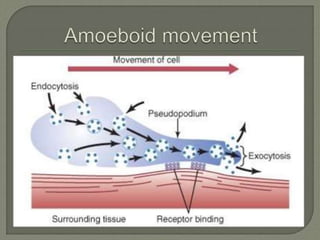
 The plasma membrane of an amoeba
has adhesive properties since new
pseudopodia attach to the substrate
as they form.
 The plasma membrane also seems to
slide over the underlying layer of
cytoplasm when an amoeba moves.
 The plasma membrane may be
“rolling” in a away that is (roughly)
analogous to a bulldozer track rolling
over its wheels.
Ciliary and Flagellar
Movement
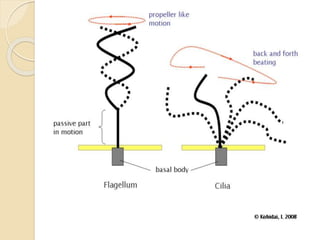
Cilia – are shorter and more numerous.
Flagella – are long an generally occur
singly or in pairs.
 Ciliary movements are coordinated.
 The epidermis of free-living flatworms and
nemertines is abundantly ciliated.
 The smallest specimen lie at the upper end
of the size range for efficient locomotion
using cilia.
 Larger flatworms have retained ciliary
creeping as the principal means of
locomotion, and the largest animals move
by ciliary creeping are the nemertines.
AN INTRODUCTION TO
ANIMAL MUSCLE
Muscle tissue has three other important
properties:
1. Excitability ( or irritability )
2. Extensibility
3. Elasticity
Animals may have one or more of the
following types of muscle tissue: smooth,
cardiac, and skeletal. The contractile cells
of these tissue is called muscle fibers.
Smooth muscle – is called
involuntary muscle because higher brain
centers do not control its contractions.
Single nucleus
Spindle shaped
Arranged in a parallel pattern to form
sheets
Striated muscle fibers – with single
nuclei are common in invertebrates, but
they occur in adult vertebrates only in the
heart, where they are called cardiac
muscle.
Skeletal muscle – a striated muscle,
THE MUSCULAR SYSTEM OF
INVERTEBRATES
A few functional differences among
invertebrates muscle indicate some of the
differences from the vertebrate skeletal
muscle.
The Locomotion of Soft-Bodied
Invertebrates
 Pedal locomotion – move by means of
waves of activity in the muscular system
that applied to the substrate.
 Looping movement – arching
movements are equivalent to the
contraction of longitudinal muscle.
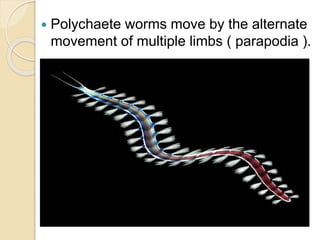
 Polychaete worms move by the alternate
movement of multiple limbs ( parapodia ).
The water vascular system of
echinoderms provides a
unique means of locomotion.
Along each canal are reservoir
ampullae and tube feet.
Terrestrial Locomotion in
Invertebrates: Walking
 They required structural support, and those
that move quickly make use of rigid skeletal
elements that interact with the ground.
 These The limbs are composed of a series
of jointed elements that become
progressively less massive toward the tip.
 Each joint articulated to allow movement in
only one plane.
 The limb plane at the basal joint with the
body can also rotate and this rotation is
responsible for forward movement.
Terrestrial Locomotion in
Invertebrates: Flight
 The physical properties of an
arthropods cuticle are such that true
flight evolved for pterygote insects
some 100 million years ago.
 The basic mechanism for flight has
been modified.
 Present day insects exhibit a wide
range of structural adaptations and
mechanism for flight.
Terrestrial Locomotion in
Invertebrates: Jumping
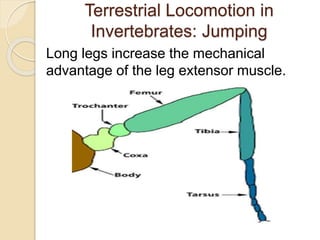
Long legs increase the mechanical
advantage of the leg extensor muscle.
MUSCULAR SYSTEM OF
VERTEBRATES
 Tendons – which are tough, fibrous,
bands or cords, attach skeletal muscle
to the skeleton.
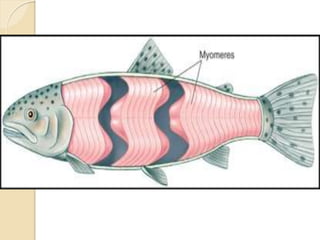
 Myomeres segments – cause the
lateral undulations of the trunk and tail
that produce fish locomotion.
Fish movement based on the myomere
contraction:
1. The muscular forces cause the
myomere segment to rotate rather
than constrict.
2. The rotation of cranial and caudal
myomere segments bend the fish’s
body about a point midway between
two segments.
3. Alternate bends of the caudal end of
the body propel the fish forward.
Skeletal Muscle Contraction
 Each skeletal muscle has a pattern
alternate dark and light bands.
 This striation of whole fibers arises from
the alternating dark and light of many
smaller, threadlike myofibrils in each
muscle fiber.
Myosin
Actin
- I band
- A band
Sarcomere
Cross bridges
Control of Skeletal Muscle
Contraction
Motor unit
- consist of one motor nerve fiber and
all the muscle fibers with which it
communicates.
Neuromuscular junction
- a space separates the specialized
end body of the motor nerve fiber from the
membrane of muscle fiber.
Acethylcholine
-released by the synaptic vesicles in
the nerve ending
Transverse tubules
- conducting paths
The calcium then binds with a
regulatory protein called troponin that
is on another protein called
tropomyosin.

Chapter 23 Protection, Support, and Movement

  • 1.
  • 2.
    Protection: Integumentary System Integument -is the external covering of an animal. It protects the animal from mechanical and chemical injury and invasion by microorganism.
  • 3.
    THE INTEGUMENTARY SYSTEM OFINVERTEBRATES Single-celled protozoa - Plasma membrane Paramecium - Pellicle (a thick protein coat)
  • 4.
     Multicellular invertebrates -Epidermis (the outer layer)  Some invertebrates - Cuticles (thin and elastic/,thick and rigid)  Cnidarian (corals) - Mucus glands  Parasitic flukes and tapeworms - Tegument  Nematodes and annelids - Epidermis  Echinoderms - thin, ciliated epidermis  Arthropods - exoskeleton
  • 6.
  • 7.
  • 8.
    THE INTEGUMENTARY SYSTEM OFVERTEBRATES  Skin - is the vertebrate integument - largest organ Skin has 2 main layers:  Dermis – is the connective tissue meshwork of collagenous, reticular, and elastic fibers beneath the epidermis. Hypodermis – consisting tissue, adipose tissue, and nerve endings, separates the skin from deeper tissue.
  • 11.
    The Skin ofCartilaginous Fishes  Multilayered and contains mucous and sensory cells.  The dermis contains bone in the form of small placoid scales called denticles  Cartilaginous fishes grow throughout life, the skin area also increases.  New denticles are produced to maintain enough of these protective structures at the skin surface.
  • 13.
    The Skin ofBony Fishes  Contains scales compose of dermal bone.  Scales are not shed, they grow at the margins and over the lower surface.  Permeable and function in gas exchange.  The dermis is richly supplied with capillary beds to facilitate its use in respiration.  The Epidermis also contains many mucous glands.  Mucus production helps prevent bacterial and fungal infections and its reduces friction as fish swims.
  • 15.
    The Skin ofAmphibians  Consists of stratified epidermis and a dermis containing mucous and serous gland plus pigmentation cells.  Amphibians are transitional between aquatic and terrestial vertebrates.  Three problems associated with terrestial environments are : desiccation, the damaging effects of ultraviolet light, and physical abrasion.
  • 16.
     During amphibianevolution, keratin production increased in the outer layer of the skin cells.  Keratin is a tough, impermeable protein that protects the skin in the physically abrasive rigorous terrestial environment.  The mucus that mucous glands produce helps prevent desiccation, facilitates gas exchange when the skin is used as respiratory organ, and makes the body slimy which facilitates escape from predators.  Within the dermis of some amphibians are poison glands that produce an unpleasant- tasting or toxic fluid that acts as a predator
  • 17.
    The Skin ofReptiles  Reflects their greater commitment to a terrestrial existence.  The outer layer of epidermis (stratum corneum) is thick, lacks glands, and is modified into keratinized scales, scutes (thick scales)  The thick, keratinized layer resists abrasion, inhibits dehydration, and protects like a suit of armor.  During shedding or molting of the skin of many reptiles, the outer layer separates from newly formed epidermis.  Diffusion of fluid between the layers aids this separation.
  • 18.
    The Skin ofBirds  Shows typically reptilian features with no epidermal glands.  The epidermis is usually thin and only two or three cell layers thick.  The most prominent part of the epidermis are the feathers.  Air spaces that are part of avian respiratory system extend into the dermis.  Feather position is important in thermal regulation, flying, and behavior.
  • 19.
    The Skin ofMammals The notable features of mammalian skin are: Hair Epidermal glands Cornified epidermis Dermis Keratinized cells make up the outer layer, called the stratum corneum.
  • 20.
    The thickest potionof mammalian skin is composed of dermis which contains: Blood vessels Lymphatic vessels Nerve endings Hair follicles Small muscles glands
  • 21.
    In humans  Theskin regulates body temperature by opening and closing sweat pores and perspiring or sweating.  The skin screens out excessive harmful ultraviolet rays from the sun  The skin also an important sense organ, containing sensory receptors for heat, cold, touch, pressure, and pain.  The skin of humans and other mammals contains several types of glands.
  • 22.
     Sudoriferous glands -are distributed over most of the human body surface. - secrete sweat by a process called perspiration.  Perspiration - helps to regulate body temperature and maintain homeostasis. In some animals, certain sweat glands also produce pheromones.  Pheromones - chemical that animal secretes and that communicate with other members the same species to elicit certain behavioral responses.
  • 23.
     Sebaceous (oil)glands - are simple glands connected to hair follicles in the dermis. - they lubricate and protect by secreting sebum. Sebum – is a permeability barrier, an emollient and protective agent against microorganisms - can also act as a pheromone.
  • 24.
     Mammalian skincolor is either to pigment or to anatomical structures that absorbs of reflect the light.  Some skin color is due to color of the blood in superficial blood vessels reflected through the epidermis.  Other skin colors may camouflage the animal.  In addition, color serve in social communication, helping members of the same species to identify each other, their sex, reproductive status, or social rank.
  • 25.
     Hair –is composed of keratin-filled cells that develop from the epidermis. An arrector pili muscle attaches to the connective tissue sheath of the a hair follicle surrounding the bulb of the hair root.  Nail – like hair, are modifications of the epidermis. - are flat, horny plates on the dorsal surface of the distal segments of the digits. Horns Baleen plates
  • 26.
    MOVEMENT AND SUPPORT: SKELETALSYSTEM Four cells types contribute movement: 1. Amoeboid cells 2. Flagellated cells 3. Ciliate cells 4. Muscles cells With respect to support, organism have three kinds of skeletons: 1. Fluid hydrostatic skeletons 2. Rigid exoskeletons 3. Rigid endoskeletons
  • 27.
    Hydrostatic Skeletons - isa core liquid surrounded by a tension resistant sheath of longitudinal and/or circular muscles.  Contracting muscle push against a hydrostatic skeleton, and the transmitted force generates body movement.  The hydrostatic skeleton of invertebrates is an excellent example of adaptation of major body functions to this simple but efficient principle of hydrodinamics – use of the internal
  • 28.
    Exoskeletons - also havelocomotion functions because they provide sites for muscle attachment and counterforces for muscle movements. - also support and protect the body, In arthropods, the epidermis of the body wall secretes a thick, hard cuticle that water proofs the body. The cuticle also protects and support the animal’s soft internal organ. In crustaceans, the exoskeleton contains calcium carbonate crystals that make it hard and inflexible – except at the joints. Exoskeleton limit an animals growth.
  • 29.
    Endoskeletons  The endoskeletonsof sponges consist of mineral spicules and fibers of spongin that keep the body from collapsing. Since adult sponges attach to the substrate, they have no need for muscle attached to the endoskeleton.  The endoskeletons of echinoderms consist of small, calcareous plates called ossicles.
  • 31.
    Mineralized Tissues and Invertebrates Cartilage – is the supportive tissue that makes up the major skeletal component of some gastropods, invertebrate chordates (amphioxus), jawless fishes such as hagfishes and lampreys, and sharks and rays. - is lighter than bone, it gives these predatory fishes the speed and agility to catch prey. It also provides buoyancy without the need for a swim bladder.
  • 32.
    The Skeletal Systemof Vertebrates This endoskeleton consist of two main types of supportive tissue: cartilage and bone.  Cartilage – provides site for muscle attachment, aids in movement at joints, provides support, and transmits the force of muscular contraction from one part to the body to another during movement, - it consist of cells, fibers, and cellular matrix.
  • 33.
    Bone or OsseousTissue - that provides a point of attachment for muscles and transmits the force of muscular contraction from one part of the body to another during movement.  Bone tissue is more rigid than the other connective tissues because its homogeneous, organic ground substance also contains in organic salts.  Bone cells are in minute chambers called lacunae which are arranged in concentric rings around osteonic canals (formerly called Haversian systems).
  • 35.
    The Skeleton ofFishes  Both cartilaginous and bony endoskeletons first appeared in the vertebrates.  Water has a buoyant effect on the fish body, the requirement for skeletal support is not as demanding in these vertebrates as it is in terrestrial vertebrates.  Most jawed fishes have an axial skeleton that includes a notochord, ribs, and cartilaginous or bony vertebrae.  Muscle used in locomotion attach to the
  • 36.
    The Skeleton ofTetrapods  Tetrapods must lift themselves to walk on land.  The first amphibians needed support to replace the buoyancy of water.  This added support resulted from the specializations of the intervertebral disk that articulate with adjoining vertebrae.  The intervertebral disk help to hold the vertebral column together and also absorb shock and provide joint mobility.  Bone replaced cartilage in the ribs, which became more rigid.  Appendages became elongated for support on hard surface, and changes in the shoulder enabled the neck to move more freely.
  • 37.
    The Human Endoskeleton Thehuman endoskeleton has two major parts: Axial skeleton – is made up of the skull, vertebral column, sternum, and ribs. Appendicular skeleton – is composed of the appendages, the pectoral girdle, and the pelvic girdle.
  • 39.
    MOVEMENT: NONMUSCULAR MOVEMENT ANDMUSCULAR SYSTEM Nonmuscular Movement  All cells have some capacity to move and changes shape due to their cytoskeleton.  Protozoan protists move by means of specific nonmuscular (pseudopodia, flagella, or cilia) that involve the contractile proteins actin and myosin.  Interactions between these proteins are also responsible for muscle contraction in animals.
  • 40.
    Amoeboid Movement  Theplasma membrane of an amoeba has adhesive properties since new pseudopodia attach to the substrate as they form.  The plasma membrane also seems to slide over the underlying layer of cytoplasm when an amoeba moves.  The plasma membrane may be “rolling” in a away that is (roughly) analogous to a bulldozer track rolling over its wheels.
  • 42.
    Ciliary and Flagellar Movement Cilia– are shorter and more numerous. Flagella – are long an generally occur singly or in pairs.  Ciliary movements are coordinated.  The epidermis of free-living flatworms and nemertines is abundantly ciliated.  The smallest specimen lie at the upper end of the size range for efficient locomotion using cilia.  Larger flatworms have retained ciliary creeping as the principal means of locomotion, and the largest animals move by ciliary creeping are the nemertines.
  • 44.
    AN INTRODUCTION TO ANIMALMUSCLE Muscle tissue has three other important properties: 1. Excitability ( or irritability ) 2. Extensibility 3. Elasticity Animals may have one or more of the following types of muscle tissue: smooth, cardiac, and skeletal. The contractile cells of these tissue is called muscle fibers.
  • 45.
    Smooth muscle –is called involuntary muscle because higher brain centers do not control its contractions. Single nucleus Spindle shaped Arranged in a parallel pattern to form sheets Striated muscle fibers – with single nuclei are common in invertebrates, but they occur in adult vertebrates only in the heart, where they are called cardiac muscle. Skeletal muscle – a striated muscle,
  • 47.
    THE MUSCULAR SYSTEMOF INVERTEBRATES A few functional differences among invertebrates muscle indicate some of the differences from the vertebrate skeletal muscle. The Locomotion of Soft-Bodied Invertebrates  Pedal locomotion – move by means of waves of activity in the muscular system that applied to the substrate.
  • 49.
     Looping movement– arching movements are equivalent to the contraction of longitudinal muscle.
  • 50.
     Polychaete wormsmove by the alternate movement of multiple limbs ( parapodia ).
  • 51.
    The water vascularsystem of echinoderms provides a unique means of locomotion. Along each canal are reservoir ampullae and tube feet.
  • 53.
    Terrestrial Locomotion in Invertebrates:Walking  They required structural support, and those that move quickly make use of rigid skeletal elements that interact with the ground.  These The limbs are composed of a series of jointed elements that become progressively less massive toward the tip.  Each joint articulated to allow movement in only one plane.  The limb plane at the basal joint with the body can also rotate and this rotation is responsible for forward movement.
  • 54.
    Terrestrial Locomotion in Invertebrates:Flight  The physical properties of an arthropods cuticle are such that true flight evolved for pterygote insects some 100 million years ago.  The basic mechanism for flight has been modified.  Present day insects exhibit a wide range of structural adaptations and mechanism for flight.
  • 55.
    Terrestrial Locomotion in Invertebrates:Jumping Long legs increase the mechanical advantage of the leg extensor muscle.
  • 56.
    MUSCULAR SYSTEM OF VERTEBRATES Tendons – which are tough, fibrous, bands or cords, attach skeletal muscle to the skeleton.  Myomeres segments – cause the lateral undulations of the trunk and tail that produce fish locomotion.
  • 59.
    Fish movement basedon the myomere contraction: 1. The muscular forces cause the myomere segment to rotate rather than constrict. 2. The rotation of cranial and caudal myomere segments bend the fish’s body about a point midway between two segments. 3. Alternate bends of the caudal end of the body propel the fish forward.
  • 60.
    Skeletal Muscle Contraction Each skeletal muscle has a pattern alternate dark and light bands.  This striation of whole fibers arises from the alternating dark and light of many smaller, threadlike myofibrils in each muscle fiber. Myosin Actin - I band - A band Sarcomere Cross bridges
  • 64.
    Control of SkeletalMuscle Contraction Motor unit - consist of one motor nerve fiber and all the muscle fibers with which it communicates. Neuromuscular junction - a space separates the specialized end body of the motor nerve fiber from the membrane of muscle fiber. Acethylcholine -released by the synaptic vesicles in the nerve ending
  • 65.
    Transverse tubules - conductingpaths The calcium then binds with a regulatory protein called troponin that is on another protein called tropomyosin.