ECOLOGICAL PROBLEMS &
SOLUTIONS
Updated in 2005, 2008, 2012 , 2014 and 2015
5 Impact of overpopulation 
6 2020: for each inhabitant in the industrialized countries, there will be five in the developing countries 
7 Global poverty 
8 - 9 Nuclear risks 
10 26/04/86: reason for a separate case study 
11 Nuclear heritage 
12 Natural and anthropogenic greenhouse effect 
13 Greenhouse gases 
14 Origin greenhouse gases and their impact 
15 Global desertification happens mainly at the peripheries 
16 Calamity of heating out of control 
17 Feedback in the carbon cycle 
18 Siberian roulette 
19 The arctic region contains 500 billion tons of carbon 
20 Methane bubbles faster up out of the tundra as expected 
21 Future choices? 
22 Anomaly surface temperature 
23 Oil pollution 
24 Deepwater Horizon, Gulf of Mexico, April 2010 
25 Nature reserves in Louisiana mutilated 
26 Bon Secour Refuge, Alabama threatened (3,5 103 ha) 
27 Lepidochelys kempii, ‘arribada’ 
28 Human and ecological risks – pesticides 
29 Reduction PCBs (35% since ’85) ensured seals of reproductive successes 
30 Bhopal shows extra risks pesticides 
31 01/11/’86 the Rhine (almost) died 
32 - 33 Acid rain 
34 Consequences of acid rain 
35 SO2 -pollution and bio-indicators 
36 Eutrophication and consequences 
37 Terrestrial eutrophication 
38 Eutrophication and solutions 
39 The O3 layer: a protective shield for all life on earth 
40 Destruction of the ozone layer 
41 First observation in 1970 … 
42 First observation in 1970 … images 1995 – 2004 
43 Ozone depletion over the Arctic in 2011 
44 ‘World avoided’ without ban CFCs 
45 Pollution of oceans by plastic and trash 
Global
warningsGlobal warnings
46 Harmful invasive species 
47 Black lists 
48 Examples of harmful exotic species A1- Ludwigia grandiflora 
49 Original distribution of Ludwigia grandiflora 
50 Situation in France in 2009 
51 Examples of harmful introduced species A1 – Rana catesbeiana 
52 A2 - Introduced species: e.g. black cherry (Prunus serotina) 
53 A2 - Introduced species: e.g. giant hogweed (Heracleum mantegazzianum) 
54 A2 - Introduced species: e.g. Egyptian goose (Alopochen aegyptiacus) 
55 A2 –Introduced species: e.g. harlequin ladybird (Harmonia axyridis) 
56 – 59 Introduced species and evolution 
60 Zebra spider (Salticus scenicus) 
61 IUCN Red List of Threatened Species 2003 
62 – 67 Threatened taxa: breeding birds in Belgium and the Netherlands 
68 – 76 Other threatened taxa in Belgium and the Netherlands 
77 Bee population density levels are dangerously low 
78 Severe infection can cause the death of the entire hive between August and October 
79 Will global warming bring about a “beepocalypse”? 
80 Global threats to taxa 
81 Corals, a specialized form of mutualism between algae en corallites 
82 Florida Keys reefs: a degraded biodiversity hotspot 
83 Reasons for the endangerment of taxa 
84 - 85 Example of endangerment through deforestation 
86 Loss of habitat and populations 
87 Genetic erosion 
88 – 92 Removal of keystone species drastically alters communities 
93 Eschrichtius robostus 
94 – 99 When a species becomes extinct, it’s gone for good 
98 Brown-headed cowbirds following grazing bisons 
100, 102 Predicted to become extinct?... 
101 Hibiscadelphus woodii in bloom 
103 Lost?.... 
104 – 108 Biodiversity in danger during the past 
109 Narrow habitats, extensive specialization and limited dispersal may put species at risk 
110 The critical predicament of biodiversity is epitomized by Banara vanderbiltii 
111 Fungi in the midst of a mass extinction 
Trojan
horses
Local flora &
fauna under
assault
Biodiversity
threatened
Trojan horses
Local flora & fauna under assault
Biodiversity threatened
112 - 113 Rifle shots and holocausts 
114 – 115 Ecosystems deserving immediate attention 
116 San Bruno Mountain, California 
117 – 118 Oases of the Dead Sea Depression, Israel and Jordan 
119 California floristic province 
120 – 122 Slash & burn in Madagascar 
123 Grandidier's Baobab (Adansonia grandidieri) 
124 The fossa (Cryptoprocta ferox) is the island's largest surviving endemic terrestrial mammal 
125 – 126 Lower slopes of the Himalayas 
127 – 129 Western Ghats, India 
130 – 132 Central Chile 
133 – 135 The Colombian Chocó 
136 – 138 Western Ecuador 
139 – 144 Uplands of western Amazonia 
145 – 147 Atlantic coast of Brazil 
148 – 149 Southwestern Ivory Coast 
150 – 152 Fynbos, South Africa 
153 – 155 Sri Lanka 
156 – 159 Peninsular Malaysia 
160 – 162 Borneo 
163 – 166 The Philippines 
167 – 171 New Caledonia 
172 – 174 Southwestern Australia 
175 – 177 The Mediterranean Basin 
178 Survey of the most important biodiversity hotspots 
179 - 182 The list is not closed… 
183 – 185 Lake Baikal 
186 – 187 Regeneration of tropical rain forest may take centuries 
188 – 189 Queimadas or burnings in the Amazon 
190 Deforestation and ecological holocaust by genetic engineering 
191 Eco-battalions and eco-soldiers 
192 – 205 Unmined riches of biodiversity 
206 Sustainable use of rain forests as extractive reserves 
207 - 208 Reforestation projects 
209 – 230 Resolution 
231 – 253 Credits, aknowledgments 
Main
biodiversity
hotspots
Aware of
our riches
Resolution
Main biodiversity hotspots
Aware of our riches
Comprehensive solution to the ecological multitask challenge
Impact of overpopulation
5Global
warnings
For each inhabitant in the industrialized countries, there
will be five in the developing countries by 2020
Previous: banana plantations in
Nicaragua
Primary production rain forest is
consumed by ‘slash & burn’
plantations
The human population puts a huge
tax on earth’s resources
One on five lives in extreme
poverty
Species are at an accelerating pace
threatened with extinction
Since 1950 1/5 of the top layer of
the earth's surface has been lost
6Global
warnings
Global poverty
Deforestation, erosion and
spoiling of cyanide and mercury in
the Napo river in Ecuador as
consequences of gold mining
Cities in developing countries
particularly face an enormous
growth of massive country flight
Water, food, smog problems, ...
are inevitable
Overexploitation of rain forests
threaten all species, a lot of
which are never investigated
and live in undisturbed forests
Problems of endangered species
are inherent to poverty and
malnutrition
7Global
warnings
Nuclear risks
The Chernobyl motor, with graphite
moderator and water cooling,
exploded after a test
The test investigated if there could be
enough energy for water cooling after
a complete stop until diesel
production gets going
Emergency cooling was stopped so
the test wouldn’t be interrupted
Power reduction to 30 MW instead of
1 000 MW as a consequence of
unforeseen development of steam in
the cooling
For this reason workers removed
control rods, deadly in combination
with shortage of cooling water
8Global
warnings
Nuclear risks
The cooling lessened and lessened,
by delay of pump operation,
powered by the turbines
The problem with this kind of
reactor is the tremendous power it
develops at low capacity
Uncontrollable generation of steam
was the consequence
Fuel elements got broken and came
in contact with water
A steam explosion attacked the
heart of the engine
The shutter of the engine let air in:
½ C + O2 → CO: highly combustible
Eight tons of Pu-fuel, Cs & I set fire
and ascended in the atmosphere
9Global
warnings
26/04/86: reason for a separate case study
Four km2 pine forest adjacent
to the engine coloured ginger
brown and died ‘Red Forest’
Slow recovery with distorted
and delayed trees
Human death toll through influence of
radiation valued at 100 000
Research of the ecological impact:
genetic damage for more than 20 sp.
E.g. horses on the island six km
further died of a desintegration of the
thyroid gland
Research is more difficult because
mutant animal is eaten quickly or dies
2 500 km2 exclusion zone show
numerous rare species e.g. eagle-owls
(Bubo bubo), great egrets (Egretta
alba), white-tailed eagles (Haliaeetus
albicilla), black storks (Ciconia nigra),
river otters (Lutra canadensis),
populations of wolves,…
Positive ecological impact of
evacuation exceeds radiation costs
10Global
warnings
Nuclear heritage
Research on swallows
(Hirundo sp.) shows that
migratory birds are very
radiation-sensitive
Migration trenches on reserves
of antioxidants
Depression of antioxidants is
linked to mutations: partial
albinism and sperm mutations
Homeless and migrating species
accumulate less radiation than these
with fixed habitat
Mutations as a result of radiation
have not been bound to one place
Migrating species are susceptible to
generative heritage or to spread the
mutations on to adjacent unpolluted
populations
Nests, eggs found in sarcophagus
Heavily contaminated rodents show
few deviations
Cleaning up by burning with
electricity generation from the
nucleotides is not an option
Mobilization of nucleotides is
extremely harmful
Vibrating ecosystem has been
destroyed 11Global
warnings
Natural and anthropogenic greenhouse effect
30% of the solar radiation is
reflected by earth (atmosphere,
clouds and surface)
70% is absorbed: 16% (e.g. UV) by
atmosphere, 3% by clouds, 51% by
earth
Stefan-Boltzmann: longwave IR
radiation is transmitted by earth (10
µm)
Atmosphere, transparent to visible
light, behaves like a black body for
IR
Only albedo- and black-body-
properties took in consideration,
earth’s surface temperature would
be 33º lower
Without convection temperature on
earth would be 72
12Global
warnings
Greenhouse gases
By car emissions, burning of fossil raw
materials, deforestation: CO2-record of
387 ppm
Greenhouse gases absorb IR-radiation:
tri- (or more) atomic molecules
Natural greenhouse effect: 60% H2O,
26% CO2, CH4, N2O, O3, CFCs (life span
up to 50 000 years)
H2O in large quantity, but is passive
with regard to climate by short yielding
life span in the atmosphere
As positive feedback with regard to
other gases, as clouds or rain
CO2, CH4 have a life span of hundreds of
years in atmosphere
[CFC], [CO2] previous century
13Global
warnings
Origin greenhouse gases and their impact
Desertification: interaction of
climate, overexploitation of
lands, erosion, industry,
deforestation, poverty, mine
construction,…
For fragile ecosystems
degradation of flora, fauna,
soil and water sources is
irreversible
CH4- increase is similar to that of CO2
Livestock, enlarging populations of
termites, deforestation, rice
plantations and fossil fuels are main
emitting factors of methane
N2O coming from chemical industry
and artificial manure
CFCs as refrigerants
Global warming:
Longer growing season plants: earlier
in spring, later in autumn
Increase [CO2]: C3-plants
Warming: thermophilic C4-plants
Glaciers melting and higher chances of
mud flows
Melting of all the ice would cause sea
level to rise 150 m
Currently with a rate of 1,8 mm/year
during the last 100 years
14Global
warnings
Global desertification happens
mainly at the peripheries
Between 1882 and 1952, the proportion of the earth’s
land surface classified as desert rose from 9,4 to 23,3%
15Global
warnings
Calamity of heating out of control
El Nino ensures periodically dryness in
Indonesia, Australia and the Amazon
In ’97 and ’98 el Nino was enormously
strong
Model studies predict that El Niño events
will become more frequent and severe as
earth’s climate warms
Research has recently found that over half
the Amazon rainforest is at risk of burning
during extreme droughts, like the one that
struck from July—November in 2005
In Indonesia and Malaysia rain forest is
growing on wet peat layers
2 billion barrel CO2 disappeared from
smouldering peat during the ‘90’s Nino’s
Some fires were switched on by owners of
palm oil companies which set up plantations
for extraction of bio-ethanol 16Global
warnings
Feedback in the carbon cycle
Few ° of temperature rise: 30% less
rainfall, arrival of a dry season
instead of daily rain
Massive wildfires lead to
desertification
90% of the Amazon rain forest could
possibly disappear with a rise of 2°
in the 21st century
Warming causes soil bacteria
to work and propagate faster
Warmer seas absorb less CO2
By means of loss of foliage
plants and trees grow less
Also if deforestation stops,
bunches of the Amazon
disappear as heating reaches
more than 2°
Forest ecosystems of the
Amazon have no defense
against fire
17Global
warnings
Siberian roulette
18Global
warnings
The arctic region contains 500 billion
tons of carbon
Cities such as Yakutsk, Vorkuta
and Noril'sk will realize they are
built on quicksand
At dry conditions bacteria will
oxidize it to CO2
If the soil is wet, anaerobic
bacteria will converse it into CH4,
20 times more powerful as a
greenhouse gas compared to CO2
The permafrost under the East
Siberian Arctic Shelf—long thought
to be an impermeable barrier
sealing in methane—is instead
perforated and leaking large
amounts of CH4 into the
atmosphere
The amount of CH4 currently
coming out of the swallow East
Siberian Arctic Shelf is comparable
to the amount coming out of the
entire world’s oceans19Global
warnings
Methane bubbles faster up out of
the tundra as expected
20Global
warnings
Future choices?
Trade in emission rights
Withdraw the status symbol
from cars
Apply efficient energy use in
construction
Minimum 2 million windmills of
1 MW
(= 50x the amount in the
year ’09)
Solar panels on roofs, solar
mirrors in deserts
Pay to stop deforestation
Certainly no bio-ethanol
400 ppm CO2-equivalent =
2° warming
Flemish metropolitan dream:
21Global
warnings
Anomaly surface temperature
22Global
warnings
Oil pollution
Oil is bottled up in a barrier of
rubbers
Boats ' skim ' oil of the sea
Bioremediation: use of manure
to promote oil-degrading
bacteria
Soapy oil-solvents, burnings
Absorption by e.g. straw, talc
Many times in history crude oil came
into the sea or rivers e.g.
Amodo Cadiz (1978) – Brittany: 230
000 tons, thousands of seabirds †
Exxon-Valdez (1989) hits a reef in
Alaska: 45 000 tons, many seabirds,
otters, seals †
Captain J. Hazelwood was drunk
Sea-Empress (1996) – Wales: 147 000
tons, 25 000 seabirds †
Since accident Erika at the Breton
coast (1999): EU applies stricter
conditions on oil transport
Prestige (2002), Galician coast
170 000 tons of heavy oil from Tricolor
(2002) pollutes the Zwin
Each year up to 500 000 tons of oil are
leaked into the Russian Ob and Yenisei
river basins with TNK-BP being the
biggest offender 23Global
warnings
Deepwater Horizon, Gulf of
Mexico, April 2010
Oil spill 24/05/2010, view by
Nasa’s Terra
Total crude oil pollution was
almost 0,95 109 l.
Exceeding Exxon-Valdez with a
factor 20
In 1979, platform Ixtoc I
caused a spill of 1,1 107 litres in
the Gulf of Mexico
The 2nd of May 2010 the
government closed the fishery
between the estuary and the
Pensacola Bay or 225 103 km2,
36% of the federal Waters of
the Gulf
24Global
warnings
Nature reserves in Louisiana
mutilated
The Breton and Chandeleur Islands
host habitats of dozens of bird
species e.g. the brown pelican
(Pelecanus occidentalis)
The quantity of oil drained is
enough to destroy the complete
marine life in the Gulf and the
coasts
Moreover, methane chokes and
benzene poisons
The heavier oil components
disturb life on the sea floor
Cloggy messes reached the
National Wildlife Refuge and the
Breton National Wildlife Refuge,
Louisiana
25Global
warnings
Bon Secour Refuge, Alabama
threatened (3,5 103 ha)
The Refuge is home to the Alabama
beach mouse (Peromyscus
polionotus ammobates), which is
associated with the sand dunes and
sea oats – IUCN 2006: Endangered
Crucial for the health of the entire
Refuge ecosystem
The Refuge beaches serve as
nesting sites for Kemp’s ridley
sea turtles (Lepidochelys
kempii), smallest but most
threatened marine turtle
Grasses of the marsh areas in
Louisiana die of oil
The vegetation of grasses is
exactly what keeps the small
islands together
The loss of these ‘wetlands’ may
enormously reinforce the impact
of hurricanes such as Katrina
(2005)
26Global
warnings
Lepidochelys kempii, ‘arribada’
Kemp’s ridley sea turtle, measuring 65 cm,
is strongly migratory and travels hundreds of km
to the nesting site where once it saw its life light
IUCN 2011: Critically Endangered 27Global
warnings
Human and ecological risks - pesticides
Dichlorodifenyltrichloroethane or DDT, fast
killer of aphids, mosquitoes, Colorado
potato beetles,… was used massively in
1943-1972, [DDT] in the soil: ½-time of
15 years
1967 was a year of success: many
countries were freed of malaria, relieving
the poverty
Abuse led to resistance
Facts that caused the ban:
Carsons ‘Silent spring’ (1962)
Organochlorines (DDT, PCB, dioxins,…)
accumulated in fatty tissues lift the risk on
breast cancer and endocrine diseases
Eggshell thinning as a reason of the
decline of birds of prey, pelicans,...
DDT is toxic for aquatic life and
neurologically toxic in general
28Global
warnings
Reduction PCBs (35% since ’85) ensured
seals of reproductive successes
PCBs are used as coolants,
insulating fluids and in pesticides
In 1968 in Japan, 400 000 birds
died after eating poultry feed
that was contaminated with PCBs
In 1999, the dioxin affair caused
serious trouble for the Belgian
government, when PCBs were found
in chickens and eggs
PCBs are neurologically toxic
pesticides with biomagnification
Immune system is affected,
teratogenic effects are multiple
Remote dispersal of PCBs by air and
ocean currents
The problem is international
Whales and polar bears found with
high [PCBs]
Spitsbergen: polar bears with male
and female properties
Eskimos subsisting primarily on
ocean resources are faced with
alarming concentrations29Global
warnings
Bhopal shows extra risks pesticides
HCl bottles in the former lab of
the abandoned factory show
the toxicity of the surrounding
Kali grounds
The local population has put up
a fight of many years against
Dow and Union Carbide
Because of receding profits, security
costs at Union Carbide India Limited
were scaled back
Bhopal (800 000 inhabitants) was
buried with 27 tons toxic methyl
isocyanate gases, 03/12/1984
Escaping people lost their intestines,
women aborted on the spot, many
suffered enormous asthma attacks
22 149 directly related deadly
victims
More than 1 000 people a year died
prematurely of chronic exposure to
the poison
One mass grave for 1000s of animals
– vegetation was evenly damaged
Families continued drinking polluted
water
30Global
warnings
01/11/’86 the Rhine (almost) died
A catastrophic fire at a chemicals
factory near Basel sends tons of
toxic chemicals, pesticides and Hg
into the river
The neighbourhood smelled the
fetidness of rotten eggs and burned
rubber
For hundreds of km dead fish
surfaced
500 000 fish died, some species
were completely lost
Plants died as well
An investigation six months later
revealed that aquatic invertebrates
and plants survived the disaster
Setback of 10 years of rehabilitating
the ecosystem of the Rhine, severely
polluted by the industrial expansion
in Germany, France and Switzerland
31Global
warnings
Acid rain
Precipitation is slightly acid: pH = 5,6
H2O + CO2 → H2CO3
NOx > traffic, nitrifying bacteria
SO2 > burning of coal, melting of
metal sulfides and volcano eruptions
NH3 > manure, reacts with H+ to
NH4
+, oxidized by nitrifying bacteria
to NO3
-
pH < 5: acid rain
East US with a record pH of 2,6
Direct dry deposition of gases have a
negative influence on water retention
of plants facing stress (E.g. Pinus sp.
at cold conditions)
NOx and SO2 reacting with H2O
produce acid compounds
Naturpark Erzgebirge (Germany),
close to the Czech border32Global
warnings
Acid rain
Acid deposition of NOx and SO2 also
occurs via dry deposition in the
absence of precipitation
This dry deposition dissolving in
water leads to sulfuric and nitric
acid
Wet deposition of acids occurs
when any form of precipitation
removes acids from the
atmosphere and delivers it to the
earth's surface
Leaching away of metal ions out of
rocks, e.g. Al3+, Hg2+, Cd2+ (toxic)…
…leads to a lessened uptake of N,
P, K, Mg by the vegetation
33Global
warnings
Consequences of acid rain
Areas affected (bottom), are not areas
that produce (SO2)
Both the lower pH and higher Al3+-
concentrations in surface water cause
damage to fish and other aquatic animals
The lakes in Scandinavia and North-America
suffered a big loss of fish since the 1920s
pH precipitation Hawaii 5,3; peak of 3,8
Since natural gas is desulfurized SO2-
emissions dropped
Young fish (trout, salmon) and diatoms die
at pH < 5
HNO3-precipitation > N-saturation of soils
Mycorrhiza are very sensitive to dissolved
heavy metals
Growth is delayed, mycorrhiza species die
Buffer capacity calcareous soil is affected
Acidic soil (peat, taiga) is more sensitive
SO2, NOx can lead to respiratory problems
34Global
warnings
SO2 -pollution and bio-indicators
SO2 is harmful for the respiratory
organs of animals and humans
SO2 penetrates plants via stomata,
chlorophyll is degraded, leading to
chlorosis under influence of a low pH
Fir, Scots pine, spinach, cucumber,
oats,... are sensitive
Corn, celery, citrus,… are more resistent
More SO2 in winter: be cautious with
evergreen species
‘Jardins du Luxembourg’ – Nylander
(1886): changing lichen vegetation
Biomonitors: lichens and Usnea sp. are
very sensitive to SO2
Beard lichen (Usnea sp.) in an
unpolluted environment, growing on a
Siberian larch (Larix sibirica)
35Global
warnings
Eutrophication and consequences
Algal blooms (Australia) of a.o.
aggregates of cyanobacterial
Microcystis aeruginosa
Toxic for man and animal in
hot summers
N-fixation benefits green algae
with N-limitation in eutrophic
conditions
Eutrophication: excess of nutrients in
aquatic and terrestrial ecosystems
[N], [P] too high
Causes are point and diffuse (industry
and household) sources of pollution
P is a limiting factor for algal growth
In very polluted waters dominance of
cyanobacteria with reduction of [light,
O2] can prevail
Stench, fish mortality, deterioration of
aquatic plants, increase of plankton-
eaters as common bream,…
Too many fish without predators
reduce zooplankton and enhance algal
growth
Charales (Chara sp.), spiny naiads
(Najas major),… disappear in favour
of waterweeds (Elodea sp.)
36Global
warnings
Terrestrial eutrophication
Eutrophication will favour sand
sedge (Carex arenaria), a
colonizer of dunes
Open pastures, heathland, dunes,
oligotroph pine forests and
deciduous forests, thickets,… run
wild with a decrease of diversity
Wet pastures may dry up by acid
deposition or by decrease of alkali
ground water
Sodding is a solution
Deciduous forests may encounter
a shortage of Mg
Forests will know an accelerated
succession and an increase of
nitrophilous plants
Some species will dominate, while
others will vanish by competition
37Global
warnings
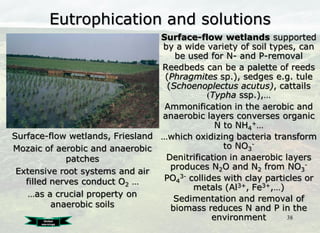
Eutrophication and solutions
Surface-flow wetlands, Friesland
Mozaic of aerobic and anaerobic
patches
Extensive root systems and air
filled nerves conduct O2 …
…as a crucial property on
anaerobic soils
Surface-flow wetlands supported
by a wide variety of soil types, can
be used for N- and P-removal
Reedbeds can be a palette of reeds
(Phragmites sp.), sedges e.g. tule
(Schoenoplectus acutus), cattails
(Typha ssp.),…
Ammonification in the aerobic and
anaerobic layers converses organic
N to NH4
+…
…which oxidizing bacteria transform
to NO3
-
Denitrification in anaerobic layers
produces N2O and N2 from NO3
-
PO4
3- collides with clay particles or
metals (Al3+, Fe3+,…)
Sedimentation and removal of
biomass reduces N and P in the
environment 38Global
warnings
The O3 layer: a protective shield for all life on earth
Reduction O3 to O2 is a chain
reaction of Cl
Optimal at -80 , in the polar
stratosphere during Antarctic winter
UV mainly damages amino acids
3% less O3 > 20% more chance of
skin cancer
Sources of depletion:
CFCs (life span of more than
100 y), since 1930 frequently
used in air conditioning,
refrigerators
CCl4, CH3CCl3, halocarbons, NOx
High concentrations of H2S, CH4
Montreal (1987): 85%
reduction CFCs by 2007
Lowest amounts of ozone found
over the Antarctic during
southern spring in October
Marine life, birds, algae and
plankton show a decline of
growth in the Antarctic zone
Some alarming holes in the
Arctic layer were observed
39Global
warnings
Destruction of the ozone layer
40Global
warnings
First observation in 1970 …
41Global
warnings
First observation in 1970 …
images 1995 - 2004
42Global
warnings
Ozone depletion over the Arctic in 2011
The ‘Dobson unit’ is a convenient
measure of the columnar density of
ozone overhead
One Dobson unit refers to a layer of
ozone that would be 10 µm thick
under standard temperature and
pressure
300 DU of ozone brought down to the
surface of the earth would occupy a
layer only 3 mm thick
The extent of ozone depletion in the
early spring 2011 was comparable to
that in the Antarctic ozone hole
Ozone depleted skies covered
Scandinavia and the northern Russia,
resulting in increased levels of
ultraviolet radiation
43Global
warnings
‘World avoided’ without ban CFCs
Left: ozone layer in 2009
Right: the ozone layer without ban
Note: red indicates high concentration O3,
blue indicates low concentrations
44Global
warnings
Pollution of oceans by plastic and trash
Fish, turtles, marine mammals and about 44%
of all seabirds e.g. royal terns (Sterna
maxima), northern fulmars (Fulmarus
glacialis),… mistake plastic for food or get
entangled in it
Plastic-derived chemicals can cause cancer in
humans and simpler life-forms may be more
susceptible than we are
Plastic debris - most of it smaller five mm -
are dispersed over millions of square miles of
ocean and miles deep in the water column
Solutions include improving the public’s
awareness, reducing the use of plastics and
enforcing laws to punish habitual litterers
The graph shows the average number of
trash items counted for several years along a
popular 7-mile stretch of Mustang Island Gulf
Beach, Texas 45Global
warnings
Harmful invasive species
If funds are limited, control of A1
species is the main priority
Eradication is only possible in
starting populations with habitats
not fully colonized
Management A2 species:
prevention of further distribution,
particularly in nature reserves
Invasive species have a
negative impact on biodiversity,
economy or health
Damage is correlated to the
integration and ecological
impact
Distribution and invasion of
black list species must be
checked at an early stage
If a species is too harmful,
eradication is appropriate
E.g. brown rats (Rattus
norvegicus) and common carps
(Cyprinus carpio)
46Trojan
horses
Black lists
A1-species: e.g. the red-eared
slider (Trachemys scripta
elegans), is omnivorous and an
ardent predator
Considered less harmful as
originally thought
Reproduction is not possible in
Western Europe, because the
embryo doesn’t survive cold
winters
Reproducing populations in
southern Europe
Prohibition of 1997 was evaded
by import of the cumberland
slider (Trachemys scripta
troosti)
47Trojan
horses
Examples of harmful exotic species
A1- Ludwigia grandiflora
Water primrose (Ludwigia grandiflora)
Invasive neophyte
Kleine Nete Retie,
Kasterlee, Herentals,
Grobbendonk (Belgium)
Escaped from garden ponds
The water primrose is being
controlled, but mechanical
removal is an awkward
manoeuvre
Vegetative reproduction
from parts of a plant makes
eradication a titanic job
48Trojan
horses
Original distribution of the water primrose
This species has a disjunct distribution with a 1st
area ranging from Pennsylvania to Texas, a 2nd in
California and Oregon and a 3rd in Brazil,
Argentina, Chili, Uruguay and Paraguay 49Trojan
horses
Situation in France in 2009
50Trojan
horses
Examples of harmful introduced
species A1 – Rana catesbeiana
The bullfrog is native to
North-America
Introduced for the rear legs or
as inhabitant of garden ponds
The bullfrog, able to catch birds
and mammals as prey, is
enormously harmful to the
native fauna
Ecosystems near the German
Rhine has to cope with
reproductive populations
In spite of a prohibition on
import, trade lingers on
51Trojan
horses
A2 - Introduced species: e.g. black
cherry (Prunus serotina)
Alder buckthorn (Frangula alnus)
host to the caterpillar of the
brimstone (Gonopteryx rhamni),
the holly blue (Celastrina argiolus)
and the brown hairstreak (Thecla
betulae)
Asian knotweed (Fallopia japonica),
another example of an A2-species,
is one of earth’s most invasive
plants
Introduced from America in Europe
in the 19th century for timber
In the 20th century applied as a
soil improver under pine trees
Invasive in forests, especially on
acid and sandy soils
Pollination by different species of
Diptera, Hymenoptera, Coleoptera
Strongly competitive through
tolerance of shade and
maintenance of saplings
Colonizing by fast fruiting and
crowding out of Frangula alnus,
Prunus padus, Quercus robur,…
Leaves are toxic to cattle
Control by pathogenic fungus
Chondrostereum purpureum
52Trojan
horses
A2 - Introduced species: e.g. giant
hogweed (Heracleum mantegazzianum)
Mass vegetation of giant
hogweed, Boxmeer, Netherlands
By forming dense stands they can
displace native plants and reduce
wildlife interests
Giant hogweed, native to Central
Asia and much appreciated by
beekeepers, was introduced into
Europe and North-America
Being a threat to natural
ecosystems, this plant is also
dangerous to human health
Contact with the toxic giant
hogweed sap leads to severe burns
Each plant produces between 30
000 and 50 000 winged seeds
Its regenerative capability means
that even an isolated plant is
capable of founding a new colony,
especially in presence of
waterways, wind or human activity
53Trojan
horses
A2 - Introduced species: e.g. Egyptian
goose (Alopochen aegyptiacus)
Egyptian goose (Alopochen
aegyptiacus) in a typical
menacing flight
Shelduck (Tadorninae), related to
the common shelduck
They are found mostly in the Nile
Valley and south of the Sahara
In 1967 some individuals escaped in
the Netherlands and Belgium and
the species is nowadays commonly
observed
Stabilization, within the recent years
there has been a further growth of
the population
Not harmed by cold winters
‘Trade mark’: aggression
Squatting the nest of other
waterfowls, hawks and buzzards
54Trojan
horses
A2 –Introduced species: e.g. harlequin
ladybird (Harmonia axyridis)
Harlequin ladybirds, easily
recognizable by the white
markings on their pronotum
("M"- or "W"-shaped black
area)
Harlequin ladybird (Harmonia
axyridis)
Introduced as herbivore of mildew
and as predator of aphids in
greenhouses
Reproduces freely in the
ecosystems of Western Europe
Ecological consequences are
considerable: as generalist species
and super predator it chases away
and predates on indigenous species
Wintering behaviour inside buildings
55Trojan
horses
Introduced species and evolution
In the African Great Lakes, the tribe of
Haplochromini (Cichlidae) have radiated
to fill almost all major niches, mostly
because of different food habits and
courtship
More than 300 adaptive types in Lake
Victoria alone
Paralabidochromis chilotes: with
thickened lips, preys on insects
Haplochromis obliquidens: grazes on
algae
They are being extinguished by the
giant Nile perch (Lates niloticus)
Introduced as a game fish by Ugandan
officials in the 1920s
Being a fat fish, a lot of wood is
required to get it done, promoting
deforestation and erosion
Local fishermen were being deprived of
their income
56Trojan
horses
Introduced species and evolution
R. pomonella on hawthorn
Both races of the maggots
are still resigned to the same
taxon
4 – 6% hybridisation between
the races
The apple maggot (Rhagoletis
pomonella) infects apple trees,
introduced into North America from
Europe around 1800
Before the arrival of apples from
Europe, it was mainly found in
hawthorns (Crataegus sp.)
The apple feeding race does not feed
on hawthorns and vice versa
This is an example of an early step in
the evolution of new species by means
of an extra choice of a new foodplant,
a case of sympatric evolution
The possible emergence of a new
species of Rhagoletis also appears to
drive the speciation among its
parasites
57Trojan
horses
Introduced species and evolution
The graph shows the temporal gap between the
two races of Rhagoletis pomonella (Bush 1969)
The imago appears before the trees set fruit
Parasitoid ichneumon wasps can be launched in
case of a plague
The ‘apple race’, with 70% less parasitoid
infection, is better protected against the wasps,
seen that the larvae live deeper inside the fruit
as the female wasps can drill their ovipositors
58Trojan
horses
Introduced species and evolution
Rhagoletis pomonella with Batesian
mimicry: the markings on the wings closely
resemble the forelegs and pedipalps of
jumping spiders (Salticidae), this way
avoiding predation by them
59Trojan
horses
Zebra spider (Salticus scenicus)
60Trojan
horses
IUCN Red List of Threatened Species 2008
61Local flora &
fauna under
assault
Threatened taxa: breeding birds in
Belgium and the Netherlands
Common cuckoo (Cuculus canorus)
Declining populations in all countries
of Western and Central Europe
More than 20 000 (1987), less than
10 000 (2009) breeding pairs in the
Netherlands
Use of insecticides affects the
cuckoos, who are dependent on insect
eating hosts
Climate change causes some hosts to
breed earlier (e.g. the robin), in
disfavour of the young cuckoo who
hatches best first…
… to eject the other eggs
Mimic cuckoo eggs in a nest of a
great reed warbler (Acrocephalus
arundinaceus)
62Local flora &
fauna under
assault
Threatened taxa: breeding birds in
Belgium and the Netherlands
Barn swallow (Hirundo rustica)
The most widespread species of
swallow in the world is not
endangered, but local populations
decline due to specific threats such
as the destruction of a reed bed with
three million birds for the
construction of an airport in Durban
In the 70s more than 200 000
breeding pairs shift to less than
30 000 in 2009 in Belgium
Habitat reduction by replacement of
old barns by more modern ones …
...of which owners keep out nests
for (supposed) hygienic reasons
High pressure cleaning and
whitewashing chase the birds away
For humans they are attractive birds
feeding on insects and therefore
they have been tolerated
63Local flora &
fauna under
assault
Threatened taxa: breeding birds in
Belgium and the Netherlands
House sparrow
(Passer domesticus)
Cities and villages nowadays have a
shortage of available nesting sites
In Western Europe and in the
Netherlands pre-eminantly, where it is
considered an endangered species,
numbers have dropped
Replacement of horses by combustion
engines, air pollution, use of toxics
against insects and plants are
contributing factors
The house sparrow is a seed eater
The hatchlings need insects for
fledging
Invasive in North America and
Australia since the 19th century
64Local flora &
fauna under
assault
Threatened taxa: breeding birds in
Belgium and the Netherlands
Nightingale
(Luscinia megarhynchos)
Dutch and Flemish red lists label the
nightingale as vulnerable: 7 500
breeding pairs
Reason of decline: biotope of marsh
forests and pastures disappear more and
more by depletion of groundwater
Drought during roosting in the south of
the African continent provides fewer
insects
Loud songs with an impressive variation
of whistles, are particularly noticeable at
night because few other birds are
singing
Nightingales sing even louder in urban
environments, in order to overcome the
background noise 65Local flora &
fauna under
assault
Threatened taxa: breeding birds in
Belgium and the Netherlands
Ficedula hypoleuca nests in
holes and can be helped by
supplying nesting-boxes
It has a preference for oak trees
The pied flycatcher is a victim of
global warming
Being migratory over long
distances, this bird is being
confronted with an earlier spring in
the temperate zones
A prerequisite to breed is an
abundance of insects
The pied flycatcher hastened its
breeding season by 10 days, by
which less recuperation is granted
The UK population has declined by
43% in the past decade,
decreasing breeding performance
being a major factor
As breeding performance is
declining, breeding-based
strategies such as habitat
management remain useful
conservation tools 66Local flora &
fauna under
assault
Threatened taxa: breeding birds in
Belgium and the Netherlands
A corn bunting (Miliaria calandra)
and a European bee-eater
(Merops apiaster) sharing private
business
Former has declined in northwest
Europe due to intensive agricultural
practices depriving it of its food
supply of weed seeds and insects
The corn bunting has recently
become extinct in Ireland where
it was once common
The Flemish population declines
by 5% every year, in 2005 it fell
to 150 breeding pairs
Referring to Flanders, the
fieldfare (Turdus pilaris), the
Montagu’s harrier (Circus
pygargus), the wheatear
(Oenanthe oenanthe), the golden
oriole (Oriolus oriolus), the
bullfinch (Pyrrhula pyrrhula), the
great grey shrike (Lanius
excubitor) a.o. illustrate this
negative trend
67Local flora &
fauna under
assault
Other threatened taxa in Belgium and the
Netherlands
The brown long-eared bat
(Plecotus auritus), endangered in
Belgium and the Netherlands
Roost sites in tree holes or buildings
are often thought of as ‘untidy’
Pesticide use has devastating effects,
causing severe decline in insect prey
abundance, and contaminating food
with potentially fatal toxins
Insecticides applied to timber inside
buildings where roosts occur are a
particular danger
An agreement on the Conservation of
Bats in Europe under the auspices of
the Bonn Convention, also known as
the Convention on Migratory species
(CMS) is in force, and all European
bats are listed under Appendix II of
the CMS
68Local flora &
fauna under
assault
Other threatened taxa in Belgium and the
Netherlands
Common midwife toad
(Alytes obstetricans)
Males carrying with them the eggs from
March until August
The common midwife toad
is a pioneer species,
preferring a habitat with
pools, hiding places and
lots of sunlight
Overgrowth of its habitat by
succession makes
populations decline
The tadpoles can linger in
chalk quarries and
holloways with waters
considered ecologically
‘bad’
69Local flora &
fauna under
assault
Other threatened taxa in Belgium and the
Netherlands
Yellow-bellied toad
(Bombina variegata)
Critically endangered in Belgium
Biotope: small-scale and
extensively managed hills and
loamy soils e.g. marl quarries
Habitat: marshes, rivers with
natural inundations and
continuous displacing waters
Undeep waters with a minimum of
vegetation and lots of sunlight,
where high temperatures may be
achieved without competition of
other amphibians
Tractor tracks as temporarily
reproduction pools are ideal
70Local flora &
fauna under
assault
Other threatened taxa in Belgium and the
Netherlands
European tree frog (Hyla arborea)
Main threats include draining &
pollution of wetlands, acidification and
habitat fragmentation
Beside these, use of fertilizers and
pesticides, and introduction of trout in
ponds account for the decline
Habitat: sunlit vegetations,
wooded banks, cattle ponds
and forest edges, preferring
the transition between water
and shrubs
They tend to avoid dark or
thick forests, eggs need a
minimum of 15° to hatch
As opposed to other frogs,
they don’t jump away in case
of mowing: they confide on
their camouflage
71Local flora &
fauna under
assault
Other threatened taxa in Belgium and the
Netherlands
Pine martens (Martes martes)
can reduce the population of
grey squirrels…
…stimulating the population of
native red squirrels who are
better camouflaged and move
less on the ground
Pine martens have a broad diet
consisting of small rodents, birds,
beetles, carrion, eggs and berries
They prefer well-wooded areas
In the Netherlands they were
heavily persecuted in the past
Current threats include human
disturbance, illegal poisoning
intended to kill foxes and crows and
fur trade
Wildlife corridors and eco-
engineering made numbers in
Flevoland increase
The Netherlands have a population
of 350 adult animals
After an absence of decades in
Flanders, an injured animal was
spotted in the center of Kalmthout
in ’07, in September ‘11 a pine
marten was seen in De Panne72Local flora &
fauna under
assault
Other threatened taxa in Belgium and the
Netherlands
The hazel dormouse (Muscardinus
avellanarius), a member of the Gliridae
family, is a rare sight in Belgium
On loess covered hillsides, on
riverbanks, in oak forests rich in food
providing trees (nuts, berries, bark, ...)
Tree or shrub dweller, rarely seen on
ground level, nocturnal
It has low mobility, but can colonize
new territory via hedgerows
Hibernates, torpor during the summer
months in case of food shortage
The hazel dormouse has limited
distribution and is endangered, has
disappeared from the wild in the
Netherlands
73Local flora &
fauna under
assault
Other threatened taxa in Belgium and the
Netherlands
The burbot (Lota lota) is the
only cod-like fresh water fish
Top predator preferring clear
streaming water or clean, deep lakes
The burbot spawns early, larvae die in
temperatures over 6°C
Dependant on flooding of river valleys
Considered extinct in Belgium since
1970
In 1999, the Flemish government
developed a reintroduction program
Primary threats are declining quality
of water and destruction of spawning
beds
Endangered but not legally protected
in the Netherlands, legal protection
does exist in Belgium
74Local flora &
fauna under
assault
Other threatened taxa in Belgium and
the Netherlands
The last known European crayfish (Astacus astacus) in Flanders
was caught in Lanaken in 1945
In the Netherlands the species has been introduced in some small
lakes of the Veluwe
Once abundant throughout Europe, it is listed as Vulnerable (IUCN
‘11) due to the crayfish plague carried by the invasive American
species signal crayfish (Pacifastacus leniusculus)
75Local flora &
fauna under
assault
Other threatened taxa in Belgium and
the Netherlands
The large blue (Maculinea
arion) caterpillar transforms
into the butterfly adult inside
Myrmica sabuleti ants’ nest
The large blue became extinct in the
United Kingdom in 1979 due to the
loss of the short turf habitat when
rabbits died out during the
myxomatosis crisis
One out of ten species of butterflies in
Europe are threatened with extinction
In Flanders, the situation is even more
severe: out of 64 native species 18 are
lost and 2/3 is threatened or on the
verge of extinction
Intensive farming, global warming and
tourism led to this disastrous result
76Local flora &
fauna under
assault
Bee population density levels are
dangerously low
Removing the sealed off drone
breeding cells from the hive 2
to 3 times in May and June can
reduce the infection by half
The Varroa mite is a parasite that
targets honey bees exclusively, first
found in the Netherlands in 1983
A fertilized Varroa jacobsoni female is
brought into the nest by a bee
The female infects the breeding cells
before they are sealed off with wax
Bee larvae deform because of the
presence of the mite, the drones are
mainly affected
The adult mite feeds on the bee’s
hemolymph
Creates deformities, affects vitality,
introduces infectious pathogens
Import of bees is prohibited,
transportation can be limited77Local flora &
fauna under
assault
Severe infection can cause the death of the
entire hive between August and October
Graph: Dietzen Hermann (1988)
Without prevention, the beekeeper will be
confronted with wax moths attacking the hive,
surrounded by dead bees
78Local flora &
fauna under
assault
Will global warming bring about a
“beepocalypse”?
Nosema ceranae and N. apis affect the
bees intestinal tract
While cleaning the cells, the bee picks up
a spore
N. apis shows accelerated germination in
CO2-heavy conditions
Bt-pesticides, used for maize
monocultures, act synergistically with the
fungal parasite
Fumagilline may be effective, but the
development of resistance cannot be
ruled out
Hive hygiene is of primary importance
Use of Imidacloprid, a highly toxic
insecticide to bees enhancing colony
collapse disorder, should be forbidden
79Local flora &
fauna under
assault
Global threats to taxa
Wellington’s solitary coral
(Rhizopsammia wellingtoni )
1 of the 3 endangered
Galapagos corals
Corals appear on the IUCN list for the
first time (2007)
Charles Darwin Research Station
(Galapagos): 3 types of coral Critically
Endangered
74 Galapagos sea weeds appear on
IUCN
Overfishing increases barnacle
population, which grazes on sea weeds
Marine ecosystems are under global
threat because of rising temperatures
Regional decline because of warmer sea
water, brought about by El Niño (mass
destruction in Costa Rica, Panama,
Ecuador and Colombia in 1982-1983)
Localized decline caused by overfishing
80Biodiversity
threatened
81
Corals, a specialized form of mutualism
between algae en corallites
Porites sp., skeleton
producing coral, can live for
up to a 1 000 years
Scleractinia (Anthozoa) are polyp-like
corallites with a hardened skeleton,
which creates the reef
Algae (Zooxanthellae) convert sunlight
to sugars, corals produce nitrogen
compounds
This symbiosis –and therefore reefs -
can only exist in shallow, clear water
Rising sea levels is a threat to coral
reefs
Increasing levels of CO2 acidifies
oceans, reducing the coral’s ability to
take up calcium and slowing their
growth
Eutrophication (induced by fertilizers)
reduces O2 levels and suffocates algae
Biodiversity
threatened
Florida Keys reefs: a degraded
biodiversity hotspot
Elkhorn coral (Acropora palmata),
2006 status: Critically Endangered
Molasses reef reduced by 96%
between 1981 and 1986, in part
caused by a 1986 Panama oil spill
A survey of 105 reefs shows a
decline by 44% between 1996
and 2005
The archipelago –the only tropical
reef belt off the North American
coast- is the 3rd largest with a
diversity of 6 000 species
520 species of fish, 128 species of
starfish, 63 species of stony coral
Reefs become engorged with oil,
lose mucus and become more
susceptible to infections
Solvents used by BP were more
toxic than the oil itself
82Biodiversity
threatened
Reasons for the endangerment of taxa
Primary cause: loss of habitat
Deforestation for the benefit of the
wood industry or cattle
WWF focuses on ‘flagship species’ or
‘keystone species’: used as ‘umbrella
species’; what is beneficial to them, is
beneficial to the entire habitat
Lemurs on Madagascar
Mountain gorillas in East Africa
Jaguars in Neotropis
Orang-utans on Borneo,...
Other causes: poaching, introduction of
new species, climate change
Coquerel’s sifaka (Propithecus
verreauxi coquereli)
Below: destruction of rainforest on
Madagascar for wood and livestock
83Biodiversity
threatened
Example of endangerment through
deforestation
The aye-aye (Daubentonia madagscariensis)
lives in the rainforests of Madagascar, but
also in the drier northwest and on the islands
Aye-aye, Nosy and Mangabe
Occupies the same niche as the woodpecker
Taps the bark of trees with its elongated
middle finger and listens for edible larvae
Large, overlapping territories of up to 1 km2
Male ranges overlap between 40 and 75%,
and these shared spaces may be occupied by
numerous individuals simultaneously
The rapid loss of their natural habitat due to
encroachment by humans is the main threat
to this species
Hunted because of their habit of eating in
coconut or lychee plantations or out of
superstition 84Biodiversity
threatened
Example of endangerment through
deforestation
Daubentonia robusta, which was
three to five times the aye-aye’s
weight, once lived in the dry
southwest, but has become extinct
less than 1 000 years ago
Identical adaptation to a diet of
insects; remarkable because
normally, only small mammals can
live exclusively on insects
Halfway through the 20th century,
people thought the aye-aye had
become extinct, but it was
rediscovered in 1961
Distribution: broad but sparse
85Biodiversity
threatened
Loss of habitat and populations
Bighorn sheep (Ovis canadensis) –
Bovidae, southwest USA
Rams have large, curved horns
Canyons, cliffs and deserts, where
water is a prerequisite for survival
Around 1900, total population imploded
to less than 1 000; preservation
restored population size
Main predator is the mountain lion
Populations of less than 100 tend to die
out rapidly
Once population becomes too small,
inbreeding starts to occur
To sustain a population of 1 000, large
carnivores need a territory of 106 ha
86Biodiversity
threatened
Genetic erosion
Cheetah (Acinonyx jubatus):
low genetic variation
Population susceptible to
diseases, weakened physical
fitness and a low fertility rate
Wildt (1992) discovered a
deformation of sperm cells for
more than ½ of the cheetahs
20 000 cheetahs on earth are
almost genetically similar
Habitat fragmentation diminishes the
gene pool of endangered low populations
of wild plant and animal species,
affecting their immune system and
viability
Populations of endangered species tend
to be small, with inbreeding, genetic drift
and a loss of heterozygosity as a
consequence
Nevertheless the existence of modern
but expensive techniques, the best way
to prevent genetic erosion is to protect
their habitat and to let them live in it
naturally
Wildlife sanctuaries and corridors to
enable endangered species to travel,
meet and breed can be integrated with
reintroduction and ex situ conservation
87Biodiversity
threatened
Removal of keystone species drastically
alters communities
The sea otter (Enhydra lutris) once thrived among the
kelp beds close to shore from Alaska to California
It was hunted by European settlers for its fur, so by the
end of the 19th century it was close to extinction
In places where sea otters disappeared completely, an
unexpected sequence of events unfolded
88Biodiversity
threatened
Removal of keystone species drastically
alters communities
Distribution Enhydra lutris
Population worldwide is estimated to be 108 000
IUCN 2000: Endangered
Remaining populations are small and widely
dispersed, causing low genetic diversity
89Biodiversity
threatened
Removal of keystone species drastically
alters communities
Sea otters feed mainly on crustaceans, including sea
urchins (Echinoidea)
The disappearance of the sea otter caused a population
explosion for the sea urchin, and because sea weed is
the urchin’s staple food, it turned the seabed that once
housed forests of kelp into a desolate waste
90Biodiversity
threatened
Removal of keystone species drastically
alters communities
Above: seabed with kelp forest
Below: seabed from which the sea
otter is absent
Small populations survived near the
Aleutian Islands (chain of islands
between the US and Russia)
Part of this population was moved to
the coasts of Canada and the US to
restore their presence there
As the sea otter population grew, the
number of sea urchins decreased and
kelp forests once again flourished
The gray whale (Eschrichtius robostus)
migrated closer to shore to protect its
young from sharks and to feed on
zooplankton 91Biodiversity
threatened
Removal of keystone species drastically
alters communities
Distribution Eschrichtius robostus, ca. 20 000 individuals, 2
populations
IUCN 2008: Critically Endangered in the northwest Pacific
Sea otter population is under threat from overfishing, oil
pollution and predation by Orcinus orca
92Biodiversity
threatened
Eschrichtius robostus
93Biodiversity
threatened
When a species becomes extinct,
it’s gone for good
1 – A species is endangered when it has a
large area of distribution, but is sparsely
dispersed
Bachman’s warbler (Verminora
bachmanii) is the rarest bird indigenous to
the US (Alabama, South-Carolina)
It winters on Cuba and occasionally on Isla
de la Juventud
Area suited for wintering becomes scarce
due to deforestation in favour of sugar
cane plantations and, upon its return, the
male risks not being noticed by females
Habitat: forested swamp valleys, preferably
rich in river cane (Arundinaria gigantea)
94Biodiversity
threatened
When a species becomes extinct,
it’s gone for good
River cane also known as ‘switch
cane’, at one time covered an area
from Virginia to Florida and western
Texas
Canebrakes were once a common
feature of the landscape in the
southeastern United States, but today
it is an endangered ecosystem
The cutting down of its habitat and
the draining of swamps are the mean
threats facing the Bachman’s warbler
Last sightings: South-Carolina (1988),
Cuba (2002)
Below: Congaree National Park
(South-Carolina), possibly one of the
last place of refuge for this species
95Biodiversity
threatened
When a species becomes extinct,
it’s gone for good
2 – A species is endangered when it consist of a few dense populations,
living in a small area of distribution
Kirtland’s warbler (Dendroica kirtlandii), southern Michigan peninsula,
requires large areas, densely forested with young Pinus banksiana
Between 1961 and 1971, the population fell to 400 birds, in part due to
brood parasitism by the brown-headed cowbird (Molothrus ater)
96Biodiversity
threatened
When a species becomes extinct,
it’s gone for good
Research suggests the cowbird exhibits
mobster-like behaviour
They will monitor the nest and destroy it
if their egg is not present
This makes warblers less inclined to
remove the egg, an action for which they
are physically underequipped to begin
with
Originally, the species followed the trek
of the bison, but contrary to the bison,
the bird adapted successfully to life in
open spaces, after the forests east of the
prairie had been cut down
Their reproductive niche complements
their nomadic lifestyle
97Biodiversity
threatened
Brown-headed cowbirds following
grazing bisons
98Biodiversity
threatened
When a species becomes extinct,
it’s gone for good
3 – A species is endangered when it
exists in large populations, distributed
over large areas, but has become highly
specialized to occupy a rare niche
The red-cockaded woodpecker
(Picoides borealis) can only claim 1% of
its original territory, which consists of
pine forests that are at least 80 years
old
To nest, they hollow out cavities in
living, mature longleaf pines (Pinus
palustris)
Offspring aids the breeding pair in
protecting their young, creating a group
that requires an area of ca. 86 ha
99Biodiversity
threatened
Predicted to become extinct?...
Hibiscadelphus distans is an
endemic of Kaua’i, Hawaii
In the Lower Koai’e Canyon rest two
existing populations of 20 wild and
150 introduced trees
Despite the extreme rarity of
H. distans, it is the biggest
population of the genus, of which
four of the six species are extinct or
are extinct in nature
H. woodii e.g. with four trees
observed on Kaua’i is even closer to
elemination
100Biodiversity
threatened
Hibiscadelphus woodii in bloom
101Biodiversity
threatened
Predicted to become extinct?...
The Socorro sowbug (Thermosphaeroma thermophilum) is an
aquatic crustacean that has lost its natural habitat and survives in
an abandoned bathhouse in New Mexico
The relict population took this refugium after the well where the
sowbugs lived was shut down in 1970
Genetic and physiologic divergention demonstrates apart from the
possible speed of evolution an extra threat if the species has to
survive in the wild again
102Biodiversity
threatened
Lost?....
Spix’s macaw (Cyanopsitta spixii) is
limited to palm groves and river-edge
woodland across southern Pará, Brazil
Poaching by bird fanciers, paying up to 40
000 $ for a single bird, has driven the
Spix’s macaw to a population of four birds
left in the wild
The decline was hastened by imported
Africanized bees, whose colonies occupy
the tree holes favored by the macaw
By late ‘90 only one single male was left in
the wild, according Tony Juniper of the
International Council for Bird Preservation,
‘being desperate to breed’
103Biodiversity
threatened
Biodiversity in danger during the past
Moa-nalo is a general term for all
extinct flightless goose-like ducks
The proof of their existence is
hidden in the sinkholes of the
Ewa Plain caves, where they were
imprisoned and died
Polynesians colonized the Pacific
islands from Tonga to Hawaii from
8000 BC on
They subsisted on crops and
domestic animals carried in their
canoes
To complete their diet, the
voyagers ate their way through the
endemic fauna
When European settlers arrived
after Captain Cook’s visit in 1778,
there were 50 native species of
landbirds in Hawaii
Bone deposits show that another
35 species had already been
extinguished by the native
Hawaiians 104Biodiversity
threatened
Biodiversity in danger during the past
Simulation of the hunting for
Dinornis giganteus
Before the Maoris arrived in New
Zealand around 1300, it was home to
11 species of moas (Emeidae and
Dinornithidae), the largest weighing
230 kg
In a period of ± 150 years all of them
have become extinct
They had undergone a radiation filling
many niches, seen the lack of
moderate and big mammals
On South Island, the deposits are piled
with moa bones dating from 1100 to
1300
105Biodiversity
threatened
Biodiversity in danger during the past
Haast’s eagle (Harpagornis moorei), twice as large as a
golden eagle, was the only natural enemy of the moas
The largest eagle known to have ever existed became
extinct in ± 1400 when its major food sources, the moas,
were hunted to extinction by humans and much of its
dense forest habitat was cleared
106Biodiversity
threatened
Biodiversity in danger during the past
Fully isolated for 70 million years, Madagascar was the theater
for a biological tragedy like New Zealand’s
The Indonesian Malagache pioneers, extinguished from 500 to
1000 the seven species of elephant birds (Aepyornithidae),
including A. maximus, the world’s largest bird
Also erased were seven of the seventeen genera of lemurs
107Biodiversity
threatened
Biodiversity in danger during the past
Quaternary (2,6 million year BC- 0)
extinctions, beside being caused by the ice
ages, appear to have occurred where naive
animals encountered humans
Paleo-Indians throughout America, Dutch
sailors on Mauritius –to meet and extirpate
the dodo -, Polynesians across the Pacific
were constrained by neither knowledge of
endemicity nor any ethic of conservation
The hunters were selective in their choice of
taxa, with a concentration on large
mammals and flightless birds
They ignored other species e.g. small
rodents
‘Human hunters help no species’ Edward O.
Wilson in ‘The Diversity Of Life’, 1992
108Biodiversity
threatened
Narrow habitats, extensive specialization and
limited dispersal may put species at risk
Freshwater and land molluscs are
vulnerable to extirpation because they are
specialized for life in narrow habitats
As a result of a miniature adaptive
radiation, the fungus grazing tree snail
genus Achatinella is endangered by
introduction of the carnivorous Euglandina
sp.,…
… loss of habitat, predation by rats and
through human collection
Moorean endemic tree snail species are
exterminated since 1987, on Tahiti the
same sequence is now unfolding
Achatinella sowerbyana, Euglandina
rosea
109Biodiversity
threatened
The critical predicament of biodiversity is
epitomized by Banara vanderbiltii
250 of the 20 000 plant species
known in the US are extinct, another
680 are in danger of extinction
(2000)
About ¾ of these occur in only five
places: California, Florida, Hawaii,
Puerto Rico and Texas
In 1986 the population of Banara
vanderbiltii was down to two plants
growing on a farm near Bayamon
(Puerto Rico)
Cuttings were obtained and are now
successfully growing in the Fairchild
Tropical Garden, Miami
110Biodiversity
threatened
Fungi in the midst of a mass extinction
Inventarisations in Germany, Austria and the Netherlands have
revealed a 40 to 50% loss in species during the past 60 years
The main cause of this decline appears to be air pollution
Many of the vanished species are mycorrhizal fungi, enhancing
absorption of nutrients by the roots of plants
Ecologists wonder what would happen to land ecosystems without
fungi, and we will soon find out
Russula rubra, extinct in Belgium in 1949
111Biodiversity
threatened
Rifle shots and holocausts
Large, conspicuous organisms receive the greater part of man’s
malign attention rather than sowbugs and spiders
Conservationists now recognize the difference between rifle shots
or the extinction of one species and holocausts, the destruction of
the entire ecosystem
The Javan rhinoceros (Rhinoceros sondaicus) cannot be saved if
the remnant woodland in which they live is cleared
The biggest players in a community are the ‘keystonespecies’,
serving as umbrellas for all life around them 112Main
biodiversity
hotspots
Rifle shots and holocausts
Even the most optimistic estimate suggests there are approximately
40 Javan rhinos in the wild on Java
Deforestation, Agent Orange and particularly the trade in horns for
traditional Chinese medicine, fetching a price 30 000 $/kg, brought
the population on the brink of extinction
Once widespread from Java and Sumatra to China and India
The Javan rhinoceros’ range has been shrinking for at least three
millennia to an area of 300 km2, insufficient to restrict inbreeding
113Main
biodiversity
hotspots
Ecosystems deserving immediate
attention
Usambara Mountain forests, Tanzania
Birds include the green headed oriole
(Oriolus chlorocephalus), one of the
species of the Amani Forest Nature
Reserve
The total area is about 836 km2, of
which 450 km2 is covered with forest
With more than 2000 plant species of
which about 25% are endemic and with
140 endemic tree species, Amani has
been declared as one of the 25
biodiversity hotspots
Overpopulation, poverty, invasive
vegetation, deforestation and soil
erosion are the main threats
114Main
biodiversity
hotspots
Ecosystems deserving immediate
attention
The long-billed forest warbler (Orthotomus
moreaui), is an endemic songbird living in the
Amani Forest Nature Reserve
Endangered, threatened by loss of montane
forests 115Main
biodiversity
hotspots
San Bruno Mountain, California
Scientists said San Francisco is notorious in
international lepidopterist circles for its long
list of disappearing butterflies
Of the 54 species that lived in San
Francisco around 1900, only 34 remain
The San Bruno elfin butterfly (Callophrys
mossii bayensis) with its typical lycaenid
interaction with ants, is restricted to a few
small populations
Host plant: Sedum spathulifolium
Native fauna and flora is diminished by off-
road vehicles, quarrying and invasive
Eucalyptus species, gorse (Ulex
europaeus),…
116Main
biodiversity
hotspots
Oases of the Dead Sea Depression,
Israel and Jordan
These humid refuges in a desert area, called ghors, are isolated
tropical ecosystems sustained by freshwater springs
True pockets of an ancient flora and fauna restricted to the vicinity of
ghors or even to a single spring, are joined by species that flourish
thousands of kilometers to the south
The springs are populated with endemic Cichlidae, the banks with e.g.
weaver ants (Oecophylla sp.) and the surrounding rocks with a.o. the
Nubian ibex (Capra nubiana), from which the wild population is
estimated at ± 1 200 animals (IUCN 2008) 117Main
biodiversity
hotspots
Oases of the Dead Sea Depression,
Israel and Jordan
The Nubian nightjar (Caprimulgus nubicus), found from Kenya to
Oman, has places for brooding in the oases
The oases are threatened by overgrazing, expansion of a quarry
and commercial development
118Main
biodiversity
hotspots
California floristic province
This Mediterranean-climate domain, stretching from Oregon to Baja
California and recognized by botanists as a separate evolutionary
center, contains ¼ of all plant species of the US
The hotspot is home to the giant sequoia (Sequoiadendron giganteum)
and holds some of the last individuals of the Critically Endangered
California condor (Gymnogyps californianus), here with common
raven escort
Wilderness destruction is caused by commercial farming, pollution and
road construction 119Main
biodiversity
hotspots
Slash & burn in Madagascar
The most basic need for the Malagasy - putting food on the table -
far exceeds that of biodiversity and forest conservation
One has only to fly over the coast or sail along the shore to see how
the red soil of Madagascar is washing into the sea
30 primates, all lemurs; reptiles and frogs (as sole amphibians) that
are 90% endemic illustrate the unique richness of nature
2/3 of all chameleons of the world live on the island
120Main
biodiversity
hotspots
Slash & burn in Madagascar
80% of the 10 000 plant species is endemic
Since the military coup by the current leader Rajoelina (2009),
forest conservation efforts in Madagascar have been reversed
and illegal logging has grown into a major revenue
Former President Ravalomanana protected forests and
promoted sustainable agriculture
Brookesia minima, world’s smallest chameleon
121Main
biodiversity
hotspots
Slash & burn in Madagascar
Adansonia is a genus of eight
species of trees, six native to
Madagascar, one native to mainland
Africa and one to Australia
The six Malagasy species are on the
IUCN Red List of Threatened Species
Adansonia madagascariensis -
Madagascar baobab
They are pollinated by a diverse
fauna of lemurs, moths, bats and in
Africa by e.g. galagos species
(Galagidae)
The fruits contain more vitamin C
than oranges
122Main
biodiversity
hotspots
Grandidier's Baobab (Adansonia
grandidieri)
123Main
biodiversity
hotspots
The fossa (Cryptoprocta ferox) is the island's
largest surviving endemic terrestrial mammal
Fossas are particularly vulnerable to extinction by forest
fragmentation, dwindling lemur populations and the persecution
by farmers to protect their poultry
IUCN 2008: Vulnerable, over the course of the last 21 years, there
has been a population reduction exceeding 30%, with a current
population size of less than 2 500 animals (Hawkins and Racey 2005)
and ±400 breeding adults 124Main
biodiversity
hotspots
Lower slopes of the Himalayas
Lush mountain forests encircle the southern and eastern edges of the
Himalayas
The fauna and flora is a complex mixture of tropical species of
southern origin and temperate species from the north
The succession of deep valleys and sharp ridges divides the fauna and
flora into large local assemblages, displaying for example 9 000 plant
species of which 40% are limited to the region
Red panda (Ailurus fulgens), Vulnerable, less than 10 000 individuals
face the risk of inbreeding (Nepal to China) 125Main
biodiversity
hotspots
Lower slopes of the Himalayas
Snow leopards (Uncia uncia) occupy
alpine and subalpine areas generally
3 350 and 6 700 meters above sea
level in Central Asia
Snow leopards have stocky bodies,
long thick fur, small and rounded ears
as adaptations to cold mountainous
environments
Considerable predation of domestic
livestock occurs which brings this
opportunist, first described in 1775
into direct conflict with humans
Home range varies with density of
prey (12 – 1000 km2)
Wild population maximum 6 500
Densely populated regions put
pressure on the virgin woods, down by
2/3 through logging,… 126Main
biodiversity
hotspots
Western Ghats, India
These moist, deciduous forests and
montane rain forests have a unique
floral composition
Former is the habitat of teak (Tectona
grandis), a lot of which were illegally
and extensively cut in the 20th century
The latter are dominated by evergreen
forests characterized by trees of the
Lauraceae a.o. Litsea oleoides
(Kerala, Tamil Nadu)
18 endemic species of this genus thrive
in the Ghats, of which three have a very
limited range
The family, with many relic species, has
its origin in the coastal laurel forests of
Gondwana
127Main
biodiversity
hotspots
Western Ghats, India
The potential for dam
developments to inundate vast
areas of its habitat also means
that the status of the purple
frog is extremely precarious
The purple frog (Nasikabatrachus
sahyadrensis) is the sole
representative of an ancient lineage
of frogs that has been evolving
independently for over 130 million
years after the break up of Gondwana
The purple frog is described as a
‘living fossil,’ closest relatives being
four tiny frog species found in the
Seychelles in the Sooglossidae family
Formally discovered in 2003, the
purple frog spends most of the year
underground, surfacing only to mate
during the monsoon
The purple frog is thought to be a rare
species, although it is hard to find
Known from only 135 individuals, of
which only three are female128Main
biodiversity
hotspots
Western Ghats, India
The Nilgiri Biosphere Reserve is home to the biggest population of
the Asian elephant (Elephas maximus)
It is also an important refuge for tigers
More than 6 000 Asian elephants roam in the Western Ghats of
Karnataka (2004)
About a third of the cover of the Ghats is gone already, the
remainder is disappearing by 2-3% a year, fragmented due to clear
felling for coffee, tea, teak, cardamom and ginger
129Main
biodiversity
hotspots
Central Chile
This Mediterranean vegetation is
characterized by a high degree of
endemism through its geographic
isolation
Chile is separated from the rest of the
continent by the high mountain range of
the Andes along its length, dry deserts
in the north and frozen ice-fields in the
Patagonian south
The flora of Central Chile contains 3
000 plant species, half of the entire
Chilean flora, crowded into 6% of the
national territory
The surviving cover is only 1/3 of the
original and is located in the most
densely populated part
Puya alpestris, Bromeliaceae
130Main
biodiversity
hotspots
Central Chile
In earlier times the Chilean palm (Jubaea chilensis) was to be
found throughout Central Chile, but it is almost extinct due to the
destructive extraction process of its sap
The sap from the trunk produces a fermented beverage, collecting it
requires felling the tree, restricting this forest type to some valleys
in La Campana and Las Palmas de Cocalan
131Main
biodiversity
hotspots
Central Chile
The high mountain lizard (Phymaturus palluma) inhabits montane
grasslands with elevations up to 3 000 m and exhibits a
thermoregulation of darkening to absorb more heat
Central Chile and West Argentina, herbivorous, viviparous
132Main
biodiversity
hotspots
The Colombian Chocó
In the core of the Chocó the Pangan
Nature Reserve encompasses 12 000
acres of super-wet tropical rain forest
Unexplored for the most part, as many
as 10 000 plant species grow here, of
which ¼ are estimated to be endemic
Keystone species include the spectacled
bear (Tremarctos ornatus), the only bear
species native to South America, the
threatened banded ground cuckoo
(Neomorphus radiolosus) and baudó
guan (Penelope ortoni)
Populations of baudó guan are extremely
sensitive to selective logging, hunting for
gold, oil palm and illegal coca plantations
133Main
biodiversity
hotspots
The Colombian Chocó
Baudó guan, blue poison dart frog
(Dendrobates azureus), the latter
found only in the Pangan Nature
Reserve, as example of an organism
with aposematic coloration to warn
predators for its toxic alkaloid
secretions
Since the early ’70s, the Chocó has
been relentlessly invaded by timber
companies and, to a lesser extent, by
poor Colombians searching for land
The forests are already down to ¾ of
their original cover and are still being
destroyed at an accelerating rate
134Main
biodiversity
hotspots
The Colombian Chocó
Jaguar (Panthera onca), IUCN 2008 Near Threatened
135Main
biodiversity
hotspots
Western Ecuador
Wilson, The Diversity Of Life, 1992
In 1978 Gentry & Dodson documented 90
plant species unique to the Centinela ridge in
Ecuador
The cloud forests in which they grow are
ecological islands surrounded by lowland rain
forests and closed off by the treeless paramos
Among the plants, mainly epiphytes and
orchids, were 38 endemic species, many of
which were unusually dark-leafed
By 1986, the botanical oasis was cleared: 96%
of the forests on the Pacific side have made
space for agriculture
A few of the endemic plants have persisted in
the shade of cacao trees
Wilson refers to similar extinctions around the
world as ‘centinelan extinctions’, Janzen
speaks of ‘living dead’
136Main
biodiversity
hotspots
Western Ecuador
South of Centinela, the Rio Palenque Science
Center a.o. collaborates in protection and
research of less than one km2 forest remnants
There are 1 200 plant species in this area, ¼
of them endemic to western Ecuador
In 1993, Dodson & Gentry identified 650 bird
species, by which the degree of endemism is
among the highest in the world
The Global Trees Campaign is working on
reforesting 40 hectares of the Awacachi
Corridor with native trees and raising
awareness in local communities to conserve
the area
Planting the endemic Carapa megistocarpa
(Endangered IUCN 2011)
137Main
biodiversity
hotspots
Western Ecuador
The harpy eagle (Harpia harpyja), a former inhabitant of
the canopy layer of the Centinela ridge and Rio Palenque
Americas most powerful raptor can be seen in lowland rain
forests, but is rare throughout its range
138Main
biodiversity
hotspots
Uplands of western Amazonia
Tertiary alluvial uplands of evergreen rain
forests engirdle the Putamayo (Colombia,
Peru), the Caquetá (Colombia), the Amazone
and the Napo river (Peru)
Common tree species of the upper canopy
are the kapok tree (Ceiba pentandra),
Terminalia amazonia, Cedrelinga
catenaeformis, Carapa guianensis and the
rubber tree (Hevea guianensis), forming the
scenery of primates e.g. the equatorial saki
(Pithecia aequatorialis), marmosets
(Callithrix sp.), jaguars, bats e.g. the
southern little yellow-eared bat (Vampyressa
pusilla), three species of anteaters, manatees
(Trichechus sp.) and tapirs (Tapirus
terrestris) nearby or in the rivers
139Main
biodiversity
hotspots
Uplands of western Amazonia
Tapirus terrestris, Vampyressa pusilla
500 species of birds populate the
Amacayacu National Park e.g. the pavovine
quetzal (Pharomachrus pavoninus), the
golden-winged tody-flycatcher
(Todirostrum calopterum) and the endemic
ochre-striped antpitta (Grallaria
dignissima)
Reptiles are represented by e.g. the
Arrau turtle (Podocnemis expansa)- the
largest fresh water turtle-, the spectacled
caiman (Caiman crocodylus) and the green
anaconda (Eunectes murinus)
The Tarapoto’s lake is renowned for its
pink dolphin’s community (Inia geoffrensis)
140Main
biodiversity
hotspots
Uplands of western Amazonia
Pavovine quetzal (Pharomachrus pavoninus)
Melanine organized in platelets renders the males a striking
iridescent coloration
141Main
biodiversity
hotspots
Uplands of western Amazonia
The diminutive pygmy marmoset (Callithrix pygmaea) is
the smallest monkey in the world, weighing only 120 g
Female pygmy marmosets are slightly heavier than males
They can produce a variety of vocalisations, including a sharp
warning whistle and a clicking sound to indicate threat
142Main
biodiversity
hotspots
Uplands of western Amazonia
Inia geoffrensis
The Amazon Pink river dolphin is on the verge of
extinction in the Amazon river basin
Pollution from agriculture, heavy metals from industry
and mining, as well as hydroelectric dams are to blame
143Main
biodiversity
hotspots
Uplands of western Amazonia
A large part of the ecoregion is intact, but still
vulnerable to advancing palm oil and coca
plantations, logging, mining and cattle-raising
1/3 is under jurisdiction of indigenous communities,
mainly between the Putamayo and Caquetá basins
Settlement of Yagua, northeast Peru
144Main
biodiversity
hotspots
Atlantic coast of Brazil
A unique rain forest once reaching
from Recife to Florianópolis has been
reduced to less than 5% during the
20th century
NGOs are huge benefactors in Brazil, a
strategy being implemented to
maintain biodiversity is creating
wildlife corridors
The tropical forest, tropical savanna
and mangrove are blessed with high
endemism: 40% of the vascular plants,
60% of the vertebrates are found
nowhere else in the world
Over 11 000 species of plants and
animals are threatened, new species
are continuously being found
145Main
biodiversity
hotspots
Atlantic coast of Brazil
In 1990 researchers discovered
a new tamarin, the black-faced
lion tamarin (Leontopithecus
caissara)
In 2006, a new species of blond
capucin (Cebus queirozi), was
discovered in norteastern Brazil
Dwindling Bahia coastal forests
threaten another species namely
the maned sloth (Bradypus
torquatus)
Almost 88% of the original forest
habitat has been lost and is
replaced by pastures, croplands and
urban areas serving a population of
130 million people
Human activity makes the Atlantic
forest more susceptible to fires, to
which it is not accustomed
146Main
biodiversity
hotspots
Atlantic coast of Brazil
Maned sloth, endemic to the Bahia coastal forests
Maned sloths are folivores, and feed exclusively on
tree and liana leaves, especially Cecropia sp.
147Main
biodiversity
hotspots
Southwestern Ivory Coast
Ivory Coast has the highest level of
biodiversity in West Africa, with over 1200
animal and 4700 plant species
Most of this diversity occurs in the rugged
interior region
Like the rest of West Africa, Ivory Coast
has suffered severe deforestation, with less
than 2% of primary forest remaining in ‘05
Prior to the outbreak of war, 17% of the
country was set aside in protected areas
and measures were taken against illegal
logging, poaching, and settler encroachment
Zebra duiker (Cephalophus zebra),
Population estimated at 28 000, ‘99
Common chimpanzee (Pan troglodytes)
Population ± 50 000 Nigeria to Guinea
148Main
biodiversity
hotspots
Southwestern Ivory Coast
Limba, Afara or Korina (Terminalia
superba), emergent tree in mature
tropical forest, deciduous during a short
dry period
The bark is used by the Kroumen for
the treatment of malaria
Taï National Park (4 520 km2) is Ivory
Coast’s last tropical evergreen forest
once roaming 160 000 km2 and a
natural reservoir of Ebola
The traditional knowledge of indigenous
communities (Bakoué, Kroumen) is an
attic of genetic potential not yet
explored by natural science and
medicine
149Main
biodiversity
hotspots
Fynbos, South Africa
Fynbos is the smallest but
richest per area unit of the
world’s six floral kingdoms
Known for its exceptional
degree of biodiversity, 8 600
plant species can be found of
which 6 200 are endemic
The flora is composed of
evergreen sclerophyllous plants
including Ericaceae, Proteaceae
and Restionaceae
30% of plants in the Fynbos
produce seeds with an
elaiosome which attract ants
carrying the seeds into their
burrows and protecting them
from common fires
150
Namaqua rock rat (Aethomys
namaquensis) pollinating patentleaf
sugarbush (Protea humiflora)
Southern double-collared sunbird
(Cinnyris chalybeus), Kniphofia
uvariaMain
biodiversity
hotspots
Fynbos, South Africa
Threats to the 71 000 km2 fynbos are the
spread of alien species e.g. Acacia sp.,
agriculture and global warming
A 51% to 65% loss of the area extent of
the fynbos is predicted, depending on the
climate scenario used
Fynbos cannot support herds of large
mammals since the nutrient poor soils on
which it grows do not provide enough
nitrogen for the protein that large
mammals require
Smaller mammals common to fynbos are
chacma baboons (Papio ursinis),
supporting diversity by seed dispersal, and
dassies (Procavia capensis)
Mountain pride (Aeropetes tulbaghia)
passionate for red visits Disa uniflora
151Main
biodiversity
hotspots
Fynbos, South Africa
Chacma baboons (Wildcliff Nature Reserve) utilize
visual signals - such as staring as threat behaviour,
canine tooth display and lip smacking -, gestures,
vocalizations and tactile communication
152
Main
biodiversity
hotspots
Sri Lanka
The forest cover has been reduced to slightly less than 10% of its
original area, much of the primary forest is being limited to a 56 km2
tract within the Sinhajara Forest
Sri Lankan elephants (Elephas maximus maximus), - population
2 000 - and Sri Lankan leopards (Panthera pardus kotiya), both listed
as Endangered by IUCN, once enjoyed a distribution from sea level to
the highest mountain ranges
153Main
biodiversity
hotspots
Sri Lanka
The Sinharaja Forest, a 112 km2
remnant of primary forest has been
designated as Biosphere Reserve and
World Heritage Site (1989)
Of Sri Lanka's 26 endemic birds, the
20 rain forest species all occur here,
e.g. the elusive red-faced malkoha
(Phaenicophaeus pyrrhocephalus),
Cuculidae (VU, IUCN ‘07)
Unusual among agamid lizards, the
rarely observed whistling lizard
(Calotes liolepis) utters a high-pitched
whistle when alarmed
The endemic Shorea trapezifolia,
Critically Endangered (IUCN 2011), is
one of most dominant canopy trees in
the protected area at Sinharaja
154Main
biodiversity
hotspots
Sri Lanka
As many Dipterocarpaceae, Shorea trapezifolia is a large forest
emergent species, found in fragments of lowland and sometimes
highland wet evergreen forest, usually on deep soils
Most of the habitat has been converted into plantations
Sri Lanka has a diversity of 257 endemic dipterocarps
155Main
biodiversity
hotspots
Peninsular Malaysia
The Peninsular Malaysian Rain Forests
ecoregion is the biggest in the Indo-
Pacific, behind the Borneo Lowland Rain
Forests
These majestic forests are dominated
by dipterocarps, with wide-ranging top
carnivores e.g. Malayan tigers (Felis
tigris jacksoni), herbivores e.g.
Sumatran rhinoceros (Didermocerus
sumatrensis),…
Less than 300 Sumatran rhinos and 500
Malayan tigers remain in the wild
Giant honey bees (Apis dorsata), never
domesticated, protect 90m reaching
Tualang trees (Koompassia excelsa)
from loggers, since the value of honey
is greater than that of the timber
156Main
biodiversity
hotspots
Peninsular Malaysia
Colony of the giant honey bee, aggressive when
disturbed, in a Tualang tree
These 30 000 bees provide 450 kg honey a year,
granting the tree a taboo against felling
157Main
biodiversity
hotspots
Peninsular Malaysia
The Sumatran rhinoceros is the smallest of all rhinos
Around 75 may live in Peninsular Malaysia, the community of Taman
Negara (2 770 km2) being the largest
The Kerinci Seblat National Park, Sumatras largest, was estimated
to contain a population of around 500 rhinos in the 80s, but due to
poaching this population is now considered extinct
Production of palm oil is the chief cause of logging lowland forests
158Main
biodiversity
hotspots
Peninsular Malaysia
The sun beer (Ursus malayanus), generally nocturnal, but also seen
during the day is the smallest of the eight living bear species
Its fondness for honey gives rise to its alternative name ‘honey bear’
Much of the sun bear's food must be detected using its keen sense of
smell, as its sight is poor
VU IUCN ’07, poached for their bile used in Chinese medicine
159Main
biodiversity
hotspots
Borneo
The world’s oldest rain forest in
northwestern Borneo is under constant
threat from unsustainable logging
practices
The seven ecoregions have a diversity
of about 15 000 plant species and are
an important refuge for many endemic
species as Orangutans (Pongo sp.)
eating fruits in dipterocarp trees, the
Sunda clouded leopard (Neofelis
diardi), the rare bay cat (Pardofelis
badia – IUCN ‘11 EN), Elephas
maximus borneensis,…
Trees comprise 267 species of
dipterocarps, holding the greatest
insect diversity on Borneo - as many as
1 000 species have been found in just
one tree 160Main
biodiversity
hotspots
Borneo
A projection towards 2020 reveals
that 2/3 of the pristine forests
which inspired famous scientists as
Wallace will be under constant
threat from palm oil plantations and
tropical timber acquisition
The rain forest was greatly
destroyed from the fires of 1997 to
1998, which were started by the
locals to clear the forests for crops
and perpetuated by an exceptionally
dry El Niño season during that
period
Borneo pygmy elephant (Elephas
maximus borneensis)
161Main
biodiversity
hotspots
Borneo
Thick smoke covering southern Borneo in ‘09, image Nasa Terra
The destruction of rain forest and peatlands during the 1997-1998
El Niño released more than 2 billion tons of CO2 in the atmosphere
In ‘09 Indonesia revealed plans to convert millions of hectares of
peatland across Kalimantan, Sumatra and Papua, despite warnings
from environmentalists 162Main
biodiversity
hotspots
The Philippines
The Philippine Biodiversity Expedition 2011 studied Luzon island for
42 days and discovered 300 new species in reefs and tropical forests
2 517 out of 8 613 species assessed by IUCN and 17 291 species in
Southeast Asia alone, are on the edge of extinction if no action is
taken to combat biodiversity loss
Fragmented into 7 100 islands in a pattern that promotes speciation,
the Philippines have evolved an immense endemic flora and fauna
The tamaraw (Bubalus mindorensis) IUCN ‘11 Critically Endangered
‘We are at the center of biodiversity loss’ ACB (ASEAN Center for
Biodiversity) Executive Director Rodrigo Fuentes 2010 163Main
biodiversity
hotspots
The Philippines
In the past 50 years, 2/3 of the forest has been cleared, including all
but 8 000 km2 of the original lowland cover
Rafflesia lobata, belonging to the genus of which the dramatic
flowers are the largest single flowers in the world (Ø = 20 - 90 cm),
can be found in the country's mountainous regions
Rafflesia is a parasite, host plants are vines of Tetrastigma spp.
Discovered in the Central Panay mountain range in ‘06, Rafflesia
lobata is inherently rare because of a double habitat specialization
164Main
biodiversity
hotspots
The Philippines
Philippine flying lemur (Cynocephalus volans), is one
of two species of flying lemurs
The membrane between tail and forelimbs helps this
arboreal lemur to glide distances of 100 meters or more
Despite the destruction of lowland forests and hunting,
IUCN downlisted it to Least Concern in 2008
165Main
biodiversity
hotspots
The Philippines
The primary prey for the Philippine eagles (Pithecophaga jefferyi)
are monkeys, birds, flying foxes and Philippine flying lemurs
In 2010, the IUCN listed this species as Critically Endangered, less
than 500 birds survive in the Philippines, exposure to pesticides
that affect breeding being a major threat
In recent years protected lands have been established specifically for
this species 166Main
biodiversity
hotspots
New Caledonia
Tropical melting pot of species, e.g. the kagu (Rhynochetos jubatus),
endemic to forests and shrubland of New Caledonia
Introduction of dogs, … reduced the population of this flightless bird to
less than 1 000 in 2009
New Caledonia lacked mammals prior to the arrival of humans, except
for Chiroptera (bats)
The loss of much of New Caledonia's native forests and the settlement
of Europeans who brought with them cats, dogs, rats and pigs are the
two major causes of decline 167Main
biodiversity
hotspots
New Caledonia
Cyathea intermedia in habitat, the tallest endemic fern-tree in
New Caledonia
The forests of New Caledonia hold 1 575 species of plants, of which
an astonishing 89 % are endemic
The ecoregion covers an area of 14 600 km2
Less than 1 500 km2 or 9% of undisturbed forests survive
168Main
biodiversity
hotspots
New Caledonia
The coral reef araucaria (Araucaria columnaris) is an
endemic conifer, showing maximum growth and abundance in
its native habitat at the edge of the sea, forming dense
populations on cliffs and reefs exposed to the prevailing wind
169Main
biodiversity
hotspots
New Caledonia
The gargoyle gecko (Rhacodactylus
auriculatus), appraised as a pet, is a
nocturnal and mainly arboreal animal with
long limbs and toes with well-developed
lamellae, assisting in climbing
Gargoyle geckos are considered medium
to large sized geckos reaching an average
size of 40 cm
The goliath imperial pigeon (Ducula
goliath), another colorful inhabitant
dwelling in the undisturbed New
Caledonian rain forests, is one of the
many endemic pigeons and also the
largest – see next slide
IUCN 2008 Near Threatened owing to
increased hunting
170Main
biodiversity
hotspots
New Caledonia
171
The goliath imperial pigeon hunted as a game
bird by most of the tribes during traditional feasts
Main
biodiversity
hotspots
Southwestern Australia
The Nullarbor Plains xeric shrubland is one of the ecoregions where
WWF pursues ecoregion conservation, a broad-scale approach to
implement a comprehensive strategy conserving species, habitats and
ecological processes
It is the world's largest single piece of limestone (200 000 km2),
characterized by a flora of e.g. marble gum (Eucaluptus gongylocarpa)
in the north, western myall (Acacia papyrocarpa) and saltbush
(Atriplex sp.) in the south
Woma python (Aspidites ramsayi), classified as Endangered (IUCN
2011), found in northern South Australia 172Main
biodiversity
hotspots
Southwestern Australia
Marble Gum with Spinifex grasses as the understory
Frequent wildfires, mining operations, feral predators and herbivores
and widespread expansion of the Mediterranean Ward’s weed
(Carrichtera annua) after an accidental introduction have substantially
modified habitats over extensive areas of both subregions and caused
numerous extinctions of indigenous mammals
173Main
biodiversity
hotspots
Southwestern Australia
Male southern hairy-nosed
wombats (Lasiorhinus latifrons) mark
their grazing area and warren refuges
with scent secretions
Rabbits compete with wombats for
forage, stimulating annual grass
species becoming the dominant
species, which are insufficient for the
wombat’s metabolic needs
On the Nullarbor Plain it is abundant,
but drought may affect the young in
this harsh environment
The largest population lives nearby
hole n°4 of the Nullarbor Links,
world's longest golf course
174Main
biodiversity
hotspots
The Mediterranean Basin
The sclerophyllus shrublands, stretching west to east from Portugal to
Jordan and north to south from Italy to Morocco, support 22 500
endemic plant species, 4 times the number found elsewhere in Europe
Being a tourist destination, populations of threatened species are
increasingly fragmented; hardly 100 000 km2 of vegetation out of
2 000 000 km2 hotspot extent is untouched
The largest population of the Iberian lynx (Lynx pardinus) is
estimated at 60 to 110 adults in the Sierra Morena
175Main
biodiversity
hotspots
The Mediterranean Basin
Distribution Lynx pardinus, 1990 and
2003
The Iberian lynx prefers environments of
open grassland with juniper (Juniperus sp.),
mastic (Pistacia lentiscus) and relict
populations of strawberry trees (Arbutus
unedo)
Its habitat loss is due mainly to infrastructure
improvement, urban and resort development
and tree monoculture (Pinus sp., Eucalyptus
sp., Pseudotsuga sp.)
In addition, the lynx’s prey population of
rabbits is declining due to diseases such as
myxomatosis and hemorrhagic pneumonia
If the Iberian lynx were to become extinct, it
would be the first big cat species to do so
since Smilodon populator 10 000 years ago
176Main
biodiversity
hotspots
The Mediterranean Basin
Strawberry trees have a preference for lime soils
Widespread in the Mediterranean region, image: Jordan
177Main
biodiversity
hotspots
Survey of the most important
biodiversity hotspots
These vulnerable ecosystems of great value have lost at least 70% of
their primary vegetation
This, and containing at least 0.5% or 1 500 species of endemic
vascular plants, is next to one of the criteria also a topic of critique
On the other hand, regions that are relatively intact (e.g. the Amazon
Basin) have experienced relatively little land loss, but are currently
losing habitat at a tremendous rate 178Main
biodiversity
hotspots
The list is not closed…
The rain forests of Mexico, Central America, the Caribbean, Liberia,
Queensland, Hawaii, the Great Lakes of East Africa, lake Baikal and
virtually every drainage system in the world near heavily populated
regions (Ganges, Tennessee, Amazone,…) can be added to this list
The keel-billed toucan (Ramphastos sulfuratus), Belize’s national
bird, uses holes that woodpeckers have made and tree hollows in
tropical forests from South-Mexico to Venezuela
In ’98 -a strong el Niño year- fires destroyed over 1,5 million acres,
while every year in Mexico close to a million acres of rain forests
disappear for fuel wood collection, agriculture and Chiapas conflicts
179
Main
biodiversity
hotspots
The list is not closed…
The Xingu River will be forever changed by the
construction of a monster dam, the Belo Monte
Up to 80% of the Xingu River will be diverted
from its original course, causing a permanent
drought on the river's 100 kilometer long ‘Big
Bend’ if the scenario is not reviewed
The area either dried out or drowned by the
dam spans the entire known world distribution
of a number of species e.g. the plant-eating
piranha (Ossubtus xinguense) and the Xingu
poison dart frog (Allobates crombiei)
During its first 10 years, the Belo Monte-dam
complex would emit 11,2 million metric tons of
CO2 and surplus amounts of CH4, due to
decomposing vegetation and anaerobic decay
The project will trigger an increase in
population, uncontrolled land occupation, illegal
logging and cattle ranching 180Main
biodiversity
hotspots
The list is not closed…
Kayapó warriors performing a traditional fishing practice
During the 6-month-long low-waterseason on the Xingu, the costly
dam would generate as little as 1 000 MW of electricity
In all probability, the rain forests in this region would not survive, 400
km2 will be flooded and ± 50 000 people would be forcibly displaced
181Main
biodiversity
hotspots
The list is not closed
The dams would flood 14 000
acres, disfiguring the otter’s
and the South Huemul deer’s
(Hippocamelus bisulcus) habitat
Fewer than 1 000 of the
diminutive animals are believed
to exist, IUCN ‘11 Endangered
In Chilean Patagonia, the construction
of dams on the Pascua River and on
the Baker River would flood rare forest
ecosystems and some of the most
productive agricultural land in the area
More than 2 000 km of transmission
lines would require one of the world's
longest clear-cuts through untouched
temperate rain forests
Supporters say the economic benefits
of the dam project justify carving
roads through the heart of Chile's
remaining wilderness
Investment in more efficient use of
electricity, together with renewable
sources such as solar, geothermal and
wind, would ensure a sustainable
energy future for Chile 182Main
biodiversity
hotspots
Lake Baikal
Lake Baikal is the world’s oldest lake, containing roughly 20% of
the world's unfrozen surface fresh water
Lake Baikal, at least 25 million years old, was formed as an
ancient rift valley, displaying the typical elongated crescent shape
Phoca sibirica or Nerpa, the only exclusively freshwater pinniped
species, arrived at Lake Baikal when a sea-passage linked the
lake with the Arctic Ocean
Excessive hunting for its pelt, as well as poaching and pollution,
may be reducing the population
183Main
biodiversity
hotspots
Lake Baikal
Lubomirskia baicalensis, with the
green colour of small symbiotic algae
– Zoochlorella sp.
Due to sponges, arthropods,
molluscs, flat worms and
nematodes, the ability of
Lake Baikal for self-
purification is one of the
greatest
Crust and branched forms of
the endemic sponge
Lubomirskia baicalensis are
real submarine forests at
depths of 2 to 40 m
Lake Baikal’s unique
chemical composition and
tectonic history is reflected
by more than 80% of animal
species being endemic
184Main
biodiversity
hotspots
Lake Baikal
Baykalsk Pulp and Paper Mill, constructed in 1966, bleaching
paper with chlorine and discharging waste into the lake
After decades of protest, it was closed in November 2008
However, on January 4th 2010 production was resumed,
despite protests of ecologists and local residents
185Main
biodiversity
hotspots
Regeneration of tropical rain forest
may take centuries
Oblique aerial views of remnant
Angkorian urban features
The forest at Angkor, for example,
dates back to the abandonment of
the Khmer capital in 1431 and is
still structurally different from older
forests in the same region
In Malaysia, a field which had been
abandoned in 1944 was not
colonized by any dipterocarp, the
dominant hardwoods in Southeast
Asia
With a primary rain forest fall from
over 70% in 1970 to just 3,1% in
2007, the deforestation rate in
Cambodia is one of the highest
186Main
biodiversity
hotspots
Regeneration of tropical rain forest
may take centuries
In 2011 the Sarus crane
(Grus antigone) has been
reintroduced in Kampong
Trach, Cambodia
In March 2010 the site held over 270
Sarus cranes, more than 30% of the
global population
The fragility of the forests is caused by
the accumulation of the nutrients in
the tissue, rather than in the soil
Regeneration is also limited by the
fragility of the seeds of the trees, with
little time to be carried by animals or
water into sites favorable for growth
Al3+-and Fe3+-ions form insoluble
compounds with PO4
3-, decreasing the
availability to plants
Ca2+ and K+ leach from the soil soon
after their compounds are dissolved in
the rain water
187Main
biodiversity
hotspots
Queimadas or burnings in the Amazon
In the Brazilian Amazon, people
recognize three seasons; dry, wet
and queimadas
From July to October 1987 the
forests seemed to be at war
50 000 km2 in Pará, Acre, Mato
Grosso and Rondonia were cleared
during these four months
“In Brazil the colour green is seriously
threatened. Although it is crying in the
wilderness to state that you need a series of
measures to preserve our environmental
wealth, and raise awareness and educate
both the entire population and the
authorities, this statement still holds true –
and is getting very urgent. Otherwise, we run
the serious risk of losing all our green – even
the green in our flag”. Chris Bueno
Queimada, soybean plantation,
Pará 188Main
biodiversity
hotspots
Queimadas or burnings in the Amazon
Smoldering pastureland cleared for cattle, Rondonia
The rampant deforestation puts Brazil among the
world’s biggest emitters of CO2 and CH4
Between 60% to 75% of Brazil’s emissions come
from deforestation of the rain forest
189Main
biodiversity
hotspots
Deforestation and ecological
holocaust by genetic engineering
South American rain forests are cleared for
genetically modified soybeans, cotton and
maize, undermining biodiversity by risking
the genetic integrity of wild plants
Studies have shown that Roundup’s active
ingredient glyphosate is toxic to earthworms,
beneficial insects, vertebrates, mycorrhizal
fungi plus it destroys the vegetation on which
they depend for food and shelter
Furthermore Monsanto has been buying up
seed merchants throughout the developing
world, blocking farmers' ability to share seeds
In 2007, at least 2 700 km2 of Amazon
rain forest were cleared for soy farming
and cattle ranching
190Main
biodiversity
hotspots
Eco-battalions and eco-soldiers
Anti-poaching teams guard four of the
world’s remaining eight northern white
rhinos (Ceratotherium simum cottoni) at
Ol Pejeta Conservancy in Kenya
In Nicaragua a unit of 580 environmental
soldiers, recently won its first ‘battlefield
victory’ by netting 111 800 cubic feet of
illegal lumber felled by loggers
The eco-battalion discovered the lumber
contraband hidden under netting and
brush to avoid detection from the air
Since 1983, Nicaragua's forest cover has
dropped from 63% to some 40%
In addition to carrying guns, the green
soldiers also carry shovels as part of a
nationwide effort to plant 560 000 trees
in the various national reserves that
have been affected by deforestation
191Main
biodiversity
hotspots
Unmined riches of biodiversity
Volcanism in the Sierra Madre (Mexico) created microhabitats,
resulting in radiation of e.g. Pinus and Quercus
The endemic Zea diploperennis survives in an area of a few square
miles in Sierra de Manantlan, in the west of the ecoregion
The discovery of this disease resistant and perennial species in 1977,
stimulated the investigation of the Sierra’s vegetation
The deep rooting diploid maize with agronomic possibilities, was only
a week away from extinction by machete and fire
192Aware of
our riches
Unmined riches of biodiversity
The rosy periwinkle (Cantharanthus roseus) can be considered as a
real star species rendering medicine one of its major breakthroughs
Endemic to Madagascar, it has been used to treat a variety of ailments
Whilst researching the anti-diabetic properties, scientists discovered
that several highly toxic alkaloids can be used in the treatment of
different types of cancer
One derived compound is credited with raising the survival rate in
childhood leukemia from less than 10% in 1960 to over 90% today
193Aware of
our riches
Unmined riches of biodiversity
Catharanthus coriaceus is the most threatened
species in the Malagasy genus Catharanthus
The habitat in Bitsileo is acutely affected by grazing
and burning, and is disappearing before any
phytochemical research has been done
194Aware of
our riches
Unmined riches of biodiversity
People in India treasure the neem tree (Azadirachta indica) as the
‘village pharmacy’
Neem oil strengthens immunity, prevents baldness and is thought to
be helpful in preventing malaria; traditionally, slender branches have
been chewed to clean one's teeth and extracts are used as insecticides
Noted for its drought resistance, it is planted in the dry southern
districts of Pakistan, India and in the Sahel Region
Neem as manifestation of the Mother Goddess Kali
195Aware of
our riches
Unmined riches of biodiversity
Throughout history, 7 000 kinds of plants
have been grown or collected as food
20 species provide 90%, 3 (maize, wheat
and rice) supply more than half, mostly
sown in monocultures
Fruits illustrate the pattern of
underutilization
At least 3 000 species are available in the
tropics, 200 are actually in use
Lulo or Naranjilla (Solanum quitoense),
Colombian Cordillera
The fruits are found at local markets
Infections and limited keeping qualities
make large-scale cultivation unsustainable
Mangosteen (Garcinia mangostana),
Southeast Asia, used in folk medicine
196Aware of
our riches
Unmined riches of biodiversity
The winged bean
(Psophocarpus
tetragonolobus), ‘one
species supermarket’, New
Guinea
Practically the entire plant
is palatable, from spinach-
like leaves to young pods
usable as green beans,
seeds resemble soybeans
and the tubers are richer in
protein than potatoes
The plant is one of the best
nitrogen fixers with
nodulation accomplished by
Rhizobium sp.
197Aware of
our riches
Unmined riches of biodiversity
The maca (Lepidium meyenii), related to
the turnip (Brassica rapa), is grown for its
fleshy hypocotyl by Andean people
Maca, increasing libido, was eaten by
Inca imperial warriors before battles,
granting them legendary strength
Its habitat was limited to 10 hectares in
‘80 around Lake Junin, Peru
The growing demand of the supplement
industry has been the reason for maca's
expanding cultivation in Peru and Bolivia
However, the starchy maca can cause
goiters when high consumption is
combined with a diet low in iodine
Maca is traditionally grown at altitudes of
8 000-14 500 ft where few other crops
can be grown 198Aware of
our riches
Unmined riches of biodiversity
Babassu palm (Orbignya phalerata), Maranhão, Amazon
Harvested in the wild and semi-wild states, this ‘tree of life’
gives the world’s highest known yield of vegetable oil
Some trees can yield up to one-half ton of fruits per year
The babassu palm has great potential for reforestation of
degraded tropical ecosystems 199Aware of
our riches
Unmined riches of biodiversity
In a ‘77 article in Science amaranth
was described as ‘the crop of the future’
Its seeds are a gluten-free source of
protein, complementing other grains in
their amino acid composition
Ancient amaranth grains used to this
day include 3 species e.g.
Amaranthus caudatus, thought to
have represented up to 80% of the
Aztec’s caloric consumption before the
conquest
In the Andes it is known today as
kiwicha, in Indonesia and Malaysia A.
tricolor is called bayam, in Africa A.
cruentus can boost food security
In Greece A. viridis is served in a salad
200Aware of
our riches
Unmined riches of biodiversity
Valued as ornamental, the amaranth is
cherished by poets as well
The flowers of the 'Hopi Red Dye'
amaranth (A. cruentes) were used by
the Hopi as the source of a deep red
dye
‘What a lovely flower is the Rose, a
favorite alike with Gods and with men. I
envy you your beauty and your
perfume." The Rose replied, "I indeed,
dear Amaranth, flourish but for a brief
season! If no cruel hand pluck me from
my stem, yet I must perish by an early
doom. But thou art immortal and dost
never fade, but bloomest for ever in
renewed youth.’ (Aesop's Fables, 600
BC)
201Aware of
our riches
Unmined riches of biodiversity
In the Atamaca Desert of northern Chile the tamarugo tree
(Prosopis tamarugo) sends roots through a meter of salt to tap
brackish water deep within the desert soil
The bushy tree apparently grows without the benefit of rainfall,
a dense mat of lateral roots obtain some water from dew
This nitrogen fixing tree can create open woodland and ground
vegetation in otherwise sterile wastelands
The tamarugo produces abundant fodder, mature plants
will support sheep at rates comparable to those of
high-quality pastures elsewhere in the world 202Aware of
our riches
Unmined riches of biodiversity
Magdalena river turtle
(Podocnemis lewyana)
The only podocnemid turtle to
occur northwest of the Andes
Habitat degradation, human
nest predation, pollution and
hydrological changes due to
dams are threats to survival
The five other species inhabit the
Amazone, Oronico and Essequibo
drainages
The turtles are highly valued as a
protein source by local people and
have been overhunted
But they are easy to cultivate in
natural ponds while being fed on
aquatic vegetation and fruit
P. expansa produces 25 000kg/ha
each year, more than 400 times the
yield of cattle raised in nearby
pasture cut from surrounding forest
It carries far less cost to the
environment than the cattle and other
exotic animals now being thrust upon
the land with disastrous result
203Aware of
our riches
Unmined riches of biodiversity
The Togian babirusa
(Babyrousa togeanensis),
endemic to the Togian Islands,
is threatened by hunting and
habitat destruction
The babirusas are omnivorous
inhabitants of tropical rain forests
with an intestinal tract similar to
that of the domestic pig
The diet of the babirusa includes
leaves, roots, fruits and animal
material; the strong jaws of a
babirusa are capable of cracking
hard nuts with ease
Considered something of a delicacy,
these 100 kg weighing pigs are easy
to raise on an inexpensive and
universally available fodder
Despite the Indonesian illegality of
poaching, the Sulawesi Christians
consider pork a staple food and
hunting a major component of their
culture 204Aware of
our riches
Unmined riches of biodiversity
Lesser Antillean iguana (Iguana
delicatissima)
Endangered IUCN ‘11 by clearance
of habitat for agriculture, a further
threat being the hybridisation
between lesser Antillean iguanas
and invasive common iguanas
This inhabitant of scrub
woodland, mangrove and low
altitude rain forest of various
qualities, can be made to yield
up to ten times the amount of
meat as cattle on the same land
The trick is to cultivate a
breeding stock, incubate the
eggs, protect the hatchlings and
leave them to feed on leaves in
the tree canopies, until they are
large enough to be harvested as
chickens of the tree
205Aware of
our riches
Sustainable use of rain forests as
extractive reserves
The fragrant white pulp of the
cupuazú (Theobroma
grandiflorum) – common
throughout the Amazon basin –
is frequently used in desserts,
juices and sweets
The poorest people with the fastest-
growing populations live next to the
richest hotspots of biological diversity
Although wilderness has benefits in
itself, ecosystems can be saved by
harvesting ‘minor’ products as fruits,
oils, latex, fibers and medicines
In 1989, Peters, Gentry and
Mendelsohn demonstrated that 275
kinds of trees in a 1 ha plot near
Mishana yielded fruits, vegetables,
chocolate and latex with a value
estimated to be $ 422
The plot contains enough timber to
generate a revenue of $ 1 000 if cut
once
206Aware of
our riches
Reforestation projects
Most reforestation efforts are being
spent on plantations, not on genuine
new forests
Unless the land is permanently restored
as a forest, there is no reforesting
Since ’06, there has been a decline in
the rate of deforestation in the Brazilian
Amazon, in ‘08 Lula da Silva attended
the “One Billion Trees for the Amazon”-
project, emissions trading can prevent
forests from being cut,…
If 4 million km2 of the tropical regions
were replanted as forest, all the current
buildup of atmospheric CO2 from human
agents would be canceled out
207Aware of
our riches
Reforestation projects
When the mangroves disappeared
in Tamil Nadu, so did the stocks of
edible fish
The villagers in Naluvedapathy
planted a wooded coastline of
80 000 saplings, granting them
future protection from the impact
of tsunamis and erosion
Approximately 35% of mangrove
area was lost during the last
several decades of the 20th century
Shrimp farming accounts for
destruction of a quarter of the
worldwide mangrove forests
In Nigeria, oil spills and leaks
damage mangroves, threatening
the local fishing economy and
water quality
Mangroves serve as barriers to
coastal storms, conservers of soil,
supporters of sustainable fisheries,
providers of medical products, fuel
wood, fodder and habitats of a
wide range of flora and fauna
208Aware of
our riches
Resolution
The glasswinged butterfly
(Greta oto), InBio Costa Rica
InBio, a biodiversity center
prototype, aims to describe
½ million species
The information is used to
improve Costa Rica’s
environment and ecology
1 – Survey the world’s fauna and
flora
The biology of more than 99% of
species remains unknown
A complete survey of earth’s vast
reserves of biological diversity may
seem beyond our reach, but the
processing of 10 million species is
achievable within 50 years
Create a systematic inventory of
broad areas to identify critical
localities (e.g. the scattered forests of
Guatemala and southern Mexico)
As biodiversity surveys proceed on
several levels, the accumulated
knowledge becomes an ever more
powerful magnet for other kinds of
science 209
Resolution
Resolution
1 – Survey the world’s fauna and
flora
The mapping of the structure of an
ecosystem exists in the form of GIS
(Geographic Information Systems)
When applied to biodiversity, the
cartography is called ‘gap analysis’
It can be used to answer questions of
conservation practice e.g.:
‘Do protected areas contain the largest
possible number of endemic species?’
‘Are the remaining habitat fragments
large enough to sustain the
populations indefinitely?’,…
210
Resolution
Resolution
Compass termites
(Amitermes meridionalis)
build mounds oriented north-
south, Litchfield NP, Australië
This thermoregulation allows
these termites to stay above
where other species are
forced to move underground
1 – Survey the world’s fauna and
flora
A complete survey may seem beyond
our reach …
….but compared to what is achieved
in high-energy physics, molecular
genetics and other branches of big
science, the magnitude of its
challenge is not all that great
25 000 professional systematists
suffice to cover 10 million species
This shortage of experts is perfectly
illustrated by the fact that exactly
three people are qualified to deal
with termite classification, owners
of 10% of the animal biomass and
major CH4-producers
211
Resolution
Resolution
1 – Survey the world’s fauna and
flora
Stimulate inventory projects on every
level, add eminent monotypic studies to
taxonomic and cladistic software
Every other form of biological information
on species – ecology; physiology;
economic uses; status as vectors,
parasites or agricultural pests; DNA
sequences – can be layered in databases
A male Oreophryne frog guards eggs
on the underside of a leaf in a New
Guinea forest
212
Resolution
Resolution
In the end, we conserve only
what we love. We will love
only what we understand. We
will understand only what we
are taught [and research!]
Baba Dioum 1968
2. Create biological wealth
As species inventories expand, they
open the economic potential of entire
ecosystems
The decision to make bioeconomic
analysis a routine part of land
management policy will protect
ecosystems by assigning them future
value
Timber and wild plant products can
be harvested on a sustainable basis,
seeds and cuttings can be
transplanted to grow crops, fungi and
microorganisms can be cultured as
sources of medicine, wild habitats can
go hand in hand with recreation,…
213
Resolution
Resolution
2. Create biological wealth
Late ’91, INBio made a deal with the
U.S. pharmaceutical firm Merck
INBio will provide 10 000 samples of
plants, animals, and soil to Merck
In return, Merck will pay INBio $ 1
million up front and will give the
institute an additional $ 130 000 worth
of laboratory equipment
Merck pays royalties to INBio for any
drugs developed from the biological
samples provided, which Costa Rica can
use for the conservation of diversity
Onchocerca volvulus causes river
blindness in tropical Africa
Drug treatment with Ivermectin (Merck),
killing microfilariae transmitted by
Simulium damnosum 214Resolution
Resolution
2. Create biological wealth
Sweet wormwood (Artemisia annua)
was used by Chinese herbalists in ancient
times (340 AD) to treat fever
Artimisinin, extracted in ’72, is one of the
most effective substances available for
the treatment of severe malaria
Establishing a nursery of sweet
wormwood helps to ensure a steady
supply of the drug and improves the
livelihoods of Artemisia growers
Inter-cropping with other plants, e.g.
maize, protects it from insect pests
Traditional pharmacopoeia, tested
through trial and error by shamans and
tribes, may disappear rapidly as they
move from their homelands into cities
215
Resolution
Resolution
Some 500 000 Seringueiros make
a living from extracting wild
resources such as rubber, Brazil
nuts, a variety of palm nuts a.o.
They drafted a key proposal to
establish ‘extractive reserves,’
authorized in ‘87 by the Brazilian
government
3. Promote sustainable
development
The rural poor neighbouring
ecoregions are hammered by
exploding populations
They cannot all move to the
cities, so they hunt the animals
within walking distance, cut
forests that cannot be regrown,…
The proving ground of
sustainable development will be
the tropical rain forests
One of the most encouraging
advances is the extraction of
nontimber products in Iquitos,
Peru
216
Resolution
Resolution
3. Promote sustainable development
ICAA watches over the natural riches in the Colombian, Peruvian
and Bolivian Amazon
As a result, thousands of settlers in the Amazon region are trained
in improving environmental and social practices (agricultural,
forestry, and sustainable tourism)
Harvesting the Brazil nut (Bertholletia excelsa)
217Resolution
Resolution
The surrounding forest rapidly
fills in the gap and within 20
years the strip is covered with
secondary forest
Amuesha Indians in Peru employ
a rotating concept, returning to
log the secondary forest
3. Promote sustainable
development
If timber is needed, the preferred
method is ‘strip logging’
Strip logging, first suggested by
Hartshorn in ‘79, imitates the
natural fall of trees creating linear
gaps through the forest
A strip of forest on a slope running
parallel to a river or road is cut
A few years later, another strip
upslope can be harvested
Nutrients run downhill, nourishing
the first cut strip and fostering the
growth of new trees
Image E. O. Wilson, The Diversity
Of Life, 1992 218
Resolution
Resolution
3. Promote sustainable development
Yanesha’ or Amuesha in the Palcazú basin, Peruvian Amazon, avoided
erosion by adopting an alternative forestry plan instead of the
clearcutting used by immigrants and logging companies
In ‘88, a territory of over 34 774 hectares was set up as the Reserva
Communal Yanesha with the purpose of protecting important fauna
that serve as sustenance to Yanesha' communities in the area
219
Resolution
Resolution
3. Promote sustainable development
If all nations held the same number of people as some densely
populated but prosperous societies, e.g. the Netherlands or Japan,
their quality of life would resemble that of Bangladesh rather than
that of the Netherlands or Japan, being dependent on massive
imports of natural resources from the rest of the world
A public debate should handle the topic of growing populations,
needing to feed themselves without impoverishment, with reference
to a healthy agriculture and its natural resources 220
Resolution
Resolution
3. Promote sustainable development
In many parts of the world, the amount of
small farms near towns and communities
has dwindled
The community-shared agriculture offers
organic, ecological and high quality fruits
and vegetables to a local community of
members
Advantages of the close consumer-
producer relationship include increased
freshness of the produce, the abolition of
environmentally impactful transportation
and refrigeration, rich educational
opportunities for the young, adult and
elderly and the elimination of the adverse
effects of farm subsidies and fertilizers
East Lake Commons development,
Decatur, Georgia 221
Resolution
Resolution
3. Promote sustainable development
Stands of a thousand species in Borneo and ancient forests in North
America are converted to pulp at an increasing rate
Jute (Corchorus sp.) and kenaf (Hibiscus cannabinus) fibers can be
used, yielding more pulp than trees and needing little fertilizer,
pesticides or whitening chemicals
Jute cultivation - Gopalganj, Bangladesh
222
Resolution
Resolution
An ecological and urban
alternative agricultural model is
approached in the
organoponicos, Cuba
3. Promote sustainable
development
Large scale recycling of organic
wastes from rice and sugar
processing and other industries
through worm composting
systems has generated and
maintained soil fertility on
otherwise unproductive urban
grounds
Shrinking cities, like Detroit and
New Orleans, are ripe for such a
project
In the United States, 7,3 calories
of energy go into delivering one
calorie of food
223
Resolution
Resolution
Opuntia ficus-indica can be
grown in arid regions, efficiently
converting water into biomass,
fruits and fodder for live-stock
However, cultivated in the wrong
place, this species can develop
into a destructive weed (Australia,
Hawaii)
3. Promote sustainable
development
‘For each one degree Celsius rise in
mean temperature, wheat yield losses
in India were likely to be around 6
million tonnes per year or around $
1,5 billion at current prices’
Swaminathan 2011, India’s Green
Revolution
The biggest challenge for the
agriculture community is dealing
with natural calamities such as
droughts or floods
Biodiversity is the feedstock for
climate resilient farming with the
emphasis on the virtues of
traditional indigenous knowledge
pertaining to sustainable
agriculture 224
Resolution
Resolution
4. Save what remains
Ecosystems can’t be created in a
laboratory, DNA of extinct species is
hopelessly scrambled, reintroduction fails
if soil conditions have been altered,
seedbanks cannot survive without their
pollinators and symbiotic fungi,…
Following the five great extinction
episodes, full recovery of biodiversity
required 10 to 100 million years
Botanical gardens harbor species that are
close to extinction, e.g. Kew, London,
holding the last remnants of the nearly
vanished tree flora of St. Helena…
… but without conservation of the cloud
forests on the island, it is work in vain
225Resolution
False gumwood
(Commidendrum spurium),
fewer than 10 surviving
trees in St Helena
Resolution
4. Save what remains
The rosters of 223 zoos are monitored by the International Species
Inventory System (ISIS), which uses the data to coordinate
preservation
They have been successful with the reintroduction of 3 species e.g. the
Arabian oryx (Oryx leucoryx)
The last wild oryx was shot in 1972 and the species persisted only in
captivity, after reintroduction the wild population in Israel and Saudi
Arabia was estimated at 1 100 (2008) 226
Resolution
Resolution
4. Save what remains
We must face the reality that habitats are disappearing at an
accelerating rate and that the study of biodiversity has a time limit
Habitats can’t be saved unless the effort is of immediate economic
advantage to the poor, who live in and around them
Hot and warm spots must be assigned the highest priority of
conservation; rescue of biodiversity can only be achieved by a skillful
blend of science, capital investment and politics
We should try to expand reserves from 4,3% nowadays to 10% of the
land surface 227
Resolution
Resolution
Dry forest hosts a rich array
of flora and fauna, including
jaguars, ocelots, pumas,
howler monkeys and white
throated magpie-jays
(Calocitta formosa)
5. Restore the wildlands
In Central America, dry forest is even
more threatened than rain forest
By 1970, dry forest was down to only
2% of its original size, due to ranching
The Guanacaste Conservation Area
program began in 1971 as the 26 000-
acre Santa Rosa National Park
In the 80s D. Janzen bought huge
ranches at lowered prices to massively
expand Santa Rosa and create
Guanacaste National Park
Today the Guanacaste Conservation
Area covers 402 610 acres of dry forest,
containing roughly 2.4% of the world's
terrestrial biodiversity, or 60% of the
species that occur in Costa Rica
228
Resolution
Resolution
5. Restore the wildlands
The coast of the Costa Rican dry forest provides nesting sites for
the olive ridley turtle (Lepidochelys olivacea)
IUCN 2012: Vulnerable
The population of the most abundant sea turtle in the world has
declined by more than 30% within only one generation
229
Resolution
Resolution
5. Restore the wildlands
The coming century will be the era of restoration in ecology
The rescue can be accomplished if natural habitats are not only
preserved but enlarged, sliding the numbers of survivable species
back up the logarithmic curve to end the great extinction spasm
Anhinga (Anhinga anhinga), Guanacaste
230
Resolution
ECOLOGICAL PROBLEMS AND
SOLUTIONS
Credits
Aknowledgments
231
232
Slide 5: http://www.wrm.org.uy/bulletin/85/general.html
Slide 6: http://users.rcn.com/jkimball.ma.ultranet/BiologyPages/P/Populations.html
Slide 7: http://www.unites.uqam.ca/neuro/design/AreasResearch.htm
Slide 8, 9: http://library.thinkquest.org/C004218/Nuclear-main.htm
Slide 10: http://chernobyl-serp.narod.ru/ http://www.nsrl.ttu.edu/chornobyl/wildlifepreserve.htm
Slide 11: http://www.nsrl.ttu.edu/chornobyl/wildlifepreserve.htm
http://news.bbc.co.uk/1/hi/sci/tech/4923220.stm
Slide 12: http://greenhouseeffect.researchtoday.net/ http://www.grida.no/climate/vitalafrica/english/10.htm
Slide 13: http://greenhouseeffect.researchtoday.net/ http://en.wikipedia.org/wiki/Carbon_dioxide
http://www.pmel.noaa.gov/cfc/review/
Slide 14: http://www.ciesin.org/docs/002-479/002-479.html
Slide 15: http://www.geo.ucl.ac.be/LUCC/Rapid_land-cover_change_product/Maps.html
Slide 16: http://www.falw.vu.nl/nl/voor-het-vwo/wetenschap-in-gewone-woorden/klimaat/Uitstoot-
Indonesie.asp http://earthobservatory.nasa.gov/Features/AmazonDrought/
Slide 17:
http://www.hier.nu/klimaatnieuws/bossen/2/904/Drogere_Amazone_vatbaar_voor_massale_bosbranden.
html
Slide 18: http://map.primorye.ru/raster/maps/commonwealth/soviet_permafrost_84.jpg
Slide 19: http://www.huffingtonpost.com/2009/02/23/methane-the-really-scary_n_169059.html
http://motherjones.com/blue-marble/2010/03/massive-methane-melt-siberia
Slide 20, 22: http://climateprogress.org/2006/09/ http://www.wwfblogs.org/climate/content/arctic-sea-ice-
record-lows-again-likely-walrus-impacts-12aug2011
Slide 21: http://www.marklynas.org/sixdegrees
http://www.youtube.com/watch?v=aH3RmllIdaw&feature=share
Slide 23: http://news.bbc.co.uk/2/low/americas/298608.stm http://nl.wikipedia.org/wiki/Milieuramp
http://newsfeedresearcher.com/data/articles_b17/spill-russia-comments.html
Slide 24-26: http://en.wikipedia.org/wiki/Deepwater_Horizon_oil_spill
http://www.wsws.org/articles/2010/may2010/envi-m07.shtml
Slide 25: http://www.nps.gov/prsf/naturescience/brown-pelican.htm
233
Slide 26: http://en.wikipedia.org/wiki/Alabama_Beach_Mouse
http://www.fws.gov/digitalmeSlide/FullRes/natdiglib/6_29_2010_Alabama%20beach%20mouse%20Credi
t%20USFWS.JPG
Slide 27: http://bajatortuga.com/krst.aspx
Slide 28: http://en.wikipedia.org/wiki/DDT http://www.junkscience.com/ddtfaq.htm
http://www.fws.gov/pacific/ecoservices/envicon/pim/reports/Olympia/HoodCanalEagle.htm
Slide 29: http://archive.greenpeace.org/toxics/downtozero/pic/food.jpg
Slide 30: http://www.inventati.org/ganchan/bhopal/
http://portland.indymeSlide.org/en/2004/12/305084.shtml
Slide 31: http://www.eawag.ch/meSlide/2006/20061101/index_EN
http://news.bbc.co.uk/onthisday/hi/dates/stories/november/1/newsid_4679000/4679789.stm
Slide 32-34: http://www.physicalgeography.net/fundamentals/8h.html
Slide 34: http://www.atm.helsinki.fi/~bonn/IKAC11.pdf
http://maps.grida.no/go/graphic/acid_rain_in_europe
http://www.elmhurst.edu/~chm/vchembook/190acidrain.html
http://www.geography.ryerson.ca/bardecki/GEO131/NotesAcidRain.pdf
Slide 35: http://pisum.bionet.nsc.ru/kosterin/landscap/tuva/usnea.htm
Slide 36: http://www.algae.info/
Slide 37: http://www-biol.paisley.ac.uk/bioref/Habitats/Dunes2.html
http://www.carolscornwall.com/Plants%20Lichens%20and%20Fungi/Sedge-Carex%20arenaria-col-10-05-
09.jpg
Slide 38: http://www.meuzelaar.nl/pages/helofyt.htm
Slide 39: http://www.tribuneinSlide.com/2002/20020919/science.htm
http://www.ntt.co.jp/kankyo/e/2001report/detail/detail_281.html
http://www.noaanews.noaa.gov/stories/s165.htm
http://nobelprize.org/nobel_prizes/chemistry/laureates/1995/illpres/1.html
Slide 40: http://nobelprize.org/nobel_prizes/chemistry/laureates/1995/illpres/1.html
Slide 41: http://www.physorg.com/news63889351.html
Slide 42: http://www.landcareresearch.co.nz/research/ecosystems/penguins/images/Ozone1.jpg
Slide 43: http://toms.gsfc.nasa.gov/dobson.html http://www.japanfs.org/en/pages/031543.html
Slide 44: http://www.livescience.com/
234
Slide 45: http://www.waterencyclopedia.com/Po-Re/Pollution-of-the-Ocean-by-Plastic-and-Trash.html
http://news.nationalgeographic.com/news/2009/08/090820-plastic-decomposes-oceans-seas.html
http://www.demorgen.be/dm/nl/5381/Dieren/article/detail/1426180/2012/04/19/De-Noordse-
Stormvogel-is-een-vliegend-vuilnisvat.dhtml
Slide 46, 47: http://www.biodiversity.be/invasions/index.htm
show/14 http://www.nic.funet.fi/pub/sci/bio/life////warp/album-Borsch.html
Slide 48: http://www.waterplanten.org/plant8.htm
http://users.skynet.be/fon/Jaarverslagen/tabellen/em020907b2.htm
http://groups.google.be/group/pic6/web/verwilderde-en-adventieve-planten?version=5
http://www.woodtli-ag.ch/pages/images/ludwigia_grandiflora.jpg
Slide 49: http://plants.usda.gov/maps/large/LU/LUGRG2.png
Slide 50: http://www.tela-
botanica.org/page:chorologie_carte?format=html&module=chorologie&action=carte_presence&pr=25&
nt=3908
Slide 51: http://www.batraciens-reptiles.com/rana_temporaria.htm
Slide 52: http://ias.biodiversity.be/ias/species/show/14
http://www.nic.funet.fi/pub/sci/bio/life////warp/album-Borsch.html
Slide 53: http://www.rspee.glu.org/recherche_espece/fiche_espece.php?recordID=440
http://www.nederlandsesoorten.nl/nsr/concept/0AHCYFCCLMXE/damageAndBenefit
http://en.wikipedia.org/wiki/Heracleum_mantegazzianum
Slide 54: http://www.bsc-eoc.org/avibase/avibase.jsp?region=be&checklist=list=clements
http://home.wxs.nl/~jwhvdijk/invloednijlganzen.htm http://nl.wikipedia.org/wiki/Nijlgans
Slide 55: http://entomologie.de/fotos/harmonia.htm
Slide 56: http://en.wikipedia.org/wiki/Cichlid http://en.wikipedia.org/wiki/Haplochromine
http://www.cichlidforums.com/gallery/showphoto.php/photo/12/size/big
http://en.wikipedia.org/wiki/Haplochromis
http://farm3.static.flickr.com/2292/2429349540_f3bfdb59e1.jpg
Slide 57: http://en.wikipedia.org/wiki/Apple_maggot http://bugguide.net/node/view/363985/bgimage
http://www.sciencecases.org/maggot_fly/maggot_fly.pdf
Slide 58: http://www.sciencecases.org/maggot_fly/maggot_fly.pdf
Slide 59: http://bugguide.net/node/view/248877/bgimage
235
Slide 60: http://www.invertebrate-images.co.uk/gallery.php?gal=Spiders
Slide 61: http://cnx.org/content/m41619/latest/
Slide 62: http://www.vogelvisie.nl/soort/koekoek.php
http://rspb.royalsocietypublishing.org/content/265/1397/673.abstract
http://nl.wikipedia.org/wiki/Belgische_Rode_Lijst_%28broedvogels%29
Slide 63: http://animaldiversity.ummz.umich.edu/site/accounts/information/Hirundo_rustica.html
http://www.ivnvechtplassen.org/ivn_vogels_veen_weide/Boerenzwaluw_Hirundo-rustica.html
Slide 64: http://nl.wikipedia.org/wiki/Belgische_Rode_Lijst_%28broedvogels%29
http://www.ivnvechtplassen.org/ivn_vogels_stad_dorp/Huismus_passer-domesticus.html
http://en.wikipedia.org/wiki/House_Sparrow
Slide 65: http://nl.wikipedia.org/wiki/Belgische_Rode_Lijst_(broedvogels)
http://www.ivnvechtplassen.org/ivn_vogels_park_bos/Nachtegaal_Luscinia-megarhynchos.html
Slide 66: http://www.ivnvechtplassen.org/ivn_vogels_park_bos/Bonte_Vliegenvanger_Ficedula-ypoleuca.html
http://bicco-net.org/climate-change-publications/challenges-conservation-declining-migrants-are-reserve-
based-intitiative
Slide 67: http://nl.wikipedia.org/wiki/Belgische_Rode_Lijst_%28broedvogels%29
http://en.wikipedia.org/wiki/Corn_Bunting
http://www.hidephotography.com/getpage.php?pg=search&sr=Miliaria%20calandra
Slide 68: http://www.arkive.org/brown-long-eared-bat/plecotus-auritus/info.html
http://nl.wikipedia.org/wiki/Convention_on_the_Conservation_of_Migratory_Species_of_Wild_Animals
http://www.ninesprings.net/mammalsamphibiansandreptiles.htm
Slide 69: http://www.herpfrance.com/amphibian/common_midwife_toad_alytes_obstetricans.php
http://nl.wikipedia.org/wiki/Nederlandse_Rode_Lijst_(amfibie%C3%ABn)
http://home.hccnet.nl/gerard.smit/ravonwm/Meetnet_Amfibieen/soorten/alyobs_2.htm
Slide 70: http://nl.wikipedia.org/wiki/Lijst_van_reptielen_en_amfibie%C3%ABn_in_Nederland
http://home.hccnet.nl/gerard.smit/ravonwm/Meetnet_Amfibieen/soorten/bomvar.htm
Slide 71: http://www.hylawerkgroep.be/index.php?id=78 http://www.de-natuur.be/pages/boomkikker.html
http://nl.wikipedia.org/wiki/Boomkikker
Slide 72: http://nl.wikipedia.org/wiki/Boommarter http://www.arkive.org/pine-marten/martes-martes/
http://en.wikipedia.org/wiki/European_Pine_Marten http://www.nigelspencer.co.uk/wildlife-web-
pages/british-mammals/pine-martin.htm
Slide 73: http://waarnemingen.be/soort/info/403
http://natuurbeleving.scene24.net/zoogdieren/Hazelmuis_Muscardinus-avellanarius.php
236
Slide 74: http://nl.wikipedia.org/wiki/Kwabaal http://bch-
cbd.naturalsciences.be/belgium/implementation/documents/symposia/symposium2002/symposium22may
2002/abstractsposter.htm
Slide 75: http://www.natuurbericht.be/?id=8105&rss=1&utm_medium=facebook&utm_source=twitterfeed
http://www.freenatureimages.eu/animals/index.php/Malacostraca-Hogere-Kreeftachtigen-Malacostracan-
Crustaceans/Astacus-astacus-Broad-fingered-Crayfish/Astacus-astacus-8-Europese-rivierkreeft-Saxifraga-
Eric-Gibcus http://nl.wikipedia.org/wiki/Europese_rivierkreeft
http://en.wikipedia.org/wiki/Astacus_astacus
Slide 76: http://vilt.be/Een_op_tien_vlindersoorten_bedreigd_in_Europa
http://ssaft.com/Blog/dotclear/index.php?tag/Fourmis
http://en.wikipedia.org/wiki/Large_Blue_%28butterfly%29
http://www.iucnredlist.org/apps/redlist/details/12659/0
Slide 77: http://www.afsca.be/sp/pa/prod-api-2_nl.asp
Slide 78: http://entomology.unl.edu/beekpg/tidings/btid1996/btidap96.htm
Slide 79: http://www.rendementdoorbijen.nl/Nosema-apis-ceranae.html http://www.i-
sis.org.uk/honeyBeeOrganicFarming.php http://www.biteback.be/news/detail.php?news_id=4951
http://en.wikipedia.org/wiki/Imidacloprid http://www.vn.nl/Archief/Politiek/Artikel-Politiek/Alweer-
dubieuze-deskundigen.htm#.T3wkc2JRdIg.twitter
Slide 80: http://g1.globo.com/Noticias/Ciencia/0,,MUL103593-5603,00-
CORAIS+ENTRAM+EM+LISTA+NEGRA+DA+EXTINCAO.html
http://www.sciencedaily.com/releases/2009/05/090513224124.htm
Slide 81: http://www.bertsgeschiedenissite.nl/geschiedenis%20aarde/zee_anemonen.htm
http://nl.wikipedia.org/wiki/Groot_Barri%C3%A8rerif
http://www.reef.crc.org.au/discover/plantsanimals/facts_plantanimal.htm
Slide 82: http://soundwaves.usgs.gov/2006/07/awards.html http://en.wikipedia.org/wiki/Florida_Reef
http://magblog.audubon.org/what-happens-florida%E2%80%99s-coral-reefs-mangroves-and-seagrass-if-
oil-spill-hits http://www.dep.state.fl.us/coastal/programs/coral/threats.htm
http://www.fl.nrcs.usda.gov/programs/flCoralReefs.html
Slide 83: http://staffwww.fullcoll.edu/tmorris/elements_of_ecology/chapter_28.htm
http://environment.nationalgeographic.com/environment/photos/rainforest-deforestation/
Slide 84: http://commons.wikimedia.org/wiki/File:Daubentonia_madagascariensis_01.jpg
http://www.arkive.org/aye-aye/daubentonia-madagascariensis/threats-and-conservation.html
http://animaldiversity.ummz.umich.edu/site/accounts/information/Daubentonia_madagascariensis.htmlhtt
p://pin.primate.wisc.edu/factsheets/entry/aye-aye
237
Slide 85: http://zinjanthropus.wordpress.com/category/lemurs/
Slide 86: http://www.worldwildlife.org/species/
http://staffwww.fullcoll.edu/tmorris/elements_of_ecology/chapter_28.htm
http://mobot.org/mobot/madagascar/image.asp?relation=B79&nextorder=38&referringcategory=drytropic
al http://nl.wikipedia.org/wiki/Dikhoornschaap http://en.wikipedia.org/wiki/File:Ovis_canadensis_0.jpg
Slide 87: http://lynx.uio.no/jon/lynx/obrien-e.htm http://www.shigen.nig.ac.jp/rice/rgn/vol13/v13p60.html
Slide 88: http://www.otterspecialistgroup.org/Species/Enhydra_lutris.html
Slide 89: http://www.iucnredlist.org/apps/redlist/details/7750/0
Slide 90: http://en.wikipedia.org/wiki/Sea_urchin http://www.arkive.org/sea-otter/enhydra-lutris/image-
G24397.html
Slide 91, 92: http://seagrant.uaf.edu/marine-ed/curriculum/images/stories/grade4/urchin_barrens2.jpg
http://en.wikipedia.org/wiki/Gray_whale
Slide 93: http://earththeunexplained.blogspot.com/2011/07/global-warming-and-gray-whales.html
Slide 94:
http://warnell.forestry.uga.edu/service/library/index.php3?docID=94&docHistory%5B%5D=5&docHistory
%5B%5D=202&docHistory%5B%5D=361 http://en.wikipedia.org/wiki/Bachman's_Warbler
Slide 95: http://www.discoverlife.org/mp/20p?see=I_SB15699&res=640 http://www.etoxtr.com/nl/7438.html
http://en.wikipedia.org/wiki/Bachman's_Warbler
Slide 96: http://en.wikipedia.org/wiki/Kirtland's_Warbler
http://www.flickr.com/explore/interesting/2007/06/26/page50/
Slide 97: http://www.sciencefriday.com/newsbriefs/read/133
http://fr.wikipedia.org/wiki/Fichier:Molothrus_ater_2.jpg
Slide 98: http://www.visualphotos.com/image/1x9106000/american_bison_bison_bison_with_brown-headed
http://en.wikipedia.org/wiki/Brown-headed_Cowbird
Slide 99: http://en.wikipedia.org/wiki/Red-cockaded_Woodpecker
http://en.wikipedia.org/wiki/Pinus_palustris
http://naturechallenge.tamu.edu/bayouregion/files/2011/04/rcw-m-at-cavity.jpg
Slide 100: http://www.pflanzen-im-web.de/pflanzen/saatgut-samen/Zimmer-und-
Kuebelpflanzen/Hibiscadelphus-distans-Hawaianischer-Gebirgshibiskus.php
http://en.wikipedia.org/wiki/Hibiscadelphus_distans http://www.arkive.org/hau-kuahiwi/hibiscadelphus-
distans/
238
Slide 101: http://www.arkive.org/hau-kuahiwi/hibiscadelphus-woodii/
Slide 102: http://dailyorganism.blogspot.com/2011_06_01_archive.html
Slide 103: http://parrotpapagaios.blogspot.com/2010/04/ararinha-azul-macaw-cyanopsitta-spixii.html
Slide 104: http://en.wikipedia.org/wiki/Late_Quaternary_prehistoric_birds
http://lyricsdog.eu/s/moa%20nalo
http://the.honoluluadvertiser.com/article/2007/Aug/07/ln/hawaii708070352.html
Slide 105: http://nl.wikipedia.org/wiki/Moa http://listas.20minutos.es/lista/lista-de-animales-extinguidos-
segunda-parte-264392/ http://whyfiles.org/shorties/moa.html
Slide 106: http://en.wikipedia.org/wiki/Haast%27s_Eagle
Slide 107: http://en.wikipedia.org/wiki/Elephant_bird http://nl.wikipedia.org/wiki/Olifantsvogels
http://www.enciclopedino.it/Famiglie%20uccelli.asp?Ordine=Struzioniformi
Slide 108: http://nl.wikipedia.org/wiki/Kwartair
Slide 109: http://en.wikipedia.org/wiki/O%27ahu_tree_snail
http://www.state.hi.us/dlnr/dofaw/cwcs/Conservation_need.htm
http://www.jaxshells.org/0430uu.htm
Slide 110: http://www.centerforplantconservation.org/Collection/CPC_ProfileImage.asp?FN=536c
Slide 111: http://www.mtsn.tn.it/russulales-news/tx_photos.asp?index=6152
http://www.inbo.be/content/page.asp?pid=EN_POL_NAT_SPE_redlist
Slide 112, 113: http://advocacy.britannica.com/blog/advocacy/2008/03/the-javan-rhinoceros-a-status-
report-and-possible-management-strategy/ http://en.wikipedia.org/wiki/Javan_Rhinoceros
http://www.worldofwildlife.nl/leefgebied-neushoorn.html
Slide 114, 115: http://en.wikipedia.org/wiki/Usambara_Mountains
http://www.utalii.com/Tanga/Amani_Forest.htm
http://africanadrenalin.co.za/utc/usumbara_moutains_and_amani_nature_reserve.htm
http://www.dumaexplorer.com/amani.php
Slide 116: http://articles.sfgate.com/2010-05-07/bay-area/20887998_1_blue-butterfly-mission-blue-san-
francisco-recreation http://simplify-your-life.com/blog/?p=1522
http://en.wikipedia.org/wiki/San_Bruno_elfin_butterfly
http://en.goldenmap.com/San%20Bruno%20elfin%20butterfly http://www.mountainwatch.org/san-
bruno-elfin-butterfly/ http://www.botanicalgarden.ubc.ca/potd/2006/02/sedum_spathulifolium.php
239
Slide 117: http://www.parks.org.il/BuildaGate5/general2/data_card.php?Cat=~25~~989817747
http://en.wikipedia.org/wiki/Nubian_Ibex
http://rhamphotheca.tumblr.com/post/13863011938/wildlifecollective-nubian-ibex-capra-nubiana
Slide 118: http://www.pbase.com/image/86517307 http://en.wikipedia.org/wiki/Nubian_Nightjar
http://www.angelfire.com/ga/wheatear/issite.html
Slide 119: http://www.biodiversityhotspots.org/xp/hotspots/california_floristic/Pages/default.aspx
http://jimburnsphotos.com/pages/californiacondor.html http://en.wikipedia.org/wiki/Sequoiadendron
Slide 120: http://hackingfamily.com/flora_&_fauna/Madagascar/MadagascarF%26F.htm
http://news.mongabay.com/2006/1123-madagascar.html
Slide 121: http://reptile-database.reptarium.cz/species?genus=Brookesia&species=minima
http://afrol.com/countries/madagascar/news
Slide 122: http://tropicaplante.over-blog.com/article-adansonia-madagascariensis-70078090.html
http://nl.wikipedia.org/wiki/Baobab
Slide 123: http://blog.morgaine-lefaye.net/archives/tags/baobab http://www.scribd.com/doc/10522153/The-
Baobabs
Slide 124: http://nl.wikipedia.org/wiki/Fretkat http://bushwarriors.wordpress.com/2011/01/21/iucn-species-
of-the-day-fossa/ http://www.iucnredlist.org/apps/redlist/details/5760/0
Slide 125: http://www.bhutantourpackage.com/about-bhutan/bhutan-ecology.shtml
http://en.wikipedia.org/wiki/Red_panda http://en.wikipedia.org/wiki/Musteloidea
http://www.arkive.org/red-panda/ailurus-fulgens/
Slide 126: http://www.arkive.org/snow-leopard/panthera-uncia/image-G1308.html
http://en.wikipedia.org/wiki/Snow_leopard http://www.bhutantourpackage.com/about-bhutan/bhutan-
ecology.shtml
Slide 127: http://nl.wikipedia.org/wiki/West-Ghats http://en.wikipedia.org/wiki/Teak
http://www.panoramio.com/photo/20556814
http://saturn.strandls.com/speciespage/images/resources/Litsea%20oleoides/litsoleo_12.jpg
Slide 128: http://endangeredfriends.blogspot.com/2008/04/purple-frog-nasikabatrachus.html
http://nl.wikipedia.org/wiki/West-Ghats http://www.arkive.org/purple-frog/nasikabatrachus-
sahyadrensis/#text=Threats http://myths-made-real.blogspot.be/2012/12/creature-feature-purple-
burrowing-frog.html
Slide 129: http://www.arkive.org/asian-elephant/elephas-maximus/ http://nl.wikipedia.org/wiki/West-Ghats
240
Slide 130: http://www.ecoelements.co.uk/gg/chile/chileflora.html
http://www.archeauxplantes.org/phototheque/Puya-alpestris-781.html
http://en.wikipedia.org/wiki/Flora_of_Chile
Slide 131: http://www.pacsoa.org.au/palms/Jubaea/chilensis.html http://en.wikipedia.org/wiki/Jubaea
http://www.ecoelements.co.uk/gg/chile/chileflora.html
Slide 132: http://bart-laurens.nl/index.php?option=com_content&view=article&id=31&Itemid=32
http://www.iucnredlist.org/apps/redlist/details/178687/0/biblio
http://www.nature.org/ourinitiatives/regions/southamerica/chile/explore/chiles-slideshow.xml
Slide 133: http://en.wikipedia.org/wiki/Spectacled_bear http://www.worldlandtrust-
us.org/index.php?page=choco http://www.superstock.com/stock-photos-images/4141-2790
http://en.wikipedia.org/wiki/Banded_Ground_Cuckoo http://www.sapayoa.com/Stock/LATEST-
ADDITIONS/17356093_q6bZLz/7/1546071171_M4F6Dbs#1635829855_2qfrpcK
http://www.birdlife.org/datazone/speciesfactsheet.php?id=74
http://www.visualphotos.com/image/1x8348080/andean_or_spectacled_bear_tremarctos_ornatus
Slide 134: http://jardinbotanicolamanigua.tumblr.com/post/2473245701/pava-del-baudo
http://www.worldlandtrust.org/news/2009/10/habitat-protection-in-choc-forests.htm
http://www.worldlandtrust-us.org/index.php?page=choco
http://en.wikipedia.org/wiki/Poison_dart_frog
Slide 135: http://carnivora.proboards.com/index.cgi?board=feline&action=display&thread=916
http://en.wikipedia.org/wiki/Jaguar
Slide 136: http://science.howstuffworks.com/environmental/life/evolution/sixth-major-extinction1.htm
http://www.endangeredspecieshandbook.org/dinos_plants.php
Slide 137: http://www.globaltrees.org/awacachi.htm
http://www.iucnredlist.org/apps/redlist/details/45488/0/links
http://www.eoearth.org/article/Western_Ecuador_moist_forests
Slide 138: http://www.arkive.org/harpy-eagle/harpia-harpyja/image-G53124.html
http://en.wikipedia.org/wiki/Harpy_Eagle
http://www.eoearth.org/article/Western_Ecuador_moist_forests
Slide 139: http://www.worldwildlife.org/wildworld/profiles/terrestrial/nt/nt0163_full.html
http://wwf.panda.org/what_we_do/where_we_work/amazon/vision_amazon/models/amazon_exped
itions/juruena_national_park/daily_logs/?72600/Juruena-Harpy-eagle-watching-and-visits-to-Alta-
Floresta-and-Apiacas
241
Slide 140: http://www.visualphotos.com/image/1x9118387/brazilian_tapir_tapirus_terrestris_in_the
http://www.worldwildlife.org/wildworld/profiles/terrestrial/nt/nt0163_full.html
http://www.sciencephoto.com/meSlide/385362/enlarge
http://en.wikipedia.org/wiki/Amacayacu_National_Park
Slide 141: http://ibc.lynxeds.com/photo/pavonine-quetzal-pharomachrus-pavoninus/male-bird-perched
Slide 142: http://www.msxlabs.org/forum/hayvan-turleri/240222-cuce-ipek-maymunu-callithrix-pygmaea.html
http://pin.primate.wisc.edu/factsheets/entry/pygmy_marmoset http://www.arkive.org/pygmy-
marmoset/cebuella-pygmaea/#text=Description
Slide 143: http://www.unique-southamerica-travel-experience.com/amazon-pink-river-dolphin.html
http://en.wikipedia.org/wiki/Amazon_river_dolphin
http://www.iucnredlist.org/apps/redlist/details/10831/0
Slide 144: http://fromzoomy.blogspot.com/2007/12/short-eared-dog-and-yagua-people.html
http://www.worldwildlife.org/wildworld/profiles/terrestrial/nt/nt0163_full.html
Slide 145: http://en.wikipedia.org/wiki/Atlantic_Forest
http://www.jokisaari.net/brasil/pics/brazil_veg_1977.jpg
Slide 146: http://mpjbiologo.blogspot.com/2010/10/veja-alguns-dos-animais-mais-ameacados.html
http://en.wikipedia.org/wiki/Atlantic_Forest
Slide 147:
http://www.nationalgeographicstock.com/ngsimages/explore/explorecomp.jsf?xsys=SE&id=1242215
http://en.wikipedia.org/wiki/Maned_sloth
Slide 148: http://rainforests.mongabay.com/20cotedivoire.htm
http://wwf.panda.org/what_we_do/where_we_work/project/projects/index.cfm?uProjectID=CI0004
http://en.wikipedia.org/wiki/Ta%C3%AF_National_Park http://www.foundalis.com/bio/zoo/zebra.htm
http://nl.wikipedia.org/wiki/Duikers_%28zoogdieren%29
http://en.wikipedia.org/wiki/Western_chimpanzee
http://news.bbc.co.uk/earth/hi/earth_news/newsid_8086000/8086246.stm
Slide 149: http://jblancetilla.org/terminalia_superba.htm http://en.wikipedia.org/wiki/Terminalia_superba
http://en.wikipedia.org/wiki/Ta%C3%AF_National_Park
http://www.worldagroforestrycentre.org/sea/products/afdbases/af/asp/SpeciesInfo.asp?SpID=1632
Slide 150: http://en.wikipedia.org/wiki/Fynbos http://home.worldonline.co.za/~cpjones/pollination.htm
242
Slide 151:
http://www.aiaccproject.org/working_papers/Working%20Papers/AIACC_WP24_von_Maltitz.pdf
http://www.capeorchids.co.za/pollination.htm http://wildcliff.org/fauna/fynbos-fauna_relationship.html
Slide 152: http://freeimagefinder.com/tag/nature.html
http://picasaweb.google.com/lh/photo/FopjyTjbYpzmm_0MpGCAKQ
http://animaldiversity.ummz.umich.edu/site/accounts/information/Papio_ursinus.html
Slide 153: http://nl.wikipedia.org/wiki/Ceylon-olifant http://www.biolib.cz/en/image/id49254/
http://en.wikipedia.org/wiki/Sri_Lankan_Elephant http://www.lanka.com/sri-lanka/flora-and-fauna-
947.html
Slide 154: http://calphotos.berkeley.edu/cgi/img_query?enlarge=0000+0000+0811+3001
http://www.arkive.org/red-faced-malkoha/phaenicophaeus-pyrrhocephalus/image-G18733.html
http://www.iucnredlist.org/apps/redlist/details/30824/0
Slide 155: http://www.sciencedaily.com/releases/2008/02/080218172312.htm
http://www.iucnredlist.org/apps/redlist/details/30824/0
Slide 156: http://www.worldwildlife.org/wildworld/profiles/terrestrial/im/im0146_full.html
http://www.discoverlife.org/mp/20q?search=Koompassia+excelsa
http://en.wikipedia.org/wiki/Sumatran_Rhinoceros
Slide 157: http://www.inventivecomputing.com/apis_dorsata.html
http://en.wikipedia.org/wiki/Apis_dorsata
http://www.worldwildlife.org/wildworld/profiles/terrestrial/im/im0146_full.html
Slide 158: http://rezakhusnul.blogspot.com/
Slide 159: http://tl.bestpicturesof.com/sun%20bear
http://shaggygod.proboards.com/index.cgi?board=sunbear&action=display&thread=142
Slide 160:
http://www.nationalgeographicstock.com/ngsimages/explore/explorecomp.jsf?xsys=SE&id=63517
http://wwf.panda.org/what_we_do/where_we_work/borneo_forests/about_borneo_forests/borneo_a
nimals/ http://www.earthwatch.org/exped/reynolds.html http://en.wikipedia.org/wiki/Borneo
http://borneanwildcat.blogspot.com/p/focal-species.html
http://en.wikipedia.org/wiki/Pygmy_elephant http://tsjok45.multiply.com/photos/photo/484/55
Slide 161: http://www.pawsforwildlife.co.uk/borneo_pygmy_elephant.php
243
Slide 162: http://earthobservatory.nasa.gov/NaturalHazards/view.php?id=40135
http://news.mongabay.com/2009/0816-moses_borneo.html
Slide 163: http://cris-a.hubpages.com/hub/rare-and-wild
http://archive.fieldmuseum.org/philippine_mammals/species/SP_88.asp
http://www.nationsencyclopeSlide.com/Asia-and-Oceania/Philippines-FLORA-AND-FAUNA.html
http://www.arkive.org/tamaraw/bubalus-mindorensis/image-G28471.html
http://post.jagran.com/300-new-species-of-flora-fauna-found-in-philippines-1309518464
http://www.ecologyasia.com/news-archives/2010/jun-10/mb_100603_1.htm
http://nl.wikipedia.org/wiki/Tamaroe
Slide 164: http://cris-a.hubpages.com/hub/rare-and-wild
http://131.230.176.4/imgs/pelserpb/r/Rafflesiaceae_Rafflesia_manillana_14532.html
http://www.arkive.org/rafflesia/rafflesia-manillana/#text=Status
http://www.parasiticplants.siu.edu/Rafflesiaceae/Raff.lobta.page.html
http://www.rafflesialobata.org/publication_&_meSlide_release.html
Slide 165: http://www.biology-online.org/biology-forum/about15564.html
http://nl.wikipedia.org/wiki/Filipijnse_vliegende_kat
http://en.wikipedia.org/wiki/Philippine_Flying_Lemur http://en.wikipedia.org/wiki/Philippine_Eagle
http://carnivora.proboards.com/index.cgi?board=aves&action=display&thread=3357&page=1
Slide 166: http://en.wikipedia.org/wiki/New_Caledonia_rain_forests
http://croixdusud.info/bio_eng/zoo_eng.php http://www.endemia.nc/faune/fiche.php?code=144
http://en.wikipedia.org/wiki/Kagu
Slide 167: http://flickrhivemind.net/Tags/cyatheales/Interesting http://www.virusphoto.com/13059-parc-
des-grandes-fougeres-de-nouvelles-caledonie.html
http://www.croixdusud.info/bio_eng/anx_flora_eng/cyathea_eng.php
Slide 168: http://www.rbge.org.uk/science/genetics-and-conservation/Molecular-
Ecology/araucaria_conservation http://nl.wikipedia.org/wiki/Araucaria_columnaris
Slide 169: http://newcaledoniangeckos.com/6.html http://en.wikipedia.org/wiki/Rhacodactylus
Slide 170: http://ncnousvoila.blogspot.com/2011/05/visite-au-parc-forestier-16-avril-11.html
Slide 171: http://www.birdlife.org/datazone/speciesfactsheet.php?id=2735&m=1
Slide 172: http://www.worldwildlife.org/science/ecoregions/item1847.html
http://en.wikipedia.org/wiki/Atriplex http://www.arkive.org/woma-python/aspidites-ramsayi/image-
G82233.html#text=Range
244
Slide 173: http://nl.wikipedia.org/wiki/Spinifex
http://www.exploroz.com/Forum/Topic/82994/Wildflowers_PhotosMarble_Gum_-
_Eucalyptus_gongylocarpa.aspx http://en.wikipedia.org/wiki/Invasive_species_in_Australia
http://en.wikipedia.org/wiki/Nullarbor_Plain http://www.publish.csiro.au/paper/RJ10001
http://www.anra.gov.au/topics/vegetation/assessment/sa/ibra-nullarbor.html
Slide 174:
http://www.abdn.ac.uk/~nhi708/classify/animalia/chordata/mammalia/marsupialia/marsupialia.html
http://en.wikipedia.org/wiki/Southern_Hairy-nosed_Wombat http://www.golf.com/courses-and-
travel/18-holes-par-71-850-miles-worlds-longest-golf-course
Slide 175: http://www.biodiversityhotspots.org/xp/hotspots/mediterranean/Pages/default.aspx
http://www.flickr.com/photos/53809283@N04/5373790850/ http://en.wikipedia.org/wiki/Iberian_Lynx
Slide 176: http://en.wikipedia.org/wiki/Iberian_Lynx
http://www.biodiversityhotspots.org/xp/hotspots/mediterranean/Pages/default.aspx
http://www.slideshare.net/psaura/lynx-270454
Slide 177: http://en.wikipedia.org/wiki/Arbutus_unedo http://www.geographylists.com/jordan_ajloun.html
Slide 178: http://drajaysharma.blogspot.com/2011/04/biodiversity-hotspots.html
http://en.wikipedia.org/wiki/Biodiversity_hotspot
Slide 179: http://www.mexicanfauna.com/keelbilledtoucan.php http://en.wikipedia.org/wiki/Ramphastos
http://www.questconnect.org/mexico_flora.htm http://rainforests.mongabay.com/20mexico.htm
http://explorebiodiversity.com/Mexico/Pages/Habitats/rainforest1.htm
http://www.mangoverde.com/wbg/picpages/pic102-31-1.html http://fotos.infojardin.com/subida-
imagenes/images/bwy1245845862p.jpg
Slide 180 – 181: http://news.mongabay.com/2011/0615-hance_lcts_xinguriver.html
http://www.internationalrivers.org/files/J4337_IRN_Factsheet_3.pdf
http://en.wikipedia.org/wiki/Belo_Monte_Dam http://amazonwatch.org/news/2012/0213-urgent-chief-
raoni-and-the-kayapo-under-attack
Slide 182: http://www.internationalrivers.org/latin-america/patagonia
http://www.time.com/time/world/article/0,8599,2070816,00.html
http://www.huffingtonpost.com/2011/05/10/chile-hidroaysen-dam-project-approved-
patagonia_n_859833.html http://tolweb.org/Hippocamelus/50962
Slide 183: : http://www.geo.uu.nl/ngv/geonieuws/geonieuwsnr.php?nummer=5 http://www.baikal-
center.ru/en/books/element.php?ID=1506 http://www.arkive.org/baikal-seal/pusa-sibirica/image-
G33386.html
245
Slide 184: http://www.bww.irk.ru/baikalfauna/baikalinvertebrates.html
http://members.fortunecity.com/natuur/bai1.htm http://baikallake.atspace.com/water%20plants.htm
Slide 185: http://buitenland.nieuws.nl/549695
http://www.sras.org/environmental_policy_and_politics_lake_baikal
Slide 186: http://news.mongabay.com/2007/0813-angkor_wat.html http://www.roadtoangkorinn.com/about-
cambodia.php http://www.rainforestconservation.org/rainforest-primer/3-rainforests-in-peril-
deforestation/f-consequences-of-deforestation/9-difficulty-of-reforestation
http://www.canbypublications.com/siemreap/srtonlesap.htm
Slide 187: http://khmerization.blogspot.com/2011/01/government-of-cambodia-declares-new.html
http://en.wikipedia.org/wiki/Sarus_Crane http://www.roadtoangkorinn.com/about-cambodia.php
Slide 188-189: http://brazilinhotpants.wordpress.com/2011/06/10/in-the-amazon-2-6-billion-trees-already-
eliminated/
Slide 190: http://www.organicconsumers.org/monsanto/roundup.cfm http://en.wikipedia.org/wiki/Monsanto
http://www.theatlantic.com/health/archive/2011/03/the-battle-for-biodiversity-monsanto-and-farmers-
clash/73117/ http://www.xtywebworks.ns.ca/Don%27t%20Eat%20This%20Shit.html
http://hgroen.wordpress.com/2011/05/01/vraagtekens-bij-verantwoord-soja-van-monsanto/
http://feww.wordpress.com/2008/04/
Slide 191: http://www.bbc.co.uk/news/world-latin-america-17062806
http://www.worldpressphoto.org/photo/2012brentstirtonnas1-kl?gallery=2634
Slide 192: http://impreso.milenio.com/node/8555164
http://www.worldwildlife.org/wildworld/profiles/terrestrial/nt/nt0310_full.html
Slide 193: http://www.arkive.org/madagascar-periwinkle/catharanthus-roseus/image-G55644.html
http://en.wikipedia.org/wiki/Catharanthus_roseus
Slide 194: http://www.flickr.com/photos/plsc100/317309402/in/photostream
http://whqlibdoc.who.int/publications/1983/9241541636_%28part2%29.pdf
Slide 195: http://www.helpfulhealthtips.com/azadirachta-indica-information-uses-and-benefits/
http://www.paghat.com/neemworship.html http://www.anthemis.nl/aromabasis/neem.htm
http://www.fao.org/forestry/49410/en/nga/ http://en.wikipedia.org/wiki/Azadirachta_indica
Slide 196: http://en.wikipedia.org/wiki/Solanum_quitoense http://www.latin-wife.com/Colombian-Flowers-
/Solanum-quitoense-lulo.asp http://en.wikipedia.org/wiki/Purple_mangosteen
http://www.anerbas.com/myrasplace/
246
Slide 197: http://www.tfljournal.org/article.php/20070821145316291/print
http://en.wikipedia.org/wiki/Winged_bean
Slide 198: http://www.cnseed.org/maca-seed-lepidium-meyenii.html
http://en.wikipedia.org/wiki/Maca_%28plant%29 http://www.incyst.com/2011/04/from-peru-with-
love-maca-amaranth.html
Slide 199: http://www.maria-brazil.org/lencois_maranhenses.htm
http://www.anthemis.nl/aromabasis/babassu.htm
http://www.pbs.org/journeyintoamazonia/plants.html
Slide 200: http://amarantohoy.blogspot.com/2011/01/amaranto-amaranthus-caudatus.html
http://en.wikipedia.org/wiki/Amaranth
http://www.nap.edu/openbook.php?record_id=1398&page=139
http://www.globinmed.com/index.php?option=com_content&view=article&id=62957:amaranthus-
tricolor-l&catid=365:a http://en.wikipedia.org/wiki/Amaranthus_cruentus
Slide 201: http://www.ebsqart.com/Artist/Lisa-Morgan/862/Art-Portfolio/The-Rose-and-the-
Amaranth/79642/ http://
Slide 202: http://eco-antropologia.blogspot.com/2009/01/flora-actual-de-la-pampa-del-tamarugal.html
http://en.wikipedia.org/wiki/Prosopis_tamarugo
http://www.worldagroforestry.org/treedb2/AFTPDFS/Prosopis_tamarugo.pdf
http://www.springerlink.com/content/l24168ql0k1qm722
Slide 203: http://www.fundacionbiodiversa.org/pdf/Mario/P.lewyana%20account%202009.pdf
http://portalplaneta.weebly.com/especies-en-peligro.html
http://gogreenasap.blogspot.com/2008/09/mini-project-3-endangered-species.html
http://www.iucnredlist.org/apps/redlist/details/17823/0
Slide 204: http://nl.wikipedia.org/wiki/Babiroessa%27s http://m-tsyganov.livejournal.com/367919.html
http://en.wikipedia.org/wiki/Babirusa
Slide 205: http://nl.wikipedia.org/wiki/Iguana
http://burchfamilyontour.wordpress.com/2011/04/06/iguanas-and-islands/
http://en.wikipedia.org/wiki/Lesser_Antillean_Iguana http://www.arkive.org/lesser-antillean-
iguana/iguana-delicatissima/#text=Habitat
Slide 206: http://www.fao.org/docrep/008/a0532e/A0532e03.htm
http://www.environment.nsw.gov.au/envalueapp/studydetail.asp?id_study=378
http://www.abc.net.au/rural/content/2011/s3386781.htm
http://en.wikipedia.org/wiki/Cupua%C3%A7u
http://www.montosogardens.com/theobroma_grandiflorum.htm
http://www.go2peru.com/allpahuayo_mishana.htm
247
Slide 207: http://www.edie.net/news/news_story.asp?id=12061&title=Amazon+reforestation+begins
http://allisonleahy.com/post/13879619925/brazilian-forest-code-reform-will-devastate-the-amazon
http://blogs.cfr.org/oneil/2011/06/03/from-the-forest-to-brasilia-brazils-fight-over-the-amazon/
http://www.treehugger.com/corporate-responsibility/dutch-bank-to-offer-carbon-credits-to-brazilian-
farmers.html
http://www.redorbit.com/news/science/1412098/brazil_launches_large_reforestation_program_in_a
mazon/ http://replantingtherainforests.org/site/index.php/Our-Methods
Slide 208: http://en.wikipedia.org/wiki/Mangrove http://www.indiawaterportal.org/node/18960
http://lighthouse-foundation.org/index.php?id=191&L=1
http://www.globalrestorationnetwork.org/database/case-study/?id=27
http://www.indiawaterportal.org/node/18960
Slide 209: http://www.pbase.com/image/112317519 http://en.wikipedia.org/wiki/Greta_oto
Slide 210: http://landsurveyorsunited.com/group/gis
Slide 211: http://www.brisbaneinsects.com/pchew_brisbane/Termites.htm
http://www.agefotostock.com/en/Stock-Images/Rights-Managed/BWI-BLWS209400
http://en.wikipedia.org/wiki/Termite
Slide 212: http://blogs.scientificamerican.com/compound-eye/2011/11/07/naskreckis-relics-argues-for-a-
conservation-ethic-rooted-in-evolutionary-history/
http://photography.nationalgeographic.com/photography/photo-of-the-day/frog-guarding-froglets.html
Slide 213: http://en.microcosmaquariumexplorer.com/wiki/Baba_Dioum
http://www.cefns.nau.edu/Academic/CSE/umeb/KatrinaTso.shtml
Slide 214: http://www.icp.ucl.ac.be/~opperd/parasites/onch1.html http://www.ciesin.org/docs/008-
129/008-129.html http://en.wikipedia.org/wiki/Merck_%26_Co.
Slide 215: http://www.seringalguapimirim.com.br/seringal_02.htm
http://findarticles.com/p/articles/mi_m1510/is_n64/ai_7906267/
http://www.culturalsurvival.org/ourpublications/csq/article/seringueiros-defend-rainforest-amazonia
Slide 216: http://www.amazonia-andina.org/en/content/sustainable-livelihoods-western-amazon
http://www.amazonia-andina.org/en/content/hablemos-de-casta%C3%B1
Slide 217: http://www.ehow.com/how-does_5518986_can-save-amazon-rain-forest.html
http://rainforests.mongabay.com/1011.htm
Slide 218: http://tsachopen.blogspot.com/ http://en.wikipedia.org/wiki/Yanesha%27_people
248
Slide 219-224: http://landscapeandurbanism.blogspot.com/2010/05/ecological-urbanism-
introduction-part-2.html http://urbanhabitat.org/climatejustice?page=1
http://theurbanfarmer.ca/cuba-programs/
http://www.thehindu.com/opinion/lead/article2624715.ece?homepage=true
http://www.adaptation-fund.org/page/photo-contest-winners-announced
http://www.aabc.co.in/inSlide/1703-adopt-mixed-cropping-climate-resilient-farming-
swaminathan.html http://agrilinks.kdid.org/library/farm-scale-management-practices-improve-
productivity-and-resilience http://flickrhivemind.net/Tags/znassen/Interesting
http://mauimike6.wordpress.com/2009/07/27/mauis-prickly-pear-cactus-opuntia-ficus-indica/
http://www.imagejuicy.com/images/plants/o/opuntia/27/
Slide 221: http://en.wikipedia.org/wiki/Community-supported_agriculture
http://www.planetizen.com/node/31263
Slide 225: http://dps.plants.ox.ac.uk/bol/helena http://www.kew.org/science-conservation/save-
seed-prosper/millennium-seed-bank/projects-partners/partner-regions/uk-overseas-
territories/st-helena/MSB-UKOTs-StHelena.htm
Slide 226: http://en.wikipedia.org/wiki/Arabian_Oryx http://www.arkive.org/arabian-oryx/oryx-
leucoryx/
Slide 227: http://www.greeniacs.com/GreeniacsArticles/Wildlife/Importance-of-Biodiversity.html
http://savingspecies.org/wp-
content/uploads/2010/10/tropical_deforestation_biodiversity_map_web.jpg
Slide 228: http://www.panoramio.com/photo/18777435 http://costa-rica-
guide.com/travel/index.php?option=com_content&task=view&id=339&Itemid=562
http://www.savenature.org/content/adopt_acre/Guanacaste
http://en.wikipedia.org/wiki/Tropical_and_subtropical_dry_broadleaf_forests
http://en.wikipedia.org/wiki/White-throated_Magpie-Jay
Slide 229: http://en.wikipedia.org/wiki/Olive_ridley_sea_turtle
http://seapics.com/gallery/Reptilia/Testudines/Cryptodira/Chelonioidea/Cheloniidae/olive-
ridley-sea-turtle-search.html http://www.savenature.org/content/adopt_acre/Guanacaste
Slide 230: http://www.ranchohumo.com/en/one-day-tour/birds-island.html
http://en.wikipedia.org/wiki/Anhinga
Background: http://wallpaper-wide.ru/en/preview.php?hd=2156 / http://www.terreform.org/
249
Attenborough D. – 1989
The Atlas Of The Living World
Marshall Editions Limited - London
Billen J. – 1994
Morfologie en Systematiek van de Invertebrata
Katholieke Universiteit Leuven - Leuven
Blamey M. & Grey-Wilson C. - 1989
De Geïllustreerde Flora
Thieme – Baarn
Buchsbaum R. – 1962
De Ongewervelde Dieren
Het Spectrum – Antwerpen
Fitter R. & Fitter A. – 1974
Tirions Nieuwe Bloemengids
Elsevier – Amsterdam
250
Heimans E., Heinsius H.W., Thysse J.P. – 1947
Geïllustreerde Flora Van Nederland
W. Versluys N.V. – Amsterdam - Antwerpen
Heywood V.H. – 1993
Flowering Plants Of The World
Oxford University Press – New York
Hillenius D. - 1967
De Vreemde Eilandbewoner
N.V. De Arbeidspers – Amsterdam
Keizer G.J. – 1997
Paddestoelen Encyclopedie
Rebo Productions – Lisse
Lynas Mark – 2008
Zes graden – Onze toekomst op een warmere planeet
Jan Van Arkel - Utrecht
251
Perl P. – 1979
Varens
De Lantaarn – Amsterdam
Peterson R., Mountfort G. & Hollom P.A.D. – 1983
Petersons Vogelgids
Tirion, Elsevier - Amsterdam
Raven & Johnson – 1992
Biology
Mosby-Yearbook – Missouri
Rozema J. & Verhoef H.A. – 1997
Leerboek Toegepaste Ecologie
VU-Uitgeverij – Amsterdam
Van Assche J. – 1989
Inleiding Tot De Plantenecologie
Katholieke Universiteit Leuven – Leuven
252
Van Veen M. & Zeegers Th. – 1988
Insecten Basis Boek
Jeugdbondsuitgeverij – Utrecht
Weier T. Elliot, Stocking C.R., Barbour M.G. & Rost T.L. – 1982
Botany – An Introduction To Plant Botany
John Wiley & Sons - California
Wilson E.O. – 1992
The Diversity Of Life
Allen Lane The Penguin Press – Harmondsworth, Middlesex
Wynhoff I., Van Der Made J., Van Swaay C. – 1990
Dagvlinders Van De Benelux
De Vlinderstichting - Utrecht
Couldn’t have made it without the aid of…
Mom, dad, my sisters and brothers, my friends
For their contribution either to the dutch or english chapters:
Gosse Bereklauw
Herwig Blockx
Joris Bortels
Doreen Angela De Greef
Wouter Joris
Frederic Kusseler
Jozef Van Assche
Peter Vanvinckenroye
…you always got the words flowing
253

Ecological problems and solutions

  • 1.
    ECOLOGICAL PROBLEMS & SOLUTIONS Updatedin 2005, 2008, 2012 , 2014 and 2015
  • 2.
    5 Impact ofoverpopulation  6 2020: for each inhabitant in the industrialized countries, there will be five in the developing countries  7 Global poverty  8 - 9 Nuclear risks  10 26/04/86: reason for a separate case study  11 Nuclear heritage  12 Natural and anthropogenic greenhouse effect  13 Greenhouse gases  14 Origin greenhouse gases and their impact  15 Global desertification happens mainly at the peripheries  16 Calamity of heating out of control  17 Feedback in the carbon cycle  18 Siberian roulette  19 The arctic region contains 500 billion tons of carbon  20 Methane bubbles faster up out of the tundra as expected  21 Future choices?  22 Anomaly surface temperature  23 Oil pollution  24 Deepwater Horizon, Gulf of Mexico, April 2010  25 Nature reserves in Louisiana mutilated  26 Bon Secour Refuge, Alabama threatened (3,5 103 ha)  27 Lepidochelys kempii, ‘arribada’  28 Human and ecological risks – pesticides  29 Reduction PCBs (35% since ’85) ensured seals of reproductive successes  30 Bhopal shows extra risks pesticides  31 01/11/’86 the Rhine (almost) died  32 - 33 Acid rain  34 Consequences of acid rain  35 SO2 -pollution and bio-indicators  36 Eutrophication and consequences  37 Terrestrial eutrophication  38 Eutrophication and solutions  39 The O3 layer: a protective shield for all life on earth  40 Destruction of the ozone layer  41 First observation in 1970 …  42 First observation in 1970 … images 1995 – 2004  43 Ozone depletion over the Arctic in 2011  44 ‘World avoided’ without ban CFCs  45 Pollution of oceans by plastic and trash  Global warningsGlobal warnings
  • 3.
    46 Harmful invasivespecies  47 Black lists  48 Examples of harmful exotic species A1- Ludwigia grandiflora  49 Original distribution of Ludwigia grandiflora  50 Situation in France in 2009  51 Examples of harmful introduced species A1 – Rana catesbeiana  52 A2 - Introduced species: e.g. black cherry (Prunus serotina)  53 A2 - Introduced species: e.g. giant hogweed (Heracleum mantegazzianum)  54 A2 - Introduced species: e.g. Egyptian goose (Alopochen aegyptiacus)  55 A2 –Introduced species: e.g. harlequin ladybird (Harmonia axyridis)  56 – 59 Introduced species and evolution  60 Zebra spider (Salticus scenicus)  61 IUCN Red List of Threatened Species 2003  62 – 67 Threatened taxa: breeding birds in Belgium and the Netherlands  68 – 76 Other threatened taxa in Belgium and the Netherlands  77 Bee population density levels are dangerously low  78 Severe infection can cause the death of the entire hive between August and October  79 Will global warming bring about a “beepocalypse”?  80 Global threats to taxa  81 Corals, a specialized form of mutualism between algae en corallites  82 Florida Keys reefs: a degraded biodiversity hotspot  83 Reasons for the endangerment of taxa  84 - 85 Example of endangerment through deforestation  86 Loss of habitat and populations  87 Genetic erosion  88 – 92 Removal of keystone species drastically alters communities  93 Eschrichtius robostus  94 – 99 When a species becomes extinct, it’s gone for good  98 Brown-headed cowbirds following grazing bisons  100, 102 Predicted to become extinct?...  101 Hibiscadelphus woodii in bloom  103 Lost?....  104 – 108 Biodiversity in danger during the past  109 Narrow habitats, extensive specialization and limited dispersal may put species at risk  110 The critical predicament of biodiversity is epitomized by Banara vanderbiltii  111 Fungi in the midst of a mass extinction  Trojan horses Local flora & fauna under assault Biodiversity threatened Trojan horses Local flora & fauna under assault Biodiversity threatened
  • 4.
    112 - 113Rifle shots and holocausts  114 – 115 Ecosystems deserving immediate attention  116 San Bruno Mountain, California  117 – 118 Oases of the Dead Sea Depression, Israel and Jordan  119 California floristic province  120 – 122 Slash & burn in Madagascar  123 Grandidier's Baobab (Adansonia grandidieri)  124 The fossa (Cryptoprocta ferox) is the island's largest surviving endemic terrestrial mammal  125 – 126 Lower slopes of the Himalayas  127 – 129 Western Ghats, India  130 – 132 Central Chile  133 – 135 The Colombian Chocó  136 – 138 Western Ecuador  139 – 144 Uplands of western Amazonia  145 – 147 Atlantic coast of Brazil  148 – 149 Southwestern Ivory Coast  150 – 152 Fynbos, South Africa  153 – 155 Sri Lanka  156 – 159 Peninsular Malaysia  160 – 162 Borneo  163 – 166 The Philippines  167 – 171 New Caledonia  172 – 174 Southwestern Australia  175 – 177 The Mediterranean Basin  178 Survey of the most important biodiversity hotspots  179 - 182 The list is not closed…  183 – 185 Lake Baikal  186 – 187 Regeneration of tropical rain forest may take centuries  188 – 189 Queimadas or burnings in the Amazon  190 Deforestation and ecological holocaust by genetic engineering  191 Eco-battalions and eco-soldiers  192 – 205 Unmined riches of biodiversity  206 Sustainable use of rain forests as extractive reserves  207 - 208 Reforestation projects  209 – 230 Resolution  231 – 253 Credits, aknowledgments  Main biodiversity hotspots Aware of our riches Resolution Main biodiversity hotspots Aware of our riches Comprehensive solution to the ecological multitask challenge
  • 5.
  • 6.
    For each inhabitantin the industrialized countries, there will be five in the developing countries by 2020 Previous: banana plantations in Nicaragua Primary production rain forest is consumed by ‘slash & burn’ plantations The human population puts a huge tax on earth’s resources One on five lives in extreme poverty Species are at an accelerating pace threatened with extinction Since 1950 1/5 of the top layer of the earth's surface has been lost 6Global warnings
  • 7.
    Global poverty Deforestation, erosionand spoiling of cyanide and mercury in the Napo river in Ecuador as consequences of gold mining Cities in developing countries particularly face an enormous growth of massive country flight Water, food, smog problems, ... are inevitable Overexploitation of rain forests threaten all species, a lot of which are never investigated and live in undisturbed forests Problems of endangered species are inherent to poverty and malnutrition 7Global warnings
  • 8.
    Nuclear risks The Chernobylmotor, with graphite moderator and water cooling, exploded after a test The test investigated if there could be enough energy for water cooling after a complete stop until diesel production gets going Emergency cooling was stopped so the test wouldn’t be interrupted Power reduction to 30 MW instead of 1 000 MW as a consequence of unforeseen development of steam in the cooling For this reason workers removed control rods, deadly in combination with shortage of cooling water 8Global warnings
  • 9.
    Nuclear risks The coolinglessened and lessened, by delay of pump operation, powered by the turbines The problem with this kind of reactor is the tremendous power it develops at low capacity Uncontrollable generation of steam was the consequence Fuel elements got broken and came in contact with water A steam explosion attacked the heart of the engine The shutter of the engine let air in: ½ C + O2 → CO: highly combustible Eight tons of Pu-fuel, Cs & I set fire and ascended in the atmosphere 9Global warnings
  • 10.
    26/04/86: reason fora separate case study Four km2 pine forest adjacent to the engine coloured ginger brown and died ‘Red Forest’ Slow recovery with distorted and delayed trees Human death toll through influence of radiation valued at 100 000 Research of the ecological impact: genetic damage for more than 20 sp. E.g. horses on the island six km further died of a desintegration of the thyroid gland Research is more difficult because mutant animal is eaten quickly or dies 2 500 km2 exclusion zone show numerous rare species e.g. eagle-owls (Bubo bubo), great egrets (Egretta alba), white-tailed eagles (Haliaeetus albicilla), black storks (Ciconia nigra), river otters (Lutra canadensis), populations of wolves,… Positive ecological impact of evacuation exceeds radiation costs 10Global warnings
  • 11.
    Nuclear heritage Research onswallows (Hirundo sp.) shows that migratory birds are very radiation-sensitive Migration trenches on reserves of antioxidants Depression of antioxidants is linked to mutations: partial albinism and sperm mutations Homeless and migrating species accumulate less radiation than these with fixed habitat Mutations as a result of radiation have not been bound to one place Migrating species are susceptible to generative heritage or to spread the mutations on to adjacent unpolluted populations Nests, eggs found in sarcophagus Heavily contaminated rodents show few deviations Cleaning up by burning with electricity generation from the nucleotides is not an option Mobilization of nucleotides is extremely harmful Vibrating ecosystem has been destroyed 11Global warnings
  • 12.
    Natural and anthropogenicgreenhouse effect 30% of the solar radiation is reflected by earth (atmosphere, clouds and surface) 70% is absorbed: 16% (e.g. UV) by atmosphere, 3% by clouds, 51% by earth Stefan-Boltzmann: longwave IR radiation is transmitted by earth (10 µm) Atmosphere, transparent to visible light, behaves like a black body for IR Only albedo- and black-body- properties took in consideration, earth’s surface temperature would be 33º lower Without convection temperature on earth would be 72 12Global warnings
  • 13.
    Greenhouse gases By caremissions, burning of fossil raw materials, deforestation: CO2-record of 387 ppm Greenhouse gases absorb IR-radiation: tri- (or more) atomic molecules Natural greenhouse effect: 60% H2O, 26% CO2, CH4, N2O, O3, CFCs (life span up to 50 000 years) H2O in large quantity, but is passive with regard to climate by short yielding life span in the atmosphere As positive feedback with regard to other gases, as clouds or rain CO2, CH4 have a life span of hundreds of years in atmosphere [CFC], [CO2] previous century 13Global warnings
  • 14.
    Origin greenhouse gasesand their impact Desertification: interaction of climate, overexploitation of lands, erosion, industry, deforestation, poverty, mine construction,… For fragile ecosystems degradation of flora, fauna, soil and water sources is irreversible CH4- increase is similar to that of CO2 Livestock, enlarging populations of termites, deforestation, rice plantations and fossil fuels are main emitting factors of methane N2O coming from chemical industry and artificial manure CFCs as refrigerants Global warming: Longer growing season plants: earlier in spring, later in autumn Increase [CO2]: C3-plants Warming: thermophilic C4-plants Glaciers melting and higher chances of mud flows Melting of all the ice would cause sea level to rise 150 m Currently with a rate of 1,8 mm/year during the last 100 years 14Global warnings
  • 15.
    Global desertification happens mainlyat the peripheries Between 1882 and 1952, the proportion of the earth’s land surface classified as desert rose from 9,4 to 23,3% 15Global warnings
  • 16.
    Calamity of heatingout of control El Nino ensures periodically dryness in Indonesia, Australia and the Amazon In ’97 and ’98 el Nino was enormously strong Model studies predict that El Niño events will become more frequent and severe as earth’s climate warms Research has recently found that over half the Amazon rainforest is at risk of burning during extreme droughts, like the one that struck from July—November in 2005 In Indonesia and Malaysia rain forest is growing on wet peat layers 2 billion barrel CO2 disappeared from smouldering peat during the ‘90’s Nino’s Some fires were switched on by owners of palm oil companies which set up plantations for extraction of bio-ethanol 16Global warnings
  • 17.
    Feedback in thecarbon cycle Few ° of temperature rise: 30% less rainfall, arrival of a dry season instead of daily rain Massive wildfires lead to desertification 90% of the Amazon rain forest could possibly disappear with a rise of 2° in the 21st century Warming causes soil bacteria to work and propagate faster Warmer seas absorb less CO2 By means of loss of foliage plants and trees grow less Also if deforestation stops, bunches of the Amazon disappear as heating reaches more than 2° Forest ecosystems of the Amazon have no defense against fire 17Global warnings
  • 18.
  • 19.
    The arctic regioncontains 500 billion tons of carbon Cities such as Yakutsk, Vorkuta and Noril'sk will realize they are built on quicksand At dry conditions bacteria will oxidize it to CO2 If the soil is wet, anaerobic bacteria will converse it into CH4, 20 times more powerful as a greenhouse gas compared to CO2 The permafrost under the East Siberian Arctic Shelf—long thought to be an impermeable barrier sealing in methane—is instead perforated and leaking large amounts of CH4 into the atmosphere The amount of CH4 currently coming out of the swallow East Siberian Arctic Shelf is comparable to the amount coming out of the entire world’s oceans19Global warnings
  • 20.
    Methane bubbles fasterup out of the tundra as expected 20Global warnings
  • 21.
    Future choices? Trade inemission rights Withdraw the status symbol from cars Apply efficient energy use in construction Minimum 2 million windmills of 1 MW (= 50x the amount in the year ’09) Solar panels on roofs, solar mirrors in deserts Pay to stop deforestation Certainly no bio-ethanol 400 ppm CO2-equivalent = 2° warming Flemish metropolitan dream: 21Global warnings
  • 22.
  • 23.
    Oil pollution Oil isbottled up in a barrier of rubbers Boats ' skim ' oil of the sea Bioremediation: use of manure to promote oil-degrading bacteria Soapy oil-solvents, burnings Absorption by e.g. straw, talc Many times in history crude oil came into the sea or rivers e.g. Amodo Cadiz (1978) – Brittany: 230 000 tons, thousands of seabirds † Exxon-Valdez (1989) hits a reef in Alaska: 45 000 tons, many seabirds, otters, seals † Captain J. Hazelwood was drunk Sea-Empress (1996) – Wales: 147 000 tons, 25 000 seabirds † Since accident Erika at the Breton coast (1999): EU applies stricter conditions on oil transport Prestige (2002), Galician coast 170 000 tons of heavy oil from Tricolor (2002) pollutes the Zwin Each year up to 500 000 tons of oil are leaked into the Russian Ob and Yenisei river basins with TNK-BP being the biggest offender 23Global warnings
  • 24.
    Deepwater Horizon, Gulfof Mexico, April 2010 Oil spill 24/05/2010, view by Nasa’s Terra Total crude oil pollution was almost 0,95 109 l. Exceeding Exxon-Valdez with a factor 20 In 1979, platform Ixtoc I caused a spill of 1,1 107 litres in the Gulf of Mexico The 2nd of May 2010 the government closed the fishery between the estuary and the Pensacola Bay or 225 103 km2, 36% of the federal Waters of the Gulf 24Global warnings
  • 25.
    Nature reserves inLouisiana mutilated The Breton and Chandeleur Islands host habitats of dozens of bird species e.g. the brown pelican (Pelecanus occidentalis) The quantity of oil drained is enough to destroy the complete marine life in the Gulf and the coasts Moreover, methane chokes and benzene poisons The heavier oil components disturb life on the sea floor Cloggy messes reached the National Wildlife Refuge and the Breton National Wildlife Refuge, Louisiana 25Global warnings
  • 26.
    Bon Secour Refuge,Alabama threatened (3,5 103 ha) The Refuge is home to the Alabama beach mouse (Peromyscus polionotus ammobates), which is associated with the sand dunes and sea oats – IUCN 2006: Endangered Crucial for the health of the entire Refuge ecosystem The Refuge beaches serve as nesting sites for Kemp’s ridley sea turtles (Lepidochelys kempii), smallest but most threatened marine turtle Grasses of the marsh areas in Louisiana die of oil The vegetation of grasses is exactly what keeps the small islands together The loss of these ‘wetlands’ may enormously reinforce the impact of hurricanes such as Katrina (2005) 26Global warnings
  • 27.
    Lepidochelys kempii, ‘arribada’ Kemp’sridley sea turtle, measuring 65 cm, is strongly migratory and travels hundreds of km to the nesting site where once it saw its life light IUCN 2011: Critically Endangered 27Global warnings
  • 28.
    Human and ecologicalrisks - pesticides Dichlorodifenyltrichloroethane or DDT, fast killer of aphids, mosquitoes, Colorado potato beetles,… was used massively in 1943-1972, [DDT] in the soil: ½-time of 15 years 1967 was a year of success: many countries were freed of malaria, relieving the poverty Abuse led to resistance Facts that caused the ban: Carsons ‘Silent spring’ (1962) Organochlorines (DDT, PCB, dioxins,…) accumulated in fatty tissues lift the risk on breast cancer and endocrine diseases Eggshell thinning as a reason of the decline of birds of prey, pelicans,... DDT is toxic for aquatic life and neurologically toxic in general 28Global warnings
  • 29.
    Reduction PCBs (35%since ’85) ensured seals of reproductive successes PCBs are used as coolants, insulating fluids and in pesticides In 1968 in Japan, 400 000 birds died after eating poultry feed that was contaminated with PCBs In 1999, the dioxin affair caused serious trouble for the Belgian government, when PCBs were found in chickens and eggs PCBs are neurologically toxic pesticides with biomagnification Immune system is affected, teratogenic effects are multiple Remote dispersal of PCBs by air and ocean currents The problem is international Whales and polar bears found with high [PCBs] Spitsbergen: polar bears with male and female properties Eskimos subsisting primarily on ocean resources are faced with alarming concentrations29Global warnings
  • 30.
    Bhopal shows extrarisks pesticides HCl bottles in the former lab of the abandoned factory show the toxicity of the surrounding Kali grounds The local population has put up a fight of many years against Dow and Union Carbide Because of receding profits, security costs at Union Carbide India Limited were scaled back Bhopal (800 000 inhabitants) was buried with 27 tons toxic methyl isocyanate gases, 03/12/1984 Escaping people lost their intestines, women aborted on the spot, many suffered enormous asthma attacks 22 149 directly related deadly victims More than 1 000 people a year died prematurely of chronic exposure to the poison One mass grave for 1000s of animals – vegetation was evenly damaged Families continued drinking polluted water 30Global warnings
  • 31.
    01/11/’86 the Rhine(almost) died A catastrophic fire at a chemicals factory near Basel sends tons of toxic chemicals, pesticides and Hg into the river The neighbourhood smelled the fetidness of rotten eggs and burned rubber For hundreds of km dead fish surfaced 500 000 fish died, some species were completely lost Plants died as well An investigation six months later revealed that aquatic invertebrates and plants survived the disaster Setback of 10 years of rehabilitating the ecosystem of the Rhine, severely polluted by the industrial expansion in Germany, France and Switzerland 31Global warnings
  • 32.
    Acid rain Precipitation isslightly acid: pH = 5,6 H2O + CO2 → H2CO3 NOx > traffic, nitrifying bacteria SO2 > burning of coal, melting of metal sulfides and volcano eruptions NH3 > manure, reacts with H+ to NH4 +, oxidized by nitrifying bacteria to NO3 - pH < 5: acid rain East US with a record pH of 2,6 Direct dry deposition of gases have a negative influence on water retention of plants facing stress (E.g. Pinus sp. at cold conditions) NOx and SO2 reacting with H2O produce acid compounds Naturpark Erzgebirge (Germany), close to the Czech border32Global warnings
  • 33.
    Acid rain Acid depositionof NOx and SO2 also occurs via dry deposition in the absence of precipitation This dry deposition dissolving in water leads to sulfuric and nitric acid Wet deposition of acids occurs when any form of precipitation removes acids from the atmosphere and delivers it to the earth's surface Leaching away of metal ions out of rocks, e.g. Al3+, Hg2+, Cd2+ (toxic)… …leads to a lessened uptake of N, P, K, Mg by the vegetation 33Global warnings
  • 34.
    Consequences of acidrain Areas affected (bottom), are not areas that produce (SO2) Both the lower pH and higher Al3+- concentrations in surface water cause damage to fish and other aquatic animals The lakes in Scandinavia and North-America suffered a big loss of fish since the 1920s pH precipitation Hawaii 5,3; peak of 3,8 Since natural gas is desulfurized SO2- emissions dropped Young fish (trout, salmon) and diatoms die at pH < 5 HNO3-precipitation > N-saturation of soils Mycorrhiza are very sensitive to dissolved heavy metals Growth is delayed, mycorrhiza species die Buffer capacity calcareous soil is affected Acidic soil (peat, taiga) is more sensitive SO2, NOx can lead to respiratory problems 34Global warnings
  • 35.
    SO2 -pollution andbio-indicators SO2 is harmful for the respiratory organs of animals and humans SO2 penetrates plants via stomata, chlorophyll is degraded, leading to chlorosis under influence of a low pH Fir, Scots pine, spinach, cucumber, oats,... are sensitive Corn, celery, citrus,… are more resistent More SO2 in winter: be cautious with evergreen species ‘Jardins du Luxembourg’ – Nylander (1886): changing lichen vegetation Biomonitors: lichens and Usnea sp. are very sensitive to SO2 Beard lichen (Usnea sp.) in an unpolluted environment, growing on a Siberian larch (Larix sibirica) 35Global warnings
  • 36.
    Eutrophication and consequences Algalblooms (Australia) of a.o. aggregates of cyanobacterial Microcystis aeruginosa Toxic for man and animal in hot summers N-fixation benefits green algae with N-limitation in eutrophic conditions Eutrophication: excess of nutrients in aquatic and terrestrial ecosystems [N], [P] too high Causes are point and diffuse (industry and household) sources of pollution P is a limiting factor for algal growth In very polluted waters dominance of cyanobacteria with reduction of [light, O2] can prevail Stench, fish mortality, deterioration of aquatic plants, increase of plankton- eaters as common bream,… Too many fish without predators reduce zooplankton and enhance algal growth Charales (Chara sp.), spiny naiads (Najas major),… disappear in favour of waterweeds (Elodea sp.) 36Global warnings
  • 37.
    Terrestrial eutrophication Eutrophication willfavour sand sedge (Carex arenaria), a colonizer of dunes Open pastures, heathland, dunes, oligotroph pine forests and deciduous forests, thickets,… run wild with a decrease of diversity Wet pastures may dry up by acid deposition or by decrease of alkali ground water Sodding is a solution Deciduous forests may encounter a shortage of Mg Forests will know an accelerated succession and an increase of nitrophilous plants Some species will dominate, while others will vanish by competition 37Global warnings
  • 38.
    Eutrophication and solutions Surface-flowwetlands, Friesland Mozaic of aerobic and anaerobic patches Extensive root systems and air filled nerves conduct O2 … …as a crucial property on anaerobic soils Surface-flow wetlands supported by a wide variety of soil types, can be used for N- and P-removal Reedbeds can be a palette of reeds (Phragmites sp.), sedges e.g. tule (Schoenoplectus acutus), cattails (Typha ssp.),… Ammonification in the aerobic and anaerobic layers converses organic N to NH4 +… …which oxidizing bacteria transform to NO3 - Denitrification in anaerobic layers produces N2O and N2 from NO3 - PO4 3- collides with clay particles or metals (Al3+, Fe3+,…) Sedimentation and removal of biomass reduces N and P in the environment 38Global warnings
  • 39.
    The O3 layer:a protective shield for all life on earth Reduction O3 to O2 is a chain reaction of Cl Optimal at -80 , in the polar stratosphere during Antarctic winter UV mainly damages amino acids 3% less O3 > 20% more chance of skin cancer Sources of depletion: CFCs (life span of more than 100 y), since 1930 frequently used in air conditioning, refrigerators CCl4, CH3CCl3, halocarbons, NOx High concentrations of H2S, CH4 Montreal (1987): 85% reduction CFCs by 2007 Lowest amounts of ozone found over the Antarctic during southern spring in October Marine life, birds, algae and plankton show a decline of growth in the Antarctic zone Some alarming holes in the Arctic layer were observed 39Global warnings
  • 40.
    Destruction of theozone layer 40Global warnings
  • 41.
    First observation in1970 … 41Global warnings
  • 42.
    First observation in1970 … images 1995 - 2004 42Global warnings
  • 43.
    Ozone depletion overthe Arctic in 2011 The ‘Dobson unit’ is a convenient measure of the columnar density of ozone overhead One Dobson unit refers to a layer of ozone that would be 10 µm thick under standard temperature and pressure 300 DU of ozone brought down to the surface of the earth would occupy a layer only 3 mm thick The extent of ozone depletion in the early spring 2011 was comparable to that in the Antarctic ozone hole Ozone depleted skies covered Scandinavia and the northern Russia, resulting in increased levels of ultraviolet radiation 43Global warnings
  • 44.
    ‘World avoided’ withoutban CFCs Left: ozone layer in 2009 Right: the ozone layer without ban Note: red indicates high concentration O3, blue indicates low concentrations 44Global warnings
  • 45.
    Pollution of oceansby plastic and trash Fish, turtles, marine mammals and about 44% of all seabirds e.g. royal terns (Sterna maxima), northern fulmars (Fulmarus glacialis),… mistake plastic for food or get entangled in it Plastic-derived chemicals can cause cancer in humans and simpler life-forms may be more susceptible than we are Plastic debris - most of it smaller five mm - are dispersed over millions of square miles of ocean and miles deep in the water column Solutions include improving the public’s awareness, reducing the use of plastics and enforcing laws to punish habitual litterers The graph shows the average number of trash items counted for several years along a popular 7-mile stretch of Mustang Island Gulf Beach, Texas 45Global warnings
  • 46.
    Harmful invasive species Iffunds are limited, control of A1 species is the main priority Eradication is only possible in starting populations with habitats not fully colonized Management A2 species: prevention of further distribution, particularly in nature reserves Invasive species have a negative impact on biodiversity, economy or health Damage is correlated to the integration and ecological impact Distribution and invasion of black list species must be checked at an early stage If a species is too harmful, eradication is appropriate E.g. brown rats (Rattus norvegicus) and common carps (Cyprinus carpio) 46Trojan horses
  • 47.
    Black lists A1-species: e.g.the red-eared slider (Trachemys scripta elegans), is omnivorous and an ardent predator Considered less harmful as originally thought Reproduction is not possible in Western Europe, because the embryo doesn’t survive cold winters Reproducing populations in southern Europe Prohibition of 1997 was evaded by import of the cumberland slider (Trachemys scripta troosti) 47Trojan horses
  • 48.
    Examples of harmfulexotic species A1- Ludwigia grandiflora Water primrose (Ludwigia grandiflora) Invasive neophyte Kleine Nete Retie, Kasterlee, Herentals, Grobbendonk (Belgium) Escaped from garden ponds The water primrose is being controlled, but mechanical removal is an awkward manoeuvre Vegetative reproduction from parts of a plant makes eradication a titanic job 48Trojan horses
  • 49.
    Original distribution ofthe water primrose This species has a disjunct distribution with a 1st area ranging from Pennsylvania to Texas, a 2nd in California and Oregon and a 3rd in Brazil, Argentina, Chili, Uruguay and Paraguay 49Trojan horses
  • 50.
    Situation in Francein 2009 50Trojan horses
  • 51.
    Examples of harmfulintroduced species A1 – Rana catesbeiana The bullfrog is native to North-America Introduced for the rear legs or as inhabitant of garden ponds The bullfrog, able to catch birds and mammals as prey, is enormously harmful to the native fauna Ecosystems near the German Rhine has to cope with reproductive populations In spite of a prohibition on import, trade lingers on 51Trojan horses
  • 52.
    A2 - Introducedspecies: e.g. black cherry (Prunus serotina) Alder buckthorn (Frangula alnus) host to the caterpillar of the brimstone (Gonopteryx rhamni), the holly blue (Celastrina argiolus) and the brown hairstreak (Thecla betulae) Asian knotweed (Fallopia japonica), another example of an A2-species, is one of earth’s most invasive plants Introduced from America in Europe in the 19th century for timber In the 20th century applied as a soil improver under pine trees Invasive in forests, especially on acid and sandy soils Pollination by different species of Diptera, Hymenoptera, Coleoptera Strongly competitive through tolerance of shade and maintenance of saplings Colonizing by fast fruiting and crowding out of Frangula alnus, Prunus padus, Quercus robur,… Leaves are toxic to cattle Control by pathogenic fungus Chondrostereum purpureum 52Trojan horses
  • 53.
    A2 - Introducedspecies: e.g. giant hogweed (Heracleum mantegazzianum) Mass vegetation of giant hogweed, Boxmeer, Netherlands By forming dense stands they can displace native plants and reduce wildlife interests Giant hogweed, native to Central Asia and much appreciated by beekeepers, was introduced into Europe and North-America Being a threat to natural ecosystems, this plant is also dangerous to human health Contact with the toxic giant hogweed sap leads to severe burns Each plant produces between 30 000 and 50 000 winged seeds Its regenerative capability means that even an isolated plant is capable of founding a new colony, especially in presence of waterways, wind or human activity 53Trojan horses
  • 54.
    A2 - Introducedspecies: e.g. Egyptian goose (Alopochen aegyptiacus) Egyptian goose (Alopochen aegyptiacus) in a typical menacing flight Shelduck (Tadorninae), related to the common shelduck They are found mostly in the Nile Valley and south of the Sahara In 1967 some individuals escaped in the Netherlands and Belgium and the species is nowadays commonly observed Stabilization, within the recent years there has been a further growth of the population Not harmed by cold winters ‘Trade mark’: aggression Squatting the nest of other waterfowls, hawks and buzzards 54Trojan horses
  • 55.
    A2 –Introduced species:e.g. harlequin ladybird (Harmonia axyridis) Harlequin ladybirds, easily recognizable by the white markings on their pronotum ("M"- or "W"-shaped black area) Harlequin ladybird (Harmonia axyridis) Introduced as herbivore of mildew and as predator of aphids in greenhouses Reproduces freely in the ecosystems of Western Europe Ecological consequences are considerable: as generalist species and super predator it chases away and predates on indigenous species Wintering behaviour inside buildings 55Trojan horses
  • 56.
    Introduced species andevolution In the African Great Lakes, the tribe of Haplochromini (Cichlidae) have radiated to fill almost all major niches, mostly because of different food habits and courtship More than 300 adaptive types in Lake Victoria alone Paralabidochromis chilotes: with thickened lips, preys on insects Haplochromis obliquidens: grazes on algae They are being extinguished by the giant Nile perch (Lates niloticus) Introduced as a game fish by Ugandan officials in the 1920s Being a fat fish, a lot of wood is required to get it done, promoting deforestation and erosion Local fishermen were being deprived of their income 56Trojan horses
  • 57.
    Introduced species andevolution R. pomonella on hawthorn Both races of the maggots are still resigned to the same taxon 4 – 6% hybridisation between the races The apple maggot (Rhagoletis pomonella) infects apple trees, introduced into North America from Europe around 1800 Before the arrival of apples from Europe, it was mainly found in hawthorns (Crataegus sp.) The apple feeding race does not feed on hawthorns and vice versa This is an example of an early step in the evolution of new species by means of an extra choice of a new foodplant, a case of sympatric evolution The possible emergence of a new species of Rhagoletis also appears to drive the speciation among its parasites 57Trojan horses
  • 58.
    Introduced species andevolution The graph shows the temporal gap between the two races of Rhagoletis pomonella (Bush 1969) The imago appears before the trees set fruit Parasitoid ichneumon wasps can be launched in case of a plague The ‘apple race’, with 70% less parasitoid infection, is better protected against the wasps, seen that the larvae live deeper inside the fruit as the female wasps can drill their ovipositors 58Trojan horses
  • 59.
    Introduced species andevolution Rhagoletis pomonella with Batesian mimicry: the markings on the wings closely resemble the forelegs and pedipalps of jumping spiders (Salticidae), this way avoiding predation by them 59Trojan horses
  • 60.
    Zebra spider (Salticusscenicus) 60Trojan horses
  • 61.
    IUCN Red Listof Threatened Species 2008 61Local flora & fauna under assault
  • 62.
    Threatened taxa: breedingbirds in Belgium and the Netherlands Common cuckoo (Cuculus canorus) Declining populations in all countries of Western and Central Europe More than 20 000 (1987), less than 10 000 (2009) breeding pairs in the Netherlands Use of insecticides affects the cuckoos, who are dependent on insect eating hosts Climate change causes some hosts to breed earlier (e.g. the robin), in disfavour of the young cuckoo who hatches best first… … to eject the other eggs Mimic cuckoo eggs in a nest of a great reed warbler (Acrocephalus arundinaceus) 62Local flora & fauna under assault
  • 63.
    Threatened taxa: breedingbirds in Belgium and the Netherlands Barn swallow (Hirundo rustica) The most widespread species of swallow in the world is not endangered, but local populations decline due to specific threats such as the destruction of a reed bed with three million birds for the construction of an airport in Durban In the 70s more than 200 000 breeding pairs shift to less than 30 000 in 2009 in Belgium Habitat reduction by replacement of old barns by more modern ones … ...of which owners keep out nests for (supposed) hygienic reasons High pressure cleaning and whitewashing chase the birds away For humans they are attractive birds feeding on insects and therefore they have been tolerated 63Local flora & fauna under assault
  • 64.
    Threatened taxa: breedingbirds in Belgium and the Netherlands House sparrow (Passer domesticus) Cities and villages nowadays have a shortage of available nesting sites In Western Europe and in the Netherlands pre-eminantly, where it is considered an endangered species, numbers have dropped Replacement of horses by combustion engines, air pollution, use of toxics against insects and plants are contributing factors The house sparrow is a seed eater The hatchlings need insects for fledging Invasive in North America and Australia since the 19th century 64Local flora & fauna under assault
  • 65.
    Threatened taxa: breedingbirds in Belgium and the Netherlands Nightingale (Luscinia megarhynchos) Dutch and Flemish red lists label the nightingale as vulnerable: 7 500 breeding pairs Reason of decline: biotope of marsh forests and pastures disappear more and more by depletion of groundwater Drought during roosting in the south of the African continent provides fewer insects Loud songs with an impressive variation of whistles, are particularly noticeable at night because few other birds are singing Nightingales sing even louder in urban environments, in order to overcome the background noise 65Local flora & fauna under assault
  • 66.
    Threatened taxa: breedingbirds in Belgium and the Netherlands Ficedula hypoleuca nests in holes and can be helped by supplying nesting-boxes It has a preference for oak trees The pied flycatcher is a victim of global warming Being migratory over long distances, this bird is being confronted with an earlier spring in the temperate zones A prerequisite to breed is an abundance of insects The pied flycatcher hastened its breeding season by 10 days, by which less recuperation is granted The UK population has declined by 43% in the past decade, decreasing breeding performance being a major factor As breeding performance is declining, breeding-based strategies such as habitat management remain useful conservation tools 66Local flora & fauna under assault
  • 67.
    Threatened taxa: breedingbirds in Belgium and the Netherlands A corn bunting (Miliaria calandra) and a European bee-eater (Merops apiaster) sharing private business Former has declined in northwest Europe due to intensive agricultural practices depriving it of its food supply of weed seeds and insects The corn bunting has recently become extinct in Ireland where it was once common The Flemish population declines by 5% every year, in 2005 it fell to 150 breeding pairs Referring to Flanders, the fieldfare (Turdus pilaris), the Montagu’s harrier (Circus pygargus), the wheatear (Oenanthe oenanthe), the golden oriole (Oriolus oriolus), the bullfinch (Pyrrhula pyrrhula), the great grey shrike (Lanius excubitor) a.o. illustrate this negative trend 67Local flora & fauna under assault
  • 68.
    Other threatened taxain Belgium and the Netherlands The brown long-eared bat (Plecotus auritus), endangered in Belgium and the Netherlands Roost sites in tree holes or buildings are often thought of as ‘untidy’ Pesticide use has devastating effects, causing severe decline in insect prey abundance, and contaminating food with potentially fatal toxins Insecticides applied to timber inside buildings where roosts occur are a particular danger An agreement on the Conservation of Bats in Europe under the auspices of the Bonn Convention, also known as the Convention on Migratory species (CMS) is in force, and all European bats are listed under Appendix II of the CMS 68Local flora & fauna under assault
  • 69.
    Other threatened taxain Belgium and the Netherlands Common midwife toad (Alytes obstetricans) Males carrying with them the eggs from March until August The common midwife toad is a pioneer species, preferring a habitat with pools, hiding places and lots of sunlight Overgrowth of its habitat by succession makes populations decline The tadpoles can linger in chalk quarries and holloways with waters considered ecologically ‘bad’ 69Local flora & fauna under assault
  • 70.
    Other threatened taxain Belgium and the Netherlands Yellow-bellied toad (Bombina variegata) Critically endangered in Belgium Biotope: small-scale and extensively managed hills and loamy soils e.g. marl quarries Habitat: marshes, rivers with natural inundations and continuous displacing waters Undeep waters with a minimum of vegetation and lots of sunlight, where high temperatures may be achieved without competition of other amphibians Tractor tracks as temporarily reproduction pools are ideal 70Local flora & fauna under assault
  • 71.
    Other threatened taxain Belgium and the Netherlands European tree frog (Hyla arborea) Main threats include draining & pollution of wetlands, acidification and habitat fragmentation Beside these, use of fertilizers and pesticides, and introduction of trout in ponds account for the decline Habitat: sunlit vegetations, wooded banks, cattle ponds and forest edges, preferring the transition between water and shrubs They tend to avoid dark or thick forests, eggs need a minimum of 15° to hatch As opposed to other frogs, they don’t jump away in case of mowing: they confide on their camouflage 71Local flora & fauna under assault
  • 72.
    Other threatened taxain Belgium and the Netherlands Pine martens (Martes martes) can reduce the population of grey squirrels… …stimulating the population of native red squirrels who are better camouflaged and move less on the ground Pine martens have a broad diet consisting of small rodents, birds, beetles, carrion, eggs and berries They prefer well-wooded areas In the Netherlands they were heavily persecuted in the past Current threats include human disturbance, illegal poisoning intended to kill foxes and crows and fur trade Wildlife corridors and eco- engineering made numbers in Flevoland increase The Netherlands have a population of 350 adult animals After an absence of decades in Flanders, an injured animal was spotted in the center of Kalmthout in ’07, in September ‘11 a pine marten was seen in De Panne72Local flora & fauna under assault
  • 73.
    Other threatened taxain Belgium and the Netherlands The hazel dormouse (Muscardinus avellanarius), a member of the Gliridae family, is a rare sight in Belgium On loess covered hillsides, on riverbanks, in oak forests rich in food providing trees (nuts, berries, bark, ...) Tree or shrub dweller, rarely seen on ground level, nocturnal It has low mobility, but can colonize new territory via hedgerows Hibernates, torpor during the summer months in case of food shortage The hazel dormouse has limited distribution and is endangered, has disappeared from the wild in the Netherlands 73Local flora & fauna under assault
  • 74.
    Other threatened taxain Belgium and the Netherlands The burbot (Lota lota) is the only cod-like fresh water fish Top predator preferring clear streaming water or clean, deep lakes The burbot spawns early, larvae die in temperatures over 6°C Dependant on flooding of river valleys Considered extinct in Belgium since 1970 In 1999, the Flemish government developed a reintroduction program Primary threats are declining quality of water and destruction of spawning beds Endangered but not legally protected in the Netherlands, legal protection does exist in Belgium 74Local flora & fauna under assault
  • 75.
    Other threatened taxain Belgium and the Netherlands The last known European crayfish (Astacus astacus) in Flanders was caught in Lanaken in 1945 In the Netherlands the species has been introduced in some small lakes of the Veluwe Once abundant throughout Europe, it is listed as Vulnerable (IUCN ‘11) due to the crayfish plague carried by the invasive American species signal crayfish (Pacifastacus leniusculus) 75Local flora & fauna under assault
  • 76.
    Other threatened taxain Belgium and the Netherlands The large blue (Maculinea arion) caterpillar transforms into the butterfly adult inside Myrmica sabuleti ants’ nest The large blue became extinct in the United Kingdom in 1979 due to the loss of the short turf habitat when rabbits died out during the myxomatosis crisis One out of ten species of butterflies in Europe are threatened with extinction In Flanders, the situation is even more severe: out of 64 native species 18 are lost and 2/3 is threatened or on the verge of extinction Intensive farming, global warming and tourism led to this disastrous result 76Local flora & fauna under assault
  • 77.
    Bee population densitylevels are dangerously low Removing the sealed off drone breeding cells from the hive 2 to 3 times in May and June can reduce the infection by half The Varroa mite is a parasite that targets honey bees exclusively, first found in the Netherlands in 1983 A fertilized Varroa jacobsoni female is brought into the nest by a bee The female infects the breeding cells before they are sealed off with wax Bee larvae deform because of the presence of the mite, the drones are mainly affected The adult mite feeds on the bee’s hemolymph Creates deformities, affects vitality, introduces infectious pathogens Import of bees is prohibited, transportation can be limited77Local flora & fauna under assault
  • 78.
    Severe infection cancause the death of the entire hive between August and October Graph: Dietzen Hermann (1988) Without prevention, the beekeeper will be confronted with wax moths attacking the hive, surrounded by dead bees 78Local flora & fauna under assault
  • 79.
    Will global warmingbring about a “beepocalypse”? Nosema ceranae and N. apis affect the bees intestinal tract While cleaning the cells, the bee picks up a spore N. apis shows accelerated germination in CO2-heavy conditions Bt-pesticides, used for maize monocultures, act synergistically with the fungal parasite Fumagilline may be effective, but the development of resistance cannot be ruled out Hive hygiene is of primary importance Use of Imidacloprid, a highly toxic insecticide to bees enhancing colony collapse disorder, should be forbidden 79Local flora & fauna under assault
  • 80.
    Global threats totaxa Wellington’s solitary coral (Rhizopsammia wellingtoni ) 1 of the 3 endangered Galapagos corals Corals appear on the IUCN list for the first time (2007) Charles Darwin Research Station (Galapagos): 3 types of coral Critically Endangered 74 Galapagos sea weeds appear on IUCN Overfishing increases barnacle population, which grazes on sea weeds Marine ecosystems are under global threat because of rising temperatures Regional decline because of warmer sea water, brought about by El Niño (mass destruction in Costa Rica, Panama, Ecuador and Colombia in 1982-1983) Localized decline caused by overfishing 80Biodiversity threatened
  • 81.
    81 Corals, a specializedform of mutualism between algae en corallites Porites sp., skeleton producing coral, can live for up to a 1 000 years Scleractinia (Anthozoa) are polyp-like corallites with a hardened skeleton, which creates the reef Algae (Zooxanthellae) convert sunlight to sugars, corals produce nitrogen compounds This symbiosis –and therefore reefs - can only exist in shallow, clear water Rising sea levels is a threat to coral reefs Increasing levels of CO2 acidifies oceans, reducing the coral’s ability to take up calcium and slowing their growth Eutrophication (induced by fertilizers) reduces O2 levels and suffocates algae Biodiversity threatened
  • 82.
    Florida Keys reefs:a degraded biodiversity hotspot Elkhorn coral (Acropora palmata), 2006 status: Critically Endangered Molasses reef reduced by 96% between 1981 and 1986, in part caused by a 1986 Panama oil spill A survey of 105 reefs shows a decline by 44% between 1996 and 2005 The archipelago –the only tropical reef belt off the North American coast- is the 3rd largest with a diversity of 6 000 species 520 species of fish, 128 species of starfish, 63 species of stony coral Reefs become engorged with oil, lose mucus and become more susceptible to infections Solvents used by BP were more toxic than the oil itself 82Biodiversity threatened
  • 83.
    Reasons for theendangerment of taxa Primary cause: loss of habitat Deforestation for the benefit of the wood industry or cattle WWF focuses on ‘flagship species’ or ‘keystone species’: used as ‘umbrella species’; what is beneficial to them, is beneficial to the entire habitat Lemurs on Madagascar Mountain gorillas in East Africa Jaguars in Neotropis Orang-utans on Borneo,... Other causes: poaching, introduction of new species, climate change Coquerel’s sifaka (Propithecus verreauxi coquereli) Below: destruction of rainforest on Madagascar for wood and livestock 83Biodiversity threatened
  • 84.
    Example of endangermentthrough deforestation The aye-aye (Daubentonia madagscariensis) lives in the rainforests of Madagascar, but also in the drier northwest and on the islands Aye-aye, Nosy and Mangabe Occupies the same niche as the woodpecker Taps the bark of trees with its elongated middle finger and listens for edible larvae Large, overlapping territories of up to 1 km2 Male ranges overlap between 40 and 75%, and these shared spaces may be occupied by numerous individuals simultaneously The rapid loss of their natural habitat due to encroachment by humans is the main threat to this species Hunted because of their habit of eating in coconut or lychee plantations or out of superstition 84Biodiversity threatened
  • 85.
    Example of endangermentthrough deforestation Daubentonia robusta, which was three to five times the aye-aye’s weight, once lived in the dry southwest, but has become extinct less than 1 000 years ago Identical adaptation to a diet of insects; remarkable because normally, only small mammals can live exclusively on insects Halfway through the 20th century, people thought the aye-aye had become extinct, but it was rediscovered in 1961 Distribution: broad but sparse 85Biodiversity threatened
  • 86.
    Loss of habitatand populations Bighorn sheep (Ovis canadensis) – Bovidae, southwest USA Rams have large, curved horns Canyons, cliffs and deserts, where water is a prerequisite for survival Around 1900, total population imploded to less than 1 000; preservation restored population size Main predator is the mountain lion Populations of less than 100 tend to die out rapidly Once population becomes too small, inbreeding starts to occur To sustain a population of 1 000, large carnivores need a territory of 106 ha 86Biodiversity threatened
  • 87.
    Genetic erosion Cheetah (Acinonyxjubatus): low genetic variation Population susceptible to diseases, weakened physical fitness and a low fertility rate Wildt (1992) discovered a deformation of sperm cells for more than ½ of the cheetahs 20 000 cheetahs on earth are almost genetically similar Habitat fragmentation diminishes the gene pool of endangered low populations of wild plant and animal species, affecting their immune system and viability Populations of endangered species tend to be small, with inbreeding, genetic drift and a loss of heterozygosity as a consequence Nevertheless the existence of modern but expensive techniques, the best way to prevent genetic erosion is to protect their habitat and to let them live in it naturally Wildlife sanctuaries and corridors to enable endangered species to travel, meet and breed can be integrated with reintroduction and ex situ conservation 87Biodiversity threatened
  • 88.
    Removal of keystonespecies drastically alters communities The sea otter (Enhydra lutris) once thrived among the kelp beds close to shore from Alaska to California It was hunted by European settlers for its fur, so by the end of the 19th century it was close to extinction In places where sea otters disappeared completely, an unexpected sequence of events unfolded 88Biodiversity threatened
  • 89.
    Removal of keystonespecies drastically alters communities Distribution Enhydra lutris Population worldwide is estimated to be 108 000 IUCN 2000: Endangered Remaining populations are small and widely dispersed, causing low genetic diversity 89Biodiversity threatened
  • 90.
    Removal of keystonespecies drastically alters communities Sea otters feed mainly on crustaceans, including sea urchins (Echinoidea) The disappearance of the sea otter caused a population explosion for the sea urchin, and because sea weed is the urchin’s staple food, it turned the seabed that once housed forests of kelp into a desolate waste 90Biodiversity threatened
  • 91.
    Removal of keystonespecies drastically alters communities Above: seabed with kelp forest Below: seabed from which the sea otter is absent Small populations survived near the Aleutian Islands (chain of islands between the US and Russia) Part of this population was moved to the coasts of Canada and the US to restore their presence there As the sea otter population grew, the number of sea urchins decreased and kelp forests once again flourished The gray whale (Eschrichtius robostus) migrated closer to shore to protect its young from sharks and to feed on zooplankton 91Biodiversity threatened
  • 92.
    Removal of keystonespecies drastically alters communities Distribution Eschrichtius robostus, ca. 20 000 individuals, 2 populations IUCN 2008: Critically Endangered in the northwest Pacific Sea otter population is under threat from overfishing, oil pollution and predation by Orcinus orca 92Biodiversity threatened
  • 93.
  • 94.
    When a speciesbecomes extinct, it’s gone for good 1 – A species is endangered when it has a large area of distribution, but is sparsely dispersed Bachman’s warbler (Verminora bachmanii) is the rarest bird indigenous to the US (Alabama, South-Carolina) It winters on Cuba and occasionally on Isla de la Juventud Area suited for wintering becomes scarce due to deforestation in favour of sugar cane plantations and, upon its return, the male risks not being noticed by females Habitat: forested swamp valleys, preferably rich in river cane (Arundinaria gigantea) 94Biodiversity threatened
  • 95.
    When a speciesbecomes extinct, it’s gone for good River cane also known as ‘switch cane’, at one time covered an area from Virginia to Florida and western Texas Canebrakes were once a common feature of the landscape in the southeastern United States, but today it is an endangered ecosystem The cutting down of its habitat and the draining of swamps are the mean threats facing the Bachman’s warbler Last sightings: South-Carolina (1988), Cuba (2002) Below: Congaree National Park (South-Carolina), possibly one of the last place of refuge for this species 95Biodiversity threatened
  • 96.
    When a speciesbecomes extinct, it’s gone for good 2 – A species is endangered when it consist of a few dense populations, living in a small area of distribution Kirtland’s warbler (Dendroica kirtlandii), southern Michigan peninsula, requires large areas, densely forested with young Pinus banksiana Between 1961 and 1971, the population fell to 400 birds, in part due to brood parasitism by the brown-headed cowbird (Molothrus ater) 96Biodiversity threatened
  • 97.
    When a speciesbecomes extinct, it’s gone for good Research suggests the cowbird exhibits mobster-like behaviour They will monitor the nest and destroy it if their egg is not present This makes warblers less inclined to remove the egg, an action for which they are physically underequipped to begin with Originally, the species followed the trek of the bison, but contrary to the bison, the bird adapted successfully to life in open spaces, after the forests east of the prairie had been cut down Their reproductive niche complements their nomadic lifestyle 97Biodiversity threatened
  • 98.
    Brown-headed cowbirds following grazingbisons 98Biodiversity threatened
  • 99.
    When a speciesbecomes extinct, it’s gone for good 3 – A species is endangered when it exists in large populations, distributed over large areas, but has become highly specialized to occupy a rare niche The red-cockaded woodpecker (Picoides borealis) can only claim 1% of its original territory, which consists of pine forests that are at least 80 years old To nest, they hollow out cavities in living, mature longleaf pines (Pinus palustris) Offspring aids the breeding pair in protecting their young, creating a group that requires an area of ca. 86 ha 99Biodiversity threatened
  • 100.
    Predicted to becomeextinct?... Hibiscadelphus distans is an endemic of Kaua’i, Hawaii In the Lower Koai’e Canyon rest two existing populations of 20 wild and 150 introduced trees Despite the extreme rarity of H. distans, it is the biggest population of the genus, of which four of the six species are extinct or are extinct in nature H. woodii e.g. with four trees observed on Kaua’i is even closer to elemination 100Biodiversity threatened
  • 101.
    Hibiscadelphus woodii inbloom 101Biodiversity threatened
  • 102.
    Predicted to becomeextinct?... The Socorro sowbug (Thermosphaeroma thermophilum) is an aquatic crustacean that has lost its natural habitat and survives in an abandoned bathhouse in New Mexico The relict population took this refugium after the well where the sowbugs lived was shut down in 1970 Genetic and physiologic divergention demonstrates apart from the possible speed of evolution an extra threat if the species has to survive in the wild again 102Biodiversity threatened
  • 103.
    Lost?.... Spix’s macaw (Cyanopsittaspixii) is limited to palm groves and river-edge woodland across southern Pará, Brazil Poaching by bird fanciers, paying up to 40 000 $ for a single bird, has driven the Spix’s macaw to a population of four birds left in the wild The decline was hastened by imported Africanized bees, whose colonies occupy the tree holes favored by the macaw By late ‘90 only one single male was left in the wild, according Tony Juniper of the International Council for Bird Preservation, ‘being desperate to breed’ 103Biodiversity threatened
  • 104.
    Biodiversity in dangerduring the past Moa-nalo is a general term for all extinct flightless goose-like ducks The proof of their existence is hidden in the sinkholes of the Ewa Plain caves, where they were imprisoned and died Polynesians colonized the Pacific islands from Tonga to Hawaii from 8000 BC on They subsisted on crops and domestic animals carried in their canoes To complete their diet, the voyagers ate their way through the endemic fauna When European settlers arrived after Captain Cook’s visit in 1778, there were 50 native species of landbirds in Hawaii Bone deposits show that another 35 species had already been extinguished by the native Hawaiians 104Biodiversity threatened
  • 105.
    Biodiversity in dangerduring the past Simulation of the hunting for Dinornis giganteus Before the Maoris arrived in New Zealand around 1300, it was home to 11 species of moas (Emeidae and Dinornithidae), the largest weighing 230 kg In a period of ± 150 years all of them have become extinct They had undergone a radiation filling many niches, seen the lack of moderate and big mammals On South Island, the deposits are piled with moa bones dating from 1100 to 1300 105Biodiversity threatened
  • 106.
    Biodiversity in dangerduring the past Haast’s eagle (Harpagornis moorei), twice as large as a golden eagle, was the only natural enemy of the moas The largest eagle known to have ever existed became extinct in ± 1400 when its major food sources, the moas, were hunted to extinction by humans and much of its dense forest habitat was cleared 106Biodiversity threatened
  • 107.
    Biodiversity in dangerduring the past Fully isolated for 70 million years, Madagascar was the theater for a biological tragedy like New Zealand’s The Indonesian Malagache pioneers, extinguished from 500 to 1000 the seven species of elephant birds (Aepyornithidae), including A. maximus, the world’s largest bird Also erased were seven of the seventeen genera of lemurs 107Biodiversity threatened
  • 108.
    Biodiversity in dangerduring the past Quaternary (2,6 million year BC- 0) extinctions, beside being caused by the ice ages, appear to have occurred where naive animals encountered humans Paleo-Indians throughout America, Dutch sailors on Mauritius –to meet and extirpate the dodo -, Polynesians across the Pacific were constrained by neither knowledge of endemicity nor any ethic of conservation The hunters were selective in their choice of taxa, with a concentration on large mammals and flightless birds They ignored other species e.g. small rodents ‘Human hunters help no species’ Edward O. Wilson in ‘The Diversity Of Life’, 1992 108Biodiversity threatened
  • 109.
    Narrow habitats, extensivespecialization and limited dispersal may put species at risk Freshwater and land molluscs are vulnerable to extirpation because they are specialized for life in narrow habitats As a result of a miniature adaptive radiation, the fungus grazing tree snail genus Achatinella is endangered by introduction of the carnivorous Euglandina sp.,… … loss of habitat, predation by rats and through human collection Moorean endemic tree snail species are exterminated since 1987, on Tahiti the same sequence is now unfolding Achatinella sowerbyana, Euglandina rosea 109Biodiversity threatened
  • 110.
    The critical predicamentof biodiversity is epitomized by Banara vanderbiltii 250 of the 20 000 plant species known in the US are extinct, another 680 are in danger of extinction (2000) About ¾ of these occur in only five places: California, Florida, Hawaii, Puerto Rico and Texas In 1986 the population of Banara vanderbiltii was down to two plants growing on a farm near Bayamon (Puerto Rico) Cuttings were obtained and are now successfully growing in the Fairchild Tropical Garden, Miami 110Biodiversity threatened
  • 111.
    Fungi in themidst of a mass extinction Inventarisations in Germany, Austria and the Netherlands have revealed a 40 to 50% loss in species during the past 60 years The main cause of this decline appears to be air pollution Many of the vanished species are mycorrhizal fungi, enhancing absorption of nutrients by the roots of plants Ecologists wonder what would happen to land ecosystems without fungi, and we will soon find out Russula rubra, extinct in Belgium in 1949 111Biodiversity threatened
  • 112.
    Rifle shots andholocausts Large, conspicuous organisms receive the greater part of man’s malign attention rather than sowbugs and spiders Conservationists now recognize the difference between rifle shots or the extinction of one species and holocausts, the destruction of the entire ecosystem The Javan rhinoceros (Rhinoceros sondaicus) cannot be saved if the remnant woodland in which they live is cleared The biggest players in a community are the ‘keystonespecies’, serving as umbrellas for all life around them 112Main biodiversity hotspots
  • 113.
    Rifle shots andholocausts Even the most optimistic estimate suggests there are approximately 40 Javan rhinos in the wild on Java Deforestation, Agent Orange and particularly the trade in horns for traditional Chinese medicine, fetching a price 30 000 $/kg, brought the population on the brink of extinction Once widespread from Java and Sumatra to China and India The Javan rhinoceros’ range has been shrinking for at least three millennia to an area of 300 km2, insufficient to restrict inbreeding 113Main biodiversity hotspots
  • 114.
    Ecosystems deserving immediate attention UsambaraMountain forests, Tanzania Birds include the green headed oriole (Oriolus chlorocephalus), one of the species of the Amani Forest Nature Reserve The total area is about 836 km2, of which 450 km2 is covered with forest With more than 2000 plant species of which about 25% are endemic and with 140 endemic tree species, Amani has been declared as one of the 25 biodiversity hotspots Overpopulation, poverty, invasive vegetation, deforestation and soil erosion are the main threats 114Main biodiversity hotspots
  • 115.
    Ecosystems deserving immediate attention Thelong-billed forest warbler (Orthotomus moreaui), is an endemic songbird living in the Amani Forest Nature Reserve Endangered, threatened by loss of montane forests 115Main biodiversity hotspots
  • 116.
    San Bruno Mountain,California Scientists said San Francisco is notorious in international lepidopterist circles for its long list of disappearing butterflies Of the 54 species that lived in San Francisco around 1900, only 34 remain The San Bruno elfin butterfly (Callophrys mossii bayensis) with its typical lycaenid interaction with ants, is restricted to a few small populations Host plant: Sedum spathulifolium Native fauna and flora is diminished by off- road vehicles, quarrying and invasive Eucalyptus species, gorse (Ulex europaeus),… 116Main biodiversity hotspots
  • 117.
    Oases of theDead Sea Depression, Israel and Jordan These humid refuges in a desert area, called ghors, are isolated tropical ecosystems sustained by freshwater springs True pockets of an ancient flora and fauna restricted to the vicinity of ghors or even to a single spring, are joined by species that flourish thousands of kilometers to the south The springs are populated with endemic Cichlidae, the banks with e.g. weaver ants (Oecophylla sp.) and the surrounding rocks with a.o. the Nubian ibex (Capra nubiana), from which the wild population is estimated at ± 1 200 animals (IUCN 2008) 117Main biodiversity hotspots
  • 118.
    Oases of theDead Sea Depression, Israel and Jordan The Nubian nightjar (Caprimulgus nubicus), found from Kenya to Oman, has places for brooding in the oases The oases are threatened by overgrazing, expansion of a quarry and commercial development 118Main biodiversity hotspots
  • 119.
    California floristic province ThisMediterranean-climate domain, stretching from Oregon to Baja California and recognized by botanists as a separate evolutionary center, contains ¼ of all plant species of the US The hotspot is home to the giant sequoia (Sequoiadendron giganteum) and holds some of the last individuals of the Critically Endangered California condor (Gymnogyps californianus), here with common raven escort Wilderness destruction is caused by commercial farming, pollution and road construction 119Main biodiversity hotspots
  • 120.
    Slash & burnin Madagascar The most basic need for the Malagasy - putting food on the table - far exceeds that of biodiversity and forest conservation One has only to fly over the coast or sail along the shore to see how the red soil of Madagascar is washing into the sea 30 primates, all lemurs; reptiles and frogs (as sole amphibians) that are 90% endemic illustrate the unique richness of nature 2/3 of all chameleons of the world live on the island 120Main biodiversity hotspots
  • 121.
    Slash & burnin Madagascar 80% of the 10 000 plant species is endemic Since the military coup by the current leader Rajoelina (2009), forest conservation efforts in Madagascar have been reversed and illegal logging has grown into a major revenue Former President Ravalomanana protected forests and promoted sustainable agriculture Brookesia minima, world’s smallest chameleon 121Main biodiversity hotspots
  • 122.
    Slash & burnin Madagascar Adansonia is a genus of eight species of trees, six native to Madagascar, one native to mainland Africa and one to Australia The six Malagasy species are on the IUCN Red List of Threatened Species Adansonia madagascariensis - Madagascar baobab They are pollinated by a diverse fauna of lemurs, moths, bats and in Africa by e.g. galagos species (Galagidae) The fruits contain more vitamin C than oranges 122Main biodiversity hotspots
  • 123.
  • 124.
    The fossa (Cryptoproctaferox) is the island's largest surviving endemic terrestrial mammal Fossas are particularly vulnerable to extinction by forest fragmentation, dwindling lemur populations and the persecution by farmers to protect their poultry IUCN 2008: Vulnerable, over the course of the last 21 years, there has been a population reduction exceeding 30%, with a current population size of less than 2 500 animals (Hawkins and Racey 2005) and ±400 breeding adults 124Main biodiversity hotspots
  • 125.
    Lower slopes ofthe Himalayas Lush mountain forests encircle the southern and eastern edges of the Himalayas The fauna and flora is a complex mixture of tropical species of southern origin and temperate species from the north The succession of deep valleys and sharp ridges divides the fauna and flora into large local assemblages, displaying for example 9 000 plant species of which 40% are limited to the region Red panda (Ailurus fulgens), Vulnerable, less than 10 000 individuals face the risk of inbreeding (Nepal to China) 125Main biodiversity hotspots
  • 126.
    Lower slopes ofthe Himalayas Snow leopards (Uncia uncia) occupy alpine and subalpine areas generally 3 350 and 6 700 meters above sea level in Central Asia Snow leopards have stocky bodies, long thick fur, small and rounded ears as adaptations to cold mountainous environments Considerable predation of domestic livestock occurs which brings this opportunist, first described in 1775 into direct conflict with humans Home range varies with density of prey (12 – 1000 km2) Wild population maximum 6 500 Densely populated regions put pressure on the virgin woods, down by 2/3 through logging,… 126Main biodiversity hotspots
  • 127.
    Western Ghats, India Thesemoist, deciduous forests and montane rain forests have a unique floral composition Former is the habitat of teak (Tectona grandis), a lot of which were illegally and extensively cut in the 20th century The latter are dominated by evergreen forests characterized by trees of the Lauraceae a.o. Litsea oleoides (Kerala, Tamil Nadu) 18 endemic species of this genus thrive in the Ghats, of which three have a very limited range The family, with many relic species, has its origin in the coastal laurel forests of Gondwana 127Main biodiversity hotspots
  • 128.
    Western Ghats, India Thepotential for dam developments to inundate vast areas of its habitat also means that the status of the purple frog is extremely precarious The purple frog (Nasikabatrachus sahyadrensis) is the sole representative of an ancient lineage of frogs that has been evolving independently for over 130 million years after the break up of Gondwana The purple frog is described as a ‘living fossil,’ closest relatives being four tiny frog species found in the Seychelles in the Sooglossidae family Formally discovered in 2003, the purple frog spends most of the year underground, surfacing only to mate during the monsoon The purple frog is thought to be a rare species, although it is hard to find Known from only 135 individuals, of which only three are female128Main biodiversity hotspots
  • 129.
    Western Ghats, India TheNilgiri Biosphere Reserve is home to the biggest population of the Asian elephant (Elephas maximus) It is also an important refuge for tigers More than 6 000 Asian elephants roam in the Western Ghats of Karnataka (2004) About a third of the cover of the Ghats is gone already, the remainder is disappearing by 2-3% a year, fragmented due to clear felling for coffee, tea, teak, cardamom and ginger 129Main biodiversity hotspots
  • 130.
    Central Chile This Mediterraneanvegetation is characterized by a high degree of endemism through its geographic isolation Chile is separated from the rest of the continent by the high mountain range of the Andes along its length, dry deserts in the north and frozen ice-fields in the Patagonian south The flora of Central Chile contains 3 000 plant species, half of the entire Chilean flora, crowded into 6% of the national territory The surviving cover is only 1/3 of the original and is located in the most densely populated part Puya alpestris, Bromeliaceae 130Main biodiversity hotspots
  • 131.
    Central Chile In earliertimes the Chilean palm (Jubaea chilensis) was to be found throughout Central Chile, but it is almost extinct due to the destructive extraction process of its sap The sap from the trunk produces a fermented beverage, collecting it requires felling the tree, restricting this forest type to some valleys in La Campana and Las Palmas de Cocalan 131Main biodiversity hotspots
  • 132.
    Central Chile The highmountain lizard (Phymaturus palluma) inhabits montane grasslands with elevations up to 3 000 m and exhibits a thermoregulation of darkening to absorb more heat Central Chile and West Argentina, herbivorous, viviparous 132Main biodiversity hotspots
  • 133.
    The Colombian Chocó Inthe core of the Chocó the Pangan Nature Reserve encompasses 12 000 acres of super-wet tropical rain forest Unexplored for the most part, as many as 10 000 plant species grow here, of which ¼ are estimated to be endemic Keystone species include the spectacled bear (Tremarctos ornatus), the only bear species native to South America, the threatened banded ground cuckoo (Neomorphus radiolosus) and baudó guan (Penelope ortoni) Populations of baudó guan are extremely sensitive to selective logging, hunting for gold, oil palm and illegal coca plantations 133Main biodiversity hotspots
  • 134.
    The Colombian Chocó Baudóguan, blue poison dart frog (Dendrobates azureus), the latter found only in the Pangan Nature Reserve, as example of an organism with aposematic coloration to warn predators for its toxic alkaloid secretions Since the early ’70s, the Chocó has been relentlessly invaded by timber companies and, to a lesser extent, by poor Colombians searching for land The forests are already down to ¾ of their original cover and are still being destroyed at an accelerating rate 134Main biodiversity hotspots
  • 135.
    The Colombian Chocó Jaguar(Panthera onca), IUCN 2008 Near Threatened 135Main biodiversity hotspots
  • 136.
    Western Ecuador Wilson, TheDiversity Of Life, 1992 In 1978 Gentry & Dodson documented 90 plant species unique to the Centinela ridge in Ecuador The cloud forests in which they grow are ecological islands surrounded by lowland rain forests and closed off by the treeless paramos Among the plants, mainly epiphytes and orchids, were 38 endemic species, many of which were unusually dark-leafed By 1986, the botanical oasis was cleared: 96% of the forests on the Pacific side have made space for agriculture A few of the endemic plants have persisted in the shade of cacao trees Wilson refers to similar extinctions around the world as ‘centinelan extinctions’, Janzen speaks of ‘living dead’ 136Main biodiversity hotspots
  • 137.
    Western Ecuador South ofCentinela, the Rio Palenque Science Center a.o. collaborates in protection and research of less than one km2 forest remnants There are 1 200 plant species in this area, ¼ of them endemic to western Ecuador In 1993, Dodson & Gentry identified 650 bird species, by which the degree of endemism is among the highest in the world The Global Trees Campaign is working on reforesting 40 hectares of the Awacachi Corridor with native trees and raising awareness in local communities to conserve the area Planting the endemic Carapa megistocarpa (Endangered IUCN 2011) 137Main biodiversity hotspots
  • 138.
    Western Ecuador The harpyeagle (Harpia harpyja), a former inhabitant of the canopy layer of the Centinela ridge and Rio Palenque Americas most powerful raptor can be seen in lowland rain forests, but is rare throughout its range 138Main biodiversity hotspots
  • 139.
    Uplands of westernAmazonia Tertiary alluvial uplands of evergreen rain forests engirdle the Putamayo (Colombia, Peru), the Caquetá (Colombia), the Amazone and the Napo river (Peru) Common tree species of the upper canopy are the kapok tree (Ceiba pentandra), Terminalia amazonia, Cedrelinga catenaeformis, Carapa guianensis and the rubber tree (Hevea guianensis), forming the scenery of primates e.g. the equatorial saki (Pithecia aequatorialis), marmosets (Callithrix sp.), jaguars, bats e.g. the southern little yellow-eared bat (Vampyressa pusilla), three species of anteaters, manatees (Trichechus sp.) and tapirs (Tapirus terrestris) nearby or in the rivers 139Main biodiversity hotspots
  • 140.
    Uplands of westernAmazonia Tapirus terrestris, Vampyressa pusilla 500 species of birds populate the Amacayacu National Park e.g. the pavovine quetzal (Pharomachrus pavoninus), the golden-winged tody-flycatcher (Todirostrum calopterum) and the endemic ochre-striped antpitta (Grallaria dignissima) Reptiles are represented by e.g. the Arrau turtle (Podocnemis expansa)- the largest fresh water turtle-, the spectacled caiman (Caiman crocodylus) and the green anaconda (Eunectes murinus) The Tarapoto’s lake is renowned for its pink dolphin’s community (Inia geoffrensis) 140Main biodiversity hotspots
  • 141.
    Uplands of westernAmazonia Pavovine quetzal (Pharomachrus pavoninus) Melanine organized in platelets renders the males a striking iridescent coloration 141Main biodiversity hotspots
  • 142.
    Uplands of westernAmazonia The diminutive pygmy marmoset (Callithrix pygmaea) is the smallest monkey in the world, weighing only 120 g Female pygmy marmosets are slightly heavier than males They can produce a variety of vocalisations, including a sharp warning whistle and a clicking sound to indicate threat 142Main biodiversity hotspots
  • 143.
    Uplands of westernAmazonia Inia geoffrensis The Amazon Pink river dolphin is on the verge of extinction in the Amazon river basin Pollution from agriculture, heavy metals from industry and mining, as well as hydroelectric dams are to blame 143Main biodiversity hotspots
  • 144.
    Uplands of westernAmazonia A large part of the ecoregion is intact, but still vulnerable to advancing palm oil and coca plantations, logging, mining and cattle-raising 1/3 is under jurisdiction of indigenous communities, mainly between the Putamayo and Caquetá basins Settlement of Yagua, northeast Peru 144Main biodiversity hotspots
  • 145.
    Atlantic coast ofBrazil A unique rain forest once reaching from Recife to Florianópolis has been reduced to less than 5% during the 20th century NGOs are huge benefactors in Brazil, a strategy being implemented to maintain biodiversity is creating wildlife corridors The tropical forest, tropical savanna and mangrove are blessed with high endemism: 40% of the vascular plants, 60% of the vertebrates are found nowhere else in the world Over 11 000 species of plants and animals are threatened, new species are continuously being found 145Main biodiversity hotspots
  • 146.
    Atlantic coast ofBrazil In 1990 researchers discovered a new tamarin, the black-faced lion tamarin (Leontopithecus caissara) In 2006, a new species of blond capucin (Cebus queirozi), was discovered in norteastern Brazil Dwindling Bahia coastal forests threaten another species namely the maned sloth (Bradypus torquatus) Almost 88% of the original forest habitat has been lost and is replaced by pastures, croplands and urban areas serving a population of 130 million people Human activity makes the Atlantic forest more susceptible to fires, to which it is not accustomed 146Main biodiversity hotspots
  • 147.
    Atlantic coast ofBrazil Maned sloth, endemic to the Bahia coastal forests Maned sloths are folivores, and feed exclusively on tree and liana leaves, especially Cecropia sp. 147Main biodiversity hotspots
  • 148.
    Southwestern Ivory Coast IvoryCoast has the highest level of biodiversity in West Africa, with over 1200 animal and 4700 plant species Most of this diversity occurs in the rugged interior region Like the rest of West Africa, Ivory Coast has suffered severe deforestation, with less than 2% of primary forest remaining in ‘05 Prior to the outbreak of war, 17% of the country was set aside in protected areas and measures were taken against illegal logging, poaching, and settler encroachment Zebra duiker (Cephalophus zebra), Population estimated at 28 000, ‘99 Common chimpanzee (Pan troglodytes) Population ± 50 000 Nigeria to Guinea 148Main biodiversity hotspots
  • 149.
    Southwestern Ivory Coast Limba,Afara or Korina (Terminalia superba), emergent tree in mature tropical forest, deciduous during a short dry period The bark is used by the Kroumen for the treatment of malaria Taï National Park (4 520 km2) is Ivory Coast’s last tropical evergreen forest once roaming 160 000 km2 and a natural reservoir of Ebola The traditional knowledge of indigenous communities (Bakoué, Kroumen) is an attic of genetic potential not yet explored by natural science and medicine 149Main biodiversity hotspots
  • 150.
    Fynbos, South Africa Fynbosis the smallest but richest per area unit of the world’s six floral kingdoms Known for its exceptional degree of biodiversity, 8 600 plant species can be found of which 6 200 are endemic The flora is composed of evergreen sclerophyllous plants including Ericaceae, Proteaceae and Restionaceae 30% of plants in the Fynbos produce seeds with an elaiosome which attract ants carrying the seeds into their burrows and protecting them from common fires 150 Namaqua rock rat (Aethomys namaquensis) pollinating patentleaf sugarbush (Protea humiflora) Southern double-collared sunbird (Cinnyris chalybeus), Kniphofia uvariaMain biodiversity hotspots
  • 151.
    Fynbos, South Africa Threatsto the 71 000 km2 fynbos are the spread of alien species e.g. Acacia sp., agriculture and global warming A 51% to 65% loss of the area extent of the fynbos is predicted, depending on the climate scenario used Fynbos cannot support herds of large mammals since the nutrient poor soils on which it grows do not provide enough nitrogen for the protein that large mammals require Smaller mammals common to fynbos are chacma baboons (Papio ursinis), supporting diversity by seed dispersal, and dassies (Procavia capensis) Mountain pride (Aeropetes tulbaghia) passionate for red visits Disa uniflora 151Main biodiversity hotspots
  • 152.
    Fynbos, South Africa Chacmababoons (Wildcliff Nature Reserve) utilize visual signals - such as staring as threat behaviour, canine tooth display and lip smacking -, gestures, vocalizations and tactile communication 152 Main biodiversity hotspots
  • 153.
    Sri Lanka The forestcover has been reduced to slightly less than 10% of its original area, much of the primary forest is being limited to a 56 km2 tract within the Sinhajara Forest Sri Lankan elephants (Elephas maximus maximus), - population 2 000 - and Sri Lankan leopards (Panthera pardus kotiya), both listed as Endangered by IUCN, once enjoyed a distribution from sea level to the highest mountain ranges 153Main biodiversity hotspots
  • 154.
    Sri Lanka The SinharajaForest, a 112 km2 remnant of primary forest has been designated as Biosphere Reserve and World Heritage Site (1989) Of Sri Lanka's 26 endemic birds, the 20 rain forest species all occur here, e.g. the elusive red-faced malkoha (Phaenicophaeus pyrrhocephalus), Cuculidae (VU, IUCN ‘07) Unusual among agamid lizards, the rarely observed whistling lizard (Calotes liolepis) utters a high-pitched whistle when alarmed The endemic Shorea trapezifolia, Critically Endangered (IUCN 2011), is one of most dominant canopy trees in the protected area at Sinharaja 154Main biodiversity hotspots
  • 155.
    Sri Lanka As manyDipterocarpaceae, Shorea trapezifolia is a large forest emergent species, found in fragments of lowland and sometimes highland wet evergreen forest, usually on deep soils Most of the habitat has been converted into plantations Sri Lanka has a diversity of 257 endemic dipterocarps 155Main biodiversity hotspots
  • 156.
    Peninsular Malaysia The PeninsularMalaysian Rain Forests ecoregion is the biggest in the Indo- Pacific, behind the Borneo Lowland Rain Forests These majestic forests are dominated by dipterocarps, with wide-ranging top carnivores e.g. Malayan tigers (Felis tigris jacksoni), herbivores e.g. Sumatran rhinoceros (Didermocerus sumatrensis),… Less than 300 Sumatran rhinos and 500 Malayan tigers remain in the wild Giant honey bees (Apis dorsata), never domesticated, protect 90m reaching Tualang trees (Koompassia excelsa) from loggers, since the value of honey is greater than that of the timber 156Main biodiversity hotspots
  • 157.
    Peninsular Malaysia Colony ofthe giant honey bee, aggressive when disturbed, in a Tualang tree These 30 000 bees provide 450 kg honey a year, granting the tree a taboo against felling 157Main biodiversity hotspots
  • 158.
    Peninsular Malaysia The Sumatranrhinoceros is the smallest of all rhinos Around 75 may live in Peninsular Malaysia, the community of Taman Negara (2 770 km2) being the largest The Kerinci Seblat National Park, Sumatras largest, was estimated to contain a population of around 500 rhinos in the 80s, but due to poaching this population is now considered extinct Production of palm oil is the chief cause of logging lowland forests 158Main biodiversity hotspots
  • 159.
    Peninsular Malaysia The sunbeer (Ursus malayanus), generally nocturnal, but also seen during the day is the smallest of the eight living bear species Its fondness for honey gives rise to its alternative name ‘honey bear’ Much of the sun bear's food must be detected using its keen sense of smell, as its sight is poor VU IUCN ’07, poached for their bile used in Chinese medicine 159Main biodiversity hotspots
  • 160.
    Borneo The world’s oldestrain forest in northwestern Borneo is under constant threat from unsustainable logging practices The seven ecoregions have a diversity of about 15 000 plant species and are an important refuge for many endemic species as Orangutans (Pongo sp.) eating fruits in dipterocarp trees, the Sunda clouded leopard (Neofelis diardi), the rare bay cat (Pardofelis badia – IUCN ‘11 EN), Elephas maximus borneensis,… Trees comprise 267 species of dipterocarps, holding the greatest insect diversity on Borneo - as many as 1 000 species have been found in just one tree 160Main biodiversity hotspots
  • 161.
    Borneo A projection towards2020 reveals that 2/3 of the pristine forests which inspired famous scientists as Wallace will be under constant threat from palm oil plantations and tropical timber acquisition The rain forest was greatly destroyed from the fires of 1997 to 1998, which were started by the locals to clear the forests for crops and perpetuated by an exceptionally dry El Niño season during that period Borneo pygmy elephant (Elephas maximus borneensis) 161Main biodiversity hotspots
  • 162.
    Borneo Thick smoke coveringsouthern Borneo in ‘09, image Nasa Terra The destruction of rain forest and peatlands during the 1997-1998 El Niño released more than 2 billion tons of CO2 in the atmosphere In ‘09 Indonesia revealed plans to convert millions of hectares of peatland across Kalimantan, Sumatra and Papua, despite warnings from environmentalists 162Main biodiversity hotspots
  • 163.
    The Philippines The PhilippineBiodiversity Expedition 2011 studied Luzon island for 42 days and discovered 300 new species in reefs and tropical forests 2 517 out of 8 613 species assessed by IUCN and 17 291 species in Southeast Asia alone, are on the edge of extinction if no action is taken to combat biodiversity loss Fragmented into 7 100 islands in a pattern that promotes speciation, the Philippines have evolved an immense endemic flora and fauna The tamaraw (Bubalus mindorensis) IUCN ‘11 Critically Endangered ‘We are at the center of biodiversity loss’ ACB (ASEAN Center for Biodiversity) Executive Director Rodrigo Fuentes 2010 163Main biodiversity hotspots
  • 164.
    The Philippines In thepast 50 years, 2/3 of the forest has been cleared, including all but 8 000 km2 of the original lowland cover Rafflesia lobata, belonging to the genus of which the dramatic flowers are the largest single flowers in the world (Ø = 20 - 90 cm), can be found in the country's mountainous regions Rafflesia is a parasite, host plants are vines of Tetrastigma spp. Discovered in the Central Panay mountain range in ‘06, Rafflesia lobata is inherently rare because of a double habitat specialization 164Main biodiversity hotspots
  • 165.
    The Philippines Philippine flyinglemur (Cynocephalus volans), is one of two species of flying lemurs The membrane between tail and forelimbs helps this arboreal lemur to glide distances of 100 meters or more Despite the destruction of lowland forests and hunting, IUCN downlisted it to Least Concern in 2008 165Main biodiversity hotspots
  • 166.
    The Philippines The primaryprey for the Philippine eagles (Pithecophaga jefferyi) are monkeys, birds, flying foxes and Philippine flying lemurs In 2010, the IUCN listed this species as Critically Endangered, less than 500 birds survive in the Philippines, exposure to pesticides that affect breeding being a major threat In recent years protected lands have been established specifically for this species 166Main biodiversity hotspots
  • 167.
    New Caledonia Tropical meltingpot of species, e.g. the kagu (Rhynochetos jubatus), endemic to forests and shrubland of New Caledonia Introduction of dogs, … reduced the population of this flightless bird to less than 1 000 in 2009 New Caledonia lacked mammals prior to the arrival of humans, except for Chiroptera (bats) The loss of much of New Caledonia's native forests and the settlement of Europeans who brought with them cats, dogs, rats and pigs are the two major causes of decline 167Main biodiversity hotspots
  • 168.
    New Caledonia Cyathea intermediain habitat, the tallest endemic fern-tree in New Caledonia The forests of New Caledonia hold 1 575 species of plants, of which an astonishing 89 % are endemic The ecoregion covers an area of 14 600 km2 Less than 1 500 km2 or 9% of undisturbed forests survive 168Main biodiversity hotspots
  • 169.
    New Caledonia The coralreef araucaria (Araucaria columnaris) is an endemic conifer, showing maximum growth and abundance in its native habitat at the edge of the sea, forming dense populations on cliffs and reefs exposed to the prevailing wind 169Main biodiversity hotspots
  • 170.
    New Caledonia The gargoylegecko (Rhacodactylus auriculatus), appraised as a pet, is a nocturnal and mainly arboreal animal with long limbs and toes with well-developed lamellae, assisting in climbing Gargoyle geckos are considered medium to large sized geckos reaching an average size of 40 cm The goliath imperial pigeon (Ducula goliath), another colorful inhabitant dwelling in the undisturbed New Caledonian rain forests, is one of the many endemic pigeons and also the largest – see next slide IUCN 2008 Near Threatened owing to increased hunting 170Main biodiversity hotspots
  • 171.
    New Caledonia 171 The goliathimperial pigeon hunted as a game bird by most of the tribes during traditional feasts Main biodiversity hotspots
  • 172.
    Southwestern Australia The NullarborPlains xeric shrubland is one of the ecoregions where WWF pursues ecoregion conservation, a broad-scale approach to implement a comprehensive strategy conserving species, habitats and ecological processes It is the world's largest single piece of limestone (200 000 km2), characterized by a flora of e.g. marble gum (Eucaluptus gongylocarpa) in the north, western myall (Acacia papyrocarpa) and saltbush (Atriplex sp.) in the south Woma python (Aspidites ramsayi), classified as Endangered (IUCN 2011), found in northern South Australia 172Main biodiversity hotspots
  • 173.
    Southwestern Australia Marble Gumwith Spinifex grasses as the understory Frequent wildfires, mining operations, feral predators and herbivores and widespread expansion of the Mediterranean Ward’s weed (Carrichtera annua) after an accidental introduction have substantially modified habitats over extensive areas of both subregions and caused numerous extinctions of indigenous mammals 173Main biodiversity hotspots
  • 174.
    Southwestern Australia Male southernhairy-nosed wombats (Lasiorhinus latifrons) mark their grazing area and warren refuges with scent secretions Rabbits compete with wombats for forage, stimulating annual grass species becoming the dominant species, which are insufficient for the wombat’s metabolic needs On the Nullarbor Plain it is abundant, but drought may affect the young in this harsh environment The largest population lives nearby hole n°4 of the Nullarbor Links, world's longest golf course 174Main biodiversity hotspots
  • 175.
    The Mediterranean Basin Thesclerophyllus shrublands, stretching west to east from Portugal to Jordan and north to south from Italy to Morocco, support 22 500 endemic plant species, 4 times the number found elsewhere in Europe Being a tourist destination, populations of threatened species are increasingly fragmented; hardly 100 000 km2 of vegetation out of 2 000 000 km2 hotspot extent is untouched The largest population of the Iberian lynx (Lynx pardinus) is estimated at 60 to 110 adults in the Sierra Morena 175Main biodiversity hotspots
  • 176.
    The Mediterranean Basin DistributionLynx pardinus, 1990 and 2003 The Iberian lynx prefers environments of open grassland with juniper (Juniperus sp.), mastic (Pistacia lentiscus) and relict populations of strawberry trees (Arbutus unedo) Its habitat loss is due mainly to infrastructure improvement, urban and resort development and tree monoculture (Pinus sp., Eucalyptus sp., Pseudotsuga sp.) In addition, the lynx’s prey population of rabbits is declining due to diseases such as myxomatosis and hemorrhagic pneumonia If the Iberian lynx were to become extinct, it would be the first big cat species to do so since Smilodon populator 10 000 years ago 176Main biodiversity hotspots
  • 177.
    The Mediterranean Basin Strawberrytrees have a preference for lime soils Widespread in the Mediterranean region, image: Jordan 177Main biodiversity hotspots
  • 178.
    Survey of themost important biodiversity hotspots These vulnerable ecosystems of great value have lost at least 70% of their primary vegetation This, and containing at least 0.5% or 1 500 species of endemic vascular plants, is next to one of the criteria also a topic of critique On the other hand, regions that are relatively intact (e.g. the Amazon Basin) have experienced relatively little land loss, but are currently losing habitat at a tremendous rate 178Main biodiversity hotspots
  • 179.
    The list isnot closed… The rain forests of Mexico, Central America, the Caribbean, Liberia, Queensland, Hawaii, the Great Lakes of East Africa, lake Baikal and virtually every drainage system in the world near heavily populated regions (Ganges, Tennessee, Amazone,…) can be added to this list The keel-billed toucan (Ramphastos sulfuratus), Belize’s national bird, uses holes that woodpeckers have made and tree hollows in tropical forests from South-Mexico to Venezuela In ’98 -a strong el Niño year- fires destroyed over 1,5 million acres, while every year in Mexico close to a million acres of rain forests disappear for fuel wood collection, agriculture and Chiapas conflicts 179 Main biodiversity hotspots
  • 180.
    The list isnot closed… The Xingu River will be forever changed by the construction of a monster dam, the Belo Monte Up to 80% of the Xingu River will be diverted from its original course, causing a permanent drought on the river's 100 kilometer long ‘Big Bend’ if the scenario is not reviewed The area either dried out or drowned by the dam spans the entire known world distribution of a number of species e.g. the plant-eating piranha (Ossubtus xinguense) and the Xingu poison dart frog (Allobates crombiei) During its first 10 years, the Belo Monte-dam complex would emit 11,2 million metric tons of CO2 and surplus amounts of CH4, due to decomposing vegetation and anaerobic decay The project will trigger an increase in population, uncontrolled land occupation, illegal logging and cattle ranching 180Main biodiversity hotspots
  • 181.
    The list isnot closed… Kayapó warriors performing a traditional fishing practice During the 6-month-long low-waterseason on the Xingu, the costly dam would generate as little as 1 000 MW of electricity In all probability, the rain forests in this region would not survive, 400 km2 will be flooded and ± 50 000 people would be forcibly displaced 181Main biodiversity hotspots
  • 182.
    The list isnot closed The dams would flood 14 000 acres, disfiguring the otter’s and the South Huemul deer’s (Hippocamelus bisulcus) habitat Fewer than 1 000 of the diminutive animals are believed to exist, IUCN ‘11 Endangered In Chilean Patagonia, the construction of dams on the Pascua River and on the Baker River would flood rare forest ecosystems and some of the most productive agricultural land in the area More than 2 000 km of transmission lines would require one of the world's longest clear-cuts through untouched temperate rain forests Supporters say the economic benefits of the dam project justify carving roads through the heart of Chile's remaining wilderness Investment in more efficient use of electricity, together with renewable sources such as solar, geothermal and wind, would ensure a sustainable energy future for Chile 182Main biodiversity hotspots
  • 183.
    Lake Baikal Lake Baikalis the world’s oldest lake, containing roughly 20% of the world's unfrozen surface fresh water Lake Baikal, at least 25 million years old, was formed as an ancient rift valley, displaying the typical elongated crescent shape Phoca sibirica or Nerpa, the only exclusively freshwater pinniped species, arrived at Lake Baikal when a sea-passage linked the lake with the Arctic Ocean Excessive hunting for its pelt, as well as poaching and pollution, may be reducing the population 183Main biodiversity hotspots
  • 184.
    Lake Baikal Lubomirskia baicalensis,with the green colour of small symbiotic algae – Zoochlorella sp. Due to sponges, arthropods, molluscs, flat worms and nematodes, the ability of Lake Baikal for self- purification is one of the greatest Crust and branched forms of the endemic sponge Lubomirskia baicalensis are real submarine forests at depths of 2 to 40 m Lake Baikal’s unique chemical composition and tectonic history is reflected by more than 80% of animal species being endemic 184Main biodiversity hotspots
  • 185.
    Lake Baikal Baykalsk Pulpand Paper Mill, constructed in 1966, bleaching paper with chlorine and discharging waste into the lake After decades of protest, it was closed in November 2008 However, on January 4th 2010 production was resumed, despite protests of ecologists and local residents 185Main biodiversity hotspots
  • 186.
    Regeneration of tropicalrain forest may take centuries Oblique aerial views of remnant Angkorian urban features The forest at Angkor, for example, dates back to the abandonment of the Khmer capital in 1431 and is still structurally different from older forests in the same region In Malaysia, a field which had been abandoned in 1944 was not colonized by any dipterocarp, the dominant hardwoods in Southeast Asia With a primary rain forest fall from over 70% in 1970 to just 3,1% in 2007, the deforestation rate in Cambodia is one of the highest 186Main biodiversity hotspots
  • 187.
    Regeneration of tropicalrain forest may take centuries In 2011 the Sarus crane (Grus antigone) has been reintroduced in Kampong Trach, Cambodia In March 2010 the site held over 270 Sarus cranes, more than 30% of the global population The fragility of the forests is caused by the accumulation of the nutrients in the tissue, rather than in the soil Regeneration is also limited by the fragility of the seeds of the trees, with little time to be carried by animals or water into sites favorable for growth Al3+-and Fe3+-ions form insoluble compounds with PO4 3-, decreasing the availability to plants Ca2+ and K+ leach from the soil soon after their compounds are dissolved in the rain water 187Main biodiversity hotspots
  • 188.
    Queimadas or burningsin the Amazon In the Brazilian Amazon, people recognize three seasons; dry, wet and queimadas From July to October 1987 the forests seemed to be at war 50 000 km2 in Pará, Acre, Mato Grosso and Rondonia were cleared during these four months “In Brazil the colour green is seriously threatened. Although it is crying in the wilderness to state that you need a series of measures to preserve our environmental wealth, and raise awareness and educate both the entire population and the authorities, this statement still holds true – and is getting very urgent. Otherwise, we run the serious risk of losing all our green – even the green in our flag”. Chris Bueno Queimada, soybean plantation, Pará 188Main biodiversity hotspots
  • 189.
    Queimadas or burningsin the Amazon Smoldering pastureland cleared for cattle, Rondonia The rampant deforestation puts Brazil among the world’s biggest emitters of CO2 and CH4 Between 60% to 75% of Brazil’s emissions come from deforestation of the rain forest 189Main biodiversity hotspots
  • 190.
    Deforestation and ecological holocaustby genetic engineering South American rain forests are cleared for genetically modified soybeans, cotton and maize, undermining biodiversity by risking the genetic integrity of wild plants Studies have shown that Roundup’s active ingredient glyphosate is toxic to earthworms, beneficial insects, vertebrates, mycorrhizal fungi plus it destroys the vegetation on which they depend for food and shelter Furthermore Monsanto has been buying up seed merchants throughout the developing world, blocking farmers' ability to share seeds In 2007, at least 2 700 km2 of Amazon rain forest were cleared for soy farming and cattle ranching 190Main biodiversity hotspots
  • 191.
    Eco-battalions and eco-soldiers Anti-poachingteams guard four of the world’s remaining eight northern white rhinos (Ceratotherium simum cottoni) at Ol Pejeta Conservancy in Kenya In Nicaragua a unit of 580 environmental soldiers, recently won its first ‘battlefield victory’ by netting 111 800 cubic feet of illegal lumber felled by loggers The eco-battalion discovered the lumber contraband hidden under netting and brush to avoid detection from the air Since 1983, Nicaragua's forest cover has dropped from 63% to some 40% In addition to carrying guns, the green soldiers also carry shovels as part of a nationwide effort to plant 560 000 trees in the various national reserves that have been affected by deforestation 191Main biodiversity hotspots
  • 192.
    Unmined riches ofbiodiversity Volcanism in the Sierra Madre (Mexico) created microhabitats, resulting in radiation of e.g. Pinus and Quercus The endemic Zea diploperennis survives in an area of a few square miles in Sierra de Manantlan, in the west of the ecoregion The discovery of this disease resistant and perennial species in 1977, stimulated the investigation of the Sierra’s vegetation The deep rooting diploid maize with agronomic possibilities, was only a week away from extinction by machete and fire 192Aware of our riches
  • 193.
    Unmined riches ofbiodiversity The rosy periwinkle (Cantharanthus roseus) can be considered as a real star species rendering medicine one of its major breakthroughs Endemic to Madagascar, it has been used to treat a variety of ailments Whilst researching the anti-diabetic properties, scientists discovered that several highly toxic alkaloids can be used in the treatment of different types of cancer One derived compound is credited with raising the survival rate in childhood leukemia from less than 10% in 1960 to over 90% today 193Aware of our riches
  • 194.
    Unmined riches ofbiodiversity Catharanthus coriaceus is the most threatened species in the Malagasy genus Catharanthus The habitat in Bitsileo is acutely affected by grazing and burning, and is disappearing before any phytochemical research has been done 194Aware of our riches
  • 195.
    Unmined riches ofbiodiversity People in India treasure the neem tree (Azadirachta indica) as the ‘village pharmacy’ Neem oil strengthens immunity, prevents baldness and is thought to be helpful in preventing malaria; traditionally, slender branches have been chewed to clean one's teeth and extracts are used as insecticides Noted for its drought resistance, it is planted in the dry southern districts of Pakistan, India and in the Sahel Region Neem as manifestation of the Mother Goddess Kali 195Aware of our riches
  • 196.
    Unmined riches ofbiodiversity Throughout history, 7 000 kinds of plants have been grown or collected as food 20 species provide 90%, 3 (maize, wheat and rice) supply more than half, mostly sown in monocultures Fruits illustrate the pattern of underutilization At least 3 000 species are available in the tropics, 200 are actually in use Lulo or Naranjilla (Solanum quitoense), Colombian Cordillera The fruits are found at local markets Infections and limited keeping qualities make large-scale cultivation unsustainable Mangosteen (Garcinia mangostana), Southeast Asia, used in folk medicine 196Aware of our riches
  • 197.
    Unmined riches ofbiodiversity The winged bean (Psophocarpus tetragonolobus), ‘one species supermarket’, New Guinea Practically the entire plant is palatable, from spinach- like leaves to young pods usable as green beans, seeds resemble soybeans and the tubers are richer in protein than potatoes The plant is one of the best nitrogen fixers with nodulation accomplished by Rhizobium sp. 197Aware of our riches
  • 198.
    Unmined riches ofbiodiversity The maca (Lepidium meyenii), related to the turnip (Brassica rapa), is grown for its fleshy hypocotyl by Andean people Maca, increasing libido, was eaten by Inca imperial warriors before battles, granting them legendary strength Its habitat was limited to 10 hectares in ‘80 around Lake Junin, Peru The growing demand of the supplement industry has been the reason for maca's expanding cultivation in Peru and Bolivia However, the starchy maca can cause goiters when high consumption is combined with a diet low in iodine Maca is traditionally grown at altitudes of 8 000-14 500 ft where few other crops can be grown 198Aware of our riches
  • 199.
    Unmined riches ofbiodiversity Babassu palm (Orbignya phalerata), Maranhão, Amazon Harvested in the wild and semi-wild states, this ‘tree of life’ gives the world’s highest known yield of vegetable oil Some trees can yield up to one-half ton of fruits per year The babassu palm has great potential for reforestation of degraded tropical ecosystems 199Aware of our riches
  • 200.
    Unmined riches ofbiodiversity In a ‘77 article in Science amaranth was described as ‘the crop of the future’ Its seeds are a gluten-free source of protein, complementing other grains in their amino acid composition Ancient amaranth grains used to this day include 3 species e.g. Amaranthus caudatus, thought to have represented up to 80% of the Aztec’s caloric consumption before the conquest In the Andes it is known today as kiwicha, in Indonesia and Malaysia A. tricolor is called bayam, in Africa A. cruentus can boost food security In Greece A. viridis is served in a salad 200Aware of our riches
  • 201.
    Unmined riches ofbiodiversity Valued as ornamental, the amaranth is cherished by poets as well The flowers of the 'Hopi Red Dye' amaranth (A. cruentes) were used by the Hopi as the source of a deep red dye ‘What a lovely flower is the Rose, a favorite alike with Gods and with men. I envy you your beauty and your perfume." The Rose replied, "I indeed, dear Amaranth, flourish but for a brief season! If no cruel hand pluck me from my stem, yet I must perish by an early doom. But thou art immortal and dost never fade, but bloomest for ever in renewed youth.’ (Aesop's Fables, 600 BC) 201Aware of our riches
  • 202.
    Unmined riches ofbiodiversity In the Atamaca Desert of northern Chile the tamarugo tree (Prosopis tamarugo) sends roots through a meter of salt to tap brackish water deep within the desert soil The bushy tree apparently grows without the benefit of rainfall, a dense mat of lateral roots obtain some water from dew This nitrogen fixing tree can create open woodland and ground vegetation in otherwise sterile wastelands The tamarugo produces abundant fodder, mature plants will support sheep at rates comparable to those of high-quality pastures elsewhere in the world 202Aware of our riches
  • 203.
    Unmined riches ofbiodiversity Magdalena river turtle (Podocnemis lewyana) The only podocnemid turtle to occur northwest of the Andes Habitat degradation, human nest predation, pollution and hydrological changes due to dams are threats to survival The five other species inhabit the Amazone, Oronico and Essequibo drainages The turtles are highly valued as a protein source by local people and have been overhunted But they are easy to cultivate in natural ponds while being fed on aquatic vegetation and fruit P. expansa produces 25 000kg/ha each year, more than 400 times the yield of cattle raised in nearby pasture cut from surrounding forest It carries far less cost to the environment than the cattle and other exotic animals now being thrust upon the land with disastrous result 203Aware of our riches
  • 204.
    Unmined riches ofbiodiversity The Togian babirusa (Babyrousa togeanensis), endemic to the Togian Islands, is threatened by hunting and habitat destruction The babirusas are omnivorous inhabitants of tropical rain forests with an intestinal tract similar to that of the domestic pig The diet of the babirusa includes leaves, roots, fruits and animal material; the strong jaws of a babirusa are capable of cracking hard nuts with ease Considered something of a delicacy, these 100 kg weighing pigs are easy to raise on an inexpensive and universally available fodder Despite the Indonesian illegality of poaching, the Sulawesi Christians consider pork a staple food and hunting a major component of their culture 204Aware of our riches
  • 205.
    Unmined riches ofbiodiversity Lesser Antillean iguana (Iguana delicatissima) Endangered IUCN ‘11 by clearance of habitat for agriculture, a further threat being the hybridisation between lesser Antillean iguanas and invasive common iguanas This inhabitant of scrub woodland, mangrove and low altitude rain forest of various qualities, can be made to yield up to ten times the amount of meat as cattle on the same land The trick is to cultivate a breeding stock, incubate the eggs, protect the hatchlings and leave them to feed on leaves in the tree canopies, until they are large enough to be harvested as chickens of the tree 205Aware of our riches
  • 206.
    Sustainable use ofrain forests as extractive reserves The fragrant white pulp of the cupuazú (Theobroma grandiflorum) – common throughout the Amazon basin – is frequently used in desserts, juices and sweets The poorest people with the fastest- growing populations live next to the richest hotspots of biological diversity Although wilderness has benefits in itself, ecosystems can be saved by harvesting ‘minor’ products as fruits, oils, latex, fibers and medicines In 1989, Peters, Gentry and Mendelsohn demonstrated that 275 kinds of trees in a 1 ha plot near Mishana yielded fruits, vegetables, chocolate and latex with a value estimated to be $ 422 The plot contains enough timber to generate a revenue of $ 1 000 if cut once 206Aware of our riches
  • 207.
    Reforestation projects Most reforestationefforts are being spent on plantations, not on genuine new forests Unless the land is permanently restored as a forest, there is no reforesting Since ’06, there has been a decline in the rate of deforestation in the Brazilian Amazon, in ‘08 Lula da Silva attended the “One Billion Trees for the Amazon”- project, emissions trading can prevent forests from being cut,… If 4 million km2 of the tropical regions were replanted as forest, all the current buildup of atmospheric CO2 from human agents would be canceled out 207Aware of our riches
  • 208.
    Reforestation projects When themangroves disappeared in Tamil Nadu, so did the stocks of edible fish The villagers in Naluvedapathy planted a wooded coastline of 80 000 saplings, granting them future protection from the impact of tsunamis and erosion Approximately 35% of mangrove area was lost during the last several decades of the 20th century Shrimp farming accounts for destruction of a quarter of the worldwide mangrove forests In Nigeria, oil spills and leaks damage mangroves, threatening the local fishing economy and water quality Mangroves serve as barriers to coastal storms, conservers of soil, supporters of sustainable fisheries, providers of medical products, fuel wood, fodder and habitats of a wide range of flora and fauna 208Aware of our riches
  • 209.
    Resolution The glasswinged butterfly (Gretaoto), InBio Costa Rica InBio, a biodiversity center prototype, aims to describe ½ million species The information is used to improve Costa Rica’s environment and ecology 1 – Survey the world’s fauna and flora The biology of more than 99% of species remains unknown A complete survey of earth’s vast reserves of biological diversity may seem beyond our reach, but the processing of 10 million species is achievable within 50 years Create a systematic inventory of broad areas to identify critical localities (e.g. the scattered forests of Guatemala and southern Mexico) As biodiversity surveys proceed on several levels, the accumulated knowledge becomes an ever more powerful magnet for other kinds of science 209 Resolution
  • 210.
    Resolution 1 – Surveythe world’s fauna and flora The mapping of the structure of an ecosystem exists in the form of GIS (Geographic Information Systems) When applied to biodiversity, the cartography is called ‘gap analysis’ It can be used to answer questions of conservation practice e.g.: ‘Do protected areas contain the largest possible number of endemic species?’ ‘Are the remaining habitat fragments large enough to sustain the populations indefinitely?’,… 210 Resolution
  • 211.
    Resolution Compass termites (Amitermes meridionalis) buildmounds oriented north- south, Litchfield NP, Australië This thermoregulation allows these termites to stay above where other species are forced to move underground 1 – Survey the world’s fauna and flora A complete survey may seem beyond our reach … ….but compared to what is achieved in high-energy physics, molecular genetics and other branches of big science, the magnitude of its challenge is not all that great 25 000 professional systematists suffice to cover 10 million species This shortage of experts is perfectly illustrated by the fact that exactly three people are qualified to deal with termite classification, owners of 10% of the animal biomass and major CH4-producers 211 Resolution
  • 212.
    Resolution 1 – Surveythe world’s fauna and flora Stimulate inventory projects on every level, add eminent monotypic studies to taxonomic and cladistic software Every other form of biological information on species – ecology; physiology; economic uses; status as vectors, parasites or agricultural pests; DNA sequences – can be layered in databases A male Oreophryne frog guards eggs on the underside of a leaf in a New Guinea forest 212 Resolution
  • 213.
    Resolution In the end,we conserve only what we love. We will love only what we understand. We will understand only what we are taught [and research!] Baba Dioum 1968 2. Create biological wealth As species inventories expand, they open the economic potential of entire ecosystems The decision to make bioeconomic analysis a routine part of land management policy will protect ecosystems by assigning them future value Timber and wild plant products can be harvested on a sustainable basis, seeds and cuttings can be transplanted to grow crops, fungi and microorganisms can be cultured as sources of medicine, wild habitats can go hand in hand with recreation,… 213 Resolution
  • 214.
    Resolution 2. Create biologicalwealth Late ’91, INBio made a deal with the U.S. pharmaceutical firm Merck INBio will provide 10 000 samples of plants, animals, and soil to Merck In return, Merck will pay INBio $ 1 million up front and will give the institute an additional $ 130 000 worth of laboratory equipment Merck pays royalties to INBio for any drugs developed from the biological samples provided, which Costa Rica can use for the conservation of diversity Onchocerca volvulus causes river blindness in tropical Africa Drug treatment with Ivermectin (Merck), killing microfilariae transmitted by Simulium damnosum 214Resolution
  • 215.
    Resolution 2. Create biologicalwealth Sweet wormwood (Artemisia annua) was used by Chinese herbalists in ancient times (340 AD) to treat fever Artimisinin, extracted in ’72, is one of the most effective substances available for the treatment of severe malaria Establishing a nursery of sweet wormwood helps to ensure a steady supply of the drug and improves the livelihoods of Artemisia growers Inter-cropping with other plants, e.g. maize, protects it from insect pests Traditional pharmacopoeia, tested through trial and error by shamans and tribes, may disappear rapidly as they move from their homelands into cities 215 Resolution
  • 216.
    Resolution Some 500 000Seringueiros make a living from extracting wild resources such as rubber, Brazil nuts, a variety of palm nuts a.o. They drafted a key proposal to establish ‘extractive reserves,’ authorized in ‘87 by the Brazilian government 3. Promote sustainable development The rural poor neighbouring ecoregions are hammered by exploding populations They cannot all move to the cities, so they hunt the animals within walking distance, cut forests that cannot be regrown,… The proving ground of sustainable development will be the tropical rain forests One of the most encouraging advances is the extraction of nontimber products in Iquitos, Peru 216 Resolution
  • 217.
    Resolution 3. Promote sustainabledevelopment ICAA watches over the natural riches in the Colombian, Peruvian and Bolivian Amazon As a result, thousands of settlers in the Amazon region are trained in improving environmental and social practices (agricultural, forestry, and sustainable tourism) Harvesting the Brazil nut (Bertholletia excelsa) 217Resolution
  • 218.
    Resolution The surrounding forestrapidly fills in the gap and within 20 years the strip is covered with secondary forest Amuesha Indians in Peru employ a rotating concept, returning to log the secondary forest 3. Promote sustainable development If timber is needed, the preferred method is ‘strip logging’ Strip logging, first suggested by Hartshorn in ‘79, imitates the natural fall of trees creating linear gaps through the forest A strip of forest on a slope running parallel to a river or road is cut A few years later, another strip upslope can be harvested Nutrients run downhill, nourishing the first cut strip and fostering the growth of new trees Image E. O. Wilson, The Diversity Of Life, 1992 218 Resolution
  • 219.
    Resolution 3. Promote sustainabledevelopment Yanesha’ or Amuesha in the Palcazú basin, Peruvian Amazon, avoided erosion by adopting an alternative forestry plan instead of the clearcutting used by immigrants and logging companies In ‘88, a territory of over 34 774 hectares was set up as the Reserva Communal Yanesha with the purpose of protecting important fauna that serve as sustenance to Yanesha' communities in the area 219 Resolution
  • 220.
    Resolution 3. Promote sustainabledevelopment If all nations held the same number of people as some densely populated but prosperous societies, e.g. the Netherlands or Japan, their quality of life would resemble that of Bangladesh rather than that of the Netherlands or Japan, being dependent on massive imports of natural resources from the rest of the world A public debate should handle the topic of growing populations, needing to feed themselves without impoverishment, with reference to a healthy agriculture and its natural resources 220 Resolution
  • 221.
    Resolution 3. Promote sustainabledevelopment In many parts of the world, the amount of small farms near towns and communities has dwindled The community-shared agriculture offers organic, ecological and high quality fruits and vegetables to a local community of members Advantages of the close consumer- producer relationship include increased freshness of the produce, the abolition of environmentally impactful transportation and refrigeration, rich educational opportunities for the young, adult and elderly and the elimination of the adverse effects of farm subsidies and fertilizers East Lake Commons development, Decatur, Georgia 221 Resolution
  • 222.
    Resolution 3. Promote sustainabledevelopment Stands of a thousand species in Borneo and ancient forests in North America are converted to pulp at an increasing rate Jute (Corchorus sp.) and kenaf (Hibiscus cannabinus) fibers can be used, yielding more pulp than trees and needing little fertilizer, pesticides or whitening chemicals Jute cultivation - Gopalganj, Bangladesh 222 Resolution
  • 223.
    Resolution An ecological andurban alternative agricultural model is approached in the organoponicos, Cuba 3. Promote sustainable development Large scale recycling of organic wastes from rice and sugar processing and other industries through worm composting systems has generated and maintained soil fertility on otherwise unproductive urban grounds Shrinking cities, like Detroit and New Orleans, are ripe for such a project In the United States, 7,3 calories of energy go into delivering one calorie of food 223 Resolution
  • 224.
    Resolution Opuntia ficus-indica canbe grown in arid regions, efficiently converting water into biomass, fruits and fodder for live-stock However, cultivated in the wrong place, this species can develop into a destructive weed (Australia, Hawaii) 3. Promote sustainable development ‘For each one degree Celsius rise in mean temperature, wheat yield losses in India were likely to be around 6 million tonnes per year or around $ 1,5 billion at current prices’ Swaminathan 2011, India’s Green Revolution The biggest challenge for the agriculture community is dealing with natural calamities such as droughts or floods Biodiversity is the feedstock for climate resilient farming with the emphasis on the virtues of traditional indigenous knowledge pertaining to sustainable agriculture 224 Resolution
  • 225.
    Resolution 4. Save whatremains Ecosystems can’t be created in a laboratory, DNA of extinct species is hopelessly scrambled, reintroduction fails if soil conditions have been altered, seedbanks cannot survive without their pollinators and symbiotic fungi,… Following the five great extinction episodes, full recovery of biodiversity required 10 to 100 million years Botanical gardens harbor species that are close to extinction, e.g. Kew, London, holding the last remnants of the nearly vanished tree flora of St. Helena… … but without conservation of the cloud forests on the island, it is work in vain 225Resolution False gumwood (Commidendrum spurium), fewer than 10 surviving trees in St Helena
  • 226.
    Resolution 4. Save whatremains The rosters of 223 zoos are monitored by the International Species Inventory System (ISIS), which uses the data to coordinate preservation They have been successful with the reintroduction of 3 species e.g. the Arabian oryx (Oryx leucoryx) The last wild oryx was shot in 1972 and the species persisted only in captivity, after reintroduction the wild population in Israel and Saudi Arabia was estimated at 1 100 (2008) 226 Resolution
  • 227.
    Resolution 4. Save whatremains We must face the reality that habitats are disappearing at an accelerating rate and that the study of biodiversity has a time limit Habitats can’t be saved unless the effort is of immediate economic advantage to the poor, who live in and around them Hot and warm spots must be assigned the highest priority of conservation; rescue of biodiversity can only be achieved by a skillful blend of science, capital investment and politics We should try to expand reserves from 4,3% nowadays to 10% of the land surface 227 Resolution
  • 228.
    Resolution Dry forest hostsa rich array of flora and fauna, including jaguars, ocelots, pumas, howler monkeys and white throated magpie-jays (Calocitta formosa) 5. Restore the wildlands In Central America, dry forest is even more threatened than rain forest By 1970, dry forest was down to only 2% of its original size, due to ranching The Guanacaste Conservation Area program began in 1971 as the 26 000- acre Santa Rosa National Park In the 80s D. Janzen bought huge ranches at lowered prices to massively expand Santa Rosa and create Guanacaste National Park Today the Guanacaste Conservation Area covers 402 610 acres of dry forest, containing roughly 2.4% of the world's terrestrial biodiversity, or 60% of the species that occur in Costa Rica 228 Resolution
  • 229.
    Resolution 5. Restore thewildlands The coast of the Costa Rican dry forest provides nesting sites for the olive ridley turtle (Lepidochelys olivacea) IUCN 2012: Vulnerable The population of the most abundant sea turtle in the world has declined by more than 30% within only one generation 229 Resolution
  • 230.
    Resolution 5. Restore thewildlands The coming century will be the era of restoration in ecology The rescue can be accomplished if natural habitats are not only preserved but enlarged, sliding the numbers of survivable species back up the logarithmic curve to end the great extinction spasm Anhinga (Anhinga anhinga), Guanacaste 230 Resolution
  • 231.
  • 232.
    232 Slide 5: http://www.wrm.org.uy/bulletin/85/general.html Slide6: http://users.rcn.com/jkimball.ma.ultranet/BiologyPages/P/Populations.html Slide 7: http://www.unites.uqam.ca/neuro/design/AreasResearch.htm Slide 8, 9: http://library.thinkquest.org/C004218/Nuclear-main.htm Slide 10: http://chernobyl-serp.narod.ru/ http://www.nsrl.ttu.edu/chornobyl/wildlifepreserve.htm Slide 11: http://www.nsrl.ttu.edu/chornobyl/wildlifepreserve.htm http://news.bbc.co.uk/1/hi/sci/tech/4923220.stm Slide 12: http://greenhouseeffect.researchtoday.net/ http://www.grida.no/climate/vitalafrica/english/10.htm Slide 13: http://greenhouseeffect.researchtoday.net/ http://en.wikipedia.org/wiki/Carbon_dioxide http://www.pmel.noaa.gov/cfc/review/ Slide 14: http://www.ciesin.org/docs/002-479/002-479.html Slide 15: http://www.geo.ucl.ac.be/LUCC/Rapid_land-cover_change_product/Maps.html Slide 16: http://www.falw.vu.nl/nl/voor-het-vwo/wetenschap-in-gewone-woorden/klimaat/Uitstoot- Indonesie.asp http://earthobservatory.nasa.gov/Features/AmazonDrought/ Slide 17: http://www.hier.nu/klimaatnieuws/bossen/2/904/Drogere_Amazone_vatbaar_voor_massale_bosbranden. html Slide 18: http://map.primorye.ru/raster/maps/commonwealth/soviet_permafrost_84.jpg Slide 19: http://www.huffingtonpost.com/2009/02/23/methane-the-really-scary_n_169059.html http://motherjones.com/blue-marble/2010/03/massive-methane-melt-siberia Slide 20, 22: http://climateprogress.org/2006/09/ http://www.wwfblogs.org/climate/content/arctic-sea-ice- record-lows-again-likely-walrus-impacts-12aug2011 Slide 21: http://www.marklynas.org/sixdegrees http://www.youtube.com/watch?v=aH3RmllIdaw&feature=share Slide 23: http://news.bbc.co.uk/2/low/americas/298608.stm http://nl.wikipedia.org/wiki/Milieuramp http://newsfeedresearcher.com/data/articles_b17/spill-russia-comments.html Slide 24-26: http://en.wikipedia.org/wiki/Deepwater_Horizon_oil_spill http://www.wsws.org/articles/2010/may2010/envi-m07.shtml Slide 25: http://www.nps.gov/prsf/naturescience/brown-pelican.htm
  • 233.
    233 Slide 26: http://en.wikipedia.org/wiki/Alabama_Beach_Mouse http://www.fws.gov/digitalmeSlide/FullRes/natdiglib/6_29_2010_Alabama%20beach%20mouse%20Credi t%20USFWS.JPG Slide27: http://bajatortuga.com/krst.aspx Slide 28: http://en.wikipedia.org/wiki/DDT http://www.junkscience.com/ddtfaq.htm http://www.fws.gov/pacific/ecoservices/envicon/pim/reports/Olympia/HoodCanalEagle.htm Slide 29: http://archive.greenpeace.org/toxics/downtozero/pic/food.jpg Slide 30: http://www.inventati.org/ganchan/bhopal/ http://portland.indymeSlide.org/en/2004/12/305084.shtml Slide 31: http://www.eawag.ch/meSlide/2006/20061101/index_EN http://news.bbc.co.uk/onthisday/hi/dates/stories/november/1/newsid_4679000/4679789.stm Slide 32-34: http://www.physicalgeography.net/fundamentals/8h.html Slide 34: http://www.atm.helsinki.fi/~bonn/IKAC11.pdf http://maps.grida.no/go/graphic/acid_rain_in_europe http://www.elmhurst.edu/~chm/vchembook/190acidrain.html http://www.geography.ryerson.ca/bardecki/GEO131/NotesAcidRain.pdf Slide 35: http://pisum.bionet.nsc.ru/kosterin/landscap/tuva/usnea.htm Slide 36: http://www.algae.info/ Slide 37: http://www-biol.paisley.ac.uk/bioref/Habitats/Dunes2.html http://www.carolscornwall.com/Plants%20Lichens%20and%20Fungi/Sedge-Carex%20arenaria-col-10-05- 09.jpg Slide 38: http://www.meuzelaar.nl/pages/helofyt.htm Slide 39: http://www.tribuneinSlide.com/2002/20020919/science.htm http://www.ntt.co.jp/kankyo/e/2001report/detail/detail_281.html http://www.noaanews.noaa.gov/stories/s165.htm http://nobelprize.org/nobel_prizes/chemistry/laureates/1995/illpres/1.html Slide 40: http://nobelprize.org/nobel_prizes/chemistry/laureates/1995/illpres/1.html Slide 41: http://www.physorg.com/news63889351.html Slide 42: http://www.landcareresearch.co.nz/research/ecosystems/penguins/images/Ozone1.jpg Slide 43: http://toms.gsfc.nasa.gov/dobson.html http://www.japanfs.org/en/pages/031543.html Slide 44: http://www.livescience.com/
  • 234.
    234 Slide 45: http://www.waterencyclopedia.com/Po-Re/Pollution-of-the-Ocean-by-Plastic-and-Trash.html http://news.nationalgeographic.com/news/2009/08/090820-plastic-decomposes-oceans-seas.html http://www.demorgen.be/dm/nl/5381/Dieren/article/detail/1426180/2012/04/19/De-Noordse- Stormvogel-is-een-vliegend-vuilnisvat.dhtml Slide46, 47: http://www.biodiversity.be/invasions/index.htm show/14 http://www.nic.funet.fi/pub/sci/bio/life////warp/album-Borsch.html Slide 48: http://www.waterplanten.org/plant8.htm http://users.skynet.be/fon/Jaarverslagen/tabellen/em020907b2.htm http://groups.google.be/group/pic6/web/verwilderde-en-adventieve-planten?version=5 http://www.woodtli-ag.ch/pages/images/ludwigia_grandiflora.jpg Slide 49: http://plants.usda.gov/maps/large/LU/LUGRG2.png Slide 50: http://www.tela- botanica.org/page:chorologie_carte?format=html&module=chorologie&action=carte_presence&pr=25& nt=3908 Slide 51: http://www.batraciens-reptiles.com/rana_temporaria.htm Slide 52: http://ias.biodiversity.be/ias/species/show/14 http://www.nic.funet.fi/pub/sci/bio/life////warp/album-Borsch.html Slide 53: http://www.rspee.glu.org/recherche_espece/fiche_espece.php?recordID=440 http://www.nederlandsesoorten.nl/nsr/concept/0AHCYFCCLMXE/damageAndBenefit http://en.wikipedia.org/wiki/Heracleum_mantegazzianum Slide 54: http://www.bsc-eoc.org/avibase/avibase.jsp?region=be&checklist=list=clements http://home.wxs.nl/~jwhvdijk/invloednijlganzen.htm http://nl.wikipedia.org/wiki/Nijlgans Slide 55: http://entomologie.de/fotos/harmonia.htm Slide 56: http://en.wikipedia.org/wiki/Cichlid http://en.wikipedia.org/wiki/Haplochromine http://www.cichlidforums.com/gallery/showphoto.php/photo/12/size/big http://en.wikipedia.org/wiki/Haplochromis http://farm3.static.flickr.com/2292/2429349540_f3bfdb59e1.jpg Slide 57: http://en.wikipedia.org/wiki/Apple_maggot http://bugguide.net/node/view/363985/bgimage http://www.sciencecases.org/maggot_fly/maggot_fly.pdf Slide 58: http://www.sciencecases.org/maggot_fly/maggot_fly.pdf Slide 59: http://bugguide.net/node/view/248877/bgimage
  • 235.
    235 Slide 60: http://www.invertebrate-images.co.uk/gallery.php?gal=Spiders Slide61: http://cnx.org/content/m41619/latest/ Slide 62: http://www.vogelvisie.nl/soort/koekoek.php http://rspb.royalsocietypublishing.org/content/265/1397/673.abstract http://nl.wikipedia.org/wiki/Belgische_Rode_Lijst_%28broedvogels%29 Slide 63: http://animaldiversity.ummz.umich.edu/site/accounts/information/Hirundo_rustica.html http://www.ivnvechtplassen.org/ivn_vogels_veen_weide/Boerenzwaluw_Hirundo-rustica.html Slide 64: http://nl.wikipedia.org/wiki/Belgische_Rode_Lijst_%28broedvogels%29 http://www.ivnvechtplassen.org/ivn_vogels_stad_dorp/Huismus_passer-domesticus.html http://en.wikipedia.org/wiki/House_Sparrow Slide 65: http://nl.wikipedia.org/wiki/Belgische_Rode_Lijst_(broedvogels) http://www.ivnvechtplassen.org/ivn_vogels_park_bos/Nachtegaal_Luscinia-megarhynchos.html Slide 66: http://www.ivnvechtplassen.org/ivn_vogels_park_bos/Bonte_Vliegenvanger_Ficedula-ypoleuca.html http://bicco-net.org/climate-change-publications/challenges-conservation-declining-migrants-are-reserve- based-intitiative Slide 67: http://nl.wikipedia.org/wiki/Belgische_Rode_Lijst_%28broedvogels%29 http://en.wikipedia.org/wiki/Corn_Bunting http://www.hidephotography.com/getpage.php?pg=search&sr=Miliaria%20calandra Slide 68: http://www.arkive.org/brown-long-eared-bat/plecotus-auritus/info.html http://nl.wikipedia.org/wiki/Convention_on_the_Conservation_of_Migratory_Species_of_Wild_Animals http://www.ninesprings.net/mammalsamphibiansandreptiles.htm Slide 69: http://www.herpfrance.com/amphibian/common_midwife_toad_alytes_obstetricans.php http://nl.wikipedia.org/wiki/Nederlandse_Rode_Lijst_(amfibie%C3%ABn) http://home.hccnet.nl/gerard.smit/ravonwm/Meetnet_Amfibieen/soorten/alyobs_2.htm Slide 70: http://nl.wikipedia.org/wiki/Lijst_van_reptielen_en_amfibie%C3%ABn_in_Nederland http://home.hccnet.nl/gerard.smit/ravonwm/Meetnet_Amfibieen/soorten/bomvar.htm Slide 71: http://www.hylawerkgroep.be/index.php?id=78 http://www.de-natuur.be/pages/boomkikker.html http://nl.wikipedia.org/wiki/Boomkikker Slide 72: http://nl.wikipedia.org/wiki/Boommarter http://www.arkive.org/pine-marten/martes-martes/ http://en.wikipedia.org/wiki/European_Pine_Marten http://www.nigelspencer.co.uk/wildlife-web- pages/british-mammals/pine-martin.htm Slide 73: http://waarnemingen.be/soort/info/403 http://natuurbeleving.scene24.net/zoogdieren/Hazelmuis_Muscardinus-avellanarius.php
  • 236.
    236 Slide 74: http://nl.wikipedia.org/wiki/Kwabaalhttp://bch- cbd.naturalsciences.be/belgium/implementation/documents/symposia/symposium2002/symposium22may 2002/abstractsposter.htm Slide 75: http://www.natuurbericht.be/?id=8105&rss=1&utm_medium=facebook&utm_source=twitterfeed http://www.freenatureimages.eu/animals/index.php/Malacostraca-Hogere-Kreeftachtigen-Malacostracan- Crustaceans/Astacus-astacus-Broad-fingered-Crayfish/Astacus-astacus-8-Europese-rivierkreeft-Saxifraga- Eric-Gibcus http://nl.wikipedia.org/wiki/Europese_rivierkreeft http://en.wikipedia.org/wiki/Astacus_astacus Slide 76: http://vilt.be/Een_op_tien_vlindersoorten_bedreigd_in_Europa http://ssaft.com/Blog/dotclear/index.php?tag/Fourmis http://en.wikipedia.org/wiki/Large_Blue_%28butterfly%29 http://www.iucnredlist.org/apps/redlist/details/12659/0 Slide 77: http://www.afsca.be/sp/pa/prod-api-2_nl.asp Slide 78: http://entomology.unl.edu/beekpg/tidings/btid1996/btidap96.htm Slide 79: http://www.rendementdoorbijen.nl/Nosema-apis-ceranae.html http://www.i- sis.org.uk/honeyBeeOrganicFarming.php http://www.biteback.be/news/detail.php?news_id=4951 http://en.wikipedia.org/wiki/Imidacloprid http://www.vn.nl/Archief/Politiek/Artikel-Politiek/Alweer- dubieuze-deskundigen.htm#.T3wkc2JRdIg.twitter Slide 80: http://g1.globo.com/Noticias/Ciencia/0,,MUL103593-5603,00- CORAIS+ENTRAM+EM+LISTA+NEGRA+DA+EXTINCAO.html http://www.sciencedaily.com/releases/2009/05/090513224124.htm Slide 81: http://www.bertsgeschiedenissite.nl/geschiedenis%20aarde/zee_anemonen.htm http://nl.wikipedia.org/wiki/Groot_Barri%C3%A8rerif http://www.reef.crc.org.au/discover/plantsanimals/facts_plantanimal.htm Slide 82: http://soundwaves.usgs.gov/2006/07/awards.html http://en.wikipedia.org/wiki/Florida_Reef http://magblog.audubon.org/what-happens-florida%E2%80%99s-coral-reefs-mangroves-and-seagrass-if- oil-spill-hits http://www.dep.state.fl.us/coastal/programs/coral/threats.htm http://www.fl.nrcs.usda.gov/programs/flCoralReefs.html Slide 83: http://staffwww.fullcoll.edu/tmorris/elements_of_ecology/chapter_28.htm http://environment.nationalgeographic.com/environment/photos/rainforest-deforestation/ Slide 84: http://commons.wikimedia.org/wiki/File:Daubentonia_madagascariensis_01.jpg http://www.arkive.org/aye-aye/daubentonia-madagascariensis/threats-and-conservation.html http://animaldiversity.ummz.umich.edu/site/accounts/information/Daubentonia_madagascariensis.htmlhtt p://pin.primate.wisc.edu/factsheets/entry/aye-aye
  • 237.
    237 Slide 85: http://zinjanthropus.wordpress.com/category/lemurs/ Slide86: http://www.worldwildlife.org/species/ http://staffwww.fullcoll.edu/tmorris/elements_of_ecology/chapter_28.htm http://mobot.org/mobot/madagascar/image.asp?relation=B79&nextorder=38&referringcategory=drytropic al http://nl.wikipedia.org/wiki/Dikhoornschaap http://en.wikipedia.org/wiki/File:Ovis_canadensis_0.jpg Slide 87: http://lynx.uio.no/jon/lynx/obrien-e.htm http://www.shigen.nig.ac.jp/rice/rgn/vol13/v13p60.html Slide 88: http://www.otterspecialistgroup.org/Species/Enhydra_lutris.html Slide 89: http://www.iucnredlist.org/apps/redlist/details/7750/0 Slide 90: http://en.wikipedia.org/wiki/Sea_urchin http://www.arkive.org/sea-otter/enhydra-lutris/image- G24397.html Slide 91, 92: http://seagrant.uaf.edu/marine-ed/curriculum/images/stories/grade4/urchin_barrens2.jpg http://en.wikipedia.org/wiki/Gray_whale Slide 93: http://earththeunexplained.blogspot.com/2011/07/global-warming-and-gray-whales.html Slide 94: http://warnell.forestry.uga.edu/service/library/index.php3?docID=94&docHistory%5B%5D=5&docHistory %5B%5D=202&docHistory%5B%5D=361 http://en.wikipedia.org/wiki/Bachman's_Warbler Slide 95: http://www.discoverlife.org/mp/20p?see=I_SB15699&res=640 http://www.etoxtr.com/nl/7438.html http://en.wikipedia.org/wiki/Bachman's_Warbler Slide 96: http://en.wikipedia.org/wiki/Kirtland's_Warbler http://www.flickr.com/explore/interesting/2007/06/26/page50/ Slide 97: http://www.sciencefriday.com/newsbriefs/read/133 http://fr.wikipedia.org/wiki/Fichier:Molothrus_ater_2.jpg Slide 98: http://www.visualphotos.com/image/1x9106000/american_bison_bison_bison_with_brown-headed http://en.wikipedia.org/wiki/Brown-headed_Cowbird Slide 99: http://en.wikipedia.org/wiki/Red-cockaded_Woodpecker http://en.wikipedia.org/wiki/Pinus_palustris http://naturechallenge.tamu.edu/bayouregion/files/2011/04/rcw-m-at-cavity.jpg Slide 100: http://www.pflanzen-im-web.de/pflanzen/saatgut-samen/Zimmer-und- Kuebelpflanzen/Hibiscadelphus-distans-Hawaianischer-Gebirgshibiskus.php http://en.wikipedia.org/wiki/Hibiscadelphus_distans http://www.arkive.org/hau-kuahiwi/hibiscadelphus- distans/
  • 238.
    238 Slide 101: http://www.arkive.org/hau-kuahiwi/hibiscadelphus-woodii/ Slide102: http://dailyorganism.blogspot.com/2011_06_01_archive.html Slide 103: http://parrotpapagaios.blogspot.com/2010/04/ararinha-azul-macaw-cyanopsitta-spixii.html Slide 104: http://en.wikipedia.org/wiki/Late_Quaternary_prehistoric_birds http://lyricsdog.eu/s/moa%20nalo http://the.honoluluadvertiser.com/article/2007/Aug/07/ln/hawaii708070352.html Slide 105: http://nl.wikipedia.org/wiki/Moa http://listas.20minutos.es/lista/lista-de-animales-extinguidos- segunda-parte-264392/ http://whyfiles.org/shorties/moa.html Slide 106: http://en.wikipedia.org/wiki/Haast%27s_Eagle Slide 107: http://en.wikipedia.org/wiki/Elephant_bird http://nl.wikipedia.org/wiki/Olifantsvogels http://www.enciclopedino.it/Famiglie%20uccelli.asp?Ordine=Struzioniformi Slide 108: http://nl.wikipedia.org/wiki/Kwartair Slide 109: http://en.wikipedia.org/wiki/O%27ahu_tree_snail http://www.state.hi.us/dlnr/dofaw/cwcs/Conservation_need.htm http://www.jaxshells.org/0430uu.htm Slide 110: http://www.centerforplantconservation.org/Collection/CPC_ProfileImage.asp?FN=536c Slide 111: http://www.mtsn.tn.it/russulales-news/tx_photos.asp?index=6152 http://www.inbo.be/content/page.asp?pid=EN_POL_NAT_SPE_redlist Slide 112, 113: http://advocacy.britannica.com/blog/advocacy/2008/03/the-javan-rhinoceros-a-status- report-and-possible-management-strategy/ http://en.wikipedia.org/wiki/Javan_Rhinoceros http://www.worldofwildlife.nl/leefgebied-neushoorn.html Slide 114, 115: http://en.wikipedia.org/wiki/Usambara_Mountains http://www.utalii.com/Tanga/Amani_Forest.htm http://africanadrenalin.co.za/utc/usumbara_moutains_and_amani_nature_reserve.htm http://www.dumaexplorer.com/amani.php Slide 116: http://articles.sfgate.com/2010-05-07/bay-area/20887998_1_blue-butterfly-mission-blue-san- francisco-recreation http://simplify-your-life.com/blog/?p=1522 http://en.wikipedia.org/wiki/San_Bruno_elfin_butterfly http://en.goldenmap.com/San%20Bruno%20elfin%20butterfly http://www.mountainwatch.org/san- bruno-elfin-butterfly/ http://www.botanicalgarden.ubc.ca/potd/2006/02/sedum_spathulifolium.php
  • 239.
    239 Slide 117: http://www.parks.org.il/BuildaGate5/general2/data_card.php?Cat=~25~~989817747 http://en.wikipedia.org/wiki/Nubian_Ibex http://rhamphotheca.tumblr.com/post/13863011938/wildlifecollective-nubian-ibex-capra-nubiana Slide118: http://www.pbase.com/image/86517307 http://en.wikipedia.org/wiki/Nubian_Nightjar http://www.angelfire.com/ga/wheatear/issite.html Slide 119: http://www.biodiversityhotspots.org/xp/hotspots/california_floristic/Pages/default.aspx http://jimburnsphotos.com/pages/californiacondor.html http://en.wikipedia.org/wiki/Sequoiadendron Slide 120: http://hackingfamily.com/flora_&_fauna/Madagascar/MadagascarF%26F.htm http://news.mongabay.com/2006/1123-madagascar.html Slide 121: http://reptile-database.reptarium.cz/species?genus=Brookesia&species=minima http://afrol.com/countries/madagascar/news Slide 122: http://tropicaplante.over-blog.com/article-adansonia-madagascariensis-70078090.html http://nl.wikipedia.org/wiki/Baobab Slide 123: http://blog.morgaine-lefaye.net/archives/tags/baobab http://www.scribd.com/doc/10522153/The- Baobabs Slide 124: http://nl.wikipedia.org/wiki/Fretkat http://bushwarriors.wordpress.com/2011/01/21/iucn-species- of-the-day-fossa/ http://www.iucnredlist.org/apps/redlist/details/5760/0 Slide 125: http://www.bhutantourpackage.com/about-bhutan/bhutan-ecology.shtml http://en.wikipedia.org/wiki/Red_panda http://en.wikipedia.org/wiki/Musteloidea http://www.arkive.org/red-panda/ailurus-fulgens/ Slide 126: http://www.arkive.org/snow-leopard/panthera-uncia/image-G1308.html http://en.wikipedia.org/wiki/Snow_leopard http://www.bhutantourpackage.com/about-bhutan/bhutan- ecology.shtml Slide 127: http://nl.wikipedia.org/wiki/West-Ghats http://en.wikipedia.org/wiki/Teak http://www.panoramio.com/photo/20556814 http://saturn.strandls.com/speciespage/images/resources/Litsea%20oleoides/litsoleo_12.jpg Slide 128: http://endangeredfriends.blogspot.com/2008/04/purple-frog-nasikabatrachus.html http://nl.wikipedia.org/wiki/West-Ghats http://www.arkive.org/purple-frog/nasikabatrachus- sahyadrensis/#text=Threats http://myths-made-real.blogspot.be/2012/12/creature-feature-purple- burrowing-frog.html Slide 129: http://www.arkive.org/asian-elephant/elephas-maximus/ http://nl.wikipedia.org/wiki/West-Ghats
  • 240.
    240 Slide 130: http://www.ecoelements.co.uk/gg/chile/chileflora.html http://www.archeauxplantes.org/phototheque/Puya-alpestris-781.html http://en.wikipedia.org/wiki/Flora_of_Chile Slide131: http://www.pacsoa.org.au/palms/Jubaea/chilensis.html http://en.wikipedia.org/wiki/Jubaea http://www.ecoelements.co.uk/gg/chile/chileflora.html Slide 132: http://bart-laurens.nl/index.php?option=com_content&view=article&id=31&Itemid=32 http://www.iucnredlist.org/apps/redlist/details/178687/0/biblio http://www.nature.org/ourinitiatives/regions/southamerica/chile/explore/chiles-slideshow.xml Slide 133: http://en.wikipedia.org/wiki/Spectacled_bear http://www.worldlandtrust- us.org/index.php?page=choco http://www.superstock.com/stock-photos-images/4141-2790 http://en.wikipedia.org/wiki/Banded_Ground_Cuckoo http://www.sapayoa.com/Stock/LATEST- ADDITIONS/17356093_q6bZLz/7/1546071171_M4F6Dbs#1635829855_2qfrpcK http://www.birdlife.org/datazone/speciesfactsheet.php?id=74 http://www.visualphotos.com/image/1x8348080/andean_or_spectacled_bear_tremarctos_ornatus Slide 134: http://jardinbotanicolamanigua.tumblr.com/post/2473245701/pava-del-baudo http://www.worldlandtrust.org/news/2009/10/habitat-protection-in-choc-forests.htm http://www.worldlandtrust-us.org/index.php?page=choco http://en.wikipedia.org/wiki/Poison_dart_frog Slide 135: http://carnivora.proboards.com/index.cgi?board=feline&action=display&thread=916 http://en.wikipedia.org/wiki/Jaguar Slide 136: http://science.howstuffworks.com/environmental/life/evolution/sixth-major-extinction1.htm http://www.endangeredspecieshandbook.org/dinos_plants.php Slide 137: http://www.globaltrees.org/awacachi.htm http://www.iucnredlist.org/apps/redlist/details/45488/0/links http://www.eoearth.org/article/Western_Ecuador_moist_forests Slide 138: http://www.arkive.org/harpy-eagle/harpia-harpyja/image-G53124.html http://en.wikipedia.org/wiki/Harpy_Eagle http://www.eoearth.org/article/Western_Ecuador_moist_forests Slide 139: http://www.worldwildlife.org/wildworld/profiles/terrestrial/nt/nt0163_full.html http://wwf.panda.org/what_we_do/where_we_work/amazon/vision_amazon/models/amazon_exped itions/juruena_national_park/daily_logs/?72600/Juruena-Harpy-eagle-watching-and-visits-to-Alta- Floresta-and-Apiacas
  • 241.
    241 Slide 140: http://www.visualphotos.com/image/1x9118387/brazilian_tapir_tapirus_terrestris_in_the http://www.worldwildlife.org/wildworld/profiles/terrestrial/nt/nt0163_full.html http://www.sciencephoto.com/meSlide/385362/enlarge http://en.wikipedia.org/wiki/Amacayacu_National_Park Slide141: http://ibc.lynxeds.com/photo/pavonine-quetzal-pharomachrus-pavoninus/male-bird-perched Slide 142: http://www.msxlabs.org/forum/hayvan-turleri/240222-cuce-ipek-maymunu-callithrix-pygmaea.html http://pin.primate.wisc.edu/factsheets/entry/pygmy_marmoset http://www.arkive.org/pygmy- marmoset/cebuella-pygmaea/#text=Description Slide 143: http://www.unique-southamerica-travel-experience.com/amazon-pink-river-dolphin.html http://en.wikipedia.org/wiki/Amazon_river_dolphin http://www.iucnredlist.org/apps/redlist/details/10831/0 Slide 144: http://fromzoomy.blogspot.com/2007/12/short-eared-dog-and-yagua-people.html http://www.worldwildlife.org/wildworld/profiles/terrestrial/nt/nt0163_full.html Slide 145: http://en.wikipedia.org/wiki/Atlantic_Forest http://www.jokisaari.net/brasil/pics/brazil_veg_1977.jpg Slide 146: http://mpjbiologo.blogspot.com/2010/10/veja-alguns-dos-animais-mais-ameacados.html http://en.wikipedia.org/wiki/Atlantic_Forest Slide 147: http://www.nationalgeographicstock.com/ngsimages/explore/explorecomp.jsf?xsys=SE&id=1242215 http://en.wikipedia.org/wiki/Maned_sloth Slide 148: http://rainforests.mongabay.com/20cotedivoire.htm http://wwf.panda.org/what_we_do/where_we_work/project/projects/index.cfm?uProjectID=CI0004 http://en.wikipedia.org/wiki/Ta%C3%AF_National_Park http://www.foundalis.com/bio/zoo/zebra.htm http://nl.wikipedia.org/wiki/Duikers_%28zoogdieren%29 http://en.wikipedia.org/wiki/Western_chimpanzee http://news.bbc.co.uk/earth/hi/earth_news/newsid_8086000/8086246.stm Slide 149: http://jblancetilla.org/terminalia_superba.htm http://en.wikipedia.org/wiki/Terminalia_superba http://en.wikipedia.org/wiki/Ta%C3%AF_National_Park http://www.worldagroforestrycentre.org/sea/products/afdbases/af/asp/SpeciesInfo.asp?SpID=1632 Slide 150: http://en.wikipedia.org/wiki/Fynbos http://home.worldonline.co.za/~cpjones/pollination.htm
  • 242.
    242 Slide 151: http://www.aiaccproject.org/working_papers/Working%20Papers/AIACC_WP24_von_Maltitz.pdf http://www.capeorchids.co.za/pollination.htm http://wildcliff.org/fauna/fynbos-fauna_relationship.html Slide152: http://freeimagefinder.com/tag/nature.html http://picasaweb.google.com/lh/photo/FopjyTjbYpzmm_0MpGCAKQ http://animaldiversity.ummz.umich.edu/site/accounts/information/Papio_ursinus.html Slide 153: http://nl.wikipedia.org/wiki/Ceylon-olifant http://www.biolib.cz/en/image/id49254/ http://en.wikipedia.org/wiki/Sri_Lankan_Elephant http://www.lanka.com/sri-lanka/flora-and-fauna- 947.html Slide 154: http://calphotos.berkeley.edu/cgi/img_query?enlarge=0000+0000+0811+3001 http://www.arkive.org/red-faced-malkoha/phaenicophaeus-pyrrhocephalus/image-G18733.html http://www.iucnredlist.org/apps/redlist/details/30824/0 Slide 155: http://www.sciencedaily.com/releases/2008/02/080218172312.htm http://www.iucnredlist.org/apps/redlist/details/30824/0 Slide 156: http://www.worldwildlife.org/wildworld/profiles/terrestrial/im/im0146_full.html http://www.discoverlife.org/mp/20q?search=Koompassia+excelsa http://en.wikipedia.org/wiki/Sumatran_Rhinoceros Slide 157: http://www.inventivecomputing.com/apis_dorsata.html http://en.wikipedia.org/wiki/Apis_dorsata http://www.worldwildlife.org/wildworld/profiles/terrestrial/im/im0146_full.html Slide 158: http://rezakhusnul.blogspot.com/ Slide 159: http://tl.bestpicturesof.com/sun%20bear http://shaggygod.proboards.com/index.cgi?board=sunbear&action=display&thread=142 Slide 160: http://www.nationalgeographicstock.com/ngsimages/explore/explorecomp.jsf?xsys=SE&id=63517 http://wwf.panda.org/what_we_do/where_we_work/borneo_forests/about_borneo_forests/borneo_a nimals/ http://www.earthwatch.org/exped/reynolds.html http://en.wikipedia.org/wiki/Borneo http://borneanwildcat.blogspot.com/p/focal-species.html http://en.wikipedia.org/wiki/Pygmy_elephant http://tsjok45.multiply.com/photos/photo/484/55 Slide 161: http://www.pawsforwildlife.co.uk/borneo_pygmy_elephant.php
  • 243.
    243 Slide 162: http://earthobservatory.nasa.gov/NaturalHazards/view.php?id=40135 http://news.mongabay.com/2009/0816-moses_borneo.html Slide163: http://cris-a.hubpages.com/hub/rare-and-wild http://archive.fieldmuseum.org/philippine_mammals/species/SP_88.asp http://www.nationsencyclopeSlide.com/Asia-and-Oceania/Philippines-FLORA-AND-FAUNA.html http://www.arkive.org/tamaraw/bubalus-mindorensis/image-G28471.html http://post.jagran.com/300-new-species-of-flora-fauna-found-in-philippines-1309518464 http://www.ecologyasia.com/news-archives/2010/jun-10/mb_100603_1.htm http://nl.wikipedia.org/wiki/Tamaroe Slide 164: http://cris-a.hubpages.com/hub/rare-and-wild http://131.230.176.4/imgs/pelserpb/r/Rafflesiaceae_Rafflesia_manillana_14532.html http://www.arkive.org/rafflesia/rafflesia-manillana/#text=Status http://www.parasiticplants.siu.edu/Rafflesiaceae/Raff.lobta.page.html http://www.rafflesialobata.org/publication_&_meSlide_release.html Slide 165: http://www.biology-online.org/biology-forum/about15564.html http://nl.wikipedia.org/wiki/Filipijnse_vliegende_kat http://en.wikipedia.org/wiki/Philippine_Flying_Lemur http://en.wikipedia.org/wiki/Philippine_Eagle http://carnivora.proboards.com/index.cgi?board=aves&action=display&thread=3357&page=1 Slide 166: http://en.wikipedia.org/wiki/New_Caledonia_rain_forests http://croixdusud.info/bio_eng/zoo_eng.php http://www.endemia.nc/faune/fiche.php?code=144 http://en.wikipedia.org/wiki/Kagu Slide 167: http://flickrhivemind.net/Tags/cyatheales/Interesting http://www.virusphoto.com/13059-parc- des-grandes-fougeres-de-nouvelles-caledonie.html http://www.croixdusud.info/bio_eng/anx_flora_eng/cyathea_eng.php Slide 168: http://www.rbge.org.uk/science/genetics-and-conservation/Molecular- Ecology/araucaria_conservation http://nl.wikipedia.org/wiki/Araucaria_columnaris Slide 169: http://newcaledoniangeckos.com/6.html http://en.wikipedia.org/wiki/Rhacodactylus Slide 170: http://ncnousvoila.blogspot.com/2011/05/visite-au-parc-forestier-16-avril-11.html Slide 171: http://www.birdlife.org/datazone/speciesfactsheet.php?id=2735&m=1 Slide 172: http://www.worldwildlife.org/science/ecoregions/item1847.html http://en.wikipedia.org/wiki/Atriplex http://www.arkive.org/woma-python/aspidites-ramsayi/image- G82233.html#text=Range
  • 244.
    244 Slide 173: http://nl.wikipedia.org/wiki/Spinifex http://www.exploroz.com/Forum/Topic/82994/Wildflowers_PhotosMarble_Gum_- _Eucalyptus_gongylocarpa.aspxhttp://en.wikipedia.org/wiki/Invasive_species_in_Australia http://en.wikipedia.org/wiki/Nullarbor_Plain http://www.publish.csiro.au/paper/RJ10001 http://www.anra.gov.au/topics/vegetation/assessment/sa/ibra-nullarbor.html Slide 174: http://www.abdn.ac.uk/~nhi708/classify/animalia/chordata/mammalia/marsupialia/marsupialia.html http://en.wikipedia.org/wiki/Southern_Hairy-nosed_Wombat http://www.golf.com/courses-and- travel/18-holes-par-71-850-miles-worlds-longest-golf-course Slide 175: http://www.biodiversityhotspots.org/xp/hotspots/mediterranean/Pages/default.aspx http://www.flickr.com/photos/53809283@N04/5373790850/ http://en.wikipedia.org/wiki/Iberian_Lynx Slide 176: http://en.wikipedia.org/wiki/Iberian_Lynx http://www.biodiversityhotspots.org/xp/hotspots/mediterranean/Pages/default.aspx http://www.slideshare.net/psaura/lynx-270454 Slide 177: http://en.wikipedia.org/wiki/Arbutus_unedo http://www.geographylists.com/jordan_ajloun.html Slide 178: http://drajaysharma.blogspot.com/2011/04/biodiversity-hotspots.html http://en.wikipedia.org/wiki/Biodiversity_hotspot Slide 179: http://www.mexicanfauna.com/keelbilledtoucan.php http://en.wikipedia.org/wiki/Ramphastos http://www.questconnect.org/mexico_flora.htm http://rainforests.mongabay.com/20mexico.htm http://explorebiodiversity.com/Mexico/Pages/Habitats/rainforest1.htm http://www.mangoverde.com/wbg/picpages/pic102-31-1.html http://fotos.infojardin.com/subida- imagenes/images/bwy1245845862p.jpg Slide 180 – 181: http://news.mongabay.com/2011/0615-hance_lcts_xinguriver.html http://www.internationalrivers.org/files/J4337_IRN_Factsheet_3.pdf http://en.wikipedia.org/wiki/Belo_Monte_Dam http://amazonwatch.org/news/2012/0213-urgent-chief- raoni-and-the-kayapo-under-attack Slide 182: http://www.internationalrivers.org/latin-america/patagonia http://www.time.com/time/world/article/0,8599,2070816,00.html http://www.huffingtonpost.com/2011/05/10/chile-hidroaysen-dam-project-approved- patagonia_n_859833.html http://tolweb.org/Hippocamelus/50962 Slide 183: : http://www.geo.uu.nl/ngv/geonieuws/geonieuwsnr.php?nummer=5 http://www.baikal- center.ru/en/books/element.php?ID=1506 http://www.arkive.org/baikal-seal/pusa-sibirica/image- G33386.html
  • 245.
    245 Slide 184: http://www.bww.irk.ru/baikalfauna/baikalinvertebrates.html http://members.fortunecity.com/natuur/bai1.htmhttp://baikallake.atspace.com/water%20plants.htm Slide 185: http://buitenland.nieuws.nl/549695 http://www.sras.org/environmental_policy_and_politics_lake_baikal Slide 186: http://news.mongabay.com/2007/0813-angkor_wat.html http://www.roadtoangkorinn.com/about- cambodia.php http://www.rainforestconservation.org/rainforest-primer/3-rainforests-in-peril- deforestation/f-consequences-of-deforestation/9-difficulty-of-reforestation http://www.canbypublications.com/siemreap/srtonlesap.htm Slide 187: http://khmerization.blogspot.com/2011/01/government-of-cambodia-declares-new.html http://en.wikipedia.org/wiki/Sarus_Crane http://www.roadtoangkorinn.com/about-cambodia.php Slide 188-189: http://brazilinhotpants.wordpress.com/2011/06/10/in-the-amazon-2-6-billion-trees-already- eliminated/ Slide 190: http://www.organicconsumers.org/monsanto/roundup.cfm http://en.wikipedia.org/wiki/Monsanto http://www.theatlantic.com/health/archive/2011/03/the-battle-for-biodiversity-monsanto-and-farmers- clash/73117/ http://www.xtywebworks.ns.ca/Don%27t%20Eat%20This%20Shit.html http://hgroen.wordpress.com/2011/05/01/vraagtekens-bij-verantwoord-soja-van-monsanto/ http://feww.wordpress.com/2008/04/ Slide 191: http://www.bbc.co.uk/news/world-latin-america-17062806 http://www.worldpressphoto.org/photo/2012brentstirtonnas1-kl?gallery=2634 Slide 192: http://impreso.milenio.com/node/8555164 http://www.worldwildlife.org/wildworld/profiles/terrestrial/nt/nt0310_full.html Slide 193: http://www.arkive.org/madagascar-periwinkle/catharanthus-roseus/image-G55644.html http://en.wikipedia.org/wiki/Catharanthus_roseus Slide 194: http://www.flickr.com/photos/plsc100/317309402/in/photostream http://whqlibdoc.who.int/publications/1983/9241541636_%28part2%29.pdf Slide 195: http://www.helpfulhealthtips.com/azadirachta-indica-information-uses-and-benefits/ http://www.paghat.com/neemworship.html http://www.anthemis.nl/aromabasis/neem.htm http://www.fao.org/forestry/49410/en/nga/ http://en.wikipedia.org/wiki/Azadirachta_indica Slide 196: http://en.wikipedia.org/wiki/Solanum_quitoense http://www.latin-wife.com/Colombian-Flowers- /Solanum-quitoense-lulo.asp http://en.wikipedia.org/wiki/Purple_mangosteen http://www.anerbas.com/myrasplace/
  • 246.
    246 Slide 197: http://www.tfljournal.org/article.php/20070821145316291/print http://en.wikipedia.org/wiki/Winged_bean Slide198: http://www.cnseed.org/maca-seed-lepidium-meyenii.html http://en.wikipedia.org/wiki/Maca_%28plant%29 http://www.incyst.com/2011/04/from-peru-with- love-maca-amaranth.html Slide 199: http://www.maria-brazil.org/lencois_maranhenses.htm http://www.anthemis.nl/aromabasis/babassu.htm http://www.pbs.org/journeyintoamazonia/plants.html Slide 200: http://amarantohoy.blogspot.com/2011/01/amaranto-amaranthus-caudatus.html http://en.wikipedia.org/wiki/Amaranth http://www.nap.edu/openbook.php?record_id=1398&page=139 http://www.globinmed.com/index.php?option=com_content&view=article&id=62957:amaranthus- tricolor-l&catid=365:a http://en.wikipedia.org/wiki/Amaranthus_cruentus Slide 201: http://www.ebsqart.com/Artist/Lisa-Morgan/862/Art-Portfolio/The-Rose-and-the- Amaranth/79642/ http:// Slide 202: http://eco-antropologia.blogspot.com/2009/01/flora-actual-de-la-pampa-del-tamarugal.html http://en.wikipedia.org/wiki/Prosopis_tamarugo http://www.worldagroforestry.org/treedb2/AFTPDFS/Prosopis_tamarugo.pdf http://www.springerlink.com/content/l24168ql0k1qm722 Slide 203: http://www.fundacionbiodiversa.org/pdf/Mario/P.lewyana%20account%202009.pdf http://portalplaneta.weebly.com/especies-en-peligro.html http://gogreenasap.blogspot.com/2008/09/mini-project-3-endangered-species.html http://www.iucnredlist.org/apps/redlist/details/17823/0 Slide 204: http://nl.wikipedia.org/wiki/Babiroessa%27s http://m-tsyganov.livejournal.com/367919.html http://en.wikipedia.org/wiki/Babirusa Slide 205: http://nl.wikipedia.org/wiki/Iguana http://burchfamilyontour.wordpress.com/2011/04/06/iguanas-and-islands/ http://en.wikipedia.org/wiki/Lesser_Antillean_Iguana http://www.arkive.org/lesser-antillean- iguana/iguana-delicatissima/#text=Habitat Slide 206: http://www.fao.org/docrep/008/a0532e/A0532e03.htm http://www.environment.nsw.gov.au/envalueapp/studydetail.asp?id_study=378 http://www.abc.net.au/rural/content/2011/s3386781.htm http://en.wikipedia.org/wiki/Cupua%C3%A7u http://www.montosogardens.com/theobroma_grandiflorum.htm http://www.go2peru.com/allpahuayo_mishana.htm
  • 247.
    247 Slide 207: http://www.edie.net/news/news_story.asp?id=12061&title=Amazon+reforestation+begins http://allisonleahy.com/post/13879619925/brazilian-forest-code-reform-will-devastate-the-amazon http://blogs.cfr.org/oneil/2011/06/03/from-the-forest-to-brasilia-brazils-fight-over-the-amazon/ http://www.treehugger.com/corporate-responsibility/dutch-bank-to-offer-carbon-credits-to-brazilian- farmers.html http://www.redorbit.com/news/science/1412098/brazil_launches_large_reforestation_program_in_a mazon/http://replantingtherainforests.org/site/index.php/Our-Methods Slide 208: http://en.wikipedia.org/wiki/Mangrove http://www.indiawaterportal.org/node/18960 http://lighthouse-foundation.org/index.php?id=191&L=1 http://www.globalrestorationnetwork.org/database/case-study/?id=27 http://www.indiawaterportal.org/node/18960 Slide 209: http://www.pbase.com/image/112317519 http://en.wikipedia.org/wiki/Greta_oto Slide 210: http://landsurveyorsunited.com/group/gis Slide 211: http://www.brisbaneinsects.com/pchew_brisbane/Termites.htm http://www.agefotostock.com/en/Stock-Images/Rights-Managed/BWI-BLWS209400 http://en.wikipedia.org/wiki/Termite Slide 212: http://blogs.scientificamerican.com/compound-eye/2011/11/07/naskreckis-relics-argues-for-a- conservation-ethic-rooted-in-evolutionary-history/ http://photography.nationalgeographic.com/photography/photo-of-the-day/frog-guarding-froglets.html Slide 213: http://en.microcosmaquariumexplorer.com/wiki/Baba_Dioum http://www.cefns.nau.edu/Academic/CSE/umeb/KatrinaTso.shtml Slide 214: http://www.icp.ucl.ac.be/~opperd/parasites/onch1.html http://www.ciesin.org/docs/008- 129/008-129.html http://en.wikipedia.org/wiki/Merck_%26_Co. Slide 215: http://www.seringalguapimirim.com.br/seringal_02.htm http://findarticles.com/p/articles/mi_m1510/is_n64/ai_7906267/ http://www.culturalsurvival.org/ourpublications/csq/article/seringueiros-defend-rainforest-amazonia Slide 216: http://www.amazonia-andina.org/en/content/sustainable-livelihoods-western-amazon http://www.amazonia-andina.org/en/content/hablemos-de-casta%C3%B1 Slide 217: http://www.ehow.com/how-does_5518986_can-save-amazon-rain-forest.html http://rainforests.mongabay.com/1011.htm Slide 218: http://tsachopen.blogspot.com/ http://en.wikipedia.org/wiki/Yanesha%27_people
  • 248.
    248 Slide 219-224: http://landscapeandurbanism.blogspot.com/2010/05/ecological-urbanism- introduction-part-2.htmlhttp://urbanhabitat.org/climatejustice?page=1 http://theurbanfarmer.ca/cuba-programs/ http://www.thehindu.com/opinion/lead/article2624715.ece?homepage=true http://www.adaptation-fund.org/page/photo-contest-winners-announced http://www.aabc.co.in/inSlide/1703-adopt-mixed-cropping-climate-resilient-farming- swaminathan.html http://agrilinks.kdid.org/library/farm-scale-management-practices-improve- productivity-and-resilience http://flickrhivemind.net/Tags/znassen/Interesting http://mauimike6.wordpress.com/2009/07/27/mauis-prickly-pear-cactus-opuntia-ficus-indica/ http://www.imagejuicy.com/images/plants/o/opuntia/27/ Slide 221: http://en.wikipedia.org/wiki/Community-supported_agriculture http://www.planetizen.com/node/31263 Slide 225: http://dps.plants.ox.ac.uk/bol/helena http://www.kew.org/science-conservation/save- seed-prosper/millennium-seed-bank/projects-partners/partner-regions/uk-overseas- territories/st-helena/MSB-UKOTs-StHelena.htm Slide 226: http://en.wikipedia.org/wiki/Arabian_Oryx http://www.arkive.org/arabian-oryx/oryx- leucoryx/ Slide 227: http://www.greeniacs.com/GreeniacsArticles/Wildlife/Importance-of-Biodiversity.html http://savingspecies.org/wp- content/uploads/2010/10/tropical_deforestation_biodiversity_map_web.jpg Slide 228: http://www.panoramio.com/photo/18777435 http://costa-rica- guide.com/travel/index.php?option=com_content&task=view&id=339&Itemid=562 http://www.savenature.org/content/adopt_acre/Guanacaste http://en.wikipedia.org/wiki/Tropical_and_subtropical_dry_broadleaf_forests http://en.wikipedia.org/wiki/White-throated_Magpie-Jay Slide 229: http://en.wikipedia.org/wiki/Olive_ridley_sea_turtle http://seapics.com/gallery/Reptilia/Testudines/Cryptodira/Chelonioidea/Cheloniidae/olive- ridley-sea-turtle-search.html http://www.savenature.org/content/adopt_acre/Guanacaste Slide 230: http://www.ranchohumo.com/en/one-day-tour/birds-island.html http://en.wikipedia.org/wiki/Anhinga Background: http://wallpaper-wide.ru/en/preview.php?hd=2156 / http://www.terreform.org/
  • 249.
    249 Attenborough D. –1989 The Atlas Of The Living World Marshall Editions Limited - London Billen J. – 1994 Morfologie en Systematiek van de Invertebrata Katholieke Universiteit Leuven - Leuven Blamey M. & Grey-Wilson C. - 1989 De Geïllustreerde Flora Thieme – Baarn Buchsbaum R. – 1962 De Ongewervelde Dieren Het Spectrum – Antwerpen Fitter R. & Fitter A. – 1974 Tirions Nieuwe Bloemengids Elsevier – Amsterdam
  • 250.
    250 Heimans E., HeinsiusH.W., Thysse J.P. – 1947 Geïllustreerde Flora Van Nederland W. Versluys N.V. – Amsterdam - Antwerpen Heywood V.H. – 1993 Flowering Plants Of The World Oxford University Press – New York Hillenius D. - 1967 De Vreemde Eilandbewoner N.V. De Arbeidspers – Amsterdam Keizer G.J. – 1997 Paddestoelen Encyclopedie Rebo Productions – Lisse Lynas Mark – 2008 Zes graden – Onze toekomst op een warmere planeet Jan Van Arkel - Utrecht
  • 251.
    251 Perl P. –1979 Varens De Lantaarn – Amsterdam Peterson R., Mountfort G. & Hollom P.A.D. – 1983 Petersons Vogelgids Tirion, Elsevier - Amsterdam Raven & Johnson – 1992 Biology Mosby-Yearbook – Missouri Rozema J. & Verhoef H.A. – 1997 Leerboek Toegepaste Ecologie VU-Uitgeverij – Amsterdam Van Assche J. – 1989 Inleiding Tot De Plantenecologie Katholieke Universiteit Leuven – Leuven
  • 252.
    252 Van Veen M.& Zeegers Th. – 1988 Insecten Basis Boek Jeugdbondsuitgeverij – Utrecht Weier T. Elliot, Stocking C.R., Barbour M.G. & Rost T.L. – 1982 Botany – An Introduction To Plant Botany John Wiley & Sons - California Wilson E.O. – 1992 The Diversity Of Life Allen Lane The Penguin Press – Harmondsworth, Middlesex Wynhoff I., Van Der Made J., Van Swaay C. – 1990 Dagvlinders Van De Benelux De Vlinderstichting - Utrecht
  • 253.
    Couldn’t have madeit without the aid of… Mom, dad, my sisters and brothers, my friends For their contribution either to the dutch or english chapters: Gosse Bereklauw Herwig Blockx Joris Bortels Doreen Angela De Greef Wouter Joris Frederic Kusseler Jozef Van Assche Peter Vanvinckenroye …you always got the words flowing 253