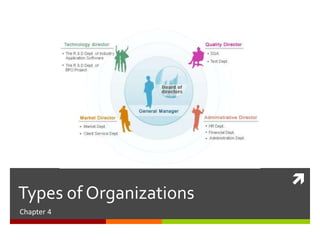
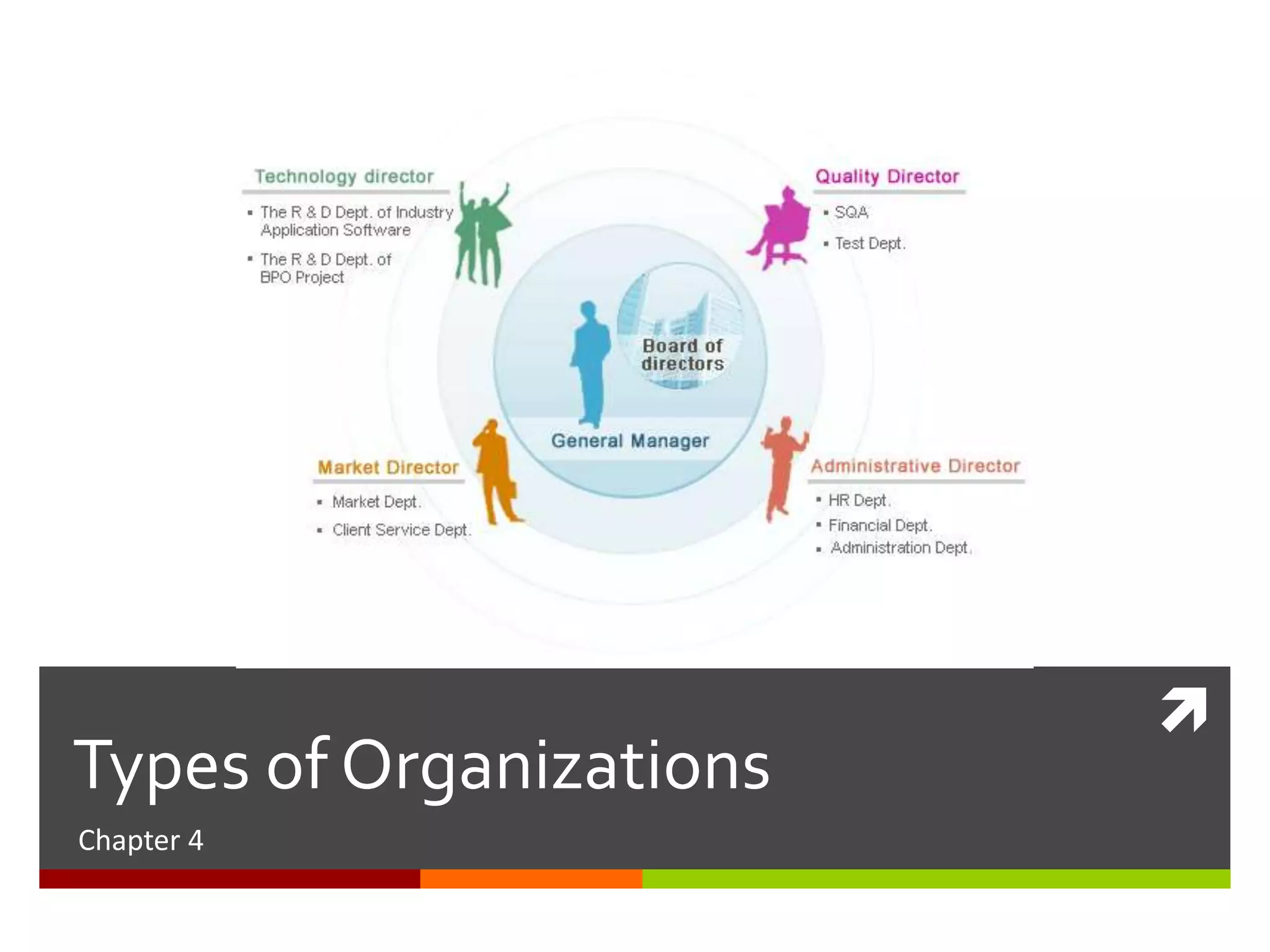
Types of OrganizationsChapter 4
1. Line Type of Organization
The Line  TypeThe superior-subordinate relationship wherein a superior delegates authority to a subordinate  who in turn delegates authority to another subordinate thus forming a line from the very top of the lowest level of the organization  structure.The simplest of the organization types.It is usually prevalent in small enterprises.Lines of authority are vertical
Line TypeLine type necessitate the highest grade of executive and requires workers to be efficient.
Advantages of the Line TypeDirectnessFixed ResponsibilityDisciplineSimplicityFlexibilityDevelopment of all-around executives at higher levels of authority.
Disadvantages of the Line TypeIt becomes difficult to secure executives , supervisors and workers with an all-round knowledge  and with the ability required.Specialization is not taken advance of.In a company considerable size , the executives are apt to be overloaded with duties and responsibilities.Too much reliance is placed on the chief and other executives.
Disadvantages of the Line TypeThe spirit of teamwork , or working toward a common goal  or end , is something lacking in a line organization
Place of the Land Type in IndustryIt does not hold an important place in a modern business; however, it is found as part of the organization of every enterprise.It permits quick , decisive action, an important factor when there is an opportunity  to be taken advantage of.
2. Functional Type of Organization
Functional TypeExperts or men trained for a particular kind of work are employed instead of all around men.In the strict functional type, we have the full application of the principle of division of labor, both mental and manual.The direct flow of authority from the head of the organization down to the workers is done away with or eliminated.
Advantages of the Functional TypeSpecialization is carried to a maximum degree.There is a greater need for specialized skills and abilities.The needed supervisors are trained for their specialized task with relatively little difficulty , thus promoting flexibility in the organization.There is simplified controlCooperation is promoted.
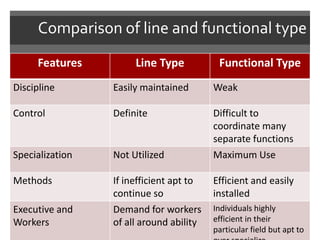
Comparison of line and functional type
Disadvantages of the Functional TypeDiscipline tends to break down among the workmen and at times even among the foremen at lower supervisory levels.When discipline is weak, moral is likely to be low.There is retarded flow of action on account of the divided control.Responsibility is theoretically fixed but in practice, buck passing becomes the rule.
3. The Line and Staff Type
Line and Staff TypeThe combination features  of both the line and the functional type.Considered as having the advantages of both and with the disadvantage of each removed or eliminated.
Advantages of the Line and Staff TypeGreater flexibilityGreater strengthSpecializationExecutive Training
Development in Organization
Functions of the AssistantsSuch work as the executive delegates to keep him (executive) informed and to advise him on any particular activity.The assistant conducts studies and investigations and makes recommendations as to the results of his studies and investigations.He confers with persons for the executive, going over their proposals  with them , presenting  his superior’s views as known to him.
Functions of CommitteesTo get the members to work as a teamTo recognize executive ability and enbale training for those who later will comprise top management.To enable the pooling together of executive abilities and experiences of the bringing together of some of the best brains of the company.To secure the unity of action upon which success in any enterprise depends.
Basic Principles of Committee Organization The organization of the committee should grow out of a need that is recognized by representative of a department and the personnel affected.The members of a committee should be representative of the function and the personnel concerned  and these members should represent variations in opinion among personnel.Duties , authorities and responsibilities must be clearly defined .The organization and operation of a committee should be a cooperative development.
Suggestions Regarding CommitteeSizeSelection of membersFrequency and duration of conferenceAdvance notices to committee members of work to be considered.The work of the committee is advisory

Chapter 4 Types Of Organization

  • 1.
  • 2.
    1. Line Typeof Organization
  • 3.
    The Line TypeThe superior-subordinate relationship wherein a superior delegates authority to a subordinate who in turn delegates authority to another subordinate thus forming a line from the very top of the lowest level of the organization structure.The simplest of the organization types.It is usually prevalent in small enterprises.Lines of authority are vertical
  • 4.
    Line TypeLine typenecessitate the highest grade of executive and requires workers to be efficient.
  • 5.
    Advantages of theLine TypeDirectnessFixed ResponsibilityDisciplineSimplicityFlexibilityDevelopment of all-around executives at higher levels of authority.
  • 6.
    Disadvantages of theLine TypeIt becomes difficult to secure executives , supervisors and workers with an all-round knowledge and with the ability required.Specialization is not taken advance of.In a company considerable size , the executives are apt to be overloaded with duties and responsibilities.Too much reliance is placed on the chief and other executives.
  • 7.
    Disadvantages of theLine TypeThe spirit of teamwork , or working toward a common goal or end , is something lacking in a line organization
  • 8.
    Place of theLand Type in IndustryIt does not hold an important place in a modern business; however, it is found as part of the organization of every enterprise.It permits quick , decisive action, an important factor when there is an opportunity to be taken advantage of.
  • 9.
    2. Functional Typeof Organization
  • 10.
    Functional TypeExperts ormen trained for a particular kind of work are employed instead of all around men.In the strict functional type, we have the full application of the principle of division of labor, both mental and manual.The direct flow of authority from the head of the organization down to the workers is done away with or eliminated.
  • 11.
    Advantages of theFunctional TypeSpecialization is carried to a maximum degree.There is a greater need for specialized skills and abilities.The needed supervisors are trained for their specialized task with relatively little difficulty , thus promoting flexibility in the organization.There is simplified controlCooperation is promoted.
  • 12.
    Comparison of lineand functional type
  • 13.
    Disadvantages of theFunctional TypeDiscipline tends to break down among the workmen and at times even among the foremen at lower supervisory levels.When discipline is weak, moral is likely to be low.There is retarded flow of action on account of the divided control.Responsibility is theoretically fixed but in practice, buck passing becomes the rule.
  • 14.
    3. The Lineand Staff Type
  • 15.
    Line and StaffTypeThe combination features of both the line and the functional type.Considered as having the advantages of both and with the disadvantage of each removed or eliminated.
  • 16.
    Advantages of theLine and Staff TypeGreater flexibilityGreater strengthSpecializationExecutive Training
  • 17.
  • 18.
    Functions of theAssistantsSuch work as the executive delegates to keep him (executive) informed and to advise him on any particular activity.The assistant conducts studies and investigations and makes recommendations as to the results of his studies and investigations.He confers with persons for the executive, going over their proposals with them , presenting his superior’s views as known to him.
  • 19.
    Functions of CommitteesToget the members to work as a teamTo recognize executive ability and enbale training for those who later will comprise top management.To enable the pooling together of executive abilities and experiences of the bringing together of some of the best brains of the company.To secure the unity of action upon which success in any enterprise depends.
  • 20.
    Basic Principles ofCommittee Organization The organization of the committee should grow out of a need that is recognized by representative of a department and the personnel affected.The members of a committee should be representative of the function and the personnel concerned and these members should represent variations in opinion among personnel.Duties , authorities and responsibilities must be clearly defined .The organization and operation of a committee should be a cooperative development.
  • 21.
    Suggestions Regarding CommitteeSizeSelectionof membersFrequency and duration of conferenceAdvance notices to committee members of work to be considered.The work of the committee is advisory