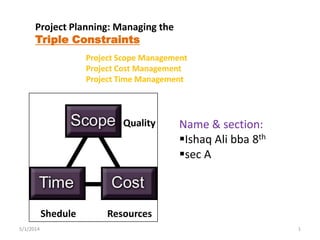
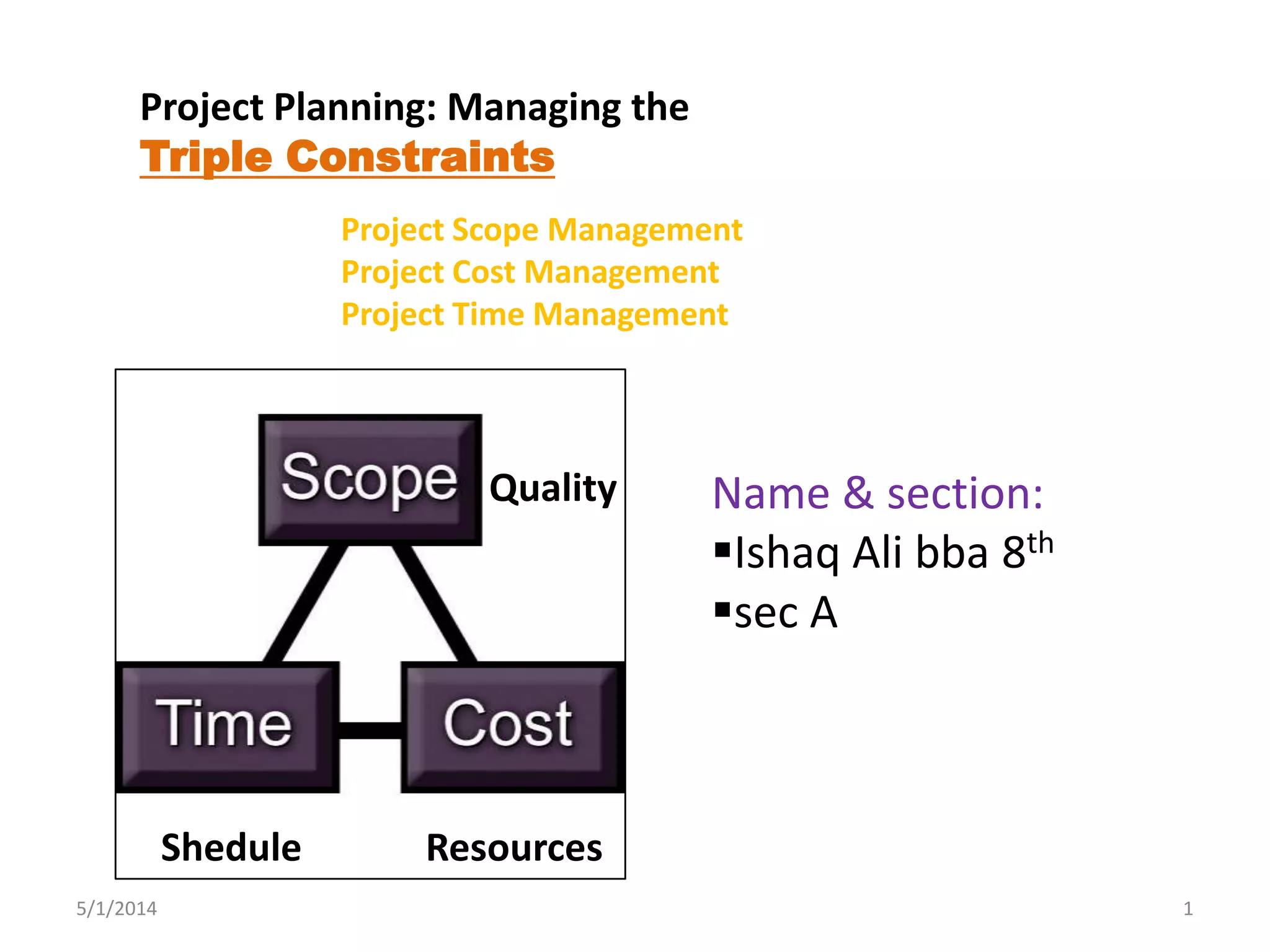
Project Scope Management
Project Cost Management
Project Time Management
Name & section:
Ishaq Ali bba 8th
sec A
5/1/2014 1
Project Planning: Managing the
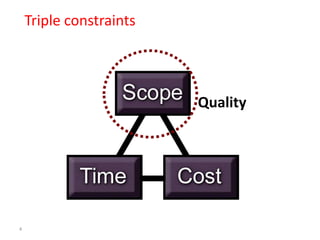
Triple Constraints
Quality
ResourcesShedule
2
Session Focus
• Summary of Scope, Time & Cost
• Review of project management terms & techniques
for controlling Scope, Time & Cost
• Tools you can use to manage Scope, Time & Cost
• Hands on introduction to the tools
3
The Project Management Knowledge Areas
• 1. Project Integration
• 2. Scope Management
• 3. Time Management
• 4. Cost Management
• 5. Quality Management
• 6. Human Resource Management
• 7. Communications Management
• 8. Risk Management
• 9. Procurement Management
4
Triple constraints
Quality
5
Project Scope management
• Defined: What is included in the project, as well as what is to be
excluded.(what the project needs to deliver),
OR
• The procecc required to ensure that the project includes all the work
required, and only the work, required to complete the project
successfully.
• i.e…project recruitment specification for achieving the end result,
• Main component of scope is quality of product,
• The overall defination of what the project is suppesed to accomplish,
• Management techniques:
• Conduct a thorough needs analysis
• Define what’s in and what’s out
• Clearly identify the projects goal, objectives and main drivers
• Checking to ensure the one is completing work
• Saying No o additional work not in the charter
• Preventing extra work
6
Project Scope Management Tools & Techniques:
• Scope Overview: Project Overview Statement summarizing the
Project, Goal, Objectives, Success criteria, Assumptions, Risks and Obstacles
• Scope Planning-Create a project scope management plan documenting how the
project scope will be defined, verified, controlled, and how the work breakdown
structure will be created and defined.
• Scope Definition-Develop a detailed project scope statement as the basis for
project decisions
• Creation of a Work Breakdown Structure (WBS)-Subdivide the major project
deliverables and project work into smaller, more manageable components
• Scope Verification-formalizing acceptance of the completed project deliverables
• Scope Control-controlling changes to the project scope
7
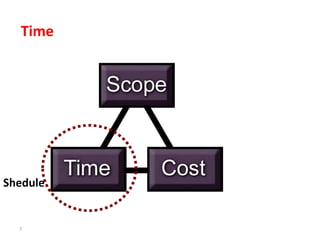
Time
Shedule
8
Time management
• Defined: A mechanism to ensure the project is completed on
time, within the resources available, and avoids delays and
associated cost overruns .
Project Time Management Techniques:
• Activity Definition
• Activity Sequencing
• Activity Resource Estimating
• Activity Duration Estimating
• Schedule Development
• Schedule Control
“For explanation see next slides”
9
Activity Definition
• The Activity Definition process identifies deliverables at the
lowest level (work package) in the work breakdown structure.
• Work packages are further broken down to provide a basis for
estimating, scheduling, executing, and monitoring and
controlling the project work.
10
Activity Sequencing
• Activity sequencing involves identifying & documenting the
relationships among schedule activities
• Network Diagram: Schematic displays of the project’s
schedule and the logical relationship among them.
11
Activity Resource Estimating
• Determining what resources (people, equipment or material)
will be needed, when and how much.
• Tools & Techniques:
• Professional judgment
• Alternatives analysis
• Published estimating data
• Project Management software
• Bottom-up Estimating
12
Activity Duration Estimating
• Tools & Techniques
• Expert judgment
• Analogous estimating
• Parametric estimating
• Three-point estimates
• Reserve analysis
13
Schedule Development
• Determines the planned start and finish dates for the project activities.
• Schedule estimates can require that time and resource estimates are
reviewed to create a project schedule that can serve as a baseline tracking
tool.
• Tools & Techniques:
• Schedule network analysis
• Critical path method calculates the possible start and end
dates for project activities and the project overall.
14
Schedule control
• Tools & Techniques
• Progress reporting
• Schedule change control system
• Performance measurement to produce the schedule variance
• PM software
• Variance analysis
• Schedule comparison bar charts-comparison of planned vs.
actual schedules
15
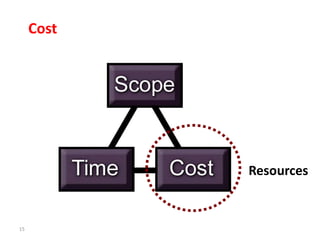
Cost
Resources
16
Cost
• Defined: The cost of all resources required to
perform and complete incremental tasks and the
overall project
• Management techniques:
• Gather internal and external costs.
• Look to vendor references
• Estimate recurring costs
• Usually 15%+ of initial hardware/software cost
17
Project Cost Management Techniques
• Cost Estimating
• Cost Budgeting
• Cost Control
“For explanation see next slides”
18
Cost Estimating
• Developing an approximate cost of the resources needed to
complete the project
• Tools & Techniques:
• Analogous Estimating: Based on similar projects
• Bottom-up Estimating: Costs at lowest level are ‘rolled up’ for reporting
and tracking
• Parametric Estimating: Base on statistical information
• PM software
• Vendor Bid Analysis
19
Cost Budgeting
• Defined: Total the estimated costs of different work packages
to establish a baseline for measuring project performance.
• Tools & Techniques:
• Cost Aggregation: Scheduled activity cost estimates are totaled in
accordance with the WBS.
• Parametric estimating: Using mathematic models to predict costs.
• Reserve Analysis: Establishes contingency reserves
• Funding Limit Reconciliation: Work scheduled to limit expenditures
20
Cost control
• Cost change control system
• Performance measurement analysis
• Forecasting
• Project performance reviews
• Project Management software
• Variance management
21
Thank you

Presintation on Project constraint

  • 1.
    Project Scope Management ProjectCost Management Project Time Management Name & section: Ishaq Ali bba 8th sec A 5/1/2014 1 Project Planning: Managing the Triple Constraints Quality ResourcesShedule
  • 2.
    2 Session Focus • Summaryof Scope, Time & Cost • Review of project management terms & techniques for controlling Scope, Time & Cost • Tools you can use to manage Scope, Time & Cost • Hands on introduction to the tools
  • 3.
    3 The Project ManagementKnowledge Areas • 1. Project Integration • 2. Scope Management • 3. Time Management • 4. Cost Management • 5. Quality Management • 6. Human Resource Management • 7. Communications Management • 8. Risk Management • 9. Procurement Management
  • 4.
  • 5.
    5 Project Scope management •Defined: What is included in the project, as well as what is to be excluded.(what the project needs to deliver), OR • The procecc required to ensure that the project includes all the work required, and only the work, required to complete the project successfully. • i.e…project recruitment specification for achieving the end result, • Main component of scope is quality of product, • The overall defination of what the project is suppesed to accomplish, • Management techniques: • Conduct a thorough needs analysis • Define what’s in and what’s out • Clearly identify the projects goal, objectives and main drivers • Checking to ensure the one is completing work • Saying No o additional work not in the charter • Preventing extra work
  • 6.
    6 Project Scope ManagementTools & Techniques: • Scope Overview: Project Overview Statement summarizing the Project, Goal, Objectives, Success criteria, Assumptions, Risks and Obstacles • Scope Planning-Create a project scope management plan documenting how the project scope will be defined, verified, controlled, and how the work breakdown structure will be created and defined. • Scope Definition-Develop a detailed project scope statement as the basis for project decisions • Creation of a Work Breakdown Structure (WBS)-Subdivide the major project deliverables and project work into smaller, more manageable components • Scope Verification-formalizing acceptance of the completed project deliverables • Scope Control-controlling changes to the project scope
  • 7.
  • 8.
    8 Time management • Defined:A mechanism to ensure the project is completed on time, within the resources available, and avoids delays and associated cost overruns . Project Time Management Techniques: • Activity Definition • Activity Sequencing • Activity Resource Estimating • Activity Duration Estimating • Schedule Development • Schedule Control “For explanation see next slides”
  • 9.
    9 Activity Definition • TheActivity Definition process identifies deliverables at the lowest level (work package) in the work breakdown structure. • Work packages are further broken down to provide a basis for estimating, scheduling, executing, and monitoring and controlling the project work.
  • 10.
    10 Activity Sequencing • Activitysequencing involves identifying & documenting the relationships among schedule activities • Network Diagram: Schematic displays of the project’s schedule and the logical relationship among them.
  • 11.
    11 Activity Resource Estimating •Determining what resources (people, equipment or material) will be needed, when and how much. • Tools & Techniques: • Professional judgment • Alternatives analysis • Published estimating data • Project Management software • Bottom-up Estimating
  • 12.
    12 Activity Duration Estimating •Tools & Techniques • Expert judgment • Analogous estimating • Parametric estimating • Three-point estimates • Reserve analysis
  • 13.
    13 Schedule Development • Determinesthe planned start and finish dates for the project activities. • Schedule estimates can require that time and resource estimates are reviewed to create a project schedule that can serve as a baseline tracking tool. • Tools & Techniques: • Schedule network analysis • Critical path method calculates the possible start and end dates for project activities and the project overall.
  • 14.
    14 Schedule control • Tools& Techniques • Progress reporting • Schedule change control system • Performance measurement to produce the schedule variance • PM software • Variance analysis • Schedule comparison bar charts-comparison of planned vs. actual schedules
  • 15.
  • 16.
    16 Cost • Defined: Thecost of all resources required to perform and complete incremental tasks and the overall project • Management techniques: • Gather internal and external costs. • Look to vendor references • Estimate recurring costs • Usually 15%+ of initial hardware/software cost
  • 17.
    17 Project Cost ManagementTechniques • Cost Estimating • Cost Budgeting • Cost Control “For explanation see next slides”
  • 18.
    18 Cost Estimating • Developingan approximate cost of the resources needed to complete the project • Tools & Techniques: • Analogous Estimating: Based on similar projects • Bottom-up Estimating: Costs at lowest level are ‘rolled up’ for reporting and tracking • Parametric Estimating: Base on statistical information • PM software • Vendor Bid Analysis
  • 19.
    19 Cost Budgeting • Defined:Total the estimated costs of different work packages to establish a baseline for measuring project performance. • Tools & Techniques: • Cost Aggregation: Scheduled activity cost estimates are totaled in accordance with the WBS. • Parametric estimating: Using mathematic models to predict costs. • Reserve Analysis: Establishes contingency reserves • Funding Limit Reconciliation: Work scheduled to limit expenditures
  • 20.
    20 Cost control • Costchange control system • Performance measurement analysis • Forecasting • Project performance reviews • Project Management software • Variance management
  • 21.