Role of Managers
Dr. G C Mohanta, BE, MSc(Engg), MBA, PhD(Mgt)
Professor
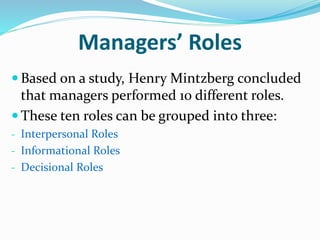
Managers’ Roles
 Based on a study, Henry Mintzberg concluded
that managers performed 10 different roles.
 These ten roles can be grouped into three:
- Interpersonal Roles
- Informational Roles
- Decisional Roles
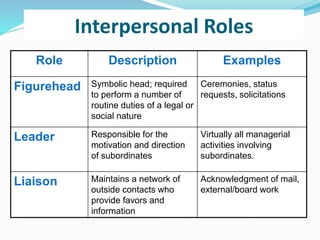
Interpersonal Roles
Role Description Examples
Figurehead Symbolic head; required
to perform a number of
routine duties of a legal or
social nature
Ceremonies, status
requests, solicitations
Leader Responsible for the
motivation and direction
of subordinates
Virtually all managerial
activities involving
subordinates.
Liaison Maintains a network of
outside contacts who
provide favors and
information
Acknowledgment of mail,
external/board work
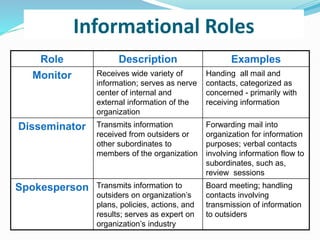
Informational Roles
Role Description Examples
Monitor Receives wide variety of
information; serves as nerve
center of internal and
external information of the
organization
Handing all mail and
contacts, categorized as
concerned - primarily with
receiving information
Disseminator Transmits information
received from outsiders or
other subordinates to
members of the organization
Forwarding mail into
organization for information
purposes; verbal contacts
involving information flow to
subordinates, such as,
review sessions
Spokesperson Transmits information to
outsiders on organization’s
plans, policies, actions, and
results; serves as expert on
organization’s industry
Board meeting; handling
contacts involving
transmission of information
to outsiders
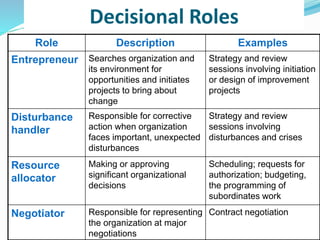
Decisional Roles
Role Description Examples
Entrepreneur Searches organization and
its environment for
opportunities and initiates
projects to bring about
change
Strategy and review
sessions involving initiation
or design of improvement
projects
Disturbance
handler
Responsible for corrective
action when organization
faces important, unexpected
disturbances
Strategy and review
sessions involving
disturbances and crises
Resource
allocator
Making or approving
significant organizational
decisions
Scheduling; requests for
authorization; budgeting,
the programming of
subordinates work
Negotiator Responsible for representing
the organization at major
negotiations
Contract negotiation

Role of managers

  • 1.
    Role of Managers Dr.G C Mohanta, BE, MSc(Engg), MBA, PhD(Mgt) Professor
  • 2.
    Managers’ Roles  Basedon a study, Henry Mintzberg concluded that managers performed 10 different roles.  These ten roles can be grouped into three: - Interpersonal Roles - Informational Roles - Decisional Roles
  • 3.
    Interpersonal Roles Role DescriptionExamples Figurehead Symbolic head; required to perform a number of routine duties of a legal or social nature Ceremonies, status requests, solicitations Leader Responsible for the motivation and direction of subordinates Virtually all managerial activities involving subordinates. Liaison Maintains a network of outside contacts who provide favors and information Acknowledgment of mail, external/board work
  • 4.
    Informational Roles Role DescriptionExamples Monitor Receives wide variety of information; serves as nerve center of internal and external information of the organization Handing all mail and contacts, categorized as concerned - primarily with receiving information Disseminator Transmits information received from outsiders or other subordinates to members of the organization Forwarding mail into organization for information purposes; verbal contacts involving information flow to subordinates, such as, review sessions Spokesperson Transmits information to outsiders on organization’s plans, policies, actions, and results; serves as expert on organization’s industry Board meeting; handling contacts involving transmission of information to outsiders
  • 5.
    Decisional Roles Role DescriptionExamples Entrepreneur Searches organization and its environment for opportunities and initiates projects to bring about change Strategy and review sessions involving initiation or design of improvement projects Disturbance handler Responsible for corrective action when organization faces important, unexpected disturbances Strategy and review sessions involving disturbances and crises Resource allocator Making or approving significant organizational decisions Scheduling; requests for authorization; budgeting, the programming of subordinates work Negotiator Responsible for representing the organization at major negotiations Contract negotiation