Historical roots of
contemporary management
Presented by : Ritu jain
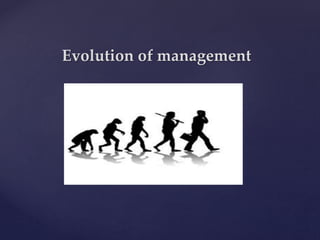
Evolution of management
Objective of the presentation
 Historical background
 Pre scientific management
 Early management
 Adam smiths contribution
 Industrial revolution
 Management theories
 Classical approach
 Neo classical approach
 Modern approach
Pre scientific management era
Robert Owen (1771-1858) : Proposed legislative reforms
to improve working conditions of labor.
Charles Babbage (1792-1871) : perceived that the
methods of science and mathematics could be applied to
operations of factories.
Andrew Ure (1778-1857) and Charles Duplin (1784-1873)
: Advocated the study of management.
Henry Robinson (1844-1924) : Emphasized the need to
consider management as separated field of study and
the importance of business skills for running a business.
James Watt (1796-1848) and Mathew Robinson (1770-1842) :
They were the sons of the distinguished inventor of the
steam engine. They applied a number of management
techniques in their Engineering Factory at Soho.
Captain Henry Metcalfe (1847-1917) : Metcalfe suggested
"new systems control“.
Metcalfe suggested a system of cards. Under this system
managers prepare two type of cards, i.e., time cards and
material cards.
(COUNT…..)
 Chanakya also known as kautilya and vishnugupta
 Mohenjo daro and harappa.
 Ancient Greece.
 Organization of the roman catholic church.
 Organization of military forces.
 Egyptian pyramids, babylonians empire.
 Chinese philosophers-selection and staffing.
 Rome-crafting and trading.
EARLY MANAGEMENT
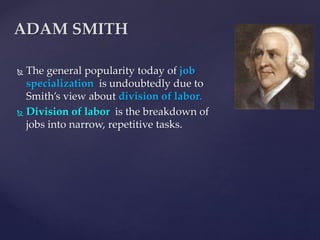
 The general popularity today of job
specialization is undoubtedly due to
Smith’s view about division of labor.
 Division of labor is the breakdown of
jobs into narrow, repetitive tasks.
ADAM SMITH
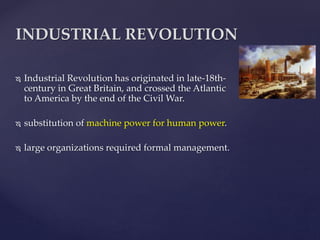
 Industrial Revolution has originated in late-18th-
century in Great Britain, and crossed the Atlantic
to America by the end of the Civil War.
 substitution of machine power for human power.
 large organizations required formal management.
INDUSTRIAL REVOLUTION
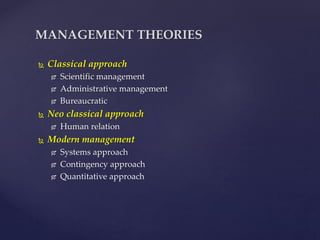
MANAGEMENT THEORIES
 Classical approach
 Scientific management
 Administrative management
 Bureaucratic
 Neo classical approach
 Human relation
 Modern management
 Systems approach
 Contingency approach
 Quantitative approach
• Focuses on machine and worker relationship.
• Increases efficiency of product processes.
Major contributors:
 F.W.Taylor (1911)- principles of scientific mgmt.
 Frank and Lillian Gillbreth (1912-1924)- Time and
motion studies.
 Henry Gantt (1910-1915)- project scheduling , the
Gantt chart.
SCIENTIFIC MANAGEMENT
 It focused on principles that could be used by managers to
coordinate the internal activities of organizations.
 Henri Fayol (1841-1925)
 Managers need specific roles in order to manage work and
workers.
 Concerned with making the overall organization more
effective.
 Developed theories of what constituted good management
practice.
 proposed a universal set of management functions.
 Published 14 principles of management.
ADMINISTARTIVE APPROACH
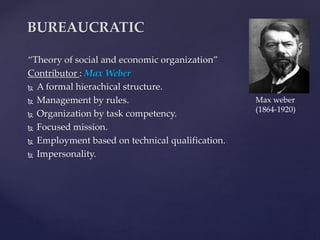
“Theory of social and economic organization”
Contributor : Max Weber
 A formal hierachical structure.
 Management by rules.
 Organization by task competency.
 Focused mission.
 Employment based on technical qualification.
 Impersonality.
BUREAUCRATIC
Max weber
(1864-1920)
 emphasized individual attitudes and behaviors and group
processes, and recognized the significance of behavioral process
in the workplace.
contributions:
 The hawthrone studies (1924)
 Mary parker (1868-1913) - psychological foundation of business
administration, power sharing and integration.
 Elton mayo (1868-1933) - foundation for the human relation
movement.
 Douglas m - theory x and theory y
NEO CLASSICAL-BEHAVIROL APPROACH
 Developed in the military during the world war II.
 It includes the application of statistics, optimization models,
information models and computer simulations.
 Basically 3 quantitative approaches:
 Management science approach- stresses the use of mathematical
models and statistical methods in decision making.
 Operations management- production process and delivery.
 Management information systems- designing and
implementing computer based info. System.
QUANTITATIVE APPROACH
 Developed in late 1960’s
 The system approach defines a system as a set of
interrelated and interdependent parts arranged in
a manner that produces a unified whole.
 Organization as a system receives input , transform it
through a process for output.
SYSTEMS APPROACH
 Assumes there is no one best way to manage.
The environment impacts the organization and
managers must be flexible to react to
environmental changes.
The way the organization is designed & control
systems selected, depend on the environment.
 Technological environments change rapidly, so must
managers.
CONTINGENCY APPROACH
Successful organizations don’t just
happen……
….they are managed to
be that way!!!!

evolution of management

  • 1.
    Historical roots of contemporarymanagement Presented by : Ritu jain
  • 2.
  • 3.
    Objective of thepresentation  Historical background  Pre scientific management  Early management  Adam smiths contribution  Industrial revolution  Management theories  Classical approach  Neo classical approach  Modern approach
  • 4.
    Pre scientific managementera Robert Owen (1771-1858) : Proposed legislative reforms to improve working conditions of labor. Charles Babbage (1792-1871) : perceived that the methods of science and mathematics could be applied to operations of factories. Andrew Ure (1778-1857) and Charles Duplin (1784-1873) : Advocated the study of management. Henry Robinson (1844-1924) : Emphasized the need to consider management as separated field of study and the importance of business skills for running a business.
  • 5.
    James Watt (1796-1848)and Mathew Robinson (1770-1842) : They were the sons of the distinguished inventor of the steam engine. They applied a number of management techniques in their Engineering Factory at Soho. Captain Henry Metcalfe (1847-1917) : Metcalfe suggested "new systems control“. Metcalfe suggested a system of cards. Under this system managers prepare two type of cards, i.e., time cards and material cards. (COUNT…..)
  • 6.
     Chanakya alsoknown as kautilya and vishnugupta  Mohenjo daro and harappa.  Ancient Greece.  Organization of the roman catholic church.  Organization of military forces.  Egyptian pyramids, babylonians empire.  Chinese philosophers-selection and staffing.  Rome-crafting and trading. EARLY MANAGEMENT
  • 7.
     The generalpopularity today of job specialization is undoubtedly due to Smith’s view about division of labor.  Division of labor is the breakdown of jobs into narrow, repetitive tasks. ADAM SMITH
  • 8.
     Industrial Revolutionhas originated in late-18th- century in Great Britain, and crossed the Atlantic to America by the end of the Civil War.  substitution of machine power for human power.  large organizations required formal management. INDUSTRIAL REVOLUTION
  • 9.
    MANAGEMENT THEORIES  Classicalapproach  Scientific management  Administrative management  Bureaucratic  Neo classical approach  Human relation  Modern management  Systems approach  Contingency approach  Quantitative approach
  • 10.
    • Focuses onmachine and worker relationship. • Increases efficiency of product processes. Major contributors:  F.W.Taylor (1911)- principles of scientific mgmt.  Frank and Lillian Gillbreth (1912-1924)- Time and motion studies.  Henry Gantt (1910-1915)- project scheduling , the Gantt chart. SCIENTIFIC MANAGEMENT
  • 11.
     It focusedon principles that could be used by managers to coordinate the internal activities of organizations.  Henri Fayol (1841-1925)  Managers need specific roles in order to manage work and workers.  Concerned with making the overall organization more effective.  Developed theories of what constituted good management practice.  proposed a universal set of management functions.  Published 14 principles of management. ADMINISTARTIVE APPROACH
  • 12.
    “Theory of socialand economic organization” Contributor : Max Weber  A formal hierachical structure.  Management by rules.  Organization by task competency.  Focused mission.  Employment based on technical qualification.  Impersonality. BUREAUCRATIC Max weber (1864-1920)
  • 13.
     emphasized individualattitudes and behaviors and group processes, and recognized the significance of behavioral process in the workplace. contributions:  The hawthrone studies (1924)  Mary parker (1868-1913) - psychological foundation of business administration, power sharing and integration.  Elton mayo (1868-1933) - foundation for the human relation movement.  Douglas m - theory x and theory y NEO CLASSICAL-BEHAVIROL APPROACH
  • 14.
     Developed inthe military during the world war II.  It includes the application of statistics, optimization models, information models and computer simulations.  Basically 3 quantitative approaches:  Management science approach- stresses the use of mathematical models and statistical methods in decision making.  Operations management- production process and delivery.  Management information systems- designing and implementing computer based info. System. QUANTITATIVE APPROACH
  • 15.
     Developed inlate 1960’s  The system approach defines a system as a set of interrelated and interdependent parts arranged in a manner that produces a unified whole.  Organization as a system receives input , transform it through a process for output. SYSTEMS APPROACH
  • 16.
     Assumes thereis no one best way to manage. The environment impacts the organization and managers must be flexible to react to environmental changes. The way the organization is designed & control systems selected, depend on the environment.  Technological environments change rapidly, so must managers. CONTINGENCY APPROACH
  • 17.
    Successful organizations don’tjust happen…… ….they are managed to be that way!!!!