Advantages of Manuals
1. Writing all –important decisions relating to
   internal organisation.
2. Avoids conflicts and overlapping of authority.
3. Enables employees know the various
   procedure and practice in the shortest possible
   time.
4. Enables quick decision.
5. Contains rules and regulations which
   employees must follow.
Disadvantages of Manual
1) Preparation is costly and time consuming and
   process
2) Little scope for individual’s initiative and
   direction.
3) Bring rigidity to the organisation.
4) Put on record those relationships which no
   one like to see exposed.
Forms of Organisation
1.   Line Organisation
2.   Line and Staff Organisation
3.   Functional Organisation
4.   Committee Organisation
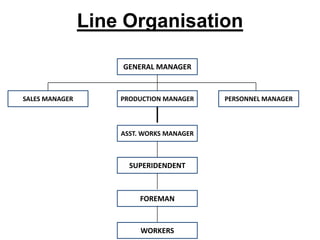
Line Organisation

                    GENERAL MANAGER


SALES MANAGER       PRODUCTION MANAGER    PERSONNEL MANAGER


                    ASST. WORKS MANAGER


                      SUPERIDENDENT


                         FOREMAN


                         WORKERS
ADVANTAGES OF LINE ORGANISATION
1) Easiest to establish and Simple to explain.

2) Fixes responsibility for the performance.

3) Clear cut identification of authority and responsibility.

4) Economical and effective.

5) Unity of control

6) Excellent discipline in the enterprise.

7) Facilitates prompt decision-making.

8) Effective coordination of activities within each dept.
DISADVANTAGES OF LINE ORGANISATION
1) With growth, superiors will get overloaded.
2) Autocratic system it is dictatorial.
3) Limited communication as orders are followed.
4) Nepotism and favouritism.
5) Lack of specialised skill of experts. Compared to
   modern business.
6) Rigid and inflexible.
7) Concentration of authority is at the top.
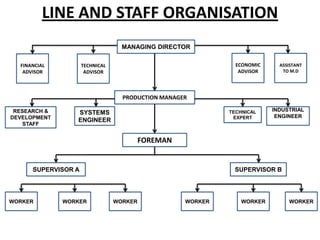
LINE AND STAFF ORGANISATION
                                   MANAGING DIRECTOR

  FINANCIAL          TECHNICAL                                 ECONOMIC     ASSISTANT
   ADVISOR            ADVISOR                                   ADVISOR      TO M.D


                                   PRODUCTION MANAGER

 RESEARCH &                                                               INDUSTRIAL
                 SYSTEMS                                     TECHNICAL
DEVELOPMENT                                                   EXPERT       ENGINEER
                 ENGINEER
    STAFF


                                       FOREMAN


      SUPERVISOR A                                            SUPERVISOR B


WORKER        WORKER             WORKER             WORKER       WORKER        WORKER
FEATURES OF LINE AND STAFF SYSTEM
1. Line officers command over authority over the
   subordinates and are accountable for tasks
   entrusted to them.

2. Staff officers prepare plan and give advice to
   the line officers.

3. Based on Principle of Specilasation.
MERITS OF LINE & STAFF ORGANISATION
1. EXPERT KNOWLEDGE
2. EXPERT ADVICE AND GUIDANCE
3. STAFF OFFICERS TAKE IMPORTANT ROLE
4. STAFF SPECILAIST HELP LINE MANAGERS BETTER
   DECISIONS
5. PERMITS UNDIVIDED REPONSIBILITY AND
   AUTHORITY & STAFF SPECIALISATION.
6. GREATER FLEXIBILITY
DEMERITS OF LINE AND STAFF ORGANISATION
1. Unless clear indication of duties and responsibilities
   It can create confusion.
2. Generally conflict between line and staff executives.
3. Line managers may resent activities of staff
   members.
4. Staff experts may be ineffective.
5. Large number of staff executives in addition to
   officers becomes expensive for organisation.
6. Staff managers not accountable for results, may not
   perform.
7. Line Manager more practical than Staff Manager
   more theoretical approach.
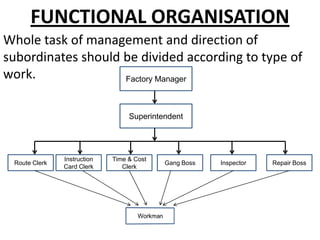
FUNCTIONAL ORGANISATION
Whole task of management and direction of
subordinates should be divided according to type of
work.               Factory Manager


                                  Superintendent


               Instruction   Time & Cost
 Route Clerk                               Gang Boss   Inspector   Repair Boss
               Card Clerk       Clerk
Features of Functional Organisation
1. Work divided into different functional dept.’s
2. Functional specialist right to give orders and has
   authority.
3. Workers receive instructions from different
   specialists.
4. Anybody to take decision after consulting with
   functional specialist.
5. Workers have to perform limited number of
   functions.
Advantages of Functional Organisation
1. Based on expert knowledge
2. Division of labour is planned.
3. No scope for one-man control.
4. Ensures separation of mental and manual
   functions.
5. Joint supervision of organisation reduces
   burden top exec.
6. Greater scope of expansion.
7. Better control and supervision of
   organisation.
Disadvantages of Functional Organisation
1. Unstable – workers work under
   different bosses.
2. Foreman of equal rank.
3. Coordinating influence needed to
   ensure smooth functioning.
4. Inability to locate and fix responsibility
   affects discipline and morale of
   workers.
5. Very costly system as large number of
   specialists to be appointed.
COMMITTEE ORGANISATION
According to Hicks, “A committee is a group of people
  who meet by plan to discuss or make a decision for
  a particular subject.”
Objectives of Committees
1. Consultations with various persons to secure their
   view-points.
2. To give participation to various groups.
3. To secure cooperation of different departments.
4. To coordinate the functioning of different dept.’s
   and individuals.
Types of Committees
1. Line Committee :- vested with authority and
   responsibility to decide whose decision implemented.
2. Staff Committee:- merely for counsel and advice.
3. Formal committee:- clear-cut jurisdiction as part of
   orgn.
4. Informal committee:-formed to advice on certain
   matters
5. Coordinating committee:-coordinate among dept.’s
6. Executive committee:-power to administer
7. Standing committee:-permanent character
8. Ad hoc committee:-temporary bodies
ADVANTAGES OF COMMITTEE ORGN.
1. Brings collective knowledge and experience for
   solving problems.
2. Offer scope for group deliberations and group
   judgment.
3. Brings coordination – integrates varying points of
   view.
4. Motivates employees for performance as they
   have a say in orgn.
5. Facilitates pooling of authority for making
   decisions.
6. Promotes organisation cohesiveness.
Disadvantages of Committee Orgn.
1. Manager can misuse or avoid decision-making by approaching
   committee.
2. Unable to take decision due to conflicting views.
3. Take more time in procedural matters.
4. Expensive device in terms of cost and time.
5. Committee findings represent compromise of different
   viewpoints.
6. No member of committee can be held individually responsible
   for wrong decisions.
7. Difficult to maintain secrecy.
ORGANISATION CULTURE
It is a system of shared beliefs and attitudes that
develop within an organisation and guides the
behaviour of its members.

An employee must learn how the particular
enterprise does things.
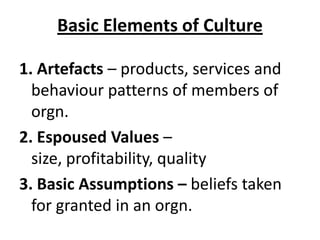
Basic Elements of Culture

1. Artefacts – products, services and
  behaviour patterns of members of
  orgn.
2. Espoused Values –
  size, profitability, quality
3. Basic Assumptions – beliefs taken
  for granted in an orgn.
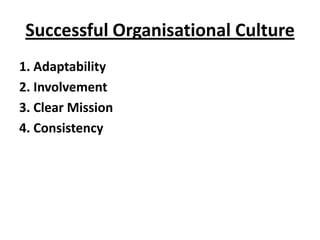
Successful Organisational Culture
1. Adaptability
2. Involvement
3. Clear Mission
4. Consistency

Unit ii - manuals, organisation, motivation

  • 1.
    Advantages of Manuals 1.Writing all –important decisions relating to internal organisation. 2. Avoids conflicts and overlapping of authority. 3. Enables employees know the various procedure and practice in the shortest possible time. 4. Enables quick decision. 5. Contains rules and regulations which employees must follow.
  • 2.
    Disadvantages of Manual 1)Preparation is costly and time consuming and process 2) Little scope for individual’s initiative and direction. 3) Bring rigidity to the organisation. 4) Put on record those relationships which no one like to see exposed.
  • 3.
    Forms of Organisation 1. Line Organisation 2. Line and Staff Organisation 3. Functional Organisation 4. Committee Organisation
  • 4.
    Line Organisation GENERAL MANAGER SALES MANAGER PRODUCTION MANAGER PERSONNEL MANAGER ASST. WORKS MANAGER SUPERIDENDENT FOREMAN WORKERS
  • 5.
    ADVANTAGES OF LINEORGANISATION 1) Easiest to establish and Simple to explain. 2) Fixes responsibility for the performance. 3) Clear cut identification of authority and responsibility. 4) Economical and effective. 5) Unity of control 6) Excellent discipline in the enterprise. 7) Facilitates prompt decision-making. 8) Effective coordination of activities within each dept.
  • 6.
    DISADVANTAGES OF LINEORGANISATION 1) With growth, superiors will get overloaded. 2) Autocratic system it is dictatorial. 3) Limited communication as orders are followed. 4) Nepotism and favouritism. 5) Lack of specialised skill of experts. Compared to modern business. 6) Rigid and inflexible. 7) Concentration of authority is at the top.
  • 7.
    LINE AND STAFFORGANISATION MANAGING DIRECTOR FINANCIAL TECHNICAL ECONOMIC ASSISTANT ADVISOR ADVISOR ADVISOR TO M.D PRODUCTION MANAGER RESEARCH & INDUSTRIAL SYSTEMS TECHNICAL DEVELOPMENT EXPERT ENGINEER ENGINEER STAFF FOREMAN SUPERVISOR A SUPERVISOR B WORKER WORKER WORKER WORKER WORKER WORKER
  • 8.
    FEATURES OF LINEAND STAFF SYSTEM 1. Line officers command over authority over the subordinates and are accountable for tasks entrusted to them. 2. Staff officers prepare plan and give advice to the line officers. 3. Based on Principle of Specilasation.
  • 9.
    MERITS OF LINE& STAFF ORGANISATION 1. EXPERT KNOWLEDGE 2. EXPERT ADVICE AND GUIDANCE 3. STAFF OFFICERS TAKE IMPORTANT ROLE 4. STAFF SPECILAIST HELP LINE MANAGERS BETTER DECISIONS 5. PERMITS UNDIVIDED REPONSIBILITY AND AUTHORITY & STAFF SPECIALISATION. 6. GREATER FLEXIBILITY
  • 10.
    DEMERITS OF LINEAND STAFF ORGANISATION 1. Unless clear indication of duties and responsibilities It can create confusion. 2. Generally conflict between line and staff executives. 3. Line managers may resent activities of staff members. 4. Staff experts may be ineffective. 5. Large number of staff executives in addition to officers becomes expensive for organisation. 6. Staff managers not accountable for results, may not perform. 7. Line Manager more practical than Staff Manager more theoretical approach.
  • 11.
    FUNCTIONAL ORGANISATION Whole taskof management and direction of subordinates should be divided according to type of work. Factory Manager Superintendent Instruction Time & Cost Route Clerk Gang Boss Inspector Repair Boss Card Clerk Clerk
  • 12.
    Features of FunctionalOrganisation 1. Work divided into different functional dept.’s 2. Functional specialist right to give orders and has authority. 3. Workers receive instructions from different specialists. 4. Anybody to take decision after consulting with functional specialist. 5. Workers have to perform limited number of functions.
  • 13.
    Advantages of FunctionalOrganisation 1. Based on expert knowledge 2. Division of labour is planned. 3. No scope for one-man control. 4. Ensures separation of mental and manual functions. 5. Joint supervision of organisation reduces burden top exec. 6. Greater scope of expansion. 7. Better control and supervision of organisation.
  • 14.
    Disadvantages of FunctionalOrganisation 1. Unstable – workers work under different bosses. 2. Foreman of equal rank. 3. Coordinating influence needed to ensure smooth functioning. 4. Inability to locate and fix responsibility affects discipline and morale of workers. 5. Very costly system as large number of specialists to be appointed.
  • 15.
    COMMITTEE ORGANISATION According toHicks, “A committee is a group of people who meet by plan to discuss or make a decision for a particular subject.” Objectives of Committees 1. Consultations with various persons to secure their view-points. 2. To give participation to various groups. 3. To secure cooperation of different departments. 4. To coordinate the functioning of different dept.’s and individuals.
  • 16.
    Types of Committees 1.Line Committee :- vested with authority and responsibility to decide whose decision implemented. 2. Staff Committee:- merely for counsel and advice. 3. Formal committee:- clear-cut jurisdiction as part of orgn. 4. Informal committee:-formed to advice on certain matters 5. Coordinating committee:-coordinate among dept.’s 6. Executive committee:-power to administer 7. Standing committee:-permanent character 8. Ad hoc committee:-temporary bodies
  • 17.
    ADVANTAGES OF COMMITTEEORGN. 1. Brings collective knowledge and experience for solving problems. 2. Offer scope for group deliberations and group judgment. 3. Brings coordination – integrates varying points of view. 4. Motivates employees for performance as they have a say in orgn. 5. Facilitates pooling of authority for making decisions. 6. Promotes organisation cohesiveness.
  • 18.
    Disadvantages of CommitteeOrgn. 1. Manager can misuse or avoid decision-making by approaching committee. 2. Unable to take decision due to conflicting views. 3. Take more time in procedural matters. 4. Expensive device in terms of cost and time. 5. Committee findings represent compromise of different viewpoints. 6. No member of committee can be held individually responsible for wrong decisions. 7. Difficult to maintain secrecy.
  • 19.
    ORGANISATION CULTURE It isa system of shared beliefs and attitudes that develop within an organisation and guides the behaviour of its members. An employee must learn how the particular enterprise does things.
  • 20.
    Basic Elements ofCulture 1. Artefacts – products, services and behaviour patterns of members of orgn. 2. Espoused Values – size, profitability, quality 3. Basic Assumptions – beliefs taken for granted in an orgn.
  • 21.
    Successful Organisational Culture 1.Adaptability 2. Involvement 3. Clear Mission 4. Consistency