

4 Chapter Four
Promotions Opportunity
Analysis
Prof. (Dr.) Kao Kveng Hong, Ph.D., D.Litt.
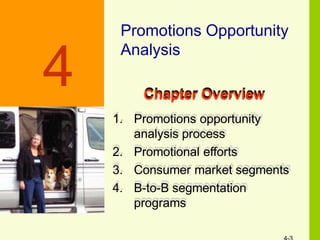
PetsMart
Pets are now part of the family.
Discussion Slide
4
• Attitudes have changed.
• New animal care products.
• New animal care services.
• Prices are secondary.
Why the Change?
Chapter Overview
1. Promotions opportunity
analysis process
2. Promotional efforts
3. Consumer market segments
4. B-to-B segmentation
programs
Promotions Opportunity
Analysis
4
1) Conduct communications marketing analysis.
2) Establish communication objectives.
3) Create communications budget.
4) Prepare promotional strategies.
5) Match tactics with strategies.
F I G U R E 4 . 1
Steps in a Promotion Opportunity Analysis
Promotions Opportunity Analysis
Step 1
Conduct a Communication Market Analysis
• Competitors
• Opportunities
• Target markets
• Customers
• Product positioning
Competitors
• Identify major competitors.
• Identify communication strategies
and tactics of each competitor.
Sources of information
•Secondary data
•Other people
•Primary research
Opportunities
• Are there customers that the competition is
ignoring?
• Which markets are heavily saturated?
• Are the benefits of our products being
clearly articulated?
• Are there opportunities to build
relationships using a slightly different
marketing approach?
• Are there opportunities that are not being
pursued?
Target Markets
• What benefits does each target market
want from the product?
• How can each target market be reached?
• What appeal works best for each target
market?
• What needs of the target market are not
being met by a competing firm?
• What is the demographic and
psychographic makeup of each target
market?
Customers
Three Types of Customers
• Current company customers
• The competitors’ customers
• Potential customers who currently
do not purchase the product but
may become interested
Product Positioning
• Is the perception created in the
consumer’s mind regarding the nature of
the company and its products relative to
the competition?
• Positioning is created by factors such as
product quality, prices, distribution, image,
and marketing communications.
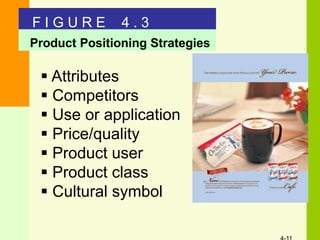
Product Positioning Strategies
 Attributes
 Competitors
 Use or application
 Price/quality
 Product user
 Product class
 Cultural symbol
F I G U R E 4 . 3
Promotions Opportunity Analysis
Step 2
Establish Communication Objectives
• Develop brand awareness
• Increase good/service category demand
• Change customer beliefs or attitudes
• Enhance purchase actions
• Encourage repeat purchases
• Build customer traffic
• Enhance firm image
• Increase market share
• Increase sales
• Reinforce purchase decisions
Promotions Opportunity Analysis
Step 3
Establish a Communications Budget
• Budgets based on
• communication objectives
• marketing objectives
• Budgets vary from consumer to B-to-B markets
• Unrealistic assumption to assume direct
relationship between advertising and sales.
Factors Impacting Relationship
Between Promotions and Sales
• The goal of the promotion
• Threshold effects
• Carryover effects
• Wear-out effects
• Decay effects
• Random events
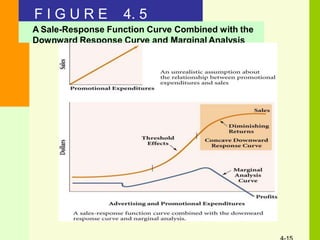
F I G U R E 4. 5
A Sale-Response Function Curve Combined with the
Downward Response Curve and Marginal Analysis
Carryover effects are
important in advertising
products such as boats.
F I G U R E 4 . 6
A Decay Effects Model
• Percentage of sales
• Meet-the-competition
• “What we can afford”
• Objective and task
• Payout planning
• Quantitative models
F I G U R E 4 . 7
Methods of Determining Marketing Communication Budgets
F I G U R E 4 . 8
Breakdown of Marketing Expenditures
Consumer
promotions,
27.9%
Advertising,
41.1%
Trade
promotions,
27.5%
Other, 3.3%
F I G U R E 4 . 9
Advertising Expenditures in Top 10 Countries
$6.4 $9.0 $11.1 $18.3 $9.5
$38.0
$6.4 $6.7
$18.4
$263.7
$0.0
$50.0
$250.0
$200.0
$150.0
$100.0
$300.0
ExpendituresinBillions
F I G U R E 4 . 10
Advertising Expenditures by Media
Internet, 6.5%
Outdoor, 2.6%
Radio, 7.4%
Cable TV, 11.2%
Syndicated TV,
2.8%
Spot TV, 11.5%
Network TV,
18.1%
Newspaper,
19.9%
Magazine, 19.9%
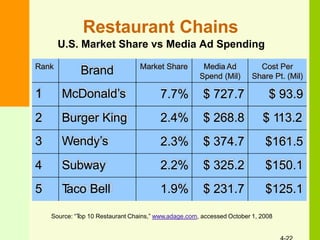
Restaurant Chains
U.S. Market Share vs Media Ad Spending
(Thousands)
Rank
Brand Market Share Media Ad
Spend (Mil)
Cost Per
Share Pt. (Mil)
1 McDonald’s 7.7% $ 727.7 $ 93.9
2 Burger King 2.4% $ 268.8 $ 113.2
3 Wendy’s 2.3% $ 374.7 $161.5
4 Subway 2.2% $ 325.2 $150.1
5 Taco Bell 1.9% $ 231.7 $125.1
Source: “Top 10 Restaurant Chains,” www.adage.com, accessed October 1, 2008
Automotive Brands
U.S. Market Share vs Media Ad Spending
(Thousands)
Rank
Brand Market
Share
Media Ad
Spend (Mil)
Cost Per
Share Pt. (Mil)
1 Toyota Camry 5.4% $ 65.6 $ 12.1
2 Honda Accord 4.6% $ 114.3 $ 24.8
3 Honda Civic 3.9% $ 112.0 $ 28.7
4 Nissan Altima 3.2% $ 132.1 $ 41.2
5 Chevrolet 3.1% $ 58.5
Impala
Source: “Top 10 Auto Brands,” www.adage.com, accessed October 1, 2008
$ 18.8
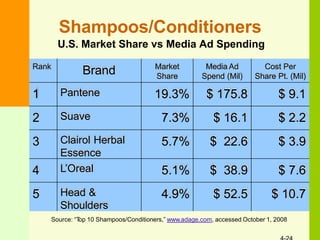
Shampoos/Conditioners
U.S. Market Share vs Media Ad Spending
(Thousands)
Rank
Brand Market
Share
Media Ad
Spend (Mil)
Cost Per
Share Pt. (Mil)
1 Pantene 19.3% $ 175.8 $ 9.1
2 Suave 7.3% $ 16.1 $ 2.2
3 Clairol Herbal
Essence
5.7% $ 22.6 $ 3.9
4 L’Oreal 5.1% $ 38.9 $ 7.6
5 Head &
Shoulders
4.9% $ 52.5 $ 10.7
Source: “Top 10 Shampoos/Conditioners,” www.adage.com, accessed October 1, 2008
Promotions Opportunity Analysis
Step 4
Prepare Communication Strategies
•Communication strategies are broad,
long-term guidelines for the marketing
communications program.
•Should be linked to opportunities and
threats identified by the communication
market analysis.
•Should fit with the company’s overall
message, image, and themes.
Promotions Opportunity Analysis
Step 5
Match Tactics with Strategies
Tactics support the communication strategies.
Examples of tactics would include:
• Specific advertisements
• Personal selling enticements for sales reps
• Sales promotions
• Special product packages and labels
• Price changes
• Trade discounts to retailers
Advantages of Marketing Segmentation
 Identify company strengths and weaknesses
 Locate opportunities
 Match firm’s expertise with most lucrative markets
 Focus budget on specific segment
F I G U R E 4 . 12
Tests to Determine if a Particular Market
Segment Is Viable
The individuals or businesses within the segment are
homogeneous.
The market segment is different from the population as
a whole and distinct from other market segments.
The market segment is large enough to be financially
viable to target with a separate marketing campaign.
 The market segment must be reachable through some
type of media or marketing communications method.
Methods of Segmenting Consumer Markets
• Demographics
• Psychographics
• Generations
• Geographic
• Geodemographics
• Benefits
• Usage
F I G U R E 4 . 13
Copyright © 2010 Pearson Education,
A Nail Cares
advertisement
targeted to
females.
Radio Ad Directed to Children
Click on speaker to play ad.
An advertisement by
Junior Fitness Academy
targeted to children.
VALS 2
Psychographic Segmentation
• Innovators – successful, sophisticated – upscale products.
• Thinkers – educated, conservative, practical – durability, value.
• Achievers – goal-oriented, conservative, career, and family
• Experiencers – young, enthusiastic, impulsive, fashion, social
• Believers – conservative, conventional, traditional
• Strivers – trendy, fun-loving, peers important
• Makers – self-sufficient, respect authority, not materialistic
• Survivors – safety, security, focus on needs, price
Psychographics and Technology
Psychographic Segmentation
• New Enthusiasts – cutting edge, eager, high
incomes/education
• Hopefuls – cutting edge, lack financial means
• Faithful – not eager, but not averse
• Oldliners – not interested in new technologies
• Independents – higher incomes, but do not value new
technology
• Surfers – ambivalent about new technology, cynical about
business
Table 4 . 1
Characteristics of Generation Segments
Ad targeted to seniors.
Geodemographic Segmentation
• Combines
• Demographic census data
• Geographic information
• Psychographic information
• PRIZM
• 62 market segments
• Southside City
• Towns and Gowns
• Industry (NAICS/SIC codes)
• Size of business
• Geographic location
• Product usage
• Customer value
F I G U R E 4 . 14
Methods of Segmenting B-to-B Markets
Copyright © 2010 Pearson Ed
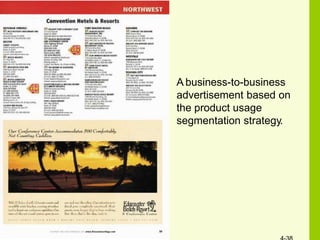
A business-to-business
advertisement based on
the product usage
segmentation strategy.
• Understand the international market
• A borderless marketing plan
• Thinking globally but acting locally
• Local partnerships
• Communication segmentation strategies
• Market communication analysis
• Solid communication objectives
F I G U R E 4 . 1 5
Successful Globally Integrated Marketing
Communications Tactics

Chapter 4 promotion analyasis opportunity

  • 1.
    4 Chapter Four PromotionsOpportunity Analysis Prof. (Dr.) Kao Kveng Hong, Ph.D., D.Litt.
  • 2.
    PetsMart Pets are nowpart of the family. Discussion Slide 4 • Attitudes have changed. • New animal care products. • New animal care services. • Prices are secondary. Why the Change?
  • 3.
    Chapter Overview 1. Promotionsopportunity analysis process 2. Promotional efforts 3. Consumer market segments 4. B-to-B segmentation programs Promotions Opportunity Analysis 4
  • 4.
    1) Conduct communicationsmarketing analysis. 2) Establish communication objectives. 3) Create communications budget. 4) Prepare promotional strategies. 5) Match tactics with strategies. F I G U R E 4 . 1 Steps in a Promotion Opportunity Analysis
  • 5.
    Promotions Opportunity Analysis Step1 Conduct a Communication Market Analysis • Competitors • Opportunities • Target markets • Customers • Product positioning
  • 6.
    Competitors • Identify majorcompetitors. • Identify communication strategies and tactics of each competitor. Sources of information •Secondary data •Other people •Primary research
  • 7.
    Opportunities • Are therecustomers that the competition is ignoring? • Which markets are heavily saturated? • Are the benefits of our products being clearly articulated? • Are there opportunities to build relationships using a slightly different marketing approach? • Are there opportunities that are not being pursued?
  • 8.
    Target Markets • Whatbenefits does each target market want from the product? • How can each target market be reached? • What appeal works best for each target market? • What needs of the target market are not being met by a competing firm? • What is the demographic and psychographic makeup of each target market?
  • 9.
    Customers Three Types ofCustomers • Current company customers • The competitors’ customers • Potential customers who currently do not purchase the product but may become interested
  • 10.
    Product Positioning • Isthe perception created in the consumer’s mind regarding the nature of the company and its products relative to the competition? • Positioning is created by factors such as product quality, prices, distribution, image, and marketing communications.
  • 11.
    Product Positioning Strategies Attributes  Competitors  Use or application  Price/quality  Product user  Product class  Cultural symbol F I G U R E 4 . 3
  • 12.
    Promotions Opportunity Analysis Step2 Establish Communication Objectives • Develop brand awareness • Increase good/service category demand • Change customer beliefs or attitudes • Enhance purchase actions • Encourage repeat purchases • Build customer traffic • Enhance firm image • Increase market share • Increase sales • Reinforce purchase decisions
  • 13.
    Promotions Opportunity Analysis Step3 Establish a Communications Budget • Budgets based on • communication objectives • marketing objectives • Budgets vary from consumer to B-to-B markets • Unrealistic assumption to assume direct relationship between advertising and sales.
  • 14.
    Factors Impacting Relationship BetweenPromotions and Sales • The goal of the promotion • Threshold effects • Carryover effects • Wear-out effects • Decay effects • Random events
  • 15.
    F I GU R E 4. 5 A Sale-Response Function Curve Combined with the Downward Response Curve and Marginal Analysis
  • 16.
    Carryover effects are importantin advertising products such as boats.
  • 17.
    F I GU R E 4 . 6 A Decay Effects Model
  • 18.
    • Percentage ofsales • Meet-the-competition • “What we can afford” • Objective and task • Payout planning • Quantitative models F I G U R E 4 . 7 Methods of Determining Marketing Communication Budgets
  • 19.
    F I GU R E 4 . 8 Breakdown of Marketing Expenditures Consumer promotions, 27.9% Advertising, 41.1% Trade promotions, 27.5% Other, 3.3%
  • 20.
    F I GU R E 4 . 9 Advertising Expenditures in Top 10 Countries $6.4 $9.0 $11.1 $18.3 $9.5 $38.0 $6.4 $6.7 $18.4 $263.7 $0.0 $50.0 $250.0 $200.0 $150.0 $100.0 $300.0 ExpendituresinBillions
  • 21.
    F I GU R E 4 . 10 Advertising Expenditures by Media Internet, 6.5% Outdoor, 2.6% Radio, 7.4% Cable TV, 11.2% Syndicated TV, 2.8% Spot TV, 11.5% Network TV, 18.1% Newspaper, 19.9% Magazine, 19.9%
  • 22.
    Restaurant Chains U.S. MarketShare vs Media Ad Spending (Thousands) Rank Brand Market Share Media Ad Spend (Mil) Cost Per Share Pt. (Mil) 1 McDonald’s 7.7% $ 727.7 $ 93.9 2 Burger King 2.4% $ 268.8 $ 113.2 3 Wendy’s 2.3% $ 374.7 $161.5 4 Subway 2.2% $ 325.2 $150.1 5 Taco Bell 1.9% $ 231.7 $125.1 Source: “Top 10 Restaurant Chains,” www.adage.com, accessed October 1, 2008
  • 23.
    Automotive Brands U.S. MarketShare vs Media Ad Spending (Thousands) Rank Brand Market Share Media Ad Spend (Mil) Cost Per Share Pt. (Mil) 1 Toyota Camry 5.4% $ 65.6 $ 12.1 2 Honda Accord 4.6% $ 114.3 $ 24.8 3 Honda Civic 3.9% $ 112.0 $ 28.7 4 Nissan Altima 3.2% $ 132.1 $ 41.2 5 Chevrolet 3.1% $ 58.5 Impala Source: “Top 10 Auto Brands,” www.adage.com, accessed October 1, 2008 $ 18.8
  • 24.
    Shampoos/Conditioners U.S. Market Sharevs Media Ad Spending (Thousands) Rank Brand Market Share Media Ad Spend (Mil) Cost Per Share Pt. (Mil) 1 Pantene 19.3% $ 175.8 $ 9.1 2 Suave 7.3% $ 16.1 $ 2.2 3 Clairol Herbal Essence 5.7% $ 22.6 $ 3.9 4 L’Oreal 5.1% $ 38.9 $ 7.6 5 Head & Shoulders 4.9% $ 52.5 $ 10.7 Source: “Top 10 Shampoos/Conditioners,” www.adage.com, accessed October 1, 2008
  • 25.
    Promotions Opportunity Analysis Step4 Prepare Communication Strategies •Communication strategies are broad, long-term guidelines for the marketing communications program. •Should be linked to opportunities and threats identified by the communication market analysis. •Should fit with the company’s overall message, image, and themes.
  • 26.
    Promotions Opportunity Analysis Step5 Match Tactics with Strategies Tactics support the communication strategies. Examples of tactics would include: • Specific advertisements • Personal selling enticements for sales reps • Sales promotions • Special product packages and labels • Price changes • Trade discounts to retailers
  • 27.
    Advantages of MarketingSegmentation  Identify company strengths and weaknesses  Locate opportunities  Match firm’s expertise with most lucrative markets  Focus budget on specific segment F I G U R E 4 . 12
  • 28.
    Tests to Determineif a Particular Market Segment Is Viable The individuals or businesses within the segment are homogeneous. The market segment is different from the population as a whole and distinct from other market segments. The market segment is large enough to be financially viable to target with a separate marketing campaign.  The market segment must be reachable through some type of media or marketing communications method.
  • 29.
    Methods of SegmentingConsumer Markets • Demographics • Psychographics • Generations • Geographic • Geodemographics • Benefits • Usage F I G U R E 4 . 13
  • 30.
    Copyright © 2010Pearson Education, A Nail Cares advertisement targeted to females.
  • 31.
    Radio Ad Directedto Children Click on speaker to play ad. An advertisement by Junior Fitness Academy targeted to children.
  • 32.
    VALS 2 Psychographic Segmentation •Innovators – successful, sophisticated – upscale products. • Thinkers – educated, conservative, practical – durability, value. • Achievers – goal-oriented, conservative, career, and family • Experiencers – young, enthusiastic, impulsive, fashion, social • Believers – conservative, conventional, traditional • Strivers – trendy, fun-loving, peers important • Makers – self-sufficient, respect authority, not materialistic • Survivors – safety, security, focus on needs, price
  • 33.
    Psychographics and Technology PsychographicSegmentation • New Enthusiasts – cutting edge, eager, high incomes/education • Hopefuls – cutting edge, lack financial means • Faithful – not eager, but not averse • Oldliners – not interested in new technologies • Independents – higher incomes, but do not value new technology • Surfers – ambivalent about new technology, cynical about business
  • 34.
    Table 4 .1 Characteristics of Generation Segments
  • 35.
  • 36.
    Geodemographic Segmentation • Combines •Demographic census data • Geographic information • Psychographic information • PRIZM • 62 market segments • Southside City • Towns and Gowns
  • 37.
    • Industry (NAICS/SICcodes) • Size of business • Geographic location • Product usage • Customer value F I G U R E 4 . 14 Methods of Segmenting B-to-B Markets
  • 38.
    Copyright © 2010Pearson Ed A business-to-business advertisement based on the product usage segmentation strategy.
  • 39.
    • Understand theinternational market • A borderless marketing plan • Thinking globally but acting locally • Local partnerships • Communication segmentation strategies • Market communication analysis • Solid communication objectives F I G U R E 4 . 1 5 Successful Globally Integrated Marketing Communications Tactics