“Case study
Of
sIGNOde INdustRIes INC.”
Group Members
•
•
•
•
•

Pooja Singh
(26NMP34)
Sankalp Garg
(26NMP46)
Satosh K Diwakar (26NMP47)
Shilpa Mahapatra (26NMP52)
Suhail Nasir
(26NMP55)
Problems:
• Raw material price had increased by 6.8%.
• Signode’s market share declined from 50% to 40% from 1987-93.
• Steel strapping market has become price sensitive and competitors are
selling their products at discounted prices (5 to 10% less then signode).

Challenges:
• Decision has to be taken, whether;
 Increase the price to counter the RM price increase.
 Maintain the same price.
 Go for “Flexi-Pricing” strategy.
Goals to be considered are Maintain Profitability, Halt Market
Share Erosion, Cash Flow, Sales Force Morale.
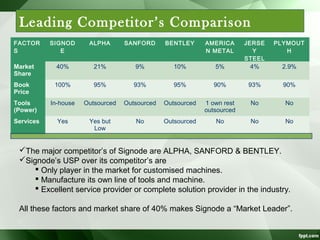
Leading Competitor’s Comparison
FACTOR
S

SIGNOD
E

ALPHA

SANFORD

BENTLEY

AMERICA
N METAL

JERSE
Y
STEEL

PLYMOUT
H

Market
Share

40%

21%

9%

10%

5%

4%

2.9%

Book
Price

100%

95%

93%

95%

90%

93%

90%

Tools
(Power)

In-house

Outsourced

Outsourced

Outsourced

1 own rest
outsourced

No

No

Services

Yes

Yes but
Low

No

Outsourced

No

No

No

The major competitor’s of Signode are ALPHA, SANFORD & BENTLEY.
Signode’s USP over its competitor’s are
 Only player in the market for customised machines.
 Manufacture its own line of tools and machine.
 Excellent service provider or complete solution provider in the industry.
All these factors and market share of 40% makes Signode a “Market Leader”.
SIGNODE’S………….. …………..Brief
Description
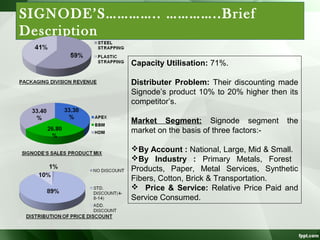
Capacity Utilisation: 71%.
Distributer Problem: Their discounting made
Signode’s product 10% to 20% higher then its
competitor’s.
Market Segment: Signode segment
market on the basis of three factors:-

the

By Account : National, Large, Mid & Small.
By Industry : Primary Metals, Forest
Products, Paper, Metal Services, Synthetic
Fibers, Cotton, Brick & Transportation.
 Price & Service: Relative Price Paid and
Service Consumed.
Alternatives
Maintain

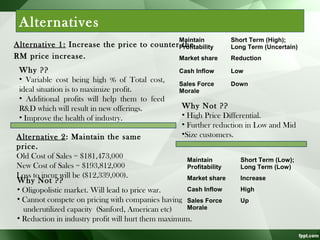
Alternative 1: Increase the price to counter Profitability
the
RM price increase.
Market share
Why ??
• Variable cost being high % of Total cost,
ideal situation is to maximize profit.
• Additional profits will help them to feed
R&D which will result in new offerings.
• Improve the health of industry.

Short Term (High);
Long Term (Uncertain)
Reduction

Cash Inflow

Low

Sales Force
Morale

Down

Why Not ??
• High Price Differential.
• Further reduction in Low and Mid
•Size customers.

Alternative 2 : Maintain the same
price.
Old Cost of Sales = $181,473,000
Maintain
New Cost of Sales = $193,812,000
Profitability
Loss to incur will be ($12,339,000).
Market share
Why Not ??
Cash Inflow
• Oligopolistic market. Will lead to price war.
• Cannot compete on pricing with companies having Sales Force
Morale
underutilized capacity (Sanford, American etc)
• Reduction in industry profit will hurt them maximum.

Short Term (Low);
Long Term (Low)
Increase
High
Up
Alternatives
Maintain
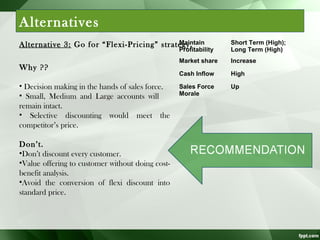
Alternative 3: Go for “Flexi-Pricing” strategy.

Profitability

Why ??
• Decision making in the hands of sales force.
• Small, Medium and Large accounts will
remain intact.
• Selective discounting would meet the
competitor’s price.
Don’t.
•Don’t discount every customer.
•Value offering to customer without doing costbenefit analysis.
•Avoid the conversion of flexi discount into
standard price.

Short Term (High);
Long Term (High)

Market share

Increase

Cash Inflow

High

Sales Force
Morale

Up
Recommended Detail Plan
•

Recognize the changing market Signode is operating in, where steel
strapping is becoming a commodity item.

•

Explain that Signode will always be undercut regarding price.

•

Start the process of evaluating how Signode can serve the smaller
customers through distributors.

•

Evaluate the economic value of the services offered and train the sales
force on this concept.

•

Implement the 'flex-pricing' plan, initially keeping a close eye on the level of
discounting.
Signode case study

Signode case study

  • 1.
    “Case study Of sIGNOde INdustRIesINC.” Group Members • • • • • Pooja Singh (26NMP34) Sankalp Garg (26NMP46) Satosh K Diwakar (26NMP47) Shilpa Mahapatra (26NMP52) Suhail Nasir (26NMP55)
  • 2.
    Problems: • Raw materialprice had increased by 6.8%. • Signode’s market share declined from 50% to 40% from 1987-93. • Steel strapping market has become price sensitive and competitors are selling their products at discounted prices (5 to 10% less then signode). Challenges: • Decision has to be taken, whether;  Increase the price to counter the RM price increase.  Maintain the same price.  Go for “Flexi-Pricing” strategy. Goals to be considered are Maintain Profitability, Halt Market Share Erosion, Cash Flow, Sales Force Morale.
  • 3.
    Leading Competitor’s Comparison FACTOR S SIGNOD E ALPHA SANFORD BENTLEY AMERICA NMETAL JERSE Y STEEL PLYMOUT H Market Share 40% 21% 9% 10% 5% 4% 2.9% Book Price 100% 95% 93% 95% 90% 93% 90% Tools (Power) In-house Outsourced Outsourced Outsourced 1 own rest outsourced No No Services Yes Yes but Low No Outsourced No No No The major competitor’s of Signode are ALPHA, SANFORD & BENTLEY. Signode’s USP over its competitor’s are  Only player in the market for customised machines.  Manufacture its own line of tools and machine.  Excellent service provider or complete solution provider in the industry. All these factors and market share of 40% makes Signode a “Market Leader”.
  • 4.
    SIGNODE’S………….. …………..Brief Description Capacity Utilisation:71%. Distributer Problem: Their discounting made Signode’s product 10% to 20% higher then its competitor’s. Market Segment: Signode segment market on the basis of three factors:- the By Account : National, Large, Mid & Small. By Industry : Primary Metals, Forest Products, Paper, Metal Services, Synthetic Fibers, Cotton, Brick & Transportation.  Price & Service: Relative Price Paid and Service Consumed.
  • 5.
    Alternatives Maintain Alternative 1: Increasethe price to counter Profitability the RM price increase. Market share Why ?? • Variable cost being high % of Total cost, ideal situation is to maximize profit. • Additional profits will help them to feed R&D which will result in new offerings. • Improve the health of industry. Short Term (High); Long Term (Uncertain) Reduction Cash Inflow Low Sales Force Morale Down Why Not ?? • High Price Differential. • Further reduction in Low and Mid •Size customers. Alternative 2 : Maintain the same price. Old Cost of Sales = $181,473,000 Maintain New Cost of Sales = $193,812,000 Profitability Loss to incur will be ($12,339,000). Market share Why Not ?? Cash Inflow • Oligopolistic market. Will lead to price war. • Cannot compete on pricing with companies having Sales Force Morale underutilized capacity (Sanford, American etc) • Reduction in industry profit will hurt them maximum. Short Term (Low); Long Term (Low) Increase High Up
  • 6.
    Alternatives Maintain Alternative 3: Gofor “Flexi-Pricing” strategy. Profitability Why ?? • Decision making in the hands of sales force. • Small, Medium and Large accounts will remain intact. • Selective discounting would meet the competitor’s price. Don’t. •Don’t discount every customer. •Value offering to customer without doing costbenefit analysis. •Avoid the conversion of flexi discount into standard price. Short Term (High); Long Term (High) Market share Increase Cash Inflow High Sales Force Morale Up
  • 7.
    Recommended Detail Plan • Recognizethe changing market Signode is operating in, where steel strapping is becoming a commodity item. • Explain that Signode will always be undercut regarding price. • Start the process of evaluating how Signode can serve the smaller customers through distributors. • Evaluate the economic value of the services offered and train the sales force on this concept. • Implement the 'flex-pricing' plan, initially keeping a close eye on the level of discounting.