Chapter 6
Urbanization and Rural-Urban
Migration (Theory and Policy)
Problems and Policies: Domestic
2
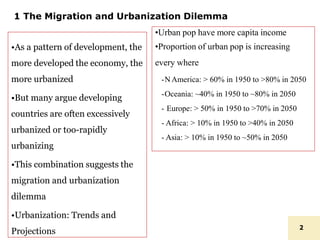
1 The Migration and Urbanization Dilemma
•As a pattern of development, the
more developed the economy, the
more urbanized
•But many argue developing
countries are often excessively
urbanized or too-rapidly
urbanizing
•This combination suggests the
migration and urbanization
dilemma
•Urbanization: Trends and
Projections
•Urban pop have more capita income
•Proportion of urban pop is increasing
every where
-NAmerica: > 60% in 1950 to >80% in 2050
-Oceania: ~40% in 1950 to ~80% in 2050
- Europe: > 50% in 1950 to >70% in 2050
- Africa: > 10% in 1950 to >40% in 2050
- Asia: > 10% in 1950 to ~50% in 2050
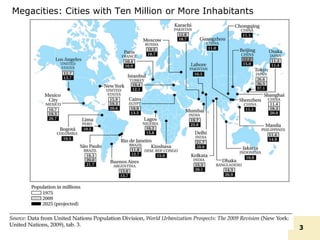
Megacities: Cities with Ten Million or More Inhabitants
3
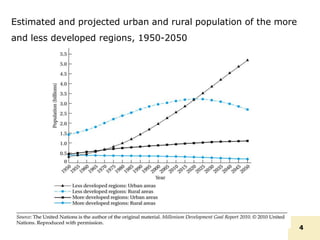
Estimated and projected urban and rural population of the more
and less developed regions, 1950-2050
4
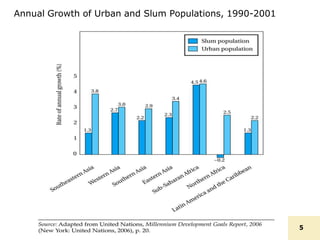
Annual Growth of Urban and Slum Populations, 1990-2001
5
2 The Role of Cities
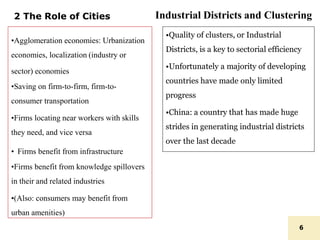
•Agglomeration economies: Urbanization
economies, localization (industry or
sector) economies
•Saving on firm-to-firm, firm-to-
consumer transportation
•Firms locating near workers with skills
they need, and vice versa
• Firms benefit from infrastructure
•Firms benefit from knowledge spillovers
in their and related industries
•(Also: consumers may benefit from
urban amenities)
6
•Quality of clusters, or Industrial
Districts, is a key to sectorial efficiency
•Unfortunately a majority of developing
countries have made only limited
progress
•China: a country that has made huge
strides in generating industrial districts
over the last decade
Industrial Districts and Clustering
Urbanization Costs, and Efficient Urban Scale
7
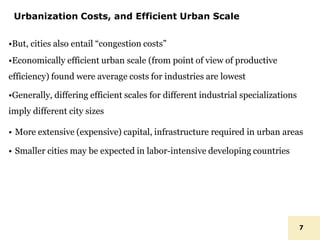
•But, cities also entail “congestion costs”
•Economically efficient urban scale (from point of view of productive
efficiency) found were average costs for industries are lowest
•Generally, differing efficient scales for different industrial specializations
imply different city sizes
• More extensive (expensive) capital, infrastructure required in urban areas
• Smaller cities may be expected in labor-intensive developing countries
3 The Urban Giantism Problem
•There may be general urban bias
•Cities are capital intensive: large
cities should be in developed countries
•But urbanization in developing
countries has taken place at
unexpectedly rapid pace
•Huge informal sectors in
shantytowns. Many workers outside
formal sector
•Much urban growth is in mid-size
cities, but urban bias remains a serious
issue in many developing countries
• First-City Bias favoring largest city
• Causes of Urban Giantism:
– Import substitution industrialization: less in’t
trade, concentration is in a single city largely to
avoid transportation costs
– “Bread and circuses” to prevent unrest
(evidence: stable democracies vs unstable
dictatorships)
– Hub and spoke transport system (rather than
web) makes transport costs high for small cities
– Compounding effect of locating the national
capital in the largest city
8
4 The Urban Informal Sector
• Why promote the urban informal sector?
– Makes surplus despite hostile environment
– Creating jobs due to low capital intensivity
– Access to (informal) training, and apprenticeships
– Creates D for less- or un-skilled workers
– Uses appropriate technologies, local resources
– Recycling of waste materials
– More benefits to poor, especially women who are concentrated in informal
sectors
• Policies for the Urban Informal Sector
• Women in the Informal Sector
9
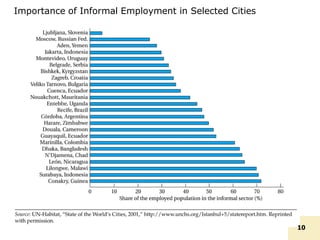
Importance of Informal Employment in Selected Cities
10
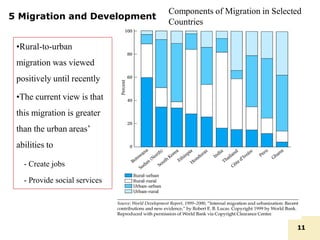
5 Migration and Development
•Rural-to-urban
migration was viewed
positively until recently
•The current view is that
this migration is greater
than the urban areas’
abilities to
- Create jobs
- Provide social services
Components of Migration in Selected
Countries
11
6 Toward an Economic Theory of Rural-Urban Migration
12
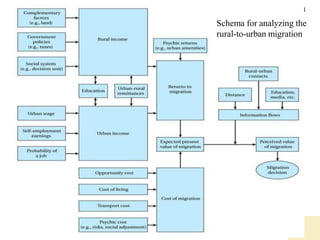
• A Verbal Description of the Todaro Model
– Migration is a rational decision
– The decision depends on expected rather than actual wage
differentials
– The probability of obtaining a city job is inversely related to the
urban unemployment rate
– High rates of migration are outcomes of rural urban imbalances
• A Diagrammatic Presentation is below
13
Schema for analyzing the
rural-to-urban migration
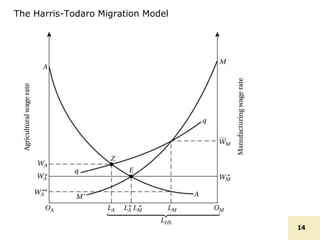
The Harris-Todaro Migration Model
14
(cont’d)
(WM)
LUS

LM
WA
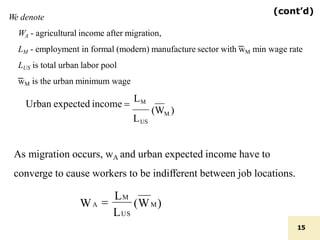
We denote
WA - agricultural income after migration,
LM - employment in formal (modern) manufacture sector with ͞wM min wage rate
LUS is total urban labor pool
͞wM is the urban minimum wage
(WM )
15
L
Urban expected income 
LM
US
As migration occurs, wA and urban expected income have to
converge to cause workers to be indifferent between job locations.
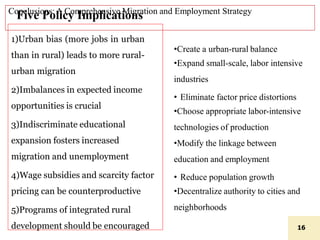
1)Urban bias (more jobs in urban
than in rural) leads to more rural-
urban migration
2)Imbalances in expected income
opportunities is crucial
3)Indiscriminate educational
expansion fosters increased
migration and unemployment
4)Wage subsidies and scarcity factor
pricing can be counterproductive
5)Programs of integrated rural
development should be encouraged 16
Five Policy ImplicationsConclusions:A Comprehensive Migration and Employment Strategy
•Create a urban-rural balance
•Expand small-scale, labor intensive
industries
• Eliminate factor price distortions
•Choose appropriate labor-intensive
technologies of production
•Modify the linkage between
education and employment
• Reduce population growth
•Decentralize authority to cities and
neighborhoods
7 Summary and Conclusions: A Comprehensive Migration
and Employment Strategy
17
• Create a urban-rural balance
• Expand small-scale, labor intensive industries
• Eliminate factor price distortions
• Choose appropriate labor-intensive technologies of production
• Modify the linkage between education and employment
• Reduce population growth
• Decentralize authority to cities and neighborhoods
Concepts for Review
18
• Agglomeration economies
• Congestion
• Efficiency wage
• Harris-Todaro model
• Induced migration
• Informal sector
• Labor turnover
• Localization economies
• Present value
• Rural-urban migration
• Social capital
• Todaro migration model
• Urban bias
• Urbanization economies
• Wage subsidy

Decon 06

  • 1.
    Chapter 6 Urbanization andRural-Urban Migration (Theory and Policy) Problems and Policies: Domestic
  • 2.
    2 1 The Migrationand Urbanization Dilemma •As a pattern of development, the more developed the economy, the more urbanized •But many argue developing countries are often excessively urbanized or too-rapidly urbanizing •This combination suggests the migration and urbanization dilemma •Urbanization: Trends and Projections •Urban pop have more capita income •Proportion of urban pop is increasing every where -NAmerica: > 60% in 1950 to >80% in 2050 -Oceania: ~40% in 1950 to ~80% in 2050 - Europe: > 50% in 1950 to >70% in 2050 - Africa: > 10% in 1950 to >40% in 2050 - Asia: > 10% in 1950 to ~50% in 2050
  • 3.
    Megacities: Cities withTen Million or More Inhabitants 3
  • 4.
    Estimated and projectedurban and rural population of the more and less developed regions, 1950-2050 4
  • 5.
    Annual Growth ofUrban and Slum Populations, 1990-2001 5
  • 6.
    2 The Roleof Cities •Agglomeration economies: Urbanization economies, localization (industry or sector) economies •Saving on firm-to-firm, firm-to- consumer transportation •Firms locating near workers with skills they need, and vice versa • Firms benefit from infrastructure •Firms benefit from knowledge spillovers in their and related industries •(Also: consumers may benefit from urban amenities) 6 •Quality of clusters, or Industrial Districts, is a key to sectorial efficiency •Unfortunately a majority of developing countries have made only limited progress •China: a country that has made huge strides in generating industrial districts over the last decade Industrial Districts and Clustering
  • 7.
    Urbanization Costs, andEfficient Urban Scale 7 •But, cities also entail “congestion costs” •Economically efficient urban scale (from point of view of productive efficiency) found were average costs for industries are lowest •Generally, differing efficient scales for different industrial specializations imply different city sizes • More extensive (expensive) capital, infrastructure required in urban areas • Smaller cities may be expected in labor-intensive developing countries
  • 8.
    3 The UrbanGiantism Problem •There may be general urban bias •Cities are capital intensive: large cities should be in developed countries •But urbanization in developing countries has taken place at unexpectedly rapid pace •Huge informal sectors in shantytowns. Many workers outside formal sector •Much urban growth is in mid-size cities, but urban bias remains a serious issue in many developing countries • First-City Bias favoring largest city • Causes of Urban Giantism: – Import substitution industrialization: less in’t trade, concentration is in a single city largely to avoid transportation costs – “Bread and circuses” to prevent unrest (evidence: stable democracies vs unstable dictatorships) – Hub and spoke transport system (rather than web) makes transport costs high for small cities – Compounding effect of locating the national capital in the largest city 8
  • 9.
    4 The UrbanInformal Sector • Why promote the urban informal sector? – Makes surplus despite hostile environment – Creating jobs due to low capital intensivity – Access to (informal) training, and apprenticeships – Creates D for less- or un-skilled workers – Uses appropriate technologies, local resources – Recycling of waste materials – More benefits to poor, especially women who are concentrated in informal sectors • Policies for the Urban Informal Sector • Women in the Informal Sector 9
  • 10.
    Importance of InformalEmployment in Selected Cities 10
  • 11.
    5 Migration andDevelopment •Rural-to-urban migration was viewed positively until recently •The current view is that this migration is greater than the urban areas’ abilities to - Create jobs - Provide social services Components of Migration in Selected Countries 11
  • 12.
    6 Toward anEconomic Theory of Rural-Urban Migration 12 • A Verbal Description of the Todaro Model – Migration is a rational decision – The decision depends on expected rather than actual wage differentials – The probability of obtaining a city job is inversely related to the urban unemployment rate – High rates of migration are outcomes of rural urban imbalances • A Diagrammatic Presentation is below
  • 13.
    13 Schema for analyzingthe rural-to-urban migration
  • 14.
  • 15.
    (cont’d) (WM) LUS  LM WA We denote WA -agricultural income after migration, LM - employment in formal (modern) manufacture sector with ͞wM min wage rate LUS is total urban labor pool ͞wM is the urban minimum wage (WM ) 15 L Urban expected income  LM US As migration occurs, wA and urban expected income have to converge to cause workers to be indifferent between job locations.
  • 16.
    1)Urban bias (morejobs in urban than in rural) leads to more rural- urban migration 2)Imbalances in expected income opportunities is crucial 3)Indiscriminate educational expansion fosters increased migration and unemployment 4)Wage subsidies and scarcity factor pricing can be counterproductive 5)Programs of integrated rural development should be encouraged 16 Five Policy ImplicationsConclusions:A Comprehensive Migration and Employment Strategy •Create a urban-rural balance •Expand small-scale, labor intensive industries • Eliminate factor price distortions •Choose appropriate labor-intensive technologies of production •Modify the linkage between education and employment • Reduce population growth •Decentralize authority to cities and neighborhoods
  • 17.
    7 Summary andConclusions: A Comprehensive Migration and Employment Strategy 17 • Create a urban-rural balance • Expand small-scale, labor intensive industries • Eliminate factor price distortions • Choose appropriate labor-intensive technologies of production • Modify the linkage between education and employment • Reduce population growth • Decentralize authority to cities and neighborhoods
  • 18.
    Concepts for Review 18 •Agglomeration economies • Congestion • Efficiency wage • Harris-Todaro model • Induced migration • Informal sector • Labor turnover • Localization economies • Present value • Rural-urban migration • Social capital • Todaro migration model • Urban bias • Urbanization economies • Wage subsidy