2021 Marketing Planning
Quick Guide
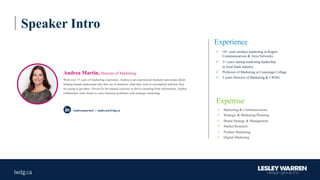
Speaker Intro
Experience
ü 10+ years product marketing at Rogers
Communications & Atria Networks
ü 3+ years startup marketing leadership
in local SaaS industry
ü Professor of Marketing at Conestoga College
ü 3 years Director of Marketing & LWDG
Andrea Martin, Director of Marketing
With over 15 years of marketing experience, Andrea is an experienced marketer passionate about
helping brands understand why they are in business, what they want to accomplish and how they
are going to get there. Driven by her natural curiosity to derive meaning from information, Andrea
collaborates with clients to solve business problems with strategic marketing.
ü Marketing & Communications
ü Strategic & Marketing Planning
ü Brand Strategy & Management
ü Market Research
ü Product Marketing
ü Digital Marketing
Expertise
Andreamartin1 | andrea@lwdg.ca
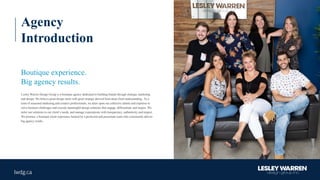
Agency
Introduction
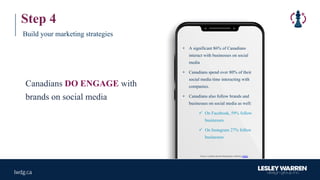
Boutique experience.
Big agency results.

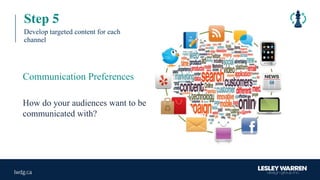
Lesley Warren Design Group is a boutique agency dedicated to building brands through strategic marketing
and design. We believe great design starts with great strategy derived from deep client understanding. As a
team of seasoned marketing and creative professionals, we draw upon our collective talents and expertise to
solve business challenges and execute meaningful design solutions that engage, differentiate and inspire. We
tailor our solutions to our client’s needs, and manage expectations with transparency, authenticity and respect.
We promise a boutique client experience backed by a proficient and passionate team who consistently deliver
big agency results.
My goal for today is…
ü aligned with business objectives
ü targeted to your audiences
ü engages through meaningful content
ü AND is quick, logical & easy to follow
…to help you build a strategic marketing
plan that is:
Can	marketing	
prepare	you	for	
success?
During the presentation…
ü Has your purpose, vision or mission changed?
ü How effectively are you managing your brand?
ü How can I engage my audience online?
Reflect on the following:
Take notes
& jot down your
thoughts
My Definition
of Marketing :
Marketing is strategy that utilizes art and data to
communicate value using a scientific approach to
test, measure and refine strategies in order to
deliver business growth by creating, delivering and
managing customer value.
What is marketing?
{
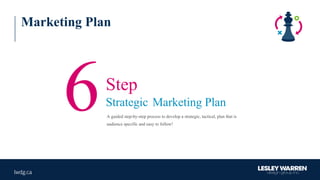
Marketing Plan
6A guided step-by-step process to develop a strategic, tactical, plan that is
audience specific and easy to follow!
Step
Strategic Marketing Plan
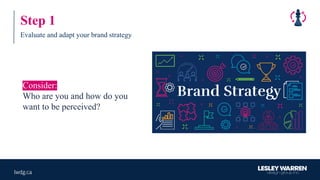
Step 1
Evaluate and adapt your brand strategy
Consider:
Who are you and how do you
want to be perceived?
Def:
is a long-term plan for the development of a successful
brand in order to achieve specific goals. A well-defined and
executed brand strategy affects all aspects of a business and is directly
connected to consumer needs, emotions, and competitive
environments.
What s a brand strategy?
{
Step 1
Evaluate and adapt your brand strategy
Why adapt your brand strategy?
üconsumer needs
üemotions
ücompetitive environments
Because COVID-19 has changed…
Step 1
Evaluate and adapt your brand strategy
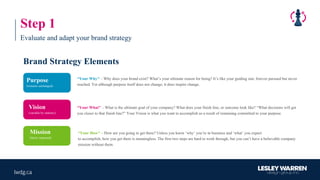
Brand Strategy Elements
“Your Why" – Why does your brand exist? What’s your ultimate reason for being? It’s like your guiding star, forever pursued but never
reached. Yet although purpose itself does not change; it does inspire change.
“Your How" – How are you going to get there? Unless you know ‘why’ you’re in business and ‘what’ you expect
to accomplish, how you get there is meaningless. The first two steps are hard to work through, but you can’t have a believable company
mission without them.
“Your What" – What is the ultimate goal of your company? What does your finish line, or outcome look like? “What decisions will get
you closer to that finish line?” Your Vision is what you want to accomplish as a result of remaining committed to your purpose.
Purpose
(remains unchanged)
Vision
(variable by industry)
Mission
(likely impacted)
Step 1
Evaluate and adapt your brand strategy
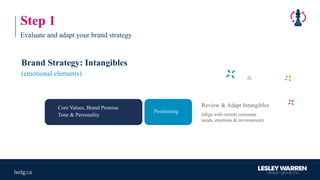
Brand Strategy: Intangibles
(emotional elements)
Review & Adapt Intangibles
(align with current consumer
needs, emotions & environment)
Core Values, Brand Promise
Tone & Personality
Positioning
Step 1
Evaluate and adapt your brand strategy
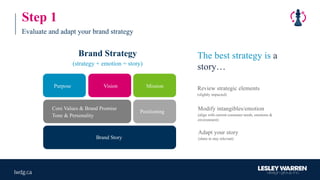
Brand Strategy
(strategy + emotion = story)
The best strategy is a
story…
Review strategic elements
(slightly impacted)
Modify intangibles/emotion
(align with current consumer needs, emotions &
environment)
Adapt your story
(share to stay relevant)
Purpose Vision Mission
Core Values & Brand Promise
Tone & Personality
Positioning
Brand Story
Step 1
Evaluate and adapt your brand strategy
Step 2
Set your marketing objectives
Consider:
What do you want to achieve?
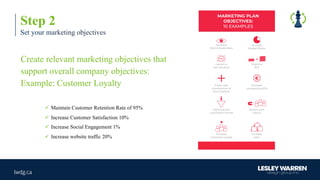
Create relevant marketing objectives that
support overall company objectives:
Example: Customer Loyalty
Step 2
Set your marketing objectives
ü Maintain Customer Retention Rate of 95%
ü Increase Customer Satisfaction 10%
ü Increase Social Engagement 1%
ü Increase website traffic 20%
Marketing Objectives
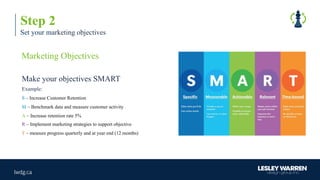
Make your objectives SMART
Example:
S – Increase Customer Retention
M – Benchmark data and measure customer activity
A – Increase retention rate 5%
R – Implement marketing strategies to support objective
T – measure progress quarterly and at year end (12 months)
Step 2
Set your marketing objectives
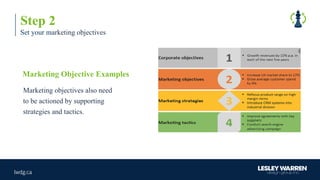
Marketing Objective Examples
Marketing objectives also need
to be actioned by supporting
strategies and tactics.
Step 2
Set your marketing objectives
Step 3
Segment Your Audiences
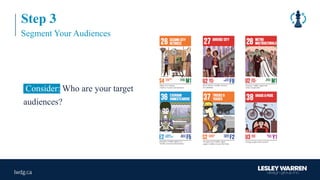
Consider: Who are your target
audiences?
Step 3
Segment Your Audiences
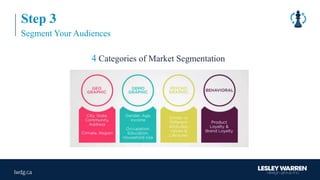
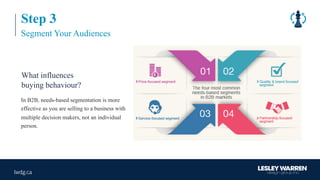
4 Categories of Market Segmentation
Step 3
Segment Your Audiences
In B2B, needs-based segmentation is more
effective as you are selling to a business with
multiple decision makers, not an individual
person.
What influences
buying behaviour?
Step 4
Build your marketing strategies
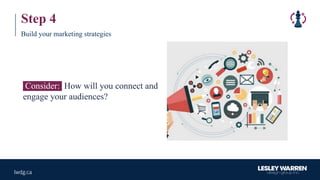
Consider: How will you connect and
engage your audiences?
Step 4
Build your marketing strategies
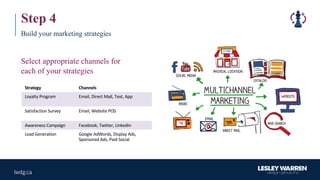
Select appropriate channels for
each of your strategies
Strategy Channels
Loyalty	Program Email,	Direct	Mail,	Text,	App
Satisfaction	Survey Email,	Website	POS
Awareness	Campaign Facebook, Twitter,	LinkedIn
Lead	Generation Google AdWords,	Display	Ads,	
Sponsored	Ads,	Paid	Social
Step 4
Build your marketing strategies
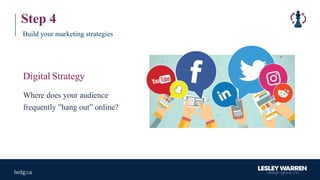
Where does your audience
frequently ”hang out” online?
Digital Strategy
How can you share your story
and engage your audience
online?
Step 4
Build your marketing strategies
Digital Storytelling
Canadians DO ENGAGE with
brands on social media
• A significant 86% of Canadians
interact with businesses on social
media
• Canadians spend over 80% of their
social media time interacting with
companies.
• Canadians also follow brands and
businesses on social media as well:
ü On Facebook, 59% follow
businesses
ü On Instagram 27% follow
businesses
Source: Canadian Internet Registration Authority (CIRA).
Step 4
Build your marketing strategies
Step 5
Develop targeted content for each
channel
Consider: How do you
create customer value?
Step 5
Develop targeted content for each
channel
How do your audiences want to be
communicated with?
Communication Preferences
Step 5
Develop targeted content for each channel
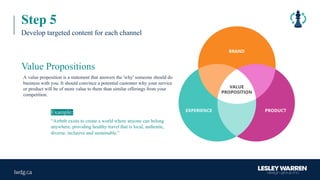
A value proposition is a statement that answers the 'why' someone should do
business with you. It should convince a potential customer why your service
or product will be of more value to them than similar offerings from your
competition.
Value Propositions
Example:
“Airbnb exists to create a world where anyone can belong
anywhere, providing healthy travel that is local, authentic,
diverse, inclusive and sustainable.”
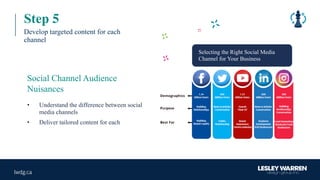
• Understand the difference between social
media channels
• Deliver tailored content for each
Selecting the Right Social Media
Channel for Your Business
Step 5
Develop targeted content for each
channel
Social Channel Audience
Nuisances
Step 6
Define your evaluation methods
and metrics
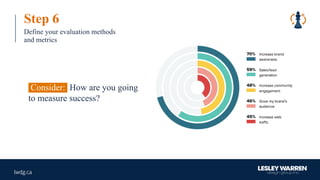
Consider: How are you going
to measure success?
Step 6
Define your evaluation methods and metrics
What KPIs are the most
meaningful?
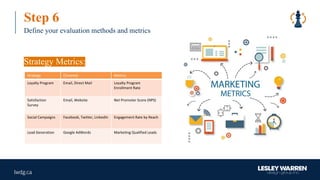
Strategy Metrics:
Show us how you shared toilet paper with those in need and we will
donate $1 for each social post that features #ShareASquare through
June 1, 2020 (up to $100,000).
Step 6
Define your evaluation methods and metrics
Strategy Channels Metrics
Loyalty	Program Email,	Direct	Mail Loyalty	Program	
Enrollment	Rate
Satisfaction	
Survey
Email,	Website Net	Promoter	Score	(NPS)
Social	Campaigns Facebook, Twitter,	LinkedIn Engagement	Rate	by	Reach	
Lead	Generation Google AdWords Marketing	Qualified	Leads
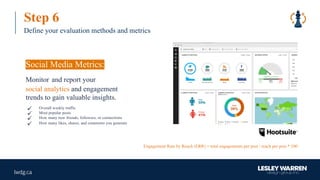
Social Media Metrics:
Monitor and report your
social analytics and engagement
trends to gain valuable insights.
Step 6
Define your evaluation methods and metrics
Engagement Rate by Reach (ERR) = total engagements per post / reach per post * 100
ü Overall weekly traffic
ü Most popular posts
ü How many new friends, followers, or connections
ü How many likes, shares, and comments you generate
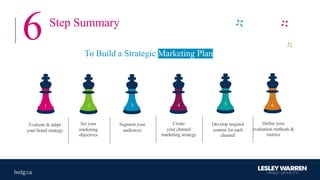
To Build a Strategic Marketing Plan
6 Step Summary
Evaluate & adapt
your brand strategy
Set your
marketing
objectives
Segment your
audiences
Create
your channel
marketing strategy
Develop targeted
content for each
channel
1 2 3 4 5 6
Define your
evaluation methods &
metrics
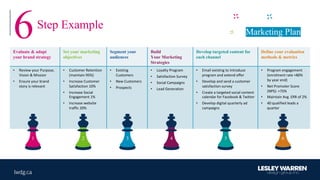
Marketing Plan6Step Example
Evaluate & adapt
your brand strategy
Set your marketing
objectives
Segment your
audiences
Build
Your Marketing
Strategies
Develop targeted content for
each channel
Define your evaluation
methods & metrics
• Review	your	Purpose,	
Vision	&	Mission
• Ensure	your	brand	
story	is	relevant
• Customer	Retention	
(maintain	95%)
• Increase	Customer	
Satisfaction	10%
• Increase	Social	
Engagement	1%
• Increase	website
traffic	20%
• Existing	
Customers
• New	Customers
• Prospects
• Loyalty	Program
• Satisfaction	Survey
• Social	Campaigns
• Lead Generation
• Email	existing	to	introduce	
program	and	extend	offer
• Develop and	send	a	customer	
satisfaction	survey
• Create	a	targeted	social	content	
calendar	for	Facebook	&	Twitter
• Develop	digital	quarterly	ad	
campaigns
• Program	engagement	
(enrolment rate	+80%	
by	year	end)
• Net Promoter	Score	
(NPS):	+75%
• Maintain	Avg.	ERR	of	2%
• 40	qualified	leads	a	
quarter
1 2 3 4 5 6
In Summary
q Who are you and how do you want to be perceived?
q What do you want to achieve?
q Who are your target audiences & customers?
q How will you connect and engage your audiences?
q What are your unique value propositions?
q How are you going to measure success?
Consider the following…
105 Randall Drive, Unit 2, Waterloo, Ontario
519.634.1124 • info@lwdg.ca • lwdg.ca
Thank You

A 6-Step Guide to 2021 Marketing Planning

  • 1.
  • 2.
    Speaker Intro Experience ü 10+years product marketing at Rogers Communications & Atria Networks ü 3+ years startup marketing leadership in local SaaS industry ü Professor of Marketing at Conestoga College ü 3 years Director of Marketing & LWDG Andrea Martin, Director of Marketing With over 15 years of marketing experience, Andrea is an experienced marketer passionate about helping brands understand why they are in business, what they want to accomplish and how they are going to get there. Driven by her natural curiosity to derive meaning from information, Andrea collaborates with clients to solve business problems with strategic marketing. ü Marketing & Communications ü Strategic & Marketing Planning ü Brand Strategy & Management ü Market Research ü Product Marketing ü Digital Marketing Expertise Andreamartin1 | andrea@lwdg.ca
  • 3.
    Agency Introduction Boutique experience. Big agencyresults. Lesley Warren Design Group is a boutique agency dedicated to building brands through strategic marketing and design. We believe great design starts with great strategy derived from deep client understanding. As a team of seasoned marketing and creative professionals, we draw upon our collective talents and expertise to solve business challenges and execute meaningful design solutions that engage, differentiate and inspire. We tailor our solutions to our client’s needs, and manage expectations with transparency, authenticity and respect. We promise a boutique client experience backed by a proficient and passionate team who consistently deliver big agency results.
  • 4.
    My goal fortoday is… ü aligned with business objectives ü targeted to your audiences ü engages through meaningful content ü AND is quick, logical & easy to follow …to help you build a strategic marketing plan that is: Can marketing prepare you for success?
  • 5.
    During the presentation… üHas your purpose, vision or mission changed? ü How effectively are you managing your brand? ü How can I engage my audience online? Reflect on the following: Take notes & jot down your thoughts
  • 6.
    My Definition of Marketing: Marketing is strategy that utilizes art and data to communicate value using a scientific approach to test, measure and refine strategies in order to deliver business growth by creating, delivering and managing customer value. What is marketing? {
  • 7.
    Marketing Plan 6A guidedstep-by-step process to develop a strategic, tactical, plan that is audience specific and easy to follow! Step Strategic Marketing Plan
  • 8.
    Step 1 Evaluate andadapt your brand strategy Consider: Who are you and how do you want to be perceived?
  • 9.
    Def: is a long-termplan for the development of a successful brand in order to achieve specific goals. A well-defined and executed brand strategy affects all aspects of a business and is directly connected to consumer needs, emotions, and competitive environments. What s a brand strategy? { Step 1 Evaluate and adapt your brand strategy
  • 10.
    Why adapt yourbrand strategy? üconsumer needs üemotions ücompetitive environments Because COVID-19 has changed… Step 1 Evaluate and adapt your brand strategy
  • 11.
    Brand Strategy Elements “YourWhy" – Why does your brand exist? What’s your ultimate reason for being? It’s like your guiding star, forever pursued but never reached. Yet although purpose itself does not change; it does inspire change. “Your How" – How are you going to get there? Unless you know ‘why’ you’re in business and ‘what’ you expect to accomplish, how you get there is meaningless. The first two steps are hard to work through, but you can’t have a believable company mission without them. “Your What" – What is the ultimate goal of your company? What does your finish line, or outcome look like? “What decisions will get you closer to that finish line?” Your Vision is what you want to accomplish as a result of remaining committed to your purpose. Purpose (remains unchanged) Vision (variable by industry) Mission (likely impacted) Step 1 Evaluate and adapt your brand strategy
  • 12.
    Brand Strategy: Intangibles (emotionalelements) Review & Adapt Intangibles (align with current consumer needs, emotions & environment) Core Values, Brand Promise Tone & Personality Positioning Step 1 Evaluate and adapt your brand strategy
  • 13.
    Brand Strategy (strategy +emotion = story) The best strategy is a story… Review strategic elements (slightly impacted) Modify intangibles/emotion (align with current consumer needs, emotions & environment) Adapt your story (share to stay relevant) Purpose Vision Mission Core Values & Brand Promise Tone & Personality Positioning Brand Story Step 1 Evaluate and adapt your brand strategy
  • 14.
    Step 2 Set yourmarketing objectives Consider: What do you want to achieve?
  • 15.
    Create relevant marketingobjectives that support overall company objectives: Example: Customer Loyalty Step 2 Set your marketing objectives ü Maintain Customer Retention Rate of 95% ü Increase Customer Satisfaction 10% ü Increase Social Engagement 1% ü Increase website traffic 20%
  • 16.
    Marketing Objectives Make yourobjectives SMART Example: S – Increase Customer Retention M – Benchmark data and measure customer activity A – Increase retention rate 5% R – Implement marketing strategies to support objective T – measure progress quarterly and at year end (12 months) Step 2 Set your marketing objectives
  • 17.
    Marketing Objective Examples Marketingobjectives also need to be actioned by supporting strategies and tactics. Step 2 Set your marketing objectives
  • 18.
    Step 3 Segment YourAudiences Consider: Who are your target audiences?
  • 19.
    Step 3 Segment YourAudiences 4 Categories of Market Segmentation
  • 20.
    Step 3 Segment YourAudiences In B2B, needs-based segmentation is more effective as you are selling to a business with multiple decision makers, not an individual person. What influences buying behaviour?
  • 21.
    Step 4 Build yourmarketing strategies Consider: How will you connect and engage your audiences?
  • 22.
    Step 4 Build yourmarketing strategies Select appropriate channels for each of your strategies Strategy Channels Loyalty Program Email, Direct Mail, Text, App Satisfaction Survey Email, Website POS Awareness Campaign Facebook, Twitter, LinkedIn Lead Generation Google AdWords, Display Ads, Sponsored Ads, Paid Social
  • 23.
    Step 4 Build yourmarketing strategies Where does your audience frequently ”hang out” online? Digital Strategy
  • 24.
    How can youshare your story and engage your audience online? Step 4 Build your marketing strategies Digital Storytelling
  • 25.
    Canadians DO ENGAGEwith brands on social media • A significant 86% of Canadians interact with businesses on social media • Canadians spend over 80% of their social media time interacting with companies. • Canadians also follow brands and businesses on social media as well: ü On Facebook, 59% follow businesses ü On Instagram 27% follow businesses Source: Canadian Internet Registration Authority (CIRA). Step 4 Build your marketing strategies
  • 26.
    Step 5 Develop targetedcontent for each channel Consider: How do you create customer value?
  • 27.
    Step 5 Develop targetedcontent for each channel How do your audiences want to be communicated with? Communication Preferences
  • 28.
    Step 5 Develop targetedcontent for each channel A value proposition is a statement that answers the 'why' someone should do business with you. It should convince a potential customer why your service or product will be of more value to them than similar offerings from your competition. Value Propositions Example: “Airbnb exists to create a world where anyone can belong anywhere, providing healthy travel that is local, authentic, diverse, inclusive and sustainable.”
  • 29.
    • Understand thedifference between social media channels • Deliver tailored content for each Selecting the Right Social Media Channel for Your Business Step 5 Develop targeted content for each channel Social Channel Audience Nuisances
  • 30.
    Step 6 Define yourevaluation methods and metrics Consider: How are you going to measure success?
  • 31.
    Step 6 Define yourevaluation methods and metrics What KPIs are the most meaningful?
  • 32.
    Strategy Metrics: Show ushow you shared toilet paper with those in need and we will donate $1 for each social post that features #ShareASquare through June 1, 2020 (up to $100,000). Step 6 Define your evaluation methods and metrics Strategy Channels Metrics Loyalty Program Email, Direct Mail Loyalty Program Enrollment Rate Satisfaction Survey Email, Website Net Promoter Score (NPS) Social Campaigns Facebook, Twitter, LinkedIn Engagement Rate by Reach Lead Generation Google AdWords Marketing Qualified Leads
  • 33.
    Social Media Metrics: Monitorand report your social analytics and engagement trends to gain valuable insights. Step 6 Define your evaluation methods and metrics Engagement Rate by Reach (ERR) = total engagements per post / reach per post * 100 ü Overall weekly traffic ü Most popular posts ü How many new friends, followers, or connections ü How many likes, shares, and comments you generate
  • 34.
    To Build aStrategic Marketing Plan 6 Step Summary Evaluate & adapt your brand strategy Set your marketing objectives Segment your audiences Create your channel marketing strategy Develop targeted content for each channel 1 2 3 4 5 6 Define your evaluation methods & metrics
  • 35.
    Marketing Plan6Step Example Evaluate& adapt your brand strategy Set your marketing objectives Segment your audiences Build Your Marketing Strategies Develop targeted content for each channel Define your evaluation methods & metrics • Review your Purpose, Vision & Mission • Ensure your brand story is relevant • Customer Retention (maintain 95%) • Increase Customer Satisfaction 10% • Increase Social Engagement 1% • Increase website traffic 20% • Existing Customers • New Customers • Prospects • Loyalty Program • Satisfaction Survey • Social Campaigns • Lead Generation • Email existing to introduce program and extend offer • Develop and send a customer satisfaction survey • Create a targeted social content calendar for Facebook & Twitter • Develop digital quarterly ad campaigns • Program engagement (enrolment rate +80% by year end) • Net Promoter Score (NPS): +75% • Maintain Avg. ERR of 2% • 40 qualified leads a quarter 1 2 3 4 5 6
  • 36.
    In Summary q Whoare you and how do you want to be perceived? q What do you want to achieve? q Who are your target audiences & customers? q How will you connect and engage your audiences? q What are your unique value propositions? q How are you going to measure success? Consider the following…
  • 37.
    105 Randall Drive,Unit 2, Waterloo, Ontario 519.634.1124 • info@lwdg.ca • lwdg.ca Thank You