Chapter 7
Marketing Environment
2
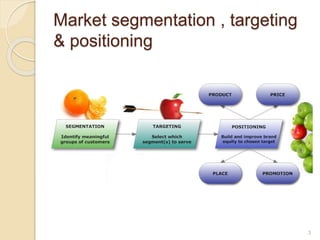
Market segmentation , targeting
& positioning
3
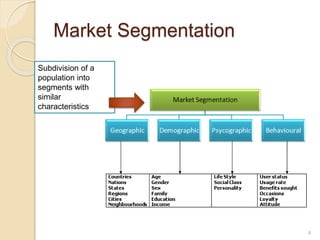
Market Segmentation
Subdivision of a
population into
segments with
similar
characteristics
4
Target Market
A specific group of
consumers at which a
company aims its products
and services .
Your target customers are
those who are most likely
to buy from you.
5
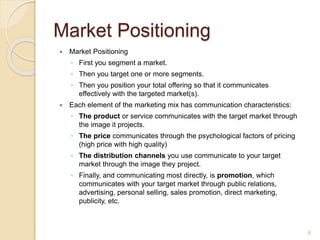
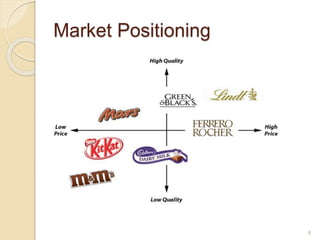
Market Positioning
 Market Positioning
◦ First you segment a market.
◦ Then you target one or more segments.
◦ Then you position your total offering so that it communicates
effectively with the targeted market(s).
 Each element of the marketing mix has communication characteristics:
◦ The product or service communicates with the target market through
the image it projects.
◦ The price communicates through the psychological factors of pricing
(high price with high quality)
◦ The distribution channels you use communicate to your target
market through the image they project.
◦ Finally, and communicating most directly, is promotion, which
communicates with your target market through public relations,
advertising, personal selling, sales promotion, direct marketing,
publicity, etc.
6
Market Positioning
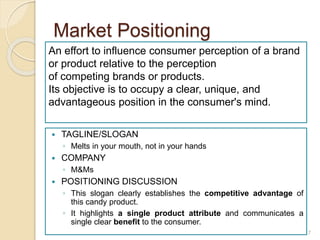
 TAGLINE/SLOGAN
◦ Melts in your mouth, not in your hands
 COMPANY
◦ M&Ms
 POSITIONING DISCUSSION
◦ This slogan clearly establishes the competitive advantage of
this candy product.
◦ It highlights a single product attribute and communicates a
single clear benefit to the consumer.
An effort to influence consumer perception of a brand
or product relative to the perception
of competing brands or products.
Its objective is to occupy a clear, unique, and
advantageous position in the consumer's mind.
7
Market Positioning
8
Marketing Strategy
 An organization's strategy that combines all
of its marketing goals into one
comprehensive plan.
 A good marketing strategy should be drawn
from market research and focus on the
right product mix in order to achieve the
maximum profit potential and sustain the
business.
 The marketing strategy is the foundation of
a marketing plan.
9
Product Strategy
 A plan for marketing a
product/good/service that is founded
upon an analysis of the nature of the
intended market, how much market
share is to be achieved, how the product
/good/ service is to be marketed and how
much profit is anticipated.
 Most business marketing directors will
develop a clear and realistic product
strategy prior to the launch of a new
product into its intended market. 10
Product Classification
 Consumer products
◦ Maggie, Milo,
 Convenience products
◦ Gillette, skin cleanser, soap, sugar, cooking oil
 Shopping products
◦ LED TV 50”, Computers, home furnitures
 Specialty products
◦ Watches, handbags, life insurance
 Business products
◦ Raw materials
◦ Machineries
◦ Supplies
◦ Industrial services – i.e. financial services, legal etc
11
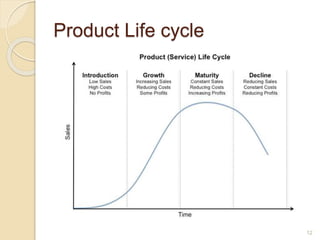
Product Life cycle
12
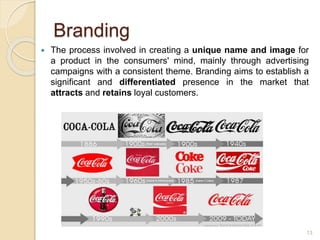
Branding
 The process involved in creating a unique name and image for
a product in the consumers' mind, mainly through advertising
campaigns with a consistent theme. Branding aims to establish a
significant and differentiated presence in the market that
attracts and retains loyal customers.
13
Packaging
 Packaging also refers to the process of design, evaluation,
and production of packages. Packaging can be described
as a coordinated system of preparing goods for transport,
warehousing, logistics, sale, and end
use. Packaging contains, protects, preserves, transports,
informs, and sells.
14
Labeling
 Packaging and labeling
do more than protect
and identify your
company’s products.
They play a vital role in
developing your image
and brand within your
target market. Failing to
pay attention to the
design of your
packaging and labeling
can decrease the
visibility and
attractiveness of your
products, which can be
devastating for sales.
15
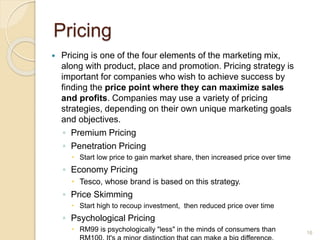
Pricing
 Pricing is one of the four elements of the marketing mix,
along with product, place and promotion. Pricing strategy is
important for companies who wish to achieve success by
finding the price point where they can maximize sales
and profits. Companies may use a variety of pricing
strategies, depending on their own unique marketing goals
and objectives.
◦ Premium Pricing
◦ Penetration Pricing
 Start low price to gain market share, then increased price over time
◦ Economy Pricing
 Tesco, whose brand is based on this strategy.
◦ Price Skimming
 Start high to recoup investment, then reduced price over time
◦ Psychological Pricing
 RM99 is psychologically "less" in the minds of consumers than 16
Distribution Channel
 A distribution channel strategy enables you to sell to customers in
geographical areas or market sectors that your direct sales team
cannot reach. You can choose from a number of distribution
channels, including wholesalers, retailers, distributors and the
Internet. Each channel gives you different options for dealing with
customers and prospects. However, to ensure that your distributors
operate effectively on your behalf, your strategy must incorporate
the right level of control and support.
17
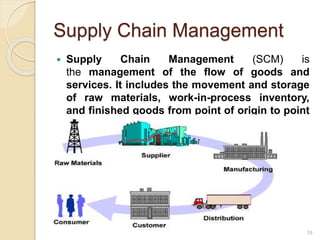
Supply Chain Management
 Supply Chain Management (SCM) is
the management of the flow of goods and
services. It includes the movement and storage
of raw materials, work-in-process inventory,
and finished goods from point of origin to point
of consumption.
18
Promotion Strategy
 Promotion is the method you use to spread the word
about your product or service to customers,
stakeholders and the broader public.
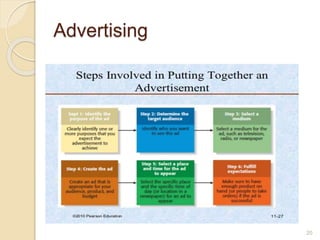
◦ Advertising
 Advertising is a form of communication designed to persuade
potential customers to choose your product or service over that of
a competitor. Also known as ‘Above the line” activities
◦ Selling
 Selling is the exchange of goods or services for an agreed sum of
money.
◦ Sales Promotion
 Sales promotion relates to short term incentives or activities that
encourage the purchase or sale of a product or service. Sales
promotions initiatives are often referred to as “below the line”
activities.
◦ Public Relations
 public relations is about building good relations with the
stakeholders (public) of your business by obtaining favorable
publicity, building a good corporate image and handling or heading
off unfavorable rumors, stories and events.
19
Advertising
20
Public relations
21
Personal Selling
 Personal selling is where
businesses use people (the
"sales force") to sell the
product after meeting
face-to-face with the
customer.
 The sellers promote the
product through their
attitude, appearance and
specialist product
knowledge
22
Online Marketing
 Online
Marketing is the
art and science of
selling products
and/or services
over digital
networks, such
as the Internet
and cellular
phone networks.
 The art of online
marketing
involves finding
the right online
marketing mix of
strategies that
appeals to your
target
market and will
actually
translate into
sales. 23
Online Pricing
 Dynamic Pricing
◦ is an approach to setting the cost for a product or
service that is highly flexible. The goal of dynamic
pricing is to allow a company that sells goods or
services over the Internet to adjust prices on the
fly in response to market demands.
 Forward auction
◦ Items are commonly placed at a special site for
auction (e.g. eBay.com) Buyers can continuously bid
for the items they are interested in. Eventually the
highest bidder wins the item.
 Reversed auction
◦ In a reverse auction, the sellers compete to obtain
business from the buyer and prices will typically
decrease as the sellers undercut each other.
24
Online Place (Distribution)
25
Online Promotion
 Using Online Marketing Promotions to Drive
Traffic
 Using an e-mail promotion to drive people to a
micro site or landing page
 Win-a-prize for signing up for an online
newsletter or social media site
 Gift certificates
 Sales racks on e-commerce sites
 Offering "White Papers" requiring e-mail
addresses, which result in qualified leads
 E-mail coupons
 Micro sites involved with an offline promotion
 Viral Marketing
26
Online Personalization
 One-to-one marketing applied directly to a specific
consumer. Having a knowledge of the consumer's
preferences enables suggesting specific products
and promotions to each consumer.
◦ Identify: Get to know the customers of a company, to collect
reliable data about their preferences and how their needs can
best be satisfied.
◦ Differentiate: To distinguish the customers in terms of their
lifetime value to the company, to know them by their priorities in
terms of their needs and segment them into more restricted
groups.
◦ Interact: Which communication channel and by what means
contact with the client is best made.
◦ Customize: It is needed to personalize the product or service to
the customer individually. The knowledge that a company has
about a customer needs to be put into practice and the
information held has to be taken into account in order to be able 27
OnlineCustomerService
Strategy
28
Case Study
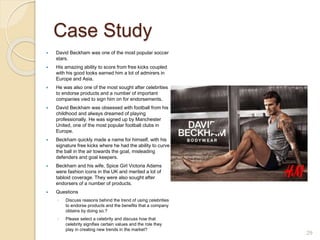
 David Beckham was one of the most popular soccer
stars.
 His amazing ability to score from free kicks coupled
with his good looks earned him a lot of admirers in
Europe and Asia.
 He was also one of the most sought after celebrities
to endorse products and a number of important
companies vied to sign him on for endorsements.
 David Beckham was obsessed with football from his
childhood and always dreamed of playing
professionally. He was signed up by Manchester
United, one of the most popular football clubs in
Europe.
 Beckham quickly made a name for himself, with his
signature free kicks where he had the ability to curve
the ball in the air towards the goal, misleading
defenders and goal keepers.
 Beckham and his wife, Spice Girl Victoria Adams
were fashion icons in the UK and merited a lot of
tabloid coverage. They were also sought after
endorsers of a number of products.
 Questions
◦ Discuss reasons behind the trend of using celebrities
to endorse products and the benefits that a company
obtains by doing so.?
◦ Please select a celebrity and discuss how that
celebrity signifies certain values and the role they
play in creating new trends in the market?
29

Chapter 7

  • 1.
  • 2.
  • 3.
    Market segmentation ,targeting & positioning 3
  • 4.
    Market Segmentation Subdivision ofa population into segments with similar characteristics 4
  • 5.
    Target Market A specificgroup of consumers at which a company aims its products and services . Your target customers are those who are most likely to buy from you. 5
  • 6.
    Market Positioning  MarketPositioning ◦ First you segment a market. ◦ Then you target one or more segments. ◦ Then you position your total offering so that it communicates effectively with the targeted market(s).  Each element of the marketing mix has communication characteristics: ◦ The product or service communicates with the target market through the image it projects. ◦ The price communicates through the psychological factors of pricing (high price with high quality) ◦ The distribution channels you use communicate to your target market through the image they project. ◦ Finally, and communicating most directly, is promotion, which communicates with your target market through public relations, advertising, personal selling, sales promotion, direct marketing, publicity, etc. 6
  • 7.
    Market Positioning  TAGLINE/SLOGAN ◦Melts in your mouth, not in your hands  COMPANY ◦ M&Ms  POSITIONING DISCUSSION ◦ This slogan clearly establishes the competitive advantage of this candy product. ◦ It highlights a single product attribute and communicates a single clear benefit to the consumer. An effort to influence consumer perception of a brand or product relative to the perception of competing brands or products. Its objective is to occupy a clear, unique, and advantageous position in the consumer's mind. 7
  • 8.
  • 9.
    Marketing Strategy  Anorganization's strategy that combines all of its marketing goals into one comprehensive plan.  A good marketing strategy should be drawn from market research and focus on the right product mix in order to achieve the maximum profit potential and sustain the business.  The marketing strategy is the foundation of a marketing plan. 9
  • 10.
    Product Strategy  Aplan for marketing a product/good/service that is founded upon an analysis of the nature of the intended market, how much market share is to be achieved, how the product /good/ service is to be marketed and how much profit is anticipated.  Most business marketing directors will develop a clear and realistic product strategy prior to the launch of a new product into its intended market. 10
  • 11.
    Product Classification  Consumerproducts ◦ Maggie, Milo,  Convenience products ◦ Gillette, skin cleanser, soap, sugar, cooking oil  Shopping products ◦ LED TV 50”, Computers, home furnitures  Specialty products ◦ Watches, handbags, life insurance  Business products ◦ Raw materials ◦ Machineries ◦ Supplies ◦ Industrial services – i.e. financial services, legal etc 11
  • 12.
  • 13.
    Branding  The processinvolved in creating a unique name and image for a product in the consumers' mind, mainly through advertising campaigns with a consistent theme. Branding aims to establish a significant and differentiated presence in the market that attracts and retains loyal customers. 13
  • 14.
    Packaging  Packaging alsorefers to the process of design, evaluation, and production of packages. Packaging can be described as a coordinated system of preparing goods for transport, warehousing, logistics, sale, and end use. Packaging contains, protects, preserves, transports, informs, and sells. 14
  • 15.
    Labeling  Packaging andlabeling do more than protect and identify your company’s products. They play a vital role in developing your image and brand within your target market. Failing to pay attention to the design of your packaging and labeling can decrease the visibility and attractiveness of your products, which can be devastating for sales. 15
  • 16.
    Pricing  Pricing isone of the four elements of the marketing mix, along with product, place and promotion. Pricing strategy is important for companies who wish to achieve success by finding the price point where they can maximize sales and profits. Companies may use a variety of pricing strategies, depending on their own unique marketing goals and objectives. ◦ Premium Pricing ◦ Penetration Pricing  Start low price to gain market share, then increased price over time ◦ Economy Pricing  Tesco, whose brand is based on this strategy. ◦ Price Skimming  Start high to recoup investment, then reduced price over time ◦ Psychological Pricing  RM99 is psychologically "less" in the minds of consumers than 16
  • 17.
    Distribution Channel  Adistribution channel strategy enables you to sell to customers in geographical areas or market sectors that your direct sales team cannot reach. You can choose from a number of distribution channels, including wholesalers, retailers, distributors and the Internet. Each channel gives you different options for dealing with customers and prospects. However, to ensure that your distributors operate effectively on your behalf, your strategy must incorporate the right level of control and support. 17
  • 18.
    Supply Chain Management Supply Chain Management (SCM) is the management of the flow of goods and services. It includes the movement and storage of raw materials, work-in-process inventory, and finished goods from point of origin to point of consumption. 18
  • 19.
    Promotion Strategy  Promotionis the method you use to spread the word about your product or service to customers, stakeholders and the broader public. ◦ Advertising  Advertising is a form of communication designed to persuade potential customers to choose your product or service over that of a competitor. Also known as ‘Above the line” activities ◦ Selling  Selling is the exchange of goods or services for an agreed sum of money. ◦ Sales Promotion  Sales promotion relates to short term incentives or activities that encourage the purchase or sale of a product or service. Sales promotions initiatives are often referred to as “below the line” activities. ◦ Public Relations  public relations is about building good relations with the stakeholders (public) of your business by obtaining favorable publicity, building a good corporate image and handling or heading off unfavorable rumors, stories and events. 19
  • 20.
  • 21.
  • 22.
    Personal Selling  Personalselling is where businesses use people (the "sales force") to sell the product after meeting face-to-face with the customer.  The sellers promote the product through their attitude, appearance and specialist product knowledge 22
  • 23.
    Online Marketing  Online Marketingis the art and science of selling products and/or services over digital networks, such as the Internet and cellular phone networks.  The art of online marketing involves finding the right online marketing mix of strategies that appeals to your target market and will actually translate into sales. 23
  • 24.
    Online Pricing  DynamicPricing ◦ is an approach to setting the cost for a product or service that is highly flexible. The goal of dynamic pricing is to allow a company that sells goods or services over the Internet to adjust prices on the fly in response to market demands.  Forward auction ◦ Items are commonly placed at a special site for auction (e.g. eBay.com) Buyers can continuously bid for the items they are interested in. Eventually the highest bidder wins the item.  Reversed auction ◦ In a reverse auction, the sellers compete to obtain business from the buyer and prices will typically decrease as the sellers undercut each other. 24
  • 25.
  • 26.
    Online Promotion  UsingOnline Marketing Promotions to Drive Traffic  Using an e-mail promotion to drive people to a micro site or landing page  Win-a-prize for signing up for an online newsletter or social media site  Gift certificates  Sales racks on e-commerce sites  Offering "White Papers" requiring e-mail addresses, which result in qualified leads  E-mail coupons  Micro sites involved with an offline promotion  Viral Marketing 26
  • 27.
    Online Personalization  One-to-onemarketing applied directly to a specific consumer. Having a knowledge of the consumer's preferences enables suggesting specific products and promotions to each consumer. ◦ Identify: Get to know the customers of a company, to collect reliable data about their preferences and how their needs can best be satisfied. ◦ Differentiate: To distinguish the customers in terms of their lifetime value to the company, to know them by their priorities in terms of their needs and segment them into more restricted groups. ◦ Interact: Which communication channel and by what means contact with the client is best made. ◦ Customize: It is needed to personalize the product or service to the customer individually. The knowledge that a company has about a customer needs to be put into practice and the information held has to be taken into account in order to be able 27
  • 28.
  • 29.
    Case Study  DavidBeckham was one of the most popular soccer stars.  His amazing ability to score from free kicks coupled with his good looks earned him a lot of admirers in Europe and Asia.  He was also one of the most sought after celebrities to endorse products and a number of important companies vied to sign him on for endorsements.  David Beckham was obsessed with football from his childhood and always dreamed of playing professionally. He was signed up by Manchester United, one of the most popular football clubs in Europe.  Beckham quickly made a name for himself, with his signature free kicks where he had the ability to curve the ball in the air towards the goal, misleading defenders and goal keepers.  Beckham and his wife, Spice Girl Victoria Adams were fashion icons in the UK and merited a lot of tabloid coverage. They were also sought after endorsers of a number of products.  Questions ◦ Discuss reasons behind the trend of using celebrities to endorse products and the benefits that a company obtains by doing so.? ◦ Please select a celebrity and discuss how that celebrity signifies certain values and the role they play in creating new trends in the market? 29