1
Advertising Planning and
Strategy
2
Learning Objectives
Learn about major components of the
advertising plan.
Understand the importance of setting
objectives.
Discuss the success factors of introductory
advertising and the relationship between
advertising and sales.
Discuss various budgeting methods used in
advertising.
3
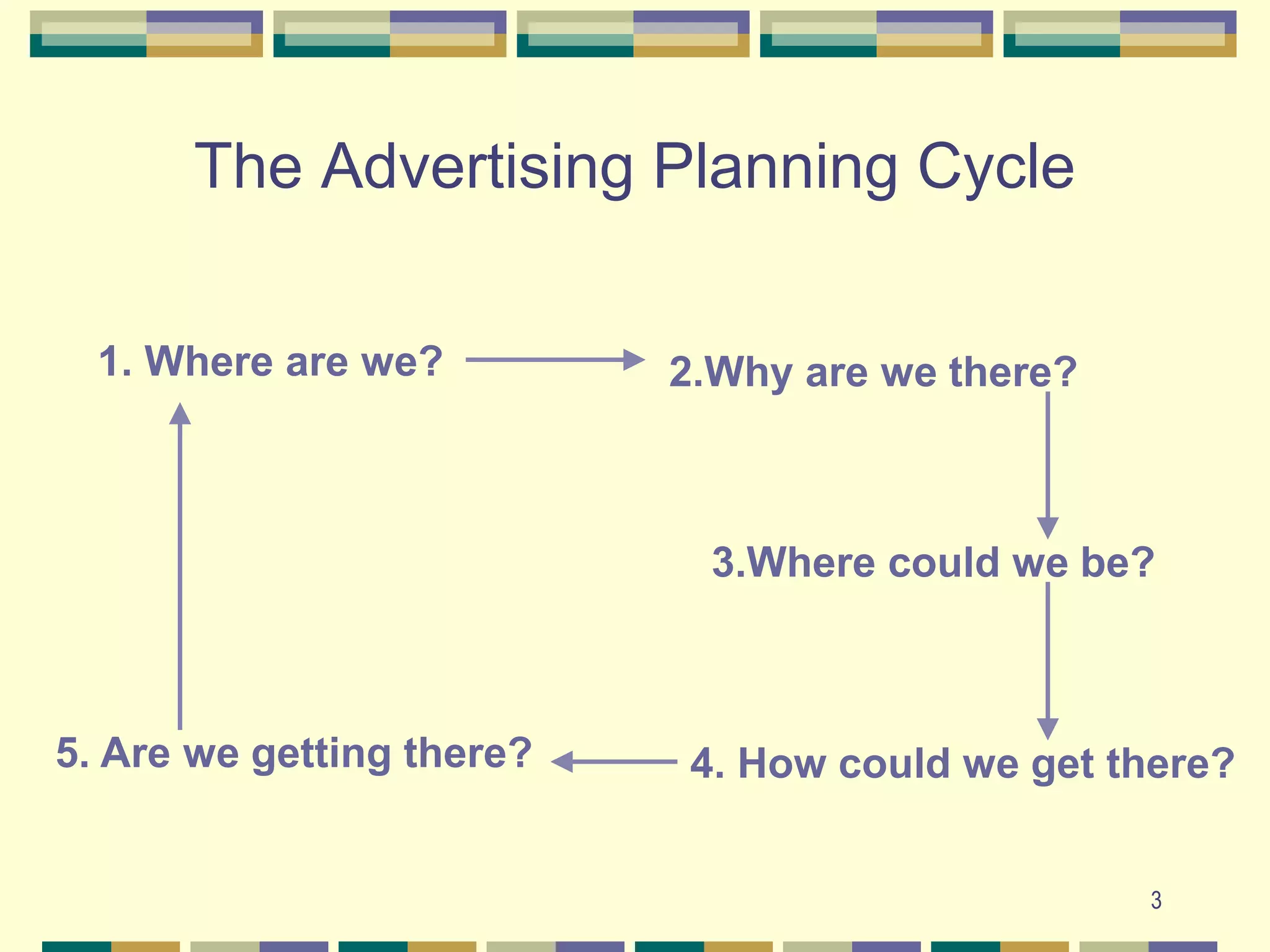
The Advertising Planning Cycle
1. Where are we? 2.Why are we there?
3.Where could we be?
4. How could we get there?
5. Are we getting there?
4
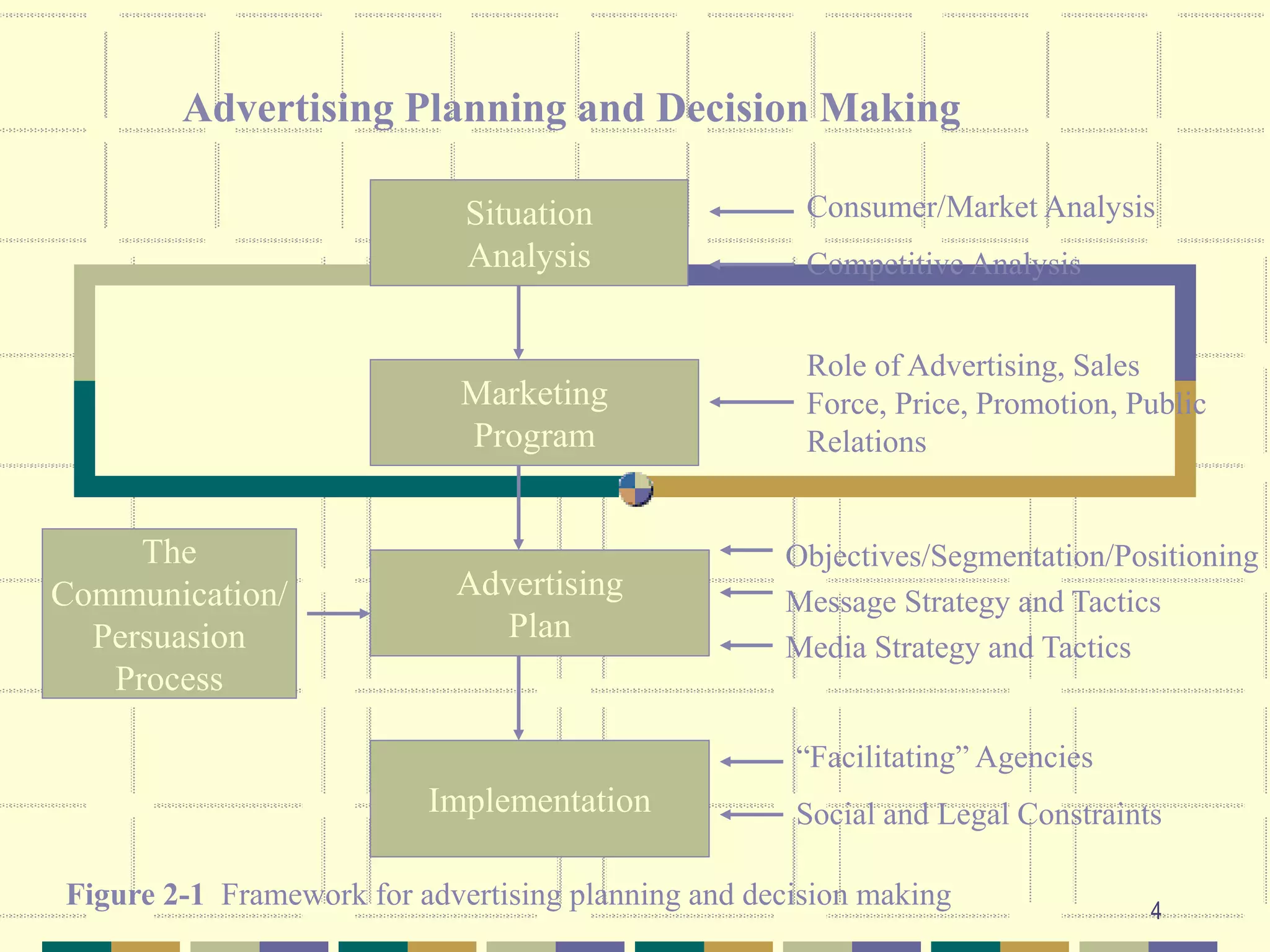
Advertising Planning and Decision Making
Situation
Analysis
Marketing
Program
Advertising
Plan
Implementation
The
Communication/
Persuasion
Process
Consumer/Market Analysis
Competitive Analysis
Role of Advertising, Sales
Force, Price, Promotion, Public
Relations
Objectives/Segmentation/Positioning
Message Strategy and Tactics
Media Strategy and Tactics
“Facilitating” Agencies
Social and Legal Constraints
Figure 2-1 Framework for advertising planning and decision making
5
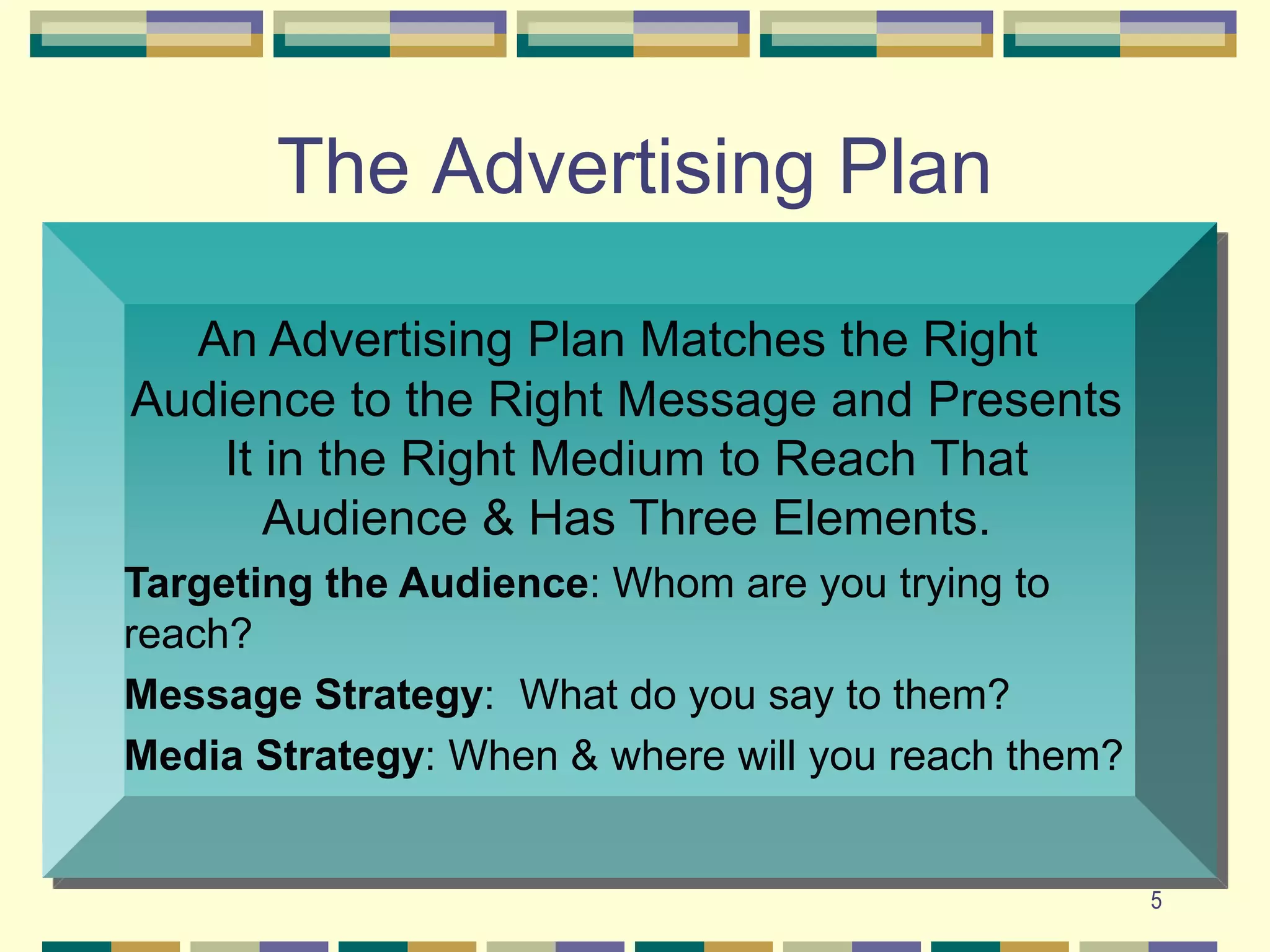
The Advertising Plan
An Advertising Plan Matches the Right
Audience to the Right Message and Presents
It in the Right Medium to Reach That
Audience & Has Three Elements.
Targeting the Audience: Whom are you trying to
reach?
Message Strategy: What do you say to them?
Media Strategy: When & where will you reach them?
6
Understanding of Comm.
Process
A typical communication process model
A model of persuasion process
 Ad exposure
 Different functions of advertising messages
 Brand attitude
 Purchase behavior
7
Developing an Advertising
Plan
Advertising objectives and target market
selection
Creative plan: Message strategy and tactics
Media plan: media strategy and tactics
Evaluation (research)
==> IMC approach: identify roles of various
forms of IMC and repeat the process.
8
Typical Advertising or Campaign
Plan Outline (Tab. 7.1)
I. Introduction
• Executive Summary or Overview is provided.
II. Situation Analysis
• Advertising Problems
• Advertising Opportunities
III. Key Strategy Decisions
• Advertising Objectives
• Target Audience
• Competitive Product Advantage
• Product Image and Personality
• Product Position
9
Typical Advertising or Campaign
Plan Outline (Tab. 7.1)
IV. The Creative Plan
V. The Media Plan
VI. The Communication Plan
• Sales promotion
• Public relations
• Direct marketing
• Personal selling
• Sponsorships, merchandising, packaging, etc.
VII. Implementation and Evaluation
VIII. Evaluation
IX. Budget
10
Situation Analysis
Opportunity analysis: to spot and
capitalize on favorable demand trends
 examples of such trends
Competitive analysis: to achieve and
maintain a “competitive advantage”
 examples of competitive advantages
Target market selection
 examples of target marketing
==> Marketing plan (4Ps)
11
Creative Platform & Message Strategy
Creative platform is a document that
outlines the message strategy decisions for
an individual ad.
Creative platforms combine the basic
advertising decisions – problems,
objectives, and target markets – with the
critical elements of the sales message
strategy – main idea and details about how
the idea will be executed.
12
Product
Benefit
Promises
Reason Why
Unique Selling
Proposition
Support
Advertisements that focus on the product
itself by looking at attributes.
Product is promoted on the basis of what it
can do for customers.
Promises that something will happen if you
use the advertised product.
Based on logic and reasoning and clearly
states a reason for the benefit gained.
A benefit statement that is both unique to the
product and important to the user.
Lends credibility to the selling premise.
Selling Premises
13
Defining Advertising Goals for Measured
Advertising Results (1962, 1995, S. Dutka)
The 6M approach
 Merchandise: important benefits to sell
 Markets: who to reach
 Motives: why people buy or fail to buy
 Media: how to reach
 Measurements: how to evaluate (time and
change)
 Messages: key ideas to convey to move
14
Setting Objectives
Why set objectives?:
-- Planning and decision making
-- Communication
-- Measurement and evaluation
Sales vs. Communication objectives
-- Problems with sales objectives
 When sales objectives are appropriate
-- Challenges with communication objectives
15
What is Good Objectives?
Good Objectives
Concrete and
Measurable
Specify a well-
defined audience
Attainable
Specify a time
period
Establish bench-
Mark measures Realistic
16
Setting Objectives Using the
Communications Effects Pyramid
Product: Backstage Shampoo
Time period: Six months
Objective 1: Create awareness among 90 percent
of target audience. Using repetitive advertising in
newspapers, magazines, TV and radio programs. Simple
message.
Objective 2: Create interest in the brand among 70
percent of target audience. Communicate information
about the features and benefits of the brand-I.e., that it contains
no soap and improves the texture of the hair
17
Setting objectives using the
communications effects pyramid
Objective 3: Create positive feelings about the
brand among 40 percent and preference among
25 percent of the target audience. Create favorable
attitudes by conveying information, promotions, sampling, etc.
Objective 4: Obtain trial among 20 percent of the
target audience. Use sampling and cents-off coupons along
with advertising and promotions
Objective 5: Develop and maintain regular use of
Backstage Shampoo among 5 percent of the
target audience. Use continued reinforcement advertising,
fewer coupons and promotions
18
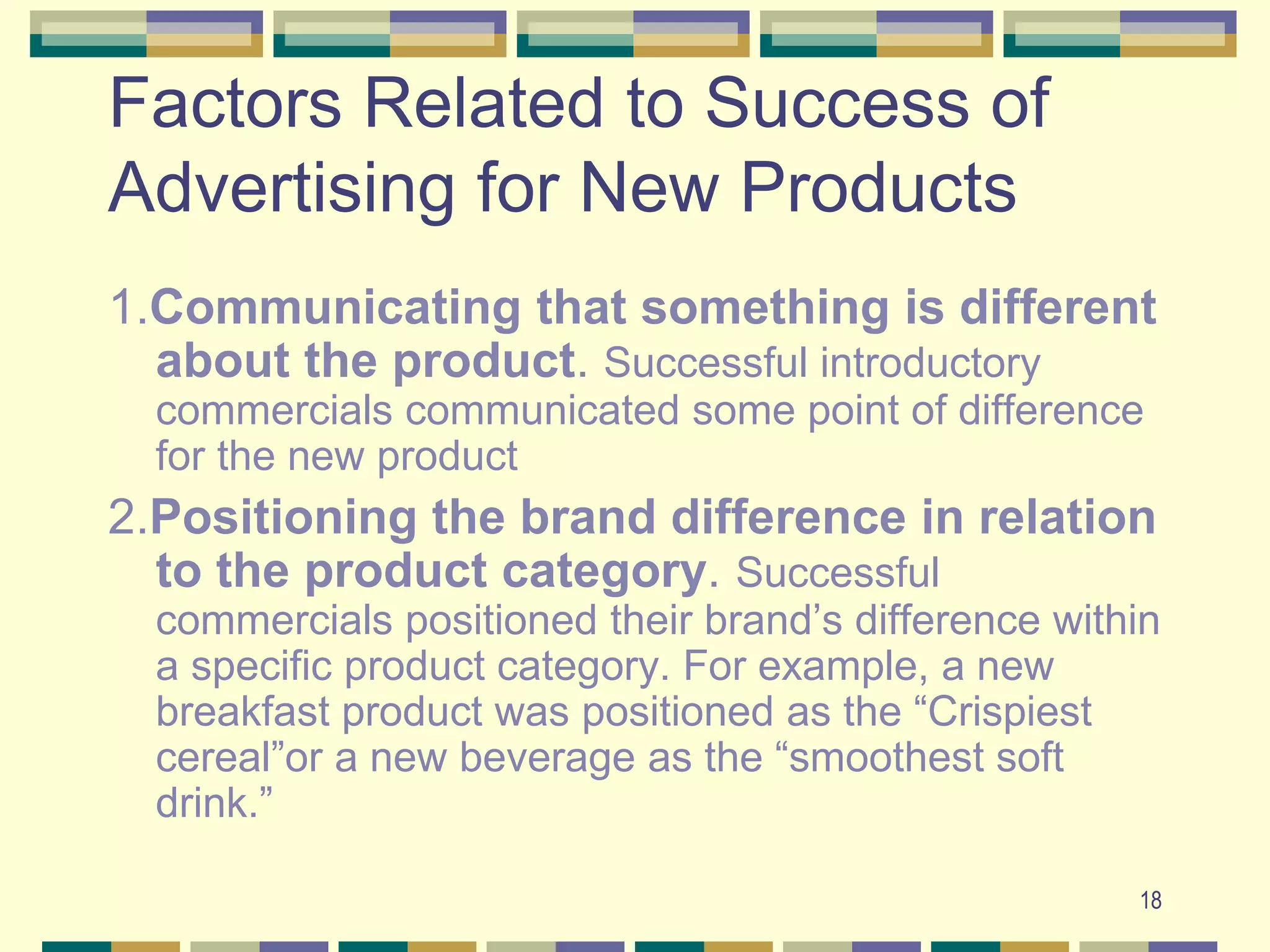
Factors Related to Success of
Advertising for New Products
1.Communicating that something is different
about the product. Successful introductory
commercials communicated some point of difference
for the new product
2.Positioning the brand difference in relation
to the product category. Successful
commercials positioned their brand’s difference within
a specific product category. For example, a new
breakfast product was positioned as the “Crispiest
cereal”or a new beverage as the “smoothest soft
drink.”
19
Factors Related to Success of
Advertising for New Products
3.Communicating that the product
difference is beneficial to consumers.
Nearly all of the successful commercials linked a
benefit directly to the new product’s difference.
4.Supporting the idea that something about
the product is different and/or beneficial to
consumers. All the successful commercials
communicated support for the product’s difference
claim or its relevance to consumers. Support took the
form of demonstrations of performance, information
supporting a uniqueness claim, endorsements, or
testimonials.
20
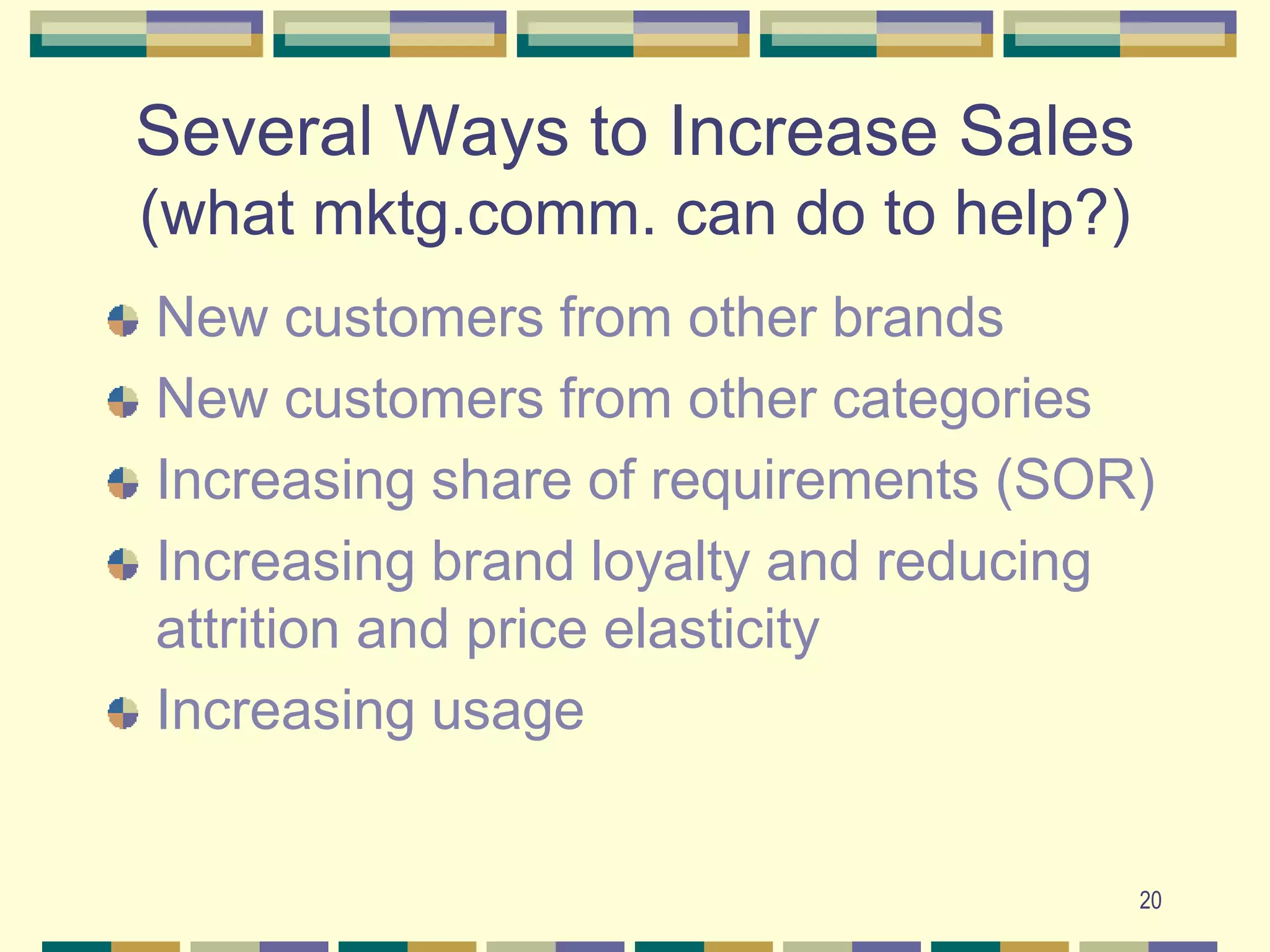
Several Ways to Increase Sales
(what mktg.comm. can do to help?)
New customers from other brands
New customers from other categories
Increasing share of requirements (SOR)
Increasing brand loyalty and reducing
attrition and price elasticity
Increasing usage
21
McDonald’s Advertising Response Function
Sales
Advertising
22
Relationship of Adv. to Sales & Profits
In consumer goods marketing, increases in market
share are closely related to increases in the
marketing budget.
There are minimum levels below which advertising
expenditures have no effect on sales.
Sales normally increase with additional advertising.
At some point, however, the rate of return declines.
There will be some sales even with no advertising.
Sales response to advertising may build over time,
but the durability of advertising is brief, so a
consistent investment is important.
Culture and competition impose saturation limits
above which no amount or advertising can increase
sales.
23
Advertising Budgeting
Methods
Objectives-and-tasks method
Percentage-of-sales method
Competitive parity method
All-you-can-afford
Arbitrary allocation
Quantitative or experimental model
24
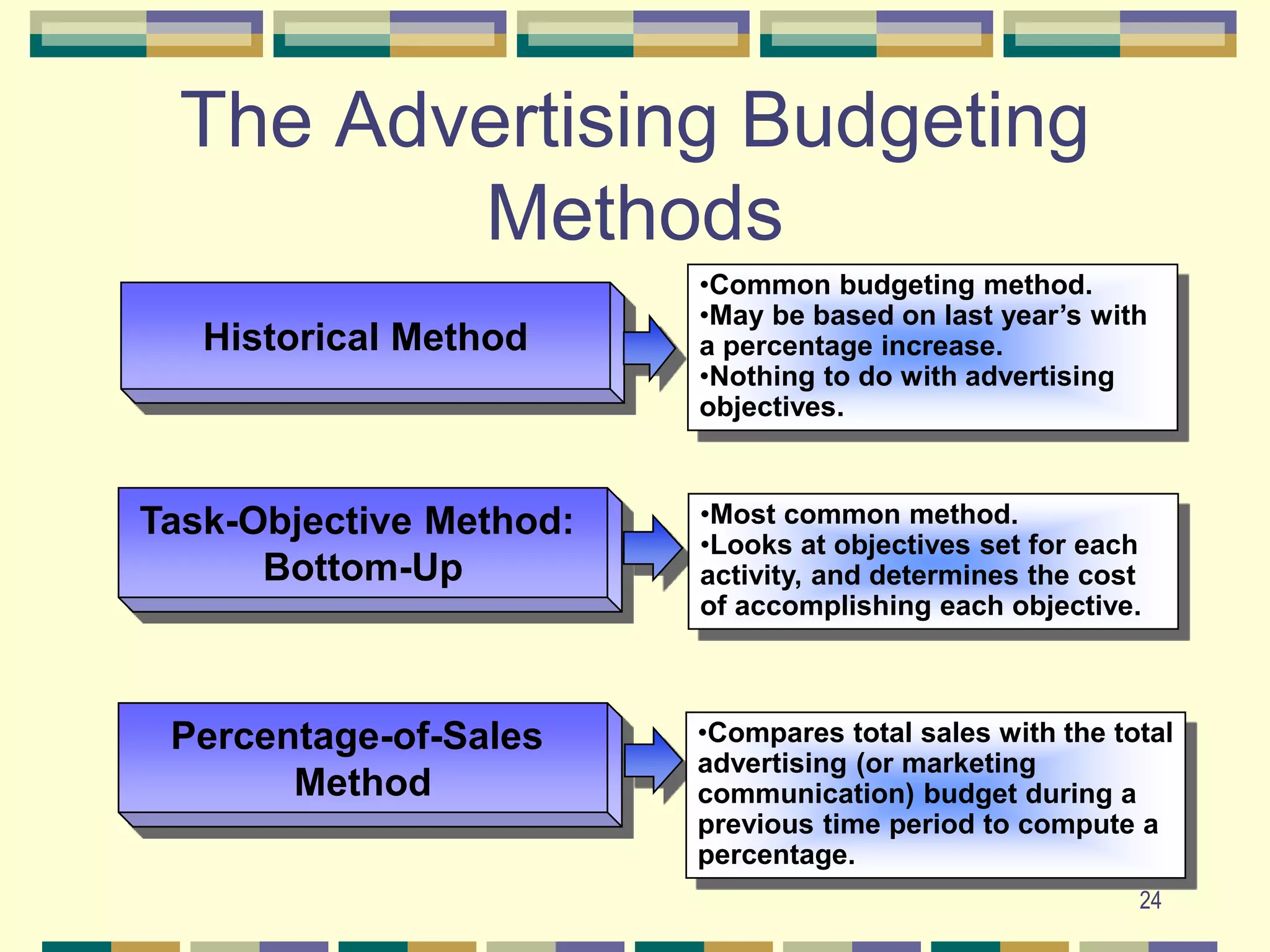
Historical Method
Task-Objective Method:
Bottom-Up
Percentage-of-Sales
Method
•Common budgeting method.
•May be based on last year’s with
a percentage increase.
•Nothing to do with advertising
objectives.
•Most common method.
•Looks at objectives set for each
activity, and determines the cost
of accomplishing each objective.
•Compares total sales with the total
advertising (or marketing
communication) budget during a
previous time period to compute a
percentage.
The Advertising Budgeting
Methods
25
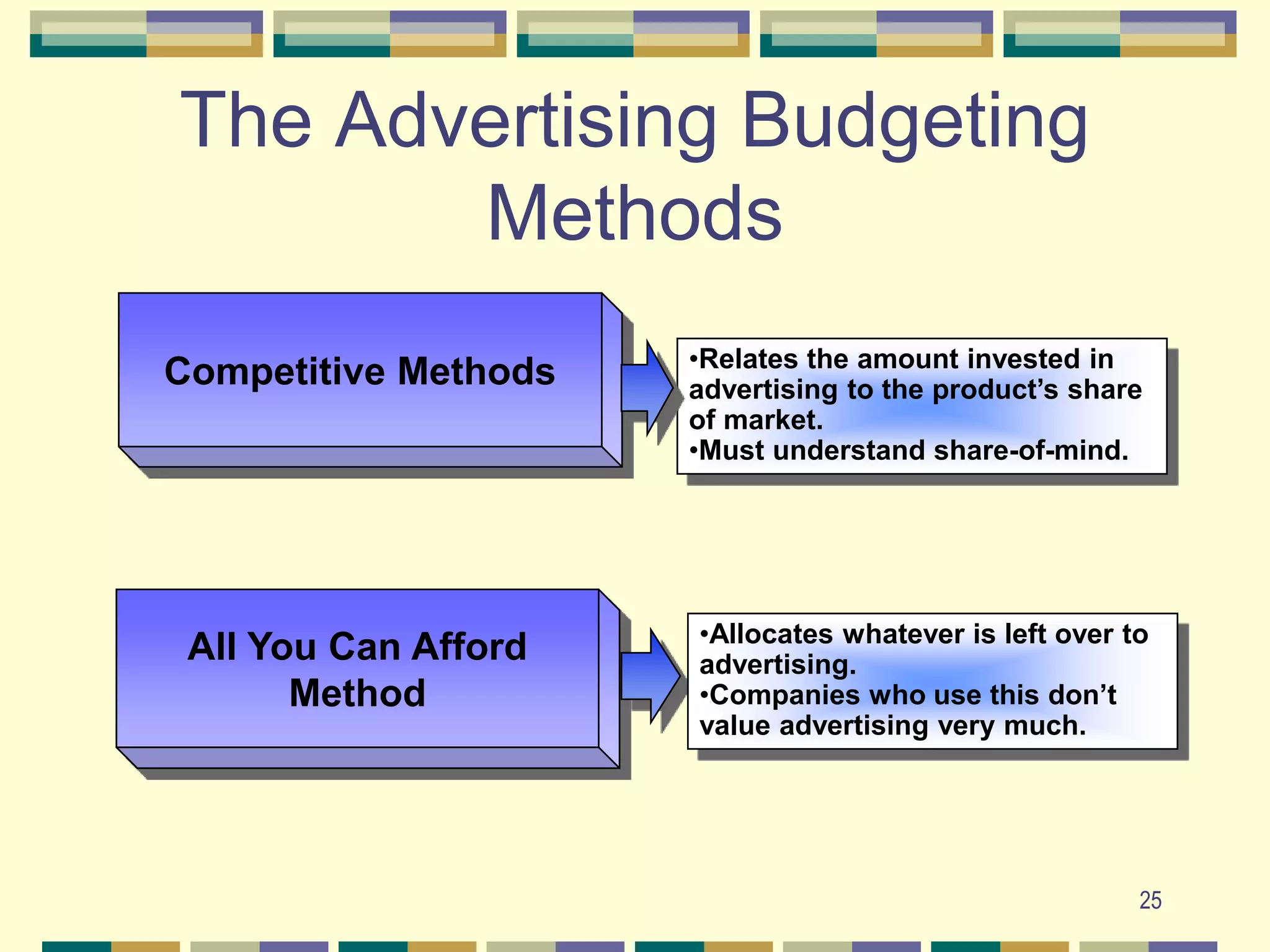
Competitive Methods
All You Can Afford
Method
•Relates the amount invested in
advertising to the product’s share
of market.
•Must understand share-of-mind.
•Allocates whatever is left over to
advertising.
•Companies who use this don’t
value advertising very much.
The Advertising Budgeting
Methods
26
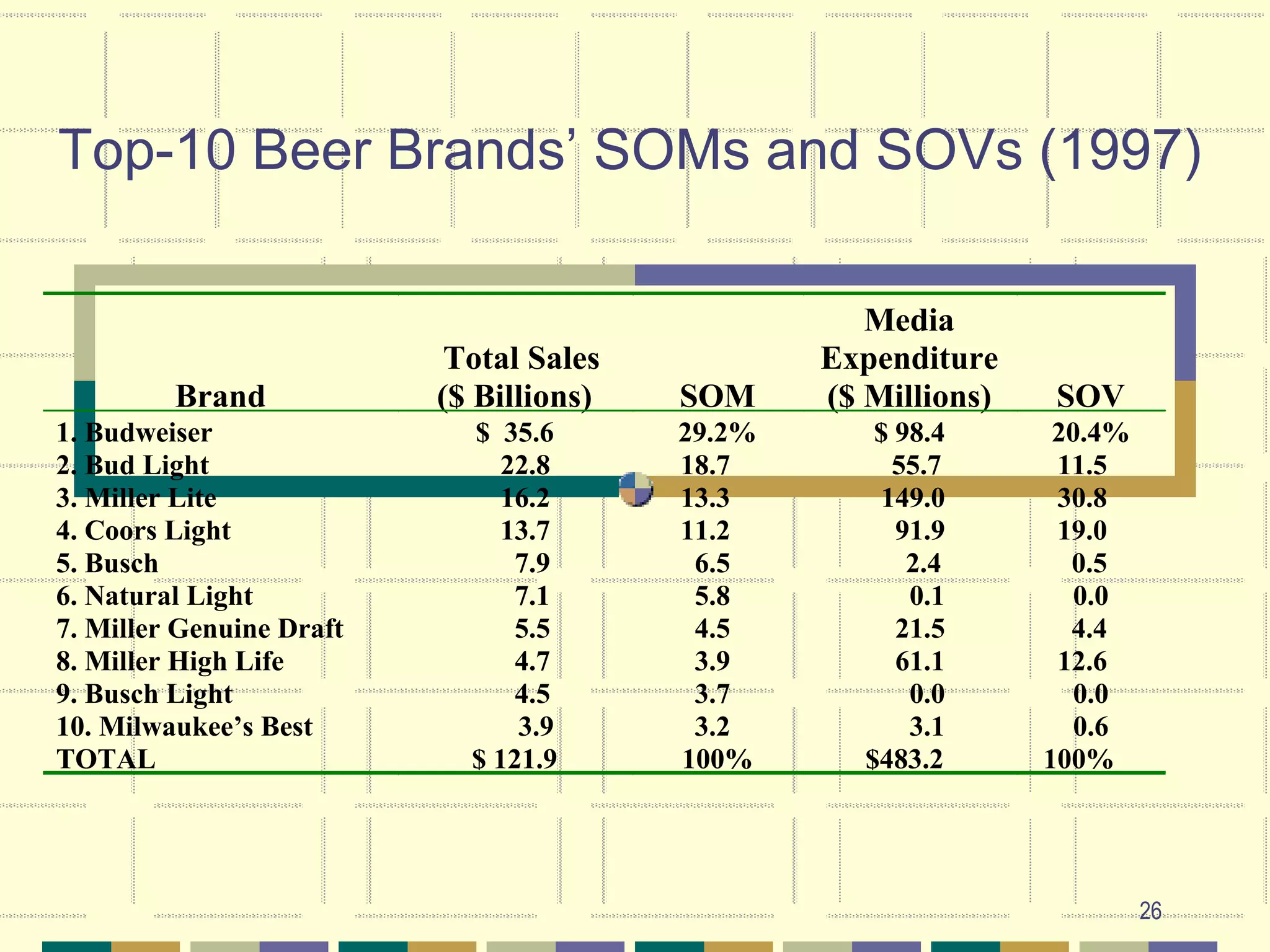
Top-10 Beer Brands’ SOMs and SOVs (1997)
Brand
Total Sales
($ Billions) SOM
Media
Expenditure
($ Millions) SOV
1. Budweiser $ 35.6 29.2% $ 98.4 20.4%
2. Bud Light 22.8 18.7 55.7 11.5
3. Miller Lite 16.2 13.3 149.0 30.8
4. Coors Light 13.7 11.2 91.9 19.0
5. Busch 7.9 6.5 2.4 0.5
6. Natural Light 7.1 5.8 0.1 0.0
7. Miller Genuine Draft 5.5 4.5 21.5 4.4
8. Miller High Life 4.7 3.9 61.1 12.6
9. Busch Light 4.5 3.7 0.0 0.0
10. Milwaukee’s Best 3.9 3.2 3.1 0.6
TOTAL $ 121.9 100% $483.2 100%
27
Review
Learn about major components of the
advertising plan.
Understand the importance of setting
objectives.
Discuss the success factors of introductory
advertising and the relationship between
advertising and sales.
Discuss various budgeting methods used in
advertising.

Advertising Planning and Strategy.ppt

  • 1.
  • 2.
    2 Learning Objectives Learn aboutmajor components of the advertising plan. Understand the importance of setting objectives. Discuss the success factors of introductory advertising and the relationship between advertising and sales. Discuss various budgeting methods used in advertising.
  • 3.
    3 The Advertising PlanningCycle 1. Where are we? 2.Why are we there? 3.Where could we be? 4. How could we get there? 5. Are we getting there?
  • 4.
    4 Advertising Planning andDecision Making Situation Analysis Marketing Program Advertising Plan Implementation The Communication/ Persuasion Process Consumer/Market Analysis Competitive Analysis Role of Advertising, Sales Force, Price, Promotion, Public Relations Objectives/Segmentation/Positioning Message Strategy and Tactics Media Strategy and Tactics “Facilitating” Agencies Social and Legal Constraints Figure 2-1 Framework for advertising planning and decision making
  • 5.
    5 The Advertising Plan AnAdvertising Plan Matches the Right Audience to the Right Message and Presents It in the Right Medium to Reach That Audience & Has Three Elements. Targeting the Audience: Whom are you trying to reach? Message Strategy: What do you say to them? Media Strategy: When & where will you reach them?
  • 6.
    6 Understanding of Comm. Process Atypical communication process model A model of persuasion process  Ad exposure  Different functions of advertising messages  Brand attitude  Purchase behavior
  • 7.
    7 Developing an Advertising Plan Advertisingobjectives and target market selection Creative plan: Message strategy and tactics Media plan: media strategy and tactics Evaluation (research) ==> IMC approach: identify roles of various forms of IMC and repeat the process.
  • 8.
    8 Typical Advertising orCampaign Plan Outline (Tab. 7.1) I. Introduction • Executive Summary or Overview is provided. II. Situation Analysis • Advertising Problems • Advertising Opportunities III. Key Strategy Decisions • Advertising Objectives • Target Audience • Competitive Product Advantage • Product Image and Personality • Product Position
  • 9.
    9 Typical Advertising orCampaign Plan Outline (Tab. 7.1) IV. The Creative Plan V. The Media Plan VI. The Communication Plan • Sales promotion • Public relations • Direct marketing • Personal selling • Sponsorships, merchandising, packaging, etc. VII. Implementation and Evaluation VIII. Evaluation IX. Budget
  • 10.
    10 Situation Analysis Opportunity analysis:to spot and capitalize on favorable demand trends  examples of such trends Competitive analysis: to achieve and maintain a “competitive advantage”  examples of competitive advantages Target market selection  examples of target marketing ==> Marketing plan (4Ps)
  • 11.
    11 Creative Platform &Message Strategy Creative platform is a document that outlines the message strategy decisions for an individual ad. Creative platforms combine the basic advertising decisions – problems, objectives, and target markets – with the critical elements of the sales message strategy – main idea and details about how the idea will be executed.
  • 12.
    12 Product Benefit Promises Reason Why Unique Selling Proposition Support Advertisementsthat focus on the product itself by looking at attributes. Product is promoted on the basis of what it can do for customers. Promises that something will happen if you use the advertised product. Based on logic and reasoning and clearly states a reason for the benefit gained. A benefit statement that is both unique to the product and important to the user. Lends credibility to the selling premise. Selling Premises
  • 13.
    13 Defining Advertising Goalsfor Measured Advertising Results (1962, 1995, S. Dutka) The 6M approach  Merchandise: important benefits to sell  Markets: who to reach  Motives: why people buy or fail to buy  Media: how to reach  Measurements: how to evaluate (time and change)  Messages: key ideas to convey to move
  • 14.
    14 Setting Objectives Why setobjectives?: -- Planning and decision making -- Communication -- Measurement and evaluation Sales vs. Communication objectives -- Problems with sales objectives  When sales objectives are appropriate -- Challenges with communication objectives
  • 15.
    15 What is GoodObjectives? Good Objectives Concrete and Measurable Specify a well- defined audience Attainable Specify a time period Establish bench- Mark measures Realistic
  • 16.
    16 Setting Objectives Usingthe Communications Effects Pyramid Product: Backstage Shampoo Time period: Six months Objective 1: Create awareness among 90 percent of target audience. Using repetitive advertising in newspapers, magazines, TV and radio programs. Simple message. Objective 2: Create interest in the brand among 70 percent of target audience. Communicate information about the features and benefits of the brand-I.e., that it contains no soap and improves the texture of the hair
  • 17.
    17 Setting objectives usingthe communications effects pyramid Objective 3: Create positive feelings about the brand among 40 percent and preference among 25 percent of the target audience. Create favorable attitudes by conveying information, promotions, sampling, etc. Objective 4: Obtain trial among 20 percent of the target audience. Use sampling and cents-off coupons along with advertising and promotions Objective 5: Develop and maintain regular use of Backstage Shampoo among 5 percent of the target audience. Use continued reinforcement advertising, fewer coupons and promotions
  • 18.
    18 Factors Related toSuccess of Advertising for New Products 1.Communicating that something is different about the product. Successful introductory commercials communicated some point of difference for the new product 2.Positioning the brand difference in relation to the product category. Successful commercials positioned their brand’s difference within a specific product category. For example, a new breakfast product was positioned as the “Crispiest cereal”or a new beverage as the “smoothest soft drink.”
  • 19.
    19 Factors Related toSuccess of Advertising for New Products 3.Communicating that the product difference is beneficial to consumers. Nearly all of the successful commercials linked a benefit directly to the new product’s difference. 4.Supporting the idea that something about the product is different and/or beneficial to consumers. All the successful commercials communicated support for the product’s difference claim or its relevance to consumers. Support took the form of demonstrations of performance, information supporting a uniqueness claim, endorsements, or testimonials.
  • 20.
    20 Several Ways toIncrease Sales (what mktg.comm. can do to help?) New customers from other brands New customers from other categories Increasing share of requirements (SOR) Increasing brand loyalty and reducing attrition and price elasticity Increasing usage
  • 21.
    21 McDonald’s Advertising ResponseFunction Sales Advertising
  • 22.
    22 Relationship of Adv.to Sales & Profits In consumer goods marketing, increases in market share are closely related to increases in the marketing budget. There are minimum levels below which advertising expenditures have no effect on sales. Sales normally increase with additional advertising. At some point, however, the rate of return declines. There will be some sales even with no advertising. Sales response to advertising may build over time, but the durability of advertising is brief, so a consistent investment is important. Culture and competition impose saturation limits above which no amount or advertising can increase sales.
  • 23.
    23 Advertising Budgeting Methods Objectives-and-tasks method Percentage-of-salesmethod Competitive parity method All-you-can-afford Arbitrary allocation Quantitative or experimental model
  • 24.
    24 Historical Method Task-Objective Method: Bottom-Up Percentage-of-Sales Method •Commonbudgeting method. •May be based on last year’s with a percentage increase. •Nothing to do with advertising objectives. •Most common method. •Looks at objectives set for each activity, and determines the cost of accomplishing each objective. •Compares total sales with the total advertising (or marketing communication) budget during a previous time period to compute a percentage. The Advertising Budgeting Methods
  • 25.
    25 Competitive Methods All YouCan Afford Method •Relates the amount invested in advertising to the product’s share of market. •Must understand share-of-mind. •Allocates whatever is left over to advertising. •Companies who use this don’t value advertising very much. The Advertising Budgeting Methods
  • 26.
    26 Top-10 Beer Brands’SOMs and SOVs (1997) Brand Total Sales ($ Billions) SOM Media Expenditure ($ Millions) SOV 1. Budweiser $ 35.6 29.2% $ 98.4 20.4% 2. Bud Light 22.8 18.7 55.7 11.5 3. Miller Lite 16.2 13.3 149.0 30.8 4. Coors Light 13.7 11.2 91.9 19.0 5. Busch 7.9 6.5 2.4 0.5 6. Natural Light 7.1 5.8 0.1 0.0 7. Miller Genuine Draft 5.5 4.5 21.5 4.4 8. Miller High Life 4.7 3.9 61.1 12.6 9. Busch Light 4.5 3.7 0.0 0.0 10. Milwaukee’s Best 3.9 3.2 3.1 0.6 TOTAL $ 121.9 100% $483.2 100%
  • 27.
    27 Review Learn about majorcomponents of the advertising plan. Understand the importance of setting objectives. Discuss the success factors of introductory advertising and the relationship between advertising and sales. Discuss various budgeting methods used in advertising.