


Chapter 10
Foreign Finance, Investment, and
Aid: Controversies and Opportunities
Problems and Policies: international and macro
2
1 The International Flow of Financial Resources
• A majority of developing nations have historically incurred deficits on current
account balance
– So, inflow of foreign financial resources plays an important role in long-run
development strategies. Resources needed for investments in key sectors and for
carrying out poverty reduction strategies.
• Three sources:
– Private direct and portfolio investment
– Remittances of earnings by international migrants
– Public and private development assistance
2 Private FDI and the Multinational Corporation
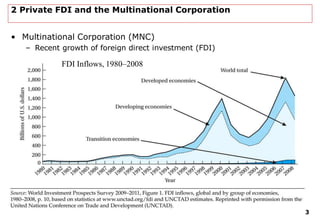
• Multinational Corporation (MNC)
– Recent growth of foreign direct investment (FDI)
FDI Inflows, 1980–2008
3
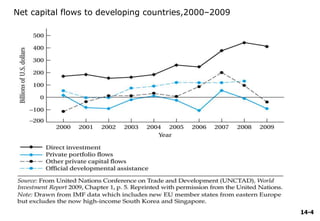
Net capital flows to developing countries,2000–2009
14-4
5
Private Foreign Investment: Pros and Cons
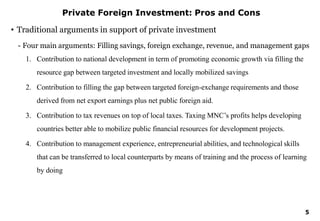
• Traditional arguments in support of private investment
- Four main arguments: Filling savings, foreign exchange, revenue, and management gaps
1. Contribution to national development in term of promoting economic growth via filling the
resource gap between targeted investment and locally mobilized savings
2. Contribution to filling the gap between targeted foreign-exchange requirements and those
derived from net export earnings plus net public foreign aid.
3. Contribution to tax revenues on top of local taxes. Taxing MNC’s profits helps developing
countries better able to mobilize public financial resources for development projects.
4. Contribution to management experience, entrepreneurial abilities, and technological skills
that can be transferred to local counterparts by means of training and the process of learning
by doing
6
• Traditional arguments against private foreign investment
– Two main arguments: Economic and ideological
i. Economic:
 FI may lower domestic savings and investment by substituting for foreign savings
*Discouraging competition through exclusive production agreements with host
governments
* Failing to reinvest much of their profits
* Generating domestic incomes for groups with lower savings propensities
*Inhibiting the expansion of indigenous firms that might supply them with intermediate
products by instead importing these goods from overseas affiliates.
*MNCs also raise a large fraction of their capital locally in the developing country itself,
and this may lead to some crowding out of investment of local firms.
 Although the initial impact of MNC investment is to improve the foreign exchange position
of the recipient nation, its long-run impact may be to reduce foreign-exchange earnings or at
least make the net increase smaller than it appeared, as a result of substantial importation of
intermediate products and capital goods and because of the overseas repatriation of profits,
interest, royalties, management fees, and other funds.
 Although MNCs do contribute to public revenue in the form of corporate taxes, their
contribution is considerably less than it might appear as a result of liberal tax concessions,
the practice of transfer pricing, excessive investment allowances, disguised public
subsidies, and tariff protection provided by the host government.
 The management, entrepreneurial skills, ideas, technology, and overseas contacts provided
by MNCs may have little impact on developing local sources of these scarce skills and
resources and may in fact inhibit their development by stifling the growth of indigenous
entrepreneurship as a result of the MNCs’ dominance of local markets.
7
8
ii. Ideological arguments refer to policy thought some of above concerns
 MNCs may reinforce dualistic economic structures and exacerbate income inequalities.
- Worsen the imbalance between rural and urban economic opportunities
 MNCs may produce inappropriate products (demanded by a small, rich minority), stimulate
wrong consumption patterns through advertising and market power, and with capital-
intensive technologies they create relatively little employment.
 MNCs may cause socially undesirable allocation of domestic resources
 MNCs may have adverse impact on government policies in term of concession, tax
holiday, and cheap factory sites
 MNCs may suppress domestic entrepreneurship
 MNCs may gain control over local assets and jobs and then exert considerable influence on
political decisions at all levels.
• Reconciling pros and cons: accept foreign investment with responsible policy –
reap the maximal benefit from MNCs
9
• What is portfolio investment?
– Basically, portfolio investment refers to foreign purchases of stocks (equity), bonds,
certificates of deposit, and other commercial papers in a home country.
• Private Portfolio Investment: Benefits and Risks?
- Portfolio Investment (SR)  FDI (LR)
- Benefit: raising capital for domestic firms to diversify their assets
- Risk: portfolio funds can flow out back unexpectedly causing instability for both the
financial market and the overall economy.
• Emerging-country stock markets
14-10
3 The Role and Growth of Remittances
• Wage differences produce migration from developing countries to more
developing countries, and developed countries
- Migrants often send money vital for keeping children in school and better-fed
- Remittances now provide a significant pathway out of poverty
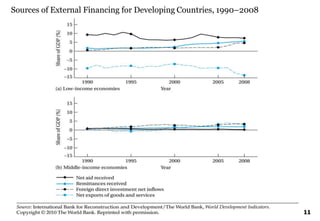
- Remittances have increased noticeably, exceeding 5% of GDP of low-income countries
in 2008, outpacing FDI and approaching inflows from aid
• “Brain Drain” is the main problem of migration for developing countries
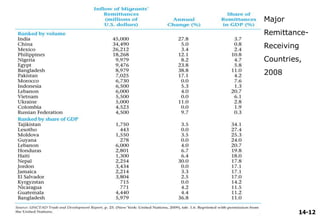
• Uneven flow of remittances
Sources of External Financing for Developing Countries, 1990–2008
11
Major
Remittance-
Receiving
Countries,
2008
14-12
13
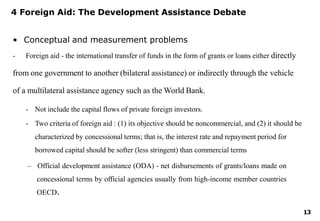
4 Foreign Aid: The Development Assistance Debate
• Conceptual and measurement problems
- Foreign aid - the international transfer of funds in the form of grants or loans either directly
from one government to another (bilateral assistance) or indirectly through the vehicle
of a multilateral assistance agency such as the World Bank.
- Not include the capital flows of private foreign investors.
- Two criteria of foreign aid : (1) its objective should be noncommercial, and (2) it should be
characterized by concessional terms; that is, the interest rate and repayment period for
borrowed capital should be softer (less stringent) than commercial terms
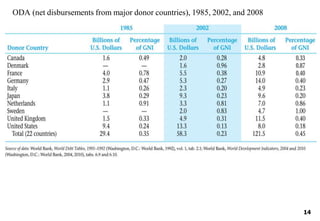
– Official development assistance (ODA) - net disbursements of grants/loans made on
concessional terms by official agencies usually from high-income member countries
OECD.
ODA (net disbursements from major donor countries), 1985, 2002, and 2008
14
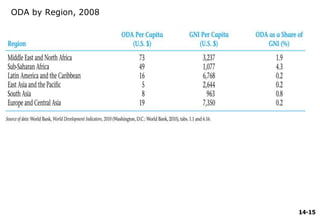
ODA by Region, 2008
14-15
16
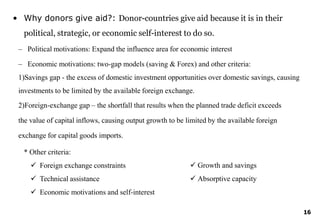
• Why donors give aid?: Donor-countries give aid because it is in their
political, strategic, or economic self-interest to do so.
– Political motivations: Expand the influence area for economic interest
– Economic motivations: two-gap models (saving & Forex) and other criteria:
1)Savings gap - the excess of domestic investment opportunities over domestic savings, causing
investments to be limited by the available foreign exchange.
2)Foreign-exchange gap – the shortfall that results when the planned trade deficit exceeds
the value of capital inflows, causing output growth to be limited by the available foreign
exchange for capital goods imports.
* Other criteria:
 Foreign exchange constraints
 Technical assistance
 Economic motivations and self-interest
 Growth and savings
 Absorptive capacity
17
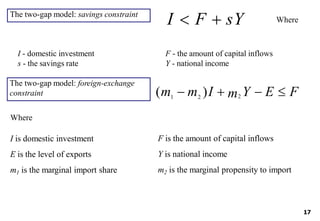
The two-gap model: savings constraint
I  F  sY
I - domestic investment
s - the savings rate
F - the amount of capital inflows
Y - national income
(m1  m2 )I  m2 Y  E  F
Where
The two-gap model: foreign-exchange
constraint
Where
I is domestic investment
E is the level of exports
m1 is the marginal import share
F is the amount of capital inflows
Y is national income
m2 is the marginal propensity to import
18
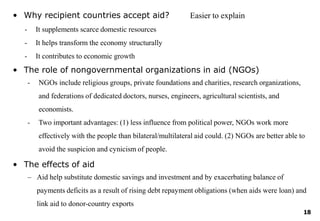
• Why recipient countries accept aid? Easier to explain
- It supplements scarce domestic resources
- It helps transform the economy structurally
- It contributes to economic growth
• The role of nongovernmental organizations in aid (NGOs)
- NGOs include religious groups, private foundations and charities, research organizations,
and federations of dedicated doctors, nurses, engineers, agricultural scientists, and
economists.
- Two important advantages: (1) less influence from political power, NGOs work more
effectively with the people than bilateral/multilateral aid could. (2) NGOs are better able to
avoid the suspicion and cynicism of people.
• The effects of aid
– Aid help substitute domestic savings and investment and by exacerbating balance of
payments deficits as a result of rising debt repayment obligations (when aids were loan) and
link aid to donor-country exports
14-19
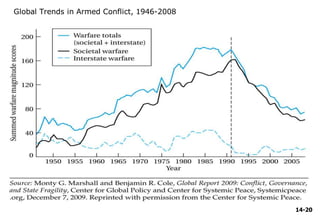
5 Conflict and Development
• The scope of violent conflict and conflict risks
- Assurance of security may be the most fundamental of all institutions for development
- Conflict creates expectation of likely future conflicts and doubts about the economic
environment
• The consequences of armed conflict
– Health
– Destruction of wealth
– Worsening hunger and poverty
– Loss of education
– A torn social fabric
Global Trends in Armed Conflict, 1946-2008
14-20
14-21
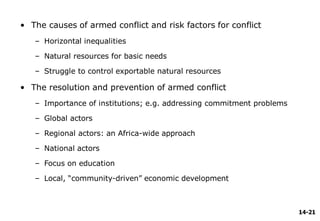
• The causes of armed conflict and risk factors for conflict
– Horizontal inequalities
– Natural resources for basic needs
– Struggle to control exportable natural resources
• The resolution and prevention of armed conflict
– Importance of institutions; e.g. addressing commitment problems
– Global actors
– Regional actors: an Africa-wide approach
– National actors
– Focus on education
– Local, “community-driven” economic development
14-22
Concepts for Review
•Absorptive capacity
• Commitment problem
• Concessional terms
• Foreign aid
• Foreign direct investment (FDI)
• Foreign-exchange gap
• Global factories
• Multinational corporation (MNC)
•Nongovernmental organizations
(NGOs)
• Official development assistance (ODA)
• Portfolio investment
• Savings gap
• Technical assistance
• Tied aid
• Transfer pricing
• Two-gap model

Decon 10

  • 1.
    Chapter 10 Foreign Finance,Investment, and Aid: Controversies and Opportunities Problems and Policies: international and macro
  • 2.
    2 1 The InternationalFlow of Financial Resources • A majority of developing nations have historically incurred deficits on current account balance – So, inflow of foreign financial resources plays an important role in long-run development strategies. Resources needed for investments in key sectors and for carrying out poverty reduction strategies. • Three sources: – Private direct and portfolio investment – Remittances of earnings by international migrants – Public and private development assistance
  • 3.
    2 Private FDIand the Multinational Corporation • Multinational Corporation (MNC) – Recent growth of foreign direct investment (FDI) FDI Inflows, 1980–2008 3
  • 4.
    Net capital flowsto developing countries,2000–2009 14-4
  • 5.
    5 Private Foreign Investment:Pros and Cons • Traditional arguments in support of private investment - Four main arguments: Filling savings, foreign exchange, revenue, and management gaps 1. Contribution to national development in term of promoting economic growth via filling the resource gap between targeted investment and locally mobilized savings 2. Contribution to filling the gap between targeted foreign-exchange requirements and those derived from net export earnings plus net public foreign aid. 3. Contribution to tax revenues on top of local taxes. Taxing MNC’s profits helps developing countries better able to mobilize public financial resources for development projects. 4. Contribution to management experience, entrepreneurial abilities, and technological skills that can be transferred to local counterparts by means of training and the process of learning by doing
  • 6.
    6 • Traditional argumentsagainst private foreign investment – Two main arguments: Economic and ideological i. Economic:  FI may lower domestic savings and investment by substituting for foreign savings *Discouraging competition through exclusive production agreements with host governments * Failing to reinvest much of their profits * Generating domestic incomes for groups with lower savings propensities *Inhibiting the expansion of indigenous firms that might supply them with intermediate products by instead importing these goods from overseas affiliates. *MNCs also raise a large fraction of their capital locally in the developing country itself, and this may lead to some crowding out of investment of local firms.
  • 7.
     Although theinitial impact of MNC investment is to improve the foreign exchange position of the recipient nation, its long-run impact may be to reduce foreign-exchange earnings or at least make the net increase smaller than it appeared, as a result of substantial importation of intermediate products and capital goods and because of the overseas repatriation of profits, interest, royalties, management fees, and other funds.  Although MNCs do contribute to public revenue in the form of corporate taxes, their contribution is considerably less than it might appear as a result of liberal tax concessions, the practice of transfer pricing, excessive investment allowances, disguised public subsidies, and tariff protection provided by the host government.  The management, entrepreneurial skills, ideas, technology, and overseas contacts provided by MNCs may have little impact on developing local sources of these scarce skills and resources and may in fact inhibit their development by stifling the growth of indigenous entrepreneurship as a result of the MNCs’ dominance of local markets. 7
  • 8.
    8 ii. Ideological argumentsrefer to policy thought some of above concerns  MNCs may reinforce dualistic economic structures and exacerbate income inequalities. - Worsen the imbalance between rural and urban economic opportunities  MNCs may produce inappropriate products (demanded by a small, rich minority), stimulate wrong consumption patterns through advertising and market power, and with capital- intensive technologies they create relatively little employment.  MNCs may cause socially undesirable allocation of domestic resources  MNCs may have adverse impact on government policies in term of concession, tax holiday, and cheap factory sites  MNCs may suppress domestic entrepreneurship  MNCs may gain control over local assets and jobs and then exert considerable influence on political decisions at all levels. • Reconciling pros and cons: accept foreign investment with responsible policy – reap the maximal benefit from MNCs
  • 9.
    9 • What isportfolio investment? – Basically, portfolio investment refers to foreign purchases of stocks (equity), bonds, certificates of deposit, and other commercial papers in a home country. • Private Portfolio Investment: Benefits and Risks? - Portfolio Investment (SR)  FDI (LR) - Benefit: raising capital for domestic firms to diversify their assets - Risk: portfolio funds can flow out back unexpectedly causing instability for both the financial market and the overall economy. • Emerging-country stock markets
  • 10.
    14-10 3 The Roleand Growth of Remittances • Wage differences produce migration from developing countries to more developing countries, and developed countries - Migrants often send money vital for keeping children in school and better-fed - Remittances now provide a significant pathway out of poverty - Remittances have increased noticeably, exceeding 5% of GDP of low-income countries in 2008, outpacing FDI and approaching inflows from aid • “Brain Drain” is the main problem of migration for developing countries • Uneven flow of remittances
  • 11.
    Sources of ExternalFinancing for Developing Countries, 1990–2008 11
  • 12.
  • 13.
    13 4 Foreign Aid:The Development Assistance Debate • Conceptual and measurement problems - Foreign aid - the international transfer of funds in the form of grants or loans either directly from one government to another (bilateral assistance) or indirectly through the vehicle of a multilateral assistance agency such as the World Bank. - Not include the capital flows of private foreign investors. - Two criteria of foreign aid : (1) its objective should be noncommercial, and (2) it should be characterized by concessional terms; that is, the interest rate and repayment period for borrowed capital should be softer (less stringent) than commercial terms – Official development assistance (ODA) - net disbursements of grants/loans made on concessional terms by official agencies usually from high-income member countries OECD.
  • 14.
    ODA (net disbursementsfrom major donor countries), 1985, 2002, and 2008 14
  • 15.
    ODA by Region,2008 14-15
  • 16.
    16 • Why donorsgive aid?: Donor-countries give aid because it is in their political, strategic, or economic self-interest to do so. – Political motivations: Expand the influence area for economic interest – Economic motivations: two-gap models (saving & Forex) and other criteria: 1)Savings gap - the excess of domestic investment opportunities over domestic savings, causing investments to be limited by the available foreign exchange. 2)Foreign-exchange gap – the shortfall that results when the planned trade deficit exceeds the value of capital inflows, causing output growth to be limited by the available foreign exchange for capital goods imports. * Other criteria:  Foreign exchange constraints  Technical assistance  Economic motivations and self-interest  Growth and savings  Absorptive capacity
  • 17.
    17 The two-gap model:savings constraint I  F  sY I - domestic investment s - the savings rate F - the amount of capital inflows Y - national income (m1  m2 )I  m2 Y  E  F Where The two-gap model: foreign-exchange constraint Where I is domestic investment E is the level of exports m1 is the marginal import share F is the amount of capital inflows Y is national income m2 is the marginal propensity to import
  • 18.
    18 • Why recipientcountries accept aid? Easier to explain - It supplements scarce domestic resources - It helps transform the economy structurally - It contributes to economic growth • The role of nongovernmental organizations in aid (NGOs) - NGOs include religious groups, private foundations and charities, research organizations, and federations of dedicated doctors, nurses, engineers, agricultural scientists, and economists. - Two important advantages: (1) less influence from political power, NGOs work more effectively with the people than bilateral/multilateral aid could. (2) NGOs are better able to avoid the suspicion and cynicism of people. • The effects of aid – Aid help substitute domestic savings and investment and by exacerbating balance of payments deficits as a result of rising debt repayment obligations (when aids were loan) and link aid to donor-country exports
  • 19.
    14-19 5 Conflict andDevelopment • The scope of violent conflict and conflict risks - Assurance of security may be the most fundamental of all institutions for development - Conflict creates expectation of likely future conflicts and doubts about the economic environment • The consequences of armed conflict – Health – Destruction of wealth – Worsening hunger and poverty – Loss of education – A torn social fabric
  • 20.
    Global Trends inArmed Conflict, 1946-2008 14-20
  • 21.
    14-21 • The causesof armed conflict and risk factors for conflict – Horizontal inequalities – Natural resources for basic needs – Struggle to control exportable natural resources • The resolution and prevention of armed conflict – Importance of institutions; e.g. addressing commitment problems – Global actors – Regional actors: an Africa-wide approach – National actors – Focus on education – Local, “community-driven” economic development
  • 22.
    14-22 Concepts for Review •Absorptivecapacity • Commitment problem • Concessional terms • Foreign aid • Foreign direct investment (FDI) • Foreign-exchange gap • Global factories • Multinational corporation (MNC) •Nongovernmental organizations (NGOs) • Official development assistance (ODA) • Portfolio investment • Savings gap • Technical assistance • Tied aid • Transfer pricing • Two-gap model