1 Chapter Four
The IMC Planning
Process
Dr Khondaker Sazzadul Karim
Associate Professor, Marketing
Faculty of Business Administration, AIUB.
Chapter Objectives
1. What makes marketing research critical to the IMC planning
process?
2. How do the various approaches to positioning influence the
selection of target markets?
3. How do marketing communication objectives interact with the
other elements of the IMC planning process?
4. How are communications budgets established?
5. What elements are considered in developing an IMC
program?
The IMC Planning Process
4
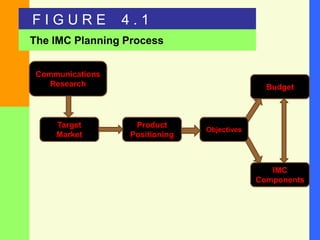
F I G U R E 4 . 1
The IMC Planning Process
Communications
Research
Target
Market
Product
Positioning
Objectives
Budget
IMC
Components
Promotion Opportunity Analysis
A promotion opportunity is the process by marketers
identify the target audience of the goods and services
produced by the company.
A promotion opportunity analysis must accomplish two
objectives:
1. Determine which promotion opportunities exists for the
company
2. Identify the characteristics of each target audience so
a coherent advertising and marketing communication
message can reach it .
(The target audience may consist of individuals, groups, niche markets,
market segments, or a general public or mass audience.
Marketers approach each of these audiences differently.)
1st Step
Communication Market Analysis
A communication market analysis is the process of
discovering organization’s strengths and
weaknesses in the area of marketing
communication and combining that information
with an analysis of opportunities and threats
present in the firm’s external environment.
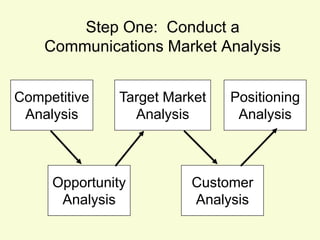
A communication market analysis typically has five
components:
• Competitive analysis
• Opportunity analysis
• Target market analysis
• Customer analysis
• Positioning analysis
Step One: Conduct a
Communications Market Analysis
Competitive
Analysis
Opportunity
Analysis
Customer
Analysis
Positioning
Analysis
Target Market
Analysis
Competitive analysis
A competitive analysis identifies major competitors.
Objective: What competitors are doing in the area
of advertising and communication?
1st: Identify competitors marketing tactics and how
they are attacking the marketplace
2nd: What potential customers see, hear, and read
about the competition.
Competitive analysis
Competitive analysis through collecting
secondary data about the competitors:
• Advertisement
• Promotional materials
• Annual repots
• A prospectus for a publicly held corporation
• Websites
Opportunity analysis
This means watching carefully a new marketing opportunities by
examining all the available data and information about the
market.
Market opportunities are areas where there are favorable
demand trends, where the company believes customer needs
and opportunities are not being satisfied, and where it can
compete effectively.
For example, the number of people who exercise has increased tremendously
in recent years, and the market for athletic footwear has reached over
$13.5 billion.
Some helpful questions in conducting an opportunity analysis are
as follow:
1. Are there customers that the competition is ignoring or not
serving?
Opportunity analysis
2. Which markets are heavily saturated and have intense
competition?
3. Are the benefits of our goods and services being clearly
articulated to our customers ?
4. Are there opportunities to build relationships with the customers
using slightly different marketing approach?
5. Are there opportunities that are not being pursued, or is our
brand positioned with a cluster of companies in such a
manner that it cannot stand out?
Target Market Analysis
This stage require the marketing department to recognize the
need of various consumers and business groups.
The segmentation process involves five distinct steps:
1. Finding ways to group consumers according to their needs.
2. Finding ways to group the marketing actions—usually the
products offered— available to the organization.
3. Developing a market-product grid to relate the market
segments to the firm’s products or actions.
4. Selecting the target segments toward which the firm directs its
marketing actions.
5. Taking marketing actions to reach target segments.
Determine the benefit of the customers and determine the way in
which they can be reached.
Customer Analysis
Study the three types of Customer group:
1. A current company customers
2. A competitor’s customers
3. Potential customers who may become interested
in purchasing from a particular company.
Reveal the interpretation of the organization’s
advertisements and its other marketing
communications and help to identify all of a
firm’s future communication avenues.
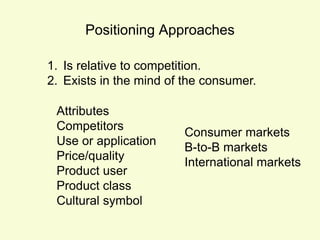
Positioning Approaches
Attributes
Competitors
Use or application
Price/quality
Product user
Product class
Cultural symbol
Consumer markets
B-to-B markets
International markets
1. Is relative to competition.
2. Exists in the mind of the consumer.
Product Positioning
• Is the perception created in the consumer’s
mind regarding the nature of the company
and its products relative to the competition?
• Positioning is created by factors such as
product quality, price, distribution, image, and
marketing communications.
Communication Research
• Understand customers purchase benefits
• Product-specific research
• Key selling points
• Desirable features
• Consumer-oriented research
• Context of product use
• Anthropological approach
• Sociological analysis
• Psychological motives
• Target-market research
• Identifies feasible market segments
Communication
Research
Product-specific research should be
conducted.
Two things should be understood at this
point.
One is whether there are problems
associated with a given good or service,
One approach is called “problem
detection.” in which consumers are asked
to report any problems or difficulties they
have encountered using a product
Communication
Research
Finally, qualitative research will
assist the vendor company and its
advertising agency.
Focus groups are often used to
bring people together to talk about a
product.
With a creative in attendance, it is
possible to hear about the kind of
person who likes a product as well
as tactics which might reach that
individual.
Communication
Research
The actual collection of
information can come from a
variety of perspectives. including
Anthropology
Sociology
Psychology
• The methods employed by Anthropology often involve direct
observation. This helps the marketing team discover not
only who is using a product, but also how it is being used.
• When Whirlpool employed anthropologists to study washing
machines
Communication Research
Sociologist examines
the social class issues
trends and analyze
cohorts and family life
cycles.
Trends come from
media and advertising.
The trend toward
greater involvements
with family and friends.
• Psychology concentrates on motivation, cognition, and
learning. When these come together, values emerge. The
values and life-style model (VALS) is designed to predict
consumer behavior by -understanding self-orientation and
resources.
Knowing the purchasing motives of a target market can greatly
enhance the effectiveness of an advertising program.
• Carefully collected knowledge about the product or service
and the audience for ads and advertising campaigns is
crucial to-success
Communication Research
• Product Attributes
• Competitors
• Use or application
• Price/quality
• Product user
• Product class
• Cultural symbol
F I G U R E 4 . 6
Product Positioning Approaches
Elements of Positioning
• Never completely fixed
• Applies to business-to-business also
• International positioning important
• Critical component of image and
brand management
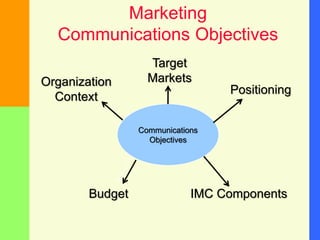
Marketing
Communications Objectives
Communications
Objectives
Organization
Context
Target
Markets
Positioning
Budget IMC Components
 Develop brand awareness
 Increase category demand
 Change customer beliefs and attitudes
 Enhance purchase actions
 Encourage repeat purchases
 Build customer traffic
 Enhance firm image
 Increase market share
 Increase sales
 Reinforce purchase decisions
F I G U R E 4 . 7
Communication Objectives
• Percentage of sales
• Meet-the-competition
• “What we can afford”
• Objective and task
• Payout planning
• Quantitative models
F I G U R E 4 . 10
Methods of Determining Marketing Communication Budgets
Types of Budgets
The percentage of Sales Method:
Prepare communication
budget for coming year
based on either:
Sales form the previous
year or
Anticipated sales for the
next year.
When the sales goes up,
so does in the
communication budget and
when the sales decline, the
communication budget
also decline.
Exceptions, in most cases,
communication budget
should be opposite.
It does not allocate money
for special need or combat
of competitive pressure.
The Meet the Competition Method
The primary of this budget
is to prevent the loss of
market share.
Often used in intense
competitive market.
Drawback: Budget may not
spend efficiently, e.g.
matching the competition
spending does not
guarantee success, which
means market share can
still be lost.
Arbitrary Allocation and
“What we can afford”
Method
Arbitrary Allocation: An arbitration allocation
method is based on management estimates of
what is needed.
There is no criteria is set and no real reasoning is
being used.
“What we can afford” Method: This technique set
the marketing budget after all of the company’s
other budgets have been determined. Money is
allocated based on what the company leader feel
they can afford.
Smaller companies leaders may view marketing
expenditure as non-revenue generating activities.
The objective and Task
Method
To prepare this budget, management first list
all of the objectives it intend to peruse during
the year and then calculate the cost of
accomplishing each objectives. So
communication budget is the cumulative
sum of the estimated costs for all objectives.
Best method due to, It relates dollar costs
related to the objectives.
But least used because of it takes longer
time.
Objective and Task Method
Establish Objectives
(create awareness of new product among
20 percent of target market)
Determine Specific Tasks
(advertise on market area television and
radio and local newspapers)
Estimate Costs Associated with Tasks
(create awareness of new product among
20 percent of target market)
Payout Planning and
Quantitative Models
Payout Planning: Payout Planning
establishing ratio of advertising to
sales or market share. This method
allocates greater amounts in early
years and yield payout in latter year.
Objective is to initially develop a
brand awareness and brand equity.
But, later stage may face a
threshold effect.
Quantitative Models: Develop a
relationship between the advertising
and promotional expenditure with
sales and profits.
F I G U R E 4 . 9
Ad Spending, Brand Recognition, and
Market Share
Auto Insurer Ad Spending
(millions)
Brand
Recognition
Market Share
Geico $600 98% 8.2%
Progressive $506 92% 7.5%
State Farm $455 76% 18.6%
Allstate $369 63% 10.5%
Farmers $203 59% 6.4%
Source: Adapted from Gregory Bresiger, “It’s Ad Infinitum,” New York Post, May 1, 2011,
www.nypost.com/f/print/news/business/it_ad_infinitum_3ThF9rxodhlKnSkcIjdTPK.
IMC Components
• Traditional advertising
• Trade promotions
• Consumer promotions
• Media spending
• Alternative media spending
• Business-to-business media spending
F I G U R E 4 . 10
Breakdown of Marketing Expenditures
Consumer
promotions,
27.9%
Advertising,
41.1%
Trade
promotions,
27.5%
Other, 3.3%
F I G U R E 4 . 11
Global Ad Spending by Media
Source: Based on Ingrid Lunden, “Nielsen: Old School TV Reigns Supreme at 58% of Ad Spend, Internet Display up 27% in Q2,”
http://techcrunch.com/2013/10/22/nielsen-internet-display-ad-spend-up-27-in-q2-but-old-school-tv-reigns-supreme-at-58-of-all-spend, October 22, 2013
Cinema, 0.3% Digital, 4.3%
Magazines, 10.0%
Newspapers, 18.9%
Outdoor, 3.5%
Radio, 5.4%
Television, 57.6%
• Understand the international market
• A borderless marketing plan
• Thinking globally but acting locally
• Local partnerships
• Communication segmentation strategies
• Market communication analysis
• Solid communication objectives
F I G U R E 4 . 1 2
Successful Globally Integrated Marketing
Communications Tactics

CHAPTER 04 The IMC Planning Process.pptx

  • 1.
    1 Chapter Four TheIMC Planning Process Dr Khondaker Sazzadul Karim Associate Professor, Marketing Faculty of Business Administration, AIUB.
  • 2.
    Chapter Objectives 1. Whatmakes marketing research critical to the IMC planning process? 2. How do the various approaches to positioning influence the selection of target markets? 3. How do marketing communication objectives interact with the other elements of the IMC planning process? 4. How are communications budgets established? 5. What elements are considered in developing an IMC program? The IMC Planning Process 4
  • 3.
    F I GU R E 4 . 1 The IMC Planning Process Communications Research Target Market Product Positioning Objectives Budget IMC Components
  • 4.
    Promotion Opportunity Analysis Apromotion opportunity is the process by marketers identify the target audience of the goods and services produced by the company. A promotion opportunity analysis must accomplish two objectives: 1. Determine which promotion opportunities exists for the company 2. Identify the characteristics of each target audience so a coherent advertising and marketing communication message can reach it . (The target audience may consist of individuals, groups, niche markets, market segments, or a general public or mass audience. Marketers approach each of these audiences differently.)
  • 5.
    1st Step Communication MarketAnalysis A communication market analysis is the process of discovering organization’s strengths and weaknesses in the area of marketing communication and combining that information with an analysis of opportunities and threats present in the firm’s external environment. A communication market analysis typically has five components: • Competitive analysis • Opportunity analysis • Target market analysis • Customer analysis • Positioning analysis
  • 6.
    Step One: Conducta Communications Market Analysis Competitive Analysis Opportunity Analysis Customer Analysis Positioning Analysis Target Market Analysis
  • 7.
    Competitive analysis A competitiveanalysis identifies major competitors. Objective: What competitors are doing in the area of advertising and communication? 1st: Identify competitors marketing tactics and how they are attacking the marketplace 2nd: What potential customers see, hear, and read about the competition.
  • 8.
    Competitive analysis Competitive analysisthrough collecting secondary data about the competitors: • Advertisement • Promotional materials • Annual repots • A prospectus for a publicly held corporation • Websites
  • 9.
    Opportunity analysis This meanswatching carefully a new marketing opportunities by examining all the available data and information about the market. Market opportunities are areas where there are favorable demand trends, where the company believes customer needs and opportunities are not being satisfied, and where it can compete effectively. For example, the number of people who exercise has increased tremendously in recent years, and the market for athletic footwear has reached over $13.5 billion. Some helpful questions in conducting an opportunity analysis are as follow: 1. Are there customers that the competition is ignoring or not serving?
  • 10.
    Opportunity analysis 2. Whichmarkets are heavily saturated and have intense competition? 3. Are the benefits of our goods and services being clearly articulated to our customers ? 4. Are there opportunities to build relationships with the customers using slightly different marketing approach? 5. Are there opportunities that are not being pursued, or is our brand positioned with a cluster of companies in such a manner that it cannot stand out?
  • 11.
    Target Market Analysis Thisstage require the marketing department to recognize the need of various consumers and business groups. The segmentation process involves five distinct steps: 1. Finding ways to group consumers according to their needs. 2. Finding ways to group the marketing actions—usually the products offered— available to the organization. 3. Developing a market-product grid to relate the market segments to the firm’s products or actions. 4. Selecting the target segments toward which the firm directs its marketing actions. 5. Taking marketing actions to reach target segments. Determine the benefit of the customers and determine the way in which they can be reached.
  • 12.
    Customer Analysis Study thethree types of Customer group: 1. A current company customers 2. A competitor’s customers 3. Potential customers who may become interested in purchasing from a particular company. Reveal the interpretation of the organization’s advertisements and its other marketing communications and help to identify all of a firm’s future communication avenues.
  • 13.
    Positioning Approaches Attributes Competitors Use orapplication Price/quality Product user Product class Cultural symbol Consumer markets B-to-B markets International markets 1. Is relative to competition. 2. Exists in the mind of the consumer.
  • 14.
    Product Positioning • Isthe perception created in the consumer’s mind regarding the nature of the company and its products relative to the competition? • Positioning is created by factors such as product quality, price, distribution, image, and marketing communications.
  • 15.
    Communication Research • Understandcustomers purchase benefits • Product-specific research • Key selling points • Desirable features • Consumer-oriented research • Context of product use • Anthropological approach • Sociological analysis • Psychological motives • Target-market research • Identifies feasible market segments
  • 16.
    Communication Research Product-specific research shouldbe conducted. Two things should be understood at this point. One is whether there are problems associated with a given good or service, One approach is called “problem detection.” in which consumers are asked to report any problems or difficulties they have encountered using a product
  • 17.
    Communication Research Finally, qualitative researchwill assist the vendor company and its advertising agency. Focus groups are often used to bring people together to talk about a product. With a creative in attendance, it is possible to hear about the kind of person who likes a product as well as tactics which might reach that individual.
  • 18.
    Communication Research The actual collectionof information can come from a variety of perspectives. including Anthropology Sociology Psychology
  • 19.
    • The methodsemployed by Anthropology often involve direct observation. This helps the marketing team discover not only who is using a product, but also how it is being used. • When Whirlpool employed anthropologists to study washing machines Communication Research
  • 20.
    Communication Research Sociologist examines thesocial class issues trends and analyze cohorts and family life cycles. Trends come from media and advertising. The trend toward greater involvements with family and friends.
  • 21.
    • Psychology concentrateson motivation, cognition, and learning. When these come together, values emerge. The values and life-style model (VALS) is designed to predict consumer behavior by -understanding self-orientation and resources. Knowing the purchasing motives of a target market can greatly enhance the effectiveness of an advertising program. • Carefully collected knowledge about the product or service and the audience for ads and advertising campaigns is crucial to-success Communication Research
  • 22.
    • Product Attributes •Competitors • Use or application • Price/quality • Product user • Product class • Cultural symbol F I G U R E 4 . 6 Product Positioning Approaches
  • 23.
    Elements of Positioning •Never completely fixed • Applies to business-to-business also • International positioning important • Critical component of image and brand management
  • 24.
  • 25.
     Develop brandawareness  Increase category demand  Change customer beliefs and attitudes  Enhance purchase actions  Encourage repeat purchases  Build customer traffic  Enhance firm image  Increase market share  Increase sales  Reinforce purchase decisions F I G U R E 4 . 7 Communication Objectives
  • 26.
    • Percentage ofsales • Meet-the-competition • “What we can afford” • Objective and task • Payout planning • Quantitative models F I G U R E 4 . 10 Methods of Determining Marketing Communication Budgets
  • 27.
    Types of Budgets Thepercentage of Sales Method: Prepare communication budget for coming year based on either: Sales form the previous year or Anticipated sales for the next year. When the sales goes up, so does in the communication budget and when the sales decline, the communication budget also decline. Exceptions, in most cases, communication budget should be opposite. It does not allocate money for special need or combat of competitive pressure.
  • 28.
    The Meet theCompetition Method The primary of this budget is to prevent the loss of market share. Often used in intense competitive market. Drawback: Budget may not spend efficiently, e.g. matching the competition spending does not guarantee success, which means market share can still be lost.
  • 29.
    Arbitrary Allocation and “Whatwe can afford” Method Arbitrary Allocation: An arbitration allocation method is based on management estimates of what is needed. There is no criteria is set and no real reasoning is being used. “What we can afford” Method: This technique set the marketing budget after all of the company’s other budgets have been determined. Money is allocated based on what the company leader feel they can afford. Smaller companies leaders may view marketing expenditure as non-revenue generating activities.
  • 30.
    The objective andTask Method To prepare this budget, management first list all of the objectives it intend to peruse during the year and then calculate the cost of accomplishing each objectives. So communication budget is the cumulative sum of the estimated costs for all objectives. Best method due to, It relates dollar costs related to the objectives. But least used because of it takes longer time.
  • 31.
    Objective and TaskMethod Establish Objectives (create awareness of new product among 20 percent of target market) Determine Specific Tasks (advertise on market area television and radio and local newspapers) Estimate Costs Associated with Tasks (create awareness of new product among 20 percent of target market)
  • 32.
    Payout Planning and QuantitativeModels Payout Planning: Payout Planning establishing ratio of advertising to sales or market share. This method allocates greater amounts in early years and yield payout in latter year. Objective is to initially develop a brand awareness and brand equity. But, later stage may face a threshold effect. Quantitative Models: Develop a relationship between the advertising and promotional expenditure with sales and profits.
  • 33.
    F I GU R E 4 . 9 Ad Spending, Brand Recognition, and Market Share Auto Insurer Ad Spending (millions) Brand Recognition Market Share Geico $600 98% 8.2% Progressive $506 92% 7.5% State Farm $455 76% 18.6% Allstate $369 63% 10.5% Farmers $203 59% 6.4% Source: Adapted from Gregory Bresiger, “It’s Ad Infinitum,” New York Post, May 1, 2011, www.nypost.com/f/print/news/business/it_ad_infinitum_3ThF9rxodhlKnSkcIjdTPK.
  • 34.
    IMC Components • Traditionaladvertising • Trade promotions • Consumer promotions • Media spending • Alternative media spending • Business-to-business media spending
  • 35.
    F I GU R E 4 . 10 Breakdown of Marketing Expenditures Consumer promotions, 27.9% Advertising, 41.1% Trade promotions, 27.5% Other, 3.3%
  • 36.
    F I GU R E 4 . 11 Global Ad Spending by Media Source: Based on Ingrid Lunden, “Nielsen: Old School TV Reigns Supreme at 58% of Ad Spend, Internet Display up 27% in Q2,” http://techcrunch.com/2013/10/22/nielsen-internet-display-ad-spend-up-27-in-q2-but-old-school-tv-reigns-supreme-at-58-of-all-spend, October 22, 2013 Cinema, 0.3% Digital, 4.3% Magazines, 10.0% Newspapers, 18.9% Outdoor, 3.5% Radio, 5.4% Television, 57.6%
  • 37.
    • Understand theinternational market • A borderless marketing plan • Thinking globally but acting locally • Local partnerships • Communication segmentation strategies • Market communication analysis • Solid communication objectives F I G U R E 4 . 1 2 Successful Globally Integrated Marketing Communications Tactics