Developing a Marketing StrategyPlan, Launch, Build Business Workshop® #501
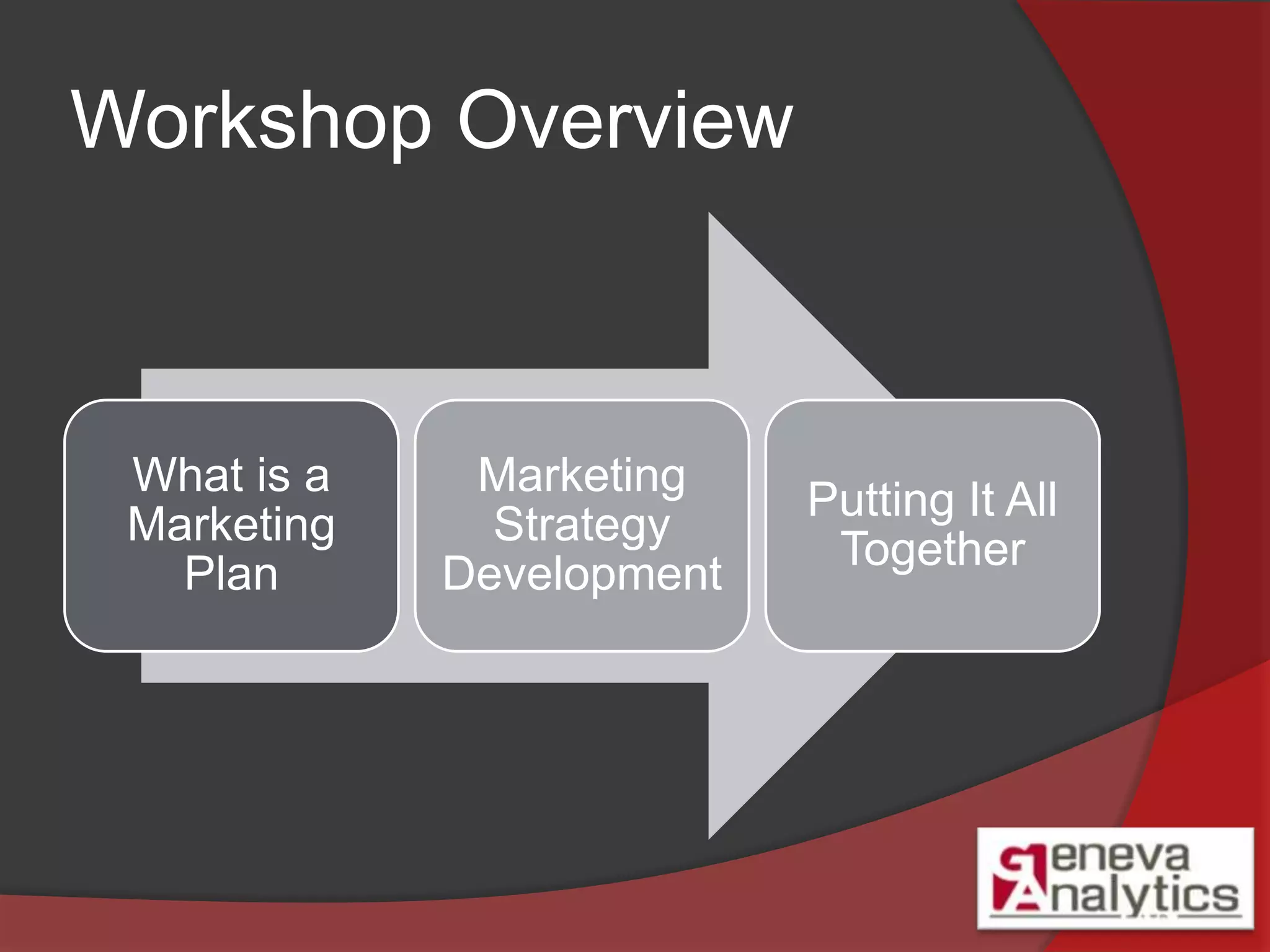
Workshop Overview
What is a Marketing Plan
Market Analysis
1.  Market SizeWhat is the current market size?How large is the potential market?Is the market stable?Where is the market heading?How many prospects are potential customers?How many companies are competing in the market?
2.  Industry TrendsChanges in Package SizeVariations in Product/ServicePromotional MethodsTechnological Changes
DemographicPsychographicUse BasedGeographicBenefits Sought3.  Market Segmentation
Which of the segments can you best serve?What is that segment’s needs?4. Target Market
The Marketing EnvironmentCurrent trends impacting the entire society and the way the product/service is marketed make up the “marketing environment”What are the current trends?What is impacting our environment?How is it impacting our products and services
Consumer AnalysisTwo types of individuals that purchase your products and servicesCustomers-  a person or entity that buys your product/service but does not actually use it.Consumers- The person or entity that actually puts your product to use.Today we will look at the “Consumer”
What type of product feature most appeal to these consumers?What are the benefits that these features provide to the consumer?How important are these features?How are choices made between competing products?What is their disposable income?What is their decision making processHow important is “brand?”What promotions does the consumer like?What are their leisure time activities?Factors Bearing on Your Typical Consumer
What Is Your Current Position?“If you don’t know where you are, it is impossible to know how to get to where you want to be.”
The Situational S.W.O.T. TestStrengths-  What does the company/product better than the competition?Weaknesses-What does the company/product do that not as good as the competition?Opportunities-What area of the market could the company enter where there is a distinct advantage?Threats-What actions could threaten the product or standing in the market?
Analyzing Your CompetitorsWho are your top 3-5 competitors?On what basis are you competing?Same product, different prices?Same product, different brand?Different market segmentsAre there “niches” within the market place where you are not directly targeted by competition?Think about the competition before implementing any marketing strategies.
Marketing ObjectivesUse the SMART system to make your marketing objectives clear:SpecificMeasurableAttainableTimebound
Developing the Marketing Strategy- Two Options
Strategies for Growth
Strategies for Non-Growth
Sustainable Competitive Advantage (SCA)An SCA is a means of competing using the products and company assets that provide a leverage or edge that is difficult to copy and is seen as advantageous by consumers.
Characteristics of Successful Sustainable Competitive Advantage They are substantial enough to make a difference in the marketAre sustainable with regard to environmental changesAre difficult for competitors to replicateAre leveraged into visible attributes that influence consumer decisionsMeans by which to gain a sustainable competitive advantage include differentiation, low cost, concentrated, niche
Differentiation	The process of making a product or service novel through a benefit that is relevant to the marketplace is a sustainable advantage.
Differentiation- Examples	Product qualityService qualityBrand nameProduct featuresTechnical superiorityDistribution channelsBreadth of product lineThe options for product differentiation is limited only by what the customer perceives to be different and important
Low Cost StrategyThis strategy relies on having the lowest cost in the industry at all times and thereby the lowest price to be offered to the customer.Any company employing a low cost and low price strategy must have the ability to match and beat its competitors should a price war breakout
No-frills productProduct designRaw material sourceLow-cost distributionLabor cost advantageLocation advantageAutomation advantageReduced overheadsExperience in producing the productMethods of Achieving a Low Cost StrategyA low cost strategy is extremely difficult to sustain long-term
ConcentratedThe concentrated thrust focuses on one part of the market or product line only.It allows a company to become an “expert” in that area.It is generally a smaller segment of the market.
Focus on product lineTargeting a segmentGeographical areaFocusing again low share competitorsMethods of Concentration
NicheStrategies focus on one particular, generally small, segment of the marketThe segment is generally too small for a major competitor to engageNiche strategies require that customers see a significant difference in the competitor and see real value
Product/Brand PositioningOut of the strategy should come a unique positioning for the productThere should be a clearly developed product/brand positioning within the marketPositioning is the way in which consumers perceive the product/service with respect to the rest of the marketProduct positioning could take years to create and is difficult to change
Product/Brand PositioningPositioning can be based around such factors as:A product attributeA consumer benefitA use or application of the productA product classThe place of originThe type of consumerCompetitive position in the market
The Market MixThe crux of any marketing strategies involves 4 elements known as the 4-PsProductPricePromotionPlace
ProductKey product features and their benefit are paramount.Key features include:FeaturesRangeBrandingPackagingAdditional accessories
Product-  Service BasedFor service based products, all aspects of presentation of the people providing the service are important.  This includes everything that is visible, such as:Dressed in a formal fashion or a branded sports shirtWhat your offices look likeAre the messages they convey complimentary to your product positioning
PriceThe price must conform to the product positioningHow important is price to the target market.In most markets price in an indicator of quality – the higher the price the higher the perceived qualityPrice should be set by “what the market will bear”
Price-  3 Important FactorsIt is a wrong assumption that offering a better price gives a better value for the money.Value for the money is a perception of the price compared to the benefits derived from the product.In most markets and to most people the price is far less important than the benefits received from the product
Types of PricingAll types of pricing decisions should be considered and planned, including:Standard pricePrice specialsDiscounts to the trade and distributorsPayment termsPayment methods
PromotionPromotion is that element in the marketing mix that determines how you communicate with customers and what tools or tactics are used to achieve the marketing objectives.Knowing the buying behavior of the target market is very important.What media do they view, how frequently and what is their reason for using it?
   The promotion mix must comply with the product positioning and should not contradict in any way with the prescribed positioning.Promotion
AdvertisingSales promotionsPublicityPersonal sellingEventsSponsorshipsDirect sellingThe internet & social mediaPromotional materialsBrochuresGiftsPromotion activities may include
Communication PlanThis component of the strategy should focus on keeping existing customers and finding new ones.Components can include:Web siteEmailSocial Media:  Twitter, FacebookBloggingPrinted and electronic newsletters
DistributionWhile fairly well established, this element should not be overlooked.Changes in the distribution channel or changes to the way in which you sell to the channel can provide great opportunities.
Distribution-  Questions You Should AddressHow and where will the product be placed so that the consumers have access to it and how will the sale be made?Will you be using wholesalers, distributors, retailers or going direct to the consumer?Are a combination of distribution points appropriate?The strategy for dealing with distribution points needs to be addressed the same way the strategy for customers was developed
Putting It All TogetherWorking through the whole process (if necessary with the help of marketing professionals) is important to getting the strategy right.  A good marketing strategy, correctly implemented, will give your company the edge over the competition.

Marketing Plan Strategic Development

  • 1.
    Developing a MarketingStrategyPlan, Launch, Build Business Workshop® #501
  • 2.
  • 3.
    What is aMarketing Plan
  • 4.
  • 5.
    1. MarketSizeWhat is the current market size?How large is the potential market?Is the market stable?Where is the market heading?How many prospects are potential customers?How many companies are competing in the market?
  • 6.
    2. IndustryTrendsChanges in Package SizeVariations in Product/ServicePromotional MethodsTechnological Changes
  • 7.
  • 8.
    Which of thesegments can you best serve?What is that segment’s needs?4. Target Market
  • 9.
    The Marketing EnvironmentCurrenttrends impacting the entire society and the way the product/service is marketed make up the “marketing environment”What are the current trends?What is impacting our environment?How is it impacting our products and services
  • 10.
    Consumer AnalysisTwo typesof individuals that purchase your products and servicesCustomers- a person or entity that buys your product/service but does not actually use it.Consumers- The person or entity that actually puts your product to use.Today we will look at the “Consumer”
  • 11.
    What type ofproduct feature most appeal to these consumers?What are the benefits that these features provide to the consumer?How important are these features?How are choices made between competing products?What is their disposable income?What is their decision making processHow important is “brand?”What promotions does the consumer like?What are their leisure time activities?Factors Bearing on Your Typical Consumer
  • 12.
    What Is YourCurrent Position?“If you don’t know where you are, it is impossible to know how to get to where you want to be.”
  • 13.
    The Situational S.W.O.T.TestStrengths- What does the company/product better than the competition?Weaknesses-What does the company/product do that not as good as the competition?Opportunities-What area of the market could the company enter where there is a distinct advantage?Threats-What actions could threaten the product or standing in the market?
  • 14.
    Analyzing Your CompetitorsWhoare your top 3-5 competitors?On what basis are you competing?Same product, different prices?Same product, different brand?Different market segmentsAre there “niches” within the market place where you are not directly targeted by competition?Think about the competition before implementing any marketing strategies.
  • 15.
    Marketing ObjectivesUse theSMART system to make your marketing objectives clear:SpecificMeasurableAttainableTimebound
  • 16.
    Developing the MarketingStrategy- Two Options
  • 17.
  • 18.
  • 19.
    Sustainable Competitive Advantage(SCA)An SCA is a means of competing using the products and company assets that provide a leverage or edge that is difficult to copy and is seen as advantageous by consumers.
  • 20.
    Characteristics of SuccessfulSustainable Competitive Advantage They are substantial enough to make a difference in the marketAre sustainable with regard to environmental changesAre difficult for competitors to replicateAre leveraged into visible attributes that influence consumer decisionsMeans by which to gain a sustainable competitive advantage include differentiation, low cost, concentrated, niche
  • 21.
    Differentiation The process ofmaking a product or service novel through a benefit that is relevant to the marketplace is a sustainable advantage.
  • 22.
    Differentiation- Examples Product qualityServicequalityBrand nameProduct featuresTechnical superiorityDistribution channelsBreadth of product lineThe options for product differentiation is limited only by what the customer perceives to be different and important
  • 23.
    Low Cost StrategyThisstrategy relies on having the lowest cost in the industry at all times and thereby the lowest price to be offered to the customer.Any company employing a low cost and low price strategy must have the ability to match and beat its competitors should a price war breakout
  • 24.
    No-frills productProduct designRawmaterial sourceLow-cost distributionLabor cost advantageLocation advantageAutomation advantageReduced overheadsExperience in producing the productMethods of Achieving a Low Cost StrategyA low cost strategy is extremely difficult to sustain long-term
  • 25.
    ConcentratedThe concentrated thrustfocuses on one part of the market or product line only.It allows a company to become an “expert” in that area.It is generally a smaller segment of the market.
  • 26.
    Focus on productlineTargeting a segmentGeographical areaFocusing again low share competitorsMethods of Concentration
  • 27.
    NicheStrategies focus onone particular, generally small, segment of the marketThe segment is generally too small for a major competitor to engageNiche strategies require that customers see a significant difference in the competitor and see real value
  • 28.
    Product/Brand PositioningOut ofthe strategy should come a unique positioning for the productThere should be a clearly developed product/brand positioning within the marketPositioning is the way in which consumers perceive the product/service with respect to the rest of the marketProduct positioning could take years to create and is difficult to change
  • 29.
    Product/Brand PositioningPositioning canbe based around such factors as:A product attributeA consumer benefitA use or application of the productA product classThe place of originThe type of consumerCompetitive position in the market
  • 30.
    The Market MixThecrux of any marketing strategies involves 4 elements known as the 4-PsProductPricePromotionPlace
  • 31.
    ProductKey product featuresand their benefit are paramount.Key features include:FeaturesRangeBrandingPackagingAdditional accessories
  • 32.
    Product- ServiceBasedFor service based products, all aspects of presentation of the people providing the service are important. This includes everything that is visible, such as:Dressed in a formal fashion or a branded sports shirtWhat your offices look likeAre the messages they convey complimentary to your product positioning
  • 33.
    PriceThe price mustconform to the product positioningHow important is price to the target market.In most markets price in an indicator of quality – the higher the price the higher the perceived qualityPrice should be set by “what the market will bear”
  • 34.
    Price- 3Important FactorsIt is a wrong assumption that offering a better price gives a better value for the money.Value for the money is a perception of the price compared to the benefits derived from the product.In most markets and to most people the price is far less important than the benefits received from the product
  • 35.
    Types of PricingAlltypes of pricing decisions should be considered and planned, including:Standard pricePrice specialsDiscounts to the trade and distributorsPayment termsPayment methods
  • 36.
    PromotionPromotion is thatelement in the marketing mix that determines how you communicate with customers and what tools or tactics are used to achieve the marketing objectives.Knowing the buying behavior of the target market is very important.What media do they view, how frequently and what is their reason for using it?
  • 37.
    The promotion mix must comply with the product positioning and should not contradict in any way with the prescribed positioning.Promotion
  • 38.
    AdvertisingSales promotionsPublicityPersonal sellingEventsSponsorshipsDirectsellingThe internet & social mediaPromotional materialsBrochuresGiftsPromotion activities may include
  • 39.
    Communication PlanThis componentof the strategy should focus on keeping existing customers and finding new ones.Components can include:Web siteEmailSocial Media: Twitter, FacebookBloggingPrinted and electronic newsletters
  • 40.
    DistributionWhile fairly wellestablished, this element should not be overlooked.Changes in the distribution channel or changes to the way in which you sell to the channel can provide great opportunities.
  • 41.
    Distribution- QuestionsYou Should AddressHow and where will the product be placed so that the consumers have access to it and how will the sale be made?Will you be using wholesalers, distributors, retailers or going direct to the consumer?Are a combination of distribution points appropriate?The strategy for dealing with distribution points needs to be addressed the same way the strategy for customers was developed
  • 42.
    Putting It AllTogetherWorking through the whole process (if necessary with the help of marketing professionals) is important to getting the strategy right. A good marketing strategy, correctly implemented, will give your company the edge over the competition.