Marketing concepts  (focus on  FMCG  products )
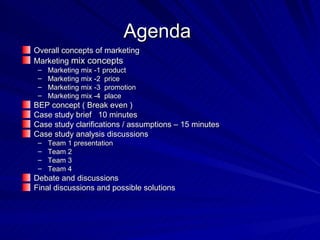
Agenda  Overall concepts of marketing  Marketing  mix concepts  Marketing mix -1 product  Marketing mix -2  price  Marketing mix -3  promotion  Marketing mix -4  place  BEP concept ( Break even )  Case study brief  10 minutes  Case study clarifications / assumptions – 15 minutes Case study analysis discussions  Team 1 presentation  Team 2  Team 3  Team 4  Debate and discussions  Final discussions and possible solutions
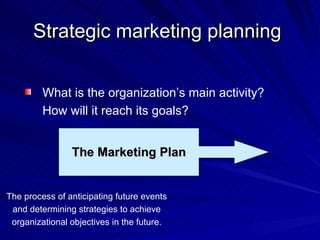
Strategic marketing planning  What is the organization’s main activity? How will it reach its goals? The Marketing Plan The process of anticipating future events and determining strategies to achieve organizational objectives in the future.
Why Write a Marketing Plan? Provides a basis for comparison of actual and expected performance  Provides clearly stated activities to work  toward common goals Serves as a reference for the  success of future activities Marketing Plan
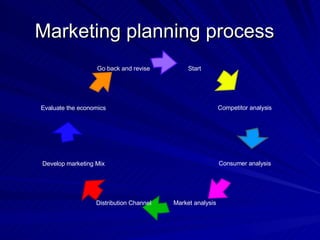
Marketing planning process  Market analysis  Consumer analysis  Start  Distribution Channel  Competitor analysis  Evaluate the economics  Develop marketing Mix  Go back and revise
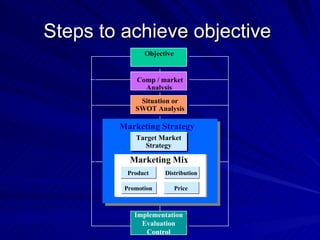
Steps to achieve objective  Marketing Strategy Product Promotion Distribution Price Marketing Mix Objective  Comp / market Analysis  Situation or SWOT Analysis Target Market Strategy Implementation Evaluation Control
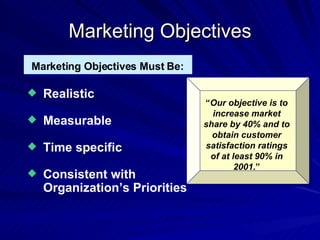
Marketing Objectives Realistic  Measurable Time specific Consistent with  Organization’s Priorities Marketing Objectives Must Be: “ Our objective is to increase market share by 40% and to obtain customer satisfaction ratings of at least 90% in 2001 .”
Marketing Plan Objectives Communicate marketing management philosophies Provide direction Serve as motivators Clarify thinking  Provide basis for control
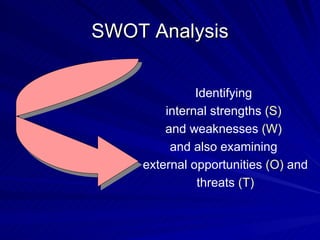
SWOT Analysis Identifying  internal strengths  (S)   and weaknesses  (W)   and also examining  external opportunities  (O)  and threats  (T)
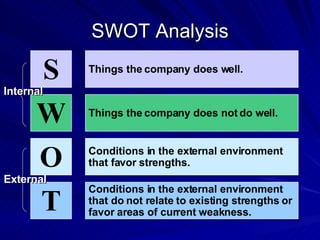
SWOT Analysis ©South-Western College Publishing S W O T Things the company does well. Things the company does not do well. Conditions in the external environment that favor strengths. Conditions in the external environment that do not relate to existing strengths or favor areas of current weakness. Internal External
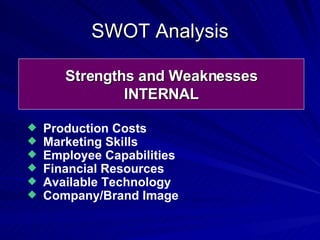
SWOT Analysis Production Costs Marketing Skills Employee Capabilities Financial Resources Available Technology Company/Brand Image Strengths and Weaknesses INTERNAL
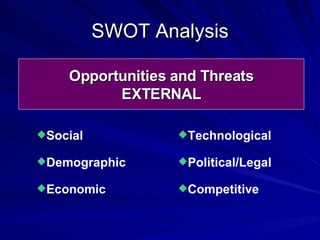
SWOT Analysis Opportunities and Threats EXTERNAL Social Demographic Economic Technological Political/Legal Competitive
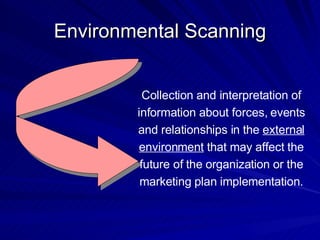
Environmental Scanning Collection and interpretation of information about forces, events and relationships in the  external   environment  that may affect the future of the organization or the marketing plan implementation.
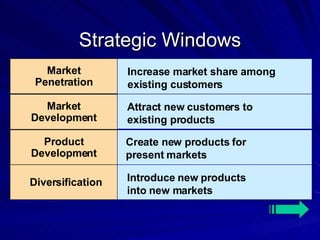
Strategic Windows Market Penetration Market Development Product Development Diversification Increase market share among  existing customers Attract new customers to  existing products Introduce new products  into new markets Create new products for  present markets
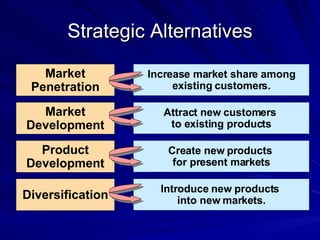
Strategic Alternatives Market Penetration Increase market share among existing customers. Market Development Attract new customers  to existing products Diversification Introduce new products  into new markets. Product Development Create new products  for present markets
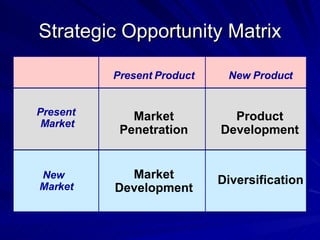
Strategic Opportunity Matrix Present Product New Product New  Market Market Penetration Market Development Product Development Diversification Present  Market
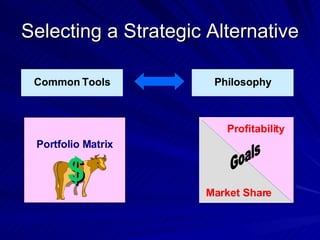
Selecting a Strategic Alternative Common Tools Philosophy Market Share Profitability Goals Portfolio Matrix $
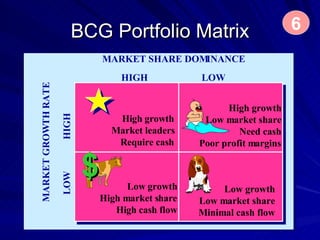
BCG Portfolio Matrix   High growth Market leaders Require cash Low growth High market share High cash flow   Low growth Low market share Minimal cash flow High growth Low market share Need cash Poor profit margins $ 6 MARKET SHARE DOMINANCE HIGH  LOW MARKET GROWTH RATE LOW  HIGH
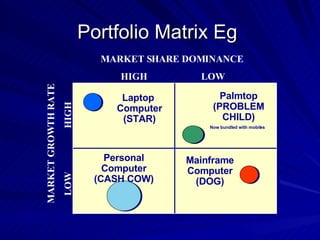
Portfolio Matrix Eg  Laptop  Computer (STAR) Palmtop (PROBLEM CHILD) Now bundled with mobiles  Personal Computer (CASH COW) Mainframe Computer (DOG) MARKET GROWTH RATE LOW  HIGH MARKET SHARE DOMINANCE HIGH  LOW
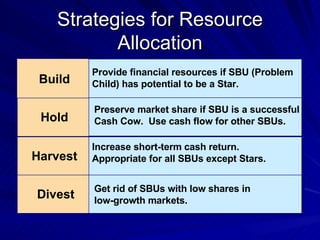
Strategies for Resource Allocation Build Hold Harvest Divest Provide financial resources if SBU (Problem Child) has potential to be a Star. Preserve market share if SBU is a successful  Cash Cow.  Use cash flow for other SBUs. Increase short-term cash return.  Appropriate for all SBUs except Stars.  Get rid of SBUs with low shares in  low-growth markets.
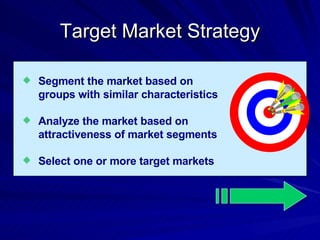
Target Market Strategy Segment the market based on  groups with similar characteristics Analyze the market based on attractiveness of market segments Select one or more target markets
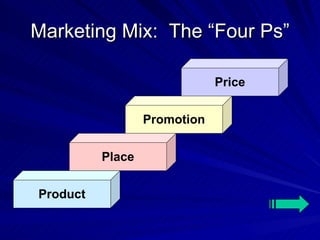
Marketing Mix:  The “Four Ps” Price Promotion Place Product
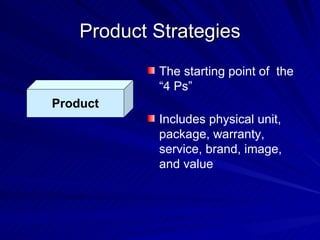
Product Strategies Product The starting point of  the “4 Ps” Includes physical unit, package, warranty, service, brand, image, and value
Distribution (Place) Strategies Place Product availability where and when customers want them. Involves all activities from raw materials to finished products
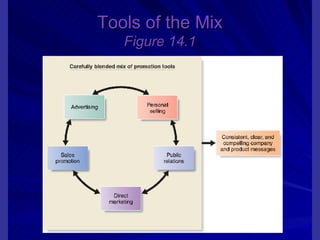
Promotion Strategies Promotion Role is to bring about exchanges with target markets Includes integration of personal selling, advertising, sales promotion, and public relations
Pricing Strategies Price The most flexible of  the “4 Ps” Price X Units Sold = Total Revenue
Learning Objective  Explain why implementation, evaluation,  and control of the  marketing plan are necessary.
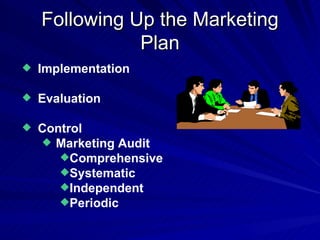
Following Up the Marketing Plan Implementation Evaluation Control Marketing Audit Comprehensive Systematic Independent Periodic
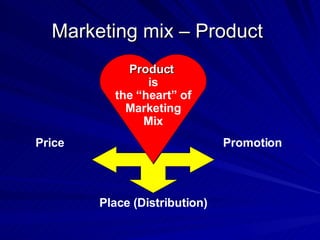
Marketing mix – Product  Promotion Product  is the “heart” of Marketing Mix Place (Distribution) Price
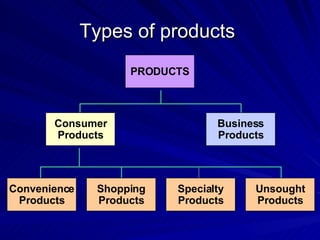
Types of products  Unsought Products Specialty Products Shopping Products Convenience Products Consumer Products Business Products PRODUCTS
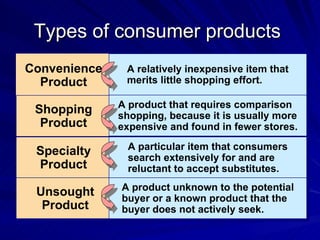
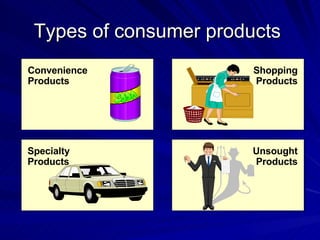
Types of consumer products  Convenience Product Shopping Product Specialty Product Unsought Product A relatively inexpensive item that merits little shopping effort. A product that requires comparison shopping, because it is usually more expensive and found in fewer stores. A particular item that consumers search extensively for and are reluctant to accept substitutes. A product unknown to the potential buyer or a known product that the buyer does not actively seek.
Types of consumer products  Specialty Products Convenience Products Shopping Products Unsought Products
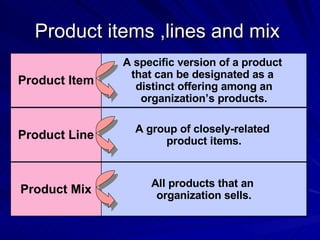
Product items ,lines and mix  Product Item Product Line Product Mix A specific version of a product  that can be designated as a  distinct offering among an organization’s products. A group of closely-related  product items. All products that an  organization sells.
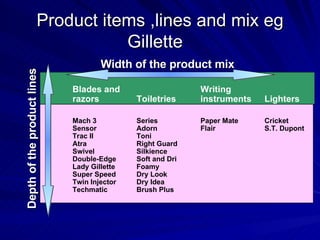
Product items ,lines and mix eg Gillette  Blades and Writing razors Toiletries instruments Lighters Mach 3  Series  Paper Mate  Cricket Sensor Adorn  Flair  S.T. Dupont  Trac II Toni Atra  Right Guard Swivel  Silkience  Double-Edge  Soft and Dri  Lady Gillette  Foamy  Super Speed  Dry Look Twin Injector  Dry Idea  Techmatic  Brush Plus  Width of the product mix Depth of the product lines
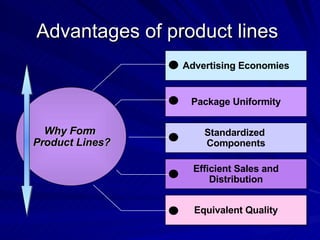
Advantages of product lines  Equivalent Quality Efficient Sales and Distribution Standardized  Components Package Uniformity Advertising Economies Why Form  Product Lines?
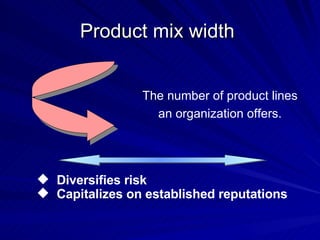
Product mix width  Diversifies risk Capitalizes on established reputations The number of product lines an organization offers.
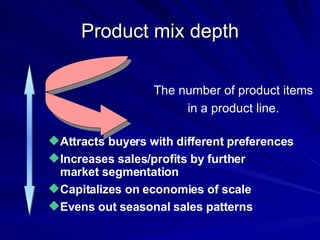
Product mix depth Attracts buyers with different preferences Increases sales/profits by further  market segmentation  Capitalizes on economies of scale Evens out seasonal sales patterns The number of product items in a product line.
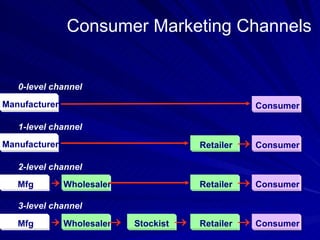
Consumer Marketing Channels Wholesaler Stockist  Retailer Consumer     Consumer Retailer Consumer  Manufacturer 0-level channel Wholesaler Retailer Consumer   Mfg 2-level channel Mfg 3-level channel 1-level channel Manufacturer
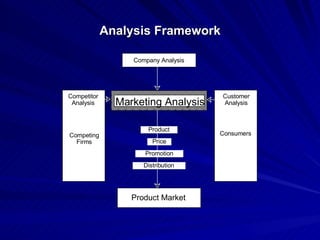
Analysis Framework Product Market Company Analysis Marketing Analysis Product Price Promotion Distribution Customer  Analysis Consumers Competitor  Analysis Competing  Firms
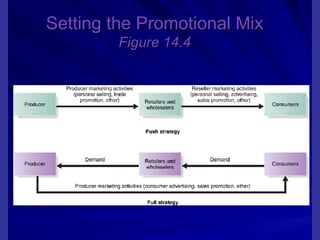
Setting the Promotional Mix Figure 14.4 14 -
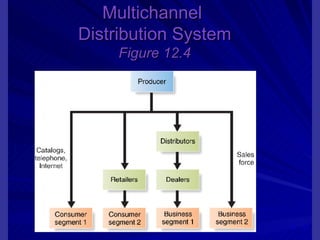
Multichannel  Distribution System Figure 12.4 12 -
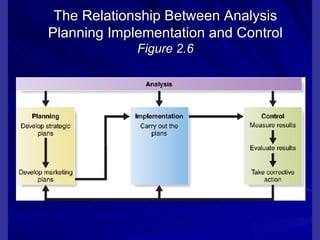
The Relationship Between Analysis Planning Implementation and Control Figure 2.6 2 -
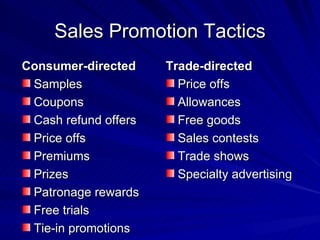
Sales Promotion Tactics Consumer-directed Samples Coupons Cash refund offers Price offs Premiums Prizes Patronage rewards Free trials Tie-in promotions  Trade-directed Price offs Allowances Free goods Sales contests Trade shows Specialty advertising
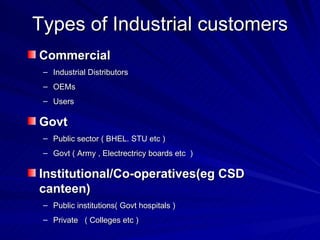
Types of Industrial customers Commercial Industrial Distributors  OEMs Users Govt Public sector ( BHEL. STU etc ) Govt ( Army , Electrectricy boards etc  ) Institutional/Co-operatives(eg CSD canteen) Public institutions( Govt hospitals ) Private  ( Colleges etc )
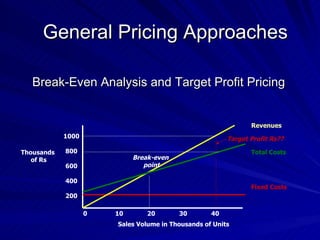
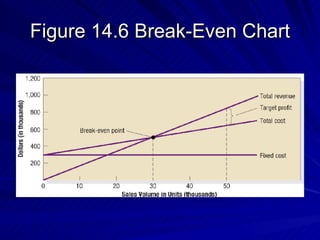
Break-Even Analysis and Target Profit Pricing General Pricing Approaches Fixed Costs Total Costs Revenues Sales Volume in Thousands of Units Thousands  of Rs 0 10 20 30 40 1000 800 600 400 200 Break-even  point Target Profit Rs?? Quantity To Be Sold To Meet Target Profit
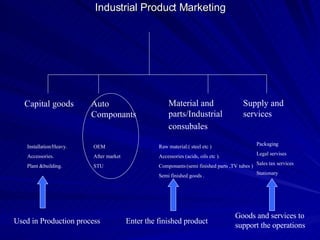
Industrial Product Marketing Installation/Heavy. Accessories. Plant &building. OEM After market  STU Raw material.( steel etc ) Accessories (acids, oils etc ). Componants (semi finished parts ,TV tubes ) Semi finished goods . Packaging Legal servises  Sales tax services Stationary  Capital goods Auto Componants  Material and parts/Industrial consubales  Supply and services  Used in Production process  Enter the finished product  Goods and services to support the operations
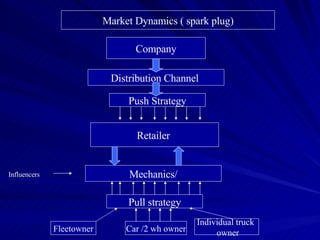
Retailer  Mechanics/ Influencers  Fleetowner Car /2 wh owner Individual truck  owner Pull strategy Push Strategy Company Distribution Channel  Market Dynamics ( spark plug)
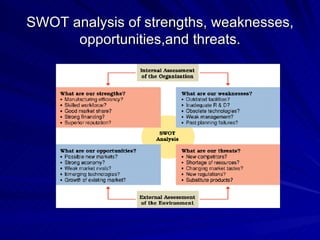
SWOT analysis of strengths, weaknesses, opportunities,and threats.
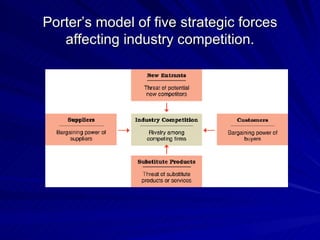
Porter’s model of five strategic forces affecting industry competition.
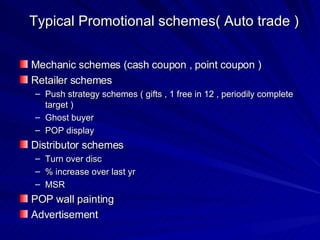
Typical Promotional schemes( Auto trade ) Mechanic schemes (cash coupon , point coupon ) Retailer schemes  Push strategy schemes ( gifts , 1 free in 12 , periodily complete target )  Ghost buyer  POP display  Distributor schemes  Turn over disc % increase over last yr  MSR  POP wall painting Advertisement
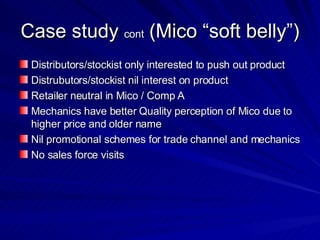
Case study  cont  (Mico “soft belly”)  Distributors/stockist only interested to push out product Distrubutors/stockist nil interest on product  Retailer neutral in Mico / Comp A  Mechanics have better Quality perception of Mico due to higher price and older name Nil promotional schemes for trade channel and mechanics No sales force visits
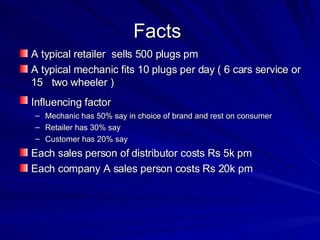
Facts  A typical retailer  sells 500 plugs pm  A typical mechanic fits 10 plugs per day ( 6 cars service or 15  two wheeler )  Influencing factor   Mechanic has 50% say in choice of brand and rest on consumer  Retailer has 30% say  Customer has 20% say  Each sales person of distributor costs Rs 5k pm  Each company A sales person costs Rs 20k pm
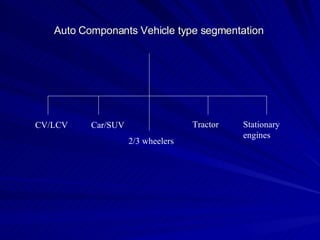
Auto Componants Vehicle type segmentation  CV/LCV Car/SUV Tractor  Stationary  engines  2/3 wheelers
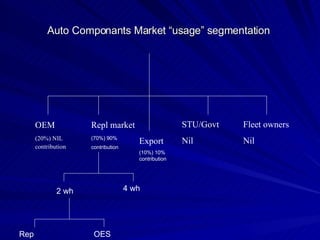
Auto Componants Market “usage” segmentation  OEM (20%) NIL contribution   Repl market (70%) 90% contribution   STU/Govt  Nil  Fleet owners  Nil  Export (10%) 10% contribution 2 wh  4 wh  OES Rep
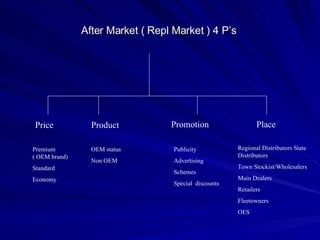
After Market ( Repl Market ) 4 P’s  Price  Product Promotion Place  OEM status  Non OEM Premium  ( OEM brand) Standard  Economy Publicity Advertising  Schemes Special  discounts  Regional Distributors State Distributors  Town Stockist/Wholesalers Main Dealers  Retailers  Fleetowners  OES
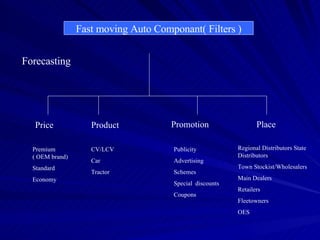
Fast consumable  Price  Product Promotion Place  CV/LCV Car Tractor Premium  ( OEM brand) Standard  Economy Publicity Advertising  Schemes Special  discounts Coupons  Regional Distributors State Distributors  Town Stockist/Wholesalers Main Dealers  Retailers  Fleetowners  OES Fast moving Auto Componant( Filters ) Forecasting
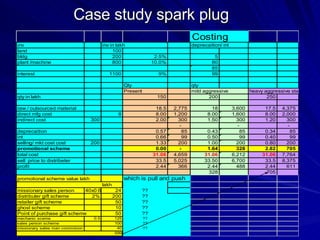
Case study spark plug
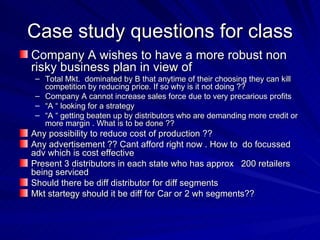
Case study questions for class Company A wishes to have a more robust non risky business plan in view of  Total Mkt.  dominated by B that anytime of their choosing they can kill competition by reducing price. If so why is it not doing ?? Company A cannot increase sales force due to very precarious profits  “ A “ looking for a strategy “ A “ getting beaten up by distributors who are demanding more credit or more margin . What is to be done ??  Any possibility to reduce cost of production ?? Any advertisement ?? Cant afford right now . How to  do focussed adv which is cost effective  Present 3 distributors in each state who has approx  200 retailers being serviced  Should there be diff distributor for diff segments  Mkt startegy should it be diff for Car or 2 wh segments??
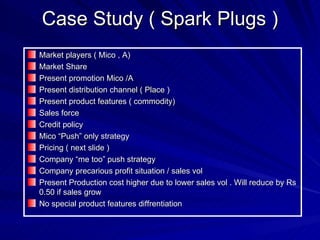
Case Study ( Spark Plugs ) Market players ( Mico , A) Market Share Present promotion Mico /A Present distribution channel ( Place ) Present product features ( commodity) Sales force  Credit policy  Mico “Push” only strategy Pricing ( next slide )  Company “me too” push strategy Company precarious profit situation / sales vol Present Production cost higher due to lower sales vol . Will reduce by Rs 0.50 if sales grow  No special product features diffrentiation
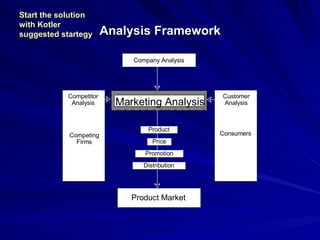
Analysis Framework Product Market Company Analysis Marketing Analysis Product Price Promotion Distribution Start the solution with Kotler suggested startegy  Customer  Analysis Consumers Competitor  Analysis Competing  Firms
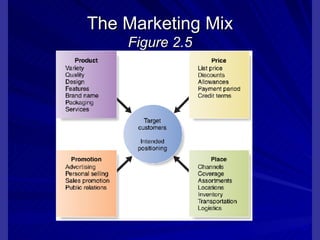
The Marketing Mix Figure 2.5 2 -
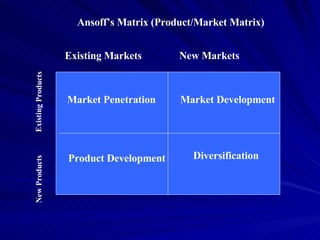
Diversification Market Penetration Market Development Product Development Existing Markets New Markets Existing Products New Products Ansoff’s Matrix (Product/Market Matrix)
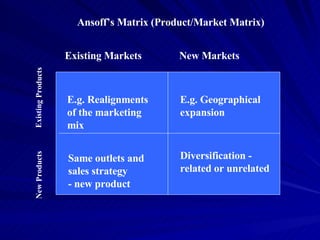
Diversification - related or unrelated E.g. Realignments of the marketing mix E.g. Geographical  expansion Same outlets and  sales strategy  - new product Existing Markets New Markets Existing Products New Products Ansoff’s Matrix (Product/Market Matrix)
Figure 14.6 Break-Even Chart
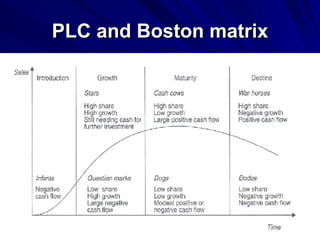
PLC and Boston matrix
Tools of the Mix Figure 14.1 14 -
Solutions and various actions A can take ( “Product” mix strategy )  Expand range by taking similar product ( same channel )  and trading under own brand name  This reduces dependance on one product  Distributes fixed mkt expense on higher turnover ( reduce fixed cost in product X )  Come up with USP ( tech which gives some percieved benefit )  on X to show differentiation
Solutions and various actions A can take ( “Price” mix strategy )  Rearrange pricing to force more profit to retailer
Solutions and various actions A can take ( “Promotion ” mix  pull   strategy )  Retailer  Increase his profit ( mark down of printed price )  Increase interest by gift schemes on completion of target  3 month complete and take Titan watch ( Rs 500 ) on 40 boxes  After 3 months increase sales by 25% and take a super gift  Complete yearly target and go to 2 nights holiday trip for wife ( involve family so that once committed to wife stays )  Mechanic Increase interest by gift schemes on every plug /  Transister free after 200 plugs
Solutions and various actions A can take ( “Place ” mix  push & pull   strategy )  Retailer  Increase his profit ( mark down of printed price )  Increase interest by gift schemes on completion of target  3 month complete and take Titan watch ( Rs 500 ) on 40 boxes  After 3 months increase sales by 25% and take a super gift  Complete yearly target and go to 2 nights holiday trip for wife ( involve family so that once committed to wife stays )  Mechanic Increase interest by gift schemes on every plug /  Transister free after 200 plugs

test web

  • 1.
    Marketing concepts (focus on FMCG products )
  • 2.
    Agenda Overallconcepts of marketing Marketing mix concepts Marketing mix -1 product Marketing mix -2 price Marketing mix -3 promotion Marketing mix -4 place BEP concept ( Break even ) Case study brief 10 minutes Case study clarifications / assumptions – 15 minutes Case study analysis discussions Team 1 presentation Team 2 Team 3 Team 4 Debate and discussions Final discussions and possible solutions
  • 3.
    Strategic marketing planning What is the organization’s main activity? How will it reach its goals? The Marketing Plan The process of anticipating future events and determining strategies to achieve organizational objectives in the future.
  • 4.
    Why Write aMarketing Plan? Provides a basis for comparison of actual and expected performance Provides clearly stated activities to work toward common goals Serves as a reference for the success of future activities Marketing Plan
  • 5.
    Marketing planning process Market analysis Consumer analysis Start Distribution Channel Competitor analysis Evaluate the economics Develop marketing Mix Go back and revise
  • 6.
    Steps to achieveobjective Marketing Strategy Product Promotion Distribution Price Marketing Mix Objective Comp / market Analysis Situation or SWOT Analysis Target Market Strategy Implementation Evaluation Control
  • 7.
    Marketing Objectives Realistic Measurable Time specific Consistent with Organization’s Priorities Marketing Objectives Must Be: “ Our objective is to increase market share by 40% and to obtain customer satisfaction ratings of at least 90% in 2001 .”
  • 8.
    Marketing Plan ObjectivesCommunicate marketing management philosophies Provide direction Serve as motivators Clarify thinking Provide basis for control
  • 9.
    SWOT Analysis Identifying internal strengths (S) and weaknesses (W) and also examining external opportunities (O) and threats (T)
  • 10.
    SWOT Analysis ©South-WesternCollege Publishing S W O T Things the company does well. Things the company does not do well. Conditions in the external environment that favor strengths. Conditions in the external environment that do not relate to existing strengths or favor areas of current weakness. Internal External
  • 11.
    SWOT Analysis ProductionCosts Marketing Skills Employee Capabilities Financial Resources Available Technology Company/Brand Image Strengths and Weaknesses INTERNAL
  • 12.
    SWOT Analysis Opportunitiesand Threats EXTERNAL Social Demographic Economic Technological Political/Legal Competitive
  • 13.
    Environmental Scanning Collectionand interpretation of information about forces, events and relationships in the external environment that may affect the future of the organization or the marketing plan implementation.
  • 14.
    Strategic Windows MarketPenetration Market Development Product Development Diversification Increase market share among existing customers Attract new customers to existing products Introduce new products into new markets Create new products for present markets
  • 15.
    Strategic Alternatives MarketPenetration Increase market share among existing customers. Market Development Attract new customers to existing products Diversification Introduce new products into new markets. Product Development Create new products for present markets
  • 16.
    Strategic Opportunity MatrixPresent Product New Product New Market Market Penetration Market Development Product Development Diversification Present Market
  • 17.
    Selecting a StrategicAlternative Common Tools Philosophy Market Share Profitability Goals Portfolio Matrix $
  • 18.
    BCG Portfolio Matrix High growth Market leaders Require cash Low growth High market share High cash flow Low growth Low market share Minimal cash flow High growth Low market share Need cash Poor profit margins $ 6 MARKET SHARE DOMINANCE HIGH LOW MARKET GROWTH RATE LOW HIGH
  • 19.
    Portfolio Matrix Eg Laptop Computer (STAR) Palmtop (PROBLEM CHILD) Now bundled with mobiles Personal Computer (CASH COW) Mainframe Computer (DOG) MARKET GROWTH RATE LOW HIGH MARKET SHARE DOMINANCE HIGH LOW
  • 20.
    Strategies for ResourceAllocation Build Hold Harvest Divest Provide financial resources if SBU (Problem Child) has potential to be a Star. Preserve market share if SBU is a successful Cash Cow. Use cash flow for other SBUs. Increase short-term cash return. Appropriate for all SBUs except Stars. Get rid of SBUs with low shares in low-growth markets.
  • 21.
    Target Market StrategySegment the market based on groups with similar characteristics Analyze the market based on attractiveness of market segments Select one or more target markets
  • 22.
    Marketing Mix: The “Four Ps” Price Promotion Place Product
  • 23.
    Product Strategies ProductThe starting point of the “4 Ps” Includes physical unit, package, warranty, service, brand, image, and value
  • 24.
    Distribution (Place) StrategiesPlace Product availability where and when customers want them. Involves all activities from raw materials to finished products
  • 25.
    Promotion Strategies PromotionRole is to bring about exchanges with target markets Includes integration of personal selling, advertising, sales promotion, and public relations
  • 26.
    Pricing Strategies PriceThe most flexible of the “4 Ps” Price X Units Sold = Total Revenue
  • 27.
    Learning Objective Explain why implementation, evaluation, and control of the marketing plan are necessary.
  • 28.
    Following Up theMarketing Plan Implementation Evaluation Control Marketing Audit Comprehensive Systematic Independent Periodic
  • 29.
    Marketing mix –Product Promotion Product is the “heart” of Marketing Mix Place (Distribution) Price
  • 30.
    Types of products Unsought Products Specialty Products Shopping Products Convenience Products Consumer Products Business Products PRODUCTS
  • 31.
    Types of consumerproducts Convenience Product Shopping Product Specialty Product Unsought Product A relatively inexpensive item that merits little shopping effort. A product that requires comparison shopping, because it is usually more expensive and found in fewer stores. A particular item that consumers search extensively for and are reluctant to accept substitutes. A product unknown to the potential buyer or a known product that the buyer does not actively seek.
  • 32.
    Types of consumerproducts Specialty Products Convenience Products Shopping Products Unsought Products
  • 33.
    Product items ,linesand mix Product Item Product Line Product Mix A specific version of a product that can be designated as a distinct offering among an organization’s products. A group of closely-related product items. All products that an organization sells.
  • 34.
    Product items ,linesand mix eg Gillette Blades and Writing razors Toiletries instruments Lighters Mach 3 Series Paper Mate Cricket Sensor Adorn Flair S.T. Dupont Trac II Toni Atra Right Guard Swivel Silkience Double-Edge Soft and Dri Lady Gillette Foamy Super Speed Dry Look Twin Injector Dry Idea Techmatic Brush Plus Width of the product mix Depth of the product lines
  • 35.
    Advantages of productlines Equivalent Quality Efficient Sales and Distribution Standardized Components Package Uniformity Advertising Economies Why Form Product Lines?
  • 36.
    Product mix width Diversifies risk Capitalizes on established reputations The number of product lines an organization offers.
  • 37.
    Product mix depthAttracts buyers with different preferences Increases sales/profits by further market segmentation Capitalizes on economies of scale Evens out seasonal sales patterns The number of product items in a product line.
  • 38.
    Consumer Marketing ChannelsWholesaler Stockist Retailer Consumer     Consumer Retailer Consumer  Manufacturer 0-level channel Wholesaler Retailer Consumer   Mfg 2-level channel Mfg 3-level channel 1-level channel Manufacturer
  • 39.
    Analysis Framework ProductMarket Company Analysis Marketing Analysis Product Price Promotion Distribution Customer Analysis Consumers Competitor Analysis Competing Firms
  • 40.
    Setting the PromotionalMix Figure 14.4 14 -
  • 41.
    Multichannel DistributionSystem Figure 12.4 12 -
  • 42.
    The Relationship BetweenAnalysis Planning Implementation and Control Figure 2.6 2 -
  • 43.
    Sales Promotion TacticsConsumer-directed Samples Coupons Cash refund offers Price offs Premiums Prizes Patronage rewards Free trials Tie-in promotions Trade-directed Price offs Allowances Free goods Sales contests Trade shows Specialty advertising
  • 44.
    Types of Industrialcustomers Commercial Industrial Distributors OEMs Users Govt Public sector ( BHEL. STU etc ) Govt ( Army , Electrectricy boards etc ) Institutional/Co-operatives(eg CSD canteen) Public institutions( Govt hospitals ) Private ( Colleges etc )
  • 45.
    Break-Even Analysis andTarget Profit Pricing General Pricing Approaches Fixed Costs Total Costs Revenues Sales Volume in Thousands of Units Thousands of Rs 0 10 20 30 40 1000 800 600 400 200 Break-even point Target Profit Rs?? Quantity To Be Sold To Meet Target Profit
  • 46.
    Industrial Product MarketingInstallation/Heavy. Accessories. Plant &building. OEM After market STU Raw material.( steel etc ) Accessories (acids, oils etc ). Componants (semi finished parts ,TV tubes ) Semi finished goods . Packaging Legal servises Sales tax services Stationary Capital goods Auto Componants Material and parts/Industrial consubales Supply and services Used in Production process Enter the finished product Goods and services to support the operations
  • 47.
    Retailer Mechanics/Influencers Fleetowner Car /2 wh owner Individual truck owner Pull strategy Push Strategy Company Distribution Channel Market Dynamics ( spark plug)
  • 48.
    SWOT analysis ofstrengths, weaknesses, opportunities,and threats.
  • 49.
    Porter’s model offive strategic forces affecting industry competition.
  • 50.
    Typical Promotional schemes(Auto trade ) Mechanic schemes (cash coupon , point coupon ) Retailer schemes Push strategy schemes ( gifts , 1 free in 12 , periodily complete target ) Ghost buyer POP display Distributor schemes Turn over disc % increase over last yr MSR POP wall painting Advertisement
  • 51.
    Case study cont (Mico “soft belly”) Distributors/stockist only interested to push out product Distrubutors/stockist nil interest on product Retailer neutral in Mico / Comp A Mechanics have better Quality perception of Mico due to higher price and older name Nil promotional schemes for trade channel and mechanics No sales force visits
  • 52.
    Facts Atypical retailer sells 500 plugs pm A typical mechanic fits 10 plugs per day ( 6 cars service or 15 two wheeler ) Influencing factor Mechanic has 50% say in choice of brand and rest on consumer Retailer has 30% say Customer has 20% say Each sales person of distributor costs Rs 5k pm Each company A sales person costs Rs 20k pm
  • 53.
    Auto Componants Vehicletype segmentation CV/LCV Car/SUV Tractor Stationary engines 2/3 wheelers
  • 54.
    Auto Componants Market“usage” segmentation OEM (20%) NIL contribution Repl market (70%) 90% contribution STU/Govt Nil Fleet owners Nil Export (10%) 10% contribution 2 wh 4 wh OES Rep
  • 55.
    After Market (Repl Market ) 4 P’s Price Product Promotion Place OEM status Non OEM Premium ( OEM brand) Standard Economy Publicity Advertising Schemes Special discounts Regional Distributors State Distributors Town Stockist/Wholesalers Main Dealers Retailers Fleetowners OES
  • 56.
    Fast consumable Price Product Promotion Place CV/LCV Car Tractor Premium ( OEM brand) Standard Economy Publicity Advertising Schemes Special discounts Coupons Regional Distributors State Distributors Town Stockist/Wholesalers Main Dealers Retailers Fleetowners OES Fast moving Auto Componant( Filters ) Forecasting
  • 57.
  • 58.
    Case study questionsfor class Company A wishes to have a more robust non risky business plan in view of Total Mkt. dominated by B that anytime of their choosing they can kill competition by reducing price. If so why is it not doing ?? Company A cannot increase sales force due to very precarious profits “ A “ looking for a strategy “ A “ getting beaten up by distributors who are demanding more credit or more margin . What is to be done ?? Any possibility to reduce cost of production ?? Any advertisement ?? Cant afford right now . How to do focussed adv which is cost effective Present 3 distributors in each state who has approx 200 retailers being serviced Should there be diff distributor for diff segments Mkt startegy should it be diff for Car or 2 wh segments??
  • 59.
    Case Study (Spark Plugs ) Market players ( Mico , A) Market Share Present promotion Mico /A Present distribution channel ( Place ) Present product features ( commodity) Sales force Credit policy Mico “Push” only strategy Pricing ( next slide ) Company “me too” push strategy Company precarious profit situation / sales vol Present Production cost higher due to lower sales vol . Will reduce by Rs 0.50 if sales grow No special product features diffrentiation
  • 60.
    Analysis Framework ProductMarket Company Analysis Marketing Analysis Product Price Promotion Distribution Start the solution with Kotler suggested startegy Customer Analysis Consumers Competitor Analysis Competing Firms
  • 61.
    The Marketing MixFigure 2.5 2 -
  • 62.
    Diversification Market PenetrationMarket Development Product Development Existing Markets New Markets Existing Products New Products Ansoff’s Matrix (Product/Market Matrix)
  • 63.
    Diversification - relatedor unrelated E.g. Realignments of the marketing mix E.g. Geographical expansion Same outlets and sales strategy - new product Existing Markets New Markets Existing Products New Products Ansoff’s Matrix (Product/Market Matrix)
  • 64.
  • 65.
  • 66.
    Tools of theMix Figure 14.1 14 -
  • 67.
    Solutions and variousactions A can take ( “Product” mix strategy ) Expand range by taking similar product ( same channel ) and trading under own brand name This reduces dependance on one product Distributes fixed mkt expense on higher turnover ( reduce fixed cost in product X ) Come up with USP ( tech which gives some percieved benefit ) on X to show differentiation
  • 68.
    Solutions and variousactions A can take ( “Price” mix strategy ) Rearrange pricing to force more profit to retailer
  • 69.
    Solutions and variousactions A can take ( “Promotion ” mix pull strategy ) Retailer Increase his profit ( mark down of printed price ) Increase interest by gift schemes on completion of target 3 month complete and take Titan watch ( Rs 500 ) on 40 boxes After 3 months increase sales by 25% and take a super gift Complete yearly target and go to 2 nights holiday trip for wife ( involve family so that once committed to wife stays ) Mechanic Increase interest by gift schemes on every plug / Transister free after 200 plugs
  • 70.
    Solutions and variousactions A can take ( “Place ” mix push & pull strategy ) Retailer Increase his profit ( mark down of printed price ) Increase interest by gift schemes on completion of target 3 month complete and take Titan watch ( Rs 500 ) on 40 boxes After 3 months increase sales by 25% and take a super gift Complete yearly target and go to 2 nights holiday trip for wife ( involve family so that once committed to wife stays ) Mechanic Increase interest by gift schemes on every plug / Transister free after 200 plugs