
Chapter 7
 Unfortunately, many companies have difficulty with the most
critical step in the promotional planning process—setting
realistic objectives.
 Complex marketing situations, conflicting perspectives, and
uncertainty over resources make the setting of marketing
communications objectives “a job of creating order out of
chaos.”
 While difficult, it must be done properly, because
budgeting for advertising and other promotional areas,
as well as creative and media strategies and tactics,
evolve from these objectives.
 They also provide a standard against which
performance can be measured.
 Many marketers are uncertain as to what IMC should
be expected to contribute to the marketing program.
 The goal of their company’s advertising and
promotional program is simple: to generate sales.
 As we know, advertising and promotion are not the
only marketing activities involved in generating sales.
 Moreover, it is not always possible or necessary to
measure the effects of advertising in terms of sales.
 Communications: The advertising and promotional
program must be coordinated within the company, inside the
ad agency, and between the two.
 Planning and Decision Making: Promotional planners
are often faced with a number of strategic and tactical options
in terms of choosing creative options, selecting media, and
allocating the budget among various elements of the
promotional mix.
 Measurement and Evaluation of Results: An
important reason for setting specific objectives is that they
provide a benchmark against which the success or failure of
the promotional campaign can be measured.
Marketing Objectives
• Generally stated in the firm’s
marketing plan
• Achieved through the overall
marketing plan
• Quantifiable, such as sales,
market share, ROI
• To be accomplished in a given
period of time
• Must be realistic and
attainable to be effective
Communications Objectives
• Derived from the overall
marketing plan
• More narrow than marketing
objectives
• Based on particular
communications tasks
• Designed to deliver
appropriate messages
• Focused on a specific target
audience
Vs.
 Sales Oriented
Objectives
◦ Some managers
prefer sales-oriented
objectives to make the
individuals involved
in advertising and
promotion think in
terms of how the
promotional program
will influence sales.
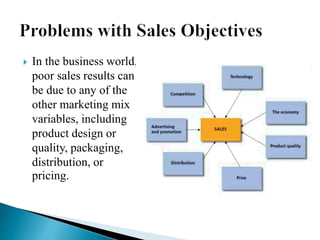
 In the business world,
poor sales results can
be due to any of the
other marketing mix
variables, including
product design or
quality, packaging,
distribution, or
pricing.
 Advertising can make consumers aware of and interested in
the brand, but it can’t make them buy it, particularly if it is
not readily available or is priced higher than a competing
brand.
 Another problem with sales objectives is that the effects of
advertising often occur over an extended period. Many
experts recognize that advertising has a lagged or
carryover effect
 Advertising may create awareness, interest, and/or
favorable attitudes toward a brand, but these feelings will
not result in an actual purchase until the consumer enters
the market for the product, which may occur later.
 There are situations where sales objectives are
appropriate.
 A major objective of most sales promotion programs is
to generate short-term increases in sales.
 Direct-response advertising is one type of advertising
that evaluates its effectiveness on the basis of sales.
Merchandise is advertised in material mailed to
customers, in newspapers and magazines, through the
Internet, or on television. The consumer purchases the
merchandise by mail, on the Net, or by calling a toll-
free number.
 For example, objectives for and the evaluation of a direct-
response ad on TV are based on the number of orders
received each time a station broadcasts the commercial.
 Because advertising is really the only form of
communication and promotion used in this situation and
response is generally immediate, setting objectives in terms
of sales is appropriate.
 Retail advertising, which accounts for a significant
percentage of all advertising expenditures, is another area
where the advertiser often seeks a direct response,
particularly when sales or special events are being
promoted.
 Retailers may also allocate advertising and promotional
dollars to image-building campaigns designed to create and
enhance favorable perceptions of their stores. In this case,
sales-oriented objectives would not be appropriate
 Sales-oriented objectives are also used when advertising
plays a dominant role in a firm’s marketing program and
other factors are relatively stable. For example, many
packaged-goods companies compete in mature markets
with established channels of distribution, stable competitive
prices and promotional budgets, and products of similar
quality.
 The DAGMAR approach to setting advertising goals and
objectives has become one of the most influential
approaches to the advertising planning process
 Under the DAGMAR approach, the communications task
is based on a hierarchical model of the communications
process with four stages:
◦ Awareness—making the consumer aware of the existence of the
brand or company.
◦ Comprehension—developing an understanding of what the product
is and what it will do for the consumer.
◦ Conviction—developing a mental disposition in the consumer to buy
the product.
◦ Action—getting the consumer to purchase the product.
Concrete,
measurable tasks
Benchmark
measures
Well-defined
audience
Specified
time period
Cons
Inhibition of creativity
Relies heavily on the response
hierarchy
May not increase sales
Practicality and cost
Pros
Focus on communications
objectives
Measurement of stages
Better understanding of goals and
objectives
Less subjective
 One of the most critical decisions facing the marketing
manager is how much to spend on the promotional
effort.
 Unfortunately, many managers fail to realize the value
of advertising and promotion.
 They treat the communications budget as an expense
rather than an investment.
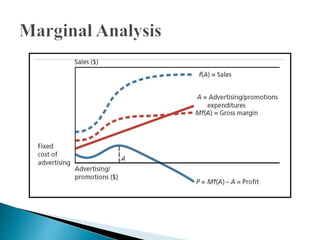
 As advertising/promotional expenditures increase, sales and
gross margins also increase to a point, but then they level off.
 Profits are shown to be a result of the gross margin minus
advertising expenditures.
 A firm would continue to spend advertising/promotional dollars
as long as the marginal revenues created by these expenditures
exceeded the incremental advertising/promotional costs.
 If the sum of the advertising/promotional expenditures exceeded
the revenues they generated, the firm would scale down the
budget.
 The optimal expenditure level is the point where marginal costs
equal the marginal revenues they generate (point A).
Sales are determined
solely by advertising
and promotion
Sales are a direct
measure of advertising
and promotions efforts
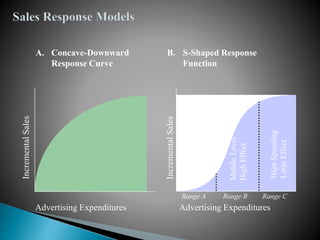
 Almost all advertisers subscribe to one of two models
of the advertising/sales response function:
◦ The concave-downward function or
◦ The S-shaped response curve
IncrementalSales
Advertising Expenditures
A. Concave-Downward
Response Curve
IncrementalSales
Advertising Expenditures
Range A Range B Range C
B. S-Shaped Response
Function
HighSpending
LittleEffect
InitialSpending
LittleEffect
MiddleLevel
HighEffect
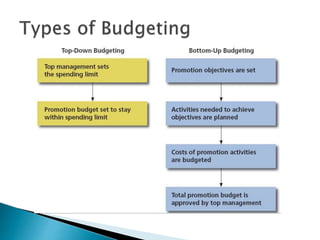
 Many firms employ more than one method, and
 Budgeting approaches vary according to the size and
sophistication of the firm.
 Affordable method
 Arbitrary allocation
 Percentage of sales
 Competitive parity, and
 Return on investment (ROI).
 Objective & Task
 Payout Planning
 Quantitative Planning
Isolate objectives
Reevaluate objectives
Determine tasks required
Estimate required expenditures
Monitor
 To determine how much to spend, marketers often
develop a payout plan that determines the investment
value of the advertising and promotion appropriation.
 The basic idea is to project the revenues the product
will generate, as well as the costs it will incur, over two
to three years.
 Based on an expected rate of return, the payout plan
will assist in determining how much advertising and
promotions expenditure will be necessary when the
return might be expected.
 Attempts to apply quantitative models to budgeting
have met with limited success.
 For the most part, these methods employ computer
simulation models involving statistical techniques
such as multiple regression analysis to determine the
relative contribution of the advertising budget to sales.
 As computers continue to find their way into the
advertising domain, better models may be forthcoming.
 Allocation depends on
 Client Agency Policies
 Market Size
 Market Potential
 Market Share Goals
 Economies of Scale in Advertising
 Organizational Characteristics
-The organization’s structure—centralized versus
decentralized, formalization, and complexity.
-Power and politics in the organizational
hierarchy.
-The use of expert opinions (e.g., consultants)
Chapter 7
Chapter 7

Chapter 7

  • 1.
  • 2.
     Unfortunately, manycompanies have difficulty with the most critical step in the promotional planning process—setting realistic objectives.  Complex marketing situations, conflicting perspectives, and uncertainty over resources make the setting of marketing communications objectives “a job of creating order out of chaos.”
  • 3.
     While difficult,it must be done properly, because budgeting for advertising and other promotional areas, as well as creative and media strategies and tactics, evolve from these objectives.  They also provide a standard against which performance can be measured.
  • 4.
     Many marketersare uncertain as to what IMC should be expected to contribute to the marketing program.  The goal of their company’s advertising and promotional program is simple: to generate sales.  As we know, advertising and promotion are not the only marketing activities involved in generating sales.  Moreover, it is not always possible or necessary to measure the effects of advertising in terms of sales.
  • 5.
     Communications: Theadvertising and promotional program must be coordinated within the company, inside the ad agency, and between the two.  Planning and Decision Making: Promotional planners are often faced with a number of strategic and tactical options in terms of choosing creative options, selecting media, and allocating the budget among various elements of the promotional mix.  Measurement and Evaluation of Results: An important reason for setting specific objectives is that they provide a benchmark against which the success or failure of the promotional campaign can be measured.
  • 6.
    Marketing Objectives • Generallystated in the firm’s marketing plan • Achieved through the overall marketing plan • Quantifiable, such as sales, market share, ROI • To be accomplished in a given period of time • Must be realistic and attainable to be effective Communications Objectives • Derived from the overall marketing plan • More narrow than marketing objectives • Based on particular communications tasks • Designed to deliver appropriate messages • Focused on a specific target audience Vs.
  • 7.
     Sales Oriented Objectives ◦Some managers prefer sales-oriented objectives to make the individuals involved in advertising and promotion think in terms of how the promotional program will influence sales.
  • 8.
     In thebusiness world, poor sales results can be due to any of the other marketing mix variables, including product design or quality, packaging, distribution, or pricing.
  • 9.
     Advertising canmake consumers aware of and interested in the brand, but it can’t make them buy it, particularly if it is not readily available or is priced higher than a competing brand.  Another problem with sales objectives is that the effects of advertising often occur over an extended period. Many experts recognize that advertising has a lagged or carryover effect  Advertising may create awareness, interest, and/or favorable attitudes toward a brand, but these feelings will not result in an actual purchase until the consumer enters the market for the product, which may occur later.
  • 10.
     There aresituations where sales objectives are appropriate.  A major objective of most sales promotion programs is to generate short-term increases in sales.  Direct-response advertising is one type of advertising that evaluates its effectiveness on the basis of sales. Merchandise is advertised in material mailed to customers, in newspapers and magazines, through the Internet, or on television. The consumer purchases the merchandise by mail, on the Net, or by calling a toll- free number.
  • 11.
     For example,objectives for and the evaluation of a direct- response ad on TV are based on the number of orders received each time a station broadcasts the commercial.  Because advertising is really the only form of communication and promotion used in this situation and response is generally immediate, setting objectives in terms of sales is appropriate.  Retail advertising, which accounts for a significant percentage of all advertising expenditures, is another area where the advertiser often seeks a direct response, particularly when sales or special events are being promoted.
  • 12.
     Retailers mayalso allocate advertising and promotional dollars to image-building campaigns designed to create and enhance favorable perceptions of their stores. In this case, sales-oriented objectives would not be appropriate  Sales-oriented objectives are also used when advertising plays a dominant role in a firm’s marketing program and other factors are relatively stable. For example, many packaged-goods companies compete in mature markets with established channels of distribution, stable competitive prices and promotional budgets, and products of similar quality.
  • 15.
     The DAGMARapproach to setting advertising goals and objectives has become one of the most influential approaches to the advertising planning process  Under the DAGMAR approach, the communications task is based on a hierarchical model of the communications process with four stages: ◦ Awareness—making the consumer aware of the existence of the brand or company. ◦ Comprehension—developing an understanding of what the product is and what it will do for the consumer. ◦ Conviction—developing a mental disposition in the consumer to buy the product. ◦ Action—getting the consumer to purchase the product.
  • 16.
  • 17.
    Cons Inhibition of creativity Reliesheavily on the response hierarchy May not increase sales Practicality and cost Pros Focus on communications objectives Measurement of stages Better understanding of goals and objectives Less subjective
  • 18.
     One ofthe most critical decisions facing the marketing manager is how much to spend on the promotional effort.  Unfortunately, many managers fail to realize the value of advertising and promotion.  They treat the communications budget as an expense rather than an investment.
  • 20.
     As advertising/promotionalexpenditures increase, sales and gross margins also increase to a point, but then they level off.  Profits are shown to be a result of the gross margin minus advertising expenditures.  A firm would continue to spend advertising/promotional dollars as long as the marginal revenues created by these expenditures exceeded the incremental advertising/promotional costs.  If the sum of the advertising/promotional expenditures exceeded the revenues they generated, the firm would scale down the budget.  The optimal expenditure level is the point where marginal costs equal the marginal revenues they generate (point A).
  • 21.
    Sales are determined solelyby advertising and promotion Sales are a direct measure of advertising and promotions efforts
  • 22.
     Almost alladvertisers subscribe to one of two models of the advertising/sales response function: ◦ The concave-downward function or ◦ The S-shaped response curve
  • 23.
    IncrementalSales Advertising Expenditures A. Concave-Downward ResponseCurve IncrementalSales Advertising Expenditures Range A Range B Range C B. S-Shaped Response Function HighSpending LittleEffect InitialSpending LittleEffect MiddleLevel HighEffect
  • 25.
     Many firmsemploy more than one method, and  Budgeting approaches vary according to the size and sophistication of the firm.
  • 27.
     Affordable method Arbitrary allocation  Percentage of sales  Competitive parity, and  Return on investment (ROI).
  • 28.
     Objective &Task  Payout Planning  Quantitative Planning
  • 29.
    Isolate objectives Reevaluate objectives Determinetasks required Estimate required expenditures Monitor
  • 30.
     To determinehow much to spend, marketers often develop a payout plan that determines the investment value of the advertising and promotion appropriation.  The basic idea is to project the revenues the product will generate, as well as the costs it will incur, over two to three years.  Based on an expected rate of return, the payout plan will assist in determining how much advertising and promotions expenditure will be necessary when the return might be expected.
  • 32.
     Attempts toapply quantitative models to budgeting have met with limited success.  For the most part, these methods employ computer simulation models involving statistical techniques such as multiple regression analysis to determine the relative contribution of the advertising budget to sales.  As computers continue to find their way into the advertising domain, better models may be forthcoming.
  • 33.
     Allocation dependson  Client Agency Policies  Market Size  Market Potential  Market Share Goals  Economies of Scale in Advertising  Organizational Characteristics -The organization’s structure—centralized versus decentralized, formalization, and complexity. -Power and politics in the organizational hierarchy. -The use of expert opinions (e.g., consultants)