Learning Targets:
Taking the Mystery out
of Mastery!
Lawrence Public Schools
Induction 2016
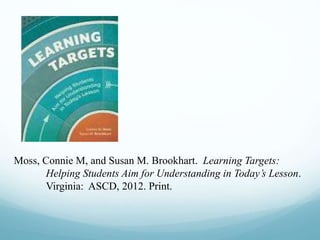
Moss, Connie M, and Susan M. Brookhart. Learning Targets:
Helping Students Aim for Understanding in Today’s Lesson.
Virginia: ASCD, 2012. Print.
Today’s Norms
• Stay Engaged
• Experience Discomfort
• Speak Your Truth
• Expect/Accept Non-Closure
How is the art and practice of
teaching similar/different to
what this gentleman does in his
job?
Students who can identify what
they are learning significantly
outscore those who cannot.
Robert J. Marzano
Educators & Students
must be able to answer……
 Where am I going?
 Where am I now?
 How can I close the gap?
 How will I know I’m getting there?
 How can I keep it going?
Setting Objectives
 Students learn most efficiently when they know the
goals or objectives of a specific lesson or learning
activity. This makes intuitive sense. If students are
aware of an intended outcome, they know what to
focus on. When setting objectives, the teacher
simply gives students a target for their learning.
Robert Marzano
Direct and Explicit Instruction
 There are several ways to provide students with an
advance organizer. In the most simple form, an
advance organizer involves verbally stating the
objective of a lesson and briefly informing students of
how they will learn the new material.
 Kathleen Lane
Research-Based Strategies
5 Research-based strategies that
significantly improve student learning:
Sharing criteria (clear learning
targets with success criteria)
Questioning
Feedback
Peer assessment
Self-assessment
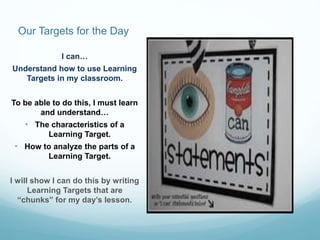
Our Targets for the Day
I can…
Understand how to use Learning
Targets in my classroom.
To be able to do this, I must learn
and understand…
• The characteristics of a
Learning Target.
• How to analyze the parts of a
Learning Target.
I will show I can do this by writing
Learning Targets that are
“chunks” for my day’s lesson.
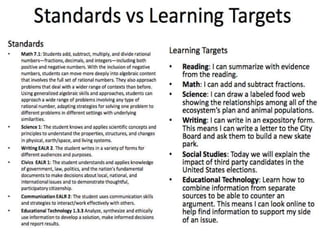
QUESTION
What is the difference between a
STANDARD
and a
TARGET?
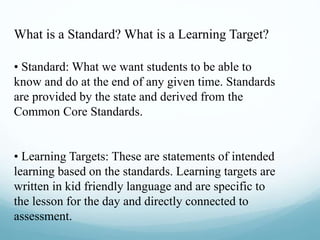
What is a Standard? What is a Learning Target?
• Standard: What we want students to be able to
know and do at the end of any given time. Standards
are provided by the state and derived from the
Common Core Standards.
• Learning Targets: These are statements of intended
learning based on the standards. Learning targets are
written in kid friendly language and are specific to
the lesson for the day and directly connected to
assessment.
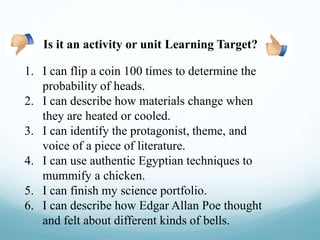
1. I can flip a coin 100 times to determine the
probability of heads.
2. I can describe how materials change when
they are heated or cooled.
3. I can identify the protagonist, theme, and
voice of a piece of literature.
4. I can use authentic Egyptian techniques to
mummify a chicken.
5. I can finish my science portfolio.
6. I can describe how Edgar Allan Poe thought
and felt about different kinds of bells.
Is it an activity or unit Learning Target?
A Learning Target should:
• Express to students, in terms the
students understand, the content
and performance they are aiming
for.
• Your Learning Target should spring
from the instructional objectives
that guide a set of lessons in this
particular unit of study.
Step One:
Identify the intended learning. What does a lesson-size
chunk of your instructional objective look like?
• What content knowledge does this lesson focus on?
• How will this particular lesson add to what students have
learned in previous lessons?
• How will this lesson increase students’ understanding of the
content?
• What skills does this lesson focus on?
• Will students learn a new skill, practice one they have yet to
master, or apply a highly developed skill to a new content?
Step Two:
Define the reason processes essential for the lesson.
(Webb’s Depth of Knowledge, Costa’s Levels of
Thinking, Bloom’s Revised Taxonomy)
• What thought demanding processes will allow my
students to build on what they already know?
• What kinds of thinking will promote deep understanding
and skill development so that students can analyze,
reshape, expand, extrapolate from, apply, and build on
what they already know?
Step Three:
Design a strong Performance of Understanding.
It is not the instructional objective, but it
provides a number of ways in which a student
can learn and produce evidence of what they are
learning and doing in the lesson.
• What Performance of Understanding will help my
students develop their thinking skills and apply their
new knowledge?
Step Four:
State the Learning Target by describing the lesson-
size chunk of learning for your class as a statement
of what the students will learn and do during the
lesson.
• An effective Learning Target must speak to students,
express the essentials of the lesson.
• An effective Learning Target is written in student-
friendly language using an “I can…” stem.
• An effective Learning Target should enable students to
see themselves as the agents of learning.
The whole concept of standards-based
instruction assumes that individual
lessons, over time, will amount to
achievement of a larger standard.
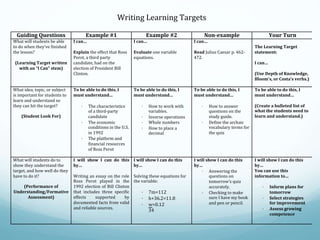
Writing Learning Targets
Guiding Questions Example #1 Example #2 Non-example Your Turn
What will students be able
to do when they’ve finished
the lesson?
(Learning Target written
with an “I Can” stem)
I can…
Explain the effect that Ross
Perot, a third party
candidate, had on the
election of President Bill
Clinton.
I can…
Evaluate one variable
equations.
I can…
Read Julius Caesar p. 462-
472.
The Learning Target
statement:
I can…
(Use Depth of Knowledge,
Bloom’s, or Costa’s verbs.)
What idea, topic, or subject
is important for students to
learn and understand so
they can hit the target?
(Student Look For)
To be able to do this, I
must understand…
· The characteristics
of a third-party
candidate
· The economic
conditions in the U.S.
in 1992
· The platform and
financial resources
of Ross Perot
To be able to do this, I
must understand…
· How to work with
variables.
· Inverse operations
· Whole numbers
· How to place a
decimal
To be able to do this, I
must understand…
· How to answer
questions on the
study guide.
· Define the archaic
vocabulary terms for
the quiz
To be able to do this, I
must understand…
(Create a bulleted list of
what the students need to
learn and understand.)
What will students do to
show they understand the
target, and how well do they
have to do it?
(Performance of
Understanding/Formative
Assessment)
I will show I can do this
by…
Writing an essay on the role
Ross Perot played in the
1992 election of Bill Clinton
that includes three specific
effects supported by
documented facts from valid
and reliable sources.
I will show I can do this
by…
Solving these equations for
the variable:
· 7m=112
· h+36.2=11.8
· w=0.12
34
I will show I can do this
by…
· Answering the
questions on
tomorrow’s quiz
accurately.
· Checking to make
sure I have my book
and pen or pencil.
I will show I can do this
by…
You can use this
information to…
· Inform plans for
tomorrow
· Select strategies
for improvement
· Assess growing
competence
With your content area colleague(s):
Pick a standard that addresses a unit or lesson that you
will be working within the next month.
Use the Writing Learning Targets form to write your
Learning Targets for that unit/lesson.
Be prepared to share your targets with other colleagues.
Next Steps:
• Find a colleague outside of your content area.
• Share your Learning Target for the lesson you have
chosen.
• Use the Learning Targets Rubric to guide your
thinking and discussion.
• Give your colleague feedback about his/her Learning
Target. I notice…/I wonder...
• Use the rubric to guide your writing of Learning
Targets in the future.

Learning Targets

  • 1.
    Learning Targets: Taking theMystery out of Mastery! Lawrence Public Schools Induction 2016
  • 2.
    Moss, Connie M,and Susan M. Brookhart. Learning Targets: Helping Students Aim for Understanding in Today’s Lesson. Virginia: ASCD, 2012. Print.
  • 3.
    Today’s Norms • StayEngaged • Experience Discomfort • Speak Your Truth • Expect/Accept Non-Closure
  • 4.
    How is theart and practice of teaching similar/different to what this gentleman does in his job?
  • 6.
    Students who canidentify what they are learning significantly outscore those who cannot. Robert J. Marzano
  • 7.
    Educators & Students mustbe able to answer……  Where am I going?  Where am I now?  How can I close the gap?  How will I know I’m getting there?  How can I keep it going?
  • 8.
    Setting Objectives  Studentslearn most efficiently when they know the goals or objectives of a specific lesson or learning activity. This makes intuitive sense. If students are aware of an intended outcome, they know what to focus on. When setting objectives, the teacher simply gives students a target for their learning. Robert Marzano
  • 10.
    Direct and ExplicitInstruction  There are several ways to provide students with an advance organizer. In the most simple form, an advance organizer involves verbally stating the objective of a lesson and briefly informing students of how they will learn the new material.  Kathleen Lane
  • 11.
    Research-Based Strategies 5 Research-basedstrategies that significantly improve student learning: Sharing criteria (clear learning targets with success criteria) Questioning Feedback Peer assessment Self-assessment
  • 12.
    Our Targets forthe Day I can… Understand how to use Learning Targets in my classroom. To be able to do this, I must learn and understand… • The characteristics of a Learning Target. • How to analyze the parts of a Learning Target. I will show I can do this by writing Learning Targets that are “chunks” for my day’s lesson.
  • 13.
    QUESTION What is thedifference between a STANDARD and a TARGET?
  • 14.
    What is aStandard? What is a Learning Target? • Standard: What we want students to be able to know and do at the end of any given time. Standards are provided by the state and derived from the Common Core Standards. • Learning Targets: These are statements of intended learning based on the standards. Learning targets are written in kid friendly language and are specific to the lesson for the day and directly connected to assessment.
  • 17.
    1. I canflip a coin 100 times to determine the probability of heads. 2. I can describe how materials change when they are heated or cooled. 3. I can identify the protagonist, theme, and voice of a piece of literature. 4. I can use authentic Egyptian techniques to mummify a chicken. 5. I can finish my science portfolio. 6. I can describe how Edgar Allan Poe thought and felt about different kinds of bells. Is it an activity or unit Learning Target?
  • 18.
    A Learning Targetshould: • Express to students, in terms the students understand, the content and performance they are aiming for. • Your Learning Target should spring from the instructional objectives that guide a set of lessons in this particular unit of study.
  • 19.
    Step One: Identify theintended learning. What does a lesson-size chunk of your instructional objective look like? • What content knowledge does this lesson focus on? • How will this particular lesson add to what students have learned in previous lessons? • How will this lesson increase students’ understanding of the content? • What skills does this lesson focus on? • Will students learn a new skill, practice one they have yet to master, or apply a highly developed skill to a new content?
  • 20.
    Step Two: Define thereason processes essential for the lesson. (Webb’s Depth of Knowledge, Costa’s Levels of Thinking, Bloom’s Revised Taxonomy) • What thought demanding processes will allow my students to build on what they already know? • What kinds of thinking will promote deep understanding and skill development so that students can analyze, reshape, expand, extrapolate from, apply, and build on what they already know?
  • 21.
    Step Three: Design astrong Performance of Understanding. It is not the instructional objective, but it provides a number of ways in which a student can learn and produce evidence of what they are learning and doing in the lesson. • What Performance of Understanding will help my students develop their thinking skills and apply their new knowledge?
  • 22.
    Step Four: State theLearning Target by describing the lesson- size chunk of learning for your class as a statement of what the students will learn and do during the lesson. • An effective Learning Target must speak to students, express the essentials of the lesson. • An effective Learning Target is written in student- friendly language using an “I can…” stem. • An effective Learning Target should enable students to see themselves as the agents of learning.
  • 23.
    The whole conceptof standards-based instruction assumes that individual lessons, over time, will amount to achievement of a larger standard.
  • 24.
    Writing Learning Targets GuidingQuestions Example #1 Example #2 Non-example Your Turn What will students be able to do when they’ve finished the lesson? (Learning Target written with an “I Can” stem) I can… Explain the effect that Ross Perot, a third party candidate, had on the election of President Bill Clinton. I can… Evaluate one variable equations. I can… Read Julius Caesar p. 462- 472. The Learning Target statement: I can… (Use Depth of Knowledge, Bloom’s, or Costa’s verbs.) What idea, topic, or subject is important for students to learn and understand so they can hit the target? (Student Look For) To be able to do this, I must understand… · The characteristics of a third-party candidate · The economic conditions in the U.S. in 1992 · The platform and financial resources of Ross Perot To be able to do this, I must understand… · How to work with variables. · Inverse operations · Whole numbers · How to place a decimal To be able to do this, I must understand… · How to answer questions on the study guide. · Define the archaic vocabulary terms for the quiz To be able to do this, I must understand… (Create a bulleted list of what the students need to learn and understand.) What will students do to show they understand the target, and how well do they have to do it? (Performance of Understanding/Formative Assessment) I will show I can do this by… Writing an essay on the role Ross Perot played in the 1992 election of Bill Clinton that includes three specific effects supported by documented facts from valid and reliable sources. I will show I can do this by… Solving these equations for the variable: · 7m=112 · h+36.2=11.8 · w=0.12 34 I will show I can do this by… · Answering the questions on tomorrow’s quiz accurately. · Checking to make sure I have my book and pen or pencil. I will show I can do this by… You can use this information to… · Inform plans for tomorrow · Select strategies for improvement · Assess growing competence
  • 25.
    With your contentarea colleague(s): Pick a standard that addresses a unit or lesson that you will be working within the next month. Use the Writing Learning Targets form to write your Learning Targets for that unit/lesson. Be prepared to share your targets with other colleagues.
  • 26.
    Next Steps: • Finda colleague outside of your content area. • Share your Learning Target for the lesson you have chosen. • Use the Learning Targets Rubric to guide your thinking and discussion. • Give your colleague feedback about his/her Learning Target. I notice…/I wonder... • Use the rubric to guide your writing of Learning Targets in the future.