
Principles of High
Quality Assessment
Teacher-made test
• Means that the teacher design them to
assess students learning
• These test are associated with the grades
on report cards
• Help measure students progress
• Test scores maybe used for a portion of
students’ mark (Williams and
Haladyna,1999)
Some suggestions that can be helpful in
constructing tests:
1.) Test should be balanced
2.) Students should not be penalized with a
low mark because they are weak in reading &
writing
3.) The teacher might choose to use format
different from conventional test
There should be no surprises when it comes to students evaluation
Students should always be aware of evaluation criteria
and procedures
They should have a role in the evaluation
They should receive regular feedback as to “how they
are doing”
According to Stiggins (2001)
“The purpose of the classroom test vary, but prior to
constructing any test, teachers should first identify the
kinds of instructional decisions will be made based on
test results, and the kinds of score-based inferences
needed to support those decisions”
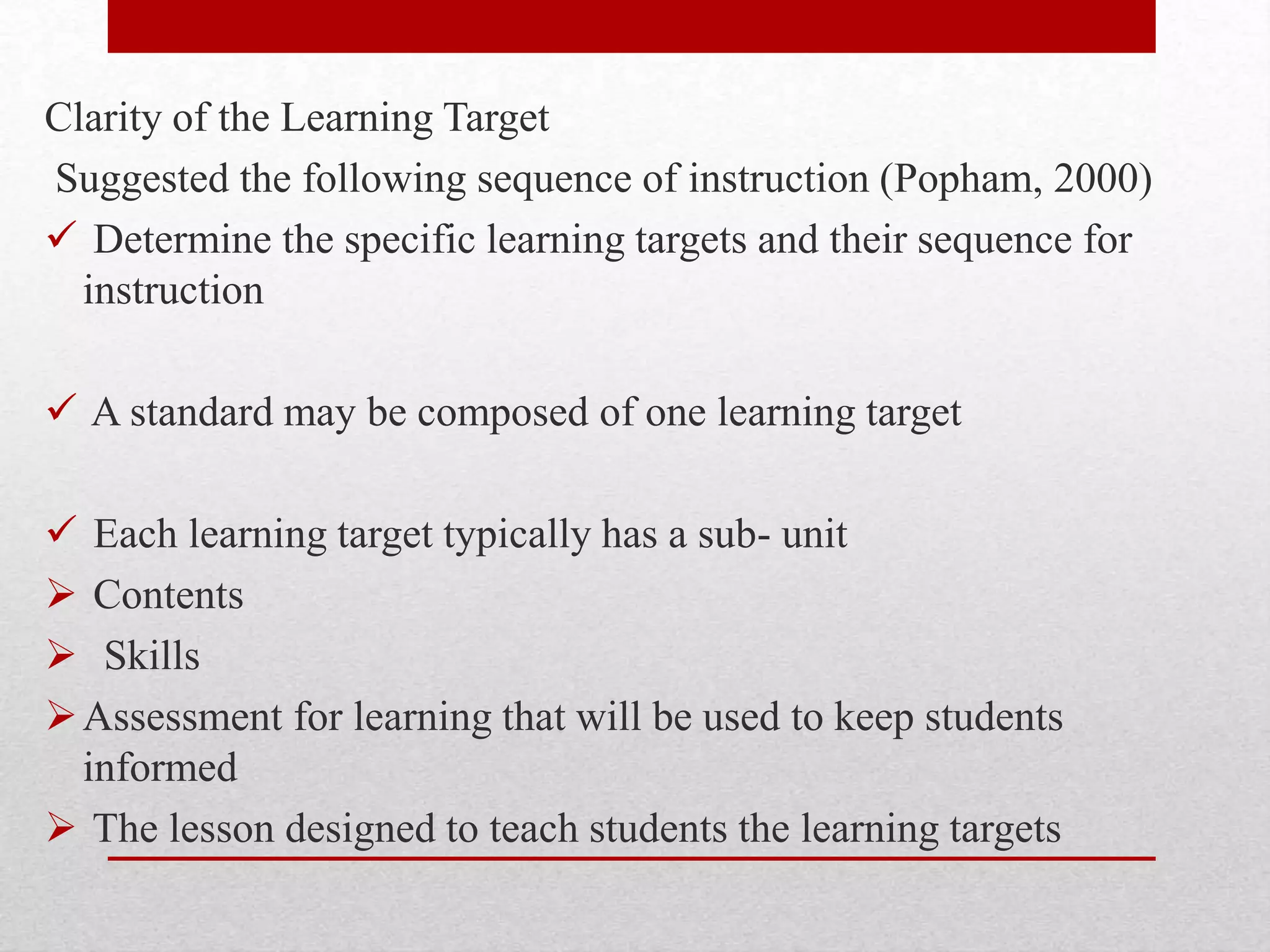
Clarity of the Learning Target
Suggested the following sequence of instruction (Popham, 2000)
 Determine the specific learning targets and their sequence for
instruction
 A standard may be composed of one learning target
 Each learning target typically has a sub- unit
 Contents
 Skills
Assessment for learning that will be used to keep students
informed
 The lesson designed to teach students the learning targets
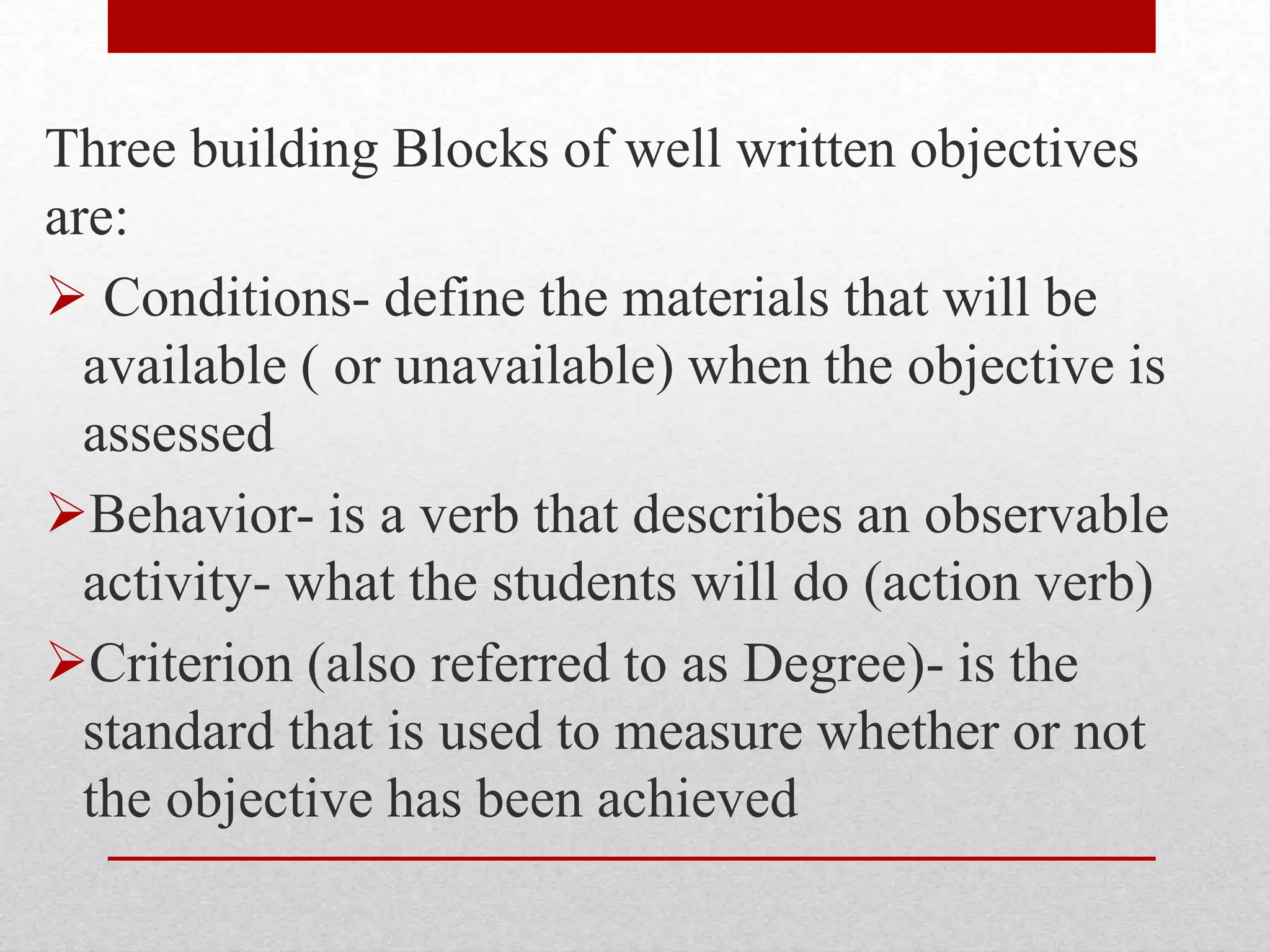
Three building Blocks of well written objectives
are:
 Conditions- define the materials that will be
available ( or unavailable) when the objective is
assessed
Behavior- is a verb that describes an observable
activity- what the students will do (action verb)
Criterion (also referred to as Degree)- is the
standard that is used to measure whether or not
the objective has been achieved
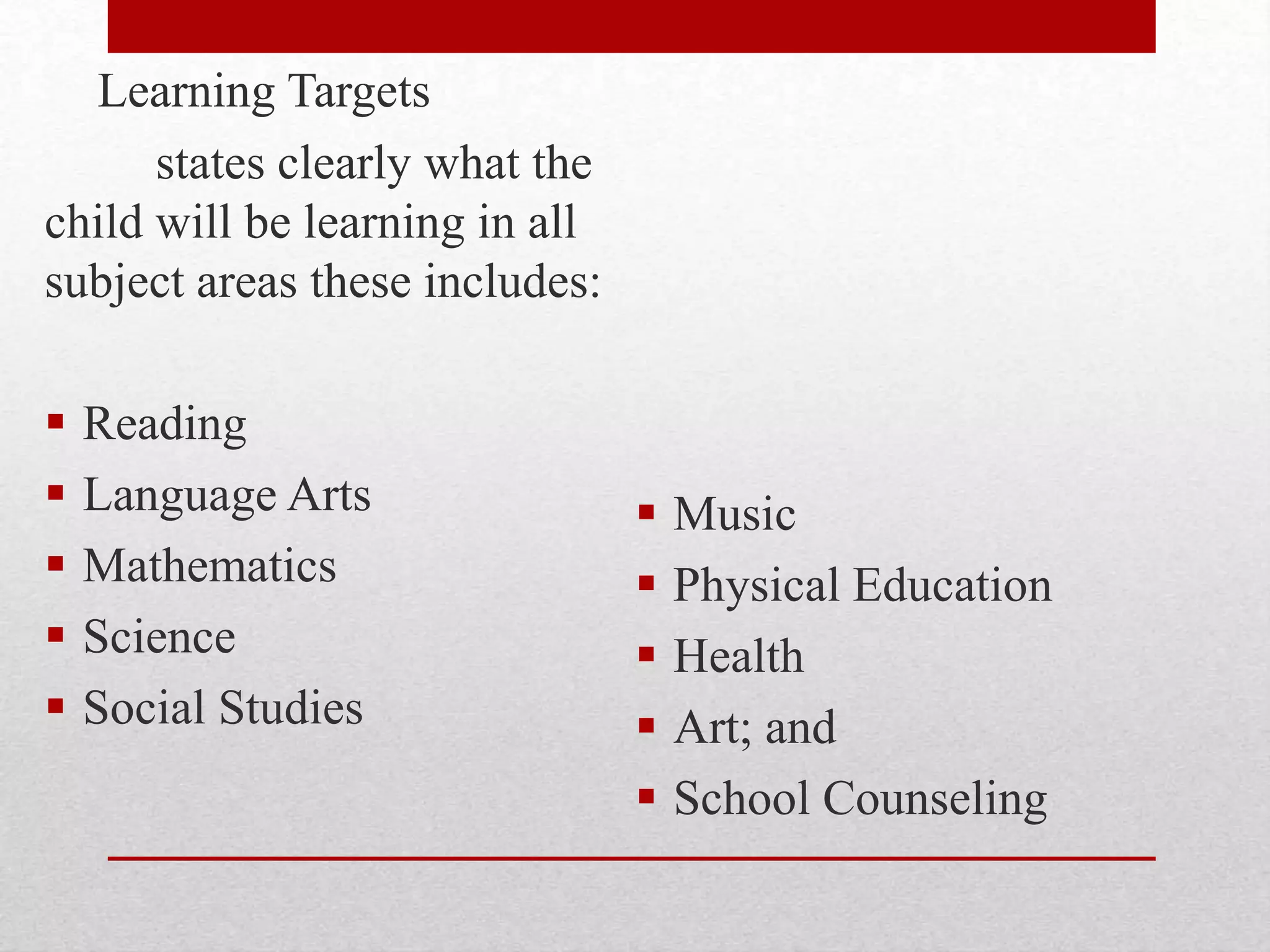
Learning Targets
states clearly what the
child will be learning in all
subject areas these includes:
 Reading
 Language Arts
 Mathematics
 Science
 Social Studies
 Music
 Physical Education
 Health
 Art; and
 School Counseling
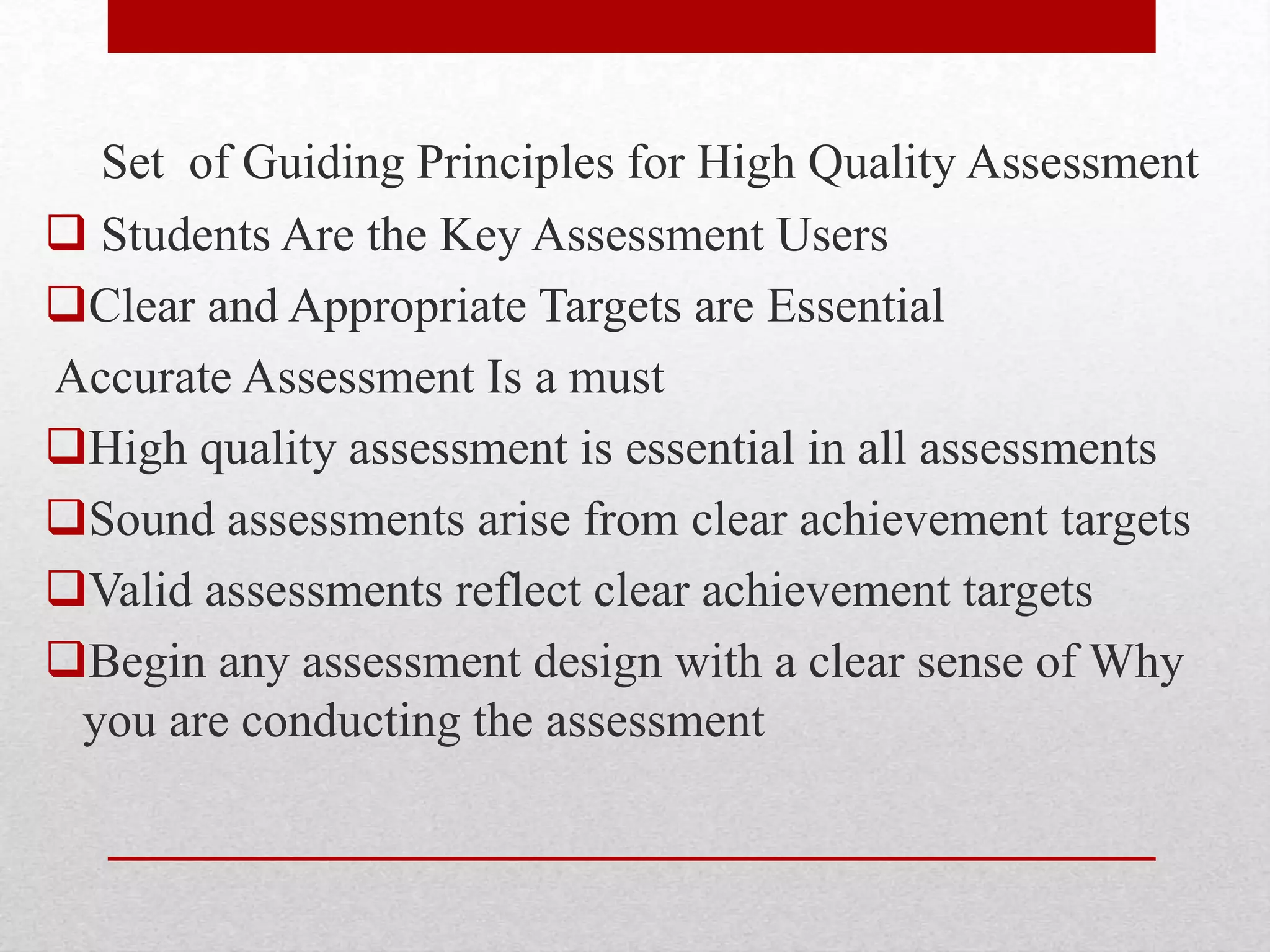
Set of Guiding Principles for High Quality Assessment
 Students Are the Key Assessment Users
Clear and Appropriate Targets are Essential
Accurate Assessment Is a must
High quality assessment is essential in all assessments
Sound assessments arise from clear achievement targets
Valid assessments reflect clear achievement targets
Begin any assessment design with a clear sense of Why
you are conducting the assessment
Benefits based on the existence of learning that clears and
usable:
 Knowledge Targets
Procedural Knowledge targets
 Reasoning Targets
Types of Reasoning
 Inductive reasoning uses specific facts or evidence to infer general
conclusions
 Deductive Reasoning begins with general rule or principle to infer specific
conclusions or solutions
 Analytical Reasoning requires examining components or structure of
something
 Comparative Reasoning describes similarities and differences between two
or more items
 Performance Skills Targets
requires the students to demonstrate their
mastery of learning and to be observed
 Product targets are not to used as frequently as
other types but highly valued calling for creation
of a product.
 Dispositional Targets rarely show up on state
standards but are important because they reflect
students’ attitude about school and learning.
Establishing Learning Goals
Educational Goals – general statements of what
students will know and be able to do.
Educational Learning Objectives
 more specific statements of what students will
know and be able to do
Types of Learning Targets
( Marzano and Kendall (1996) identified five types of
learning targets:
 Knowledge and Simple Understanding- includes mastery of facts
and information, typically through recall, as well as simple
understanding
Deep Understanding and Reasoning- includes problem solving,
critical thinking, synthesis, comparing, higher order thinking skills
and judgement
Skills-involves something that a student must demonstrate in a way
other than answering questions
Products- includes a sample of students work that demonstrates the
ability knowledge, understanding, reasoning and skills
Affective- includes attitudes, values, interests, feelings and beliefs
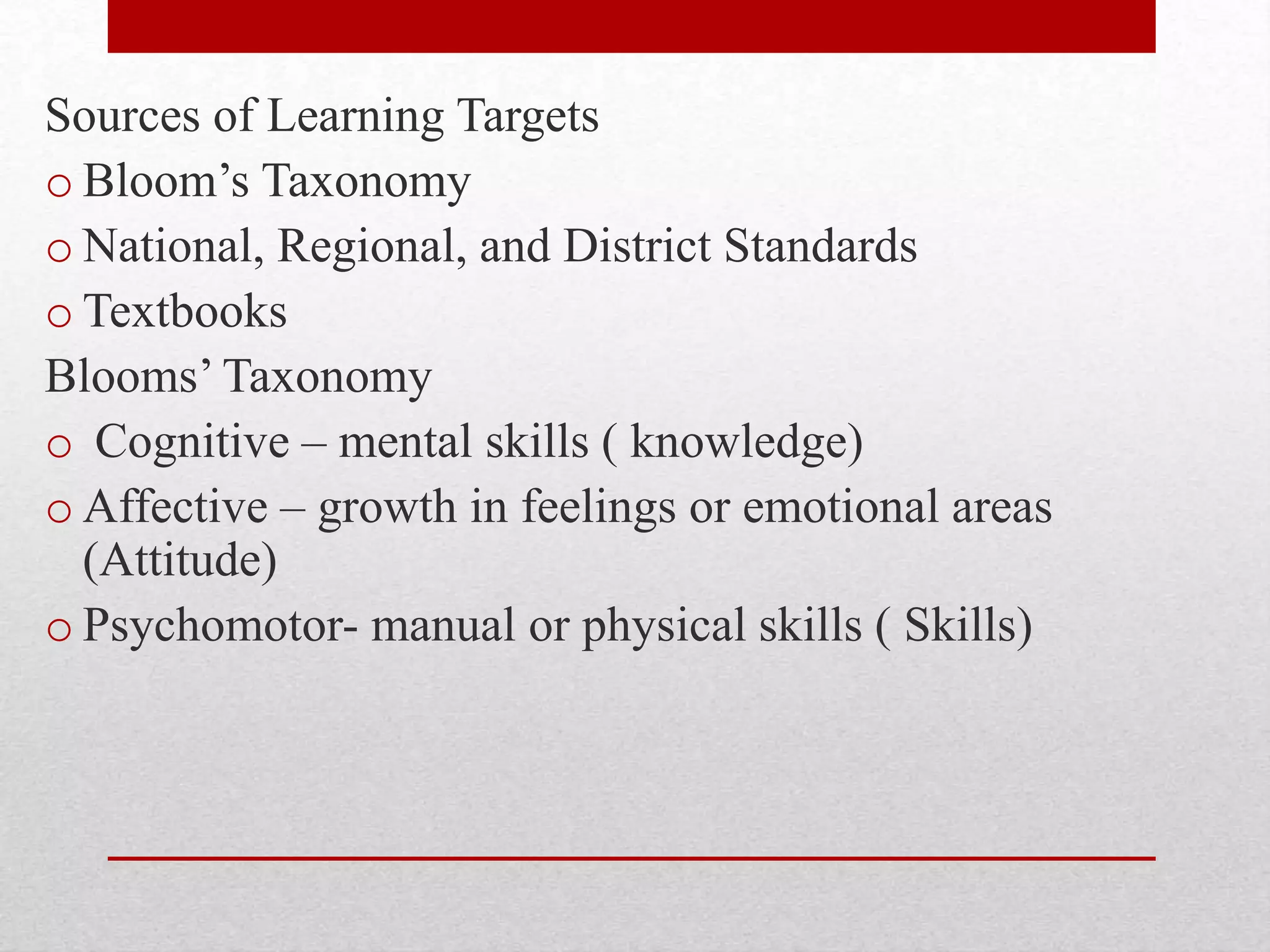
Sources of Learning Targets
o Bloom’s Taxonomy
o National, Regional, and District Standards
o Textbooks
Blooms’ Taxonomy
o Cognitive – mental skills ( knowledge)
o Affective – growth in feelings or emotional areas
(Attitude)
o Psychomotor- manual or physical skills ( Skills)
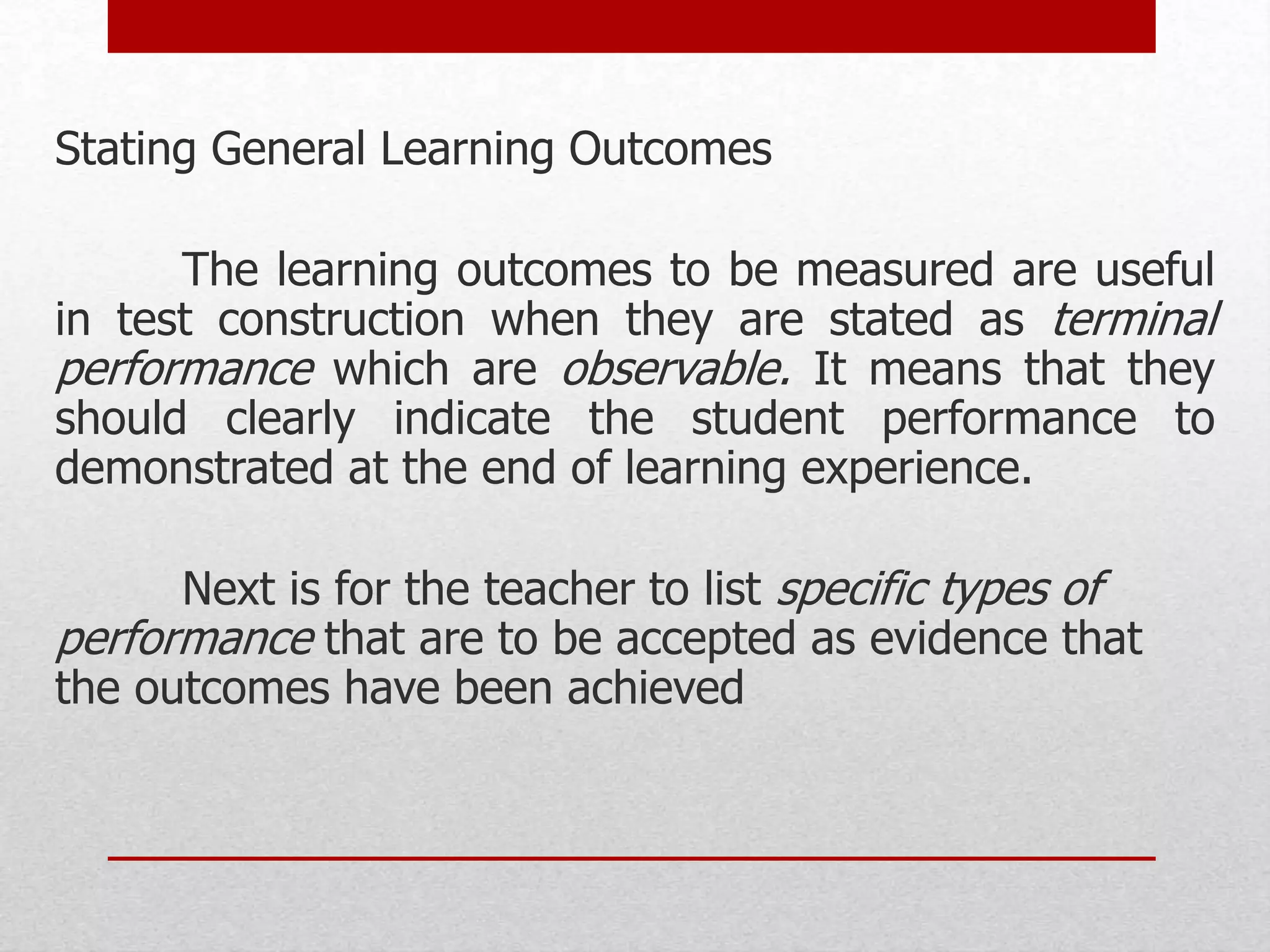
Stating General Learning Outcomes
The learning outcomes to be measured are useful
in test construction when they are stated as terminal
performance which are observable. It means that they
should clearly indicate the student performance to
demonstrated at the end of learning experience.
Next is for the teacher to list specific types of
performance that are to be accepted as evidence that
the outcomes have been achieved
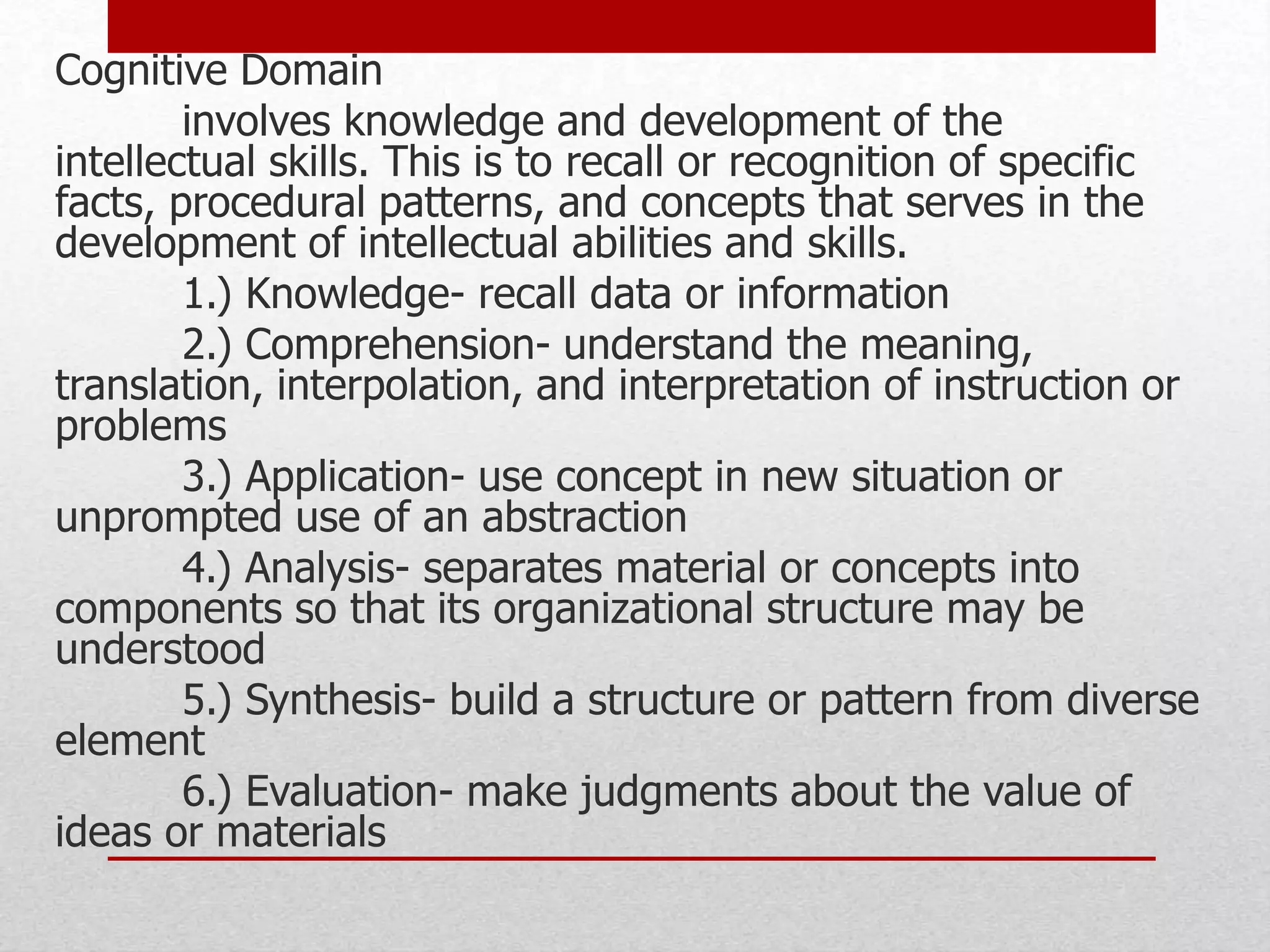
Cognitive Domain
involves knowledge and development of the
intellectual skills. This is to recall or recognition of specific
facts, procedural patterns, and concepts that serves in the
development of intellectual abilities and skills.
1.) Knowledge- recall data or information
2.) Comprehension- understand the meaning,
translation, interpolation, and interpretation of instruction or
problems
3.) Application- use concept in new situation or
unprompted use of an abstraction
4.) Analysis- separates material or concepts into
components so that its organizational structure may be
understood
5.) Synthesis- build a structure or pattern from diverse
element
6.) Evaluation- make judgments about the value of
ideas or materials
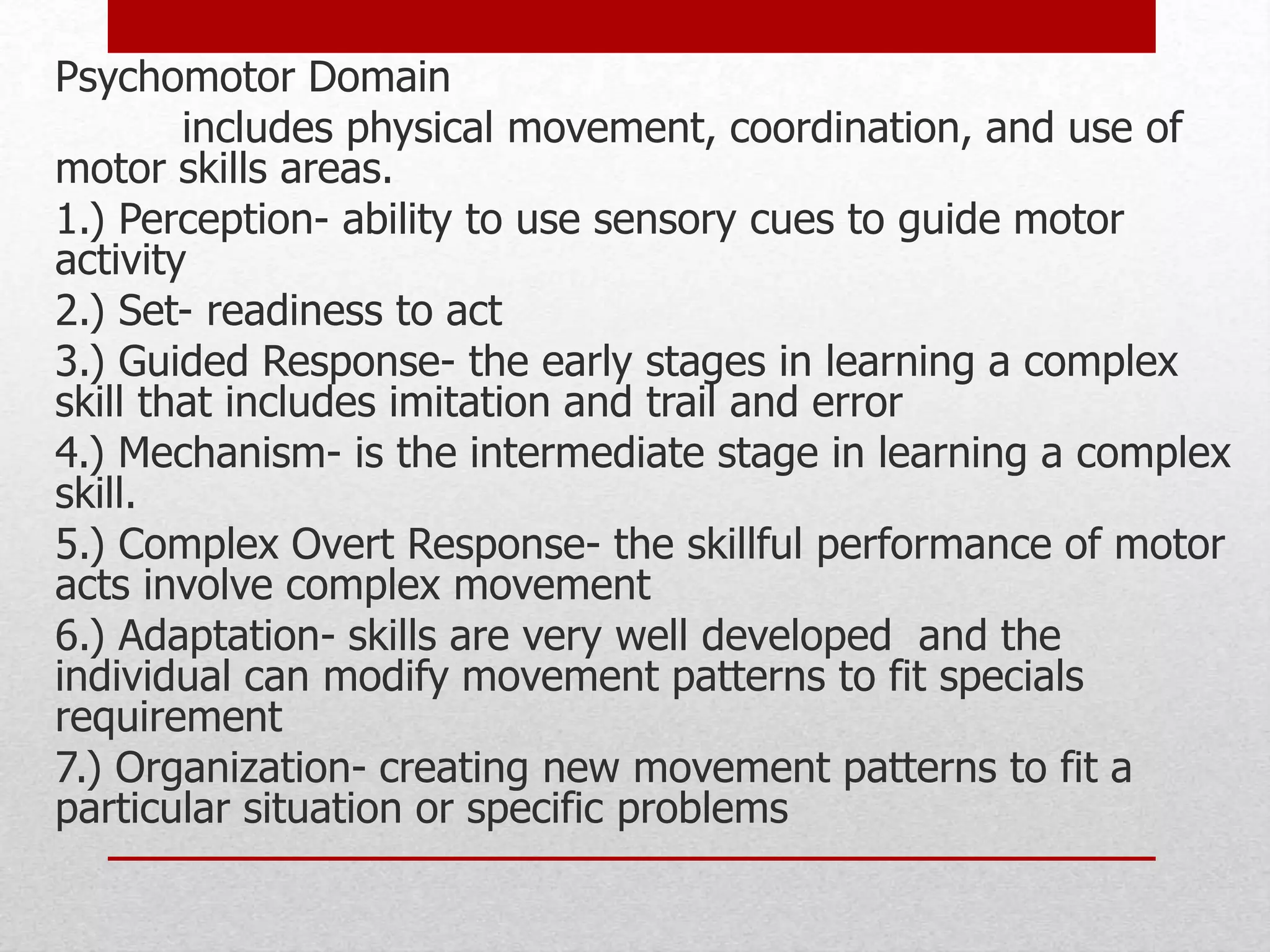
Psychomotor Domain
includes physical movement, coordination, and use of
motor skills areas.
1.) Perception- ability to use sensory cues to guide motor
activity
2.) Set- readiness to act
3.) Guided Response- the early stages in learning a complex
skill that includes imitation and trail and error
4.) Mechanism- is the intermediate stage in learning a complex
skill.
5.) Complex Overt Response- the skillful performance of motor
acts involve complex movement
6.) Adaptation- skills are very well developed and the
individual can modify movement patterns to fit specials
requirement
7.) Organization- creating new movement patterns to fit a
particular situation or specific problems
Principles of high quality assessment criteria and techniques

Principles of high quality assessment criteria and techniques

  • 1.
  • 2.
    Teacher-made test • Meansthat the teacher design them to assess students learning • These test are associated with the grades on report cards • Help measure students progress • Test scores maybe used for a portion of students’ mark (Williams and Haladyna,1999)
  • 3.
    Some suggestions thatcan be helpful in constructing tests: 1.) Test should be balanced 2.) Students should not be penalized with a low mark because they are weak in reading & writing 3.) The teacher might choose to use format different from conventional test
  • 4.
    There should beno surprises when it comes to students evaluation Students should always be aware of evaluation criteria and procedures They should have a role in the evaluation They should receive regular feedback as to “how they are doing” According to Stiggins (2001) “The purpose of the classroom test vary, but prior to constructing any test, teachers should first identify the kinds of instructional decisions will be made based on test results, and the kinds of score-based inferences needed to support those decisions”
  • 5.
    Clarity of theLearning Target Suggested the following sequence of instruction (Popham, 2000)  Determine the specific learning targets and their sequence for instruction  A standard may be composed of one learning target  Each learning target typically has a sub- unit  Contents  Skills Assessment for learning that will be used to keep students informed  The lesson designed to teach students the learning targets
  • 6.
    Three building Blocksof well written objectives are:  Conditions- define the materials that will be available ( or unavailable) when the objective is assessed Behavior- is a verb that describes an observable activity- what the students will do (action verb) Criterion (also referred to as Degree)- is the standard that is used to measure whether or not the objective has been achieved
  • 7.
    Learning Targets states clearlywhat the child will be learning in all subject areas these includes:  Reading  Language Arts  Mathematics  Science  Social Studies  Music  Physical Education  Health  Art; and  School Counseling
  • 8.
    Set of GuidingPrinciples for High Quality Assessment  Students Are the Key Assessment Users Clear and Appropriate Targets are Essential Accurate Assessment Is a must High quality assessment is essential in all assessments Sound assessments arise from clear achievement targets Valid assessments reflect clear achievement targets Begin any assessment design with a clear sense of Why you are conducting the assessment
  • 9.
    Benefits based onthe existence of learning that clears and usable:  Knowledge Targets Procedural Knowledge targets  Reasoning Targets Types of Reasoning  Inductive reasoning uses specific facts or evidence to infer general conclusions  Deductive Reasoning begins with general rule or principle to infer specific conclusions or solutions  Analytical Reasoning requires examining components or structure of something  Comparative Reasoning describes similarities and differences between two or more items
  • 10.
     Performance SkillsTargets requires the students to demonstrate their mastery of learning and to be observed  Product targets are not to used as frequently as other types but highly valued calling for creation of a product.  Dispositional Targets rarely show up on state standards but are important because they reflect students’ attitude about school and learning.
  • 11.
    Establishing Learning Goals EducationalGoals – general statements of what students will know and be able to do. Educational Learning Objectives  more specific statements of what students will know and be able to do
  • 12.
    Types of LearningTargets ( Marzano and Kendall (1996) identified five types of learning targets:  Knowledge and Simple Understanding- includes mastery of facts and information, typically through recall, as well as simple understanding Deep Understanding and Reasoning- includes problem solving, critical thinking, synthesis, comparing, higher order thinking skills and judgement Skills-involves something that a student must demonstrate in a way other than answering questions Products- includes a sample of students work that demonstrates the ability knowledge, understanding, reasoning and skills Affective- includes attitudes, values, interests, feelings and beliefs
  • 13.
    Sources of LearningTargets o Bloom’s Taxonomy o National, Regional, and District Standards o Textbooks Blooms’ Taxonomy o Cognitive – mental skills ( knowledge) o Affective – growth in feelings or emotional areas (Attitude) o Psychomotor- manual or physical skills ( Skills)
  • 14.
    Stating General LearningOutcomes The learning outcomes to be measured are useful in test construction when they are stated as terminal performance which are observable. It means that they should clearly indicate the student performance to demonstrated at the end of learning experience. Next is for the teacher to list specific types of performance that are to be accepted as evidence that the outcomes have been achieved
  • 15.
    Cognitive Domain involves knowledgeand development of the intellectual skills. This is to recall or recognition of specific facts, procedural patterns, and concepts that serves in the development of intellectual abilities and skills. 1.) Knowledge- recall data or information 2.) Comprehension- understand the meaning, translation, interpolation, and interpretation of instruction or problems 3.) Application- use concept in new situation or unprompted use of an abstraction 4.) Analysis- separates material or concepts into components so that its organizational structure may be understood 5.) Synthesis- build a structure or pattern from diverse element 6.) Evaluation- make judgments about the value of ideas or materials
  • 16.
    Psychomotor Domain includes physicalmovement, coordination, and use of motor skills areas. 1.) Perception- ability to use sensory cues to guide motor activity 2.) Set- readiness to act 3.) Guided Response- the early stages in learning a complex skill that includes imitation and trail and error 4.) Mechanism- is the intermediate stage in learning a complex skill. 5.) Complex Overt Response- the skillful performance of motor acts involve complex movement 6.) Adaptation- skills are very well developed and the individual can modify movement patterns to fit specials requirement 7.) Organization- creating new movement patterns to fit a particular situation or specific problems