COGNITIVE TARGETS
Assessment can be made precise, accurate, and
dependable only if what are to be achieved are
clearly stated and feasible.
Clarity of Learning Targets
Learning Targets
 involve knowledge, reasoning, skills, products
and effects
 need to be stated in behavioral terms or terms
which denote something which can be
observed through the behavior of the students
The Cognitive Domain
involves knowledge and the development of
intellectual skills
 includes the recall or recognition of specific
facts, procedural patterns, and concepts that
serve in the development of intellectual
abilities and skills
addresses development that is individual
rather than interpersonal, focuses on
content rather than context, and is
independent of emotion
The Cognitive Domain
Skills in the cognitive domain revolve around
knowledge, comprehension, and critical thinking
of a particular topic.
As proposed by Benjamin Bloom (1954),there are
6 major levels of educational objectives at the
cognitive level, starting from the simplest
behavior to the most complex. The categories can
be thought of as degrees of difficulties. That is,
the first ones must normally be mastered before
the next ones can take place.
The Six Levels in the Cognitive Domain
1. KNOWLEDGE – refers to the acquisition of
facts, concepts, and theories.
- forms the foundation of all other cognitive
objectives for without it, it’s not possible to
move up to the next higher level of thinking in
the hierarchy of educational objectives.
KNOWLEDGE
This level require the students to remember.
The Six Levels in the Cognitive Domain
Words typically used in the KNOWLEDGE level
are: define, recall, recognize, remember,
the question words who, what, where, and
when
example question: What are the health benefits
of eating apples?
Cognitive Domain
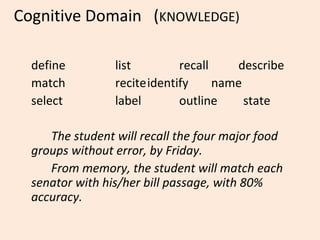
Cognitive Domain (KNOWLEDGE)
define list recall describe
match reciteidentify name
select label outline state
The student will recall the four major food
groups without error, by Friday.
From memory, the student will match each
senator with his/her bill passage, with 80%
accuracy.
The Six Levels in the Cognitive Domain
2. COMPREHENSION – refers to the same
concept as “understanding”
- demonstrates that the student has
sufficient understanding to organize
and arrange material mentally
- a step higher than mere acquisition of facts
and involves a cognition or awareness
of the interrelationships of facts and
concept
The Six Levels in the Cognitive Domain
Words typically used in the COMPREHENSION
level are: describe, compare, contrast,
rephrase, put in your own words, explain the
man idea
example question: Compare the health benefits
of eating apples vs. oranges.
The Six Levels in the Cognitive Domain
3. APPLICATION - refers to the transfer of
knowledge from one field of study to
another or from one concept to another
concept in the same discipline
- a question that asks a student to apply
previously learned information to reach
an answer
The Six Levels in the Cognitive Domain
Words typically used in the APPLICATION level:
apply, classify, use, choose, employ, write an
example, solve, compute, show
example question: Which kinds of apples are
best for baking a pie, and why?
The Six Levels in the Cognitive Domain
4. ANALYSIS - refers to the breaking down of a
concept or idea in its components and
explaining the concept as a composition of
these concepts
- higher order questions that require
students to think critically and in-depth
The Six Levels in the Cognitive Domain
Words typically used in the ANALYSIS level:
identify motives/causes, draw conclusions,
determine evidence, support, analyze, the
question word why, analyze
example question: List four ways of serving foods
made with apples and explain which ones
have the highest health benefits. Provide
references to support your statements.
The Six Levels in the Cognitive Domain
5. SYNTHESIS – refers to the opposite of
analysis and entails putting together the
components in order to summarize the concept
- a higher order question that asks the student to
perform original and creative thinking
The Six Levels in the Cognitive Domain
Words typically used in the SYNTHESIS level:
predict, produce, write, design, develop,
synthesize, construct, how can we improve,
what would happen if, can you devise, how can
we solve
example question: Convert an "unhealthy" recipe
for apple pie to a "healthy" recipe by
replacing your choice of ingredients. Explain the
health benefits of using the ingredients you
chose vs. the original ones.
The Six Levels in the Cognitive Domain
6. EVALUATION AND REASONING – refers to
valuing and judgment or putting the
worth of a concept or principle
- requires the student to judge the merit of
an idea, a solution to a problem, or
an aesthetic work
- a higher level question that does not have a
single correct answer.
The Six Levels in the Cognitive Domain
Words typically used in the EVALUATION level:
Appraise, Argue, Assess, Evaluate, Judge,
Justify, Prove, Rank, Rate
example question: Do you feel that serving apple
pie for an after school snack for children is
healthy? Why or why not?
The Six Levels in the Cognitive Domain
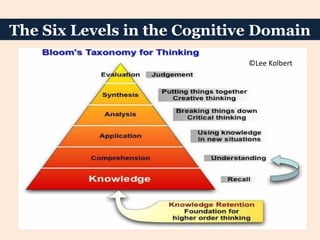
©Lee Kolbert
The Six Levels in the Cognitive Domain
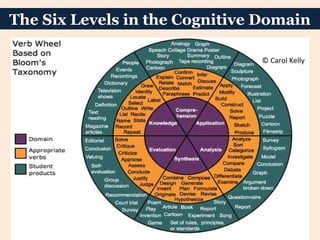
© Carol Kelly
References
De Guzman-Santos, Rosita. (2007). Assessment of Learning 1.
Quezon City, Philippines: Adriana Printing Co., Inc.
http://www.nwlink.com/~donclark/hrd/bloom.html
http://en.wikipedia.org/wiki/Bloom's_Taxonomy
http://cetl.matcmadison.edu/efgb/2/2_3_4.htm
http://weblogs.pbspaces.com/mrskolbert/2010/11/06/defined-
or-denied-21st-century-students-in-todays-classrooms/
http://nsuwptechnology.wikispaces.com/Bloom's+Verb+Wheel

3. cognitive targets

  • 1.
  • 2.
    Assessment can bemade precise, accurate, and dependable only if what are to be achieved are clearly stated and feasible. Clarity of Learning Targets
  • 3.
    Learning Targets  involveknowledge, reasoning, skills, products and effects  need to be stated in behavioral terms or terms which denote something which can be observed through the behavior of the students
  • 4.
    The Cognitive Domain involvesknowledge and the development of intellectual skills  includes the recall or recognition of specific facts, procedural patterns, and concepts that serve in the development of intellectual abilities and skills addresses development that is individual rather than interpersonal, focuses on content rather than context, and is independent of emotion
  • 5.
    The Cognitive Domain Skillsin the cognitive domain revolve around knowledge, comprehension, and critical thinking of a particular topic. As proposed by Benjamin Bloom (1954),there are 6 major levels of educational objectives at the cognitive level, starting from the simplest behavior to the most complex. The categories can be thought of as degrees of difficulties. That is, the first ones must normally be mastered before the next ones can take place.
  • 6.
    The Six Levelsin the Cognitive Domain 1. KNOWLEDGE – refers to the acquisition of facts, concepts, and theories. - forms the foundation of all other cognitive objectives for without it, it’s not possible to move up to the next higher level of thinking in the hierarchy of educational objectives. KNOWLEDGE This level require the students to remember.
  • 7.
    The Six Levelsin the Cognitive Domain Words typically used in the KNOWLEDGE level are: define, recall, recognize, remember, the question words who, what, where, and when example question: What are the health benefits of eating apples?
  • 8.
  • 9.
    Cognitive Domain (KNOWLEDGE) definelist recall describe match reciteidentify name select label outline state The student will recall the four major food groups without error, by Friday. From memory, the student will match each senator with his/her bill passage, with 80% accuracy.
  • 10.
    The Six Levelsin the Cognitive Domain 2. COMPREHENSION – refers to the same concept as “understanding” - demonstrates that the student has sufficient understanding to organize and arrange material mentally - a step higher than mere acquisition of facts and involves a cognition or awareness of the interrelationships of facts and concept
  • 11.
    The Six Levelsin the Cognitive Domain Words typically used in the COMPREHENSION level are: describe, compare, contrast, rephrase, put in your own words, explain the man idea example question: Compare the health benefits of eating apples vs. oranges.
  • 12.
    The Six Levelsin the Cognitive Domain 3. APPLICATION - refers to the transfer of knowledge from one field of study to another or from one concept to another concept in the same discipline - a question that asks a student to apply previously learned information to reach an answer
  • 13.
    The Six Levelsin the Cognitive Domain Words typically used in the APPLICATION level: apply, classify, use, choose, employ, write an example, solve, compute, show example question: Which kinds of apples are best for baking a pie, and why?
  • 14.
    The Six Levelsin the Cognitive Domain 4. ANALYSIS - refers to the breaking down of a concept or idea in its components and explaining the concept as a composition of these concepts - higher order questions that require students to think critically and in-depth
  • 15.
    The Six Levelsin the Cognitive Domain Words typically used in the ANALYSIS level: identify motives/causes, draw conclusions, determine evidence, support, analyze, the question word why, analyze example question: List four ways of serving foods made with apples and explain which ones have the highest health benefits. Provide references to support your statements.
  • 16.
    The Six Levelsin the Cognitive Domain 5. SYNTHESIS – refers to the opposite of analysis and entails putting together the components in order to summarize the concept - a higher order question that asks the student to perform original and creative thinking
  • 17.
    The Six Levelsin the Cognitive Domain Words typically used in the SYNTHESIS level: predict, produce, write, design, develop, synthesize, construct, how can we improve, what would happen if, can you devise, how can we solve example question: Convert an "unhealthy" recipe for apple pie to a "healthy" recipe by replacing your choice of ingredients. Explain the health benefits of using the ingredients you chose vs. the original ones.
  • 18.
    The Six Levelsin the Cognitive Domain 6. EVALUATION AND REASONING – refers to valuing and judgment or putting the worth of a concept or principle - requires the student to judge the merit of an idea, a solution to a problem, or an aesthetic work - a higher level question that does not have a single correct answer.
  • 19.
    The Six Levelsin the Cognitive Domain Words typically used in the EVALUATION level: Appraise, Argue, Assess, Evaluate, Judge, Justify, Prove, Rank, Rate example question: Do you feel that serving apple pie for an after school snack for children is healthy? Why or why not?
  • 20.
    The Six Levelsin the Cognitive Domain ©Lee Kolbert
  • 21.
    The Six Levelsin the Cognitive Domain © Carol Kelly
  • 22.
    References De Guzman-Santos, Rosita.(2007). Assessment of Learning 1. Quezon City, Philippines: Adriana Printing Co., Inc. http://www.nwlink.com/~donclark/hrd/bloom.html http://en.wikipedia.org/wiki/Bloom's_Taxonomy http://cetl.matcmadison.edu/efgb/2/2_3_4.htm http://weblogs.pbspaces.com/mrskolbert/2010/11/06/defined- or-denied-21st-century-students-in-todays-classrooms/ http://nsuwptechnology.wikispaces.com/Bloom's+Verb+Wheel