TABLE OF CONTENTS States of Matter   2 – 10 Changes in state 11 – 12 Heating Curve & Heat equations 13 – 18 Practice Problems   17 Review questions 19 - 20
5 STATES OF MATTER Solid Liquid Gas   Most common on Earth Plasma Bose-Einstein Condensate Although there is matter all over the Universe, we typically see matter in solid, liquid or gas form.
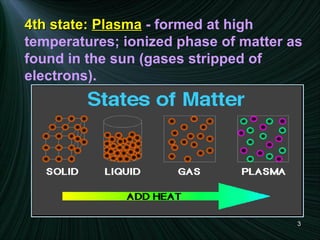
4th state:   Plasma   - formed at high temperatures; ionized phase of matter as found in the sun (gases stripped of electrons).
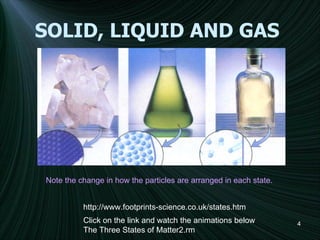
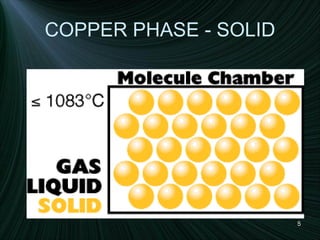
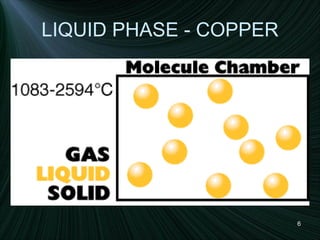
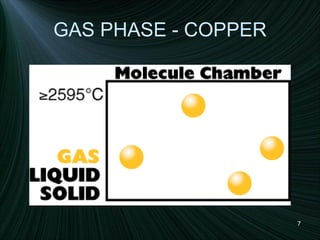
SOLID, LIQUID AND GAS  http://www.footprints-science.co.uk/states.htm Click on the link and watch the animations below The Three States of Matter2.rm Note the change in how the particles are arranged in each state.
COPPER PHASE - SOLID
LIQUID PHASE - COPPER
GAS PHASE - COPPER
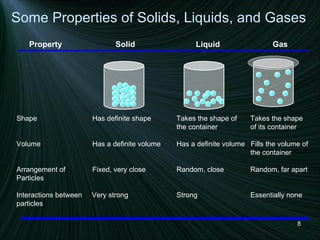
Some Properties of Solids, Liquids, and Gases Property   Solid   Liquid   Gas Shape   Has definite shape Takes the shape of   Takes the shape    the container   of its container Volume   Has a definite volume Has a definite volume  Fills the volume of     the container Arrangement of   Fixed, very close Random, close   Random, far apart Particles Interactions between  Very strong Strong   Essentially none particles
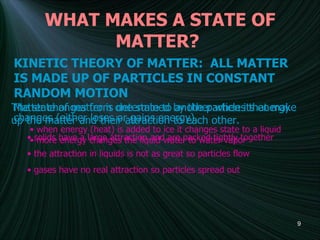
WHAT MAKES A STATE OF MATTER?   The state of matter is determined by the particles that make up the matter and their attraction to each other. solids have a large attraction and are packed tightly together the attraction in liquids is not as great so particles flow gases have no real attraction so particles spread out Matter changes from one state to another when its energy changes (either loses or gains energy). when energy (heat) is added to ice it changes state to a liquid  more energy changes the liquid water to water vapor KINETIC THEORY OF MATTER:  ALL MATTER IS MADE UP OF PARTICLES IN CONSTANT RANDOM MOTION
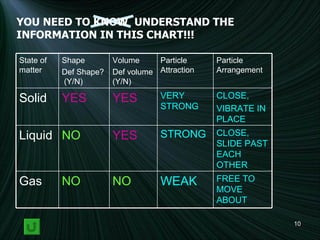
YOU NEED TO KNOW  UNDERSTAND THE INFORMATION IN THIS CHART!!! WEAK STRONG VERY STRONG Particle Attraction FREE TO MOVE ABOUT NO NO Gas CLOSE, SLIDE PAST EACH OTHER YES NO Liquid CLOSE,  VIBRATE IN PLACE YES YES Solid Particle Arrangement Volume Def volume (Y/N) Shape Def Shape?  (Y/N) State of matter
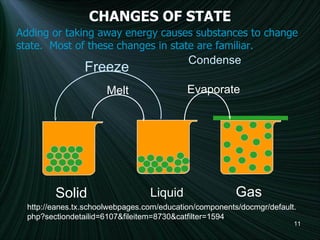
CHANGES OF STATE Adding or taking away energy causes substances to change state.  Most of these changes in state are familiar. http://eanes.tx.schoolwebpages.com/education/components/docmgr/default.php?sectiondetailid=6107&fileitem=8730&catfilter=1594 Solid Liquid   Gas  Melt Evaporate Condense Freeze
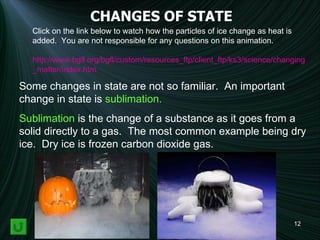
Click on the link below to watch how the particles of ice change as heat is added.  You are not responsible for any questions on this animation. http://www.bgfl.org/bgfl/custom/resources_ftp/client_ftp/ks3/science/changing_matter/index.htm CHANGES OF STATE Some changes in state are not so familiar.  An important change in state is  sublimation. Sublimation  is the change of a substance as it goes from a solid directly to a gas.  The most common example being dry ice.  Dry ice is frozen carbon dioxide gas.
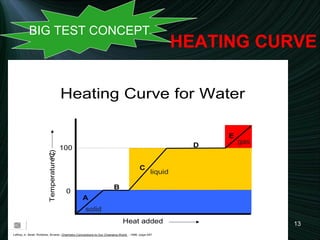
HEATING CURVE BIG TEST CONCEPT
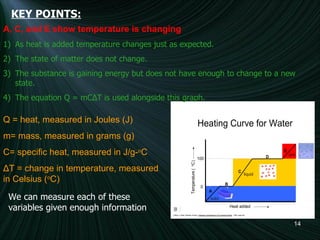
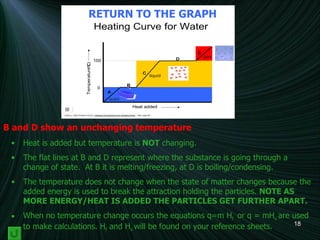
KEY POINTS: A, C, and E show temperature is changing As heat is added temperature changes just as expected. The state of matter does not change. The substance is gaining energy but does not have enough to change to a new state. The equation Q = mC Δ T is used alongside this graph.  Q = heat, measured in Joules (J) m= mass, measured in grams (g)  C= specific heat, measured in J/g- o C Δ T = change in temperature, measured in Celsius ( o C) We can measure each of these variables given enough information
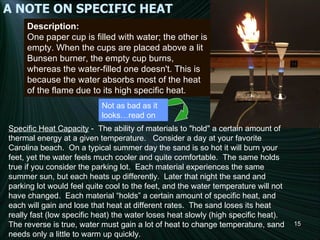
A NOTE ON SPECIFIC HEAT Description: One paper cup is filled with water; the other is empty. When the cups are placed above a lit Bunsen burner, the empty cup burns, whereas the water-filled one doesn't. This is because the water absorbs most of the heat of the flame due to its high specific heat. Specific Heat Capacity  -  The ability of materials to "hold" a certain amount of thermal energy at a given temperature.   Consider a day at your favorite Carolina beach.  On a typical summer day the sand is so hot it will burn your feet, yet the water feels much cooler and quite comfortable.  The same holds true if you consider the parking lot.  Each material experiences the same summer sun, but each heats up differently.  Later that night the sand and parking lot would feel quite cool to the feet, and the water temperature will not have changed.  Each material “holds” a certain amount of specific heat, and each will gain and lose that heat at different rates.  The sand loses its heat really fast (low specific heat) the water loses heat slowly (high specific heat).  The reverse is true, water must gain a lot of heat to change temperature, sand needs only a little to warm up quickly. Not as bad as it looks…read on 140 °C 70 °C Foosium 140 °C 40 °C Unobtainium 100 °C 20 °C Bolognium Boiling point Melting point Substance
Q = m  x  C x  Δ T Determine the energy needed (in Joules) when 55.6 grams of water at 43.2 °C is heated to 78.1 °C.   Q = ?  m = 55.6 g  Δ T = T f  – T i  (final temp – initial temp) 78.1 o  – 43.2 o  = 34.9  o C C = specific heat of water 4.18J (found on your reference table) Q = 55.6g x 4.18J x 34.9 o C  =  8111 J of energy needed
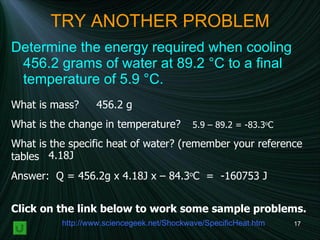
TRY ANOTHER PROBLEM Determine the energy required when cooling 456.2 grams of water at 89.2 °C to a final temperature of 5.9 °C.   What is mass?  What is the change in temperature?  What is the specific heat of water? (remember your reference tables  Answer:  Q = 456.2g x 4.18J x – 84.3 o C  =  -160753 J 456.2 g 5.9 – 89.2 = -83.3 o C 4.18J http:// www.sciencegeek.net/Shockwave/SpecificHeat.htm Click on the link below to work some sample problems.
Heat is added but temperature is  NOT  changing. The flat lines at B and D represent where the substance is going through a change of state.  At B it is melting/freezing, at D is boiling/condensing. The temperature does not change when the state of matter changes because the added energy is used to break the attraction holding the particles.  NOTE AS MORE ENERGY/HEAT IS ADDED THE PARTICLES GET FURTHER APART. When no temperature change occurs the equations q=m H f  or q = mH v  are used to make calculations. H f  and H v  will be found on your reference sheets. B and D show an unchanging temperature RETURN TO THE GRAPH
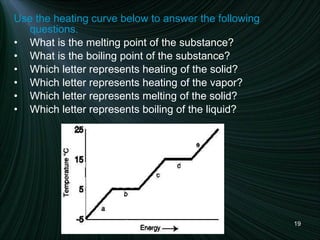
Use the heating curve below to answer the following questions. What is the melting point of the substance? What is the boiling point of the substance? Which letter represents heating of the solid? Which letter represents heating of the vapor? Which letter represents melting of the solid? Which letter represents boiling of the liquid?
REVIEW A solid has a ____________ shape and takes up a _____________ amount of space. A ______________ has no definite shape and no definite  volume. A liquid has a ____________ shape and _____________ volume . During a change in state, as energy is added, temperature (does or does not ) change. The change of state when a substance goes from a solid directly to a gas is called _____________.

Matter Part C

  • 1.
    TABLE OF CONTENTSStates of Matter 2 – 10 Changes in state 11 – 12 Heating Curve & Heat equations 13 – 18 Practice Problems 17 Review questions 19 - 20
  • 2.
    5 STATES OFMATTER Solid Liquid Gas Most common on Earth Plasma Bose-Einstein Condensate Although there is matter all over the Universe, we typically see matter in solid, liquid or gas form.
  • 3.
    4th state: Plasma - formed at high temperatures; ionized phase of matter as found in the sun (gases stripped of electrons).
  • 4.
    SOLID, LIQUID ANDGAS http://www.footprints-science.co.uk/states.htm Click on the link and watch the animations below The Three States of Matter2.rm Note the change in how the particles are arranged in each state.
  • 5.
  • 6.
  • 7.
  • 8.
    Some Properties ofSolids, Liquids, and Gases Property Solid Liquid Gas Shape Has definite shape Takes the shape of Takes the shape the container of its container Volume Has a definite volume Has a definite volume Fills the volume of the container Arrangement of Fixed, very close Random, close Random, far apart Particles Interactions between Very strong Strong Essentially none particles
  • 9.
    WHAT MAKES ASTATE OF MATTER? The state of matter is determined by the particles that make up the matter and their attraction to each other. solids have a large attraction and are packed tightly together the attraction in liquids is not as great so particles flow gases have no real attraction so particles spread out Matter changes from one state to another when its energy changes (either loses or gains energy). when energy (heat) is added to ice it changes state to a liquid more energy changes the liquid water to water vapor KINETIC THEORY OF MATTER: ALL MATTER IS MADE UP OF PARTICLES IN CONSTANT RANDOM MOTION
  • 10.
    YOU NEED TOKNOW UNDERSTAND THE INFORMATION IN THIS CHART!!! WEAK STRONG VERY STRONG Particle Attraction FREE TO MOVE ABOUT NO NO Gas CLOSE, SLIDE PAST EACH OTHER YES NO Liquid CLOSE, VIBRATE IN PLACE YES YES Solid Particle Arrangement Volume Def volume (Y/N) Shape Def Shape? (Y/N) State of matter
  • 11.
    CHANGES OF STATEAdding or taking away energy causes substances to change state. Most of these changes in state are familiar. http://eanes.tx.schoolwebpages.com/education/components/docmgr/default.php?sectiondetailid=6107&fileitem=8730&catfilter=1594 Solid Liquid Gas Melt Evaporate Condense Freeze
  • 12.
    Click on thelink below to watch how the particles of ice change as heat is added. You are not responsible for any questions on this animation. http://www.bgfl.org/bgfl/custom/resources_ftp/client_ftp/ks3/science/changing_matter/index.htm CHANGES OF STATE Some changes in state are not so familiar. An important change in state is sublimation. Sublimation is the change of a substance as it goes from a solid directly to a gas. The most common example being dry ice. Dry ice is frozen carbon dioxide gas.
  • 13.
    HEATING CURVE BIGTEST CONCEPT
  • 14.
    KEY POINTS: A,C, and E show temperature is changing As heat is added temperature changes just as expected. The state of matter does not change. The substance is gaining energy but does not have enough to change to a new state. The equation Q = mC Δ T is used alongside this graph. Q = heat, measured in Joules (J) m= mass, measured in grams (g) C= specific heat, measured in J/g- o C Δ T = change in temperature, measured in Celsius ( o C) We can measure each of these variables given enough information
  • 15.
    A NOTE ONSPECIFIC HEAT Description: One paper cup is filled with water; the other is empty. When the cups are placed above a lit Bunsen burner, the empty cup burns, whereas the water-filled one doesn't. This is because the water absorbs most of the heat of the flame due to its high specific heat. Specific Heat Capacity -  The ability of materials to "hold" a certain amount of thermal energy at a given temperature.  Consider a day at your favorite Carolina beach. On a typical summer day the sand is so hot it will burn your feet, yet the water feels much cooler and quite comfortable. The same holds true if you consider the parking lot. Each material experiences the same summer sun, but each heats up differently. Later that night the sand and parking lot would feel quite cool to the feet, and the water temperature will not have changed. Each material “holds” a certain amount of specific heat, and each will gain and lose that heat at different rates. The sand loses its heat really fast (low specific heat) the water loses heat slowly (high specific heat). The reverse is true, water must gain a lot of heat to change temperature, sand needs only a little to warm up quickly. Not as bad as it looks…read on 140 °C 70 °C Foosium 140 °C 40 °C Unobtainium 100 °C 20 °C Bolognium Boiling point Melting point Substance
  • 16.
    Q = m x C x Δ T Determine the energy needed (in Joules) when 55.6 grams of water at 43.2 °C is heated to 78.1 °C. Q = ? m = 55.6 g Δ T = T f – T i (final temp – initial temp) 78.1 o – 43.2 o = 34.9 o C C = specific heat of water 4.18J (found on your reference table) Q = 55.6g x 4.18J x 34.9 o C = 8111 J of energy needed
  • 17.
    TRY ANOTHER PROBLEMDetermine the energy required when cooling 456.2 grams of water at 89.2 °C to a final temperature of 5.9 °C. What is mass? What is the change in temperature? What is the specific heat of water? (remember your reference tables Answer: Q = 456.2g x 4.18J x – 84.3 o C = -160753 J 456.2 g 5.9 – 89.2 = -83.3 o C 4.18J http:// www.sciencegeek.net/Shockwave/SpecificHeat.htm Click on the link below to work some sample problems.
  • 18.
    Heat is addedbut temperature is NOT changing. The flat lines at B and D represent where the substance is going through a change of state. At B it is melting/freezing, at D is boiling/condensing. The temperature does not change when the state of matter changes because the added energy is used to break the attraction holding the particles. NOTE AS MORE ENERGY/HEAT IS ADDED THE PARTICLES GET FURTHER APART. When no temperature change occurs the equations q=m H f or q = mH v are used to make calculations. H f and H v will be found on your reference sheets. B and D show an unchanging temperature RETURN TO THE GRAPH
  • 19.
    Use the heatingcurve below to answer the following questions. What is the melting point of the substance? What is the boiling point of the substance? Which letter represents heating of the solid? Which letter represents heating of the vapor? Which letter represents melting of the solid? Which letter represents boiling of the liquid?
  • 20.
    REVIEW A solidhas a ____________ shape and takes up a _____________ amount of space. A ______________ has no definite shape and no definite volume. A liquid has a ____________ shape and _____________ volume . During a change in state, as energy is added, temperature (does or does not ) change. The change of state when a substance goes from a solid directly to a gas is called _____________.

Editor's Notes

  • #9 The three common phases (or states) of matter are gas, liquid, and solid 1. Gases a. Have the lowest density of the three states of matter b. Are highly compressible c. Completely fill any container in which they are placed d. Their intermolecular forces are weak e. Molecules are constantly moving independently of the other molecules present 2. Solids a. Dense b. Rigid c. Incompressible d. Intermolecular forces are strong e. Molecules locked in place 3. Liquids a. Dense b. Incompressible c. Flow readily to adapt to the shape of the container d. Sum of the intermolecular forces are between those of gases and solids • The state of a given substance depends strongly on conditions