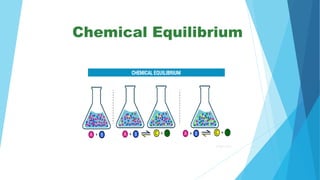
1) Chemical equilibrium occurs when the rates of the forward and reverse reactions are equal. The law of mass action states that the rate of a reaction depends on the concentrations of reactants.
2) The equilibrium constant, K, is defined as the ratio of products over reactants at equilibrium. For heterogeneous reactions involving different phases, the equilibrium constant is expressed in terms of partial pressures.
3) According to Le Chatelier's principle, if a stress is applied to a system at equilibrium, the equilibrium shifts to minimize the effect of the stress. Changes in concentration, pressure, or temperature cause the equilibrium to shift left or right to counteract the applied change.
![Law of mass action :
The rate of a chemical reaction is proportional to the active masses is proportional to the
active masses of the reactants if the temperature became constant.
Let us consider a general reaction,
𝑨 + 𝑩 ⇄ 𝑪 + 𝑫
Let, [A], [B], [C], [D] represents the molar concentrations of A, B, C and D at equilibrium
point.
According to the law of the mass action :
Rate of forward reaction, α [A] [B]
= 𝒌 𝟏 𝑨 [𝑩]
Rate of reverse reaction, α [C] [D]
= 𝒌 𝟐 𝑪 [𝑫]
Where, k1 and k2 are rate constant for the forward and reverse reaction.](https://image.slidesharecdn.com/chemicalequilibrium-180416085643/85/Chemical-equilibrium-2-320.jpg)
![Equilibrium Constant :
The ratio of the active masses of the products and the active
masses of the reactants is called the equilibrium constant.
Let us consider a general reaction,
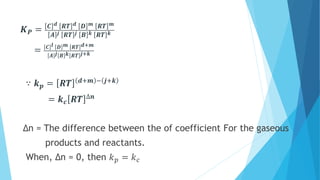
𝑱𝑨 + 𝑲𝑩 ⇄ 𝒍𝑪 + 𝒎𝑫 −−−−−−− −①
𝒌 𝒑 =
𝒑 𝑪
𝒍
𝒑 𝑫
𝒎
𝑷 𝑨
𝒋 𝑷 𝑩
𝒌
−−−−−−−−−− −②
For ideal gas,
Pv=nRT
⇒ P=
𝒏
𝒗
𝑹𝑻
⇒P = CRT [C = concentration ]
Now, we are put the value of p in ①](https://image.slidesharecdn.com/chemicalequilibrium-180416085643/85/Chemical-equilibrium-4-320.jpg)
![Heterogeneous equilibrium :
If all the products and reactants are not in same phases then it’s called
heterogeneous equilibrium.
Ex : 𝑪𝒂𝑪𝑶 𝟑 𝒔 ⇄ 𝑪𝒂𝑶 𝒔 + 𝑪𝑶 𝟐 𝒈
The decomposition of calcium carbonate upon heating to from calcium
oxide and carbon dioxide is an example of heterogeneous equilibrium.
Here, k=
𝑪𝑶 𝟐 [𝑪𝒂𝑶]
[𝑪𝒂𝑪𝑶 𝟑]
Ignoring the concentrations of 𝐶𝑎𝐶𝑂3 and 𝐶𝑎𝑂 the equilibrium constant
expression for the decomposition of 𝐶𝑎𝐶𝑂3 may be written as , 𝑘 𝑐 =
𝐶𝑂2
Or, in terms of partial pressures ,
𝒌 𝒑 = 𝑷 𝑪𝑶 𝟐](https://image.slidesharecdn.com/chemicalequilibrium-180416085643/85/Chemical-equilibrium-5-320.jpg)