Chapter 17.3
1) Explain the concept of reaction mechanism.
2) Use the collision theory to interpret chemical
reactions.
3) Define activated complex.
4) Relate activation energy to enthalpy of reaction.
• Chemists have found that chemical reactions occur at
widely differing rates.
• The speed of a chemical reaction depends on the
energy pathway that a reaction follows and the
changes that take place on the molecular level when
substances interact.
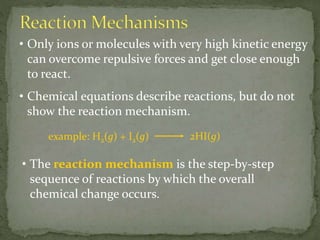
• Only ions or molecules with very high kinetic energy
can overcome repulsive forces and get close enough
to react.
• Chemical equations describe reactions, but do not
show the reaction mechanism.
example: H2(g) + I2(g) 2HI(g)
• The reaction mechanism is the step-by-step
sequence of reactions by which the overall
chemical change occurs.
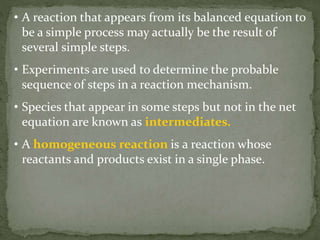
• A reaction that appears from its balanced equation to
be a simple process may actually be the result of
several simple steps.
• Experiments are used to determine the probable
sequence of steps in a reaction mechanism.
• Species that appear in some steps but not in the net
equation are known as intermediates.
• A homogeneous reaction is a reaction whose
reactants and products exist in a single phase.
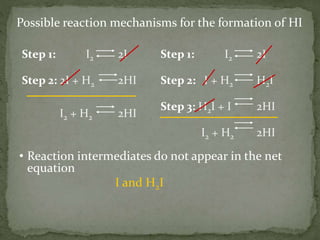
Possible reaction mechanisms for the formation of HI
Step 1: I2 2I
Step 2: 2I + H2 2HI
I2 + H2 2HI
Step 1: I2 2I
Step 2: I + H2 H2I
Step 3: H2I + I 2HI
I2 + H2 2HI
• Reaction intermediates do not appear in the net
equation
I and H2I
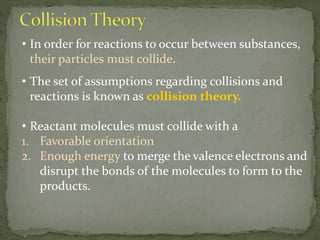
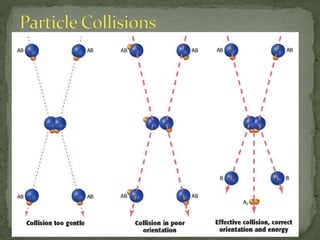
• In order for reactions to occur between substances,
their particles must collide.
• The set of assumptions regarding collisions and
reactions is known as collision theory.
• Reactant molecules must collide with a
1. Favorable orientation
2. Enough energy to merge the valence electrons and
disrupt the bonds of the molecules to form to the
products.
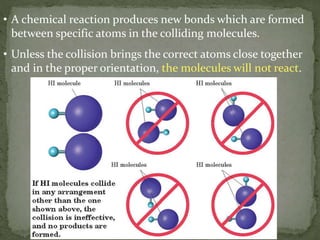
• A chemical reaction produces new bonds which are formed
between specific atoms in the colliding molecules.
• Unless the collision brings the correct atoms close together
and in the proper orientation, the molecules will not react.
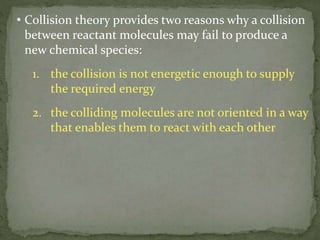
• Collision theory provides two reasons why a collision
between reactant molecules may fail to produce a
new chemical species:
1. the collision is not energetic enough to supply
the required energy
2. the colliding molecules are not oriented in a way
that enables them to react with each other
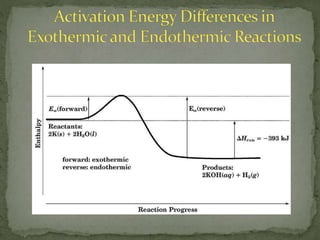
• The reaction for the formation of water from the
diatomic gases oxygen and hydrogen is exothermic.
2H2(g) + O2(g) 2H2O(l)
• The reaction does not occur spontaneously and
immediately to at room temperature.
1. The bonds of these molecular species must be
broken in order for new bonds to be formed.
2. Bond breaking is an endothermic process, and
bond forming is exothermic.
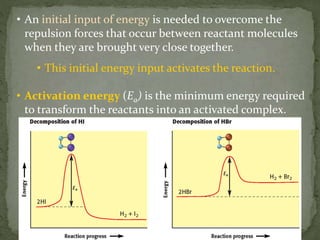
• An initial input of energy is needed to overcome the
repulsion forces that occur between reactant molecules
when they are brought very close together.
• This initial energy input activates the reaction.
• Activation energy (Ea) is the minimum energy required
to transform the reactants into an activated complex.
• In the brief interval of bond breakage and bond
formation, the collision complex is in a transition state.
• Some partial bonding exists in this transitional
structure.
• A transitional structure that results from an effective
collision and that persists while old bonds are breaking
and new bonds are forming is called an activated
complex.
• The activated complex is a very short-lived molecular
complex.
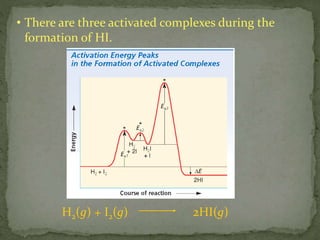
• There are three activated complexes during the
formation of HI.
H2(g) + I2(g) 2HI(g)
• The kinetic-molecular theory states that the speeds
and therefore the kinetic energies of the molecules
increase as the temperature increases.
• The collisions between molecules must possess
sufficient energy to form an activated complex or a
reaction will not take place.
• Raising the temperature of a reaction provides more
molecules that have the necessary activation energy
and causes an increase in the reaction rate.
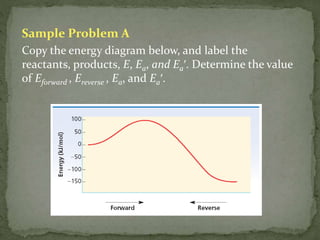
Sample Problem A
Copy the energy diagram below, and label the
reactants, products, E, Ea, and Ea′. Determine the value
of Eforward , Ereverse , Ea, and Ea′.
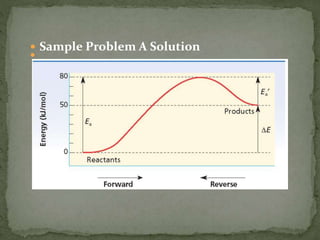
 Sample Problem A Solution

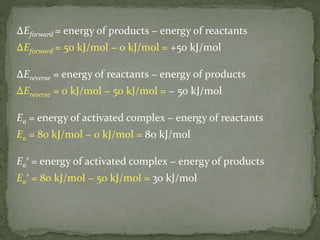
∆Eforward = energy of products − energy of reactants
∆Eforward = 50 kJ/mol − 0 kJ/mol = +50 kJ/mol
∆Ereverse = energy of reactants − energy of products
∆Ereverse = 0 kJ/mol − 50 kJ/mol = − 50 kJ/mol
Ea = energy of activated complex − energy of reactants
Ea = 80 kJ/mol − 0 kJ/mol = 80 kJ/mol
Ea′ = energy of activated complex − energy of products
Ea′ = 80 kJ/mol − 50 kJ/mol = 30 kJ/mol

Chapter 17.3 : The Reaction Process

  • 1.
  • 2.
    1) Explain theconcept of reaction mechanism. 2) Use the collision theory to interpret chemical reactions. 3) Define activated complex. 4) Relate activation energy to enthalpy of reaction.
  • 3.
    • Chemists havefound that chemical reactions occur at widely differing rates. • The speed of a chemical reaction depends on the energy pathway that a reaction follows and the changes that take place on the molecular level when substances interact.
  • 4.
    • Only ionsor molecules with very high kinetic energy can overcome repulsive forces and get close enough to react. • Chemical equations describe reactions, but do not show the reaction mechanism. example: H2(g) + I2(g) 2HI(g) • The reaction mechanism is the step-by-step sequence of reactions by which the overall chemical change occurs.
  • 5.
    • A reactionthat appears from its balanced equation to be a simple process may actually be the result of several simple steps. • Experiments are used to determine the probable sequence of steps in a reaction mechanism. • Species that appear in some steps but not in the net equation are known as intermediates. • A homogeneous reaction is a reaction whose reactants and products exist in a single phase.
  • 6.
    Possible reaction mechanismsfor the formation of HI Step 1: I2 2I Step 2: 2I + H2 2HI I2 + H2 2HI Step 1: I2 2I Step 2: I + H2 H2I Step 3: H2I + I 2HI I2 + H2 2HI • Reaction intermediates do not appear in the net equation I and H2I
  • 7.
    • In orderfor reactions to occur between substances, their particles must collide. • The set of assumptions regarding collisions and reactions is known as collision theory. • Reactant molecules must collide with a 1. Favorable orientation 2. Enough energy to merge the valence electrons and disrupt the bonds of the molecules to form to the products.
  • 9.
    • A chemicalreaction produces new bonds which are formed between specific atoms in the colliding molecules. • Unless the collision brings the correct atoms close together and in the proper orientation, the molecules will not react.
  • 10.
    • Collision theoryprovides two reasons why a collision between reactant molecules may fail to produce a new chemical species: 1. the collision is not energetic enough to supply the required energy 2. the colliding molecules are not oriented in a way that enables them to react with each other
  • 11.
    • The reactionfor the formation of water from the diatomic gases oxygen and hydrogen is exothermic. 2H2(g) + O2(g) 2H2O(l) • The reaction does not occur spontaneously and immediately to at room temperature. 1. The bonds of these molecular species must be broken in order for new bonds to be formed. 2. Bond breaking is an endothermic process, and bond forming is exothermic.
  • 12.
    • An initialinput of energy is needed to overcome the repulsion forces that occur between reactant molecules when they are brought very close together. • This initial energy input activates the reaction. • Activation energy (Ea) is the minimum energy required to transform the reactants into an activated complex.
  • 14.
    • In thebrief interval of bond breakage and bond formation, the collision complex is in a transition state. • Some partial bonding exists in this transitional structure. • A transitional structure that results from an effective collision and that persists while old bonds are breaking and new bonds are forming is called an activated complex. • The activated complex is a very short-lived molecular complex.
  • 15.
    • There arethree activated complexes during the formation of HI. H2(g) + I2(g) 2HI(g)
  • 16.
    • The kinetic-moleculartheory states that the speeds and therefore the kinetic energies of the molecules increase as the temperature increases. • The collisions between molecules must possess sufficient energy to form an activated complex or a reaction will not take place. • Raising the temperature of a reaction provides more molecules that have the necessary activation energy and causes an increase in the reaction rate.
  • 17.
    Sample Problem A Copythe energy diagram below, and label the reactants, products, E, Ea, and Ea′. Determine the value of Eforward , Ereverse , Ea, and Ea′.
  • 18.
     Sample ProblemA Solution 
  • 19.
    ∆Eforward = energyof products − energy of reactants ∆Eforward = 50 kJ/mol − 0 kJ/mol = +50 kJ/mol ∆Ereverse = energy of reactants − energy of products ∆Ereverse = 0 kJ/mol − 50 kJ/mol = − 50 kJ/mol Ea = energy of activated complex − energy of reactants Ea = 80 kJ/mol − 0 kJ/mol = 80 kJ/mol Ea′ = energy of activated complex − energy of products Ea′ = 80 kJ/mol − 50 kJ/mol = 30 kJ/mol