QUESTION?QUESTION?
ANSWER!ANSWER!
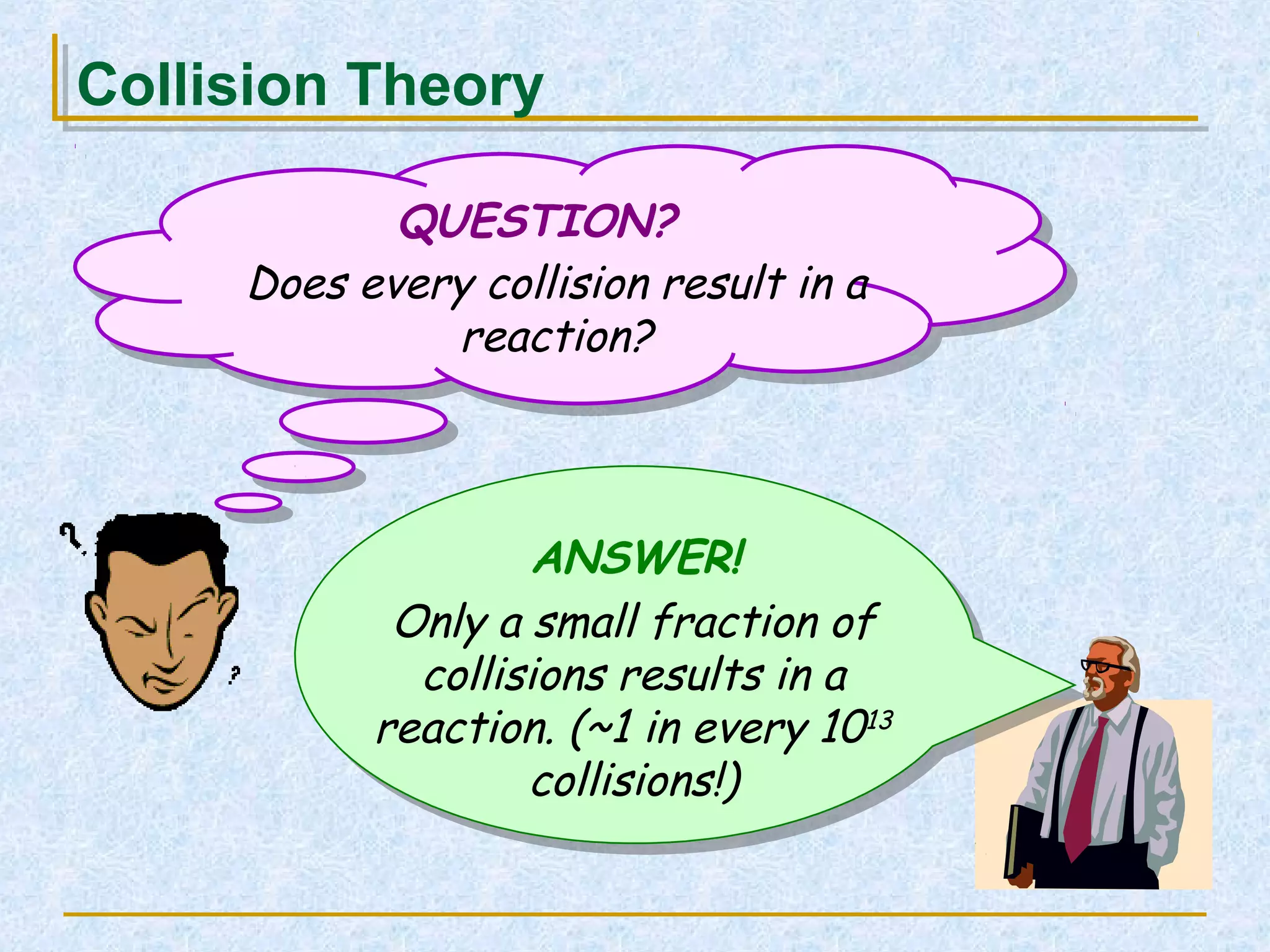
Only a small fraction of
collisions results in a
reaction. (~1 in every 1013
collisions!)
Does every collision result in a
reaction?
Collision Theory
REACTION RATE & TEMPERATURE
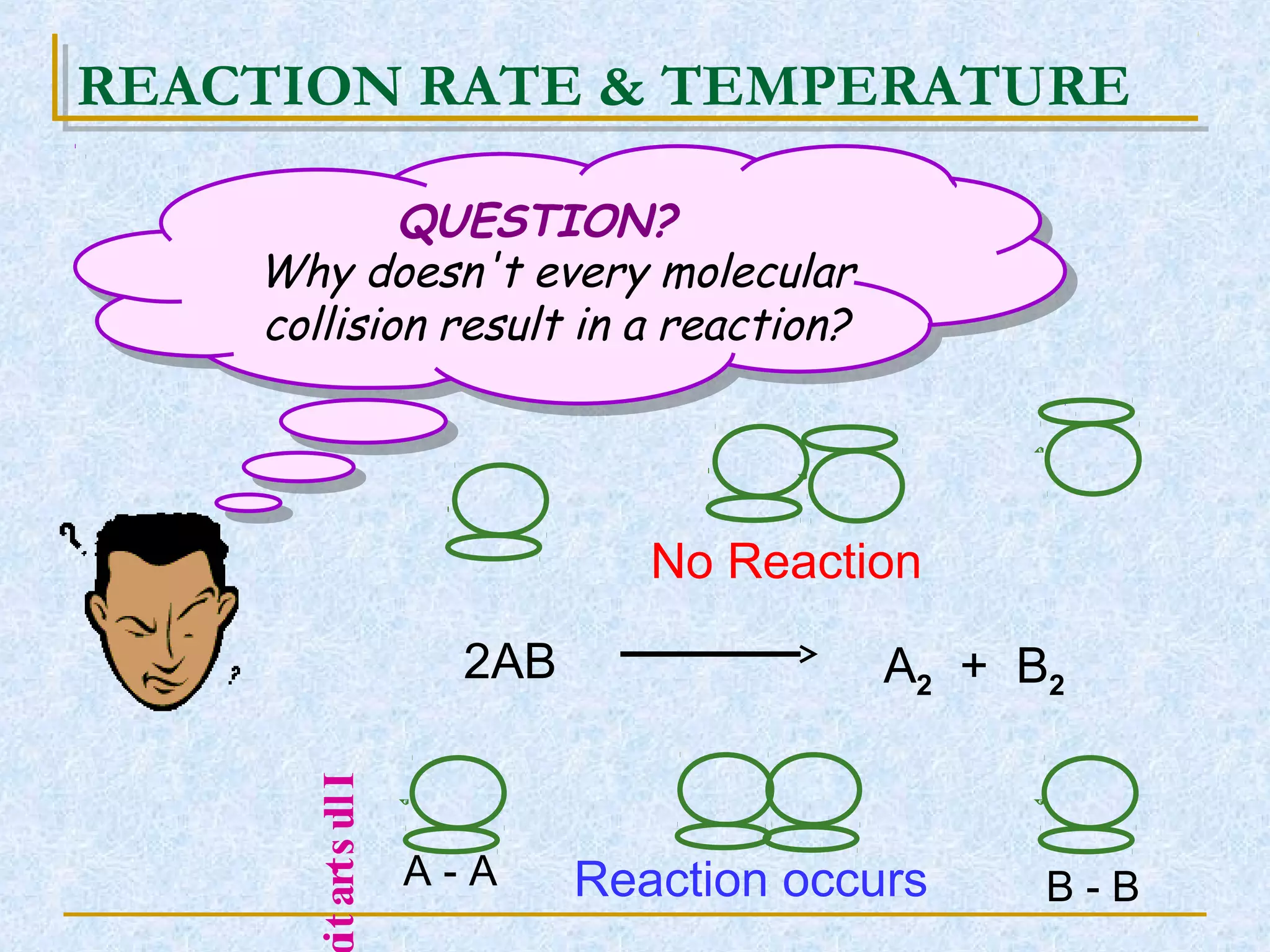
QUESTION?QUESTION?
Why doesn't every molecular
collision result in a reaction?
2AB A2 + B2
No Reaction
Reaction occursA - A B - B
Illustrati
Collision Theory
No Reaction
Reaction occursA - A
B - B
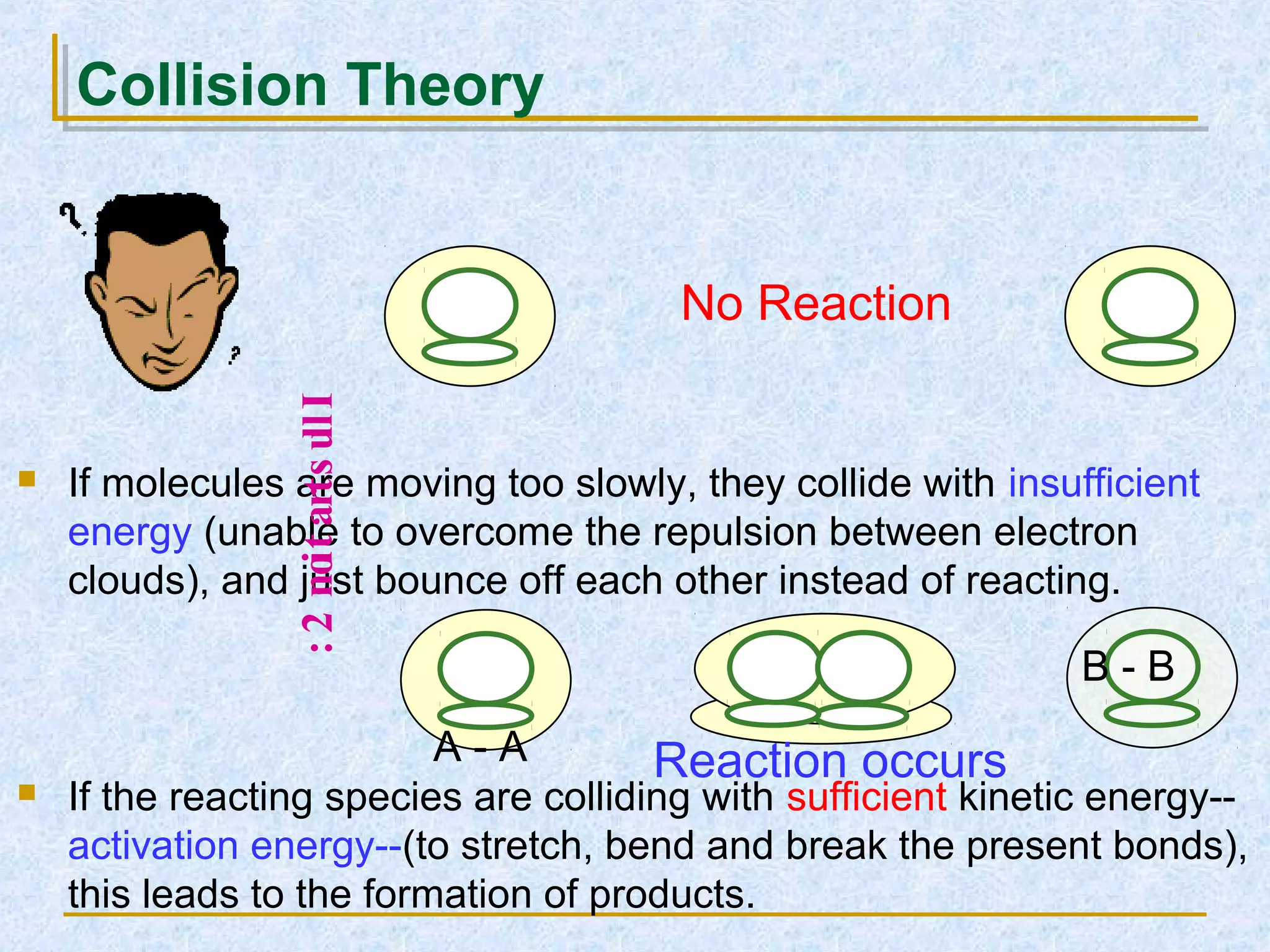
 If molecules are moving too slowly, they collide with insufficient
energy (unable to overcome the repulsion between electron
clouds), and just bounce off each other instead of reacting.
 If the reacting species are colliding with sufficient kinetic energy--
activation energy--(to stretch, bend and break the present bonds),
this leads to the formation of products.
Illustration2:
Conditions for a Reaction to Occur
Reacting species must
 Collide
 Collide in a favourable orientation (appropriate geometry
or juxtaposition) – steric factor
 Collide with a certain minimum kinetic energy – (more
than the activation energy barrier).
Collision Theory
Reaction Profile
Energy
Reaction Pathway
CH3• + HCl → [H3C---H---Cl]#
→ CH4 + Cl•
CH3• + HCl
[ H3C---H---Cl ]#
CH4 + Cl•
∆H
Ea1
Ea2
A) One Essential Step
or Energy Profile Diagram
Characteristics of Activated Complex
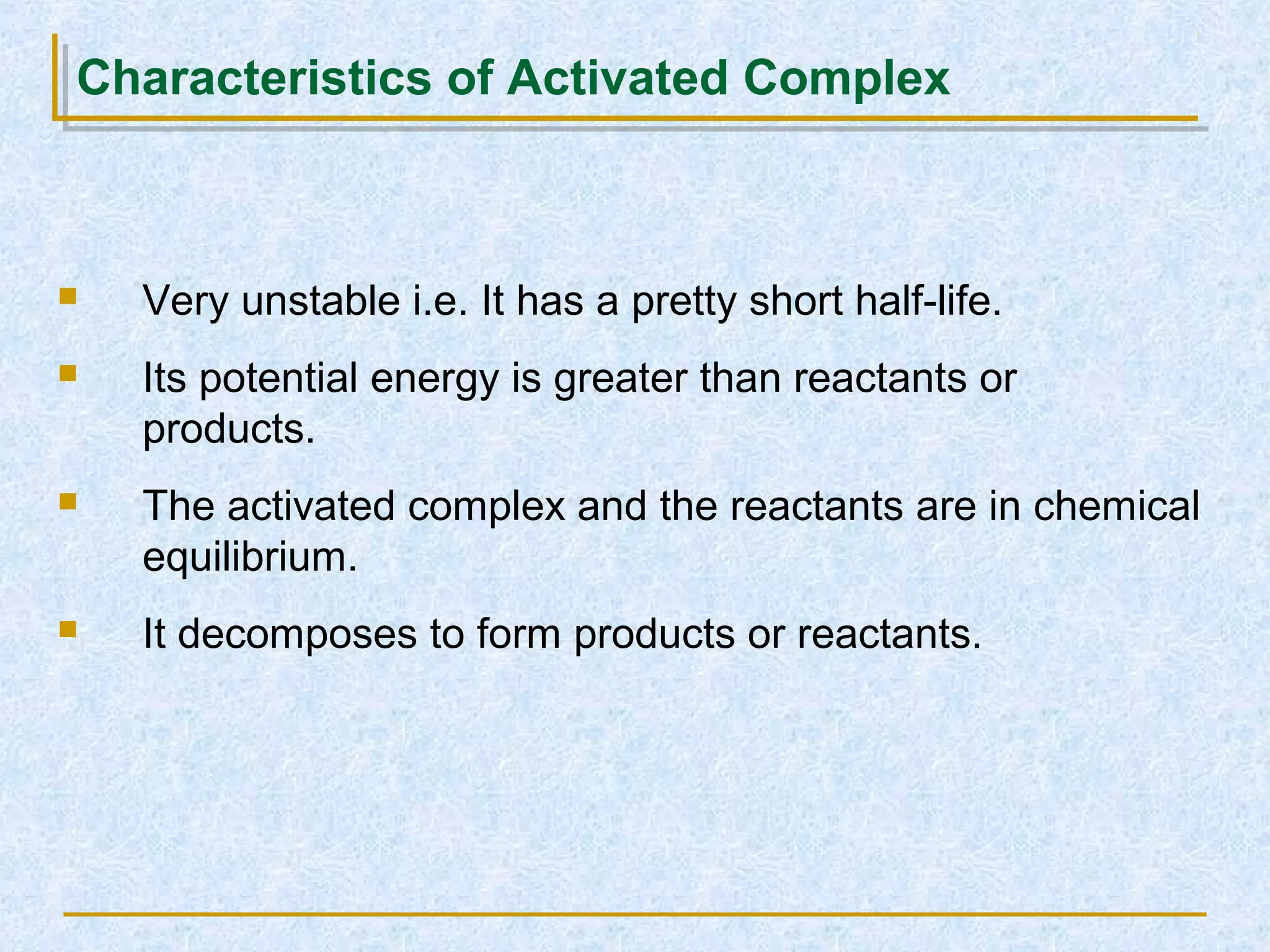
 Very unstable i.e. It has a pretty short half-life.
 Its potential energy is greater than reactants or
products.
 The activated complex and the reactants are in chemical
equilibrium.
 It decomposes to form products or reactants.
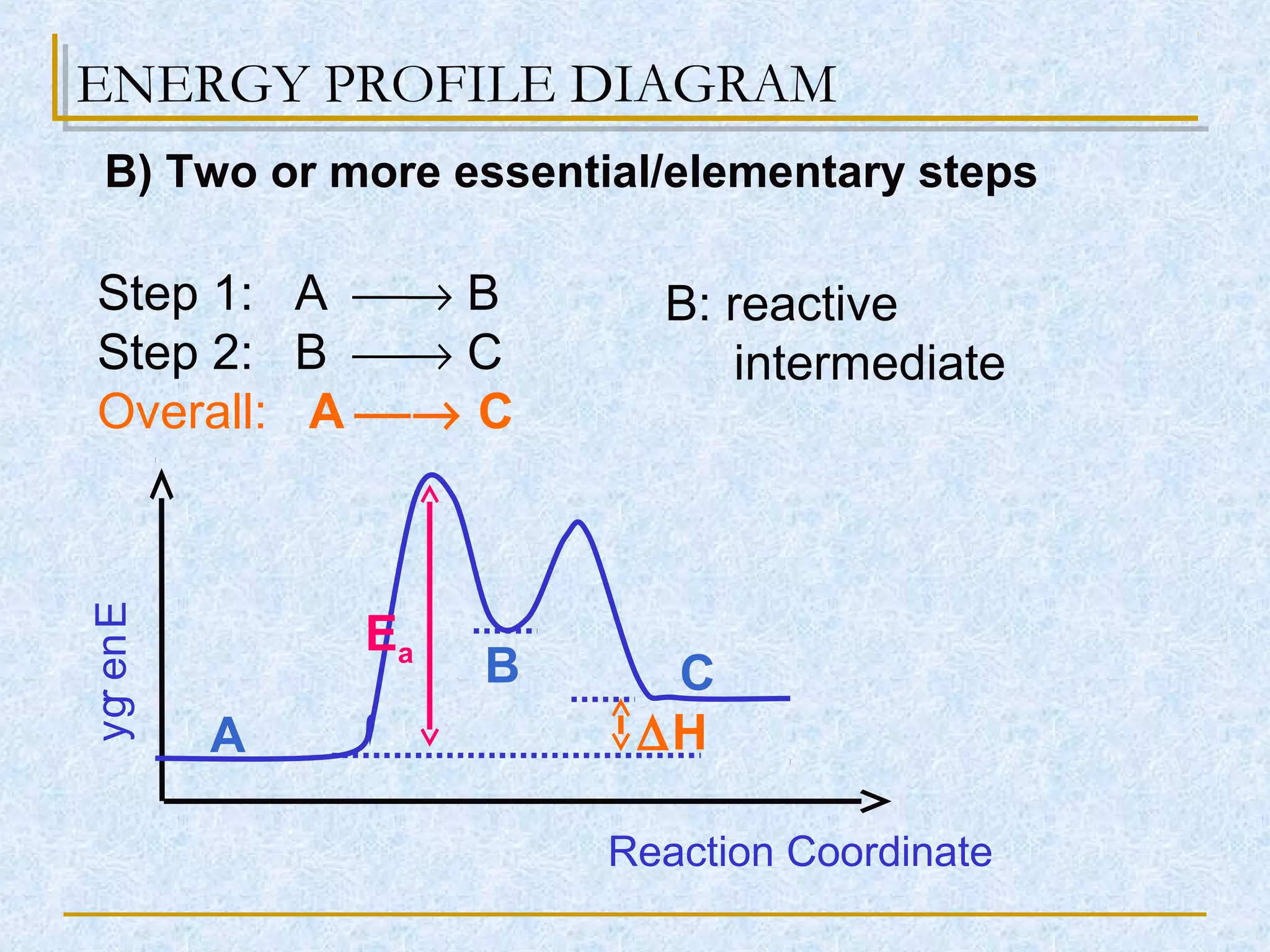
ENERGY PROFILE DIAGRAM
B) Two or more essential/elementary steps
Step 1: A → B
Step 2: B → C
Overall: A → C
Energy
Reaction Coordinate
∆H
Ea
A
B C
B: reactive
intermediate
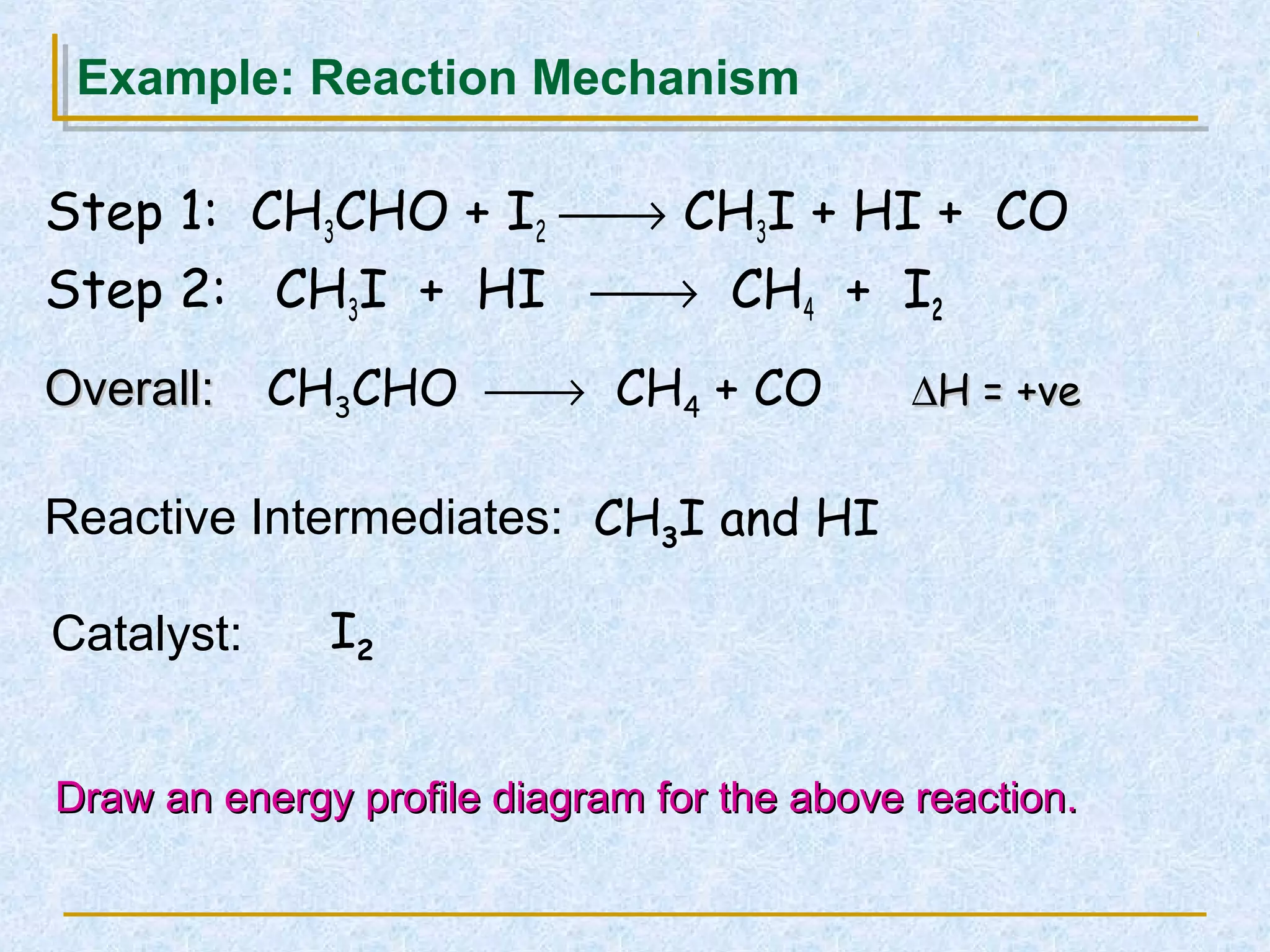
Example: Reaction Mechanism
Step 1: CH3CHO + I2 → CH3I + HI + CO
Step 2: CH3I + HI → CH4 + I2
Draw an energy profile diagram for the above reaction.Draw an energy profile diagram for the above reaction.
Overall:Overall: CH3CHO → CH4 + CO ∆∆H = +veH = +ve
Reactive Intermediates: CH3I and HI
Catalyst: I2
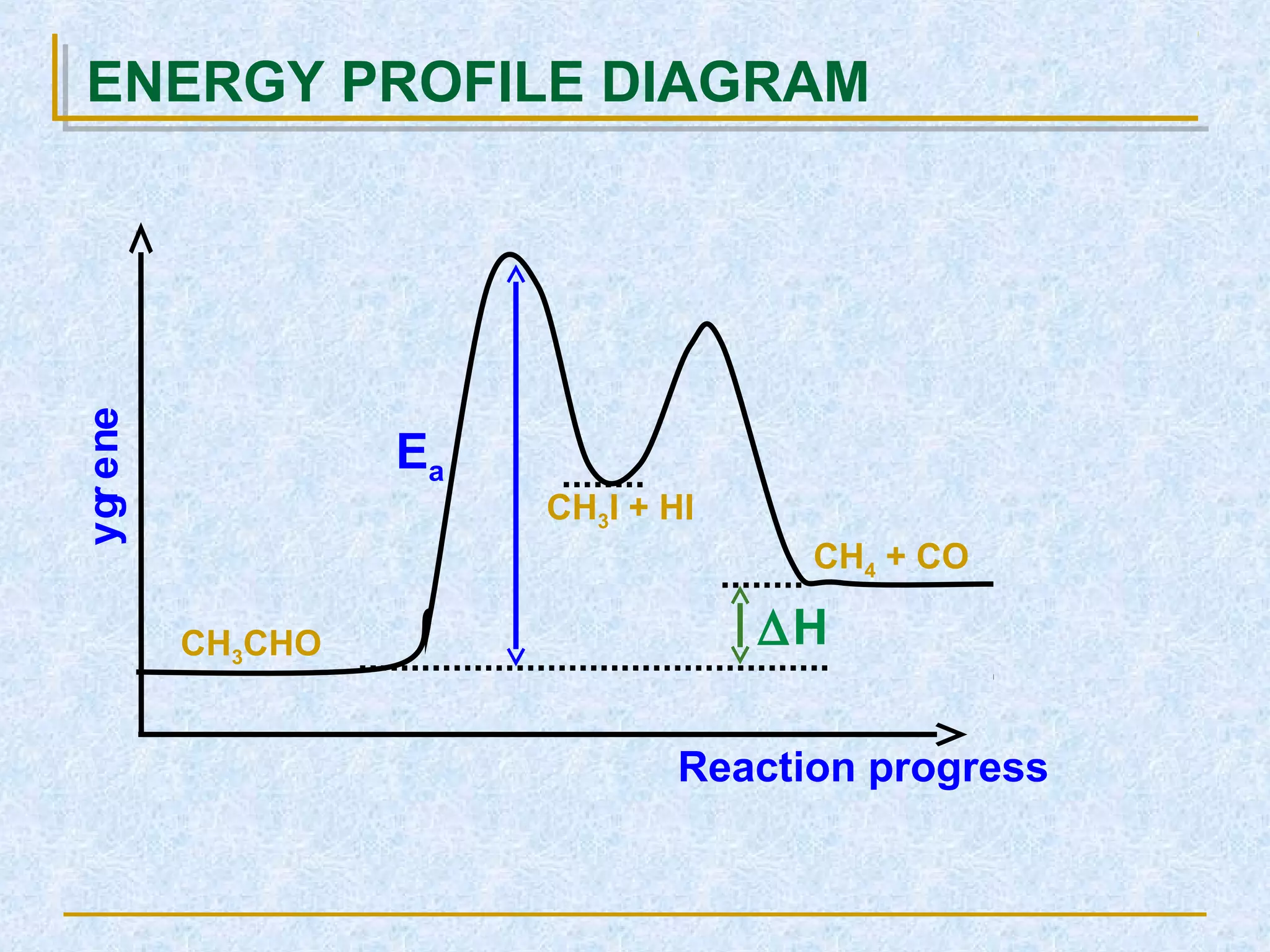
ENERGY PROFILE DIAGRAMenergy
Reaction progress
∆H
Ea
CH3CHO
CH4 + CO
CH3I + HI
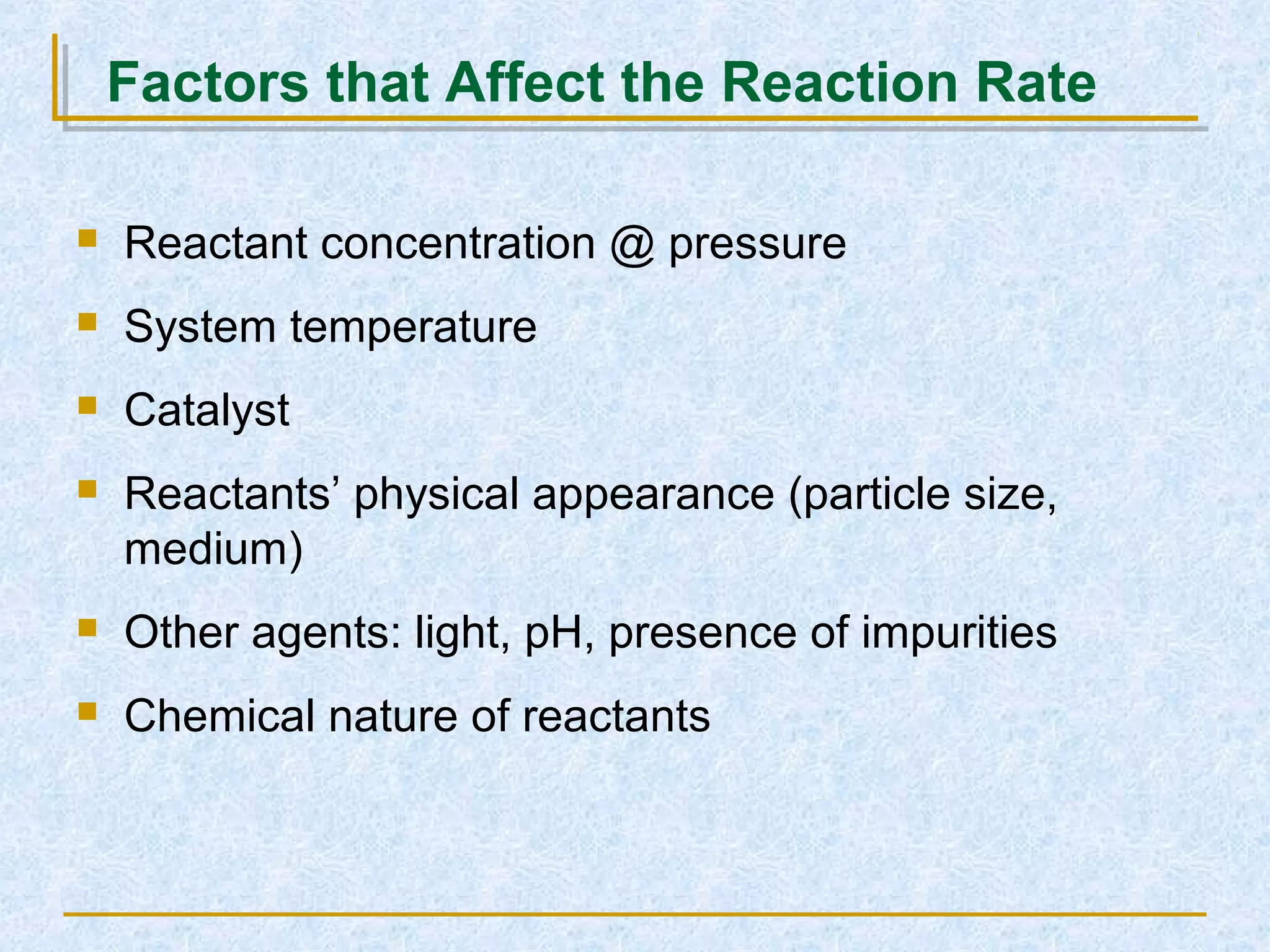
Objectives:
 Explain the effects of concentration
change/pressure, temperature change ,
surface area and the presence of catalyst on
the reaction rate
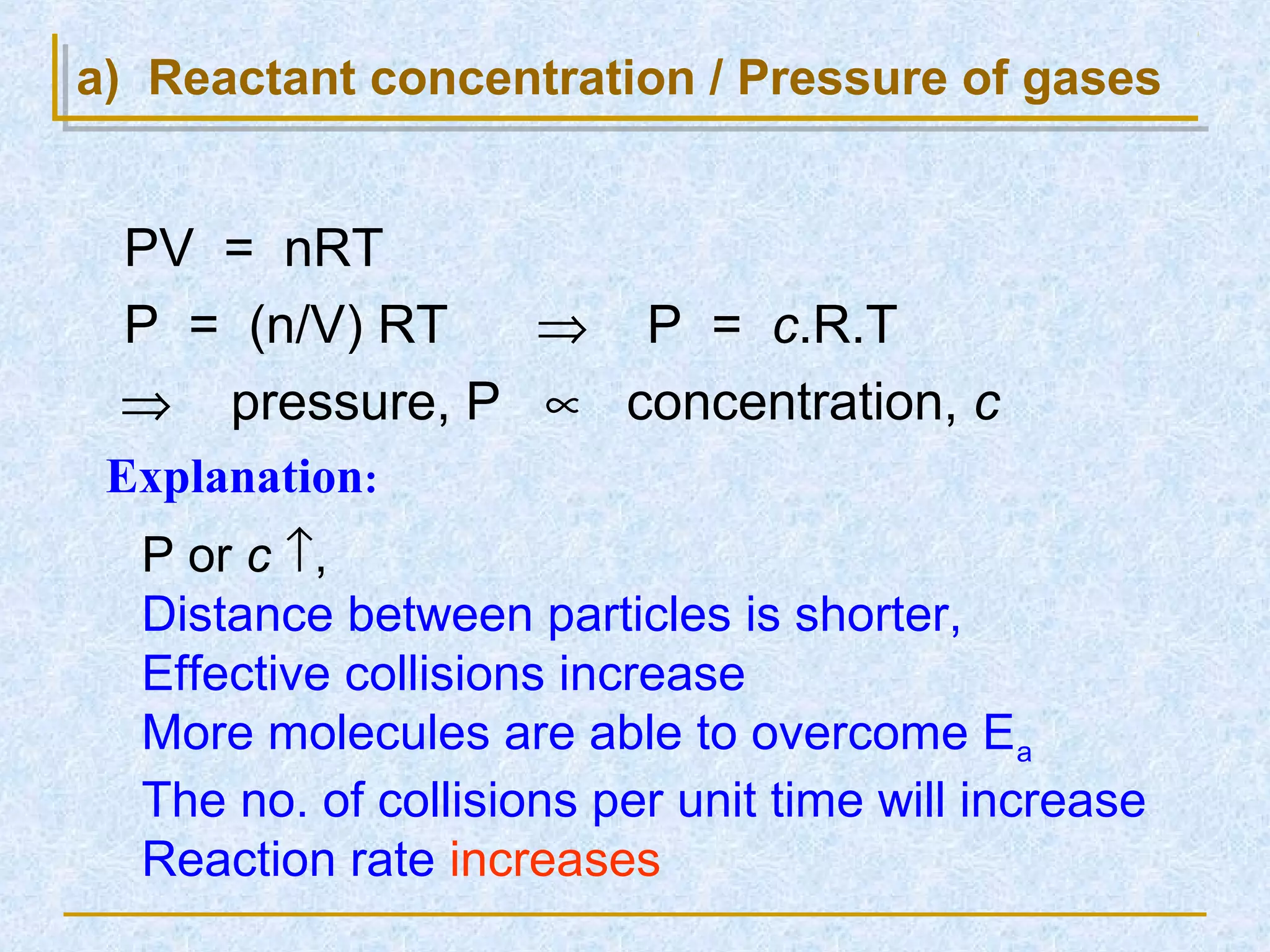
Factors that Affect the Reaction Rate
 Reactant concentration @ pressure
 System temperature
 Catalyst
 Reactants’ physical appearance (particle size,
medium)
 Other agents: light, pH, presence of impurities
 Chemical nature of reactants
a) Reactant concentration / Pressure of gases
PV = nRT
P = (n/V) RT ⇒ P = c.R.T
⇒ pressure, P ∝ concentration, c
P or c ↑,
Distance between particles is shorter,
Effective collisions increase
More molecules are able to overcome Ea
The no. of collisions per unit time will increase
Reaction rate increases
Explanation:
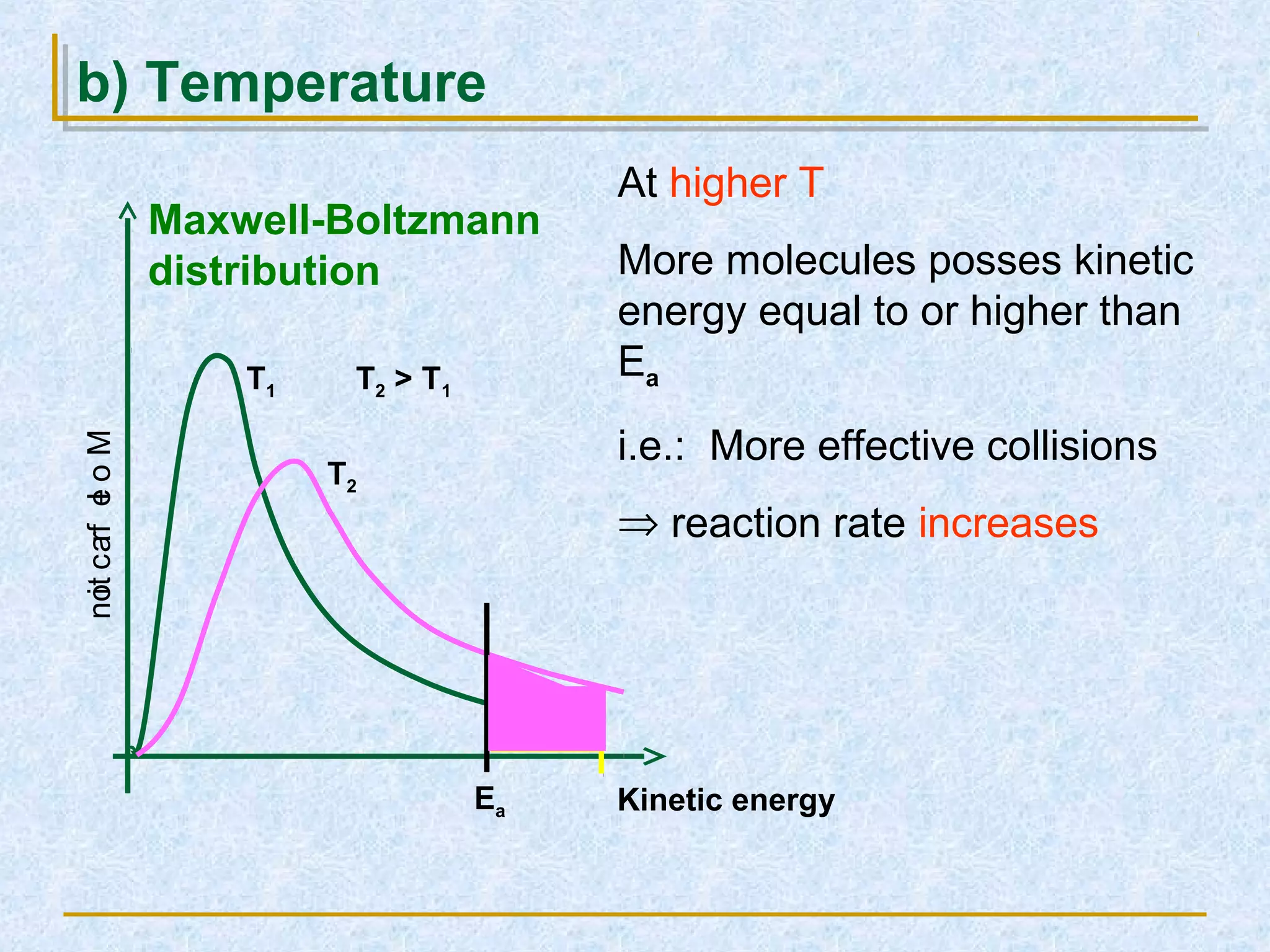
b) TemperatureMolefraction
Kinetic energyEa
T1
T2
T2 > T1
Maxwell-Boltzmann
distribution
At higher T
More molecules posses kinetic
energy equal to or higher than
Ea
i.e.: More effective collisions
⇒ reaction rate increases
c) Catalyst
 A catalyst speeds up a chemical reaction by
providing an alternative pathway
(mechanism) that has a lower activation
energy.
 Catalyst are not consumed in a chemical
reaction.
(A substance, which slows down the rate of a
reaction, is called an inhibitor )
Function of Catalyst
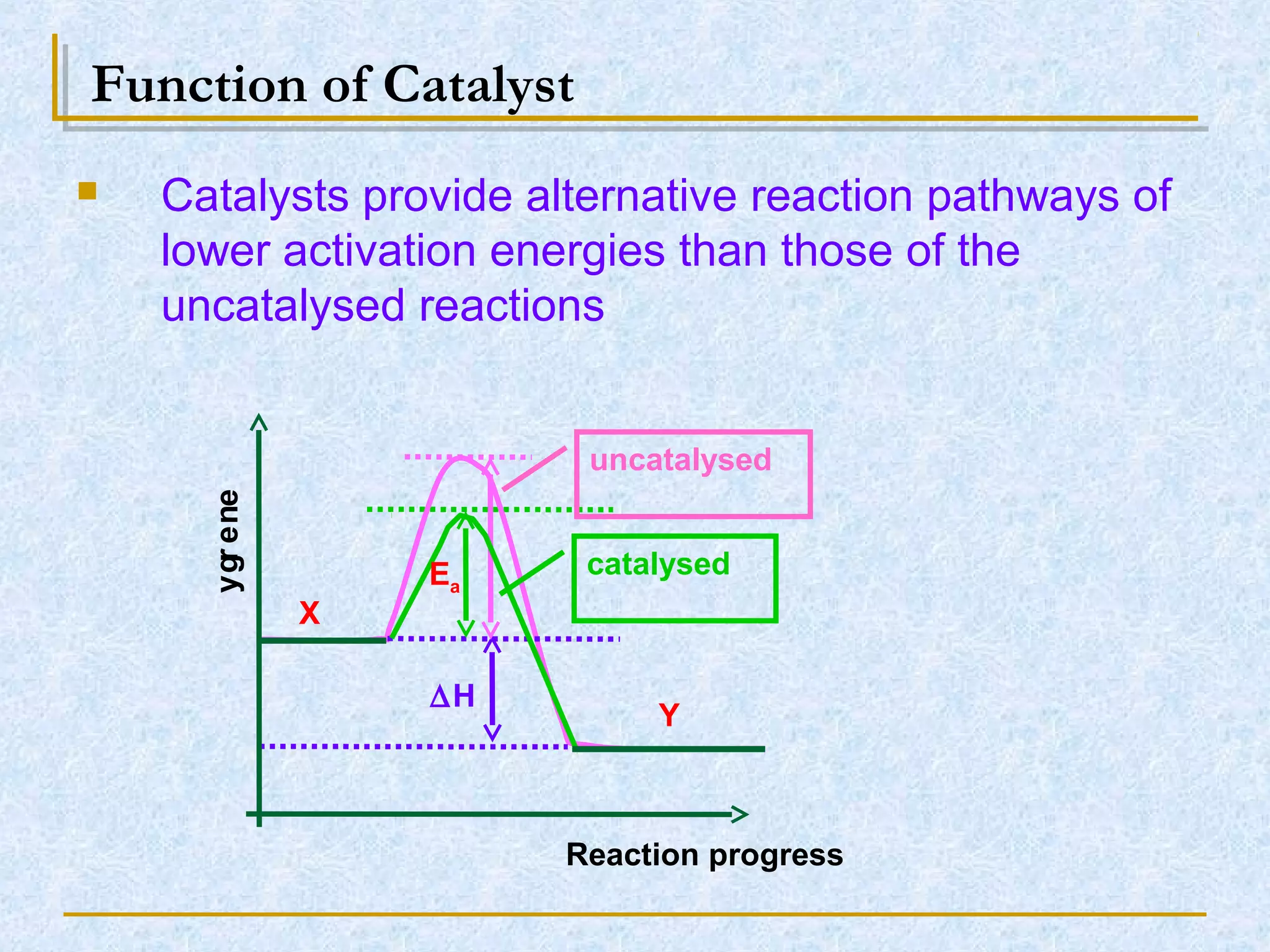
 Catalysts provide alternative reaction pathways of
lower activation energies than those of the
uncatalysed reactions
energy
Reaction progress
X
Y
catalysed
∆H
Ea
uncatalysed
d) Surface Area
Collisions can only occur on the surface of a
solid. If you cut a potato in half, then the boiling
water can reach the “inside” surface that it
couldn’t previously. So again the number of
collisions per unit time will increase

reaction kinetic . collision theory a level

  • 1.
    QUESTION?QUESTION? ANSWER!ANSWER! Only a smallfraction of collisions results in a reaction. (~1 in every 1013 collisions!) Does every collision result in a reaction? Collision Theory
  • 2.
    REACTION RATE &TEMPERATURE QUESTION?QUESTION? Why doesn't every molecular collision result in a reaction? 2AB A2 + B2 No Reaction Reaction occursA - A B - B Illustrati
  • 3.
    Collision Theory No Reaction ReactionoccursA - A B - B  If molecules are moving too slowly, they collide with insufficient energy (unable to overcome the repulsion between electron clouds), and just bounce off each other instead of reacting.  If the reacting species are colliding with sufficient kinetic energy-- activation energy--(to stretch, bend and break the present bonds), this leads to the formation of products. Illustration2:
  • 4.
    Conditions for aReaction to Occur Reacting species must  Collide  Collide in a favourable orientation (appropriate geometry or juxtaposition) – steric factor  Collide with a certain minimum kinetic energy – (more than the activation energy barrier). Collision Theory
  • 5.
    Reaction Profile Energy Reaction Pathway CH3•+ HCl → [H3C---H---Cl]# → CH4 + Cl• CH3• + HCl [ H3C---H---Cl ]# CH4 + Cl• ∆H Ea1 Ea2 A) One Essential Step or Energy Profile Diagram
  • 6.
    Characteristics of ActivatedComplex  Very unstable i.e. It has a pretty short half-life.  Its potential energy is greater than reactants or products.  The activated complex and the reactants are in chemical equilibrium.  It decomposes to form products or reactants.
  • 7.
    ENERGY PROFILE DIAGRAM B)Two or more essential/elementary steps Step 1: A → B Step 2: B → C Overall: A → C Energy Reaction Coordinate ∆H Ea A B C B: reactive intermediate
  • 8.
    Example: Reaction Mechanism Step1: CH3CHO + I2 → CH3I + HI + CO Step 2: CH3I + HI → CH4 + I2 Draw an energy profile diagram for the above reaction.Draw an energy profile diagram for the above reaction. Overall:Overall: CH3CHO → CH4 + CO ∆∆H = +veH = +ve Reactive Intermediates: CH3I and HI Catalyst: I2
  • 9.
    ENERGY PROFILE DIAGRAMenergy Reactionprogress ∆H Ea CH3CHO CH4 + CO CH3I + HI
  • 10.
    Objectives:  Explain theeffects of concentration change/pressure, temperature change , surface area and the presence of catalyst on the reaction rate Factors that Affect the Reaction Rate
  • 11.
    Factors that Affectthe Reaction Rate  Reactant concentration @ pressure  System temperature  Catalyst  Reactants’ physical appearance (particle size, medium)  Other agents: light, pH, presence of impurities  Chemical nature of reactants
  • 12.
    a) Reactant concentration/ Pressure of gases PV = nRT P = (n/V) RT ⇒ P = c.R.T ⇒ pressure, P ∝ concentration, c P or c ↑, Distance between particles is shorter, Effective collisions increase More molecules are able to overcome Ea The no. of collisions per unit time will increase Reaction rate increases Explanation:
  • 13.
    b) TemperatureMolefraction Kinetic energyEa T1 T2 T2> T1 Maxwell-Boltzmann distribution At higher T More molecules posses kinetic energy equal to or higher than Ea i.e.: More effective collisions ⇒ reaction rate increases
  • 14.
    c) Catalyst  Acatalyst speeds up a chemical reaction by providing an alternative pathway (mechanism) that has a lower activation energy.  Catalyst are not consumed in a chemical reaction. (A substance, which slows down the rate of a reaction, is called an inhibitor )
  • 15.
    Function of Catalyst Catalysts provide alternative reaction pathways of lower activation energies than those of the uncatalysed reactions energy Reaction progress X Y catalysed ∆H Ea uncatalysed
  • 16.
    d) Surface Area Collisionscan only occur on the surface of a solid. If you cut a potato in half, then the boiling water can reach the “inside” surface that it couldn’t previously. So again the number of collisions per unit time will increase