TUMKUR UNIVERSITY
TUMAKURU
Department of studies and research in organic chemistry
Seminar on
"Cotton effect"
Presented by
DARSHAN A S
M.Sc,1st semester
Under the Guidance
Dr. MARULASIDDESHWARA.M.B
Department of studies and research in organic chemistry
Tumkur university
Contents.
• Introduction
• Cotton effect
• Circular dichroism
• Optical rotatory dispersion
• Cotton effect curves
• Classification of cotton effect curves
• Single cotton effect curves
• Multiple cotton effect curves
• reference
Introduction
In the nineteenth century, cotton studied optical rotatory dispersion
curves of compounds in the region of their absorptions, where both
optical rotation and circular dichroism occur simultaneously.
He noticed that not only is it possible to observe the circular
dichroism(CD)and ellipticity in an absorption region, but also that the
shape of optical rotatory dispersion(ORD) curves inside the
absorption region differs markedly from their shape outside these
regions.
For many years ORD curves inside absorption regions were referred
to as "anomalous" ORD curves, but this is erroneous, since this
shape is the usual one for ORD curves inside these regions.
Cotton effect.
The cotton effect is the characteristic change in optical
rotatory dispersion in the vicinity of an absorption band of a
substance.
The combination of both (circular birefringence and circular
dichroism) effects in the region in which optically active
absorption bands are observed gives rise to a phenomenon
called cotton effect
• Circular dichroism :
circular dichroism is the differential
absorption of left and right handed
circularly polarized light.
•Optical rotatory dispersion:
It measures the ability of an optically active
compound in clock wise or anti clockwise
direction.
COTTON EFFECT-
Djerassi and klyne suggested that rotatory dispersion
curves(i.e. plot of optical rotation against
wavelength.)should be classified in to two main types
1. Plain curves.
2. Cotton effects curves.
1.plain curves
a) These are normal or plain curves.
b) These curves occur at absorption maximum.
c) These curves obtain from compound which does have
absorption in wavelength where optically active
compounds are examined.
Ex: hydrocarbons, alcohols etc
2.COTTON EFFECT CURVE-
• The each cotton effect consist consists of two extremes, a
geometric maximum called a "peak" and a geometric minimum
called a "trough".
• These curves will obtain for the compounds which are having
asymmetric carbon and chromophore which absorbs near UV
region.
• The cotton effect is called positive if the optical rotation
first increases as the wavelength decreases that means positive
cotton effect curve has its peak in the longer wavelength region, while
it is called negative if optical rotation first decreases as the
wavelength decreases.
• Negative cotton effect curve is defined as having its trough appearing
at the longer wavelength.
These are again divided into 2 types ,they are
•Single cotton effect curves.
•Multiple cotton effect curves.
 Single cotton curves.
 These single cotton curves will show both maximum
and minimum curves at maximum absorption.
§ From the longer wavelength towards the
cotton effect region if crest passes first through it
then the trough it is called positive cotton effect .
§ In the same manner if it happens in opposite way it
is called as negative cotton effect curves.
 Positive cotton effect curves
Multiple cotton effect-
 These are little different from the single cotton effect curves, here
more than two crest and troughs are obtained.
CD and ORD curves with cotton effect
ORD and CD curves showing one or more cotton effects are more
useful and have a variety of applications as shown below.
• Functional group analysis.
• Position of the functional group.
• Determination of configuration.
• Study of conformational changes.
• Structure of polypeptides and proteins.
Assignment of absolute configuration using ORD and CD
• Compounds with similar structure gives similar ORD /CD spectra
provided that they have the same absolute configuration.
• The essence of the method is to recognize that molecule of identical
configuration should have the same cotton effect for electronic
transition of the same origin, whereas enantiomers will have mirror
image cotton effect.
• If the complex is levorotatory, the cotton curve falls to a minimum,
rises rapidly to a maximum and then slowly falls
• If the complex is dextrorotatory, the effect is reversed for the ORD
curve rising first to a maximum, then falling etc. This represent
positive and negative cotton effect
Determination of configuration.
• It depends on two principles : ORD and CD curves for
enantiomeric structures are exact mirror images
across the wavelength. secondly, if the three
dimensional structures of two molecules in the
immediate vicinity of the chromophore are identical.
• If the structures are antipodal, quasi enantiomeric,
the sign of the cotton effects will be opposite.
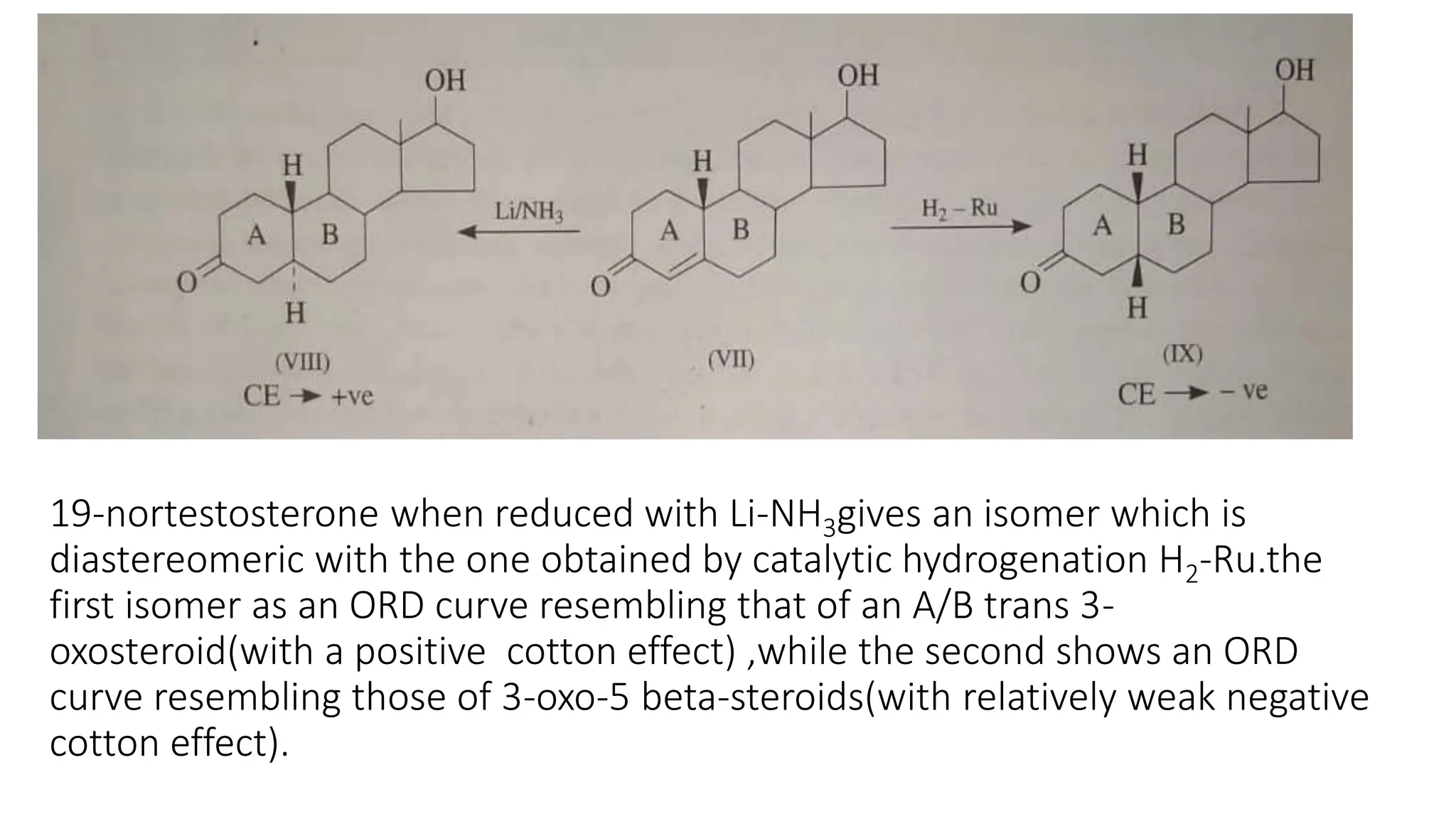
19-nortestosterone when reduced with Li-NH3gives an isomer which is
diastereomeric with the one obtained by catalytic hydrogenation H2-Ru.the
first isomer as an ORD curve resembling that of an A/B trans 3-
oxosteroid(with a positive cotton effect) ,while the second shows an ORD
curve resembling those of 3-oxo-5 beta-steroids(with relatively weak negative
cotton effect).
REFERENCE:
• Stereochemistry of Organic Compounds by D. Nasipuri Second Edition
[page no.423- 425]
• http:/www.sciencedirect.com
• http:/www.access science.com
• https://epgp.inflibnet.ac.in/Home/About
• Inorganic stereochemistry by David L. Kepert [volume 6]
[page no.398-402].
THANK YOU

cotton effect

  • 1.
    TUMKUR UNIVERSITY TUMAKURU Department ofstudies and research in organic chemistry Seminar on "Cotton effect" Presented by DARSHAN A S M.Sc,1st semester Under the Guidance Dr. MARULASIDDESHWARA.M.B Department of studies and research in organic chemistry Tumkur university
  • 2.
    Contents. • Introduction • Cottoneffect • Circular dichroism • Optical rotatory dispersion • Cotton effect curves • Classification of cotton effect curves • Single cotton effect curves • Multiple cotton effect curves • reference
  • 3.
    Introduction In the nineteenthcentury, cotton studied optical rotatory dispersion curves of compounds in the region of their absorptions, where both optical rotation and circular dichroism occur simultaneously. He noticed that not only is it possible to observe the circular dichroism(CD)and ellipticity in an absorption region, but also that the shape of optical rotatory dispersion(ORD) curves inside the absorption region differs markedly from their shape outside these regions. For many years ORD curves inside absorption regions were referred to as "anomalous" ORD curves, but this is erroneous, since this shape is the usual one for ORD curves inside these regions.
  • 4.
    Cotton effect. The cottoneffect is the characteristic change in optical rotatory dispersion in the vicinity of an absorption band of a substance. The combination of both (circular birefringence and circular dichroism) effects in the region in which optically active absorption bands are observed gives rise to a phenomenon called cotton effect
  • 5.
    • Circular dichroism: circular dichroism is the differential absorption of left and right handed circularly polarized light. •Optical rotatory dispersion: It measures the ability of an optically active compound in clock wise or anti clockwise direction.
  • 6.
    COTTON EFFECT- Djerassi andklyne suggested that rotatory dispersion curves(i.e. plot of optical rotation against wavelength.)should be classified in to two main types 1. Plain curves. 2. Cotton effects curves.
  • 7.
    1.plain curves a) Theseare normal or plain curves. b) These curves occur at absorption maximum. c) These curves obtain from compound which does have absorption in wavelength where optically active compounds are examined. Ex: hydrocarbons, alcohols etc
  • 8.
    2.COTTON EFFECT CURVE- •The each cotton effect consist consists of two extremes, a geometric maximum called a "peak" and a geometric minimum called a "trough". • These curves will obtain for the compounds which are having asymmetric carbon and chromophore which absorbs near UV region. • The cotton effect is called positive if the optical rotation first increases as the wavelength decreases that means positive cotton effect curve has its peak in the longer wavelength region, while it is called negative if optical rotation first decreases as the wavelength decreases. • Negative cotton effect curve is defined as having its trough appearing at the longer wavelength.
  • 9.
    These are againdivided into 2 types ,they are •Single cotton effect curves. •Multiple cotton effect curves.
  • 10.
     Single cottoncurves.  These single cotton curves will show both maximum and minimum curves at maximum absorption. § From the longer wavelength towards the cotton effect region if crest passes first through it then the trough it is called positive cotton effect . § In the same manner if it happens in opposite way it is called as negative cotton effect curves.
  • 11.
     Positive cottoneffect curves
  • 12.
    Multiple cotton effect- These are little different from the single cotton effect curves, here more than two crest and troughs are obtained.
  • 13.
    CD and ORDcurves with cotton effect ORD and CD curves showing one or more cotton effects are more useful and have a variety of applications as shown below. • Functional group analysis. • Position of the functional group. • Determination of configuration. • Study of conformational changes. • Structure of polypeptides and proteins.
  • 14.
    Assignment of absoluteconfiguration using ORD and CD • Compounds with similar structure gives similar ORD /CD spectra provided that they have the same absolute configuration. • The essence of the method is to recognize that molecule of identical configuration should have the same cotton effect for electronic transition of the same origin, whereas enantiomers will have mirror image cotton effect. • If the complex is levorotatory, the cotton curve falls to a minimum, rises rapidly to a maximum and then slowly falls • If the complex is dextrorotatory, the effect is reversed for the ORD curve rising first to a maximum, then falling etc. This represent positive and negative cotton effect
  • 15.
    Determination of configuration. •It depends on two principles : ORD and CD curves for enantiomeric structures are exact mirror images across the wavelength. secondly, if the three dimensional structures of two molecules in the immediate vicinity of the chromophore are identical. • If the structures are antipodal, quasi enantiomeric, the sign of the cotton effects will be opposite.
  • 16.
    19-nortestosterone when reducedwith Li-NH3gives an isomer which is diastereomeric with the one obtained by catalytic hydrogenation H2-Ru.the first isomer as an ORD curve resembling that of an A/B trans 3- oxosteroid(with a positive cotton effect) ,while the second shows an ORD curve resembling those of 3-oxo-5 beta-steroids(with relatively weak negative cotton effect).
  • 17.
    REFERENCE: • Stereochemistry ofOrganic Compounds by D. Nasipuri Second Edition [page no.423- 425] • http:/www.sciencedirect.com • http:/www.access science.com • https://epgp.inflibnet.ac.in/Home/About • Inorganic stereochemistry by David L. Kepert [volume 6] [page no.398-402].
  • 18.