1
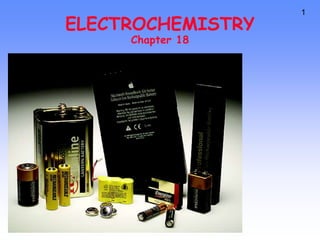
ELECTROCHEMISTRY
Chapter 18
2
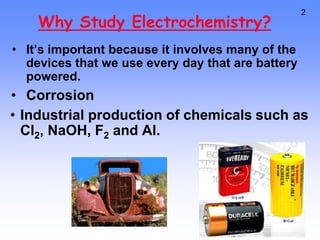
Why Study Electrochemistry?
• It’s important because it involves many of the
devices that we use every day that are battery
powered.
• Corrosion
• Industrial production of chemicals such as
Cl2, NaOH, F2 and Al.
3
Electron Transfer Reactions
• Electron transfer reactions are oxidation-
reduction or redox reactions.
• it Results in the generation of an electric
current (electricity)
• ELECTROCHEMISTRY is the connection
between chemistry and electricity.
Electrochemistry
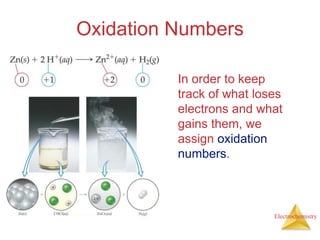
Oxidation Numbers
In order to keep
track of what loses
electrons and what
gains them, we
assign oxidation
numbers.
Electrochemistry
Oxidation and Reduction
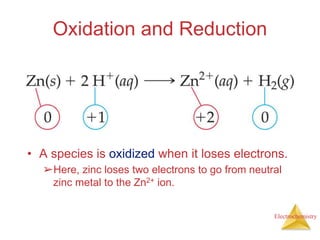
• A species is oxidized when it loses electrons.
➢Here, zinc loses two electrons to go from neutral
zinc metal to the Zn2+ ion.
Electrochemistry
Oxidation and Reduction
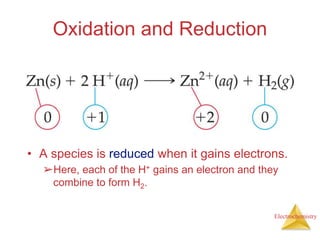
• A species is reduced when it gains electrons.
➢Here, each of the H+ gains an electron and they
combine to form H2.
Electrochemistry
Oxidation and Reduction
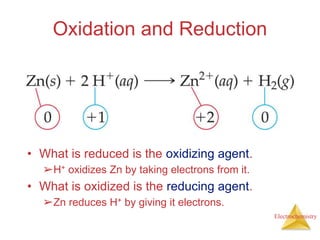
• What is reduced is the oxidizing agent.
➢H+ oxidizes Zn by taking electrons from it.
• What is oxidized is the reducing agent.
➢Zn reduces H+ by giving it electrons.
8
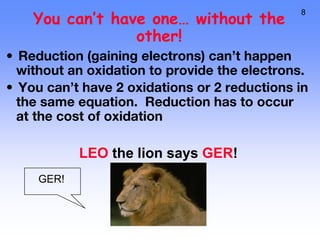
You can’t have one… without the
other!
• Reduction (gaining electrons) can’t happen
without an oxidation to provide the electrons.
• You can’t have 2 oxidations or 2 reductions in
the same equation. Reduction has to occur
at the cost of oxidation
LEO the lion says GER!
GER!
9
Another way to remember
•OIL RIG
Oxidation is loss of
electrons and
Reduction is gain of
electrons.
Electrochemistry
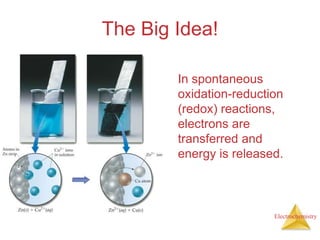
The Big Idea!
In spontaneous
oxidation-reduction
(redox) reactions,
electrons are
transferred and
energy is released.
Electrochemistry
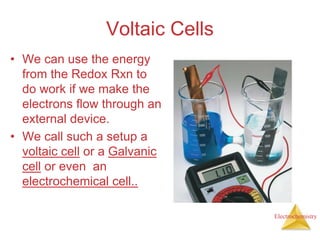
Voltaic Cells
• We can use the energy
from the Redox Rxn to
do work if we make the
electrons flow through an
external device.
• We call such a setup a
voltaic cell or a Galvanic
cell or even an
electrochemical cell..
Electrochemistry
Voltaic Cells
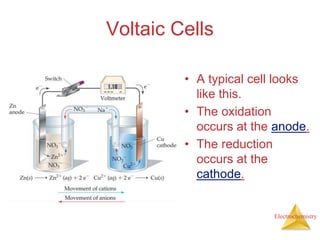
• A typical cell looks
like this.
• The oxidation
occurs at the anode.
• The reduction
occurs at the
cathode.
Electrochemistry
Voltaic Cells
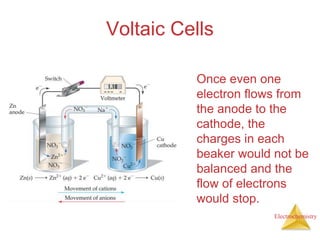
Once even one
electron flows from
the anode to the
cathode, the
charges in each
beaker would not be
balanced and the
flow of electrons
would stop.
Electrochemistry
Voltaic Cells
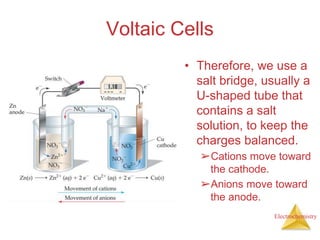
• Therefore, we use a
salt bridge, usually a
U-shaped tube that
contains a salt
solution, to keep the
charges balanced.
➢Cations move toward
the cathode.
➢Anions move toward
the anode.
Electrochemistry
Voltaic Cells
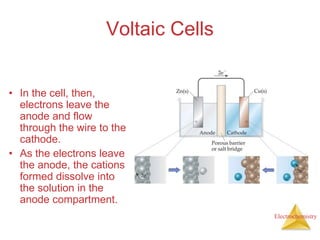
• In the cell, then,
electrons leave the
anode and flow
through the wire to the
cathode.
• As the electrons leave
the anode, the cations
formed dissolve into
the solution in the
anode compartment.
Electrochemistry
Voltaic Cells
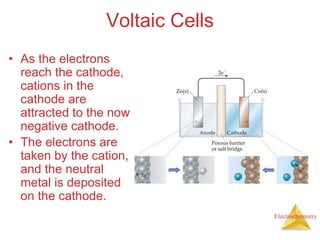
• As the electrons
reach the cathode,
cations in the
cathode are
attracted to the now
negative cathode.
• The electrons are
taken by the cation,
and the neutral
metal is deposited
on the cathode.
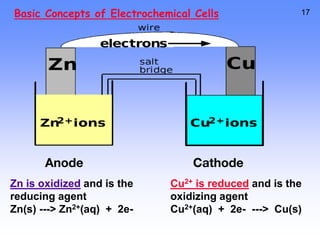
17
Anode Cathode
Basic Concepts of Electrochemical Cells
Zn is oxidized and is the
reducing agent
Zn(s) ---> Zn2+(aq) + 2e-
Cu2+ is reduced and is the
oxidizing agent
Cu2+(aq) + 2e- ---> Cu(s)
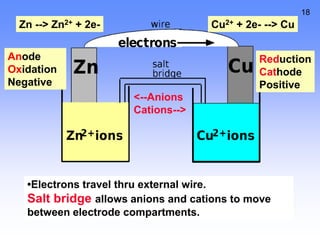
18
•Electrons travel thru external wire.
Salt bridge allows anions and cations to move
between electrode compartments.
Zn --> Zn2+ + 2e- Cu2+ + 2e- --> Cu
<--Anions
Cations-->
Anode
Oxidation
Negative
Reduction
Cathode
Positive
Electrochemistry
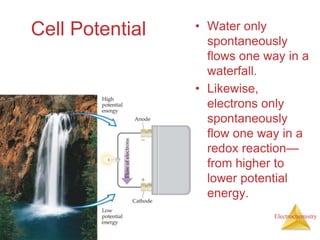
Cell Potential • Water only
spontaneously
flows one way in a
waterfall.
• Likewise,
electrons only
spontaneously
flow one way in a
redox reaction—
from higher to
lower potential
energy.
Electrochemistry
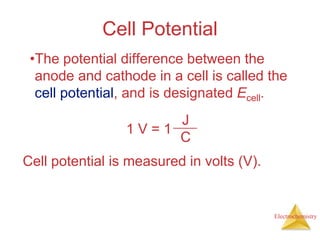
Cell Potential
•The potential difference between the
anode and cathode in a cell is called the
cell potential, and is designated Ecell.
Cell potential is measured in volts (V).
1 V = 1
J
C
21
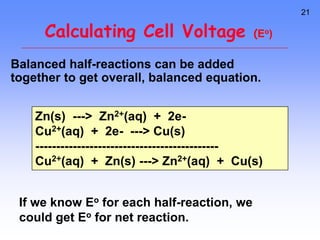
Calculating Cell Voltage (Eo)
Balanced half-reactions can be added
together to get overall, balanced equation.
Zn(s) ---> Zn2+(aq) + 2e-
Cu2+(aq) + 2e- ---> Cu(s)
--------------------------------------------
Cu2+(aq) + Zn(s) ---> Zn2+(aq) + Cu(s)
If we know Eo for each half-reaction, we
could get Eo for net reaction.
22
Electrochemistry
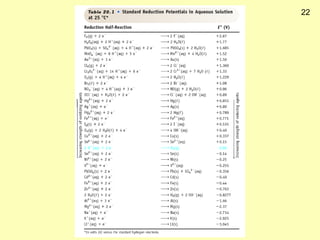
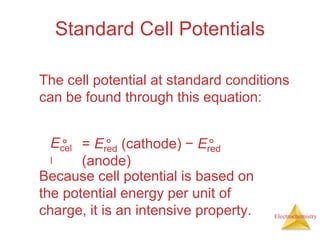
Standard Cell Potentials
The cell potential at standard conditions
can be found through this equation:
Ecel
l
° = Ered (cathode) − Ered
(anode)
° °
Because cell potential is based on
the potential energy per unit of
charge, it is an intensive property.
Electrochemistry
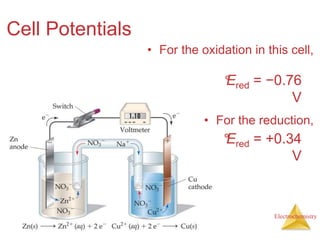
Cell Potentials
• For the oxidation in this cell,
• For the reduction,
Ered = −0.76
V
°
Ered = +0.34
V
°
Electrochemistry
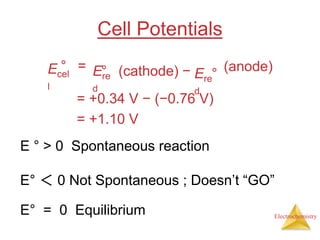
Cell Potentials
Ecel
l
° = Ere
d
° (cathode) − Ere
d
°
(anode)
= +0.34 V − (−0.76 V)
= +1.10 V
E ° > 0 Spontaneous reaction
E° < 0 Not Spontaneous ; Doesn’t “GO”
E° = 0 Equilibrium
Electrochemistry
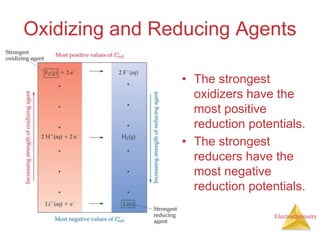
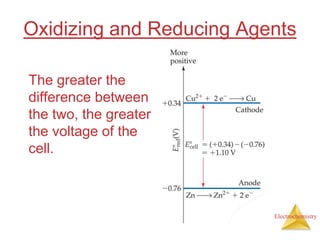
Oxidizing and Reducing Agents
• The strongest
oxidizers have the
most positive
reduction potentials.
• The strongest
reducers have the
most negative
reduction potentials.
Electrochemistry
Oxidizing and Reducing Agents
The greater the
difference between
the two, the greater
the voltage of the
cell.
What is Electroplating?
An electrochemical process where metal ions are transferred
from a solution and are deposited as a thin layer onto surface of
a cathode.
The setup is composed DC circuit with an anode and a cathode
sitting in a bath of solution that has the metal ions necessary for
coating or plating
Electrolysis is the process of making a non-spontaneous chemical
redox reaction occur by passing electricity through a substance.
(electrolytic cell)
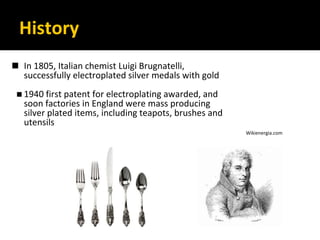
History
◼ In 1805, Italian chemist Luigi Brugnatelli,
successfully electroplated silver medals with gold
◼ 1940 first patent for electroplating awarded, and
soon factories in England were mass producing
silver plated items, including teapots, brushes and
utensils
Wikienergia.com
Benefits of Electroplating
Electroplating can enhance:
▪ Chemical properties---increase corrosion resistance
▪ Physical properties---increase thickness of part
▪ Mechanical properties---increase tensile strength &
hardness
Commercial Examples:
◼ Coating jewelry with thin layer of expensive metal.
◼ Coating chromium over steel to make rust resistant.
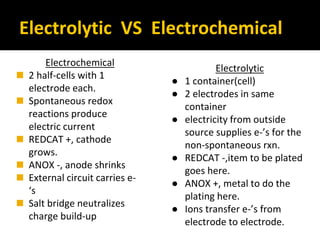
Electrolytic VS Electrochemical
Electrochemical
◼ 2 half-cells with 1
electrode each.
◼ Spontaneous redox
reactions produce
electric current
◼ REDCAT +, cathode
grows.
◼ ANOX -, anode shrinks
◼ External circuit carries e-
‘s
◼ Salt bridge neutralizes
charge build-up
Electrolytic
● 1 container(cell)
● 2 electrodes in same
container
● electricity from outside
source supplies e-’s for the
non-spontaneous rxn.
● REDCAT -,item to be plated
goes here.
● ANOX +, metal to do the
plating here.
● Ions transfer e-’s from
electrode to electrode.
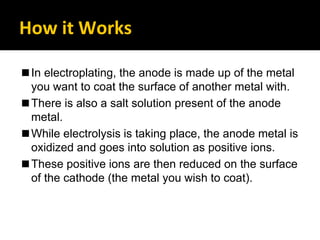
How it Works
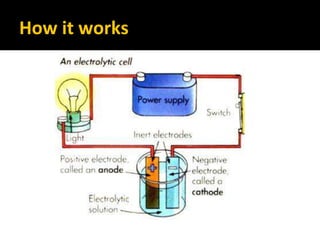
◼In electroplating, the anode is made up of the metal
you want to coat the surface of another metal with.
◼There is also a salt solution present of the anode
metal.
◼While electrolysis is taking place, the anode metal is
oxidized and goes into solution as positive ions.
◼These positive ions are then reduced on the surface
of the cathode (the metal you wish to coat).
How it works
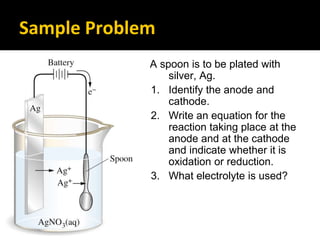
Sample Problem
A spoon is to be plated with
silver, Ag.
1. Identify the anode and
cathode.
2. Write an equation for the
reaction taking place at the
anode and at the cathode
and indicate whether it is
oxidation or reduction.
3. What electrolyte is used?
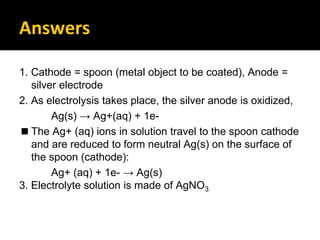
Answers
1. Cathode = spoon (metal object to be coated), Anode =
silver electrode
2. As electrolysis takes place, the silver anode is oxidized,
Ag(s) → Ag+(aq) + 1e-
◼ The Ag+ (aq) ions in solution travel to the spoon cathode
and are reduced to form neutral Ag(s) on the surface of
the spoon (cathode):
Ag+ (aq) + 1e- → Ag(s)
3. Electrolyte solution is made of AgNO3
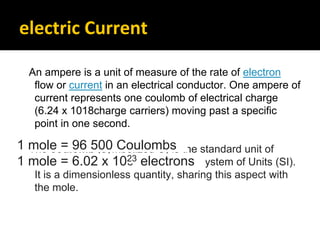
electric Current
An ampere is a unit of measure of the rate of electron
flow or current in an electrical conductor. One ampere of
current represents one coulomb of electrical charge
(6.24 x 10¹⁸charge carriers) moving past a specific
point in one second.
The coulomb (symbolized C) is the standard unit of
electric charge in the International System of Units (SI).
It is a dimensionless quantity, sharing this aspect with
the mole.
1 mole = 96 500 Coulombs
1 mole = 6.02 x 10²³ electrons
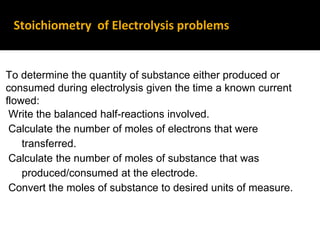
Stoichiometry of Electrolysis problems
To determine the quantity of substance either produced or
consumed during electrolysis given the time a known current
flowed:
Write the balanced half-reactions involved.
Calculate the number of moles of electrons that were
transferred.
Calculate the number of moles of substance that was
produced/consumed at the electrode.
Convert the moles of substance to desired units of measure.
Sample Problem
A 40.0 amp current flowed through a solution of iron(III) chloride for 10.0 hours.
Determine the mass of iron (measured at 25oC and 1 atm) that is produced
during this time.
Calculating the time required
To determine the quantity of time required to produce a
known quantity of a substance given the amount of
current that flowed:
● Find the quantity of substance produced/consumed in
moles.
● Write the balanced half-reaction involved.
● Calculate the number of moles of electrons required.
● Convert the moles of electrons into coulombs.
● Calculate the time required.
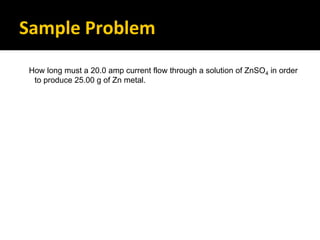
Sample Problem
How long must a 20.0 amp current flow through a solution of ZnSO4 in order
to produce 25.00 g of Zn metal.
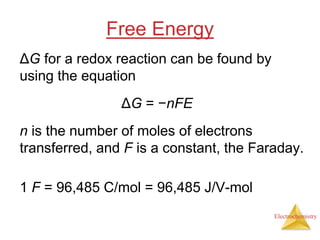
Electrochemistry
Free Energy
ΔG for a redox reaction can be found by
using the equation
ΔG = −nFE
n is the number of moles of electrons
transferred, and F is a constant, the Faraday.
1 F = 96,485 C/mol = 96,485 J/V-mol
Electrochemistry
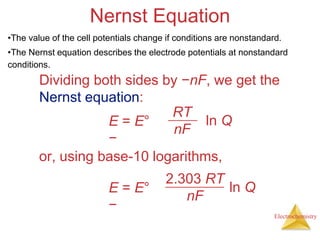
Nernst Equation
Dividing both sides by −nF, we get the
Nernst equation:
E = E°
−
RT
nF
ln Q
or, using base-10 logarithms,
E = E°
−
2.303 RT
nF
ln Q
•The value of the cell potentials change if conditions are nonstandard.
•The Nernst equation describes the electrode potentials at nonstandard
conditions.
Electrochemistry
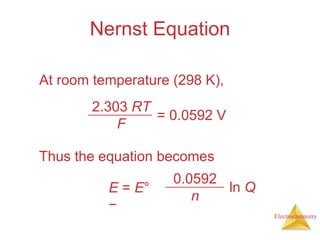
Nernst Equation
At room temperature (298 K),
Thus the equation becomes
E = E°
−
0.0592
n
ln Q
2.303 RT
F
= 0.0592 V
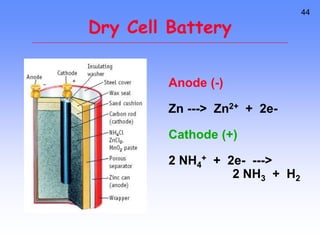
44
Dry Cell Battery
Anode (-)
Zn ---> Zn2+ + 2e-
Cathode (+)
2 NH4
+ + 2e- --->
2 NH3 + H2
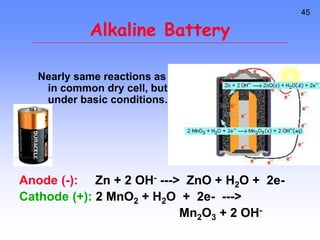
45
Alkaline Battery
Nearly same reactions as
in common dry cell, but
under basic conditions.
Anode (-): Zn + 2 OH- ---> ZnO + H2O + 2e-
Cathode (+): 2 MnO2 + H2O + 2e- --->
Mn2O3 + 2 OH-
46
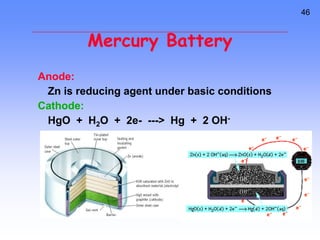
Mercury Battery
Anode:
Zn is reducing agent under basic conditions
Cathode:
HgO + H2O + 2e- ---> Hg + 2 OH-
47
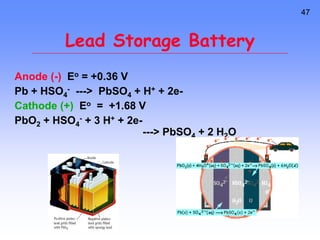
Lead Storage Battery
Anode (-) Eo = +0.36 V
Pb + HSO4
- ---> PbSO4 + H+ + 2e-
Cathode (+) Eo = +1.68 V
PbO2 + HSO4
- + 3 H+ + 2e-
---> PbSO4 + 2 H2O
48
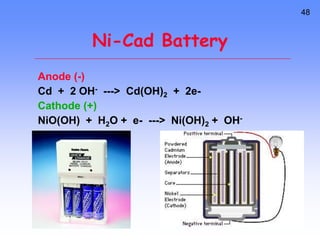
Ni-Cad Battery
Anode (-)
Cd + 2 OH- ---> Cd(OH)2 + 2e-
Cathode (+)
NiO(OH) + H2O + e- ---> Ni(OH)2 + OH-
49
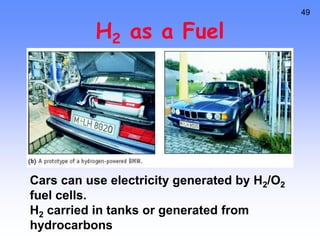
H2 as a Fuel
Cars can use electricity generated by H2/O2
fuel cells.
H2 carried in tanks or generated from
hydrocarbons
50
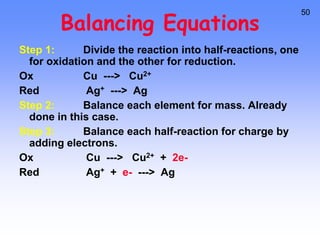
Balancing Equations
Step 1: Divide the reaction into half-reactions, one
for oxidation and the other for reduction.
Ox Cu ---> Cu2+
Red Ag+ ---> Ag
Step 2: Balance each element for mass. Already
done in this case.
Step 3: Balance each half-reaction for charge by
adding electrons.
Ox Cu ---> Cu2+ + 2e-
Red Ag+ + e- ---> Ag
51
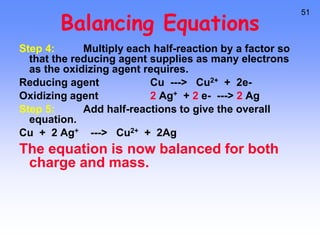
Balancing Equations
Step 4: Multiply each half-reaction by a factor so
that the reducing agent supplies as many electrons
as the oxidizing agent requires.
Reducing agent Cu ---> Cu2+ + 2e-
Oxidizing agent 2 Ag+ + 2 e- ---> 2 Ag
Step 5: Add half-reactions to give the overall
equation.
Cu + 2 Ag+ ---> Cu2+ + 2Ag
The equation is now balanced for both
charge and mass.
52
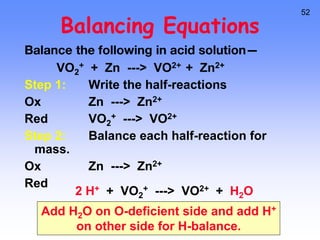
Balancing Equations
Balance the following in acid solution—
VO2
+ + Zn ---> VO2+ + Zn2+
Step 1: Write the half-reactions
Ox Zn ---> Zn2+
Red VO2
+ ---> VO2+
Step 2: Balance each half-reaction for
mass.
Ox Zn ---> Zn2+
Red
VO2
+ ---> VO2+ + H2O
2 H+ +
Add H2O on O-deficient side and add H+
on other side for H-balance.
53
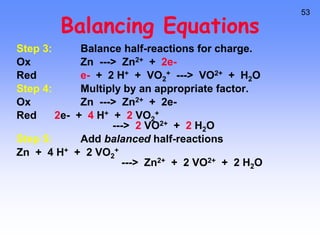
Balancing Equations
Step 3: Balance half-reactions for charge.
Ox Zn ---> Zn2+ + 2e-
Red e- + 2 H+ + VO2
+ ---> VO2+ + H2O
Step 4: Multiply by an appropriate factor.
Ox Zn ---> Zn2+ + 2e-
Red 2e- + 4 H+ + 2 VO2
+
---> 2 VO2+ + 2 H2O
Step 5: Add balanced half-reactions
Zn + 4 H+ + 2 VO2
+
---> Zn2+ + 2 VO2+ + 2 H2O
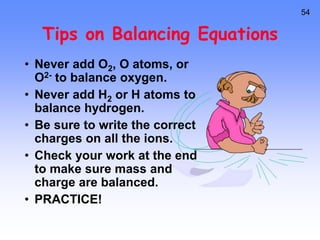
54
Tips on Balancing Equations
• Never add O2, O atoms, or
O2- to balance oxygen.
• Never add H2 or H atoms to
balance hydrogen.
• Be sure to write the correct
charges on all the ions.
• Check your work at the end
to make sure mass and
charge are balanced.
• PRACTICE!

Ap ch 18 electrochemistry ppt

  • 1.
  • 2.
    2 Why Study Electrochemistry? •It’s important because it involves many of the devices that we use every day that are battery powered. • Corrosion • Industrial production of chemicals such as Cl2, NaOH, F2 and Al.
  • 3.
    3 Electron Transfer Reactions •Electron transfer reactions are oxidation- reduction or redox reactions. • it Results in the generation of an electric current (electricity) • ELECTROCHEMISTRY is the connection between chemistry and electricity.
  • 4.
    Electrochemistry Oxidation Numbers In orderto keep track of what loses electrons and what gains them, we assign oxidation numbers.
  • 5.
    Electrochemistry Oxidation and Reduction •A species is oxidized when it loses electrons. ➢Here, zinc loses two electrons to go from neutral zinc metal to the Zn2+ ion.
  • 6.
    Electrochemistry Oxidation and Reduction •A species is reduced when it gains electrons. ➢Here, each of the H+ gains an electron and they combine to form H2.
  • 7.
    Electrochemistry Oxidation and Reduction •What is reduced is the oxidizing agent. ➢H+ oxidizes Zn by taking electrons from it. • What is oxidized is the reducing agent. ➢Zn reduces H+ by giving it electrons.
  • 8.
    8 You can’t haveone… without the other! • Reduction (gaining electrons) can’t happen without an oxidation to provide the electrons. • You can’t have 2 oxidations or 2 reductions in the same equation. Reduction has to occur at the cost of oxidation LEO the lion says GER! GER!
  • 9.
    9 Another way toremember •OIL RIG Oxidation is loss of electrons and Reduction is gain of electrons.
  • 10.
    Electrochemistry The Big Idea! Inspontaneous oxidation-reduction (redox) reactions, electrons are transferred and energy is released.
  • 11.
    Electrochemistry Voltaic Cells • Wecan use the energy from the Redox Rxn to do work if we make the electrons flow through an external device. • We call such a setup a voltaic cell or a Galvanic cell or even an electrochemical cell..
  • 12.
    Electrochemistry Voltaic Cells • Atypical cell looks like this. • The oxidation occurs at the anode. • The reduction occurs at the cathode.
  • 13.
    Electrochemistry Voltaic Cells Once evenone electron flows from the anode to the cathode, the charges in each beaker would not be balanced and the flow of electrons would stop.
  • 14.
    Electrochemistry Voltaic Cells • Therefore,we use a salt bridge, usually a U-shaped tube that contains a salt solution, to keep the charges balanced. ➢Cations move toward the cathode. ➢Anions move toward the anode.
  • 15.
    Electrochemistry Voltaic Cells • Inthe cell, then, electrons leave the anode and flow through the wire to the cathode. • As the electrons leave the anode, the cations formed dissolve into the solution in the anode compartment.
  • 16.
    Electrochemistry Voltaic Cells • Asthe electrons reach the cathode, cations in the cathode are attracted to the now negative cathode. • The electrons are taken by the cation, and the neutral metal is deposited on the cathode.
  • 17.
    17 Anode Cathode Basic Conceptsof Electrochemical Cells Zn is oxidized and is the reducing agent Zn(s) ---> Zn2+(aq) + 2e- Cu2+ is reduced and is the oxidizing agent Cu2+(aq) + 2e- ---> Cu(s)
  • 18.
    18 •Electrons travel thruexternal wire. Salt bridge allows anions and cations to move between electrode compartments. Zn --> Zn2+ + 2e- Cu2+ + 2e- --> Cu <--Anions Cations--> Anode Oxidation Negative Reduction Cathode Positive
  • 19.
    Electrochemistry Cell Potential •Water only spontaneously flows one way in a waterfall. • Likewise, electrons only spontaneously flow one way in a redox reaction— from higher to lower potential energy.
  • 20.
    Electrochemistry Cell Potential •The potentialdifference between the anode and cathode in a cell is called the cell potential, and is designated Ecell. Cell potential is measured in volts (V). 1 V = 1 J C
  • 21.
    21 Calculating Cell Voltage(Eo) Balanced half-reactions can be added together to get overall, balanced equation. Zn(s) ---> Zn2+(aq) + 2e- Cu2+(aq) + 2e- ---> Cu(s) -------------------------------------------- Cu2+(aq) + Zn(s) ---> Zn2+(aq) + Cu(s) If we know Eo for each half-reaction, we could get Eo for net reaction.
  • 22.
  • 23.
    Electrochemistry Standard Cell Potentials Thecell potential at standard conditions can be found through this equation: Ecel l ° = Ered (cathode) − Ered (anode) ° ° Because cell potential is based on the potential energy per unit of charge, it is an intensive property.
  • 24.
    Electrochemistry Cell Potentials • Forthe oxidation in this cell, • For the reduction, Ered = −0.76 V ° Ered = +0.34 V °
  • 25.
    Electrochemistry Cell Potentials Ecel l ° =Ere d ° (cathode) − Ere d ° (anode) = +0.34 V − (−0.76 V) = +1.10 V E ° > 0 Spontaneous reaction E° < 0 Not Spontaneous ; Doesn’t “GO” E° = 0 Equilibrium
  • 26.
    Electrochemistry Oxidizing and ReducingAgents • The strongest oxidizers have the most positive reduction potentials. • The strongest reducers have the most negative reduction potentials.
  • 27.
    Electrochemistry Oxidizing and ReducingAgents The greater the difference between the two, the greater the voltage of the cell.
  • 28.
    What is Electroplating? Anelectrochemical process where metal ions are transferred from a solution and are deposited as a thin layer onto surface of a cathode. The setup is composed DC circuit with an anode and a cathode sitting in a bath of solution that has the metal ions necessary for coating or plating Electrolysis is the process of making a non-spontaneous chemical redox reaction occur by passing electricity through a substance. (electrolytic cell)
  • 29.
    History ◼ In 1805,Italian chemist Luigi Brugnatelli, successfully electroplated silver medals with gold ◼ 1940 first patent for electroplating awarded, and soon factories in England were mass producing silver plated items, including teapots, brushes and utensils Wikienergia.com
  • 30.
    Benefits of Electroplating Electroplatingcan enhance: ▪ Chemical properties---increase corrosion resistance ▪ Physical properties---increase thickness of part ▪ Mechanical properties---increase tensile strength & hardness Commercial Examples: ◼ Coating jewelry with thin layer of expensive metal. ◼ Coating chromium over steel to make rust resistant.
  • 31.
    Electrolytic VS Electrochemical Electrochemical ◼2 half-cells with 1 electrode each. ◼ Spontaneous redox reactions produce electric current ◼ REDCAT +, cathode grows. ◼ ANOX -, anode shrinks ◼ External circuit carries e- ‘s ◼ Salt bridge neutralizes charge build-up Electrolytic ● 1 container(cell) ● 2 electrodes in same container ● electricity from outside source supplies e-’s for the non-spontaneous rxn. ● REDCAT -,item to be plated goes here. ● ANOX +, metal to do the plating here. ● Ions transfer e-’s from electrode to electrode.
  • 32.
    How it Works ◼Inelectroplating, the anode is made up of the metal you want to coat the surface of another metal with. ◼There is also a salt solution present of the anode metal. ◼While electrolysis is taking place, the anode metal is oxidized and goes into solution as positive ions. ◼These positive ions are then reduced on the surface of the cathode (the metal you wish to coat).
  • 33.
  • 34.
    Sample Problem A spoonis to be plated with silver, Ag. 1. Identify the anode and cathode. 2. Write an equation for the reaction taking place at the anode and at the cathode and indicate whether it is oxidation or reduction. 3. What electrolyte is used?
  • 35.
    Answers 1. Cathode =spoon (metal object to be coated), Anode = silver electrode 2. As electrolysis takes place, the silver anode is oxidized, Ag(s) → Ag+(aq) + 1e- ◼ The Ag+ (aq) ions in solution travel to the spoon cathode and are reduced to form neutral Ag(s) on the surface of the spoon (cathode): Ag+ (aq) + 1e- → Ag(s) 3. Electrolyte solution is made of AgNO3
  • 36.
    electric Current An ampereis a unit of measure of the rate of electron flow or current in an electrical conductor. One ampere of current represents one coulomb of electrical charge (6.24 x 10¹⁸charge carriers) moving past a specific point in one second. The coulomb (symbolized C) is the standard unit of electric charge in the International System of Units (SI). It is a dimensionless quantity, sharing this aspect with the mole. 1 mole = 96 500 Coulombs 1 mole = 6.02 x 10²³ electrons
  • 37.
    Stoichiometry of Electrolysisproblems To determine the quantity of substance either produced or consumed during electrolysis given the time a known current flowed: Write the balanced half-reactions involved. Calculate the number of moles of electrons that were transferred. Calculate the number of moles of substance that was produced/consumed at the electrode. Convert the moles of substance to desired units of measure.
  • 38.
    Sample Problem A 40.0amp current flowed through a solution of iron(III) chloride for 10.0 hours. Determine the mass of iron (measured at 25oC and 1 atm) that is produced during this time.
  • 39.
    Calculating the timerequired To determine the quantity of time required to produce a known quantity of a substance given the amount of current that flowed: ● Find the quantity of substance produced/consumed in moles. ● Write the balanced half-reaction involved. ● Calculate the number of moles of electrons required. ● Convert the moles of electrons into coulombs. ● Calculate the time required.
  • 40.
    Sample Problem How longmust a 20.0 amp current flow through a solution of ZnSO4 in order to produce 25.00 g of Zn metal.
  • 41.
    Electrochemistry Free Energy ΔG fora redox reaction can be found by using the equation ΔG = −nFE n is the number of moles of electrons transferred, and F is a constant, the Faraday. 1 F = 96,485 C/mol = 96,485 J/V-mol
  • 42.
    Electrochemistry Nernst Equation Dividing bothsides by −nF, we get the Nernst equation: E = E° − RT nF ln Q or, using base-10 logarithms, E = E° − 2.303 RT nF ln Q •The value of the cell potentials change if conditions are nonstandard. •The Nernst equation describes the electrode potentials at nonstandard conditions.
  • 43.
    Electrochemistry Nernst Equation At roomtemperature (298 K), Thus the equation becomes E = E° − 0.0592 n ln Q 2.303 RT F = 0.0592 V
  • 44.
    44 Dry Cell Battery Anode(-) Zn ---> Zn2+ + 2e- Cathode (+) 2 NH4 + + 2e- ---> 2 NH3 + H2
  • 45.
    45 Alkaline Battery Nearly samereactions as in common dry cell, but under basic conditions. Anode (-): Zn + 2 OH- ---> ZnO + H2O + 2e- Cathode (+): 2 MnO2 + H2O + 2e- ---> Mn2O3 + 2 OH-
  • 46.
    46 Mercury Battery Anode: Zn isreducing agent under basic conditions Cathode: HgO + H2O + 2e- ---> Hg + 2 OH-
  • 47.
    47 Lead Storage Battery Anode(-) Eo = +0.36 V Pb + HSO4 - ---> PbSO4 + H+ + 2e- Cathode (+) Eo = +1.68 V PbO2 + HSO4 - + 3 H+ + 2e- ---> PbSO4 + 2 H2O
  • 48.
    48 Ni-Cad Battery Anode (-) Cd+ 2 OH- ---> Cd(OH)2 + 2e- Cathode (+) NiO(OH) + H2O + e- ---> Ni(OH)2 + OH-
  • 49.
    49 H2 as aFuel Cars can use electricity generated by H2/O2 fuel cells. H2 carried in tanks or generated from hydrocarbons
  • 50.
    50 Balancing Equations Step 1:Divide the reaction into half-reactions, one for oxidation and the other for reduction. Ox Cu ---> Cu2+ Red Ag+ ---> Ag Step 2: Balance each element for mass. Already done in this case. Step 3: Balance each half-reaction for charge by adding electrons. Ox Cu ---> Cu2+ + 2e- Red Ag+ + e- ---> Ag
  • 51.
    51 Balancing Equations Step 4:Multiply each half-reaction by a factor so that the reducing agent supplies as many electrons as the oxidizing agent requires. Reducing agent Cu ---> Cu2+ + 2e- Oxidizing agent 2 Ag+ + 2 e- ---> 2 Ag Step 5: Add half-reactions to give the overall equation. Cu + 2 Ag+ ---> Cu2+ + 2Ag The equation is now balanced for both charge and mass.
  • 52.
    52 Balancing Equations Balance thefollowing in acid solution— VO2 + + Zn ---> VO2+ + Zn2+ Step 1: Write the half-reactions Ox Zn ---> Zn2+ Red VO2 + ---> VO2+ Step 2: Balance each half-reaction for mass. Ox Zn ---> Zn2+ Red VO2 + ---> VO2+ + H2O 2 H+ + Add H2O on O-deficient side and add H+ on other side for H-balance.
  • 53.
    53 Balancing Equations Step 3:Balance half-reactions for charge. Ox Zn ---> Zn2+ + 2e- Red e- + 2 H+ + VO2 + ---> VO2+ + H2O Step 4: Multiply by an appropriate factor. Ox Zn ---> Zn2+ + 2e- Red 2e- + 4 H+ + 2 VO2 + ---> 2 VO2+ + 2 H2O Step 5: Add balanced half-reactions Zn + 4 H+ + 2 VO2 + ---> Zn2+ + 2 VO2+ + 2 H2O
  • 54.
    54 Tips on BalancingEquations • Never add O2, O atoms, or O2- to balance oxygen. • Never add H2 or H atoms to balance hydrogen. • Be sure to write the correct charges on all the ions. • Check your work at the end to make sure mass and charge are balanced. • PRACTICE!