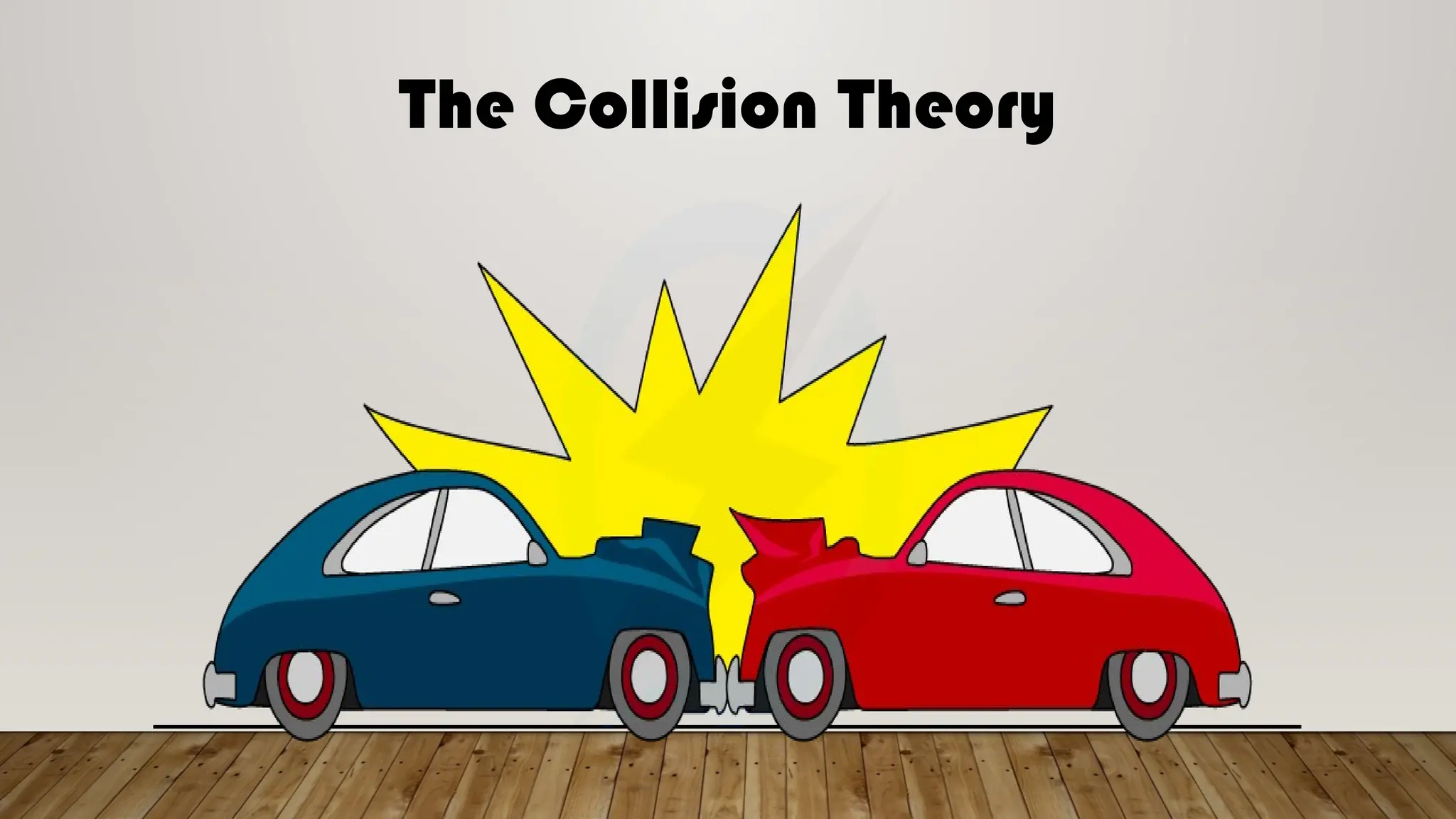
The Collision Theory
● It is a branch of chemistry that deals with the mechanism
and rates of chemical reactions.
● It can describe reaction mechanisms that explain how
atoms or units of molecules combine to form products.
● It can also identify the formation of reaction
intermediates that preliminarily form along the reaction
course but are used up before the reaction is completely
finished.
CHEMICAL KINETICS
● It can also tell how fast the whole series of reactions occur.
● It is highly empirical.
● It relies heavily on experimental data and results.
CHEMICAL KINETICS
• It is one of the first theories that explain reaction
mechanisms and reaction rates.
• The collision theory established how chemical changes
initiate.
• This theory was separately proposed by German chemist,
Max Trautz, and British physical chemist, William
Cudmore McCullagh Lewis, in 1916 and 1917,
respectively.
THE COLLISION THEORY
According the this theory, a chemical reaction can only occur
upon following a specific set of conditions, namely:
1. the molecules should collide in order to react;
2. the collision of molecules should be in the proper
orientation; and
3. the colliding molecules should hav enough energy to
react.
THE COLLISION THEORY
• All molecules are moving which in turn causes them to
eventually collide with each other.
• Solids vibrate in place.
• Liquids slide past each other.
• Gases are basically free to move in random directions.
• According to the collision theory, for a certain chemical
reaction to occur, the molecules of the reacting species
should be colliding with one another.
COLLISION REQUIREMENT
• Collisions may involve two or more kinds of molecules or
atoms to complete a reaction. It can even be a single
compound reacting with like molecules to form a new product.
• Molecules or atoms that are very mobile have higher chances
of colliding with other molecules.
• The higher the number of participating units is, the greater is
the chance of successful collisions.
COLLISION REQUIREMENT
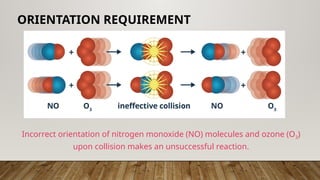
ORIENTATION REQUIREMENT
Incorrect orientation of nitrogen monoxide (NO) molecules and ozone (O3)
upon collision makes an unsuccessful reaction.
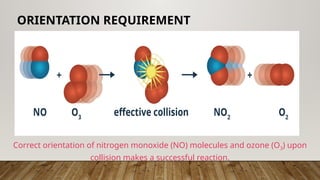
ORIENTATION REQUIREMENT
Correct orientation of nitrogen monoxide (NO) molecules and ozone (O3) upon
collision makes a successful reaction.
• The energy of molecules involved in a chemical reaction is
as important as their collision for a successful chemical
reaction to take place.
• Chemical reactions need a minimum energy requirement
for it to proceed.
• This minimum energy requirement is known as the
activation energy (Ea).
ENERGY REQUIREMENT
• It serves as the threshold for a chemical reaction to occur.
• If two reacting species collide with one another and the
energy of the collision is less than the Ea, then the
chemical reaction will not take place.
• If two reacting species collide with one another and the
energy of the collision is equal to or greater than the Ea,
then the chemical reaction will take place.
ACTIVATION ENERGY (EA)
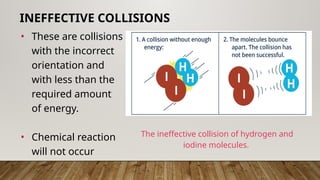
• These are collisions
with the incorrect
orientation and
with less than the
required amount
of energy.
• Chemical reaction
will not occur
INEFFECTIVE COLLISIONS
The ineffective collision of hydrogen and
iodine molecules.
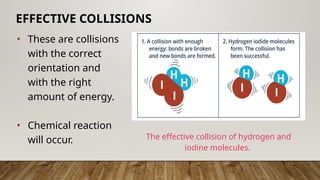
• These are collisions
with the correct
orientation and
with the right
amount of energy.
• Chemical reaction
will occur.
EFFECTIVE COLLISIONS
The effective collision of hydrogen and
iodine molecules.
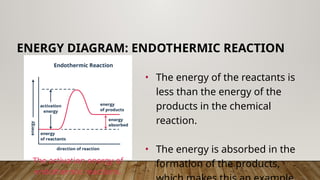
• The energy of the reactants is
less than the energy of the
products in the chemical
reaction.
• The energy is absorbed in the
formation of the products,
ENERGY DIAGRAM: ENDOTHERMIC REACTION
The activation energy of
endothermic reactions.
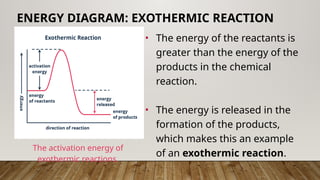
• The energy of the reactants is
greater than the energy of the
products in the chemical
reaction.
• The energy is released in the
formation of the products,
which makes this an example
of an exothermic reaction.
ENERGY DIAGRAM: EXOTHERMIC REACTION
The activation energy of
exothermic reactions.
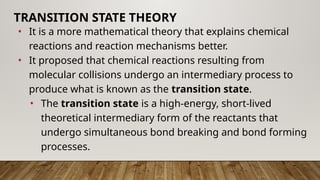
• It is a more mathematical theory that explains chemical
reactions and reaction mechanisms better.
• It proposed that chemical reactions resulting from
molecular collisions undergo an intermediary process to
produce what is known as the transition state.
• The transition state is a high-energy, short-lived
theoretical intermediary form of the reactants that
undergo simultaneous bond breaking and bond forming
processes.
TRANSITION STATE THEORY
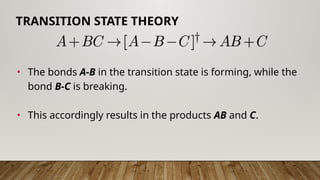
• The bonds A-B in the transition state is forming, while the
bond B-C is breaking.
• This accordingly results in the products AB and C.
TRANSITION STATE THEORY
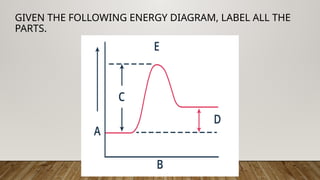
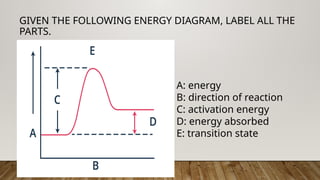
GIVEN THE FOLLOWING ENERGY DIAGRAM, LABEL ALL THE
PARTS.
GIVEN THE FOLLOWING ENERGY DIAGRAM, LABEL ALL THE
PARTS.
A: energy
B: direction of reaction
C: activation energy
D: energy absorbed
E: transition state
Chemical kinetics is a branch of chemistry that deals
with the mechanism and rates of chemical reactions.
1
According to the collision theory, a chemical reaction can
only occur upon following these conditions:
● the molecules should collide in order to react;
● the collision of molecules should be in the proper
orientation; and
● the colliding molecules should have enough energy
to react.
2
Chemical reactions happen when molecules or atoms
undergo effective collisions.
3
Endothermic reactions absorbs energy from the
surroundings. They are often associated with bond
breaking processes.
4
Exothermic reactions releases energy to the
surroundings. They are often associated with bond
forming processes.
5
The transition state theory proposed that chemical
reactions resulting from molecular collisions undergo an
intermediary process to produce what is known as the
transition state.
6
1. For a chemical reaction to occur, species must collide effectively with
the correct orientation and the right amount of energy.
2. The collision theory proposed that chemical reactions resulted from
molecular collisions produces transition state before producing the
final product.
3. Bond-forming processes are classified as endothermic reactions
because they absorb energy.
4. Chemical kinetics is an branch of chemistry that relies heavily on
experimental results and observations.
5. Chemical reactions occur if two reacting molecules collide with one
another and the energy of the collision is equal to or greater than the
inactivation energy.
WRITE TRUE IF THE FOLLOWING STATEMENT IS CORRECT. OTHERWISE,
WRITE FALSE.
COLLISION THEORY.powerpoint presentation

COLLISION THEORY.powerpoint presentation

  • 1.
  • 2.
    ● It isa branch of chemistry that deals with the mechanism and rates of chemical reactions. ● It can describe reaction mechanisms that explain how atoms or units of molecules combine to form products. ● It can also identify the formation of reaction intermediates that preliminarily form along the reaction course but are used up before the reaction is completely finished. CHEMICAL KINETICS
  • 3.
    ● It canalso tell how fast the whole series of reactions occur. ● It is highly empirical. ● It relies heavily on experimental data and results. CHEMICAL KINETICS
  • 4.
    • It isone of the first theories that explain reaction mechanisms and reaction rates. • The collision theory established how chemical changes initiate. • This theory was separately proposed by German chemist, Max Trautz, and British physical chemist, William Cudmore McCullagh Lewis, in 1916 and 1917, respectively. THE COLLISION THEORY
  • 5.
    According the thistheory, a chemical reaction can only occur upon following a specific set of conditions, namely: 1. the molecules should collide in order to react; 2. the collision of molecules should be in the proper orientation; and 3. the colliding molecules should hav enough energy to react. THE COLLISION THEORY
  • 6.
    • All moleculesare moving which in turn causes them to eventually collide with each other. • Solids vibrate in place. • Liquids slide past each other. • Gases are basically free to move in random directions. • According to the collision theory, for a certain chemical reaction to occur, the molecules of the reacting species should be colliding with one another. COLLISION REQUIREMENT
  • 7.
    • Collisions mayinvolve two or more kinds of molecules or atoms to complete a reaction. It can even be a single compound reacting with like molecules to form a new product. • Molecules or atoms that are very mobile have higher chances of colliding with other molecules. • The higher the number of participating units is, the greater is the chance of successful collisions. COLLISION REQUIREMENT
  • 8.
    ORIENTATION REQUIREMENT Incorrect orientationof nitrogen monoxide (NO) molecules and ozone (O3) upon collision makes an unsuccessful reaction.
  • 9.
    ORIENTATION REQUIREMENT Correct orientationof nitrogen monoxide (NO) molecules and ozone (O3) upon collision makes a successful reaction.
  • 10.
    • The energyof molecules involved in a chemical reaction is as important as their collision for a successful chemical reaction to take place. • Chemical reactions need a minimum energy requirement for it to proceed. • This minimum energy requirement is known as the activation energy (Ea). ENERGY REQUIREMENT
  • 11.
    • It servesas the threshold for a chemical reaction to occur. • If two reacting species collide with one another and the energy of the collision is less than the Ea, then the chemical reaction will not take place. • If two reacting species collide with one another and the energy of the collision is equal to or greater than the Ea, then the chemical reaction will take place. ACTIVATION ENERGY (EA)
  • 12.
    • These arecollisions with the incorrect orientation and with less than the required amount of energy. • Chemical reaction will not occur INEFFECTIVE COLLISIONS The ineffective collision of hydrogen and iodine molecules.
  • 13.
    • These arecollisions with the correct orientation and with the right amount of energy. • Chemical reaction will occur. EFFECTIVE COLLISIONS The effective collision of hydrogen and iodine molecules.
  • 14.
    • The energyof the reactants is less than the energy of the products in the chemical reaction. • The energy is absorbed in the formation of the products, ENERGY DIAGRAM: ENDOTHERMIC REACTION The activation energy of endothermic reactions.
  • 15.
    • The energyof the reactants is greater than the energy of the products in the chemical reaction. • The energy is released in the formation of the products, which makes this an example of an exothermic reaction. ENERGY DIAGRAM: EXOTHERMIC REACTION The activation energy of exothermic reactions.
  • 16.
    • It isa more mathematical theory that explains chemical reactions and reaction mechanisms better. • It proposed that chemical reactions resulting from molecular collisions undergo an intermediary process to produce what is known as the transition state. • The transition state is a high-energy, short-lived theoretical intermediary form of the reactants that undergo simultaneous bond breaking and bond forming processes. TRANSITION STATE THEORY
  • 17.
    • The bondsA-B in the transition state is forming, while the bond B-C is breaking. • This accordingly results in the products AB and C. TRANSITION STATE THEORY
  • 18.
    GIVEN THE FOLLOWINGENERGY DIAGRAM, LABEL ALL THE PARTS.
  • 19.
    GIVEN THE FOLLOWINGENERGY DIAGRAM, LABEL ALL THE PARTS. A: energy B: direction of reaction C: activation energy D: energy absorbed E: transition state
  • 20.
    Chemical kinetics isa branch of chemistry that deals with the mechanism and rates of chemical reactions. 1 According to the collision theory, a chemical reaction can only occur upon following these conditions: ● the molecules should collide in order to react; ● the collision of molecules should be in the proper orientation; and ● the colliding molecules should have enough energy to react. 2
  • 21.
    Chemical reactions happenwhen molecules or atoms undergo effective collisions. 3 Endothermic reactions absorbs energy from the surroundings. They are often associated with bond breaking processes. 4 Exothermic reactions releases energy to the surroundings. They are often associated with bond forming processes. 5
  • 22.
    The transition statetheory proposed that chemical reactions resulting from molecular collisions undergo an intermediary process to produce what is known as the transition state. 6
  • 23.
    1. For achemical reaction to occur, species must collide effectively with the correct orientation and the right amount of energy. 2. The collision theory proposed that chemical reactions resulted from molecular collisions produces transition state before producing the final product. 3. Bond-forming processes are classified as endothermic reactions because they absorb energy. 4. Chemical kinetics is an branch of chemistry that relies heavily on experimental results and observations. 5. Chemical reactions occur if two reacting molecules collide with one another and the energy of the collision is equal to or greater than the inactivation energy. WRITE TRUE IF THE FOLLOWING STATEMENT IS CORRECT. OTHERWISE, WRITE FALSE.