Seminar Project 2
Submitted by Rakhi Shyamlal Vishwakarma
16GRT209
Mtech Green Technology
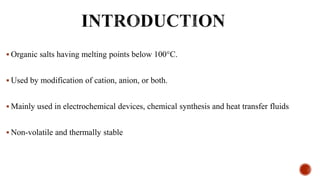
 Organic salts having melting points below 100°C.
 Used by modification of cation, anion, or both.
 Mainly used in electrochemical devices, chemical synthesis and heat transfer fluids
 Non-volatile and thermally stable
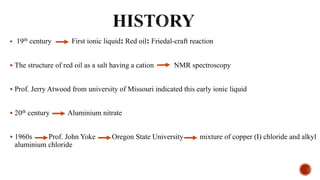
 19th century First ionic liquid: Red oil: Friedal-craft reaction
 The structure of red oil as a salt having a cation NMR spectroscopy
 Prof. Jerry Atwood from university of Missouri indicated this early ionic liquid
 20th century Aluminium nitrate
 1960s Prof. John Yoke Oregon State University mixture of copper (I) chloride and alkyl
aluminium chloride
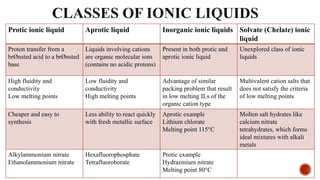
Protic ionic liquid Aprotic liquid Inorganic ionic liquids Solvate (Chelate) ionic
liquid
Proton transfer from a
brØnsted acid to a brØnsted
base
Liquids involving cations
are organic molecular ions
(contains no acidic protons)
Present in both protic and
aprotic ionic liquid
Unexplored class of ionic
liquids
High fluidity and
conductivity
Low melting points
Low fluidity and
conductivity
High melting points
Advantage of similar
packing problem that result
in low melting ILs of the
organic cation type
Multivalent cation salts that
does not satisfy the criteria
of low melting points
Cheaper and easy to
synthesis
Less ability to react quickly
with fresh metallic surface
Aprotic example
Lithium chlorate
Melting point 115°C
Molten salt hydrates like
calcium nitrate
tetrahydrates, which forms
ideal mixtures with alkali
metals
Alkylammonium nitrate
Ethanolammonium nitrate
Hexafluorophosphate
Tetrafluoroborate
Protic example
Hydrazinium nitrate
Melting point 80°C
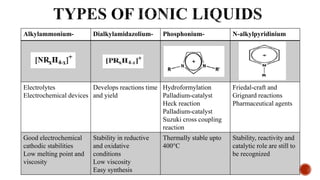
Alkylammonium- Dialkylamidazolium- Phosphonium- N-alkylpyridinium
Electrolytes
Electrochemical devices
Develops reactions time
and yield
Hydroformylation
Palladium-catalyst
Heck reaction
Palladium-catalyst
Suzuki cross coupling
reaction
Friedal-craft and
Grignard reactions
Pharmaceutical agents
Good electrochemical
cathodic stabilities
Low melting point and
viscosity
Stability in reductive
and oxidative
conditions
Low viscosity
Easy synthesis
Thermally stable upto
400°C
Stability, reactivity and
catalytic role are still to
be recognized
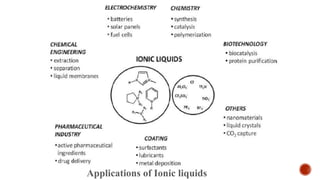
Applications of Ionic liquids
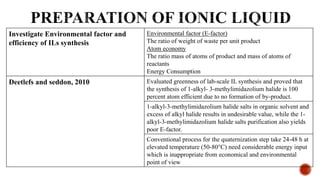
Investigate Environmental factor and
efficiency of ILs synthesis
Environmental factor (E-factor)
The ratio of weight of waste per unit product
Atom economy
The ratio mass of atoms of product and mass of atoms of
reactants
Energy Consumption
Deetlefs and seddon, 2010 Evaluated greenness of lab-scale IL synthesis and proved that
the synthesis of 1-alkyl- 3-methylimidazolium halide is 100
percent atom efficient due to no formation of by-product.
1-alkyl-3-methylimidazolium halide salts in organic solvent and
excess of alkyl halide results in undesirable value, while the 1-
alkyl-3-methylimidazolium halide salts purification also yields
poor E-factor.
Conventional process for the quaternization step take 24-48 h at
elevated temperature (50-80°C) need considerable energy input
which is inappropriate from economical and environmental
point of view
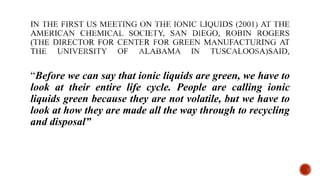
“Before we can say that ionic liquids are green, we have to
look at their entire life cycle. People are calling ionic
liquids green because they are not volatile, but we have to
look at how they are made all the way through to recycling
and disposal”
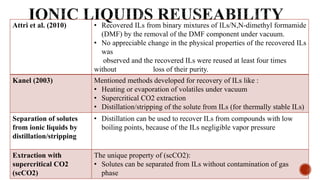
Attri et al. (2010) • Recovered ILs from binary mixtures of ILs/N,N-dimethyl formamide
(DMF) by the removal of the DMF component under vacuum.
• No appreciable change in the physical properties of the recovered ILs
was
observed and the recovered ILs were reused at least four times
without loss of their purity.
Kanel (2003) Mentioned methods developed for recovery of ILs like :
• Heating or evaporation of volatiles under vacuum
• Supercritical CO2 extraction
• Distillation/stripping of the solute from ILs (for thermally stable ILs)
Separation of solutes
from ionic liquids by
distillation/stripping
• Distillation can be used to recover ILs from compounds with low
boiling points, because of the ILs negligible vapor pressure
Extraction with
supercritical CO2
(scCO2)
The unique property of (scCO2):
• Solutes can be separated from ILs without contamination of gas
phase
bmpy][N(Tf)2 : 1-butyl-3-methylpyridinium bis(trifluoromethylsulfonyl)imide
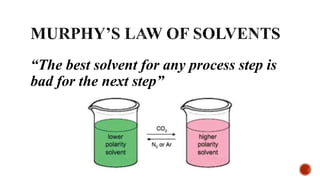
“The best solvent for any process step is
bad for the next step”
• Helps in organic synthesis and separation by eliminating the demand to remove and
change solvents after reaction steps
• Enables the application of same solvent for several reaction or separation steps
• Application of solvents is a challenge in chemical industries for green chemical
processing
• Using different solvents to solvate the processing steps increases costs
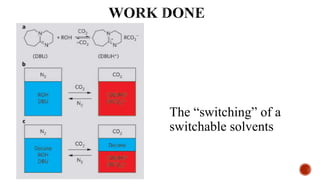
The “switching” of a
switchable solvents
Synthesize of switchable ionic liquids (SWILs) using 2,2,2-Trifluoroethanol
(TFE;99%),2,2,3,3-tetrafluoro-1-propanol(TFP;99%),1,8-diazabicyclo-[5.4.0]-undec-
7-ene(DBU;98%),1,1,3,3-tetramethyguanidine(TMG;99%)and phenolphthalein (99%),
Nile Red (99.5%), analytical grade heptane and CO2.
Switchable polarity images of four switchable polarity of ionic liquids with a CO2
as the gas trigger: (a)[DBUH][TFE],(b)[TMGH][TFE],(c)[DBUH][TFP], and
(d) [TMGH][TFP].
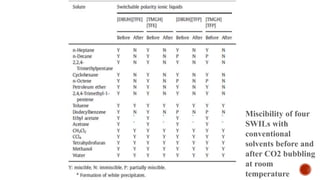
Miscibility of four
SWILs with
conventional
solvents before and
after CO2 bubbling
at room
temperature
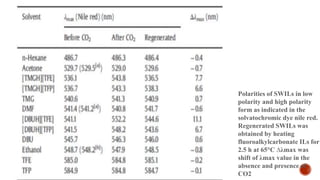
Polarities of SWILs in low
polarity and high polarity
form as indicated in the
solvatochromic dye nile red.
Regenerated SWILs was
obtained by heating
fluoroalkylcarbonate ILs for
2.5 h at 65°C ∆λmax was
shift of λmax value in the
absence and presence of
CO2
Prepared as two-liquid component mixtures, either 1,8-
diazabicyclo-[5.4.0]-undec-7-ene DBU and an alcohol shown
in figure below or DBU and a primary amine
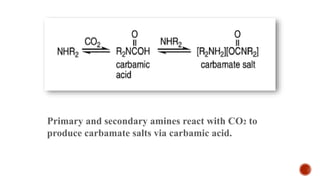
Primary and secondary amines react with CO2 to
produce carbamate salts via carbamic acid.
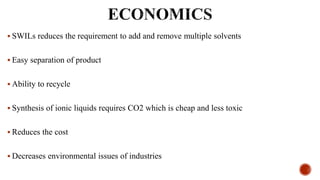
 SWILs reduces the requirement to add and remove multiple solvents
 Easy separation of product
 Ability to recycle
 Synthesis of ionic liquids requires CO2 which is cheap and less toxic
 Reduces the cost
 Decreases environmental issues of industries
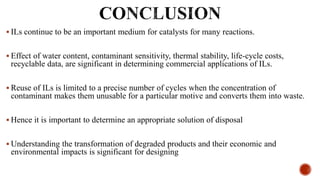
 ILs continue to be an important medium for catalysts for many reactions.
 Effect of water content, contaminant sensitivity, thermal stability, life-cycle costs,
recyclable data, are significant in determining commercial applications of ILs.
 Reuse of ILs is limited to a precise number of cycles when the concentration of
contaminant makes them unusable for a particular motive and converts them into waste.
 Hence it is important to determine an appropriate solution of disposal
 Understanding the transformation of degraded products and their economic and
environmental impacts is significant for designing
 Abu-eishah, S.I., 2010. Ionic Liquids Recycling for Reuse. Ion. Liq. - Classes Prop. 239–272.
doi:10.5772/853
 Austen Angell, C., Ansari, Y., Zhao, Z., 2012. Ionic Liquids: Past, present and future. Faraday Discuss.
154, 9–27. doi:10.1039/C1FD00112D
 Chen, Y., Cao, Y., Shi, Y., Xue, Z., Mu, T., 2012. Quantitative research on the vaporization and
decomposition of [EMIM][Tf 2N] by thermogravimetric analysis-mass spectrometry. Ind. Eng. Chem.
Res. 51, 7418–7427.
 Cvjetko Bubalo, M., Radošević, K., Radojčić Redovniković, I., Halambek, J., Gaurina Srček, V., 2014. A
brief overview of the potential environmental hazards of ionic liquids. Ecotoxicol. Environ. Saf. 99, 1–
12. doi:10.1016/j.ecoenv.2013.10.019
 Docherty, K.M., Dixon, J.K., Kulpa, C.F., 2007. Biodegradability of imidazolium and pyridinium ionic
liquids by an activated sludge microbial community. Biodegradation 18, 481–493. doi:10.1007/s10532-
006-9081-7
 Ghandi, K., 2014. A Review of Ionic Liquids , Their Limits and Applications. Green Sustain. Chem. 4,
44–53. doi:10.4236/gsc.2014.41008
 Greaves, T.L., Drummond, C.J., 2008. Protic ionic liquids: Properties and applications. Chem.
Rev. 108, 206–237. doi:10.1021/cr068040u
 Hart, R., Pollet, P., Hahne, D.J., John, E., Llopis-Mestre, V., Blasucci, V., Huttenhower, H., Leitner,
W., Eckert, C.A., Liotta, C.L., 2010. Benign coupling of reactions and separations with reversible
ionic liquids. Tetrahedron 66, 1082–1090. doi:10.1016/j.tet.2009.11.014
 Henderson, L.C., Byrne, N., 2011. Rapid and efficient protic ionic liquid-mediated pinacol
rearrangements under microwave irradiation. Green Chem. 13, 813–816. doi:10.1039/c0gc00916d
 Ilisson, M., Tomson, K., Selyutina, A., Türk, S., 2015. Synthetic Communications : An International
Journal for Rapid Communication of Synthetic Organic Chemistry Synthesis of Novel Saccharide
Hydrazones 37–41. doi:10.1080/00397911.2015.1021425
 Jessop, P.G., Mercer, S.M., Heldebrant, D.J., 2012. CO 2 -triggered switchable solvents, surfactants,
and other materials 7240–7253. doi:10.1039/c2ee02912j
 Jessop, P.P.G., Heldebrant, D.J.D., Li, X., Eckert, C.A.C., Liotta, C.C.L., 2005. Green chemistry:
Reversible nonpolar-to-polar solvent. Nature 436, 1102. doi:10.1038/nature4361101a
 Lam Phan, Jeremy R. Andreatta, Loel K. Horvey, Colin F. Edie, Aimée-Lee Luco, Anish
Mirchandani, Donald J. Darensbourg, and, Philip G. Jessop*, 2007. Switchable-Polarity Solvents
Prepared with a Single Liquid Component 127–132. doi:10.1021/JO7017697
 Lee, E.H., Cha, S.W., Dharma, M.M., Choe, Y., Ahn, J.Y., Park, D.W., 2007. Cycloaddition of carbon
dioxide to epichlorohydrin using ionic liquid as a catalyst. Korean J. Chem. Eng. 24, 547–550.
doi:10.1007/s11814-007-0097-4
 Liu, Z., Hu, P., Meng, X., Zhang, R., Yue, H., Xu, C., Hu, Y., 2014. Synthesis and properties of
switchable polarity ionic liquids based on organic superbases and fluoroalcohols. Chem. Eng. Sci.
108, 176–182. doi:10.1016/j.ces.2013.12.040
 Olivier, H., 1999. Recent developments in the use of non-aqueous ionic liquids for two-phase
catalysis. J. Mol. Catal. A Chem. 146, 285–289. doi:10.1016/S1381-1169(99)00114-4
 Schaefer, G.W., Eckert, C.A., 2010. Switchable Solvents: A Combination of Reaction & Separations.
Tower J. - Spring 2010 71–77.
 Sheldon, R. a., 2007. The E Factor: fifteen years on. Green Chem. 9, 1273. doi:10.1039/b713736m
 Stepnowski, P., Zaleska, A., 2005. Comparison of different advanced oxidation processes for the
degradation of room temperature ionic liquids. J. Photochem. Photobiol. A Chem. 170, 45–50.
doi:10.1016/j.jphotochem.2004.07.019
 Taige, M., Hilbert, D., Schubert, T.J.S., 2012. Mixtures of Ionic Liquids as Possible Electrolytes for
Lithium Ion Batteries. Zeitschrift für Phys. Chemie 226, 129–139. doi:10.1524/zpch.2012.0161
 Wilkes, J.S., 2002. A Short History of Ionic Liquids - From Molten Salts to Neoteric Solvents. Green
Chem. 4, 73–80. doi:10.1039/b110838g
 Yoshizawa, M., Xu, W., Angell, C.A., 2003. Ionic liquids by proton transfer: vapor pressure,
conductivity, and the relevance of DeltapKa from aqueous solutions. J. Am. Chem. Soc. 125, 15411–
15419. doi:10.1021/ja035783d

Ionic liquid with switchable polarity

  • 1.
    Seminar Project 2 Submittedby Rakhi Shyamlal Vishwakarma 16GRT209 Mtech Green Technology
  • 2.
     Organic saltshaving melting points below 100°C.  Used by modification of cation, anion, or both.  Mainly used in electrochemical devices, chemical synthesis and heat transfer fluids  Non-volatile and thermally stable
  • 3.
     19th centuryFirst ionic liquid: Red oil: Friedal-craft reaction  The structure of red oil as a salt having a cation NMR spectroscopy  Prof. Jerry Atwood from university of Missouri indicated this early ionic liquid  20th century Aluminium nitrate  1960s Prof. John Yoke Oregon State University mixture of copper (I) chloride and alkyl aluminium chloride
  • 4.
    Protic ionic liquidAprotic liquid Inorganic ionic liquids Solvate (Chelate) ionic liquid Proton transfer from a brØnsted acid to a brØnsted base Liquids involving cations are organic molecular ions (contains no acidic protons) Present in both protic and aprotic ionic liquid Unexplored class of ionic liquids High fluidity and conductivity Low melting points Low fluidity and conductivity High melting points Advantage of similar packing problem that result in low melting ILs of the organic cation type Multivalent cation salts that does not satisfy the criteria of low melting points Cheaper and easy to synthesis Less ability to react quickly with fresh metallic surface Aprotic example Lithium chlorate Melting point 115°C Molten salt hydrates like calcium nitrate tetrahydrates, which forms ideal mixtures with alkali metals Alkylammonium nitrate Ethanolammonium nitrate Hexafluorophosphate Tetrafluoroborate Protic example Hydrazinium nitrate Melting point 80°C
  • 5.
    Alkylammonium- Dialkylamidazolium- Phosphonium-N-alkylpyridinium Electrolytes Electrochemical devices Develops reactions time and yield Hydroformylation Palladium-catalyst Heck reaction Palladium-catalyst Suzuki cross coupling reaction Friedal-craft and Grignard reactions Pharmaceutical agents Good electrochemical cathodic stabilities Low melting point and viscosity Stability in reductive and oxidative conditions Low viscosity Easy synthesis Thermally stable upto 400°C Stability, reactivity and catalytic role are still to be recognized
  • 6.
  • 7.
    Investigate Environmental factorand efficiency of ILs synthesis Environmental factor (E-factor) The ratio of weight of waste per unit product Atom economy The ratio mass of atoms of product and mass of atoms of reactants Energy Consumption Deetlefs and seddon, 2010 Evaluated greenness of lab-scale IL synthesis and proved that the synthesis of 1-alkyl- 3-methylimidazolium halide is 100 percent atom efficient due to no formation of by-product. 1-alkyl-3-methylimidazolium halide salts in organic solvent and excess of alkyl halide results in undesirable value, while the 1- alkyl-3-methylimidazolium halide salts purification also yields poor E-factor. Conventional process for the quaternization step take 24-48 h at elevated temperature (50-80°C) need considerable energy input which is inappropriate from economical and environmental point of view
  • 8.
    “Before we cansay that ionic liquids are green, we have to look at their entire life cycle. People are calling ionic liquids green because they are not volatile, but we have to look at how they are made all the way through to recycling and disposal”
  • 9.
    Attri et al.(2010) • Recovered ILs from binary mixtures of ILs/N,N-dimethyl formamide (DMF) by the removal of the DMF component under vacuum. • No appreciable change in the physical properties of the recovered ILs was observed and the recovered ILs were reused at least four times without loss of their purity. Kanel (2003) Mentioned methods developed for recovery of ILs like : • Heating or evaporation of volatiles under vacuum • Supercritical CO2 extraction • Distillation/stripping of the solute from ILs (for thermally stable ILs) Separation of solutes from ionic liquids by distillation/stripping • Distillation can be used to recover ILs from compounds with low boiling points, because of the ILs negligible vapor pressure Extraction with supercritical CO2 (scCO2) The unique property of (scCO2): • Solutes can be separated from ILs without contamination of gas phase
  • 11.
    bmpy][N(Tf)2 : 1-butyl-3-methylpyridiniumbis(trifluoromethylsulfonyl)imide
  • 12.
    “The best solventfor any process step is bad for the next step”
  • 13.
    • Helps inorganic synthesis and separation by eliminating the demand to remove and change solvents after reaction steps • Enables the application of same solvent for several reaction or separation steps • Application of solvents is a challenge in chemical industries for green chemical processing • Using different solvents to solvate the processing steps increases costs
  • 14.
    The “switching” ofa switchable solvents
  • 15.
    Synthesize of switchableionic liquids (SWILs) using 2,2,2-Trifluoroethanol (TFE;99%),2,2,3,3-tetrafluoro-1-propanol(TFP;99%),1,8-diazabicyclo-[5.4.0]-undec- 7-ene(DBU;98%),1,1,3,3-tetramethyguanidine(TMG;99%)and phenolphthalein (99%), Nile Red (99.5%), analytical grade heptane and CO2.
  • 16.
    Switchable polarity imagesof four switchable polarity of ionic liquids with a CO2 as the gas trigger: (a)[DBUH][TFE],(b)[TMGH][TFE],(c)[DBUH][TFP], and (d) [TMGH][TFP].
  • 17.
    Miscibility of four SWILswith conventional solvents before and after CO2 bubbling at room temperature
  • 18.
    Polarities of SWILsin low polarity and high polarity form as indicated in the solvatochromic dye nile red. Regenerated SWILs was obtained by heating fluoroalkylcarbonate ILs for 2.5 h at 65°C ∆λmax was shift of λmax value in the absence and presence of CO2
  • 19.
    Prepared as two-liquidcomponent mixtures, either 1,8- diazabicyclo-[5.4.0]-undec-7-ene DBU and an alcohol shown in figure below or DBU and a primary amine
  • 20.
    Primary and secondaryamines react with CO2 to produce carbamate salts via carbamic acid.
  • 21.
     SWILs reducesthe requirement to add and remove multiple solvents  Easy separation of product  Ability to recycle  Synthesis of ionic liquids requires CO2 which is cheap and less toxic  Reduces the cost  Decreases environmental issues of industries
  • 22.
     ILs continueto be an important medium for catalysts for many reactions.  Effect of water content, contaminant sensitivity, thermal stability, life-cycle costs, recyclable data, are significant in determining commercial applications of ILs.  Reuse of ILs is limited to a precise number of cycles when the concentration of contaminant makes them unusable for a particular motive and converts them into waste.  Hence it is important to determine an appropriate solution of disposal  Understanding the transformation of degraded products and their economic and environmental impacts is significant for designing
  • 23.
     Abu-eishah, S.I.,2010. Ionic Liquids Recycling for Reuse. Ion. Liq. - Classes Prop. 239–272. doi:10.5772/853  Austen Angell, C., Ansari, Y., Zhao, Z., 2012. Ionic Liquids: Past, present and future. Faraday Discuss. 154, 9–27. doi:10.1039/C1FD00112D  Chen, Y., Cao, Y., Shi, Y., Xue, Z., Mu, T., 2012. Quantitative research on the vaporization and decomposition of [EMIM][Tf 2N] by thermogravimetric analysis-mass spectrometry. Ind. Eng. Chem. Res. 51, 7418–7427.  Cvjetko Bubalo, M., Radošević, K., Radojčić Redovniković, I., Halambek, J., Gaurina Srček, V., 2014. A brief overview of the potential environmental hazards of ionic liquids. Ecotoxicol. Environ. Saf. 99, 1– 12. doi:10.1016/j.ecoenv.2013.10.019  Docherty, K.M., Dixon, J.K., Kulpa, C.F., 2007. Biodegradability of imidazolium and pyridinium ionic liquids by an activated sludge microbial community. Biodegradation 18, 481–493. doi:10.1007/s10532- 006-9081-7  Ghandi, K., 2014. A Review of Ionic Liquids , Their Limits and Applications. Green Sustain. Chem. 4, 44–53. doi:10.4236/gsc.2014.41008
  • 24.
     Greaves, T.L.,Drummond, C.J., 2008. Protic ionic liquids: Properties and applications. Chem. Rev. 108, 206–237. doi:10.1021/cr068040u  Hart, R., Pollet, P., Hahne, D.J., John, E., Llopis-Mestre, V., Blasucci, V., Huttenhower, H., Leitner, W., Eckert, C.A., Liotta, C.L., 2010. Benign coupling of reactions and separations with reversible ionic liquids. Tetrahedron 66, 1082–1090. doi:10.1016/j.tet.2009.11.014  Henderson, L.C., Byrne, N., 2011. Rapid and efficient protic ionic liquid-mediated pinacol rearrangements under microwave irradiation. Green Chem. 13, 813–816. doi:10.1039/c0gc00916d  Ilisson, M., Tomson, K., Selyutina, A., Türk, S., 2015. Synthetic Communications : An International Journal for Rapid Communication of Synthetic Organic Chemistry Synthesis of Novel Saccharide Hydrazones 37–41. doi:10.1080/00397911.2015.1021425  Jessop, P.G., Mercer, S.M., Heldebrant, D.J., 2012. CO 2 -triggered switchable solvents, surfactants, and other materials 7240–7253. doi:10.1039/c2ee02912j  Jessop, P.P.G., Heldebrant, D.J.D., Li, X., Eckert, C.A.C., Liotta, C.C.L., 2005. Green chemistry: Reversible nonpolar-to-polar solvent. Nature 436, 1102. doi:10.1038/nature4361101a  Lam Phan, Jeremy R. Andreatta, Loel K. Horvey, Colin F. Edie, Aimée-Lee Luco, Anish Mirchandani, Donald J. Darensbourg, and, Philip G. Jessop*, 2007. Switchable-Polarity Solvents Prepared with a Single Liquid Component 127–132. doi:10.1021/JO7017697
  • 25.
     Lee, E.H.,Cha, S.W., Dharma, M.M., Choe, Y., Ahn, J.Y., Park, D.W., 2007. Cycloaddition of carbon dioxide to epichlorohydrin using ionic liquid as a catalyst. Korean J. Chem. Eng. 24, 547–550. doi:10.1007/s11814-007-0097-4  Liu, Z., Hu, P., Meng, X., Zhang, R., Yue, H., Xu, C., Hu, Y., 2014. Synthesis and properties of switchable polarity ionic liquids based on organic superbases and fluoroalcohols. Chem. Eng. Sci. 108, 176–182. doi:10.1016/j.ces.2013.12.040  Olivier, H., 1999. Recent developments in the use of non-aqueous ionic liquids for two-phase catalysis. J. Mol. Catal. A Chem. 146, 285–289. doi:10.1016/S1381-1169(99)00114-4  Schaefer, G.W., Eckert, C.A., 2010. Switchable Solvents: A Combination of Reaction & Separations. Tower J. - Spring 2010 71–77.  Sheldon, R. a., 2007. The E Factor: fifteen years on. Green Chem. 9, 1273. doi:10.1039/b713736m  Stepnowski, P., Zaleska, A., 2005. Comparison of different advanced oxidation processes for the degradation of room temperature ionic liquids. J. Photochem. Photobiol. A Chem. 170, 45–50. doi:10.1016/j.jphotochem.2004.07.019
  • 26.
     Taige, M.,Hilbert, D., Schubert, T.J.S., 2012. Mixtures of Ionic Liquids as Possible Electrolytes for Lithium Ion Batteries. Zeitschrift für Phys. Chemie 226, 129–139. doi:10.1524/zpch.2012.0161  Wilkes, J.S., 2002. A Short History of Ionic Liquids - From Molten Salts to Neoteric Solvents. Green Chem. 4, 73–80. doi:10.1039/b110838g  Yoshizawa, M., Xu, W., Angell, C.A., 2003. Ionic liquids by proton transfer: vapor pressure, conductivity, and the relevance of DeltapKa from aqueous solutions. J. Am. Chem. Soc. 125, 15411– 15419. doi:10.1021/ja035783d