Chemical Kinetics
Reaction Mechanisms, Phases
and the
Movement of Molecules
PHASE DIAGRAMS (N. AND I.)
■New and Improved!
■Phase Change Diagrams only account for
temperature
■New Phase Diagrams account for
Pressure, as well.
■Terms:
■Critical Point
■Triple Point
*This change comes as a result of our study of Gas Laws!
PHASE DIAGRAMS
Temperature →
Pressure
→
A
B
C
D
Solid
Liquid
Vapor
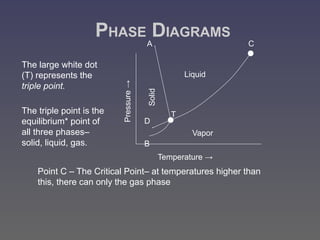
The large white dot
(T) represents the
triple point.
The triple point is the
equilibrium* point of
all three phases–
solid, liquid, gas.
Point C – The Critical Point– at temperatures higher than
this, there can only the gas phase
T
MORE TRIPLE POINT
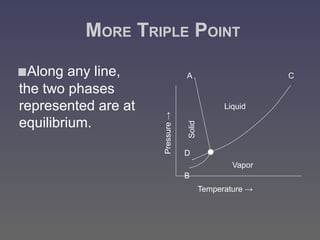
■Along any line,
the two phases
represented are at
equilibrium.
Temperature →
Pressure
→
A
B
C
D
Solid
Liquid
Vapor
CHEMICAL LINE UP
Temperature →
Pressure
→
A
B
C
D
Solid
Liquid
Vapor
Each Line has a “meaning”:
Tp
-A: Solid-Liquid Eq.
Tp
-B: Solid-Gas Eq.
Tp
-C: Liquid-Solid Eq.
Tp
-D: Supercooled H2O
EQUILIBRIUM
■The state in which two or more processes
are occurring at the same time:
■Phase Changes
■As one molecule melts, another freezes
■As one molecule boils, another condenses
■Triple Point:
■ALL of the phase changes occur at the SAME time, at
Equilibrium
RELATIONSHIPS (FOR WATER)
■1 atm:
■BP = 100 C
■FP = 0.016 C
(273.16K)
■0.0063 atm:
■BP = 0.0098 C
■FP = 0.0098 C
Temperature →
Pressure
→
A
B
C
D
Solid
Liquid
V
a
p
o
r
1 atm
100
C
0.0063 atm
0.0098
C
0
C
High-Density
Ice
1000 atm
SOME IDEAS TO CONSIDER
■Adding pressure causes a shift to the more
dense phase.
■Adding temp. causes a shift to the less
dense phase
■“Gibbs Phase Rule”
WATER’S UNIQUE PROPERTY
■What is the most dense phase of water?
Gibbs’ Phase Rule explains why ice skates work the way they do!!!
The blade of a skate provides pressure to the ice, which should be
near 0 C
This causes a shift to the more dense phase.
This provides a film of water which allows the skate to slide!
OTHER PHASE CHANGE GRAPHS
■Carbon
Dioxide
■What can this
tell us about
CO2
?
Temperature →
Pressure
→
Solid
Liquid
Vapor
1 atm
0 C
THERMODYNAMICS
■The study of heat/energy as it moves
through a system
■Phase changes: Melting = Freezing?
■Yes-- in one, energy is being added (melting); in the other,
it’s being taken away (freezing)
■Calculated using Calorimetry
■Uses masses and temperature changes to
determine energy flow
CALORIMETRY
■Energy can be calculated using the
formula:
Q = m x c x ∆T
Where:
Q = energy (joules, kilojoules, or calories)
m = mass in g
c = Specific Heat (more)
∆T = Change in Temperature (K or o
C)
SPECIFIC HEAT
■Term given for the amount of energy
needed to raise 1 g of a substance a given
temperature:
■For water, c = 1 cal / g o
C
■Also c = 4.18 j / g o
C
■From which we can deduce:
■1 cal = 4.18 j
FOR ICE? STEAM?
■Ice’s Specific Heat:
■2.09 j/g o
C
■Steam’s Specific Heat:
■1.84 j/g o
C
ENERGY OF A PHASE CHANGE
■Heat of Fusion: The amount of heat
required to MELT a solid;
■Also, the heat given off by freezing a liquid
■For H2
O: 333 j / g
■Heat of Vaporization: The amount of heat
needed to BOIL a liquid;
■Also, the heat given off by condensing a gas
■For H2
O: 2230 j / g
Chemical Kinetics
WE KNOW:
■Chemical Bonds form due to electron
movement to a state of lower energy.
■NOW: we begin learning about the forces
that drive reactions.
CHEMICAL KINETICS HAS FOUR
PRIMARY PARTS:
■Kinetic Molecular Theory
■Reaction Mechanisms
■Reaction Rates
■Phases and Phase Changes (already started!)
KINETIC MOLECULAR THEORY
■Says that all particles are moving at all
times
■Also called collision theory
■“Proven” (sorta) through our studies of
gases.
POSTULATES OF KMT
■All molecules are extremely small in mass.
■All molecules are in constant motion.
■There are so many particles, even in a
small sample, that we can use statistics
(mean, median, mode, etc.) to make
generalizations about particle movement.
MORE POSTULATES OF KMT
■Collisions are perfectly elastic (all energy
remains kinetic)
■The kinetic energy of the system is directly
related to the temperature (higher temp. =
more E!)
■… So what?
WHAT IT MEANS:
■Heat is a function of the energy of
motion of particles
■When something gets hot, its particles are
moving faster than before.
■Everything, whether you like it or not, is
moving (at a molecular level).
■Chemical reactions and interactions
are all a result of chemicals colliding with
one another… which leads us to…
REACTION MECHANISMS
■Chemical Kinetic Theory says that NO
reaction can occur without the effective
collision of two or more molecules.
■Contact
■Electron Clouds Must “touch”
■Proper Alignment
■Molecules Must Align correctly in order to react
■High Enough Energy to Begin Reacting
■Activation E!
■This WHOLE concept is called:
COLLISION THEORY
REACTION MECHANISMS
■Are defined as the underlying action in a
chemical reaction
■2C8
H18
+ 25 O2
16CO2
+ 18 H2
O
■What are the odds that both Octanes and ALL 25
O2
collide at the same time?
■Problem: this is a highly exothermic reaction,
rapid reaction-- How can this be?
ANSWER: ACTIVATED COMPLEXES
■Molecules that exist ONLY DURING a
reaction
■Parts of molecules that have either:
■Broken apart from reactants
■Formed together to make products
■CO and OH (0) exist during this reaction,
among others.
■Act. Complexes Video
SO WHAT?
■If we agree that kinetic theory is true,
and…
■Activated Complexes exist, then…
■We can control how fast some chemical
reactions occur.
RATE DETERMINING STEP
■Activated Complexes say that reactions
occur in steps.
■Some steps are slower than others, which
limit how fast a reaction can occur.
■Video here
REACTION RATES
■Demonstration Reaction:
■Zn + NH4
NO3
ZnO + N2
+ H2
O
■Slow Reaction was Changed to a quick one!
■Reaction Rate can be Affected!
■Slow Rate: Heat given off
■Fast Rate: EXPLOSION!!
■Watch this guy…
FACTORS AFFECTING REACTION
RATE
■There are FOUR you need to know:
■Nature of the Reactants
■Temperature of the System
■Concentration of Reactants and/or Products
■Catalysts
NATURE OF REACTANTS
■Depends on what types of things are
being reacted.
■Primarily a measure of the reactivity of
the involved chemicals.
■The more reactive each participant, the more
quickly the reaction occurs.
■Reactivity increases as E! increases
■Affects the number of effective collisions
■Includes Phase Differences: More later
TEMPERATURE
■In a vast majority of Reactions, a
higher temp. Results in a faster
reaction
■An increase in effective collisions from
having higher E! available
■To effectively deliver temperature:
■Add Heat: Fire, Sun, etc.
■Add H2
O: Has a high Specific Heat
CONCENTRATION AND REACTION
RATE
■An increase in the Conc. of Reactants=
Faster Reaction
■An increase in the Conc. of Products=
Slower Reaction
■Think of a Jr. High dance…
CONCENTRATION AND REACTION
RATE (CONTINUED)
■Surface Area Increase = An Increase in
Conc.
■More Molecules Available to Collide
■Phases have variable surface area*:
■Liquid-Liquid
■Liquid-Gas (bubbling)
■Gas-Gas
■Liquid-Solid
■Gas-Solid
■Solid-Solid
CATALYSTS AND REACTION RATE
■Catalysts always increase reaction
rate.
■Defined:
■Chemicals that act to speed up a reaction
without being used up themselves in the
reaction.
■We do not fully understand the function
of Catalysts
■Catalysts MAY break down during a
reaction-- but will always re-form by the
end of it.
REVERSIBLE REACTIONS
■Chemical Reactions that can occur in
either direction in nature.
■Under certain circumstances, reactants
become products
■Under different circumstances, products
turn back into reactants
■Can (and will) achieve Equilibrium
A + B C + D
Vid Here
LECHATELIER’S PRINCIPLE
■LeChatelier said that a reversible reaction
can be affected by adding a stress.
■Stresses include:
■Concentration of Chemicals
■Temperature
■Addition of a Catalyst
LECHATELIER’S RESULTS
■Concentration of Chemicals
■More reactant added
■Shifts reaction to the products side
■More product added
■Shifts reaction to the reactants side
■Temperature
■Increasing temp causes:
■Exothermic reactions to move toward reactants
■Endothermic reactions to move towards products
LAST FOR LECHATELIER
■A Catalyst will ALWAYS move a reaction
towards the products side
■Catalysts always act to speed up reactions
CONTROLLING REACTIONS IN THE FIRST
PLACE?
■We can control how fast reactions take place.
■We know that collisions are the root of all
chemical reactions.
■We know that particles are in constant motion.
■Can we make a reaction occur? Stop a reaction
from occurring?
CONTROLLING CHEMICAL REACTIONS
■It is possible to prevent reactions from
occurring, and it is possible to make
reactions occur that normally wouldn’t:
■Activation Energy
■Enthalpy and Entropy
ACTIVATION ENERGY
■The Energy Required to START a
Chemical Reaction
■E! act (abbr.)
■Examples: Gasoline; Ba(OH)2
+ NH4
Cl
■Can be shown on an potential E! Graph
■Without enough E!, no reaction will
occur.
REACTION RATE FORCES
■Additionally, nature controls whether or
not reactions through two forces:
■Enthalpy, or ΔH
■The total amount of energy in an object/chemical
■Entropy, or ΔS
■The amount of disorder in an object or chemical
WHAT NATURE WANTS…
■Nature wants:
■Energy to be given off to the universe
■An decrease in ∆H (- ∆H)
■Entropy to increase
■An increase in ∆S (+ ∆S)
PREDICTING REACTION OCCURRENCE
■Given the ΔH and ΔS of a system, you can
predict if a reaction will occur.
■If ΔH is negative and:
ΔS is Positive, the reaction will occur
ΔS is Negative, the reaction will occur if:
ΔH has a greater absolute value than ΔS
■If ΔS is positive and:
ΔH is positive, the reaction will occur if:
ΔS has the larger absolute value
MORE PREDICITING
■If ΔH is positive and ΔS is negative the
reaction will never occur.
■Although not “the whole story,” phases are
related to ΔH and ΔS.
PHASES AND FORCES
■Recall:
Solids: Very Low ΔS, Very Low ΔH
Orderly, low E!
Liquids: Low ΔS, Low H
Semi-Orderly, moderate E!
Gases: High ΔS, High ΔH
Disorderly, high E!
Plasma: Very High ΔS, Very High ΔH
Ridiculous disorder, ridiculous E!
INTERMOLECULAR FORCES
■Forces that act between 2 separate
molecules.
■Phases are directly related to the
strength of the Intermolecular Forces in
a system.
■Solids- Strong IMF
■Plasma- Weak IMF
INTERMOLECULAR FORCES
■There are 4 Primary Intermolecular Forces:
■London Dispersion Forces
■Dipole Forces
■Hydrogen Bonds
■Gravity
REMEMBER THIS?
■To aide in your understanding of IMF,
check out this blast from the past:
0 2
0.9
3
1.8
1
LONDON DISPERSION FORCES
■Occur primarily in Non-Polar Covalent Cpds., but
do occur in all substances.
■Caused by the random “dispersion” of electrons
within a compound.
■As e- move, they create weak positive and negative areas
that are therefore attracted to each other.
■A temporary electro-magnetic force
DIPOLE FORCES
■Occur in polar molecules and ionic
compounds only.
■The (∂+) or (+) portion is attracted, quite
strongly, to the (∂-) or (-) part.
■*This force is stronger as substances become
more ionic in character.*
■A permanent, though variable (depending on
the differential), electro-magnetic force
HYDROGEN BONDS
■Occur only in Polar Molecules that
contain a hydrogen and highly
electronegative element.
■F, O, Cl <in decreasing order>
■A permanent, average strength (because of
the partial differential) electro-magnetic force
H O
H
H
H
O
Hydrogen Bond
GRAVITY
■The pull of two massive bodies towards
each other
■For their size, atoms are quite massive
■Extremely weak force in spite of this
■Gravity is directly tied to mass; size, at the atomic level, is
generally irrelevant
IMF AFFECT PHYSICAL PROPERTIES
■According to periodic trends, Water
should boil at a much lower temperature:
Atomic Mass →
Temp
●H2S
●H2Se
●H2Te
●(H2Po)
H2O ●H2S
●H2Se
●H2Te
●(H2Po)
● H2O
● H2O boils at 100 C; H2Te boils at -2 C!
Trends Say:
Real Life Proves:

Chemical Kinetics.pdf

  • 1.
    Chemical Kinetics Reaction Mechanisms,Phases and the Movement of Molecules
  • 2.
    PHASE DIAGRAMS (N.AND I.) ■New and Improved! ■Phase Change Diagrams only account for temperature ■New Phase Diagrams account for Pressure, as well. ■Terms: ■Critical Point ■Triple Point *This change comes as a result of our study of Gas Laws!
  • 3.
    PHASE DIAGRAMS Temperature → Pressure → A B C D Solid Liquid Vapor Thelarge white dot (T) represents the triple point. The triple point is the equilibrium* point of all three phases– solid, liquid, gas. Point C – The Critical Point– at temperatures higher than this, there can only the gas phase T
  • 4.
    MORE TRIPLE POINT ■Alongany line, the two phases represented are at equilibrium. Temperature → Pressure → A B C D Solid Liquid Vapor
  • 5.
    CHEMICAL LINE UP Temperature→ Pressure → A B C D Solid Liquid Vapor Each Line has a “meaning”: Tp -A: Solid-Liquid Eq. Tp -B: Solid-Gas Eq. Tp -C: Liquid-Solid Eq. Tp -D: Supercooled H2O
  • 6.
    EQUILIBRIUM ■The state inwhich two or more processes are occurring at the same time: ■Phase Changes ■As one molecule melts, another freezes ■As one molecule boils, another condenses ■Triple Point: ■ALL of the phase changes occur at the SAME time, at Equilibrium
  • 7.
    RELATIONSHIPS (FOR WATER) ■1atm: ■BP = 100 C ■FP = 0.016 C (273.16K) ■0.0063 atm: ■BP = 0.0098 C ■FP = 0.0098 C Temperature → Pressure → A B C D Solid Liquid V a p o r 1 atm 100 C 0.0063 atm 0.0098 C 0 C High-Density Ice 1000 atm
  • 8.
    SOME IDEAS TOCONSIDER ■Adding pressure causes a shift to the more dense phase. ■Adding temp. causes a shift to the less dense phase ■“Gibbs Phase Rule”
  • 9.
    WATER’S UNIQUE PROPERTY ■Whatis the most dense phase of water? Gibbs’ Phase Rule explains why ice skates work the way they do!!! The blade of a skate provides pressure to the ice, which should be near 0 C This causes a shift to the more dense phase. This provides a film of water which allows the skate to slide!
  • 10.
    OTHER PHASE CHANGEGRAPHS ■Carbon Dioxide ■What can this tell us about CO2 ? Temperature → Pressure → Solid Liquid Vapor 1 atm 0 C
  • 11.
    THERMODYNAMICS ■The study ofheat/energy as it moves through a system ■Phase changes: Melting = Freezing? ■Yes-- in one, energy is being added (melting); in the other, it’s being taken away (freezing) ■Calculated using Calorimetry ■Uses masses and temperature changes to determine energy flow
  • 12.
    CALORIMETRY ■Energy can becalculated using the formula: Q = m x c x ∆T Where: Q = energy (joules, kilojoules, or calories) m = mass in g c = Specific Heat (more) ∆T = Change in Temperature (K or o C)
  • 13.
    SPECIFIC HEAT ■Term givenfor the amount of energy needed to raise 1 g of a substance a given temperature: ■For water, c = 1 cal / g o C ■Also c = 4.18 j / g o C ■From which we can deduce: ■1 cal = 4.18 j
  • 14.
    FOR ICE? STEAM? ■Ice’sSpecific Heat: ■2.09 j/g o C ■Steam’s Specific Heat: ■1.84 j/g o C
  • 15.
    ENERGY OF APHASE CHANGE ■Heat of Fusion: The amount of heat required to MELT a solid; ■Also, the heat given off by freezing a liquid ■For H2 O: 333 j / g ■Heat of Vaporization: The amount of heat needed to BOIL a liquid; ■Also, the heat given off by condensing a gas ■For H2 O: 2230 j / g
  • 16.
  • 17.
    WE KNOW: ■Chemical Bondsform due to electron movement to a state of lower energy. ■NOW: we begin learning about the forces that drive reactions.
  • 18.
    CHEMICAL KINETICS HASFOUR PRIMARY PARTS: ■Kinetic Molecular Theory ■Reaction Mechanisms ■Reaction Rates ■Phases and Phase Changes (already started!)
  • 19.
    KINETIC MOLECULAR THEORY ■Saysthat all particles are moving at all times ■Also called collision theory ■“Proven” (sorta) through our studies of gases.
  • 20.
    POSTULATES OF KMT ■Allmolecules are extremely small in mass. ■All molecules are in constant motion. ■There are so many particles, even in a small sample, that we can use statistics (mean, median, mode, etc.) to make generalizations about particle movement.
  • 21.
    MORE POSTULATES OFKMT ■Collisions are perfectly elastic (all energy remains kinetic) ■The kinetic energy of the system is directly related to the temperature (higher temp. = more E!) ■… So what?
  • 22.
    WHAT IT MEANS: ■Heatis a function of the energy of motion of particles ■When something gets hot, its particles are moving faster than before. ■Everything, whether you like it or not, is moving (at a molecular level). ■Chemical reactions and interactions are all a result of chemicals colliding with one another… which leads us to…
  • 23.
    REACTION MECHANISMS ■Chemical KineticTheory says that NO reaction can occur without the effective collision of two or more molecules. ■Contact ■Electron Clouds Must “touch” ■Proper Alignment ■Molecules Must Align correctly in order to react ■High Enough Energy to Begin Reacting ■Activation E! ■This WHOLE concept is called: COLLISION THEORY
  • 24.
    REACTION MECHANISMS ■Are definedas the underlying action in a chemical reaction ■2C8 H18 + 25 O2 16CO2 + 18 H2 O ■What are the odds that both Octanes and ALL 25 O2 collide at the same time? ■Problem: this is a highly exothermic reaction, rapid reaction-- How can this be?
  • 25.
    ANSWER: ACTIVATED COMPLEXES ■Moleculesthat exist ONLY DURING a reaction ■Parts of molecules that have either: ■Broken apart from reactants ■Formed together to make products ■CO and OH (0) exist during this reaction, among others. ■Act. Complexes Video
  • 26.
    SO WHAT? ■If weagree that kinetic theory is true, and… ■Activated Complexes exist, then… ■We can control how fast some chemical reactions occur.
  • 27.
    RATE DETERMINING STEP ■ActivatedComplexes say that reactions occur in steps. ■Some steps are slower than others, which limit how fast a reaction can occur. ■Video here
  • 28.
    REACTION RATES ■Demonstration Reaction: ■Zn+ NH4 NO3 ZnO + N2 + H2 O ■Slow Reaction was Changed to a quick one! ■Reaction Rate can be Affected! ■Slow Rate: Heat given off ■Fast Rate: EXPLOSION!! ■Watch this guy…
  • 29.
    FACTORS AFFECTING REACTION RATE ■Thereare FOUR you need to know: ■Nature of the Reactants ■Temperature of the System ■Concentration of Reactants and/or Products ■Catalysts
  • 30.
    NATURE OF REACTANTS ■Dependson what types of things are being reacted. ■Primarily a measure of the reactivity of the involved chemicals. ■The more reactive each participant, the more quickly the reaction occurs. ■Reactivity increases as E! increases ■Affects the number of effective collisions ■Includes Phase Differences: More later
  • 31.
    TEMPERATURE ■In a vastmajority of Reactions, a higher temp. Results in a faster reaction ■An increase in effective collisions from having higher E! available ■To effectively deliver temperature: ■Add Heat: Fire, Sun, etc. ■Add H2 O: Has a high Specific Heat
  • 32.
    CONCENTRATION AND REACTION RATE ■Anincrease in the Conc. of Reactants= Faster Reaction ■An increase in the Conc. of Products= Slower Reaction ■Think of a Jr. High dance…
  • 33.
    CONCENTRATION AND REACTION RATE(CONTINUED) ■Surface Area Increase = An Increase in Conc. ■More Molecules Available to Collide ■Phases have variable surface area*: ■Liquid-Liquid ■Liquid-Gas (bubbling) ■Gas-Gas ■Liquid-Solid ■Gas-Solid ■Solid-Solid
  • 34.
    CATALYSTS AND REACTIONRATE ■Catalysts always increase reaction rate. ■Defined: ■Chemicals that act to speed up a reaction without being used up themselves in the reaction. ■We do not fully understand the function of Catalysts ■Catalysts MAY break down during a reaction-- but will always re-form by the end of it.
  • 35.
    REVERSIBLE REACTIONS ■Chemical Reactionsthat can occur in either direction in nature. ■Under certain circumstances, reactants become products ■Under different circumstances, products turn back into reactants ■Can (and will) achieve Equilibrium A + B C + D Vid Here
  • 36.
    LECHATELIER’S PRINCIPLE ■LeChatelier saidthat a reversible reaction can be affected by adding a stress. ■Stresses include: ■Concentration of Chemicals ■Temperature ■Addition of a Catalyst
  • 37.
    LECHATELIER’S RESULTS ■Concentration ofChemicals ■More reactant added ■Shifts reaction to the products side ■More product added ■Shifts reaction to the reactants side ■Temperature ■Increasing temp causes: ■Exothermic reactions to move toward reactants ■Endothermic reactions to move towards products
  • 38.
    LAST FOR LECHATELIER ■ACatalyst will ALWAYS move a reaction towards the products side ■Catalysts always act to speed up reactions
  • 39.
    CONTROLLING REACTIONS INTHE FIRST PLACE? ■We can control how fast reactions take place. ■We know that collisions are the root of all chemical reactions. ■We know that particles are in constant motion. ■Can we make a reaction occur? Stop a reaction from occurring?
  • 40.
    CONTROLLING CHEMICAL REACTIONS ■Itis possible to prevent reactions from occurring, and it is possible to make reactions occur that normally wouldn’t: ■Activation Energy ■Enthalpy and Entropy
  • 41.
    ACTIVATION ENERGY ■The EnergyRequired to START a Chemical Reaction ■E! act (abbr.) ■Examples: Gasoline; Ba(OH)2 + NH4 Cl ■Can be shown on an potential E! Graph ■Without enough E!, no reaction will occur.
  • 42.
    REACTION RATE FORCES ■Additionally,nature controls whether or not reactions through two forces: ■Enthalpy, or ΔH ■The total amount of energy in an object/chemical ■Entropy, or ΔS ■The amount of disorder in an object or chemical
  • 43.
    WHAT NATURE WANTS… ■Naturewants: ■Energy to be given off to the universe ■An decrease in ∆H (- ∆H) ■Entropy to increase ■An increase in ∆S (+ ∆S)
  • 44.
    PREDICTING REACTION OCCURRENCE ■Giventhe ΔH and ΔS of a system, you can predict if a reaction will occur. ■If ΔH is negative and: ΔS is Positive, the reaction will occur ΔS is Negative, the reaction will occur if: ΔH has a greater absolute value than ΔS ■If ΔS is positive and: ΔH is positive, the reaction will occur if: ΔS has the larger absolute value
  • 45.
    MORE PREDICITING ■If ΔHis positive and ΔS is negative the reaction will never occur. ■Although not “the whole story,” phases are related to ΔH and ΔS.
  • 46.
    PHASES AND FORCES ■Recall: Solids:Very Low ΔS, Very Low ΔH Orderly, low E! Liquids: Low ΔS, Low H Semi-Orderly, moderate E! Gases: High ΔS, High ΔH Disorderly, high E! Plasma: Very High ΔS, Very High ΔH Ridiculous disorder, ridiculous E!
  • 47.
    INTERMOLECULAR FORCES ■Forces thatact between 2 separate molecules. ■Phases are directly related to the strength of the Intermolecular Forces in a system. ■Solids- Strong IMF ■Plasma- Weak IMF
  • 48.
    INTERMOLECULAR FORCES ■There are4 Primary Intermolecular Forces: ■London Dispersion Forces ■Dipole Forces ■Hydrogen Bonds ■Gravity
  • 49.
    REMEMBER THIS? ■To aidein your understanding of IMF, check out this blast from the past: 0 2 0.9 3 1.8 1
  • 50.
    LONDON DISPERSION FORCES ■Occurprimarily in Non-Polar Covalent Cpds., but do occur in all substances. ■Caused by the random “dispersion” of electrons within a compound. ■As e- move, they create weak positive and negative areas that are therefore attracted to each other. ■A temporary electro-magnetic force
  • 51.
    DIPOLE FORCES ■Occur inpolar molecules and ionic compounds only. ■The (∂+) or (+) portion is attracted, quite strongly, to the (∂-) or (-) part. ■*This force is stronger as substances become more ionic in character.* ■A permanent, though variable (depending on the differential), electro-magnetic force
  • 52.
    HYDROGEN BONDS ■Occur onlyin Polar Molecules that contain a hydrogen and highly electronegative element. ■F, O, Cl <in decreasing order> ■A permanent, average strength (because of the partial differential) electro-magnetic force H O H H H O Hydrogen Bond
  • 53.
    GRAVITY ■The pull oftwo massive bodies towards each other ■For their size, atoms are quite massive ■Extremely weak force in spite of this ■Gravity is directly tied to mass; size, at the atomic level, is generally irrelevant
  • 54.
    IMF AFFECT PHYSICALPROPERTIES ■According to periodic trends, Water should boil at a much lower temperature: Atomic Mass → Temp ●H2S ●H2Se ●H2Te ●(H2Po) H2O ●H2S ●H2Se ●H2Te ●(H2Po) ● H2O ● H2O boils at 100 C; H2Te boils at -2 C! Trends Say: Real Life Proves: