Essentials of Human Anatomy & Physiology
Seventh Edition
Slides 16.1 – 16.20
Lecture Slides in PowerPoint by Jerry L. Cook
Copyright © 2003 Pearson Education, Inc. publishing as Benjamin Cummings
The Reproductive System
Slide 16.1
Copyright © 2003 Pearson Education, Inc. publishing as Benjamin Cummings
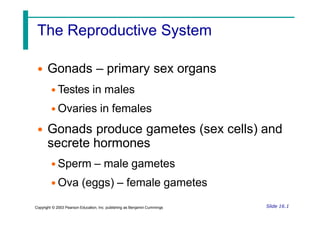
• Gonads – primary sex organs
• Testes in males
• Ovaries in females
• Gonads produce gametes (sex cells) and
secrete hormones
• Sperm – male gametes
• Ova (eggs) – female gametes
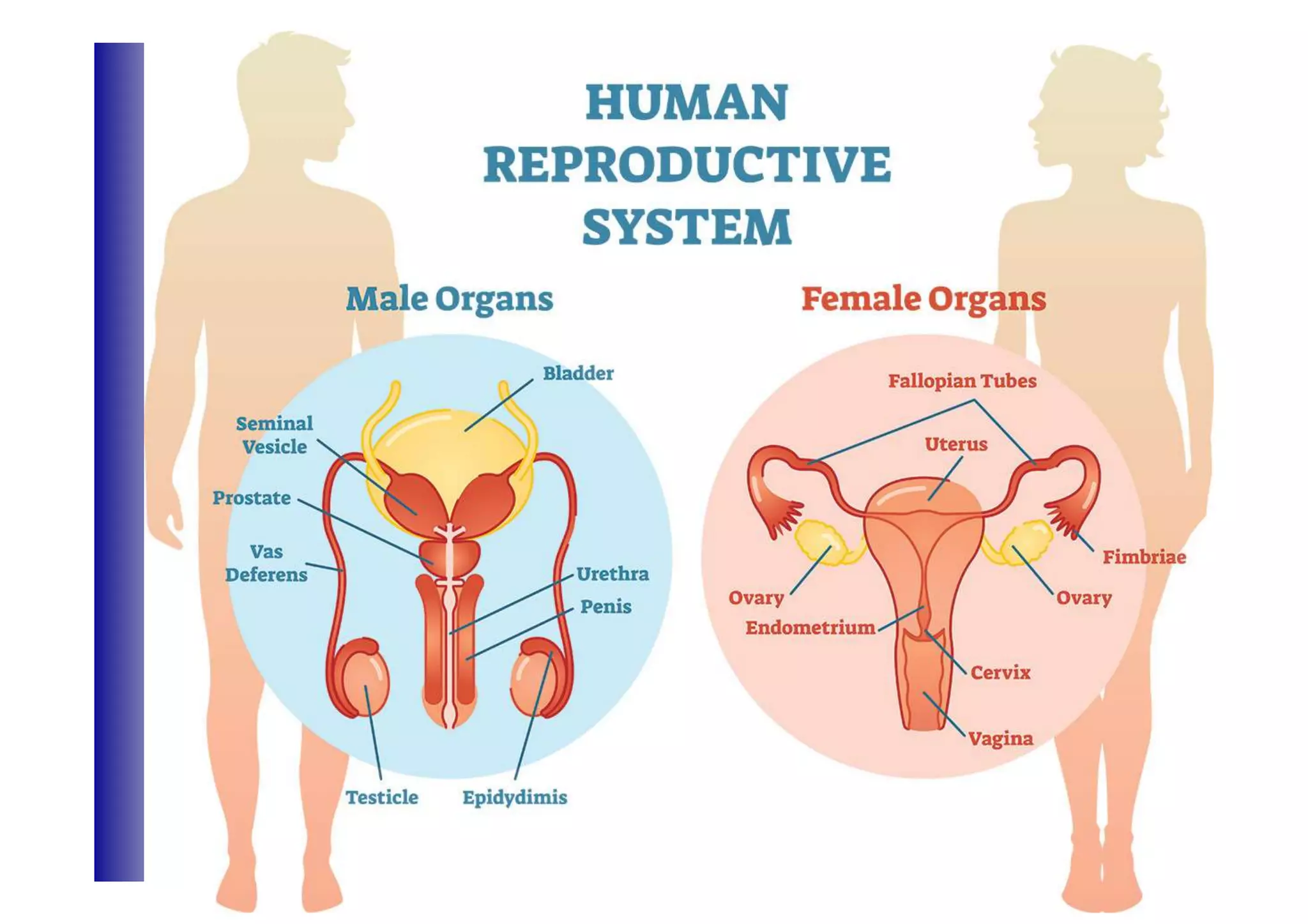
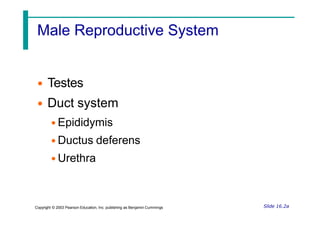
Male Reproductive System
• Testes
• Duct system
• Epididymis
• Ductus deferens
• Urethra
Slide 16.2a
Copyright © 2003 Pearson Education, Inc. publishing as Benjamin Cummings
Male Reproductive System
• Accessory organs
• Seminal vesicle
• Prostate gland
• Bulbourethral gland
• External genitalia
• Penis
• Scrotum
Slide 16.2b
Copyright © 2003 Pearson Education, Inc. publishing as Benjamin Cummings
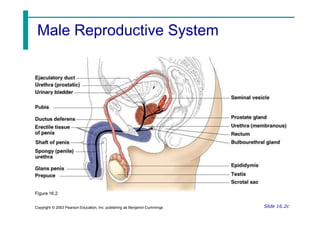
Male Reproductive System
Slide 16.2c
Copyright © 2003 Pearson Education, Inc. publishing as Benjamin Cummings
Figure 16.2
Testes
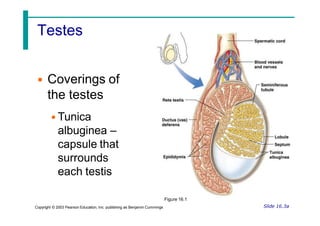
• Coverings of
the testes
• Tunica
albuginea –
capsule that
surrounds
each testis
Slide 16.3a
Figure 16.1
Copyright © 2003 Pearson Education, Inc. publishing as Benjamin Cummings
Testes
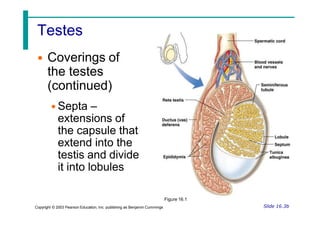
• Coverings of
the testes
(continued)
• Septa –
extensions of
the capsule that
extend into the
testis and divide
it into lobules
Slide 16.3b
Figure 16.1
Copyright © 2003 Pearson Education, Inc. publishing as Benjamin Cummings
Testes
• Each lobule contains one to four
seminiferous tubules
• Tightly coiled structures
• Function as sperm-forming factories
• Empty sperm into the rete testis
• Sperm travels through the rete testis to
the epididymis
• Interstitial cells produce androgens such
as testosterone
Slide 16.4
Copyright © 2003 Pearson Education, Inc. publishing as Benjamin Cummings
Epididymis
• Comma-shaped, tightly coiled tube
• Found on the superior part of the testis
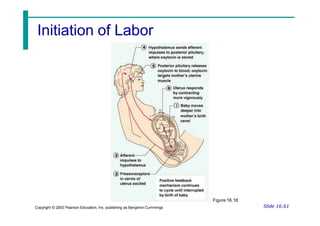
and along the posterior lateral side
• Functions to mature and store sperm
cells (at least 20 days)
• Expels sperm with the contraction of
muscles in the epididymis walls to the
vas deferens
Slide 16.5
Copyright © 2003 Pearson Education, Inc. publishing as Benjamin Cummings
Ductus Deferens (Vas Deferens)
• Carries sperm from the epididymis to the
ejaculatory duct
• Passes through the inguinal canal and
over the bladder
• Moves sperm by peristalsis
• Spermatic cord – ductus deferens, blood
vessels, and nerves in a connective
tissue sheath
Slide 16.6a
Copyright © 2003 Pearson Education, Inc. publishing as Benjamin Cummings
Ductus Deferens (Vas Deferens)
• Ends in the ejaculatory duct which
unites with the urethra
• Vasectomy – cutting of the ductus
deferens at the level of the testes to
prevent transportation of sperm
Slide 16.6b
Copyright © 2003 Pearson Education, Inc. publishing as Benjamin Cummings
Urethra
• Extends from the base of the urinary
bladder to the tip of the penis
• Carries both urine and sperm
• Sperm enters from the ejaculatory duct
Slide 16.7a
Copyright © 2003 Pearson Education, Inc. publishing as Benjamin Cummings
Urethra
Slide 16.7b
Copyright © 2003 Pearson Education, Inc. publishing as Benjamin Cummings
• Regions of the urethra
•Prostatic urethra –surrounded by
prostate
•Membranous urethra – from prostatic
urethra to penis
•Spongy (penile) urethra – runs the
length of the penis
Seminal Vesicles
• Located at the base of the bladder
• Produces a thick, yellowish secretion
(60% of semen)
• Fructose (sugar)
• Vitamin C
• Prostaglandins
• Other substances that nourish and activate
sperm
Slide 16.8
Copyright © 2003 Pearson Education, Inc. publishing as Benjamin Cummings
Prostate Gland
• Encircles the upper part of the urethra
• Secretes a milky fluid
• Helps to activate sperm
• Enters the urethra through several small
ducts
Slide 16.9
Copyright © 2003 Pearson Education, Inc. publishing as Benjamin Cummings
Bulbourethral Glands
• Pea-sized gland inferior to the prostate
• Produces a thick, clear mucus
• Cleanses the urethra of acidic urine
• Serves as a lubricant during sexual
intercourse
• Secreted into the penile urethra
Slide 16.10
Copyright © 2003 Pearson Education, Inc. publishing as Benjamin Cummings
Semen
• Mixture of sperm and accessory gland
secretions
• Advantages of accessory gland
secretions
• Fructose provides energy for sperm cells
• Alkalinity of semen helps neutralize the
acidic environment of vagina
• Semen inhibits bacterial multiplication
• Elements of semen enhance sperm motility
Slide 16.11
Copyright © 2003 Pearson Education, Inc. publishing as Benjamin Cummings
External Genitalia
• Scrotum
• Divided sac of skin outside the abdomen
• Maintains testes at 3°C lower than normal
body temperature to protect sperm viability
Slide 16.12
Copyright © 2003 Pearson Education, Inc. publishing as Benjamin Cummings
External Genitalia
• Penis
• Delivers sperm into the female reproductive
tract
• Regions of the penis
• Shaft
• Glans penis (enlarged tip)
• Prepuce (foreskin)
• Folded cuff of skin around proximal end
• Often removed by circumcision
Slide 16.13a
Copyright © 2003 Pearson Education, Inc. publishing as Benjamin Cummings
External Genitalia
• Internally there are three areas of spongy
erectile tissue around the urethra
Slide 16.13b
Copyright © 2003 Pearson Education, Inc. publishing as Benjamin Cummings
Spermatogenesis
• Production of sperm cells
• Begins at puberty and continues
Slide 16.14
Copyright © 2003 Pearson Education, Inc. publishing as Benjamin Cummings
throughout life
• Occurs in the seminiferous tubules
Processes of Spermatogenesis
Slide 16.15a
Copyright © 2003 Pearson Education, Inc. publishing as Benjamin Cummings
• Spermatogonia (stem cells) undergo
rapid mitosis to produce more stem cells
before puberty
• Follicle stimulating hormone (FSH)
modifies spermatogonia division
•One cell produced is a stem cell
•The other cell produced becomes a
primary spermatocyte
Processes of Spermatogenesis
Slide 16.15b
Copyright © 2003 Pearson Education, Inc. publishing as Benjamin Cummings
• Primary spermatocytes undergo meiosis
• Haploid spermatids are produced
Processes of Spermatogenesis
• Spermiogenesis
• Late spermatids are produced with distinct
regions
• Head – contains DNA covered by the
acrosome
• Midpiece
• Tail
• Sperm cells result after maturing of
spermatids
• Spermatogenesis takes 64 to 72 days
Slide 16.16
Copyright © 2003 Pearson Education, Inc. publishing as Benjamin Cummings
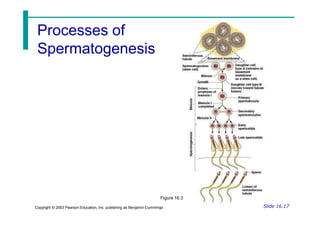
Processes of
Spermatogenesis
Figure 16.3
Slide 16.17
Copyright © 2003 Pearson Education, Inc. publishing as Benjamin Cummings
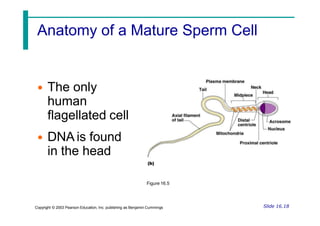
Anatomy of a Mature Sperm Cell
• The only
human
flagellated cell
• DNA is found
in the head
Figure 16.5
Slide 16.18
Copyright © 2003 Pearson Education, Inc. publishing as Benjamin Cummings
Testosterone Production
• The most important hormone of the
testes
• Produced in interstitial cells
Slide 16.19a
Copyright © 2003 Pearson Education, Inc. publishing as Benjamin Cummings
Testosterone Production
• Functions of testosterone
• Stimulates reproductive organ development
• Underlies sex drive
• Causes secondary sex characteristics
• Deepening of voice
• Increased hair growth
• Enlargement of skeletal muscles
• Thickening of bones
Slide 16.19b
Copyright © 2003 Pearson Education, Inc. publishing as Benjamin Cummings
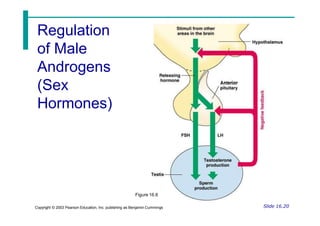
Regulation
of Male
Androgens
(Sex
Hormones)
Slide 16.20
Copyright © 2003 Pearson Education, Inc. publishing as Benjamin Cummings
Figure 16.6
Female Reproductive System
Slide 16.21a
Copyright © 2003 Pearson Education, Inc. publishing as Benjamin Cummings
• Ovaries
• Duct System
• Uterine tubes (fallopian tubes)
• Uterus
• Vagina
• External genitalia
Female Reproductive System
Slide 16.21b
Copyright © 2003 Pearson Education, Inc. publishing as Benjamin Cummings
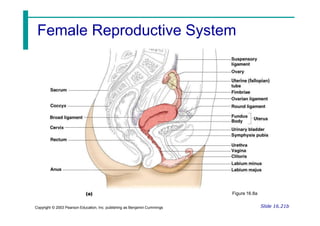
Figure 16.8a
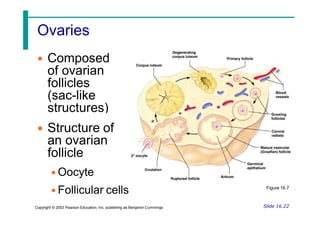
Ovaries
• Composed
of ovarian
follicles
(sac-like
structures)
• Structure of
an ovarian
follicle
• Oocyte
• Follicular cells Figure 16.7
Slide 16.22
Copyright © 2003 Pearson Education, Inc. publishing as Benjamin Cummings
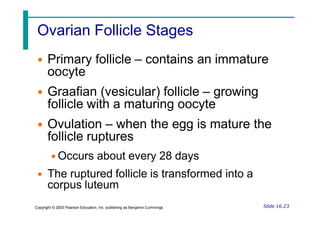
Ovarian Follicle Stages
• Primary follicle – contains an immature
oocyte
• Graafian (vesicular) follicle – growing
follicle with a maturing oocyte
• Ovulation – when the egg is mature the
follicle ruptures
• Occurs about every 28 days
• The ruptured follicle is transformed into a
corpus luteum
Slide 16.23
Copyright © 2003 Pearson Education, Inc. publishing as Benjamin Cummings
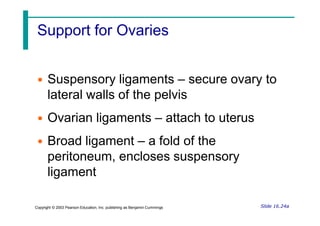
Support for Ovaries
• Suspensory ligaments – secure ovary to
lateral walls of the pelvis
• Ovarian ligaments – attach to uterus
• Broad ligament – a fold of the
peritoneum, encloses suspensory
ligament
Slide 16.24a
Copyright © 2003 Pearson Education, Inc. publishing as Benjamin Cummings
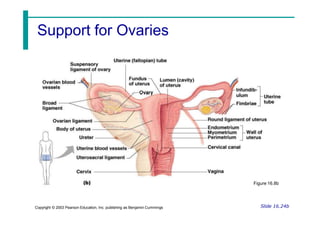
Support for Ovaries
Slide 16.24b
Copyright © 2003 Pearson Education, Inc. publishing as Benjamin Cummings
Figure 16.8b
Uterine (Fallopian) Tubes
• Receive the ovulated oocyte
• Provide a site for fertilization
• Attaches to the uterus
• Does not physically attach to the ovary
• Supported by the broad ligament
Slide 16.25
Copyright © 2003 Pearson Education, Inc. publishing as Benjamin Cummings
Uterine Tube Function
• Fimbriae – finger-like projections at the
distal end that receive the oocyte
• Cilia inside the uterine tube slowly move
the oocyte towards the uterus
(takes 3–4 days)
• Fertilization occurs inside the uterine
tube
Slide 16.26
Copyright © 2003 Pearson Education, Inc. publishing as Benjamin Cummings
Uterus
• Located between the urinary bladder
and rectum
• Hollow organ
• Functions of the uterus
• Receives a fertilized egg
• Retains the fertilized egg
• Nourishes the fertilized egg
Slide 16.27
Copyright © 2003 Pearson Education, Inc. publishing as Benjamin Cummings
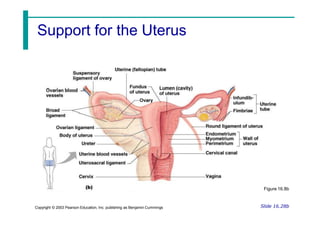
Support for the Uterus
Slide 16.28a
Copyright © 2003 Pearson Education, Inc. publishing as Benjamin Cummings
• Broad ligament – attached to the pelvis
•
• Uterosacral ligaments – anchored
posteriorly
Support for the Uterus
Slide 16.28b
Copyright © 2003 Pearson Education, Inc. publishing as Benjamin Cummings
Figure 16.8b
Regions of the Uterus
• Body – main portion
• Fundus – area where uterine tube
enters
• Cervix – narrow outlet that protrudes
into the vagina
Slide 16.29
Copyright © 2003 Pearson Education, Inc. publishing as Benjamin Cummings
Walls of the Uterus
• Endometrium
• Inner layer
• Allows for implantation of a fertilized egg
• Sloughs off if no pregnancy occurs
(menses)
• Myometrium – middle layer of smooth
muscle
• Serous layer – outer visceral
peritoneum
Slide 16.30
Copyright © 2003 Pearson Education, Inc. publishing as Benjamin Cummings
Vagina
• Extends from cervix to exterior of body
• Behind bladder and in front of rectum
• Serves as the birth canal
• Receives the penis during sexual
intercourse
• Hymen – partially closes the vagina until
it is ruptured
Slide 16.31
Copyright © 2003 Pearson Education, Inc. publishing as Benjamin Cummings
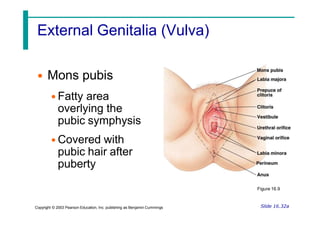
External Genitalia (Vulva)
Slide 16.32a
Copyright © 2003 Pearson Education, Inc. publishing as Benjamin Cummings
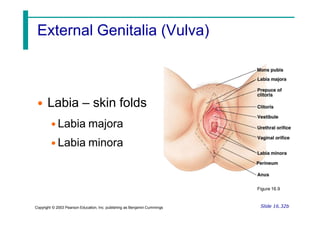
• Mons pubis
• Fatty area
overlying the
pubic symphysis
• Covered with
pubic hair after
puberty
Figure 16.9
External Genitalia (Vulva)
• Labia – skin folds
• Labia majora
• Labia minora
Slide 16.32b
Copyright © 2003 Pearson Education, Inc. publishing as Benjamin Cummings
Figure 16.9
External Genitalia
• Vestibule
• Enclosed by labia majora
• Contains opening of the urethra and the
greater vestibular glands (produce mucus)
• Clitoris
• Contains erectile tissue
• Corresponds to the male penis
Slide 16.33
Copyright © 2003 Pearson Education, Inc. publishing as Benjamin Cummings
Oogenesis
• The total supply of eggs are present at
birth
• Ability to release eggs begins at puberty
• Reproductive ability ends at menopause
• Oocytes are matured in developing
ovarian follicles
Slide 16.34
Copyright © 2003 Pearson Education, Inc. publishing as Benjamin Cummings
Oogenesis
• Oogonia – female stem cells found in a
developing fetus
• Oogonia undergo mitosis to produce
primary oocytes
• Primary oocytes are surrounded by cells
that form primary follicles in the ovary
• Oogonia no longer exist by the time of
birth
Slide 16.35
Copyright © 2003 Pearson Education, Inc. publishing as Benjamin Cummings
Oogenesis
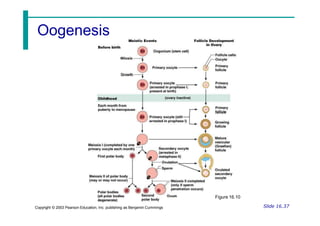
• Primary oocytes are inactive until puberty
• Follicle stimulating hormone (FSH)
causes some primary follicles to mature
• Meiosis starts inside maturing follicle
• Produces a secondary oocyte and the first
polar body
• Meiosis is completed after ovulation only if
sperm penetrates
• Two additional polar bodies are produced
Slide 16.36
Copyright © 2003 Pearson Education, Inc. publishing as Benjamin Cummings
Oogenesis
Figure 16.10
Slide 16.37
Copyright © 2003 Pearson Education, Inc. publishing as Benjamin Cummings
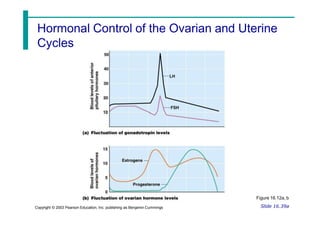
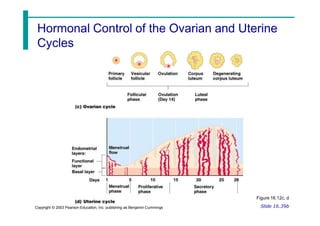
Menstrual (Uterine) Cycle
• Cyclic changes of the endometrium
• Regulated by cyclic production of
estrogens and progesterone
• Stages of the menstrual cycle
• Menses – functional layer of the
endometrium is sloughed
• Proliferative stage – regeneration of
functional layer
• Secretory stage – endometrium increases
in size and readies for implantation
Slide 16.38
Copyright © 2003 Pearson Education, Inc. publishing as Benjamin Cummings
Hormonal Control of the Ovarian and Uterine
Cycles
Slide 16.39a
Copyright © 2003 Pearson Education, Inc. publishing as Benjamin Cummings
Figure 16.12a, b
Hormonal Control of the Ovarian and Uterine
Cycles
Slide 16.39b
Copyright © 2003 Pearson Education, Inc. publishing as Benjamin Cummings
Figure 16.12c, d
Hormone Production by the Ovaries
• Estrogens
• Produced by follicle cells
• Cause secondary sex characteristics
• Enlargement of accessory organs
• Development of breasts
• Appearance of pubic hair
• Increase in fat beneath the skin
• Widening and lightening of the pelvis
• Onset of menses
Slide 16.40
Copyright © 2003 Pearson Education, Inc. publishing as Benjamin Cummings
Hormone Production by the Ovaries
• Progesterone
• Produced by the corpus luteum
• Production continues until LH diminishes in
the blood
• Helps maintain pregnancy
Slide 16.41
Copyright © 2003 Pearson Education, Inc. publishing as Benjamin Cummings
Mammary Glands
• Present in both sexes, but only function
in females
• Modified sweat glands
• Function is to produce milk
• Stimulated by sex hormones (mostly
estrogens) to increase in size
Slide 16.42
Copyright © 2003 Pearson Education, Inc. publishing as Benjamin Cummings
Anatomy of Mammary Glands
• Areola – central pigmented area
• Nipple – protruding central area of
areola
• Lobes – internal structures that radiate
around nipple
• Alveolar glands – clusters of milk
producing glands within lobules
• Lactiferous ducts – connect alveolar
glands to nipple
Slide 16.43
Copyright © 2003 Pearson Education, Inc. publishing as Benjamin Cummings
Stages of Pregnancy and
Development
• Fertilization
•
• Fetal development
• Childbirth
Slide 16.44
Copyright © 2003 Pearson Education, Inc. publishing as Benjamin Cummings
Fertilization
• The oocyte is viable for 12 to 24 hours
after ovulation
• Sperm are viable for 12 to 48 hours
after ejaculation
• Sperm cells must make their way to the
uterine tube for fertilization to be
possible
Slide 16.45
Copyright © 2003 Pearson Education, Inc. publishing as Benjamin Cummings
Mechanisms of Fertilization
• Membrane receptors on an oocyte pulls
in the head of the first sperm cell to
make contact
• The membrane of the oocyte does not
permit a second sperm head to enter
• The oocyte then undergoes its second
meiotic division
• Fertilization occurs when the genetic
material of a sperm combines with that
of an oocyte to form a zygote
Slide 16.46
Copyright © 2003 Pearson Education, Inc. publishing as Benjamin Cummings
The Zygote
• First cell of a new individual
• The result of the fusion of DNA from
sperm and egg
• The zygote begins rapid mitotic cell
divisions
• The zygote stage is in the uterine tube,
moving toward the uterus
Slide 16.47
Copyright © 2003 Pearson Education, Inc. publishing as Benjamin Cummings
The Embryo
• Developmental stage from the start of
cleavage until the ninth week
• The embryo first undergoes division
without growth
• The embryo enters the uterus at the
16-cell state
• The embryo floats free in the uterus
temporarily
• Uterine secretions are used for
nourishment
Slide 16.48
Copyright © 2003 Pearson Education, Inc. publishing as Benjamin Cummings
The Blastocyst
• Ball-like circle of cells
• Begins at about the 100 cell stage
• Secretes human chorionic gonadotropin
(hCG) to produce the corpus luteum to
continue producing hormones
• Functional areas of the blastocyst
• Trophoblast – large fluid-filled sphere
• Inner cell mass
Slide 16.49
Copyright © 2003 Pearson Education, Inc. publishing as Benjamin Cummings
The Blastocyst
• Primary germ layers are eventually
formed
• Ectoderm – outside layer
• Mesoderm – middle layer
• Endoderm – inside layer
• The late blastocyst implants in the wall
of the uterus (by day 14)
Slide 16.50
Copyright © 2003 Pearson Education, Inc. publishing as Benjamin Cummings
Derivatives of Germ Layers
• Ectoderm
• Nervous system
• Epidermis of the skin
• Endoderm
• Mucosae
• Glands
• Mesoderm
• Everything else
Slide 16.51
Copyright © 2003 Pearson Education, Inc. publishing as Benjamin Cummings
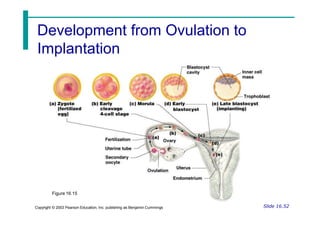
Development from Ovulation to
Implantation
Figure 16.15
Slide 16.52
Copyright © 2003 Pearson Education, Inc. publishing as Benjamin Cummings
Development After Implantation
• Chorionic villi (projections of the
blastocyst) develop
• Cooperate with cells of the uterus to form
the placenta
• The embryo is surrounded by the
amnion (a fluid filled sac)
• An umbilical cord forms to attach the
embryo to the placenta
Slide 16.53
Copyright © 2003 Pearson Education, Inc. publishing as Benjamin Cummings
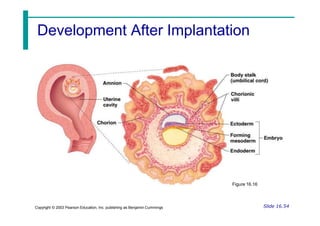
Development After Implantation
Figure 16.16
Slide 16.54
Copyright © 2003 Pearson Education, Inc. publishing as Benjamin Cummings
Functions of the Placenta
• Forms a barrier between mother and embryo
(blood is not exchanged)
• Delivers nutrients and oxygen
• Removes waste from embryonic blood
• Becomes an endocrine organ (produces
hormones) and takes over for the corpus
luteum
• Estrogen
• Progesterone
• Other hormones that maintain pregnancy
Slide 16.55
Copyright © 2003 Pearson Education, Inc. publishing as Benjamin Cummings
The Fetus (Beginning of the Ninth
Week)
• All organ systems are formed by the
end of the eighth week
• Activities of the fetus are growth and
organ specialization
• A stage of tremendous growth and
change in appearance
Slide 16.56
Copyright © 2003 Pearson Education, Inc. publishing as Benjamin Cummings
The Effects of Pregnancy on the
Mother
• Pregnancy – period from conception
until birth
• Anatomical changes
• Enlargements of the uterus
• Accentuated lumbar curvature
• Relaxation of the pelvic ligaments and
pubic symphysis due to production of
relaxin
Slide 16.57
Copyright © 2003 Pearson Education, Inc. publishing as Benjamin Cummings
Effects of Pregnancy on the Mother
• Physiological changes
• Gastrointestinal system
• Morning sickness is common due to
Slide 16.58a
Copyright © 2003 Pearson Education, Inc. publishing as Benjamin Cummings
elevated progesterone
• Heartburn is common because of organ
crowding by the fetus
• Constipation is caused by declining
motility of the digestive tract
Effects of Pregnancy on the Mother
Slide 16.58b
Copyright © 2003 Pearson Education, Inc. publishing as Benjamin Cummings
• Physiological changes
• Urinary System
• Kidneys have additional burden and
produce more urine
• The uterus compresses the bladder
Effects of Pregnancy on the Mother
Slide 16.59a
Copyright © 2003 Pearson Education, Inc. publishing as Benjamin Cummings
• Physiological changes
• Respiratory System
• Nasal mucosa becomes congested and
swollen
• Vital capacity and respiratory rate
increase
Effects of Pregnancy on the Mother
Slide 16.59b
Copyright © 2003 Pearson Education, Inc. publishing as Benjamin Cummings
• Physiological changes
• Cardiovascular system
• Body water rises
• Blood volume increases by 25 to 40
percent
• Blood pressure and pulse increase
• Varicose veins are common
Childbirth (Partition)
• Labor – the series of events that expel
the infant from the uterus
• Initiation of labor
• Estrogen levels rise
• Uterine contractions begin
• The placenta releases prostaglandins
• Oxytocin is released by the pituitary
• Combination of these hormones produces
contractions
Slide 16.60
Copyright © 2003 Pearson Education, Inc. publishing as Benjamin Cummings
Initiation of Labor
Figure 16.18
Slide 16.61
Copyright © 2003 Pearson Education, Inc. publishing as Benjamin Cummings
Stages of Labor
Slide 16.62a
Copyright © 2003 Pearson Education, Inc. publishing as Benjamin Cummings
• Dilation
• Cervix becomes dilated
• Uterine contractions begin and increase
• The amnion ruptures
Stages of Labor
• Expulsion
• Infant passes through the cervix and vagina
• Normal delivery is head first
• Placental stage
• Delivery of the placenta
Slide 16.62b
Copyright © 2003 Pearson Education, Inc. publishing as Benjamin Cummings
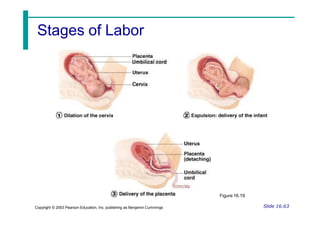
Stages of Labor
Slide 16.63
Copyright © 2003 Pearson Education, Inc. publishing as Benjamin Cummings
Figure 16.19
Developmental Aspects of the
Reproductive System
Slide 16.64a
Copyright © 2003 Pearson Education, Inc. publishing as Benjamin Cummings
• Gender is determined at fertilization
• Males have XY sex chromosomes
• Females have XX sex chromosomes
• Gonads do not begin to form until the
eighth week
Developmental Aspects of the
Reproductive System
• Testes form in the abdominal cavity and
descend to the scrotum one month
before birth
• The determining factor for gonad
differentiation is testosterone
Slide 16.64b
Copyright © 2003 Pearson Education, Inc. publishing as Benjamin Cummings
Developmental Aspects of the
Reproductive System
• Reproductive system organs do not
function until puberty
• Puberty usually begins between ages
10 and 15
• The first menses usually occurs about
two years after the start of puberty
• Most women reach peak reproductive
ability in their late 20s
Slide 16.65
Copyright © 2003 Pearson Education, Inc. publishing as Benjamin Cummings
Developmental Aspects of the
Reproductive System
• Menopause occurs when ovulation and
menses cease entirely
• Ovaries stop functioning as endocrine
organs
• There is a no equivalent of menopause
in males, but there is a steady decline in
testosterone
Slide 16.66
Copyright © 2003 Pearson Education, Inc. publishing as Benjamin Cummings

Chapter 16 jk.pptx

  • 1.
    Essentials of HumanAnatomy & Physiology Seventh Edition Slides 16.1 – 16.20 Lecture Slides in PowerPoint by Jerry L. Cook Copyright © 2003 Pearson Education, Inc. publishing as Benjamin Cummings
  • 2.
    The Reproductive System Slide16.1 Copyright © 2003 Pearson Education, Inc. publishing as Benjamin Cummings • Gonads – primary sex organs • Testes in males • Ovaries in females • Gonads produce gametes (sex cells) and secrete hormones • Sperm – male gametes • Ova (eggs) – female gametes
  • 3.
    Male Reproductive System •Testes • Duct system • Epididymis • Ductus deferens • Urethra Slide 16.2a Copyright © 2003 Pearson Education, Inc. publishing as Benjamin Cummings
  • 4.
    Male Reproductive System •Accessory organs • Seminal vesicle • Prostate gland • Bulbourethral gland • External genitalia • Penis • Scrotum Slide 16.2b Copyright © 2003 Pearson Education, Inc. publishing as Benjamin Cummings
  • 5.
    Male Reproductive System Slide16.2c Copyright © 2003 Pearson Education, Inc. publishing as Benjamin Cummings Figure 16.2
  • 6.
    Testes • Coverings of thetestes • Tunica albuginea – capsule that surrounds each testis Slide 16.3a Figure 16.1 Copyright © 2003 Pearson Education, Inc. publishing as Benjamin Cummings
  • 7.
    Testes • Coverings of thetestes (continued) • Septa – extensions of the capsule that extend into the testis and divide it into lobules Slide 16.3b Figure 16.1 Copyright © 2003 Pearson Education, Inc. publishing as Benjamin Cummings
  • 8.
    Testes • Each lobulecontains one to four seminiferous tubules • Tightly coiled structures • Function as sperm-forming factories • Empty sperm into the rete testis • Sperm travels through the rete testis to the epididymis • Interstitial cells produce androgens such as testosterone Slide 16.4 Copyright © 2003 Pearson Education, Inc. publishing as Benjamin Cummings
  • 9.
    Epididymis • Comma-shaped, tightlycoiled tube • Found on the superior part of the testis and along the posterior lateral side • Functions to mature and store sperm cells (at least 20 days) • Expels sperm with the contraction of muscles in the epididymis walls to the vas deferens Slide 16.5 Copyright © 2003 Pearson Education, Inc. publishing as Benjamin Cummings
  • 10.
    Ductus Deferens (VasDeferens) • Carries sperm from the epididymis to the ejaculatory duct • Passes through the inguinal canal and over the bladder • Moves sperm by peristalsis • Spermatic cord – ductus deferens, blood vessels, and nerves in a connective tissue sheath Slide 16.6a Copyright © 2003 Pearson Education, Inc. publishing as Benjamin Cummings
  • 11.
    Ductus Deferens (VasDeferens) • Ends in the ejaculatory duct which unites with the urethra • Vasectomy – cutting of the ductus deferens at the level of the testes to prevent transportation of sperm Slide 16.6b Copyright © 2003 Pearson Education, Inc. publishing as Benjamin Cummings
  • 12.
    Urethra • Extends fromthe base of the urinary bladder to the tip of the penis • Carries both urine and sperm • Sperm enters from the ejaculatory duct Slide 16.7a Copyright © 2003 Pearson Education, Inc. publishing as Benjamin Cummings
  • 13.
    Urethra Slide 16.7b Copyright ©2003 Pearson Education, Inc. publishing as Benjamin Cummings • Regions of the urethra •Prostatic urethra –surrounded by prostate •Membranous urethra – from prostatic urethra to penis •Spongy (penile) urethra – runs the length of the penis
  • 14.
    Seminal Vesicles • Locatedat the base of the bladder • Produces a thick, yellowish secretion (60% of semen) • Fructose (sugar) • Vitamin C • Prostaglandins • Other substances that nourish and activate sperm Slide 16.8 Copyright © 2003 Pearson Education, Inc. publishing as Benjamin Cummings
  • 15.
    Prostate Gland • Encirclesthe upper part of the urethra • Secretes a milky fluid • Helps to activate sperm • Enters the urethra through several small ducts Slide 16.9 Copyright © 2003 Pearson Education, Inc. publishing as Benjamin Cummings
  • 16.
    Bulbourethral Glands • Pea-sizedgland inferior to the prostate • Produces a thick, clear mucus • Cleanses the urethra of acidic urine • Serves as a lubricant during sexual intercourse • Secreted into the penile urethra Slide 16.10 Copyright © 2003 Pearson Education, Inc. publishing as Benjamin Cummings
  • 17.
    Semen • Mixture ofsperm and accessory gland secretions • Advantages of accessory gland secretions • Fructose provides energy for sperm cells • Alkalinity of semen helps neutralize the acidic environment of vagina • Semen inhibits bacterial multiplication • Elements of semen enhance sperm motility Slide 16.11 Copyright © 2003 Pearson Education, Inc. publishing as Benjamin Cummings
  • 18.
    External Genitalia • Scrotum •Divided sac of skin outside the abdomen • Maintains testes at 3°C lower than normal body temperature to protect sperm viability Slide 16.12 Copyright © 2003 Pearson Education, Inc. publishing as Benjamin Cummings
  • 19.
    External Genitalia • Penis •Delivers sperm into the female reproductive tract • Regions of the penis • Shaft • Glans penis (enlarged tip) • Prepuce (foreskin) • Folded cuff of skin around proximal end • Often removed by circumcision Slide 16.13a Copyright © 2003 Pearson Education, Inc. publishing as Benjamin Cummings
  • 20.
    External Genitalia • Internallythere are three areas of spongy erectile tissue around the urethra Slide 16.13b Copyright © 2003 Pearson Education, Inc. publishing as Benjamin Cummings
  • 21.
    Spermatogenesis • Production ofsperm cells • Begins at puberty and continues Slide 16.14 Copyright © 2003 Pearson Education, Inc. publishing as Benjamin Cummings throughout life • Occurs in the seminiferous tubules
  • 22.
    Processes of Spermatogenesis Slide16.15a Copyright © 2003 Pearson Education, Inc. publishing as Benjamin Cummings • Spermatogonia (stem cells) undergo rapid mitosis to produce more stem cells before puberty • Follicle stimulating hormone (FSH) modifies spermatogonia division •One cell produced is a stem cell •The other cell produced becomes a primary spermatocyte
  • 23.
    Processes of Spermatogenesis Slide16.15b Copyright © 2003 Pearson Education, Inc. publishing as Benjamin Cummings • Primary spermatocytes undergo meiosis • Haploid spermatids are produced
  • 24.
    Processes of Spermatogenesis •Spermiogenesis • Late spermatids are produced with distinct regions • Head – contains DNA covered by the acrosome • Midpiece • Tail • Sperm cells result after maturing of spermatids • Spermatogenesis takes 64 to 72 days Slide 16.16 Copyright © 2003 Pearson Education, Inc. publishing as Benjamin Cummings
  • 25.
    Processes of Spermatogenesis Figure 16.3 Slide16.17 Copyright © 2003 Pearson Education, Inc. publishing as Benjamin Cummings
  • 26.
    Anatomy of aMature Sperm Cell • The only human flagellated cell • DNA is found in the head Figure 16.5 Slide 16.18 Copyright © 2003 Pearson Education, Inc. publishing as Benjamin Cummings
  • 27.
    Testosterone Production • Themost important hormone of the testes • Produced in interstitial cells Slide 16.19a Copyright © 2003 Pearson Education, Inc. publishing as Benjamin Cummings
  • 28.
    Testosterone Production • Functionsof testosterone • Stimulates reproductive organ development • Underlies sex drive • Causes secondary sex characteristics • Deepening of voice • Increased hair growth • Enlargement of skeletal muscles • Thickening of bones Slide 16.19b Copyright © 2003 Pearson Education, Inc. publishing as Benjamin Cummings
  • 29.
    Regulation of Male Androgens (Sex Hormones) Slide 16.20 Copyright© 2003 Pearson Education, Inc. publishing as Benjamin Cummings Figure 16.6
  • 30.
    Female Reproductive System Slide16.21a Copyright © 2003 Pearson Education, Inc. publishing as Benjamin Cummings • Ovaries • Duct System • Uterine tubes (fallopian tubes) • Uterus • Vagina • External genitalia
  • 31.
    Female Reproductive System Slide16.21b Copyright © 2003 Pearson Education, Inc. publishing as Benjamin Cummings Figure 16.8a
  • 32.
    Ovaries • Composed of ovarian follicles (sac-like structures) •Structure of an ovarian follicle • Oocyte • Follicular cells Figure 16.7 Slide 16.22 Copyright © 2003 Pearson Education, Inc. publishing as Benjamin Cummings
  • 33.
    Ovarian Follicle Stages •Primary follicle – contains an immature oocyte • Graafian (vesicular) follicle – growing follicle with a maturing oocyte • Ovulation – when the egg is mature the follicle ruptures • Occurs about every 28 days • The ruptured follicle is transformed into a corpus luteum Slide 16.23 Copyright © 2003 Pearson Education, Inc. publishing as Benjamin Cummings
  • 34.
    Support for Ovaries •Suspensory ligaments – secure ovary to lateral walls of the pelvis • Ovarian ligaments – attach to uterus • Broad ligament – a fold of the peritoneum, encloses suspensory ligament Slide 16.24a Copyright © 2003 Pearson Education, Inc. publishing as Benjamin Cummings
  • 35.
    Support for Ovaries Slide16.24b Copyright © 2003 Pearson Education, Inc. publishing as Benjamin Cummings Figure 16.8b
  • 36.
    Uterine (Fallopian) Tubes •Receive the ovulated oocyte • Provide a site for fertilization • Attaches to the uterus • Does not physically attach to the ovary • Supported by the broad ligament Slide 16.25 Copyright © 2003 Pearson Education, Inc. publishing as Benjamin Cummings
  • 37.
    Uterine Tube Function •Fimbriae – finger-like projections at the distal end that receive the oocyte • Cilia inside the uterine tube slowly move the oocyte towards the uterus (takes 3–4 days) • Fertilization occurs inside the uterine tube Slide 16.26 Copyright © 2003 Pearson Education, Inc. publishing as Benjamin Cummings
  • 38.
    Uterus • Located betweenthe urinary bladder and rectum • Hollow organ • Functions of the uterus • Receives a fertilized egg • Retains the fertilized egg • Nourishes the fertilized egg Slide 16.27 Copyright © 2003 Pearson Education, Inc. publishing as Benjamin Cummings
  • 39.
    Support for theUterus Slide 16.28a Copyright © 2003 Pearson Education, Inc. publishing as Benjamin Cummings • Broad ligament – attached to the pelvis • • Uterosacral ligaments – anchored posteriorly
  • 40.
    Support for theUterus Slide 16.28b Copyright © 2003 Pearson Education, Inc. publishing as Benjamin Cummings Figure 16.8b
  • 41.
    Regions of theUterus • Body – main portion • Fundus – area where uterine tube enters • Cervix – narrow outlet that protrudes into the vagina Slide 16.29 Copyright © 2003 Pearson Education, Inc. publishing as Benjamin Cummings
  • 42.
    Walls of theUterus • Endometrium • Inner layer • Allows for implantation of a fertilized egg • Sloughs off if no pregnancy occurs (menses) • Myometrium – middle layer of smooth muscle • Serous layer – outer visceral peritoneum Slide 16.30 Copyright © 2003 Pearson Education, Inc. publishing as Benjamin Cummings
  • 43.
    Vagina • Extends fromcervix to exterior of body • Behind bladder and in front of rectum • Serves as the birth canal • Receives the penis during sexual intercourse • Hymen – partially closes the vagina until it is ruptured Slide 16.31 Copyright © 2003 Pearson Education, Inc. publishing as Benjamin Cummings
  • 44.
    External Genitalia (Vulva) Slide16.32a Copyright © 2003 Pearson Education, Inc. publishing as Benjamin Cummings • Mons pubis • Fatty area overlying the pubic symphysis • Covered with pubic hair after puberty Figure 16.9
  • 45.
    External Genitalia (Vulva) •Labia – skin folds • Labia majora • Labia minora Slide 16.32b Copyright © 2003 Pearson Education, Inc. publishing as Benjamin Cummings Figure 16.9
  • 46.
    External Genitalia • Vestibule •Enclosed by labia majora • Contains opening of the urethra and the greater vestibular glands (produce mucus) • Clitoris • Contains erectile tissue • Corresponds to the male penis Slide 16.33 Copyright © 2003 Pearson Education, Inc. publishing as Benjamin Cummings
  • 47.
    Oogenesis • The totalsupply of eggs are present at birth • Ability to release eggs begins at puberty • Reproductive ability ends at menopause • Oocytes are matured in developing ovarian follicles Slide 16.34 Copyright © 2003 Pearson Education, Inc. publishing as Benjamin Cummings
  • 48.
    Oogenesis • Oogonia –female stem cells found in a developing fetus • Oogonia undergo mitosis to produce primary oocytes • Primary oocytes are surrounded by cells that form primary follicles in the ovary • Oogonia no longer exist by the time of birth Slide 16.35 Copyright © 2003 Pearson Education, Inc. publishing as Benjamin Cummings
  • 49.
    Oogenesis • Primary oocytesare inactive until puberty • Follicle stimulating hormone (FSH) causes some primary follicles to mature • Meiosis starts inside maturing follicle • Produces a secondary oocyte and the first polar body • Meiosis is completed after ovulation only if sperm penetrates • Two additional polar bodies are produced Slide 16.36 Copyright © 2003 Pearson Education, Inc. publishing as Benjamin Cummings
  • 50.
    Oogenesis Figure 16.10 Slide 16.37 Copyright© 2003 Pearson Education, Inc. publishing as Benjamin Cummings
  • 51.
    Menstrual (Uterine) Cycle •Cyclic changes of the endometrium • Regulated by cyclic production of estrogens and progesterone • Stages of the menstrual cycle • Menses – functional layer of the endometrium is sloughed • Proliferative stage – regeneration of functional layer • Secretory stage – endometrium increases in size and readies for implantation Slide 16.38 Copyright © 2003 Pearson Education, Inc. publishing as Benjamin Cummings
  • 52.
    Hormonal Control ofthe Ovarian and Uterine Cycles Slide 16.39a Copyright © 2003 Pearson Education, Inc. publishing as Benjamin Cummings Figure 16.12a, b
  • 53.
    Hormonal Control ofthe Ovarian and Uterine Cycles Slide 16.39b Copyright © 2003 Pearson Education, Inc. publishing as Benjamin Cummings Figure 16.12c, d
  • 54.
    Hormone Production bythe Ovaries • Estrogens • Produced by follicle cells • Cause secondary sex characteristics • Enlargement of accessory organs • Development of breasts • Appearance of pubic hair • Increase in fat beneath the skin • Widening and lightening of the pelvis • Onset of menses Slide 16.40 Copyright © 2003 Pearson Education, Inc. publishing as Benjamin Cummings
  • 55.
    Hormone Production bythe Ovaries • Progesterone • Produced by the corpus luteum • Production continues until LH diminishes in the blood • Helps maintain pregnancy Slide 16.41 Copyright © 2003 Pearson Education, Inc. publishing as Benjamin Cummings
  • 56.
    Mammary Glands • Presentin both sexes, but only function in females • Modified sweat glands • Function is to produce milk • Stimulated by sex hormones (mostly estrogens) to increase in size Slide 16.42 Copyright © 2003 Pearson Education, Inc. publishing as Benjamin Cummings
  • 57.
    Anatomy of MammaryGlands • Areola – central pigmented area • Nipple – protruding central area of areola • Lobes – internal structures that radiate around nipple • Alveolar glands – clusters of milk producing glands within lobules • Lactiferous ducts – connect alveolar glands to nipple Slide 16.43 Copyright © 2003 Pearson Education, Inc. publishing as Benjamin Cummings
  • 58.
    Stages of Pregnancyand Development • Fertilization • • Fetal development • Childbirth Slide 16.44 Copyright © 2003 Pearson Education, Inc. publishing as Benjamin Cummings
  • 59.
    Fertilization • The oocyteis viable for 12 to 24 hours after ovulation • Sperm are viable for 12 to 48 hours after ejaculation • Sperm cells must make their way to the uterine tube for fertilization to be possible Slide 16.45 Copyright © 2003 Pearson Education, Inc. publishing as Benjamin Cummings
  • 60.
    Mechanisms of Fertilization •Membrane receptors on an oocyte pulls in the head of the first sperm cell to make contact • The membrane of the oocyte does not permit a second sperm head to enter • The oocyte then undergoes its second meiotic division • Fertilization occurs when the genetic material of a sperm combines with that of an oocyte to form a zygote Slide 16.46 Copyright © 2003 Pearson Education, Inc. publishing as Benjamin Cummings
  • 61.
    The Zygote • Firstcell of a new individual • The result of the fusion of DNA from sperm and egg • The zygote begins rapid mitotic cell divisions • The zygote stage is in the uterine tube, moving toward the uterus Slide 16.47 Copyright © 2003 Pearson Education, Inc. publishing as Benjamin Cummings
  • 62.
    The Embryo • Developmentalstage from the start of cleavage until the ninth week • The embryo first undergoes division without growth • The embryo enters the uterus at the 16-cell state • The embryo floats free in the uterus temporarily • Uterine secretions are used for nourishment Slide 16.48 Copyright © 2003 Pearson Education, Inc. publishing as Benjamin Cummings
  • 63.
    The Blastocyst • Ball-likecircle of cells • Begins at about the 100 cell stage • Secretes human chorionic gonadotropin (hCG) to produce the corpus luteum to continue producing hormones • Functional areas of the blastocyst • Trophoblast – large fluid-filled sphere • Inner cell mass Slide 16.49 Copyright © 2003 Pearson Education, Inc. publishing as Benjamin Cummings
  • 64.
    The Blastocyst • Primarygerm layers are eventually formed • Ectoderm – outside layer • Mesoderm – middle layer • Endoderm – inside layer • The late blastocyst implants in the wall of the uterus (by day 14) Slide 16.50 Copyright © 2003 Pearson Education, Inc. publishing as Benjamin Cummings
  • 65.
    Derivatives of GermLayers • Ectoderm • Nervous system • Epidermis of the skin • Endoderm • Mucosae • Glands • Mesoderm • Everything else Slide 16.51 Copyright © 2003 Pearson Education, Inc. publishing as Benjamin Cummings
  • 66.
    Development from Ovulationto Implantation Figure 16.15 Slide 16.52 Copyright © 2003 Pearson Education, Inc. publishing as Benjamin Cummings
  • 67.
    Development After Implantation •Chorionic villi (projections of the blastocyst) develop • Cooperate with cells of the uterus to form the placenta • The embryo is surrounded by the amnion (a fluid filled sac) • An umbilical cord forms to attach the embryo to the placenta Slide 16.53 Copyright © 2003 Pearson Education, Inc. publishing as Benjamin Cummings
  • 68.
    Development After Implantation Figure16.16 Slide 16.54 Copyright © 2003 Pearson Education, Inc. publishing as Benjamin Cummings
  • 69.
    Functions of thePlacenta • Forms a barrier between mother and embryo (blood is not exchanged) • Delivers nutrients and oxygen • Removes waste from embryonic blood • Becomes an endocrine organ (produces hormones) and takes over for the corpus luteum • Estrogen • Progesterone • Other hormones that maintain pregnancy Slide 16.55 Copyright © 2003 Pearson Education, Inc. publishing as Benjamin Cummings
  • 70.
    The Fetus (Beginningof the Ninth Week) • All organ systems are formed by the end of the eighth week • Activities of the fetus are growth and organ specialization • A stage of tremendous growth and change in appearance Slide 16.56 Copyright © 2003 Pearson Education, Inc. publishing as Benjamin Cummings
  • 71.
    The Effects ofPregnancy on the Mother • Pregnancy – period from conception until birth • Anatomical changes • Enlargements of the uterus • Accentuated lumbar curvature • Relaxation of the pelvic ligaments and pubic symphysis due to production of relaxin Slide 16.57 Copyright © 2003 Pearson Education, Inc. publishing as Benjamin Cummings
  • 72.
    Effects of Pregnancyon the Mother • Physiological changes • Gastrointestinal system • Morning sickness is common due to Slide 16.58a Copyright © 2003 Pearson Education, Inc. publishing as Benjamin Cummings elevated progesterone • Heartburn is common because of organ crowding by the fetus • Constipation is caused by declining motility of the digestive tract
  • 73.
    Effects of Pregnancyon the Mother Slide 16.58b Copyright © 2003 Pearson Education, Inc. publishing as Benjamin Cummings • Physiological changes • Urinary System • Kidneys have additional burden and produce more urine • The uterus compresses the bladder
  • 74.
    Effects of Pregnancyon the Mother Slide 16.59a Copyright © 2003 Pearson Education, Inc. publishing as Benjamin Cummings • Physiological changes • Respiratory System • Nasal mucosa becomes congested and swollen • Vital capacity and respiratory rate increase
  • 75.
    Effects of Pregnancyon the Mother Slide 16.59b Copyright © 2003 Pearson Education, Inc. publishing as Benjamin Cummings • Physiological changes • Cardiovascular system • Body water rises • Blood volume increases by 25 to 40 percent • Blood pressure and pulse increase • Varicose veins are common
  • 76.
    Childbirth (Partition) • Labor– the series of events that expel the infant from the uterus • Initiation of labor • Estrogen levels rise • Uterine contractions begin • The placenta releases prostaglandins • Oxytocin is released by the pituitary • Combination of these hormones produces contractions Slide 16.60 Copyright © 2003 Pearson Education, Inc. publishing as Benjamin Cummings
  • 77.
    Initiation of Labor Figure16.18 Slide 16.61 Copyright © 2003 Pearson Education, Inc. publishing as Benjamin Cummings
  • 78.
    Stages of Labor Slide16.62a Copyright © 2003 Pearson Education, Inc. publishing as Benjamin Cummings • Dilation • Cervix becomes dilated • Uterine contractions begin and increase • The amnion ruptures
  • 79.
    Stages of Labor •Expulsion • Infant passes through the cervix and vagina • Normal delivery is head first • Placental stage • Delivery of the placenta Slide 16.62b Copyright © 2003 Pearson Education, Inc. publishing as Benjamin Cummings
  • 80.
    Stages of Labor Slide16.63 Copyright © 2003 Pearson Education, Inc. publishing as Benjamin Cummings Figure 16.19
  • 81.
    Developmental Aspects ofthe Reproductive System Slide 16.64a Copyright © 2003 Pearson Education, Inc. publishing as Benjamin Cummings • Gender is determined at fertilization • Males have XY sex chromosomes • Females have XX sex chromosomes • Gonads do not begin to form until the eighth week
  • 82.
    Developmental Aspects ofthe Reproductive System • Testes form in the abdominal cavity and descend to the scrotum one month before birth • The determining factor for gonad differentiation is testosterone Slide 16.64b Copyright © 2003 Pearson Education, Inc. publishing as Benjamin Cummings
  • 83.
    Developmental Aspects ofthe Reproductive System • Reproductive system organs do not function until puberty • Puberty usually begins between ages 10 and 15 • The first menses usually occurs about two years after the start of puberty • Most women reach peak reproductive ability in their late 20s Slide 16.65 Copyright © 2003 Pearson Education, Inc. publishing as Benjamin Cummings
  • 84.
    Developmental Aspects ofthe Reproductive System • Menopause occurs when ovulation and menses cease entirely • Ovaries stop functioning as endocrine organs • There is a no equivalent of menopause in males, but there is a steady decline in testosterone Slide 16.66 Copyright © 2003 Pearson Education, Inc. publishing as Benjamin Cummings