ELAINE N. MARIEB
EIGHTH EDITION
16
Copyright © 2006 Pearson Education, Inc., publishing as Benjamin Cummings
PowerPoint® Lecture Slide Presentation by Jerry L. Cook, Sam Houston University
ESSENTIALS
OF HUMAN
ANATOMY
& PHYSIOLOGY
PART A
The Reproductive
System
Copyright © 2006 Pearson Education, Inc., publishing as Benjamin Cummings
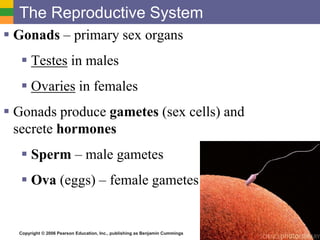
The Reproductive System
 Gonads – primary sex organs
 Testes in males
 Ovaries in females
 Gonads produce gametes (sex cells) and
secrete hormones
 Sperm – male gametes
 Ova (eggs) – female gametes
Copyright © 2006 Pearson Education, Inc., publishing as Benjamin Cummings
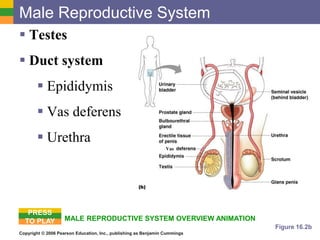
Male Reproductive System
 Testes
 Duct system
 Epididymis
 Vas deferens
 Urethra
Figure 16.2b
MALE REPRODUCTIVE SYSTEM OVERVIEW ANIMATION
PRESS
TO PLAY
Vas
Copyright © 2006 Pearson Education, Inc., publishing as Benjamin Cummings
Male Reproductive System
Vas
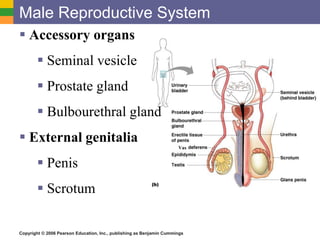
 Accessory organs
 Seminal vesicle
 Prostate gland
 Bulbourethral gland
 External genitalia
 Penis
 Scrotum
Copyright © 2006 Pearson Education, Inc., publishing as Benjamin Cummings
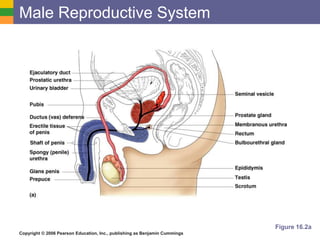
Male Reproductive System
Figure 16.2a
Copyright © 2006 Pearson Education, Inc., publishing as Benjamin Cummings
Testes
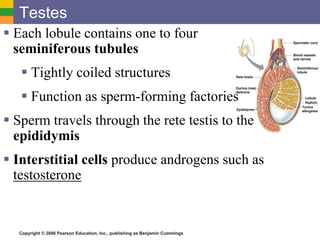
 Each lobule contains one to four
seminiferous tubules
 Tightly coiled structures
 Function as sperm-forming factories
 Sperm travels through the rete testis to the
epididymis
 Interstitial cells produce androgens such as
testosterone
Copyright © 2006 Pearson Education, Inc., publishing as Benjamin Cummings
Epididymis
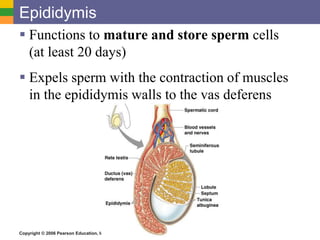
 Functions to mature and store sperm cells
(at least 20 days)
 Expels sperm with the contraction of muscles
in the epididymis walls to the vas deferens
Copyright © 2006 Pearson Education, Inc., publishing as Benjamin Cummings
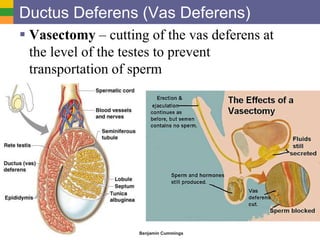
Ductus Deferens (Vas Deferens)
 Vasectomy – cutting of the vas deferens at
the level of the testes to prevent
transportation of sperm
Copyright © 2006 Pearson Education, Inc., publishing as Benjamin Cummings
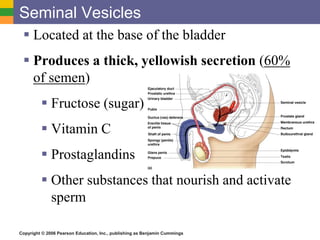
Seminal Vesicles
 Located at the base of the bladder
 Produces a thick, yellowish secretion (60%
of semen)
 Fructose (sugar)
 Vitamin C
 Prostaglandins
 Other substances that nourish and activate
sperm
Copyright © 2006 Pearson Education, Inc., publishing as Benjamin Cummings
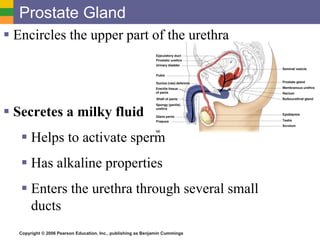
Prostate Gland
 Encircles the upper part of the urethra
 Secretes a milky fluid
 Helps to activate sperm
 Has alkaline properties
 Enters the urethra through several small
ducts
Copyright © 2006 Pearson Education, Inc., publishing as Benjamin Cummings
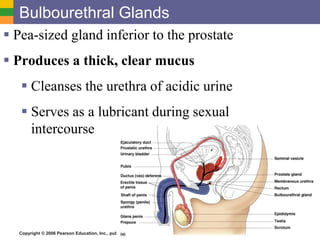
Bulbourethral Glands
 Pea-sized gland inferior to the prostate
 Produces a thick, clear mucus
 Cleanses the urethra of acidic urine
 Serves as a lubricant during sexual
intercourse
Copyright © 2006 Pearson Education, Inc., publishing as Benjamin Cummings
Semen
 Mixture of sperm and accessory gland
secretions
 Advantages of accessory gland secretions
 Fructose provides energy for sperm cells
 Alkalinity of semen helps neutralize the
acidic environment of vagina
 Semen inhibits bacterial multiplication
 Elements of semen enhance sperm motility
Copyright © 2006 Pearson Education, Inc., publishing as Benjamin Cummings
External Genitalia
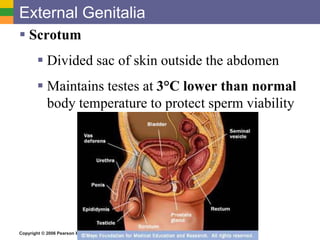
 Scrotum
 Divided sac of skin outside the abdomen
 Maintains testes at 3°C lower than normal
body temperature to protect sperm viability
Copyright © 2006 Pearson Education, Inc., publishing as Benjamin Cummings
External Genitalia
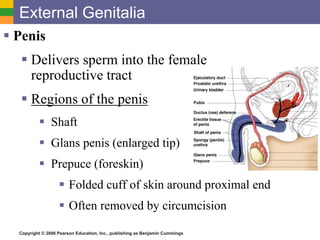
 Penis
 Delivers sperm into the female
reproductive tract
 Regions of the penis
 Shaft
 Glans penis (enlarged tip)
 Prepuce (foreskin)
 Folded cuff of skin around proximal end
 Often removed by circumcision
Copyright © 2006 Pearson Education, Inc., publishing as Benjamin Cummings
Spermatogenesis
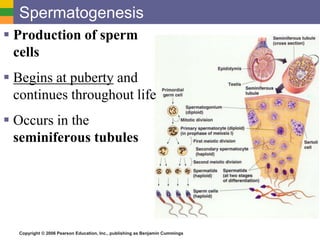
 Production of sperm
cells
 Begins at puberty and
continues throughout life
 Occurs in the
seminiferous tubules
Copyright © 2006 Pearson Education, Inc., publishing as Benjamin Cummings
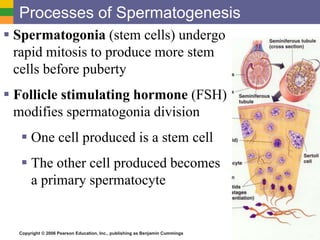
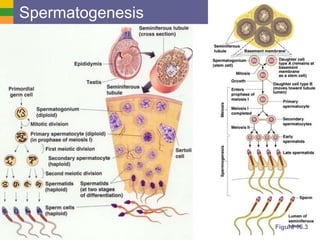
Processes of Spermatogenesis
 Spermatogonia (stem cells) undergo
rapid mitosis to produce more stem
cells before puberty
 Follicle stimulating hormone (FSH)
modifies spermatogonia division
 One cell produced is a stem cell
 The other cell produced becomes
a primary spermatocyte
Copyright © 2006 Pearson Education, Inc., publishing as Benjamin Cummings
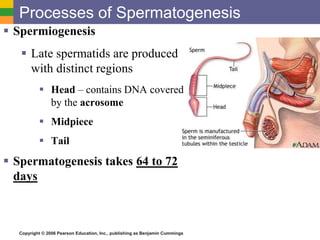
Processes of Spermatogenesis
 Spermiogenesis
 Late spermatids are produced
with distinct regions
 Head – contains DNA covered
by the acrosome
 Midpiece
 Tail
 Spermatogenesis takes 64 to 72
days
Copyright © 2006 Pearson Education, Inc., publishing as Benjamin Cummings
Spermatogenesis
Figure 16.3
Copyright © 2006 Pearson Education, Inc., publishing as Benjamin Cummings
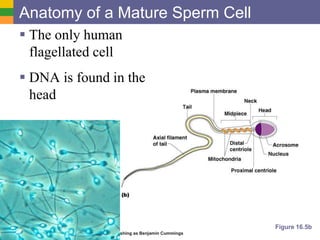
Anatomy of a Mature Sperm Cell
 The only human
flagellated cell
 DNA is found in the
head
Figure 16.5b
Copyright © 2006 Pearson Education, Inc., publishing as Benjamin Cummings
Testosterone Production
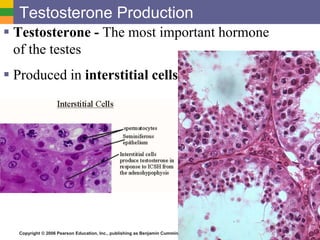
 Testosterone - The most important hormone
of the testes
 Produced in interstitial cells
Copyright © 2006 Pearson Education, Inc., publishing as Benjamin Cummings
Testosterone Production
 Functions of testosterone
 Stimulates reproductive organ development
 Underlies sex drive
 Causes secondary sex characteristics
 Deepening of voice
 Increased hair growth
 Enlargement of skeletal muscles
 Thickening of bones
Copyright © 2006 Pearson Education, Inc., publishing as Benjamin Cummings
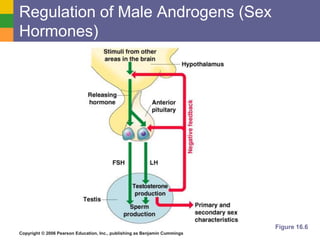
Regulation of Male Androgens (Sex
Hormones)
Figure 16.6

8692656.ppt

  • 1.
    ELAINE N. MARIEB EIGHTHEDITION 16 Copyright © 2006 Pearson Education, Inc., publishing as Benjamin Cummings PowerPoint® Lecture Slide Presentation by Jerry L. Cook, Sam Houston University ESSENTIALS OF HUMAN ANATOMY & PHYSIOLOGY PART A The Reproductive System
  • 2.
    Copyright © 2006Pearson Education, Inc., publishing as Benjamin Cummings The Reproductive System  Gonads – primary sex organs  Testes in males  Ovaries in females  Gonads produce gametes (sex cells) and secrete hormones  Sperm – male gametes  Ova (eggs) – female gametes
  • 3.
    Copyright © 2006Pearson Education, Inc., publishing as Benjamin Cummings Male Reproductive System  Testes  Duct system  Epididymis  Vas deferens  Urethra Figure 16.2b MALE REPRODUCTIVE SYSTEM OVERVIEW ANIMATION PRESS TO PLAY Vas
  • 4.
    Copyright © 2006Pearson Education, Inc., publishing as Benjamin Cummings Male Reproductive System Vas  Accessory organs  Seminal vesicle  Prostate gland  Bulbourethral gland  External genitalia  Penis  Scrotum
  • 5.
    Copyright © 2006Pearson Education, Inc., publishing as Benjamin Cummings Male Reproductive System Figure 16.2a
  • 6.
    Copyright © 2006Pearson Education, Inc., publishing as Benjamin Cummings Testes  Each lobule contains one to four seminiferous tubules  Tightly coiled structures  Function as sperm-forming factories  Sperm travels through the rete testis to the epididymis  Interstitial cells produce androgens such as testosterone
  • 7.
    Copyright © 2006Pearson Education, Inc., publishing as Benjamin Cummings Epididymis  Functions to mature and store sperm cells (at least 20 days)  Expels sperm with the contraction of muscles in the epididymis walls to the vas deferens
  • 8.
    Copyright © 2006Pearson Education, Inc., publishing as Benjamin Cummings Ductus Deferens (Vas Deferens)  Vasectomy – cutting of the vas deferens at the level of the testes to prevent transportation of sperm
  • 9.
    Copyright © 2006Pearson Education, Inc., publishing as Benjamin Cummings Seminal Vesicles  Located at the base of the bladder  Produces a thick, yellowish secretion (60% of semen)  Fructose (sugar)  Vitamin C  Prostaglandins  Other substances that nourish and activate sperm
  • 10.
    Copyright © 2006Pearson Education, Inc., publishing as Benjamin Cummings Prostate Gland  Encircles the upper part of the urethra  Secretes a milky fluid  Helps to activate sperm  Has alkaline properties  Enters the urethra through several small ducts
  • 11.
    Copyright © 2006Pearson Education, Inc., publishing as Benjamin Cummings Bulbourethral Glands  Pea-sized gland inferior to the prostate  Produces a thick, clear mucus  Cleanses the urethra of acidic urine  Serves as a lubricant during sexual intercourse
  • 12.
    Copyright © 2006Pearson Education, Inc., publishing as Benjamin Cummings Semen  Mixture of sperm and accessory gland secretions  Advantages of accessory gland secretions  Fructose provides energy for sperm cells  Alkalinity of semen helps neutralize the acidic environment of vagina  Semen inhibits bacterial multiplication  Elements of semen enhance sperm motility
  • 13.
    Copyright © 2006Pearson Education, Inc., publishing as Benjamin Cummings External Genitalia  Scrotum  Divided sac of skin outside the abdomen  Maintains testes at 3°C lower than normal body temperature to protect sperm viability
  • 14.
    Copyright © 2006Pearson Education, Inc., publishing as Benjamin Cummings External Genitalia  Penis  Delivers sperm into the female reproductive tract  Regions of the penis  Shaft  Glans penis (enlarged tip)  Prepuce (foreskin)  Folded cuff of skin around proximal end  Often removed by circumcision
  • 15.
    Copyright © 2006Pearson Education, Inc., publishing as Benjamin Cummings Spermatogenesis  Production of sperm cells  Begins at puberty and continues throughout life  Occurs in the seminiferous tubules
  • 16.
    Copyright © 2006Pearson Education, Inc., publishing as Benjamin Cummings Processes of Spermatogenesis  Spermatogonia (stem cells) undergo rapid mitosis to produce more stem cells before puberty  Follicle stimulating hormone (FSH) modifies spermatogonia division  One cell produced is a stem cell  The other cell produced becomes a primary spermatocyte
  • 17.
    Copyright © 2006Pearson Education, Inc., publishing as Benjamin Cummings Processes of Spermatogenesis  Spermiogenesis  Late spermatids are produced with distinct regions  Head – contains DNA covered by the acrosome  Midpiece  Tail  Spermatogenesis takes 64 to 72 days
  • 18.
    Copyright © 2006Pearson Education, Inc., publishing as Benjamin Cummings Spermatogenesis Figure 16.3
  • 19.
    Copyright © 2006Pearson Education, Inc., publishing as Benjamin Cummings Anatomy of a Mature Sperm Cell  The only human flagellated cell  DNA is found in the head Figure 16.5b
  • 20.
    Copyright © 2006Pearson Education, Inc., publishing as Benjamin Cummings Testosterone Production  Testosterone - The most important hormone of the testes  Produced in interstitial cells
  • 21.
    Copyright © 2006Pearson Education, Inc., publishing as Benjamin Cummings Testosterone Production  Functions of testosterone  Stimulates reproductive organ development  Underlies sex drive  Causes secondary sex characteristics  Deepening of voice  Increased hair growth  Enlargement of skeletal muscles  Thickening of bones
  • 22.
    Copyright © 2006Pearson Education, Inc., publishing as Benjamin Cummings Regulation of Male Androgens (Sex Hormones) Figure 16.6