Book Title
Edition
Chapter 1 Lecture
© 2012 Pearson Education, Inc.
Chapter 8
Injuries to the Face,
Eye, and Throat
Slide Presentation prepared by
Randall Benner, M.Ed., NREMT-P
Learning Objectives
• Describe the assessment and first aid care for a
range of eye injuries including foreign or impaled
objects, chemical burns, and eyeball, eyelid and
eye socket injuries.
• Describe the first aid care for injuries to the face,
mouth, jaw, nose, and throat, including dental
injuries.
© 2012 Pearson Education, Inc.
Injuries to the Eye
• True ocular emergencies tend to be urgent.
• Other common, and less serious, eye injuries
occur more frequently.
• Can involve underlying bone and soft tissues.
• Because of the potential for permanent damage,
never assume an eye injury is minor until
confirmed.
• All eye injuries should receive immediate
medical attention.
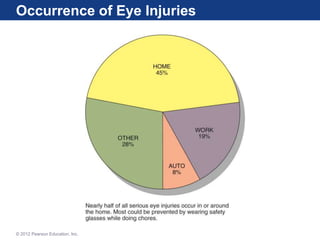
• Almost half of all serious eye injuries occur in the
home.
© 2012 Pearson Education, Inc.
Occurrence of Eye Injuries
© 2012 Pearson Education, Inc.
Assessment for Eye Injuries
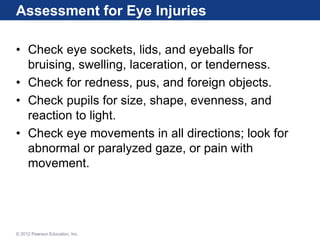
• Check eye sockets, lids, and eyeballs for
bruising, swelling, laceration, or tenderness.
• Check for redness, pus, and foreign objects.
• Check pupils for size, shape, evenness, and
reaction to light.
• Check eye movements in all directions; look for
abnormal or paralyzed gaze, or pain with
movement.
© 2012 Pearson Education, Inc.
Basic First Aid Care for Eye Injuries
• Never put direct pressure on the eyeball.
• Don’t irrigate except for chemical burns or
foreign objects.
• Don’t put salves (ointments) or medicine in the
eye.
• Don’t remove blood or blood clots.
© 2012 Pearson Education, Inc.
Basic First Aid Care for Eye Injuries
• Don’t try to force the eyelid open except to
irrigate.
• Have the victim lie down and stay still.
• Limit use of the uninjured eye.
• Give the victim nothing by mouth.
• Get a physician’s evaluation.
© 2012 Pearson Education, Inc.
Foreign Objects in the Eye
• If not removed, can cause significant damage.
• Pain is often severe.
• Light may cause further irritation.
• Never let a victim rub the affected eye.
• Ask the victim to blink or cry to help remove
objects.
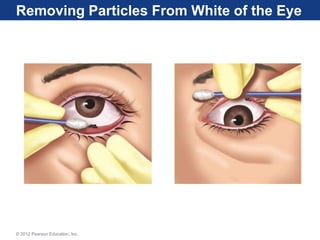
• Attempt to remove only objects that are not on or
in the cornea.
• Notify EMS.
© 2012 Pearson Education, Inc.
Removing Particles From White of the Eye
© 2012 Pearson Education, Inc.
Eye Socket Injuries
• Be aware that Facial injury may also cause
damage to skull bones.
• When an eye socket has been fractured, always
assume there is also head injury.
• Signs and symptoms include
– Double vision
– Decreased vision
– Loss of feeling
– Nasal discharge
– Paralysis of upward gaze
© 2012 Pearson Education, Inc.
Eyelid Injuries
• Include black eyes, burns, and lacerations
• Due to the profusion of blood vessels, eyelid
lacerations can cause profuse bleeding.
• Always also check for eyeball injury.
• Control bleeding and protect injured tissue and
underlying structures.
• Activate the EMS system.
© 2012 Pearson Education, Inc.
Eyeball Injuries
• Include bruising, cuts, foreign object damage,
and abrasions
• Deep lacerations can cut the cornea; if so,
eyeball contents may spill out.
• Severe blunt trauma can rupture the eyeball.
• Signs and symptoms include an irregularly-
shaped eyeball, and blood in the front chamber
of the eye.
© 2012 Pearson Education, Inc.
Chemical Burns of the Eye
• Eye burns represent a dire emergency
• Permanent damage can occur within seconds
• The first ten minutes after a chemical burn injury
can determine the final outcome
• Burning and tissue damage continue while any
substance remains in the eye
• Signs and symptoms include irritation and
swelling; redness; blurred vision; extreme pain;
irritated skin around the eye
© 2012 Pearson Education, Inc.
Light Burns of the Eye
• Results from looking at ultraviolet light sources,
tanning lamps, arc welders, etc.
• Extreme pain follows one to six hours after
exposure.
• Victim should see an ophthalmologist.
• Move the victim from light sources; keep in dark
rooms.
• Cover both eyes with moist gauze pads.
• Discourage the victim from rubbing their eyes.
© 2012 Pearson Education, Inc.
Impaled Objects or Extruded Eyeball
• Should be removed only by a physician
• Stabilize the object to prevent movement.
• If serious, the eyeball may be forced out of its
socket; if so, do not attempt to replace.
• Activate the EMS immediately.
• Treat the victim for shock.
© 2012 Pearson Education, Inc.
Injuries to the Face
• Always suspect additional spinal injuries of the
neck and back.
• Establish an airway if needed; inspect the mouth
and remove fragments.
• Immobilize the neck.
• Control bleeding.
• Cover injured nerves, tendons or blood vessels
with moist, sterile dressing.
• Inspect inside and outside of the cheeks and
teeth.
• Do not use force to stop bleeding; apply gentle
pressure or just enough to stop bleeding.
© 2012 Pearson Education, Inc.
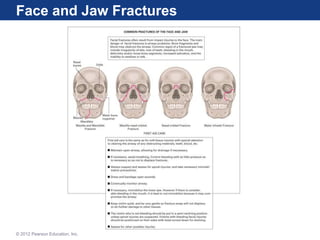
Face and Jaw Fractures
© 2012 Pearson Education, Inc.
Injuries to the Cheek and Nose
• The only time to remove an impaled facial object
is when it is in the cheek, has penetrated
through, and is loose; this presents an airway
obstruction danger.
• Nose injuries are usually caused by blunt
trauma; follow the same treatment guidelines as
for other soft-tissue injuries.
• Be careful to maintain an open airway; don’t
allow blood to drain into the throat.
• Best position for nose injury victims is usually
sitting, leaning slightly forward.
© 2012 Pearson Education, Inc.
Injuries to the Ear
• Common, but rarely life-threatening
• Sections may become severed
• If so, treat the same as other soft-tissue injuries.
• Generally, don’t probe the ear.
• Never pack the ear to prevent canal bleeding;
place a loose, clean dressing across ear
opening; don’t apply pressure.
• If you can see an embedded object, gently
remove with tweezers.
• Never irrigate to remove a foreign object; this will
cause swelling and make removal harder.
© 2012 Pearson Education, Inc.
Throat Injuries
• Can be caused by blows, constriction, falls, cuts
• If cut, major artery bleeding is a serious concern
• Maintaining an open airway is critical.
• Have the victim lie down to reduce the chance of
air entering blood vessels.
• Position the victim on her left side, and tilt her
body downward at a 15 degree angle (head
lower than legs).
• Control bleeding.
• Treat for shock.
© 2012 Pearson Education, Inc.
Dental Emergencies
• Rarely life threatening but can be very painful
• Rapid first aid care can dramatically improve
outcomes
• In emergencies, the victim should see a dentist
or oral surgeon promptly.
• Check for and control bleeding.
• Common problems include
– Loose tooth
– Broken tooth
– Knocked-out tooth
© 2012 Pearson Education, Inc.
Summary
• Never try to remove a foreign object lodged in
the cornea or main part of the eye.
• For eyelid injuries, control bleeding but don’t
apply pressure.
• Irrigate chemical burns in eyes and seek
immediate medical help.
• With facial injuries, always suspect the
possibility of additional spinal injury.
• Top priority in treating victims of facial or jaw
injury is to maintain an open airway.
© 2012 Pearson Education, Inc.

Lecture 5_M08_KARR120_10E_PPT_C08.ppt

  • 1.
    Book Title Edition Chapter 1Lecture © 2012 Pearson Education, Inc. Chapter 8 Injuries to the Face, Eye, and Throat Slide Presentation prepared by Randall Benner, M.Ed., NREMT-P
  • 2.
    Learning Objectives • Describethe assessment and first aid care for a range of eye injuries including foreign or impaled objects, chemical burns, and eyeball, eyelid and eye socket injuries. • Describe the first aid care for injuries to the face, mouth, jaw, nose, and throat, including dental injuries. © 2012 Pearson Education, Inc.
  • 3.
    Injuries to theEye • True ocular emergencies tend to be urgent. • Other common, and less serious, eye injuries occur more frequently. • Can involve underlying bone and soft tissues. • Because of the potential for permanent damage, never assume an eye injury is minor until confirmed. • All eye injuries should receive immediate medical attention. • Almost half of all serious eye injuries occur in the home. © 2012 Pearson Education, Inc.
  • 4.
    Occurrence of EyeInjuries © 2012 Pearson Education, Inc.
  • 5.
    Assessment for EyeInjuries • Check eye sockets, lids, and eyeballs for bruising, swelling, laceration, or tenderness. • Check for redness, pus, and foreign objects. • Check pupils for size, shape, evenness, and reaction to light. • Check eye movements in all directions; look for abnormal or paralyzed gaze, or pain with movement. © 2012 Pearson Education, Inc.
  • 6.
    Basic First AidCare for Eye Injuries • Never put direct pressure on the eyeball. • Don’t irrigate except for chemical burns or foreign objects. • Don’t put salves (ointments) or medicine in the eye. • Don’t remove blood or blood clots. © 2012 Pearson Education, Inc.
  • 7.
    Basic First AidCare for Eye Injuries • Don’t try to force the eyelid open except to irrigate. • Have the victim lie down and stay still. • Limit use of the uninjured eye. • Give the victim nothing by mouth. • Get a physician’s evaluation. © 2012 Pearson Education, Inc.
  • 8.
    Foreign Objects inthe Eye • If not removed, can cause significant damage. • Pain is often severe. • Light may cause further irritation. • Never let a victim rub the affected eye. • Ask the victim to blink or cry to help remove objects. • Attempt to remove only objects that are not on or in the cornea. • Notify EMS. © 2012 Pearson Education, Inc.
  • 9.
    Removing Particles FromWhite of the Eye © 2012 Pearson Education, Inc.
  • 10.
    Eye Socket Injuries •Be aware that Facial injury may also cause damage to skull bones. • When an eye socket has been fractured, always assume there is also head injury. • Signs and symptoms include – Double vision – Decreased vision – Loss of feeling – Nasal discharge – Paralysis of upward gaze © 2012 Pearson Education, Inc.
  • 11.
    Eyelid Injuries • Includeblack eyes, burns, and lacerations • Due to the profusion of blood vessels, eyelid lacerations can cause profuse bleeding. • Always also check for eyeball injury. • Control bleeding and protect injured tissue and underlying structures. • Activate the EMS system. © 2012 Pearson Education, Inc.
  • 12.
    Eyeball Injuries • Includebruising, cuts, foreign object damage, and abrasions • Deep lacerations can cut the cornea; if so, eyeball contents may spill out. • Severe blunt trauma can rupture the eyeball. • Signs and symptoms include an irregularly- shaped eyeball, and blood in the front chamber of the eye. © 2012 Pearson Education, Inc.
  • 13.
    Chemical Burns ofthe Eye • Eye burns represent a dire emergency • Permanent damage can occur within seconds • The first ten minutes after a chemical burn injury can determine the final outcome • Burning and tissue damage continue while any substance remains in the eye • Signs and symptoms include irritation and swelling; redness; blurred vision; extreme pain; irritated skin around the eye © 2012 Pearson Education, Inc.
  • 14.
    Light Burns ofthe Eye • Results from looking at ultraviolet light sources, tanning lamps, arc welders, etc. • Extreme pain follows one to six hours after exposure. • Victim should see an ophthalmologist. • Move the victim from light sources; keep in dark rooms. • Cover both eyes with moist gauze pads. • Discourage the victim from rubbing their eyes. © 2012 Pearson Education, Inc.
  • 15.
    Impaled Objects orExtruded Eyeball • Should be removed only by a physician • Stabilize the object to prevent movement. • If serious, the eyeball may be forced out of its socket; if so, do not attempt to replace. • Activate the EMS immediately. • Treat the victim for shock. © 2012 Pearson Education, Inc.
  • 16.
    Injuries to theFace • Always suspect additional spinal injuries of the neck and back. • Establish an airway if needed; inspect the mouth and remove fragments. • Immobilize the neck. • Control bleeding. • Cover injured nerves, tendons or blood vessels with moist, sterile dressing. • Inspect inside and outside of the cheeks and teeth. • Do not use force to stop bleeding; apply gentle pressure or just enough to stop bleeding. © 2012 Pearson Education, Inc.
  • 17.
    Face and JawFractures © 2012 Pearson Education, Inc.
  • 18.
    Injuries to theCheek and Nose • The only time to remove an impaled facial object is when it is in the cheek, has penetrated through, and is loose; this presents an airway obstruction danger. • Nose injuries are usually caused by blunt trauma; follow the same treatment guidelines as for other soft-tissue injuries. • Be careful to maintain an open airway; don’t allow blood to drain into the throat. • Best position for nose injury victims is usually sitting, leaning slightly forward. © 2012 Pearson Education, Inc.
  • 19.
    Injuries to theEar • Common, but rarely life-threatening • Sections may become severed • If so, treat the same as other soft-tissue injuries. • Generally, don’t probe the ear. • Never pack the ear to prevent canal bleeding; place a loose, clean dressing across ear opening; don’t apply pressure. • If you can see an embedded object, gently remove with tweezers. • Never irrigate to remove a foreign object; this will cause swelling and make removal harder. © 2012 Pearson Education, Inc.
  • 20.
    Throat Injuries • Canbe caused by blows, constriction, falls, cuts • If cut, major artery bleeding is a serious concern • Maintaining an open airway is critical. • Have the victim lie down to reduce the chance of air entering blood vessels. • Position the victim on her left side, and tilt her body downward at a 15 degree angle (head lower than legs). • Control bleeding. • Treat for shock. © 2012 Pearson Education, Inc.
  • 21.
    Dental Emergencies • Rarelylife threatening but can be very painful • Rapid first aid care can dramatically improve outcomes • In emergencies, the victim should see a dentist or oral surgeon promptly. • Check for and control bleeding. • Common problems include – Loose tooth – Broken tooth – Knocked-out tooth © 2012 Pearson Education, Inc.
  • 22.
    Summary • Never tryto remove a foreign object lodged in the cornea or main part of the eye. • For eyelid injuries, control bleeding but don’t apply pressure. • Irrigate chemical burns in eyes and seek immediate medical help. • With facial injuries, always suspect the possibility of additional spinal injury. • Top priority in treating victims of facial or jaw injury is to maintain an open airway. © 2012 Pearson Education, Inc.