EXERCISE EFFECT ON THE RESPIRATORY SYSTEM
Mr. Anirban Misra
Assistant Professor,
Department of Physical Education,
Union Christian Training College,
Berhampore, Murshidabad, W.B.
Exercise is the most influential
physiological stress on breathing
 Exercise increases the
breaths/minute
 Exercise increases the
amount of air in each
breath (tidal volume)
How is increased ventilation accomplished?
During light exercise
 Ventilation increases linearly
with oxygen uptake and carbon
dioxide production
 This increase in ventilation is
accomplished more by
increased tidal volume
(breathing deeper in and out)
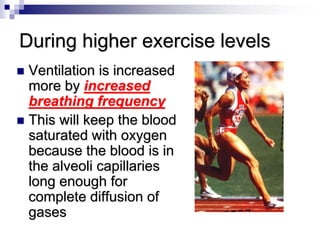
During higher exercise levels
 Ventilation is increased
more by increased
breathing frequency
 This will keep the blood
saturated with oxygen
because the blood is in
the alveoli capillaries
long enough for
complete diffusion of
gases
Steady rate (moderate) exercise
 sufficient oxygen is supplied to muscles
 due to increased oxygen up take, there is little,
or no, build up of lactic acid in the muscles
 some lactate will be produced and removed by
the blood stream
 lactic acid is neutralized in the blood (this
reaction produces carbon dioxide as a by-
product)
 increased carbon dioxide in the blood will
stimulate increased ventilation
 Increased ventilation is accomplished by both
increased tidal volume and frequency
How does pulmonary ventilation
(breathing) increase during exercise?
1. During light exercise (walking)?
By increasing the tidal volume (breathing deeper)
2. During intense exercise (sprinting)?
By increasing the frequency of breathing
3. During steady state exercise (jogging)?
By increasing both the tidal volume and the
frequency of breathing
It is the oxygen up take of the
muscles that does not keep up with
the oxygen demand (of muscles)
during strenuous exercises –
pulmonary ventilation is usually
adequate – usually more than
adequate.
IMPORTANT!!
The Energy Cost of
Breathing
At rest and with light exercise
 the energy cost of breathing is minimal
(4% of energy)
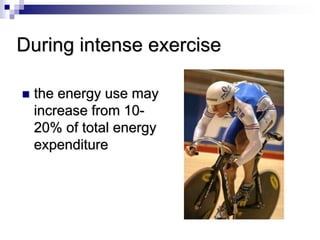
During intense exercise
 the energy use may
increase from 10-
20% of total energy
expenditure
In a person with respiratory disease
 the work of
breathing itself
during exercise
may be
exhausting
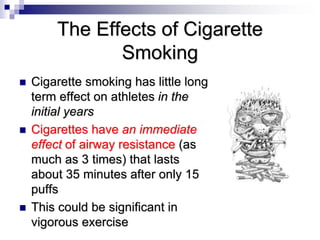
The Effects of Cigarette
Smoking
 Cigarette smoking has little long
term effect on athletes in the
initial years
 Cigarettes have an immediate
effect of airway resistance (as
much as 3 times) that lasts
about 35 minutes after only 15
puffs
 This could be significant in
vigorous exercise
Ventilation Adaptations
with Training
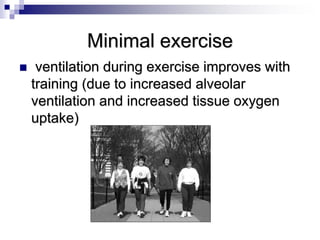
Minimal exercise
 ventilation during exercise improves with
training (due to increased alveolar
ventilation and increased tissue oxygen
uptake)
Sub-maximal exercise
The percentage of energy used in breathing is
reduced after training only 4 weeks
 Tidal volume increases
 Breathing frequency is reduced
 This results in increased amounts of
oxygen extracted from inspired air
Untrained expired air contains 18%
oxygen
Trained expired air contains 14-15%
oxygen
This is important
because
It reduces the fatiguing of the
ventilation musculature
The freed up oxygen (not used by
the respiratory muscles) can be
available for the exercising muscle
Specificity of Ventilation Response
 The improvements in the ventilation were
evident only when the athletes performed
the specific exercises that they were
trained in
 New exercises did not show any improved
ventilation
 Why?
It may be, the ventilation adjustments
were signaled by neural and chemical
changes in the trained muscles
What is Blood Doping?
 Blood doping is the practice of boosting
the number of red blood cells (RBCs) in
the bloodstream in order to enhance
athletic performance.
 Because RBC’s carry oxygen from the
lungs to the muscles, more RBC’s in the
blood can improve an athlete’s aerobic
capacity and endurance.
THANK YOU

AM_EXERCISE.ppt

  • 1.
    EXERCISE EFFECT ONTHE RESPIRATORY SYSTEM Mr. Anirban Misra Assistant Professor, Department of Physical Education, Union Christian Training College, Berhampore, Murshidabad, W.B.
  • 2.
    Exercise is themost influential physiological stress on breathing  Exercise increases the breaths/minute  Exercise increases the amount of air in each breath (tidal volume) How is increased ventilation accomplished?
  • 3.
    During light exercise Ventilation increases linearly with oxygen uptake and carbon dioxide production  This increase in ventilation is accomplished more by increased tidal volume (breathing deeper in and out)
  • 4.
    During higher exerciselevels  Ventilation is increased more by increased breathing frequency  This will keep the blood saturated with oxygen because the blood is in the alveoli capillaries long enough for complete diffusion of gases
  • 5.
    Steady rate (moderate)exercise  sufficient oxygen is supplied to muscles  due to increased oxygen up take, there is little, or no, build up of lactic acid in the muscles  some lactate will be produced and removed by the blood stream  lactic acid is neutralized in the blood (this reaction produces carbon dioxide as a by- product)  increased carbon dioxide in the blood will stimulate increased ventilation  Increased ventilation is accomplished by both increased tidal volume and frequency
  • 6.
    How does pulmonaryventilation (breathing) increase during exercise? 1. During light exercise (walking)? By increasing the tidal volume (breathing deeper) 2. During intense exercise (sprinting)? By increasing the frequency of breathing 3. During steady state exercise (jogging)? By increasing both the tidal volume and the frequency of breathing
  • 7.
    It is theoxygen up take of the muscles that does not keep up with the oxygen demand (of muscles) during strenuous exercises – pulmonary ventilation is usually adequate – usually more than adequate. IMPORTANT!!
  • 8.
    The Energy Costof Breathing
  • 9.
    At rest andwith light exercise  the energy cost of breathing is minimal (4% of energy)
  • 10.
    During intense exercise the energy use may increase from 10- 20% of total energy expenditure
  • 11.
    In a personwith respiratory disease  the work of breathing itself during exercise may be exhausting
  • 12.
    The Effects ofCigarette Smoking  Cigarette smoking has little long term effect on athletes in the initial years  Cigarettes have an immediate effect of airway resistance (as much as 3 times) that lasts about 35 minutes after only 15 puffs  This could be significant in vigorous exercise
  • 13.
  • 14.
    Minimal exercise  ventilationduring exercise improves with training (due to increased alveolar ventilation and increased tissue oxygen uptake)
  • 15.
    Sub-maximal exercise The percentageof energy used in breathing is reduced after training only 4 weeks  Tidal volume increases  Breathing frequency is reduced  This results in increased amounts of oxygen extracted from inspired air Untrained expired air contains 18% oxygen Trained expired air contains 14-15% oxygen
  • 16.
    This is important because Itreduces the fatiguing of the ventilation musculature The freed up oxygen (not used by the respiratory muscles) can be available for the exercising muscle
  • 17.
    Specificity of VentilationResponse  The improvements in the ventilation were evident only when the athletes performed the specific exercises that they were trained in  New exercises did not show any improved ventilation  Why? It may be, the ventilation adjustments were signaled by neural and chemical changes in the trained muscles
  • 18.
    What is BloodDoping?  Blood doping is the practice of boosting the number of red blood cells (RBCs) in the bloodstream in order to enhance athletic performance.  Because RBC’s carry oxygen from the lungs to the muscles, more RBC’s in the blood can improve an athlete’s aerobic capacity and endurance.
  • 19.