ICU Admission and
Triage Criteria
Pat Melanson, MD
McGill University Health Center
Requests for ICU Beds
• excellent care
• abundant resources
– high nurse-patient ratios
– pharmacists,nutritionist, RT’s, etc
– high tech equipment
• signs of deterioration quickly identified
• “give them a chance”
• discomfort with death
• convenience
• Demand frequently exceeds supply
The “Expensive” Care Unit
• Canada
– 8% of total inpatient cost
– 0.2 % of GNP
– $1500 per day
• USA
– 20 - 28 % of total inpatient cost
– 0.8 to 1 % of the GNP
• 1 ICU day = 3 to 6 times non-ICU day
• Higher costs in non-survivors
• ICU resources are finite
ICU Admission Criteria
• A service for patients with
potentially recoverable conditions
who can benefit from more detailed
observation and invasive treatment
than can be safely provided in
general wards or high dependency
areas
ICU Triage
• admission criteria remain poorly defined
• identification of patients who can benefit
from ICU care is extremely difficult
• demand for ICU services exceeds supply
• rationing of ICU beds is common
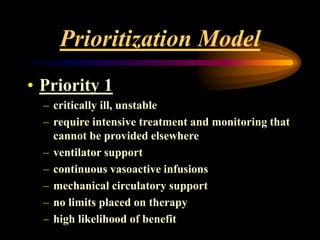
Prioritization Model
• Priority 1
– critically ill, unstable
– require intensive treatment and monitoring that
cannot be provided elsewhere
– ventilator support
– continuous vasoactive infusions
– mechanical circulatory support
– no limits placed on therapy
– high likelihood of benefit
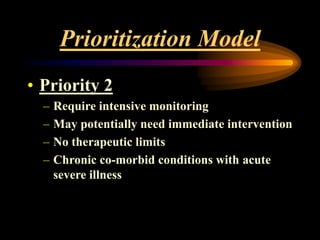
Prioritization Model
• Priority 2
– Require intensive monitoring
– May potentially need immediate intervention
– No therapeutic limits
– Chronic co-morbid conditions with acute
severe illness
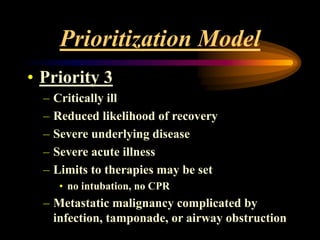
Prioritization Model
• Priority 3
– Critically ill
– Reduced likelihood of recovery
– Severe underlying disease
– Severe acute illness
– Limits to therapies may be set
• no intubation, no CPR
– Metastatic malignancy complicated by
infection, tamponade, or airway obstruction
Prioritization Model
• Priority 4
– Generally not appropriate for ICU
– May admit on individual basis if unusual
circumstances
– Too well for ICU
• mild CHF, stable DKA, conscious drug overdose,
peripheral vascular surgery
– Too sick for ICU (terminal, irreversible)
• irreversible brain damage, irreversible
multisystem failure, metastatic cancer
unresponsive to chemotherapy
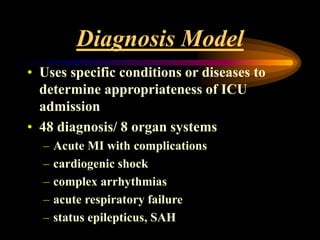
Diagnosis Model
• Uses specific conditions or diseases to
determine appropriateness of ICU
admission
• 48 diagnosis/ 8 organ systems
– Acute MI with complications
– cardiogenic shock
– complex arrhythmias
– acute respiratory failure
– status epilepticus, SAH
JCAHCO
Objectives Parameters Model
• Vital signs
– HR < 40 or > 150
– SBP <80
– MAP <60
– DBP >120
– RR > 35
Objectives Parameters Model
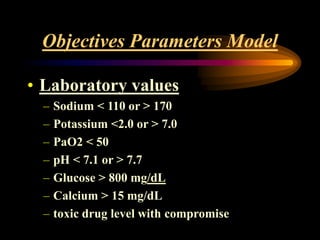
• Laboratory values
– Sodium < 110 or > 170
– Potassium <2.0 or > 7.0
– PaO2 < 50
– pH < 7.1 or > 7.7
– Glucose > 800 mg/dL
– Calcium > 15 mg/dL
– toxic drug level with compromise
Objectives Parameters Model
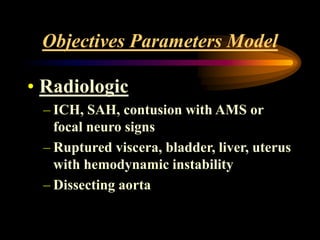
• Radiologic
– ICH, SAH, contusion with AMS or
focal neuro signs
– Ruptured viscera, bladder, liver, uterus
with hemodynamic instability
– Dissecting aorta
Objectives Parameters Model
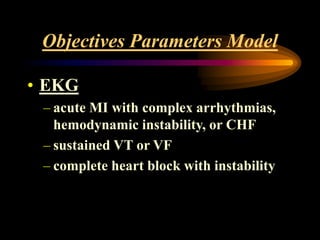
• EKG
– acute MI with complex arrhythmias,
hemodynamic instability, or CHF
– sustained VT or VF
– complete heart block with instability
Objectives Parameters Model
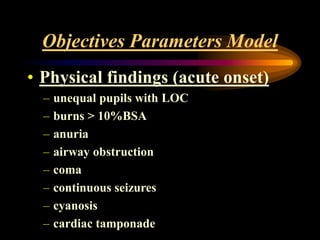
• Physical findings (acute onset)
– unequal pupils with LOC
– burns > 10%BSA
– anuria
– airway obstruction
– coma
– continuous seizures
– cyanosis
– cardiac tamponade
ICU Admission Criteria
• Potential or established organ failure
• Factors to be considered
– Diagnosis
– Severity of illness
– Age and functional status
– Co-existing disease
– Physiological reserve
– Prognosis
– Availability of suitable treatment
– Response to treatment to date
– Recent cardiopulmonary arrest
– Anticipated quality of life
– The patient’s wishes
Discharge Criteria
• physiologic status has stabilized
– need for ICU monitoring and care no longer
necessary
• physiologic status has deteriorated
– active interventions no longer planned
Intermediate Care Units
• monitoring and care of patients with moderate
or potentially severe physiologic instability
• require technical support
• frequent monitoring of vital signs
• frequent nursing interventions
• not necessarily artificial life support
• do not require invasive monitoring
• require less care than ICU
• require more care than general ward
Intermediate Care Units
• 22% of ICU bed days
• 6180/17440 admissions with less than a
10% risk of requiring active treatment
based on this monitoring
• reduced costs with ICU demonstrated
• increased patient satisfaction
Intermediate Care Units
• reduces costs
• reduces ICU LOS
• no negative impact on outcome
• improves patient/family satisfaction
ICU Outcome Studies
• no difference ICU vs. Ward for CEA
• femoral bypass
• GI bleeds
• drug overdose
• bone marrow transplants
• closed units
• AAA
ICU Triage
• Patients should be admitted if they can
benefit with decreased risk of death
• patients with reversible medical
conditions who have a “reasonable”
prospect of substantial recovery
– NIH Concensus conference
ICU Triage
• good prognosis over poor
• likelihood of benefit
• life expectancy due to disease
• anticipated quality of life
• wishes of patient or surrogate
• obligations to current patients outweigh
new patients
ICU Triage
• “Too well to benefit”
– Possibility of being detrimental by providing
overly aggressive care
– Procedure complications
– Increased chance of multi-resistant infections
– Patients who will survive anyway should not
be admitted for anticipatory monitoring
ICU Triage
• “Too sick to benefit”
–Hopelessly ill patients should not
be admitted to an ICU
ICU Triage
• age
• diagnosis - good or bad
• number of ICU beds available
• patients refused admission had higher
APACHE scores
• Sprung et al, CCM 1999;27:1073-1079
ICU Triage
• Intensive therapy not available elsewhere
– reasonable survival with, death without
• Monitored patients at high risk of
complications
• Comatose with poor quality of life expected
• Little likelihood of survival
• Monitored patients at low risk for
complications

ICU-Triage.ppt

  • 1.
    ICU Admission and TriageCriteria Pat Melanson, MD McGill University Health Center
  • 2.
    Requests for ICUBeds • excellent care • abundant resources – high nurse-patient ratios – pharmacists,nutritionist, RT’s, etc – high tech equipment • signs of deterioration quickly identified • “give them a chance” • discomfort with death • convenience • Demand frequently exceeds supply
  • 3.
    The “Expensive” CareUnit • Canada – 8% of total inpatient cost – 0.2 % of GNP – $1500 per day • USA – 20 - 28 % of total inpatient cost – 0.8 to 1 % of the GNP • 1 ICU day = 3 to 6 times non-ICU day • Higher costs in non-survivors • ICU resources are finite
  • 4.
    ICU Admission Criteria •A service for patients with potentially recoverable conditions who can benefit from more detailed observation and invasive treatment than can be safely provided in general wards or high dependency areas
  • 5.
    ICU Triage • admissioncriteria remain poorly defined • identification of patients who can benefit from ICU care is extremely difficult • demand for ICU services exceeds supply • rationing of ICU beds is common
  • 6.
    Prioritization Model • Priority1 – critically ill, unstable – require intensive treatment and monitoring that cannot be provided elsewhere – ventilator support – continuous vasoactive infusions – mechanical circulatory support – no limits placed on therapy – high likelihood of benefit
  • 7.
    Prioritization Model • Priority2 – Require intensive monitoring – May potentially need immediate intervention – No therapeutic limits – Chronic co-morbid conditions with acute severe illness
  • 8.
    Prioritization Model • Priority3 – Critically ill – Reduced likelihood of recovery – Severe underlying disease – Severe acute illness – Limits to therapies may be set • no intubation, no CPR – Metastatic malignancy complicated by infection, tamponade, or airway obstruction
  • 9.
    Prioritization Model • Priority4 – Generally not appropriate for ICU – May admit on individual basis if unusual circumstances – Too well for ICU • mild CHF, stable DKA, conscious drug overdose, peripheral vascular surgery – Too sick for ICU (terminal, irreversible) • irreversible brain damage, irreversible multisystem failure, metastatic cancer unresponsive to chemotherapy
  • 10.
    Diagnosis Model • Usesspecific conditions or diseases to determine appropriateness of ICU admission • 48 diagnosis/ 8 organ systems – Acute MI with complications – cardiogenic shock – complex arrhythmias – acute respiratory failure – status epilepticus, SAH
  • 11.
    JCAHCO Objectives Parameters Model •Vital signs – HR < 40 or > 150 – SBP <80 – MAP <60 – DBP >120 – RR > 35
  • 12.
    Objectives Parameters Model •Laboratory values – Sodium < 110 or > 170 – Potassium <2.0 or > 7.0 – PaO2 < 50 – pH < 7.1 or > 7.7 – Glucose > 800 mg/dL – Calcium > 15 mg/dL – toxic drug level with compromise
  • 13.
    Objectives Parameters Model •Radiologic – ICH, SAH, contusion with AMS or focal neuro signs – Ruptured viscera, bladder, liver, uterus with hemodynamic instability – Dissecting aorta
  • 14.
    Objectives Parameters Model •EKG – acute MI with complex arrhythmias, hemodynamic instability, or CHF – sustained VT or VF – complete heart block with instability
  • 15.
    Objectives Parameters Model •Physical findings (acute onset) – unequal pupils with LOC – burns > 10%BSA – anuria – airway obstruction – coma – continuous seizures – cyanosis – cardiac tamponade
  • 16.
    ICU Admission Criteria •Potential or established organ failure • Factors to be considered – Diagnosis – Severity of illness – Age and functional status – Co-existing disease – Physiological reserve – Prognosis – Availability of suitable treatment – Response to treatment to date – Recent cardiopulmonary arrest – Anticipated quality of life – The patient’s wishes
  • 17.
    Discharge Criteria • physiologicstatus has stabilized – need for ICU monitoring and care no longer necessary • physiologic status has deteriorated – active interventions no longer planned
  • 18.
    Intermediate Care Units •monitoring and care of patients with moderate or potentially severe physiologic instability • require technical support • frequent monitoring of vital signs • frequent nursing interventions • not necessarily artificial life support • do not require invasive monitoring • require less care than ICU • require more care than general ward
  • 19.
    Intermediate Care Units •22% of ICU bed days • 6180/17440 admissions with less than a 10% risk of requiring active treatment based on this monitoring • reduced costs with ICU demonstrated • increased patient satisfaction
  • 20.
    Intermediate Care Units •reduces costs • reduces ICU LOS • no negative impact on outcome • improves patient/family satisfaction
  • 21.
    ICU Outcome Studies •no difference ICU vs. Ward for CEA • femoral bypass • GI bleeds • drug overdose • bone marrow transplants • closed units • AAA
  • 22.
    ICU Triage • Patientsshould be admitted if they can benefit with decreased risk of death • patients with reversible medical conditions who have a “reasonable” prospect of substantial recovery – NIH Concensus conference
  • 23.
    ICU Triage • goodprognosis over poor • likelihood of benefit • life expectancy due to disease • anticipated quality of life • wishes of patient or surrogate • obligations to current patients outweigh new patients
  • 24.
    ICU Triage • “Toowell to benefit” – Possibility of being detrimental by providing overly aggressive care – Procedure complications – Increased chance of multi-resistant infections – Patients who will survive anyway should not be admitted for anticipatory monitoring
  • 25.
    ICU Triage • “Toosick to benefit” –Hopelessly ill patients should not be admitted to an ICU
  • 26.
    ICU Triage • age •diagnosis - good or bad • number of ICU beds available • patients refused admission had higher APACHE scores • Sprung et al, CCM 1999;27:1073-1079
  • 27.
    ICU Triage • Intensivetherapy not available elsewhere – reasonable survival with, death without • Monitored patients at high risk of complications • Comatose with poor quality of life expected • Little likelihood of survival • Monitored patients at low risk for complications