TABLE OF CONTENTS:
Defination of a scrub nurse
Specific role in OR
Responsibilities of a scrub nurse
Video on ASEPTIC TECHNIQUES
Orientation on SURGICAL NEEDLES
Orientation on SURGICAL SUTURES
Orientation on SURGICAL INSTRUMENTS
Video on INSTRUMENT HANDLING
WHAT IS A SCRUB
NURSE?
To prepare and drape
sterile drapes,instruements
& supplies
To assist surgeon &
assistants throughout
operation by providing
instruements & supplies
To maintain patient’s safety
throughout operation
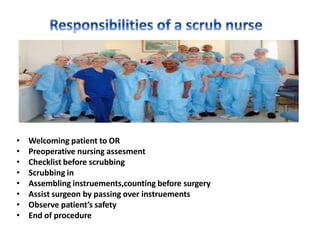
• Welcoming patient to OR
• Preoperative nursing assesment
• Checklist before scrubbing
• Scrubbing in
• Assembling instruements,counting before surgery
• Assist surgeon by passing over instruements
• Observe patient’s safety
• End of procedure
WELCOMING A PATIENT TO OR
• Welcome patient
• Introduce yourself
• Get personal information
from patient
• Ask if he/she needs any
further help
• Show her around (where
to sit,bathroom,changing
room etc)
• Ask to remove jewelry
Preoperative nursing assessment
• Age
• Allergies
• Presence of infections (temp ≥38)
• Vital signs
• Drugs contraindicated
(aspirin,heparin,warfarin)
• Nutritional status
• Physiological state(labs,x-rays)
• Psychological state
• Tolerance to anesthesia
(smoking,alcoholism)
CHECK CONSENT
CONFIRM SURGICAL PROCEDURE
CHECK INSTRUEMENTS
CHECK SUPPLIES
“Scrubbing in”
• usually involves thoroughly
washing hands and arms with
an antibacterial soap, then
putting on a sterile mask, hat,
gown and gloves so that
patients cannot be
contaminated when their bodies
are exposed for surgery.
• Open the inner sterile set &
assemble sterile instruments
on mayo tray & trolley
• Perform surgical count
• Assemble surgical blade
• Prepare sutures
• Assist surgeon in cleaning & draping patient
• Bring mayo’s tray over the patient
• Pass instruments to
surgeon in a proper
position & safe
manner
• Pass & Receive
scalpel in kidney dish
• Place the skin knife
away from working
field
• Retract tissue gently if
required
• Remove artery tips as
directed by surgeon
• Cut sutures with
scissors,help in suturing
• Assist in cautery
• Anticipate surgeon
need through out
procedure
• keep one step
ahead of surgeon in
passing
instruments,sutures
,sponges etc
• Maintain neat &
orderly sterile field
of operation
• Maintain strict aseptic techniques
• Keep talking to minimum,turn away while
sneezing,coughing
Keep your hands at table level while unengaged
• Perform second surgical count of
sponges,sharps,instruements as surgeon begins closing
• Apply dressing to the wound by non touch technique &
assist in removing the drapes
• Dispose of sharps
• Cover the soiled
instruments before
sending them for
cleaning/autoclave
• Remove gown &
glove and check
documentation
SURGICAL NEEDLES
• Surgical needles
are necessary for
the placement of
sutures in tissues
• NEEDLE
ANATOMY
– Swage
– Body
– Point
NEEDLE SWAGE
Classification by the needle
swage:
• 1. Closed Eye
• 2. French Eye
• 3. Swage
Body of the needle
• classification by the body of the needle:
¼ circle 3/8 circle ½ circle 5/8 circle
Straight Half Curved (Ski) compound Curved
Point of the needle
- Conventional cutting
(cutting on the inside)
- Reverse Cutting
(cutting on outside)
- Taper point
(Pierce and spread tissue without cutting it
- Blunt
Pierce and spread tissue without cutting it.
The word "suture" describes any strand of
material used to ligate (tie) blood vessels or
approximate (sew) tissues.
Absorbable / Nonabsorbable
Natural / Synthetic
Braided / Monofilament
Example Suture Selection
Absorbable
Natural
Synthetic
Non Absorbable
Natural
Synthetic
Fast Absorbing Gut
Chromic gut
Plain Gut
VICRYLRapide*
(polyglactin 910) suture
VICRYL*
( polyglacin 910) suture
MONOCRYL*
(polyglecaprone 25) suture
PDS II*
(polydioxanone) suture
Stainless steel
Silk
Ethilon*
(nylon)suture
NOROLON*
(nylon)suture
MERSILENE*
(polyester) suture
ETHIBOND*
(polyester) suture
PROLENE*
(polypropylene)suture
Example Suture Selection
Absorbable (Natural)
Fast Absorbing Gut Plain Gut Chromic Gut
Tensile strangth 7 days
Mass absorption 21- 42 days
Tensile strength 7-10 days
Mass absorption 60-90 days
Tensile strength
Mass absorption
28 days
90 days
Example suture selection
Absorbable (Synthetic)
PDS II
VICRYL Rapide
Mass absorption 42 days
MONOCRYL
VICRYL
Mass absorption 56-70 days
Mass absorption 6 months
Example suture Selection
Nonabsorbable
Natural
Stainless steel
Silk
Example Suture Selection
Nonabsorbable
Synthetic
NUROLON ETHIBOND
PROLENE
MERSILENE
ETHILON
Artery Forceps
used as a hemostat for
clamping bleeding vessels.
 For grasping tissue ( Opening and closing
peritoneum) .
 to hold stay sutures.
Allis' Forceps
for grasping tough structures like Rectus sheath
or fascia in LSCS or Hysterectomy
Babcock's Forceps
for grasping tubular structures like
fallopian tube in tubectomy In
Pomeroy's operation , ureter,
appendix etc.
Self retaining speculum.
Used in OPD for routine examination.
procedures like taking of Pap smear ,
insertion and removal of Copper T can be
done
Sims' Speculum
for inspection of vagina and cervix in OPD. It
retracts posterior vaginal wall.
Taking Pap Smear , Insertion and removal of
Copper T, Taking swabs,D&C , Cervix Biopsy ,
Vaginal Hysterectomy ,
CUSCO’S SPECULUM
Doyen's
Retractor
Deaver's
Retractor
for retraction of deep structures
Right Angle
Retractor
bladder retractor during LSCS/hysterectomy
Mayo scissors
Straight mayo scissors
Curved mayo scissors
Towel clip
PINNARD’S FETOSCOPE
For auscultation of fetal heart sounds
Sims' Anterior Vaginal Wall
Retractor
To take biopsy from the cervix
Sponge holding forceps
Punch biopsy forceps
To hold sponges or cervical lips
Episiotomy Scissors
Toothed
To hold tough
structures like
rectus sheath,
vaginal flaps or
skin margins
during suturing
Non toothed
DISSECTING FORCEPS (TOOTHED AND
NON- TOOTHED
LOOP HOOK
To remove IUCD from the uterine cavity
when the threads are missing
ELECTRO CAUTERY
Thermal cauterisation of the cervix
for cervical ectopy
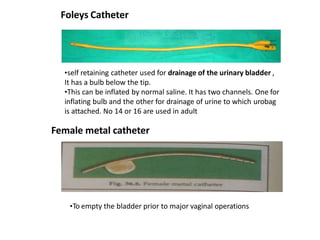
Foleys Catheter
•self retaining catheter used for drainage of the urinary bladder ,
It has a bulb below the tip.
•This can be inflated by normal saline. It has two channels. One for
inflating bulb and the other for drainage of urine to which urobag
is attached. No 14 or 16 are used in adult
Female metal catheter
•To empty the bladder prior to major vaginal operations
Hegar's Dilator
It is used for measuring length of the cervix
Uterine sound
For dilatation of cervix
TENACULUM
For grasping the cervix in hysterosalpingography or IUCD
insertion
Suction Curette
This instrument is used for first trimester MTP,
suction of vesicular mole.
Shirodkars Cerclage Needle
This is specially designed needle for putting
stitch around the cervix.
Khocker’s forceps
•used in hysterectomy /salpingectomy to
clamp fallopian tube
•for clamping umbilical cord of new born or
for artificial low rupture of membranes ( ARM).
Surgical Blades/ Scalpel
Green Armytage Forceps Needle holder
used as a hemostat in LSCS
Uterine Curette
Flushing curette
Sharman’s curette
Used for diagnostic D&C
Simple curette
Uterine dressing forceps
•To swab the uterine cavity following D+E
operation with a small gauze piece
UTERINE HOLDING FORCEPS
To fix and steady uterus when conservative
surgery is done on the adnexae
•To fix the myoma
•To give traction in a big uterus
requiring hysterectomy
MYOMA SCREW
MULTIPLE TOOTHED VULSELLUM
•used for grasping the cervix ( Usually
anterior lip of the cervix is grasped)
•in procedures like Insertion of IUCD ,
Cx Biopsy D&C, First trimester MTP
with Suction Evacuation. Cx Biopsy
•Posterior lip of the cervix is grasped for
post. colpotomy
SINGLE TOOTHED VULSELLUM
To hold the cervix after opening the vault of
vagina
•To hold new cervical stump after amputation
of the cervix and fothrergill’s operation after
subtotal hysterectomy
WRIGLEY'S FORCEPS
Obstetric forceps for out let
forceps delivery. Parts of
the forceps are blades (
which has windows or
fenestrate for firm grip of
the head) ,Shank , Lock(
English lock for Wriglys
forceps) , Handle.
VACCUM (VENTOUSE)
Alternative to forceps
delivery. Causes less
trauma to mother and
fetus
Silastic cup Metallic cup
Ayre's Spatula
Used for taking PAP smear
RING PESSARY
Used for correction of UV prolapse
UMBILICAL CORD CLAMP
UMBILICAL CORD CUTTING SCISSORS
presentation1-140615135842-phpapp02.pptx

presentation1-140615135842-phpapp02.pptx

  • 2.
    TABLE OF CONTENTS: Definationof a scrub nurse Specific role in OR Responsibilities of a scrub nurse Video on ASEPTIC TECHNIQUES Orientation on SURGICAL NEEDLES Orientation on SURGICAL SUTURES Orientation on SURGICAL INSTRUMENTS Video on INSTRUMENT HANDLING
  • 3.
    WHAT IS ASCRUB NURSE?
  • 4.
    To prepare anddrape sterile drapes,instruements & supplies To assist surgeon & assistants throughout operation by providing instruements & supplies To maintain patient’s safety throughout operation
  • 5.
    • Welcoming patientto OR • Preoperative nursing assesment • Checklist before scrubbing • Scrubbing in • Assembling instruements,counting before surgery • Assist surgeon by passing over instruements • Observe patient’s safety • End of procedure
  • 6.
    WELCOMING A PATIENTTO OR • Welcome patient • Introduce yourself • Get personal information from patient • Ask if he/she needs any further help • Show her around (where to sit,bathroom,changing room etc) • Ask to remove jewelry
  • 7.
    Preoperative nursing assessment •Age • Allergies • Presence of infections (temp ≥38) • Vital signs • Drugs contraindicated (aspirin,heparin,warfarin) • Nutritional status • Physiological state(labs,x-rays) • Psychological state • Tolerance to anesthesia (smoking,alcoholism)
  • 8.
    CHECK CONSENT CONFIRM SURGICALPROCEDURE CHECK INSTRUEMENTS CHECK SUPPLIES
  • 9.
    “Scrubbing in” • usuallyinvolves thoroughly washing hands and arms with an antibacterial soap, then putting on a sterile mask, hat, gown and gloves so that patients cannot be contaminated when their bodies are exposed for surgery.
  • 10.
    • Open theinner sterile set & assemble sterile instruments on mayo tray & trolley • Perform surgical count • Assemble surgical blade • Prepare sutures
  • 11.
    • Assist surgeonin cleaning & draping patient • Bring mayo’s tray over the patient
  • 12.
    • Pass instrumentsto surgeon in a proper position & safe manner • Pass & Receive scalpel in kidney dish • Place the skin knife away from working field
  • 13.
    • Retract tissuegently if required • Remove artery tips as directed by surgeon • Cut sutures with scissors,help in suturing • Assist in cautery
  • 14.
    • Anticipate surgeon needthrough out procedure • keep one step ahead of surgeon in passing instruments,sutures ,sponges etc • Maintain neat & orderly sterile field of operation
  • 15.
    • Maintain strictaseptic techniques • Keep talking to minimum,turn away while sneezing,coughing Keep your hands at table level while unengaged
  • 16.
    • Perform secondsurgical count of sponges,sharps,instruements as surgeon begins closing • Apply dressing to the wound by non touch technique & assist in removing the drapes
  • 17.
    • Dispose ofsharps • Cover the soiled instruments before sending them for cleaning/autoclave • Remove gown & glove and check documentation
  • 18.
    SURGICAL NEEDLES • Surgicalneedles are necessary for the placement of sutures in tissues • NEEDLE ANATOMY – Swage – Body – Point
  • 19.
    NEEDLE SWAGE Classification bythe needle swage: • 1. Closed Eye • 2. French Eye • 3. Swage
  • 20.
    Body of theneedle • classification by the body of the needle: ¼ circle 3/8 circle ½ circle 5/8 circle Straight Half Curved (Ski) compound Curved
  • 21.
    Point of theneedle - Conventional cutting (cutting on the inside) - Reverse Cutting (cutting on outside) - Taper point (Pierce and spread tissue without cutting it - Blunt Pierce and spread tissue without cutting it.
  • 22.
    The word "suture"describes any strand of material used to ligate (tie) blood vessels or approximate (sew) tissues. Absorbable / Nonabsorbable Natural / Synthetic Braided / Monofilament
  • 23.
    Example Suture Selection Absorbable Natural Synthetic NonAbsorbable Natural Synthetic Fast Absorbing Gut Chromic gut Plain Gut VICRYLRapide* (polyglactin 910) suture VICRYL* ( polyglacin 910) suture MONOCRYL* (polyglecaprone 25) suture PDS II* (polydioxanone) suture Stainless steel Silk Ethilon* (nylon)suture NOROLON* (nylon)suture MERSILENE* (polyester) suture ETHIBOND* (polyester) suture PROLENE* (polypropylene)suture
  • 24.
    Example Suture Selection Absorbable(Natural) Fast Absorbing Gut Plain Gut Chromic Gut Tensile strangth 7 days Mass absorption 21- 42 days Tensile strength 7-10 days Mass absorption 60-90 days Tensile strength Mass absorption 28 days 90 days
  • 25.
    Example suture selection Absorbable(Synthetic) PDS II VICRYL Rapide Mass absorption 42 days MONOCRYL VICRYL Mass absorption 56-70 days Mass absorption 6 months
  • 26.
  • 27.
  • 29.
    Artery Forceps used asa hemostat for clamping bleeding vessels.  For grasping tissue ( Opening and closing peritoneum) .  to hold stay sutures. Allis' Forceps for grasping tough structures like Rectus sheath or fascia in LSCS or Hysterectomy Babcock's Forceps for grasping tubular structures like fallopian tube in tubectomy In Pomeroy's operation , ureter, appendix etc.
  • 30.
    Self retaining speculum. Usedin OPD for routine examination. procedures like taking of Pap smear , insertion and removal of Copper T can be done Sims' Speculum for inspection of vagina and cervix in OPD. It retracts posterior vaginal wall. Taking Pap Smear , Insertion and removal of Copper T, Taking swabs,D&C , Cervix Biopsy , Vaginal Hysterectomy , CUSCO’S SPECULUM
  • 31.
    Doyen's Retractor Deaver's Retractor for retraction ofdeep structures Right Angle Retractor bladder retractor during LSCS/hysterectomy
  • 32.
    Mayo scissors Straight mayoscissors Curved mayo scissors Towel clip PINNARD’S FETOSCOPE For auscultation of fetal heart sounds
  • 33.
    Sims' Anterior VaginalWall Retractor To take biopsy from the cervix Sponge holding forceps Punch biopsy forceps To hold sponges or cervical lips Episiotomy Scissors
  • 34.
    Toothed To hold tough structureslike rectus sheath, vaginal flaps or skin margins during suturing Non toothed DISSECTING FORCEPS (TOOTHED AND NON- TOOTHED LOOP HOOK To remove IUCD from the uterine cavity when the threads are missing ELECTRO CAUTERY Thermal cauterisation of the cervix for cervical ectopy
  • 35.
    Foleys Catheter •self retainingcatheter used for drainage of the urinary bladder , It has a bulb below the tip. •This can be inflated by normal saline. It has two channels. One for inflating bulb and the other for drainage of urine to which urobag is attached. No 14 or 16 are used in adult Female metal catheter •To empty the bladder prior to major vaginal operations
  • 36.
    Hegar's Dilator It isused for measuring length of the cervix Uterine sound For dilatation of cervix TENACULUM For grasping the cervix in hysterosalpingography or IUCD insertion
  • 37.
    Suction Curette This instrumentis used for first trimester MTP, suction of vesicular mole. Shirodkars Cerclage Needle This is specially designed needle for putting stitch around the cervix. Khocker’s forceps •used in hysterectomy /salpingectomy to clamp fallopian tube •for clamping umbilical cord of new born or for artificial low rupture of membranes ( ARM).
  • 38.
    Surgical Blades/ Scalpel GreenArmytage Forceps Needle holder used as a hemostat in LSCS
  • 39.
    Uterine Curette Flushing curette Sharman’scurette Used for diagnostic D&C Simple curette
  • 40.
    Uterine dressing forceps •Toswab the uterine cavity following D+E operation with a small gauze piece UTERINE HOLDING FORCEPS To fix and steady uterus when conservative surgery is done on the adnexae •To fix the myoma •To give traction in a big uterus requiring hysterectomy MYOMA SCREW
  • 41.
    MULTIPLE TOOTHED VULSELLUM •usedfor grasping the cervix ( Usually anterior lip of the cervix is grasped) •in procedures like Insertion of IUCD , Cx Biopsy D&C, First trimester MTP with Suction Evacuation. Cx Biopsy •Posterior lip of the cervix is grasped for post. colpotomy SINGLE TOOTHED VULSELLUM To hold the cervix after opening the vault of vagina •To hold new cervical stump after amputation of the cervix and fothrergill’s operation after subtotal hysterectomy
  • 42.
    WRIGLEY'S FORCEPS Obstetric forcepsfor out let forceps delivery. Parts of the forceps are blades ( which has windows or fenestrate for firm grip of the head) ,Shank , Lock( English lock for Wriglys forceps) , Handle. VACCUM (VENTOUSE) Alternative to forceps delivery. Causes less trauma to mother and fetus Silastic cup Metallic cup
  • 43.
    Ayre's Spatula Used fortaking PAP smear RING PESSARY Used for correction of UV prolapse UMBILICAL CORD CLAMP UMBILICAL CORD CUTTING SCISSORS