Chapter 16 The Reproductive System Essentials of Human Anatomy & Physiology Copyright © 2003 Pearson Education, Inc. publishing as Benjamin Cummings Slides 16.1 – 16.20 Seventh Edition Elaine N. Marieb Lecture Slides in PowerPoint by Jerry L. Cook
The Reproductive System Slide 16.1 Copyright © 2003 Pearson Education, Inc. publishing as Benjamin Cummings Gonads – primary sex organs Testes in males Ovaries in females Gonads produce gametes (sex cells) and secrete hormones Sperm – male gametes Ova (eggs) – female gametes
Male Reproductive System Slide 16.2a Copyright © 2003 Pearson Education, Inc. publishing as Benjamin Cummings Testes Duct system Epididymis Ductus deferens Urethra
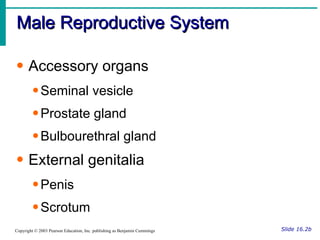
Male Reproductive System Slide 16.2b Copyright © 2003 Pearson Education, Inc. publishing as Benjamin Cummings Accessory organs Seminal vesicle Prostate gland Bulbourethral gland External genitalia Penis Scrotum
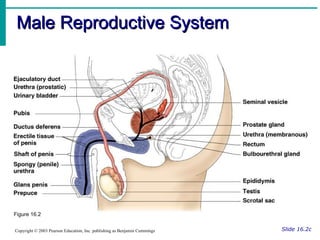
Male Reproductive System Slide 16.2c Copyright © 2003 Pearson Education, Inc. publishing as Benjamin Cummings Figure 16.2
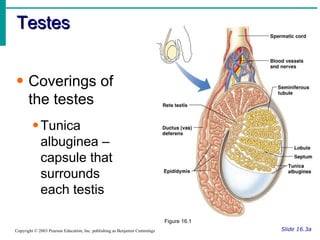
Testes Slide 16.3a Copyright © 2003 Pearson Education, Inc. publishing as Benjamin Cummings Coverings of the testes Tunica albuginea – capsule that surrounds each testis Figure 16.1
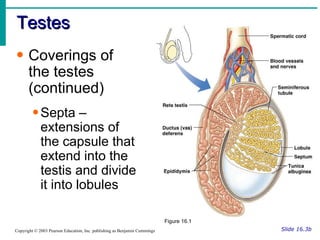
Testes Slide 16.3b Copyright © 2003 Pearson Education, Inc. publishing as Benjamin Cummings Coverings of the testes (continued) Septa – extensions of the capsule that extend into the testis and divide it into lobules Figure 16.1
Testes Slide 16.4 Copyright © 2003 Pearson Education, Inc. publishing as Benjamin Cummings Each lobule contains one to four seminiferous tubules Tightly coiled structures Function as sperm-forming factories Empty sperm into the rete testis Sperm travels through the rete testis to the epididymis Interstitial cells produce androgens such as testosterone
Epididymis Slide 16.5 Copyright © 2003 Pearson Education, Inc. publishing as Benjamin Cummings Comma-shaped, tightly coiled tube Found on the superior part of the testis and along the posterior lateral side Functions to mature and store sperm cells (at least 20 days) Expels sperm with the contraction of muscles in the epididymis walls to the vas deferens
Ductus Deferens (Vas Deferens) Slide 16.6a Copyright © 2003 Pearson Education, Inc. publishing as Benjamin Cummings Carries sperm from the epididymis to the ejaculatory duct Passes through the inguinal canal and over the bladder Moves sperm by peristalsis Spermatic cord – ductus deferens, blood vessels, and nerves in a connective tissue sheath
Ductus Deferens (Vas Deferens) Slide 16.6b Copyright © 2003 Pearson Education, Inc. publishing as Benjamin Cummings Ends in the ejaculatory duct which unites with the urethra Vasectomy – cutting of the ductus deferens at the level of the testes to prevent transportation of sperm
Urethra Slide 16.7a Copyright © 2003 Pearson Education, Inc. publishing as Benjamin Cummings Extends from the base of the urinary bladder to the tip of the penis Carries both urine and sperm Sperm enters from the ejaculatory duct
Urethra Slide 16.7b Copyright © 2003 Pearson Education, Inc. publishing as Benjamin Cummings Regions of the urethra Prostatic urethra –surrounded by prostate Membranous urethra – from prostatic urethra to penis Spongy (penile) urethra – runs the length of the penis
Seminal Vesicles Slide 16.8 Copyright © 2003 Pearson Education, Inc. publishing as Benjamin Cummings Located at the base of the bladder Produces a thick, yellowish secretion (60% of semen) Fructose (sugar) Vitamin C Prostaglandins Other substances that nourish and activate sperm
Prostate Gland Slide 16.9 Copyright © 2003 Pearson Education, Inc. publishing as Benjamin Cummings Encircles the upper part of the urethra Secretes a milky fluid Helps to activate sperm Enters the urethra through several small ducts
Bulbourethral Glands Slide 16.10 Copyright © 2003 Pearson Education, Inc. publishing as Benjamin Cummings Pea-sized gland inferior to the prostate Produces a thick, clear mucus Cleanses the urethra of acidic urine Serves as a lubricant during sexual intercourse Secreted into the penile urethra
Semen Slide 16.11 Copyright © 2003 Pearson Education, Inc. publishing as Benjamin Cummings Mixture of sperm and accessory gland secretions Advantages of accessory gland secretions Fructose provides energy for sperm cells Alkalinity of semen helps neutralize the acidic environment of vagina Semen inhibits bacterial multiplication Elements of semen enhance sperm motility
External Genitalia Slide 16.12 Copyright © 2003 Pearson Education, Inc. publishing as Benjamin Cummings Scrotum Divided sac of skin outside the abdomen Maintains testes at 3°C lower than normal body temperature to protect sperm viability
External Genitalia Slide 16.13a Copyright © 2003 Pearson Education, Inc. publishing as Benjamin Cummings Penis Delivers sperm into the female reproductive tract Regions of the penis Shaft Glans penis (enlarged tip)  Prepuce (foreskin) Folded cuff of skin around proximal end Often removed by circumcision
External Genitalia Slide 16.13b Copyright © 2003 Pearson Education, Inc. publishing as Benjamin Cummings Internally there are three areas of spongy erectile tissue around the urethra
Spermatogenesis Slide 16.14 Copyright © 2003 Pearson Education, Inc. publishing as Benjamin Cummings Production of sperm cells Begins at puberty and continues throughout life Occurs in the seminiferous tubules
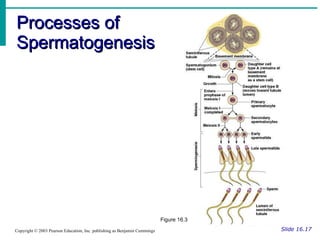
Processes of Spermatogenesis Slide 16.15a Copyright © 2003 Pearson Education, Inc. publishing as Benjamin Cummings Spermatogonia (stem cells) undergo rapid mitosis to produce more stem cells before puberty Follicle stimulating hormone (FSH) modifies spermatogonia division One cell produced is a stem cell The other cell produced becomes a primary spermatocyte
Processes of Spermatogenesis Slide 16.15b Copyright © 2003 Pearson Education, Inc. publishing as Benjamin Cummings Primary spermatocytes undergo meiosis Haploid spermatids are produced
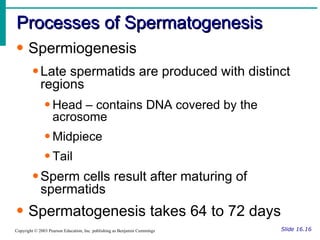
Processes of Spermatogenesis Slide 16.16 Copyright © 2003 Pearson Education, Inc. publishing as Benjamin Cummings Spermiogenesis Late spermatids are produced with distinct regions Head – contains DNA covered by the acrosome Midpiece Tail Sperm cells result after maturing of spermatids Spermatogenesis takes 64 to 72 days
Processes of Spermatogenesis Slide 16.17 Copyright © 2003 Pearson Education, Inc. publishing as Benjamin Cummings Figure 16.3
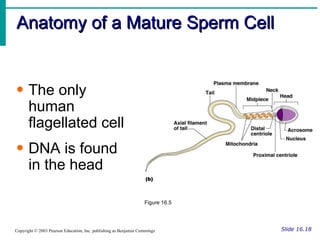
Anatomy of a Mature Sperm Cell Slide 16.18 Copyright © 2003 Pearson Education, Inc. publishing as Benjamin Cummings The only human flagellated cell DNA is found in the head Figure 16.5
Testosterone Production Slide 16.19a Copyright © 2003 Pearson Education, Inc. publishing as Benjamin Cummings The most important hormone of the testes Produced in interstitial cells
Testosterone Production Slide 16.19b Copyright © 2003 Pearson Education, Inc. publishing as Benjamin Cummings Functions of testosterone Stimulates reproductive organ development Underlies sex drive Causes secondary sex characteristics Deepening of voice Increased hair growth  Enlargement of skeletal muscles Thickening of bones
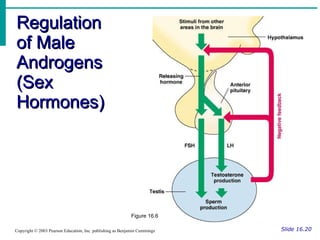
Regulation of Male Androgens (Sex Hormones) Slide 16.20 Copyright © 2003 Pearson Education, Inc. publishing as Benjamin Cummings Figure 16.6

Male Reproductive System

  • 1.
    Chapter 16 TheReproductive System Essentials of Human Anatomy & Physiology Copyright © 2003 Pearson Education, Inc. publishing as Benjamin Cummings Slides 16.1 – 16.20 Seventh Edition Elaine N. Marieb Lecture Slides in PowerPoint by Jerry L. Cook
  • 2.
    The Reproductive SystemSlide 16.1 Copyright © 2003 Pearson Education, Inc. publishing as Benjamin Cummings Gonads – primary sex organs Testes in males Ovaries in females Gonads produce gametes (sex cells) and secrete hormones Sperm – male gametes Ova (eggs) – female gametes
  • 3.
    Male Reproductive SystemSlide 16.2a Copyright © 2003 Pearson Education, Inc. publishing as Benjamin Cummings Testes Duct system Epididymis Ductus deferens Urethra
  • 4.
    Male Reproductive SystemSlide 16.2b Copyright © 2003 Pearson Education, Inc. publishing as Benjamin Cummings Accessory organs Seminal vesicle Prostate gland Bulbourethral gland External genitalia Penis Scrotum
  • 5.
    Male Reproductive SystemSlide 16.2c Copyright © 2003 Pearson Education, Inc. publishing as Benjamin Cummings Figure 16.2
  • 6.
    Testes Slide 16.3aCopyright © 2003 Pearson Education, Inc. publishing as Benjamin Cummings Coverings of the testes Tunica albuginea – capsule that surrounds each testis Figure 16.1
  • 7.
    Testes Slide 16.3bCopyright © 2003 Pearson Education, Inc. publishing as Benjamin Cummings Coverings of the testes (continued) Septa – extensions of the capsule that extend into the testis and divide it into lobules Figure 16.1
  • 8.
    Testes Slide 16.4Copyright © 2003 Pearson Education, Inc. publishing as Benjamin Cummings Each lobule contains one to four seminiferous tubules Tightly coiled structures Function as sperm-forming factories Empty sperm into the rete testis Sperm travels through the rete testis to the epididymis Interstitial cells produce androgens such as testosterone
  • 9.
    Epididymis Slide 16.5Copyright © 2003 Pearson Education, Inc. publishing as Benjamin Cummings Comma-shaped, tightly coiled tube Found on the superior part of the testis and along the posterior lateral side Functions to mature and store sperm cells (at least 20 days) Expels sperm with the contraction of muscles in the epididymis walls to the vas deferens
  • 10.
    Ductus Deferens (VasDeferens) Slide 16.6a Copyright © 2003 Pearson Education, Inc. publishing as Benjamin Cummings Carries sperm from the epididymis to the ejaculatory duct Passes through the inguinal canal and over the bladder Moves sperm by peristalsis Spermatic cord – ductus deferens, blood vessels, and nerves in a connective tissue sheath
  • 11.
    Ductus Deferens (VasDeferens) Slide 16.6b Copyright © 2003 Pearson Education, Inc. publishing as Benjamin Cummings Ends in the ejaculatory duct which unites with the urethra Vasectomy – cutting of the ductus deferens at the level of the testes to prevent transportation of sperm
  • 12.
    Urethra Slide 16.7aCopyright © 2003 Pearson Education, Inc. publishing as Benjamin Cummings Extends from the base of the urinary bladder to the tip of the penis Carries both urine and sperm Sperm enters from the ejaculatory duct
  • 13.
    Urethra Slide 16.7bCopyright © 2003 Pearson Education, Inc. publishing as Benjamin Cummings Regions of the urethra Prostatic urethra –surrounded by prostate Membranous urethra – from prostatic urethra to penis Spongy (penile) urethra – runs the length of the penis
  • 14.
    Seminal Vesicles Slide16.8 Copyright © 2003 Pearson Education, Inc. publishing as Benjamin Cummings Located at the base of the bladder Produces a thick, yellowish secretion (60% of semen) Fructose (sugar) Vitamin C Prostaglandins Other substances that nourish and activate sperm
  • 15.
    Prostate Gland Slide16.9 Copyright © 2003 Pearson Education, Inc. publishing as Benjamin Cummings Encircles the upper part of the urethra Secretes a milky fluid Helps to activate sperm Enters the urethra through several small ducts
  • 16.
    Bulbourethral Glands Slide16.10 Copyright © 2003 Pearson Education, Inc. publishing as Benjamin Cummings Pea-sized gland inferior to the prostate Produces a thick, clear mucus Cleanses the urethra of acidic urine Serves as a lubricant during sexual intercourse Secreted into the penile urethra
  • 17.
    Semen Slide 16.11Copyright © 2003 Pearson Education, Inc. publishing as Benjamin Cummings Mixture of sperm and accessory gland secretions Advantages of accessory gland secretions Fructose provides energy for sperm cells Alkalinity of semen helps neutralize the acidic environment of vagina Semen inhibits bacterial multiplication Elements of semen enhance sperm motility
  • 18.
    External Genitalia Slide16.12 Copyright © 2003 Pearson Education, Inc. publishing as Benjamin Cummings Scrotum Divided sac of skin outside the abdomen Maintains testes at 3°C lower than normal body temperature to protect sperm viability
  • 19.
    External Genitalia Slide16.13a Copyright © 2003 Pearson Education, Inc. publishing as Benjamin Cummings Penis Delivers sperm into the female reproductive tract Regions of the penis Shaft Glans penis (enlarged tip) Prepuce (foreskin) Folded cuff of skin around proximal end Often removed by circumcision
  • 20.
    External Genitalia Slide16.13b Copyright © 2003 Pearson Education, Inc. publishing as Benjamin Cummings Internally there are three areas of spongy erectile tissue around the urethra
  • 21.
    Spermatogenesis Slide 16.14Copyright © 2003 Pearson Education, Inc. publishing as Benjamin Cummings Production of sperm cells Begins at puberty and continues throughout life Occurs in the seminiferous tubules
  • 22.
    Processes of SpermatogenesisSlide 16.15a Copyright © 2003 Pearson Education, Inc. publishing as Benjamin Cummings Spermatogonia (stem cells) undergo rapid mitosis to produce more stem cells before puberty Follicle stimulating hormone (FSH) modifies spermatogonia division One cell produced is a stem cell The other cell produced becomes a primary spermatocyte
  • 23.
    Processes of SpermatogenesisSlide 16.15b Copyright © 2003 Pearson Education, Inc. publishing as Benjamin Cummings Primary spermatocytes undergo meiosis Haploid spermatids are produced
  • 24.
    Processes of SpermatogenesisSlide 16.16 Copyright © 2003 Pearson Education, Inc. publishing as Benjamin Cummings Spermiogenesis Late spermatids are produced with distinct regions Head – contains DNA covered by the acrosome Midpiece Tail Sperm cells result after maturing of spermatids Spermatogenesis takes 64 to 72 days
  • 25.
    Processes of SpermatogenesisSlide 16.17 Copyright © 2003 Pearson Education, Inc. publishing as Benjamin Cummings Figure 16.3
  • 26.
    Anatomy of aMature Sperm Cell Slide 16.18 Copyright © 2003 Pearson Education, Inc. publishing as Benjamin Cummings The only human flagellated cell DNA is found in the head Figure 16.5
  • 27.
    Testosterone Production Slide16.19a Copyright © 2003 Pearson Education, Inc. publishing as Benjamin Cummings The most important hormone of the testes Produced in interstitial cells
  • 28.
    Testosterone Production Slide16.19b Copyright © 2003 Pearson Education, Inc. publishing as Benjamin Cummings Functions of testosterone Stimulates reproductive organ development Underlies sex drive Causes secondary sex characteristics Deepening of voice Increased hair growth Enlargement of skeletal muscles Thickening of bones
  • 29.
    Regulation of MaleAndrogens (Sex Hormones) Slide 16.20 Copyright © 2003 Pearson Education, Inc. publishing as Benjamin Cummings Figure 16.6