Essentials of Human Anatomy & Physiology
Seventh Edition
Elaine N. Marieb
Chapter 11
The Cardiovascular System
Copyright © 2003 Pearson Education, Inc. publishing as Benjamin Cummings
Slides 11.1 – 11.19
The Cardiovascular System
Lecture Slides in PowerPoint by Jerry L. Cook
The Cardiovascular System
 A closed system of the heart and blood
vessels
The heart pumps blood
Blood vessels allow blood to circulate to all
Slide 11.2
Copyright © 2003 Pearson Education, Inc. publishing as Benjamin Cummings
Blood vessels allow blood to circulate to all
parts of the body
 The function of the cardiovascular
system is to deliver oxygen and
nutrients and to remove carbon dioxide
and other waste products
The Heart
The Heart
 Location
Thorax between the lungs
Slide 11.3
Copyright © 2003 Pearson Education, Inc. publishing as Benjamin Cummings
Pointed apex directed toward left hip
 About the size of your fist
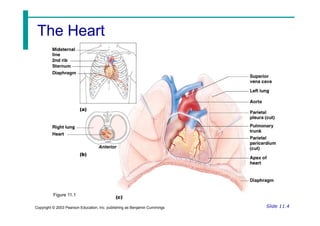
The Heart
The Heart
Slide 11.4
Copyright © 2003 Pearson Education, Inc. publishing as Benjamin Cummings
Figure 11.1
The Heart: Coverings
 Pericardium – a double serous
membrane
Visceral pericardium
Next to heart
Slide 11.5
Copyright © 2003 Pearson Education, Inc. publishing as Benjamin Cummings
Next to heart
Parietal pericardium
Outside layer
 Serous fluid fills the space between the
layers of pericardium
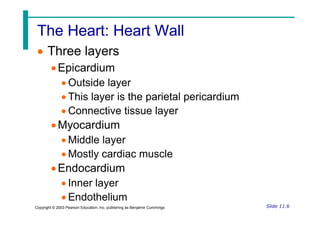
The Heart: Heart Wall
 Three layers
Epicardium
 Outside layer
 This layer is the parietal pericardium
 Connective tissue layer
Slide 11.6
Copyright © 2003 Pearson Education, Inc. publishing as Benjamin Cummings
 Connective tissue layer
Myocardium
 Middle layer
 Mostly cardiac muscle
Endocardium
 Inner layer
 Endothelium
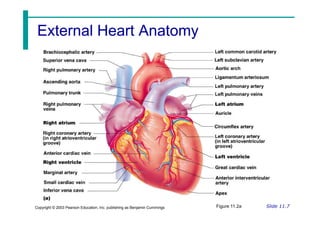
External Heart Anatomy
Slide 11.7
Copyright © 2003 Pearson Education, Inc. publishing as Benjamin Cummings Figure 11.2a
The Heart: Chambers
The Heart: Chambers
 Right and left side act as separate pumps
 Four chambers
Atria
 Receiving chambers
Slide 11.8
Copyright © 2003 Pearson Education, Inc. publishing as Benjamin Cummings
 Right atrium
 Left atrium
Ventricles
 Discharging chambers
 Right ventricle
 Left ventricle
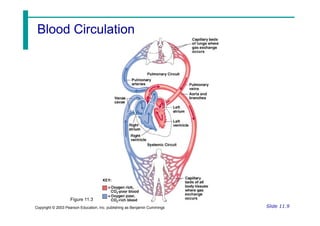
Blood Circulation
Blood Circulation
Slide 11.9
Copyright © 2003 Pearson Education, Inc. publishing as Benjamin Cummings
Figure 11.3
The Heart: Valves
The Heart: Valves
 Allow blood to flow in only one direction
 Four valves
Atrioventricular valves – between atria and
ventricles
 Bicuspid valve (left)
Slide 11.10
Copyright © 2003 Pearson Education, Inc. publishing as Benjamin Cummings
 Bicuspid valve (left)
 Tricuspid valve (right)
Semilunar valves between ventricle and
artery
 Pulmonary semilunar valve
 Aortic semilunar valve
The Heart: Valves
The Heart: Valves
 Valves open as blood is pumped
through
Slide 11.11
Copyright © 2003 Pearson Education, Inc. publishing as Benjamin Cummings
 Held in place by chordae tendineae
(“heart strings”)
 Close to prevent backflow
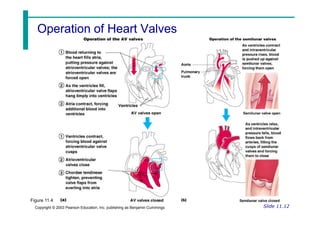
Operation of Heart Valves
Slide 11.12
Copyright © 2003 Pearson Education, Inc. publishing as Benjamin Cummings
Figure 11.4
The Heart: Associated Great Vessels
 Aorta
Leaves left ventricle
 Pulmonary arteries
Leave right ventricle
Slide 11.13
Copyright © 2003 Pearson Education, Inc. publishing as Benjamin Cummings
Leave right ventricle
 Vena cava
Enters right atrium
 Pulmonary veins (four)
Enter left atrium
Coronary Circulation
 Blood in the heart chambers does not
nourish the myocardium
 The heart has its own nourishing
circulatory system
Slide 11.14
Copyright © 2003 Pearson Education, Inc. publishing as Benjamin Cummings
circulatory system
Coronary arteries
Cardiac veins
Blood empties into the right atrium via the
coronary sinus
The Heart: Conduction System
 Intrinsic conduction system
(nodal system)
Slide 11.15
Copyright © 2003 Pearson Education, Inc. publishing as Benjamin Cummings
(nodal system)
Heart muscle cells contract, without nerve
impulses, in a regular, continuous way
The Heart: Conduction System
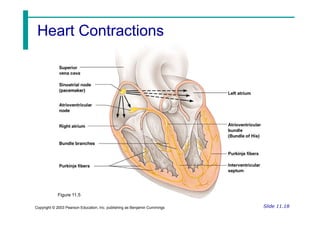
Special tissue sets the pace
Sinoatrial node
 Pacemaker
Slide 11.16
Copyright © 2003 Pearson Education, Inc. publishing as Benjamin Cummings
 Pacemaker
Atrioventricular node
Atrioventricular bundle
Bundle branches
Purkinje fibers
Heart Contractions
Heart Contractions
 Contraction is initiated by the sinoatrial
node
Slide 11.17
Copyright © 2003 Pearson Education, Inc. publishing as Benjamin Cummings
 Sequential stimulation occurs at other
autorhythmic cells
Heart Contractions
Heart Contractions
Slide 11.18
Copyright © 2003 Pearson Education, Inc. publishing as Benjamin Cummings
Figure 11.5
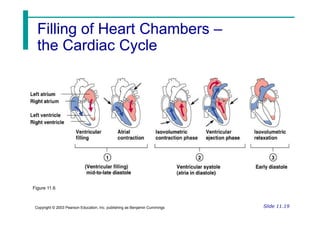
Filling of Heart Chambers
Filling of Heart Chambers –
–
the Cardiac Cycle
the Cardiac Cycle
Slide 11.19
Copyright © 2003 Pearson Education, Inc. publishing as Benjamin Cummings
Figure 11.6
The Heart: Cardiac Cycle
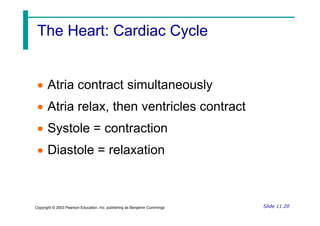
 Atria contract simultaneously
 Atria relax, then ventricles contract
Slide 11.20
Copyright © 2003 Pearson Education, Inc. publishing as Benjamin Cummings
 Atria relax, then ventricles contract
 Systole = contraction
 Diastole = relaxation
The Heart: Cardiac Cycle
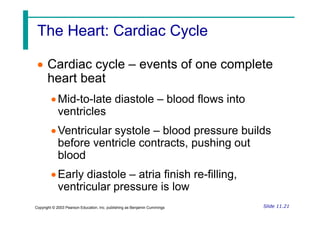
 Cardiac cycle – events of one complete
heart beat
Mid-to-late diastole – blood flows into
ventricles
Slide 11.21
Copyright © 2003 Pearson Education, Inc. publishing as Benjamin Cummings
ventricles
Ventricular systole – blood pressure builds
before ventricle contracts, pushing out
blood
Early diastole – atria finish re-filling,
ventricular pressure is low
The Heart: Cardiac Output
 Cardiac output (CO)
Amount of blood pumped by each side of
the heart in one minute
CO = (heart rate [HR]) x (stroke volume
Slide 11.22
Copyright © 2003 Pearson Education, Inc. publishing as Benjamin Cummings
CO = (heart rate [HR]) x (stroke volume
[SV])
 Stroke volume
Volume of blood pumped by each ventricle
in one contraction
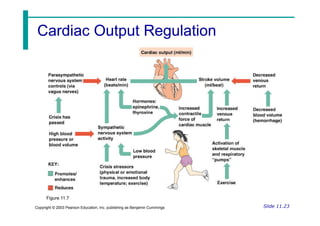
Cardiac Output Regulation
Slide 11.23
Copyright © 2003 Pearson Education, Inc. publishing as Benjamin Cummings
Figure 11.7
The Heart: Regulation of Heart Rate
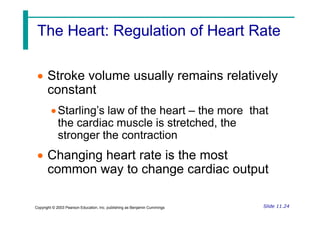
 Stroke volume usually remains relatively
constant
Starling’s law of the heart – the more that
Slide 11.24
Copyright © 2003 Pearson Education, Inc. publishing as Benjamin Cummings
Starling’s law of the heart – the more that
the cardiac muscle is stretched, the
stronger the contraction
 Changing heart rate is the most
common way to change cardiac output
The Heart: Regulation of Heart Rate
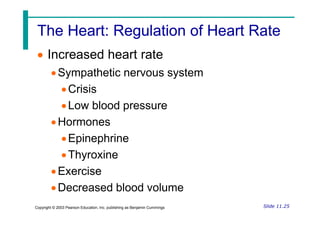
 Increased heart rate
Sympathetic nervous system
Crisis
Low blood pressure
Slide 11.25
Copyright © 2003 Pearson Education, Inc. publishing as Benjamin Cummings
Hormones
Epinephrine
Thyroxine
Exercise
Decreased blood volume
The Heart: Regulation of Heart Rate
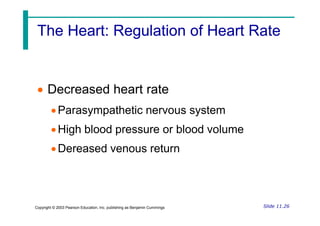
 Decreased heart rate
Parasympathetic nervous system
Slide 11.26
Copyright © 2003 Pearson Education, Inc. publishing as Benjamin Cummings
Parasympathetic nervous system
High blood pressure or blood volume
Dereased venous return
Blood Vessels: The Vascular
System
System
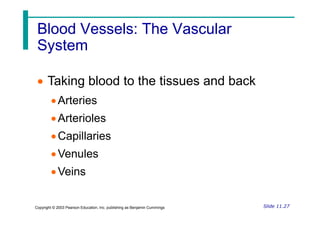
 Taking blood to the tissues and back
Arteries
Arterioles
Slide 11.27
Copyright © 2003 Pearson Education, Inc. publishing as Benjamin Cummings
Arterioles
Capillaries
Venules
Veins
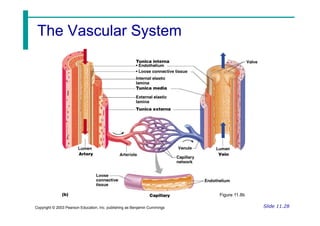
The Vascular System
The Vascular System
Slide 11.28
Copyright © 2003 Pearson Education, Inc. publishing as Benjamin Cummings
Figure 11.8b
Blood Vessels: Anatomy
 Three layers (tunics)
Tunic intima
Endothelium
Tunic media
Slide 11.29
Copyright © 2003 Pearson Education, Inc. publishing as Benjamin Cummings
Tunic media
Smooth muscle
Controlled by sympathetic nervous
system
Tunic externa
Mostly fibrous connective tissue
Differences Between Blood Vessel
Types
Types
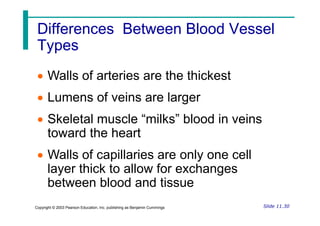
 Walls of arteries are the thickest
 Lumens of veins are larger
 Skeletal muscle “milks” blood in veins
Slide 11.30
Copyright © 2003 Pearson Education, Inc. publishing as Benjamin Cummings
 Skeletal muscle “milks” blood in veins
toward the heart
 Walls of capillaries are only one cell
layer thick to allow for exchanges
between blood and tissue
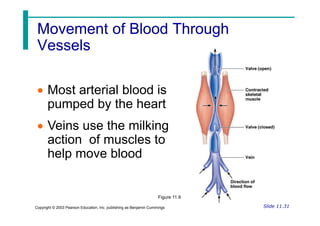
Movement of Blood Through
Vessels
Vessels
 Most arterial blood is
pumped by the heart
Slide 11.31
Copyright © 2003 Pearson Education, Inc. publishing as Benjamin Cummings
 Veins use the milking
action of muscles to
help move blood
Figure 11.9
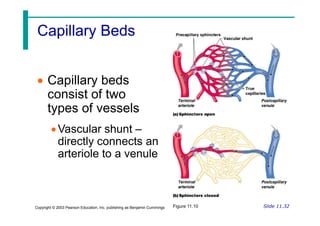
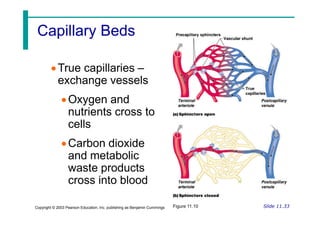
Capillary Beds
Capillary Beds
 Capillary beds
consist of two
types of vessels
Slide 11.32
Copyright © 2003 Pearson Education, Inc. publishing as Benjamin Cummings
types of vessels
Vascular shunt –
directly connects an
arteriole to a venule
Figure 11.10
Capillary Beds
Capillary Beds
True capillaries –
exchange vessels
Oxygen and
nutrients cross to
Slide 11.33
Copyright © 2003 Pearson Education, Inc. publishing as Benjamin Cummings
nutrients cross to
cells
Carbon dioxide
and metabolic
waste products
cross into blood
Figure 11.10
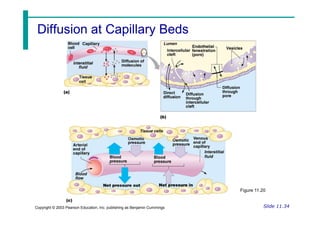
Diffusion at Capillary Beds
Slide 11.34
Copyright © 2003 Pearson Education, Inc. publishing as Benjamin Cummings
Figure 11.20
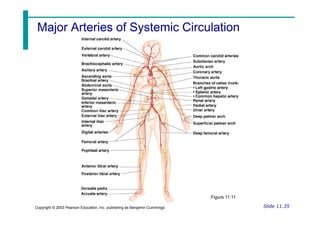
Major Arteries of Systemic Circulation
Slide 11.35
Copyright © 2003 Pearson Education, Inc. publishing as Benjamin Cummings
Figure 11.11
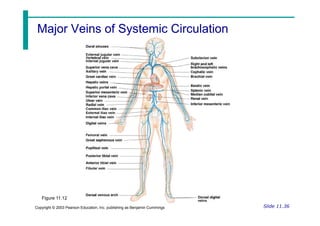
Major Veins of Systemic Circulation
Slide 11.36
Copyright © 2003 Pearson Education, Inc. publishing as Benjamin Cummings
Figure 11.12
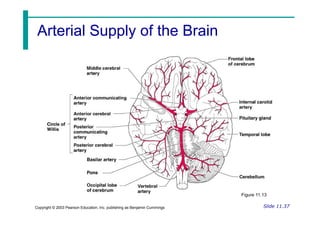
Arterial Supply of the Brain
Slide 11.37
Copyright © 2003 Pearson Education, Inc. publishing as Benjamin Cummings
Figure 11.13
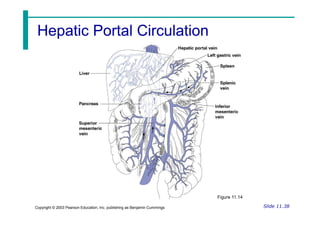
Hepatic Portal Circulation
Slide 11.38
Copyright © 2003 Pearson Education, Inc. publishing as Benjamin Cummings
Figure 11.14
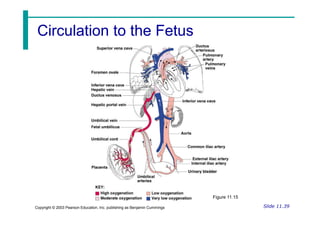
Circulation to the Fetus
Slide 11.39
Copyright © 2003 Pearson Education, Inc. publishing as Benjamin Cummings
Figure 11.15
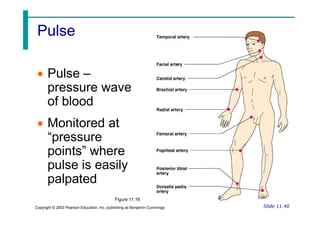
Pulse
Pulse
 Pulse –
pressure wave
of blood
Slide 11.40
Copyright © 2003 Pearson Education, Inc. publishing as Benjamin Cummings
 Monitored at
“pressure
points” where
pulse is easily
palpated
Figure 11.16
Blood Pressure
Blood Pressure
 Measurements by health professionals
are made on the pressure in large
arteries
Systolic – pressure at the peak of
Slide 11.41
Copyright © 2003 Pearson Education, Inc. publishing as Benjamin Cummings
Systolic – pressure at the peak of
ventricular contraction
Diastolic – pressure when ventricles relax
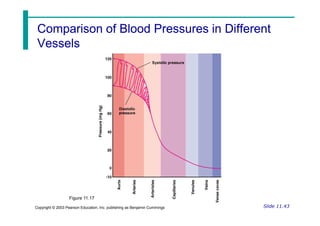
 Pressure in blood vessels decreases as
the distance away from the heart
increases
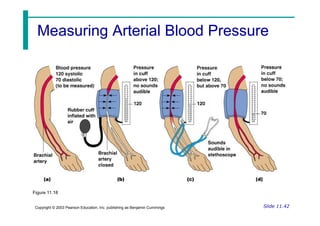
Measuring Arterial Blood Pressure
Slide 11.42
Copyright © 2003 Pearson Education, Inc. publishing as Benjamin Cummings
Figure 11.18
Comparison of Blood Pressures in Different
Vessels
Vessels
Slide 11.43
Copyright © 2003 Pearson Education, Inc. publishing as Benjamin Cummings
Figure 11.17
Blood Pressure: Effects of Factors
 Neural factors
Autonomic nervous system adjustments
(sympathetic division)
Slide 11.44
Copyright © 2003 Pearson Education, Inc. publishing as Benjamin Cummings
 Renal factors
Regulation by altering blood volume
Renin – hormonal control
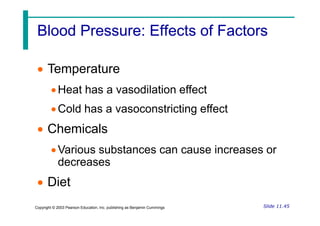
Blood Pressure: Effects of Factors
 Temperature
Heat has a vasodilation effect
Cold has a vasoconstricting effect
Slide 11.45
Copyright © 2003 Pearson Education, Inc. publishing as Benjamin Cummings
Cold has a vasoconstricting effect
 Chemicals
Various substances can cause increases or
decreases
 Diet
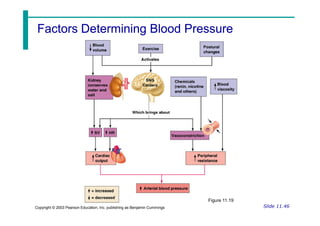
Factors Determining Blood Pressure
Slide 11.46
Copyright © 2003 Pearson Education, Inc. publishing as Benjamin Cummings
Figure 11.19
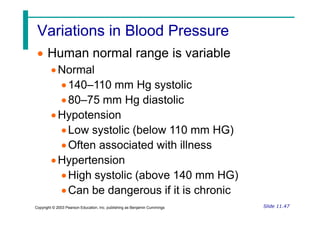
Variations in Blood Pressure
 Human normal range is variable
Normal
140–110 mm Hg systolic
80–75 mm Hg diastolic
Hypotension
Slide 11.47
Copyright © 2003 Pearson Education, Inc. publishing as Benjamin Cummings
Hypotension
Low systolic (below 110 mm HG)
Often associated with illness
Hypertension
High systolic (above 140 mm HG)
Can be dangerous if it is chronic
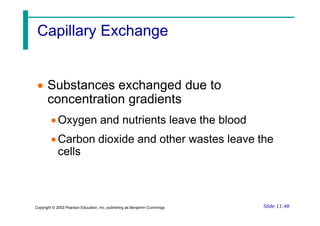
Capillary Exchange
Capillary Exchange
 Substances exchanged due to
concentration gradients

Slide 11.48
Copyright © 2003 Pearson Education, Inc. publishing as Benjamin Cummings
Oxygen and nutrients leave the blood
Carbon dioxide and other wastes leave the
cells
Capillary Exchange: Mechanisms
 Direct diffusion across plasma
membranes
 Endocytosis or exocytosis
 Some capillaries have gaps (intercellular
clefts)
Slide 11.49
Copyright © 2003 Pearson Education, Inc. publishing as Benjamin Cummings
 Some capillaries have gaps (intercellular
clefts)
Plasma membrane not joined by tight
junctions
 Fenestrations of some capillaries
Fenestrations = pores
Developmental Aspects of the
Cardiovascular System
 A simple “tube heart” develops in the
embryo and pumps by the fourth week
 The heart becomes a four-chambered
Slide 11.50
Copyright © 2003 Pearson Education, Inc. publishing as Benjamin Cummings
 The heart becomes a four-chambered
organ by the end of seven weeks
 Few structural changes occur after the
seventh week

Chapter 11 cardio ppt.pdf

  • 1.
    Essentials of HumanAnatomy & Physiology Seventh Edition Elaine N. Marieb Chapter 11 The Cardiovascular System Copyright © 2003 Pearson Education, Inc. publishing as Benjamin Cummings Slides 11.1 – 11.19 The Cardiovascular System Lecture Slides in PowerPoint by Jerry L. Cook
  • 2.
    The Cardiovascular System TheCardiovascular System  A closed system of the heart and blood vessels The heart pumps blood Blood vessels allow blood to circulate to all Slide 11.2 Copyright © 2003 Pearson Education, Inc. publishing as Benjamin Cummings Blood vessels allow blood to circulate to all parts of the body  The function of the cardiovascular system is to deliver oxygen and nutrients and to remove carbon dioxide and other waste products
  • 3.
    The Heart The Heart Location Thorax between the lungs Slide 11.3 Copyright © 2003 Pearson Education, Inc. publishing as Benjamin Cummings Pointed apex directed toward left hip  About the size of your fist
  • 4.
    The Heart The Heart Slide11.4 Copyright © 2003 Pearson Education, Inc. publishing as Benjamin Cummings Figure 11.1
  • 5.
    The Heart: Coverings TheHeart: Coverings  Pericardium – a double serous membrane Visceral pericardium Next to heart Slide 11.5 Copyright © 2003 Pearson Education, Inc. publishing as Benjamin Cummings Next to heart Parietal pericardium Outside layer  Serous fluid fills the space between the layers of pericardium
  • 6.
    The Heart: HeartWall The Heart: Heart Wall  Three layers Epicardium  Outside layer  This layer is the parietal pericardium  Connective tissue layer Slide 11.6 Copyright © 2003 Pearson Education, Inc. publishing as Benjamin Cummings  Connective tissue layer Myocardium  Middle layer  Mostly cardiac muscle Endocardium  Inner layer  Endothelium
  • 7.
    External Heart Anatomy ExternalHeart Anatomy Slide 11.7 Copyright © 2003 Pearson Education, Inc. publishing as Benjamin Cummings Figure 11.2a
  • 8.
    The Heart: Chambers TheHeart: Chambers  Right and left side act as separate pumps  Four chambers Atria  Receiving chambers Slide 11.8 Copyright © 2003 Pearson Education, Inc. publishing as Benjamin Cummings  Right atrium  Left atrium Ventricles  Discharging chambers  Right ventricle  Left ventricle
  • 9.
    Blood Circulation Blood Circulation Slide11.9 Copyright © 2003 Pearson Education, Inc. publishing as Benjamin Cummings Figure 11.3
  • 10.
    The Heart: Valves TheHeart: Valves  Allow blood to flow in only one direction  Four valves Atrioventricular valves – between atria and ventricles  Bicuspid valve (left) Slide 11.10 Copyright © 2003 Pearson Education, Inc. publishing as Benjamin Cummings  Bicuspid valve (left)  Tricuspid valve (right) Semilunar valves between ventricle and artery  Pulmonary semilunar valve  Aortic semilunar valve
  • 11.
    The Heart: Valves TheHeart: Valves  Valves open as blood is pumped through Slide 11.11 Copyright © 2003 Pearson Education, Inc. publishing as Benjamin Cummings  Held in place by chordae tendineae (“heart strings”)  Close to prevent backflow
  • 12.
    Operation of HeartValves Operation of Heart Valves Slide 11.12 Copyright © 2003 Pearson Education, Inc. publishing as Benjamin Cummings Figure 11.4
  • 13.
    The Heart: AssociatedGreat Vessels The Heart: Associated Great Vessels  Aorta Leaves left ventricle  Pulmonary arteries Leave right ventricle Slide 11.13 Copyright © 2003 Pearson Education, Inc. publishing as Benjamin Cummings Leave right ventricle  Vena cava Enters right atrium  Pulmonary veins (four) Enter left atrium
  • 14.
    Coronary Circulation Coronary Circulation Blood in the heart chambers does not nourish the myocardium  The heart has its own nourishing circulatory system Slide 11.14 Copyright © 2003 Pearson Education, Inc. publishing as Benjamin Cummings circulatory system Coronary arteries Cardiac veins Blood empties into the right atrium via the coronary sinus
  • 15.
    The Heart: ConductionSystem The Heart: Conduction System  Intrinsic conduction system (nodal system) Slide 11.15 Copyright © 2003 Pearson Education, Inc. publishing as Benjamin Cummings (nodal system) Heart muscle cells contract, without nerve impulses, in a regular, continuous way
  • 16.
    The Heart: ConductionSystem The Heart: Conduction System Special tissue sets the pace Sinoatrial node  Pacemaker Slide 11.16 Copyright © 2003 Pearson Education, Inc. publishing as Benjamin Cummings  Pacemaker Atrioventricular node Atrioventricular bundle Bundle branches Purkinje fibers
  • 17.
    Heart Contractions Heart Contractions Contraction is initiated by the sinoatrial node Slide 11.17 Copyright © 2003 Pearson Education, Inc. publishing as Benjamin Cummings  Sequential stimulation occurs at other autorhythmic cells
  • 18.
    Heart Contractions Heart Contractions Slide11.18 Copyright © 2003 Pearson Education, Inc. publishing as Benjamin Cummings Figure 11.5
  • 19.
    Filling of HeartChambers Filling of Heart Chambers – – the Cardiac Cycle the Cardiac Cycle Slide 11.19 Copyright © 2003 Pearson Education, Inc. publishing as Benjamin Cummings Figure 11.6
  • 20.
    The Heart: CardiacCycle The Heart: Cardiac Cycle  Atria contract simultaneously  Atria relax, then ventricles contract Slide 11.20 Copyright © 2003 Pearson Education, Inc. publishing as Benjamin Cummings  Atria relax, then ventricles contract  Systole = contraction  Diastole = relaxation
  • 21.
    The Heart: CardiacCycle The Heart: Cardiac Cycle  Cardiac cycle – events of one complete heart beat Mid-to-late diastole – blood flows into ventricles Slide 11.21 Copyright © 2003 Pearson Education, Inc. publishing as Benjamin Cummings ventricles Ventricular systole – blood pressure builds before ventricle contracts, pushing out blood Early diastole – atria finish re-filling, ventricular pressure is low
  • 22.
    The Heart: CardiacOutput The Heart: Cardiac Output  Cardiac output (CO) Amount of blood pumped by each side of the heart in one minute CO = (heart rate [HR]) x (stroke volume Slide 11.22 Copyright © 2003 Pearson Education, Inc. publishing as Benjamin Cummings CO = (heart rate [HR]) x (stroke volume [SV])  Stroke volume Volume of blood pumped by each ventricle in one contraction
  • 23.
    Cardiac Output Regulation CardiacOutput Regulation Slide 11.23 Copyright © 2003 Pearson Education, Inc. publishing as Benjamin Cummings Figure 11.7
  • 24.
    The Heart: Regulationof Heart Rate The Heart: Regulation of Heart Rate  Stroke volume usually remains relatively constant Starling’s law of the heart – the more that Slide 11.24 Copyright © 2003 Pearson Education, Inc. publishing as Benjamin Cummings Starling’s law of the heart – the more that the cardiac muscle is stretched, the stronger the contraction  Changing heart rate is the most common way to change cardiac output
  • 25.
    The Heart: Regulationof Heart Rate The Heart: Regulation of Heart Rate  Increased heart rate Sympathetic nervous system Crisis Low blood pressure Slide 11.25 Copyright © 2003 Pearson Education, Inc. publishing as Benjamin Cummings Hormones Epinephrine Thyroxine Exercise Decreased blood volume
  • 26.
    The Heart: Regulationof Heart Rate The Heart: Regulation of Heart Rate  Decreased heart rate Parasympathetic nervous system Slide 11.26 Copyright © 2003 Pearson Education, Inc. publishing as Benjamin Cummings Parasympathetic nervous system High blood pressure or blood volume Dereased venous return
  • 27.
    Blood Vessels: TheVascular Blood Vessels: The Vascular System System  Taking blood to the tissues and back Arteries Arterioles Slide 11.27 Copyright © 2003 Pearson Education, Inc. publishing as Benjamin Cummings Arterioles Capillaries Venules Veins
  • 28.
    The Vascular System TheVascular System Slide 11.28 Copyright © 2003 Pearson Education, Inc. publishing as Benjamin Cummings Figure 11.8b
  • 29.
    Blood Vessels: Anatomy BloodVessels: Anatomy  Three layers (tunics) Tunic intima Endothelium Tunic media Slide 11.29 Copyright © 2003 Pearson Education, Inc. publishing as Benjamin Cummings Tunic media Smooth muscle Controlled by sympathetic nervous system Tunic externa Mostly fibrous connective tissue
  • 30.
    Differences Between BloodVessel Differences Between Blood Vessel Types Types  Walls of arteries are the thickest  Lumens of veins are larger  Skeletal muscle “milks” blood in veins Slide 11.30 Copyright © 2003 Pearson Education, Inc. publishing as Benjamin Cummings  Skeletal muscle “milks” blood in veins toward the heart  Walls of capillaries are only one cell layer thick to allow for exchanges between blood and tissue
  • 31.
    Movement of BloodThrough Movement of Blood Through Vessels Vessels  Most arterial blood is pumped by the heart Slide 11.31 Copyright © 2003 Pearson Education, Inc. publishing as Benjamin Cummings  Veins use the milking action of muscles to help move blood Figure 11.9
  • 32.
    Capillary Beds Capillary Beds Capillary beds consist of two types of vessels Slide 11.32 Copyright © 2003 Pearson Education, Inc. publishing as Benjamin Cummings types of vessels Vascular shunt – directly connects an arteriole to a venule Figure 11.10
  • 33.
    Capillary Beds Capillary Beds Truecapillaries – exchange vessels Oxygen and nutrients cross to Slide 11.33 Copyright © 2003 Pearson Education, Inc. publishing as Benjamin Cummings nutrients cross to cells Carbon dioxide and metabolic waste products cross into blood Figure 11.10
  • 34.
    Diffusion at CapillaryBeds Diffusion at Capillary Beds Slide 11.34 Copyright © 2003 Pearson Education, Inc. publishing as Benjamin Cummings Figure 11.20
  • 35.
    Major Arteries ofSystemic Circulation Major Arteries of Systemic Circulation Slide 11.35 Copyright © 2003 Pearson Education, Inc. publishing as Benjamin Cummings Figure 11.11
  • 36.
    Major Veins ofSystemic Circulation Major Veins of Systemic Circulation Slide 11.36 Copyright © 2003 Pearson Education, Inc. publishing as Benjamin Cummings Figure 11.12
  • 37.
    Arterial Supply ofthe Brain Arterial Supply of the Brain Slide 11.37 Copyright © 2003 Pearson Education, Inc. publishing as Benjamin Cummings Figure 11.13
  • 38.
    Hepatic Portal Circulation HepaticPortal Circulation Slide 11.38 Copyright © 2003 Pearson Education, Inc. publishing as Benjamin Cummings Figure 11.14
  • 39.
    Circulation to theFetus Circulation to the Fetus Slide 11.39 Copyright © 2003 Pearson Education, Inc. publishing as Benjamin Cummings Figure 11.15
  • 40.
    Pulse Pulse  Pulse – pressurewave of blood Slide 11.40 Copyright © 2003 Pearson Education, Inc. publishing as Benjamin Cummings  Monitored at “pressure points” where pulse is easily palpated Figure 11.16
  • 41.
    Blood Pressure Blood Pressure Measurements by health professionals are made on the pressure in large arteries Systolic – pressure at the peak of Slide 11.41 Copyright © 2003 Pearson Education, Inc. publishing as Benjamin Cummings Systolic – pressure at the peak of ventricular contraction Diastolic – pressure when ventricles relax  Pressure in blood vessels decreases as the distance away from the heart increases
  • 42.
    Measuring Arterial BloodPressure Measuring Arterial Blood Pressure Slide 11.42 Copyright © 2003 Pearson Education, Inc. publishing as Benjamin Cummings Figure 11.18
  • 43.
    Comparison of BloodPressures in Different Comparison of Blood Pressures in Different Vessels Vessels Slide 11.43 Copyright © 2003 Pearson Education, Inc. publishing as Benjamin Cummings Figure 11.17
  • 44.
    Blood Pressure: Effectsof Factors Blood Pressure: Effects of Factors  Neural factors Autonomic nervous system adjustments (sympathetic division) Slide 11.44 Copyright © 2003 Pearson Education, Inc. publishing as Benjamin Cummings  Renal factors Regulation by altering blood volume Renin – hormonal control
  • 45.
    Blood Pressure: Effectsof Factors Blood Pressure: Effects of Factors  Temperature Heat has a vasodilation effect Cold has a vasoconstricting effect Slide 11.45 Copyright © 2003 Pearson Education, Inc. publishing as Benjamin Cummings Cold has a vasoconstricting effect  Chemicals Various substances can cause increases or decreases  Diet
  • 46.
    Factors Determining BloodPressure Factors Determining Blood Pressure Slide 11.46 Copyright © 2003 Pearson Education, Inc. publishing as Benjamin Cummings Figure 11.19
  • 47.
    Variations in BloodPressure Variations in Blood Pressure  Human normal range is variable Normal 140–110 mm Hg systolic 80–75 mm Hg diastolic Hypotension Slide 11.47 Copyright © 2003 Pearson Education, Inc. publishing as Benjamin Cummings Hypotension Low systolic (below 110 mm HG) Often associated with illness Hypertension High systolic (above 140 mm HG) Can be dangerous if it is chronic
  • 48.
    Capillary Exchange Capillary Exchange Substances exchanged due to concentration gradients  Slide 11.48 Copyright © 2003 Pearson Education, Inc. publishing as Benjamin Cummings Oxygen and nutrients leave the blood Carbon dioxide and other wastes leave the cells
  • 49.
    Capillary Exchange: Mechanisms CapillaryExchange: Mechanisms  Direct diffusion across plasma membranes  Endocytosis or exocytosis  Some capillaries have gaps (intercellular clefts) Slide 11.49 Copyright © 2003 Pearson Education, Inc. publishing as Benjamin Cummings  Some capillaries have gaps (intercellular clefts) Plasma membrane not joined by tight junctions  Fenestrations of some capillaries Fenestrations = pores
  • 50.
    Developmental Aspects ofthe Developmental Aspects of the Cardiovascular System Cardiovascular System  A simple “tube heart” develops in the embryo and pumps by the fourth week  The heart becomes a four-chambered Slide 11.50 Copyright © 2003 Pearson Education, Inc. publishing as Benjamin Cummings  The heart becomes a four-chambered organ by the end of seven weeks  Few structural changes occur after the seventh week