Chapter 13 Comparative Forms of Doing Business
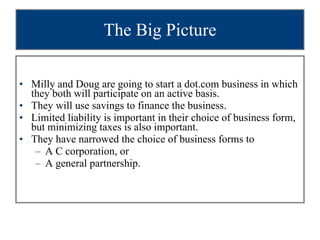
The Big Picture Milly and Doug are going to start a dot.com business in which they both will participate on an active basis.  They will use savings to finance the business. Limited liability is important in their choice of business form, but minimizing taxes is also important.  They have narrowed the choice of business forms to A C corporation, or  A general partnership.
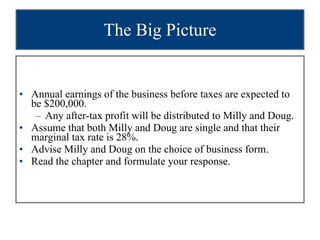
The Big Picture Annual earnings of the business before taxes are expected to be $200,000. Any after-tax profit will be distributed to Milly and Doug.  Assume that both Milly and Doug are single and that their marginal tax rate is 28%. Advise Milly and Doug on the choice of business form.  Read the chapter and formulate your response.
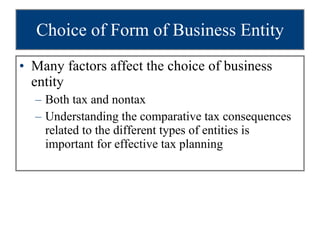
Choice of Form of Business Entity Many factors affect the choice of business entity Both tax and nontax Understanding the comparative tax consequences related to the different types of entities is important for effective tax planning
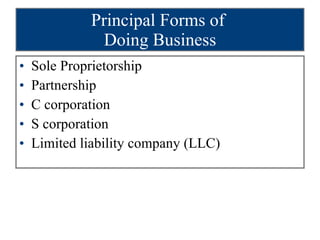
Principal Forms of  Doing Business Sole Proprietorship Partnership C corporation S corporation Limited liability company (LLC)
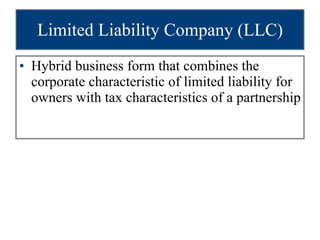
Limited Liability Company (LLC) Hybrid business form that combines the corporate characteristic of limited liability for owners with tax characteristics of a partnership
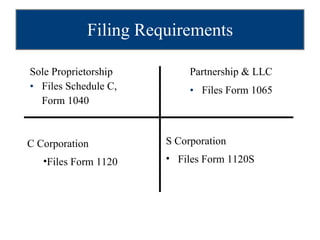
Filing Requirements Sole Proprietorship Files Schedule C, Form 1040 Partnership & LLC Files Form 1065 C Corporation Files Form 1120 S Corporation Files Form 1120S
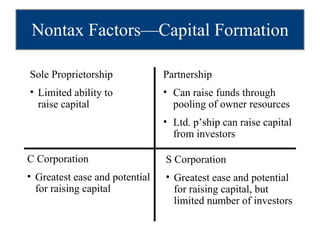
Nontax Factors—Capital Formation Sole Proprietorship Limited ability to raise capital  Partnership Can raise funds through pooling of owner resources Ltd. p’ship can raise capital from investors C Corporation Greatest ease and potential for raising capital S Corporation Greatest ease and potential for raising capital, but limited number of investors
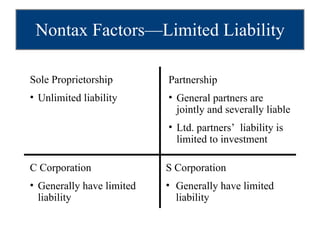
Nontax Factors—Limited Liability Sole Proprietorship Unlimited liability Partnership General partners are jointly and severally liable Ltd. partners’  liability is  limited to investment C Corporation Generally have limited liability S Corporation Generally have limited liability
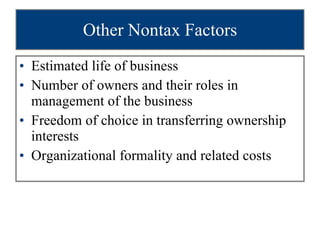
Other Nontax Factors Estimated life of business Number of owners and their roles in management of the business Freedom of choice in transferring ownership interests Organizational formality and related costs
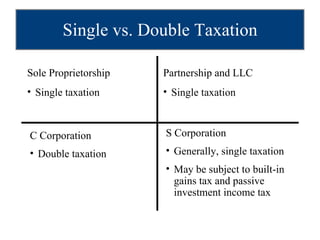
Single vs. Double Taxation Sole Proprietorship Single taxation Partnership and LLC Single taxation C Corporation Double taxation S Corporation Generally, single taxation May be subject to built-in gains tax and passive investment income tax
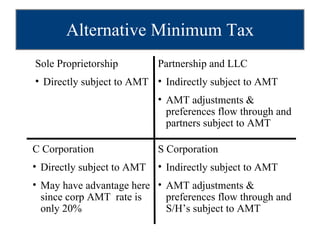
Alternative Minimum Tax Sole Proprietorship Directly subject to AMT Partnership and LLC Indirectly subject to AMT AMT adjustments &  preferences flow through and partners subject to AMT C Corporation Directly subject to AMT May have advantage here since corp AMT  rate is only 20% S Corporation Indirectly subject to AMT AMT adjustments &  preferences flow through and S/H’s subject to AMT
Controlling the Entity Tax Various techniques can be used to control the tax liability, whether imposed on the entity or owners, such as: Distribution policy Recognizing the interaction between the regular tax liability and the AMT liability Utilization of special allocations Fringe benefits Minimizing double taxation
Fringe Benefits  (slide 1 of 2) Generally produce the following tax consequences: Deductible by entity (employer) providing the fringe benefit Excludible from gross income of taxpayer (employee) who receives the fringe benefit
Fringe Benefits  (slide 2 of 2) Favorable tax treatment of fringe benefits is available only to employees For owner of entity to be an employee, the entity must be a corporation Partners in a partnership are not employees Greater-than-2% shareholders in an S corp are treated as partners  If not an employee Deduction of cost of fringe benefit is disallowed Owner must include cost of fringe benefit in gross income
Minimizing Double Taxation  of C Corporations  (slide 1 of 5) Several techniques are available for reducing the double taxation of C corps including: Making distributions to shareholders that are deductible by corp Retaining earnings at corp level Making distributions treated as a return of capital Making the S corp election
Minimizing Double Taxation  of C Corporations  (slide 2 of 5) Deductible distributions include: Salary payments to shareholder-employees Rental payments to shareholder-lessors Interest payments to shareholder-creditors IRS scrutinizes these types of transactions Must be reasonable
Minimizing Double Taxation  of C Corporations  (slide 3 of 5) Retain earnings at corporate level Double tax is avoided unless corp makes distributions (actual or deemed) to shareholders Must watch out for accumulated earnings tax problems For distributions made in 2003 and thereafter the 15%/0% rate for qualified dividends reduces the potential negative impact of double taxation
Minimizing Double Taxation  of C Corporations  (slide 4 of 5) Make return of capital distributions For ongoing businesses, redemption provisions may help reduce gross income at the shareholder level Corporate liquidation provisions can be used if business will cease to operate in corporate form
Minimizing Double Taxation  of C Corporations  (slide 5 of 5) Electing S corp status Generally eliminates double taxation but other factors must be considered such as: Will all shareholders consent to election? Can qualification requirements be met currently and on an ongoing basis? Are conditions favorable to an S corp election and how long will those conditions be favorable Distribution policy may cause problems paying tax at shareholder level
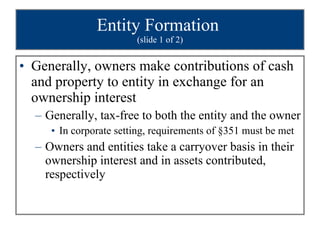
Entity Formation  (slide 1 of 2) Generally, owners make contributions of cash and property to entity in exchange for an ownership interest Generally, tax-free to both the entity and the owner In corporate setting, requirements of §351 must be met Owners and entities take a carryover basis in their ownership interest and in assets contributed, respectively
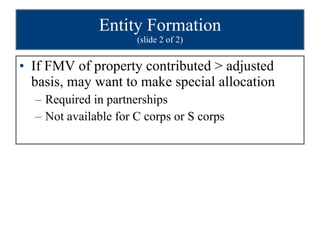
Entity Formation (slide 2 of 2) If FMV of property contributed > adjusted basis, may want to make special allocation Required in partnerships Not available for C corps or S corps
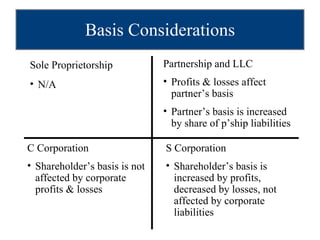
Basis Considerations Sole Proprietorship N/A Partnership and LLC Profits & losses affect partner’s basis Partner’s basis is increased by share of p’ship liabilities C Corporation Shareholder’s basis is not affected by corporate profits & losses S Corporation Shareholder’s basis is increased by profits, decreased by losses, not affected by corporate liabilities
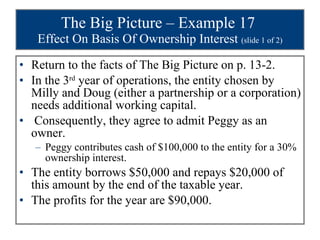
The Big Picture – Example 17  Effect On Basis Of Ownership Interest  (slide 1 of 2) Return to the facts of The Big Picture on p. 13-2.  In the 3 rd  year of operations, the entity chosen by Milly and Doug (either a partnership or a corporation) needs additional working capital. Consequently, they agree to admit Peggy as an owner.  Peggy contributes cash of $100,000 to the entity for a 30% ownership interest.  The entity borrows $50,000 and repays $20,000 of this amount by the end of the taxable year.  The profits for the year are $90,000.
The Big Picture – Example 17  Effect On Basis Of Ownership Interest  (slide 2 of 2) If the entity is a partnership, Peggy’s basis at the end of the period is $136,000 ($100,000 investment + $9,000 share of net liability increase + $27,000 share of profits). Note that Peggy’s basis would be the same if the entity is an LLC—an entity form that Milly and Doug should have considered. If Peggy is a C corporation shareholder instead, her stock basis is $100,000 ($100,000 original investment).  If the corporation is an S corporation (another entity form that Milly and Doug should have considered), Peggy’s stock basis is $127,000($100,000 + $27,000).
Distributions Distributions can be made to partners, LLC owners, or S corp. shareholders tax-free The same distribution would produce dividend income treatment for C corp. shareholders If appreciated property is distributed to S corp. shareholders, realized gain is recognized at the corporate level (same treatment as a C corp.) This corporate-level gain is passed-through to the S corp. shareholders
Passive Activity Losses  (slide 1 of 2) Loss limits apply to owners of partnerships, LLCs, and S corps Passive losses are separately stated items that flow through to owners  Passive loss rules apply at the owner level
Passive Activity Losses  (slide 2 of 2) For corporations, only apply if a closely held corp or a personal service corp  Closely held corp—more than 50% of value of stock at any time during last half of year is owned by 5 or less individuals Passive losses can offset active income but not portfolio income Personal service corp—principal activity is performance of personal services by owner-employees who own more than 10% in value of corp’s stock General passive loss rules apply
At-Risk Rules At-risk rules apply to: Partnerships LLCs S corps Closely held C corps May be more troublesome for partnerships and LLCs since liabilities are included in partner’s basis in partnership interest
Special Allocations Partnership and LLCs  have many opportunities to use special allocations Not generally available in C corps and S corps May be able to achieve the same results using payments to owners for services, rents and interest
Disposition of a Business or  an Ownership Interest Disposing of a business may be viewed as either: A sale of an ownership interest, or A sale of assets Tax consequences are, in general, more favorable for a sale of an ownership interest
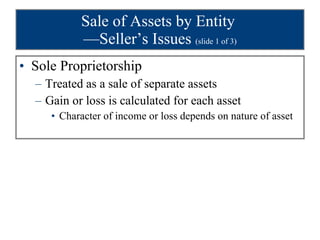
Sale of Assets by Entity  —Seller’s Issues  (slide 1 of 3) Sole Proprietorship Treated as a sale of separate assets Gain or loss is calculated for each asset Character of income or loss depends on nature of asset
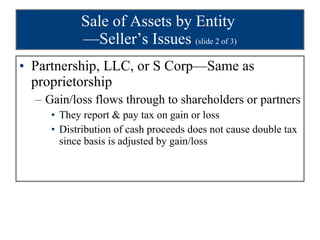
Sale of Assets by Entity  —Seller’s Issues  (slide 2 of 3) Partnership, LLC, or S Corp—Same as proprietorship Gain/loss flows through to shareholders or partners They report & pay tax on gain or loss Distribution of cash proceeds does not cause double tax since basis is adjusted by gain/loss
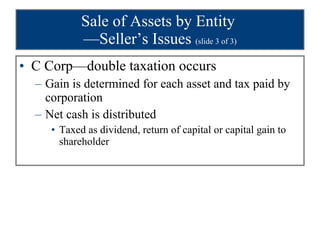
Sale of Assets by Entity  —Seller’s Issues  (slide 3 of 3) C Corp—double taxation occurs Gain is determined for each asset and tax paid by corporation Net cash is distributed Taxed as dividend, return of capital or capital gain to shareholder
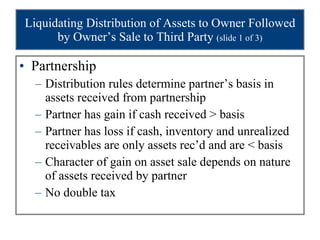
Liquidating Distribution of Assets to Owner Followed by Owner’s Sale to Third Party  (slide 1 of 3) Partnership Distribution rules determine partner’s basis in assets received from partnership Partner has gain if cash received > basis Partner has loss if cash, inventory and unrealized receivables are only assets rec’d and are < basis Character of gain on asset sale depends on nature of assets received by partner No double tax
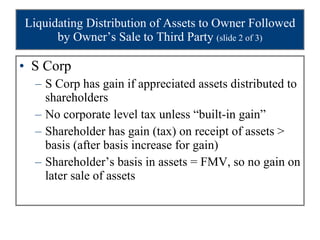
Liquidating Distribution of Assets to Owner Followed by Owner’s Sale to Third Party  (slide 2 of 3) S Corp S Corp has gain if appreciated assets distributed to shareholders No corporate level tax unless “built-in gain” Shareholder has gain (tax) on receipt of assets > basis (after basis increase for gain) Shareholder’s basis in assets = FMV, so no gain on later sale of assets
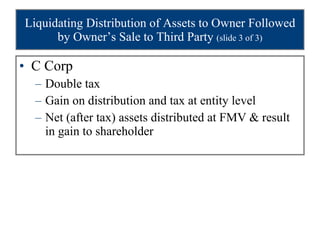
Liquidating Distribution of Assets to Owner Followed by Owner’s Sale to Third Party  (slide 3 of 3) C Corp Double tax Gain on distribution and tax at entity level Net (after tax) assets distributed at FMV & result in gain to shareholder
Purchase of Business Assets—Buyer’s Issues  (slide 1 of 2) The purchaser of individual assets is not generally affected by the type of entity through which the seller operates: The buyer (whether individual, partnership, LLC, C corp or S corp) allocates the total amount paid to the individual assets acquired Part of the cost may be allocated to intangible assets such as goodwill
Purchase of Business Assets—Buyer’s Issues  (slide 2 of 2) Asset cost is recovered through depreciation, amortization, sale of inventory, collection of accounts receivable, etc... The buyer can contribute the assets to a partnership or C corp under §721 or §351 If the C corp is qualified, an S corp election can be made
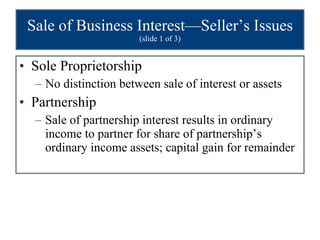
Sale of Business Interest—Seller’s Issues  (slide 1 of 3) Sole Proprietorship No distinction between sale of interest or assets Partnership Sale of partnership interest results in ordinary income to partner for share of partnership’s ordinary income assets; capital gain for remainder
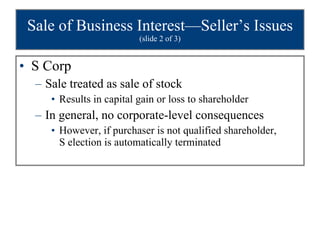
Sale of Business Interest—Seller’s Issues  (slide 2 of 3) S Corp Sale treated as sale of stock Results in capital gain or loss to shareholder In general, no corporate-level consequences However, if purchaser is not qualified shareholder,  S election is automatically terminated
Sale of Business Interest— Seller’s Issues  (slide 3 of 3) C Corp Sale treated as sale of stock Results in capital gain or loss to shareholder No corporate level consequences
Purchase of Business Interest—Buyer’s Issues  (slide 1 of 3) If the purchaser acquires an interest in one of these types of entities, he or she is treated as follows: Sole Proprietorship Purchaser is deemed  to buy assets Purchase price is allocated to assets Assets are depreciated, amortized, etc...
Purchase of Business Interest—Buyer’s Issues  (slide 2 of 3) Partnership Purchaser buys partnership interest Purchaser may ask partnership to make §754 election to step up inside basis in assets
Purchase of Business Interest—Buyer’s Issues  (slide 3 of 3) S Corp or C Corp Purchaser buys stock There is no effect on underlying assets owned by the entity
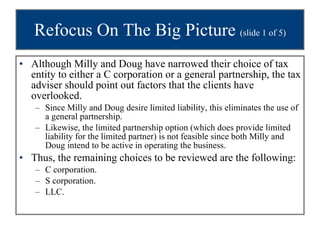
Refocus On The Big Picture  (slide 1 of 5) Although Milly and Doug have narrowed their choice of tax entity to either a C corporation or a general partnership, the tax adviser should point out factors that the clients have overlooked. Since Milly and Doug desire limited liability, this eliminates the use of a general partnership.  Likewise, the limited partnership option (which does provide limited liability for the limited partner) is not feasible since both Milly and Doug intend to be active in operating the business. Thus, the remaining choices to be reviewed are the following: C corporation. S corporation. LLC.
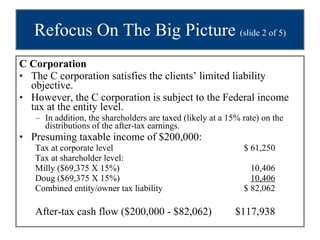
Refocus On The Big Picture  (slide 2 of 5) C Corporation The C corporation satisfies the clients’ limited liability objective.  However, the C corporation is subject to the Federal income tax at the entity level.  In addition, the shareholders are taxed (likely at a 15% rate) on the distributions of the after-tax earnings.  Presuming taxable income of $200,000:  Tax at corporate level  $ 61,250 Tax at shareholder level: Milly ($69,375 X 15%)  10,406 Doug ($69,375 X 15%)  10,406 Combined entity/owner tax liability  $ 82,062 After-tax cash flow ($200,000 - $82,062)  $117,938
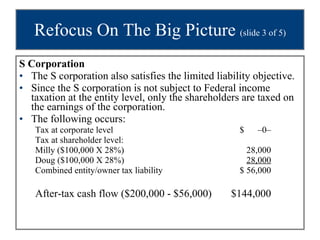
Refocus On The Big Picture  (slide 3 of 5) S Corporation The S corporation also satisfies the limited liability objective.  Since the S corporation is not subject to Federal income taxation at the entity level, only the shareholders are taxed on the earnings of the corporation.  The following occurs: Tax at corporate level  $  –0– Tax at shareholder level: Milly ($100,000 X 28%)  28,000 Doug ($100,000 X 28%)  28,000 Combined entity/owner tax liability  $ 56,000 After-tax cash flow ($200,000 - $56,000)  $144,000
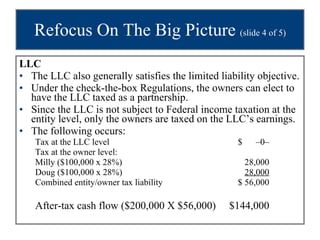
Refocus On The Big Picture  (slide 4 of 5) LLC The LLC also generally satisfies the limited liability objective.  Under the check-the-box Regulations, the owners can elect to have the LLC taxed as a partnership.  Since the LLC is not subject to Federal income taxation at the entity level, only the owners are taxed on the LLC’s earnings.  The following occurs: Tax at the LLC level  $  –0– Tax at the owner level: Milly ($100,000 x 28%)  28,000 Doug ($100,000 x 28%)  28,000 Combined entity/owner tax liability  $ 56,000 After-tax cash flow ($200,000 X $56,000)  $144,000
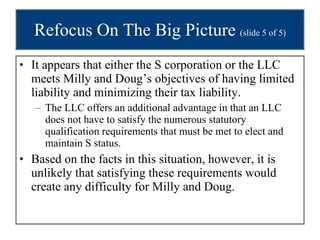
Refocus On The Big Picture  (slide 5 of 5) It appears that either the S corporation or the LLC meets Milly and Doug’s objectives of having limited liability and minimizing their tax liability.  The LLC offers an additional advantage in that an LLC does not have to satisfy the numerous statutory qualification requirements that must be met to elect and maintain S status.  Based on the facts in this situation, however, it is unlikely that satisfying these requirements would create any difficulty for Milly and Doug.
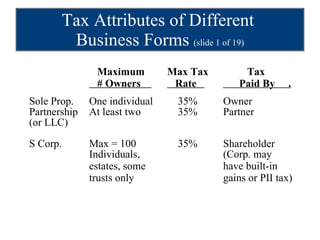
Tax Attributes of Different  Business Forms  (slide 1 of 19)   Maximum Max Tax   Tax   # Owners    Rate    Paid By  . Sole Prop. One individual   35% Owner Partnership At least two   35% Partner (or LLC) S Corp. Max = 100   35% Shareholder Individuals, (Corp. may estates, some have built-in   trusts only gains or PII tax)
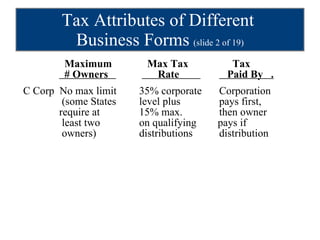
Tax Attributes of Different  Business Forms   (slide 2 of 19)   Maximum   Max Tax   Tax    # Owners    Rate    Paid By  . C Corp  No max limit 35% corporate  Corporation  (some States  level plus pays first,    require at  15% max.  then owner     least two on qualifying  pays if   owners) distributions distribution
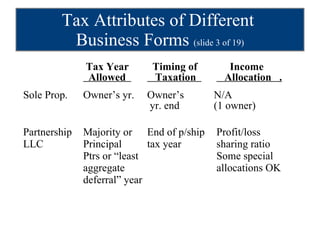
Tax Attributes of Different  Business Forms  (slide 3 of 19)   Tax Year   Timing of   Income   Allowed    Taxation    Allocation  . Sole Prop. Owner’s yr. Owner’s   N/A    yr. end   (1 owner) Partnership Majority or End of p/ship   Profit/loss LLC Principal  tax year   sharing ratio     Ptrs or “least    Some special     aggregate    allocations OK   deferral” year
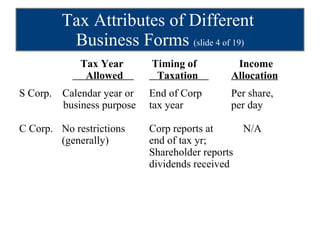
Tax Attributes of Different  Business Forms  (slide 4 of 19)     Tax Year  Timing of   Income   Allowed    Taxation  Allocation S Corp.  Calendar year or End of Corp Per share,   business purpose tax year per day C Corp.  No restrictions Corp reports at N/A   (generally) end of tax yr; Shareholder reports dividends received
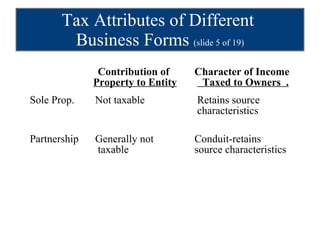
Tax Attributes of Different  Business Forms  (slide 5 of 19)   Contribution of Character of Income     Property to Entity     Taxed to Owners  . Sole Prop.  Not taxable  Retains source   characteristics Partnership  Generally not Conduit-retains    taxable source characteristics
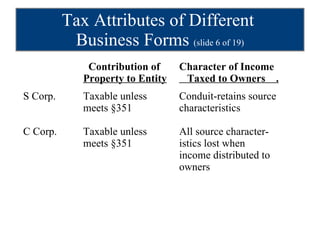
Tax Attributes of Different  Business Forms  (slide 6 of 19)   Contribution of Character of Income  Property to Entity   Taxed to Owners  . S Corp. Taxable unless  Conduit-retains source meets §351   characteristics C Corp. Taxable unless All source character- meets §351   istics lost when  income distributed to    owners
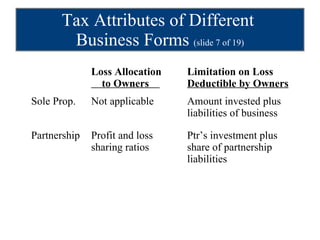
Tax Attributes of Different  Business Forms  (slide 7 of 19) Loss Allocation Limitation on Loss   to Owners  Deductible by Owners Sole Prop. Not applicable Amount invested plus liabilities of business Partnership Profit and loss Ptr’s investment plus sharing ratios share of partnership liabilities
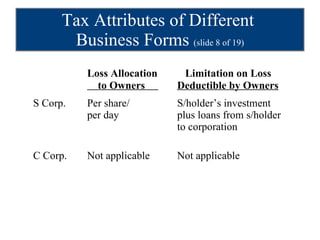
Tax Attributes of Different  Business Forms  (slide 8 of 19) Loss Allocation   Limitation on Loss   to Owners  Deductible by Owners S Corp. Per share/ S/holder’s investment per day  plus loans from s/holder to corporation C Corp. Not applicable  Not applicable
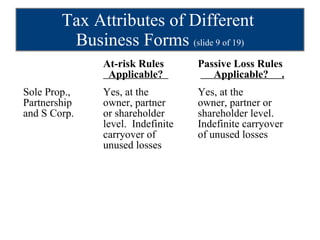
Tax Attributes of Different  Business Forms  (slide 9 of 19) At-risk Rules   Passive Loss Rules   Applicable?    Applicable?  . Sole Prop., Yes, at the   Yes, at the Partnership owner, partner   owner, partner or and S Corp. or shareholder    shareholder level. level.  Indefinite    Indefinite carryover carryover of    of unused losses unused losses
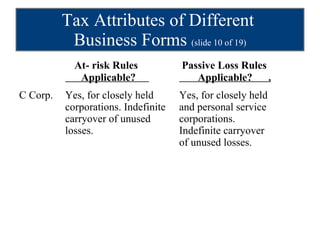
Tax Attributes of Different  Business Forms  (slide 10 of 19)   At- risk Rules  Passive Loss Rules   Applicable?    Applicable?  . C Corp. Yes, for closely held Yes, for closely held corporations. Indefinite and personal service carryover of unused corporations.    losses.     Indefinite carryover    of unused losses.
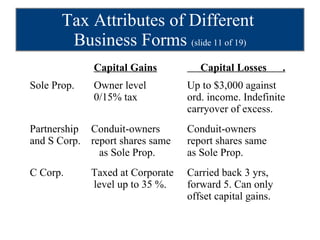
Tax Attributes of Different  Business Forms  (slide 11 of 19)   Capital Gains   Capital Losses  . Sole Prop.  Owner level Up to $3,000 against   0/15% tax ord. income. Indefinite carryover of excess. Partnership Conduit-owners Conduit-owners  and S Corp. report shares same report shares same   as Sole Prop. as Sole Prop. C Corp. Taxed at Corporate Carried back 3 yrs,   level up to 35 %. forward 5. Can only offset capital gains.
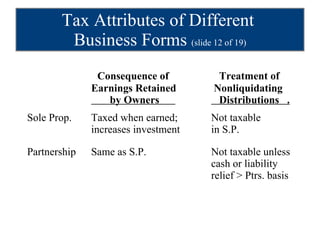
Tax Attributes of Different  Business Forms  (slide 12 of 19)   Consequence of   Treatment of Earnings Retained  Nonliquidating   by Owners    Distributions  . Sole Prop. Taxed when earned;  Not taxable increases investment in S.P. Partnership Same as S.P.   Not taxable unless   cash or liability  relief > Ptrs. basis
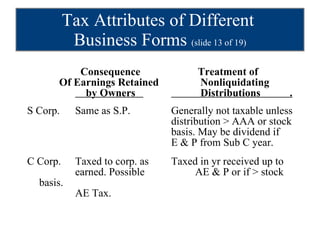
Tax Attributes of Different  Business Forms  (slide 13 of 19)   Consequence   Treatment of   Of Earnings Retained   Nonliquidating     by Owners    Distributions  . S Corp. Same as S.P.   Generally not taxable unless  distribution > AAA or stock  basis. May be dividend if E & P from Sub C year. C Corp. Taxed to corp. as  Taxed in yr received up to  earned. Possible  AE & P or if > stock basis. AE Tax.
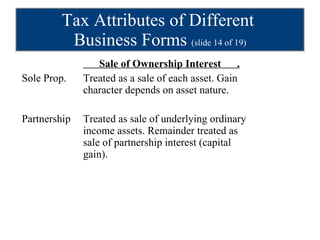
Tax Attributes of Different  Business Forms  (slide 14 of 19)   Sale of Ownership Interest  . Sole Prop. Treated as a sale of each asset. Gain  character depends on asset nature.  Partnership Treated as sale of underlying ordinary  income assets. Remainder treated as  sale of partnership interest (capital  gain).
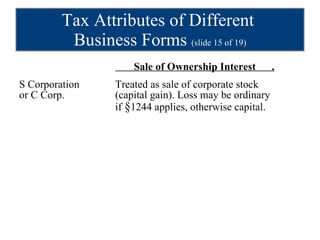
Tax Attributes of Different  Business Forms  (slide 15 of 19)   Sale of Ownership Interest  . S Corporation Treated as sale of corporate stock  or C Corp. (capital gain). Loss may be ordinary  if  § 1244 applies, otherwise capital.
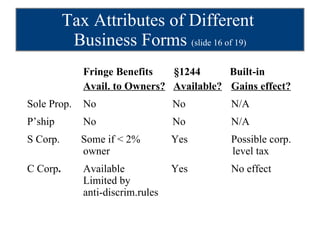
Tax Attributes of Different  Business Forms  (slide 16 of 19)   Fringe Benefits  §1244  Built-in   Avail. to Owners?   Available? Gains effect? Sole Prop.   No   No N/A P’ship   No   No N/A S Corp.  Some if < 2% Yes   Possible corp.   owner       level tax C Corp .   Available Yes   No effect   Limited by   anti-discrim.rules
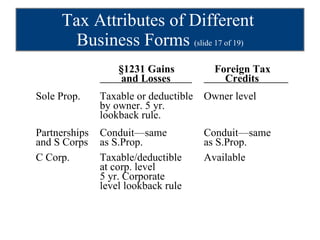
Tax Attributes of Different  Business Forms  (slide 17 of 19)   §1231 Gains   Foreign Tax     and Losses    Credits  Sole Prop. Taxable or deductible Owner level by owner. 5 yr. lookback rule. Partnerships Conduit—same Conduit—same and S Corps as S.Prop. as S.Prop. C Corp. Taxable/deductible Available  at corp. level  5 yr. Corporate  level lookback rule
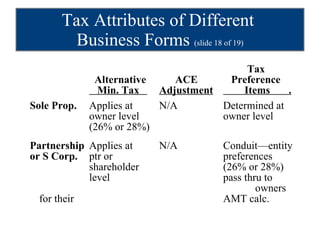
Tax Attributes of Different  Business Forms  (slide 18 of 19)   Tax    Alternative   ACE   Preference   Min. Tax  Adjustment   Items  . Sole Prop. Applies at  N/A Determined at  owner level owner level (26% or 28%) Partnership Applies at N/A Conduit—entity or S Corp. ptr or preferences  shareholder  (26% or 28%) level  pass thru to  owners for their  AMT calc.
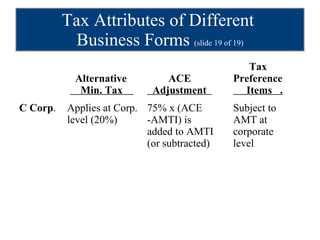
Tax Attributes of Different  Business Forms  (slide 19 of 19)   Tax    Alternative   ACE Preference   Min. Tax    Adjustment    Items  . C Corp . Applies at Corp. 75% x (ACE Subject to level (20%) -AMTI) is AMT at added to AMTI corporate (or subtracted) level
If you have any comments or suggestions concerning this PowerPoint Presentation for South-Western Federal Taxation, please contact: Dr. Donald  R. Trippeer, CPA [email_address] SUNY Oneonta

Chapter 13 presentation

  • 1.
    Chapter 13 ComparativeForms of Doing Business
  • 2.
    The Big PictureMilly and Doug are going to start a dot.com business in which they both will participate on an active basis. They will use savings to finance the business. Limited liability is important in their choice of business form, but minimizing taxes is also important. They have narrowed the choice of business forms to A C corporation, or A general partnership.
  • 3.
    The Big PictureAnnual earnings of the business before taxes are expected to be $200,000. Any after-tax profit will be distributed to Milly and Doug. Assume that both Milly and Doug are single and that their marginal tax rate is 28%. Advise Milly and Doug on the choice of business form. Read the chapter and formulate your response.
  • 4.
    Choice of Formof Business Entity Many factors affect the choice of business entity Both tax and nontax Understanding the comparative tax consequences related to the different types of entities is important for effective tax planning
  • 5.
    Principal Forms of Doing Business Sole Proprietorship Partnership C corporation S corporation Limited liability company (LLC)
  • 6.
    Limited Liability Company(LLC) Hybrid business form that combines the corporate characteristic of limited liability for owners with tax characteristics of a partnership
  • 7.
    Filing Requirements SoleProprietorship Files Schedule C, Form 1040 Partnership & LLC Files Form 1065 C Corporation Files Form 1120 S Corporation Files Form 1120S
  • 8.
    Nontax Factors—Capital FormationSole Proprietorship Limited ability to raise capital Partnership Can raise funds through pooling of owner resources Ltd. p’ship can raise capital from investors C Corporation Greatest ease and potential for raising capital S Corporation Greatest ease and potential for raising capital, but limited number of investors
  • 9.
    Nontax Factors—Limited LiabilitySole Proprietorship Unlimited liability Partnership General partners are jointly and severally liable Ltd. partners’ liability is limited to investment C Corporation Generally have limited liability S Corporation Generally have limited liability
  • 10.
    Other Nontax FactorsEstimated life of business Number of owners and their roles in management of the business Freedom of choice in transferring ownership interests Organizational formality and related costs
  • 11.
    Single vs. DoubleTaxation Sole Proprietorship Single taxation Partnership and LLC Single taxation C Corporation Double taxation S Corporation Generally, single taxation May be subject to built-in gains tax and passive investment income tax
  • 12.
    Alternative Minimum TaxSole Proprietorship Directly subject to AMT Partnership and LLC Indirectly subject to AMT AMT adjustments & preferences flow through and partners subject to AMT C Corporation Directly subject to AMT May have advantage here since corp AMT rate is only 20% S Corporation Indirectly subject to AMT AMT adjustments & preferences flow through and S/H’s subject to AMT
  • 13.
    Controlling the EntityTax Various techniques can be used to control the tax liability, whether imposed on the entity or owners, such as: Distribution policy Recognizing the interaction between the regular tax liability and the AMT liability Utilization of special allocations Fringe benefits Minimizing double taxation
  • 14.
    Fringe Benefits (slide 1 of 2) Generally produce the following tax consequences: Deductible by entity (employer) providing the fringe benefit Excludible from gross income of taxpayer (employee) who receives the fringe benefit
  • 15.
    Fringe Benefits (slide 2 of 2) Favorable tax treatment of fringe benefits is available only to employees For owner of entity to be an employee, the entity must be a corporation Partners in a partnership are not employees Greater-than-2% shareholders in an S corp are treated as partners If not an employee Deduction of cost of fringe benefit is disallowed Owner must include cost of fringe benefit in gross income
  • 16.
    Minimizing Double Taxation of C Corporations (slide 1 of 5) Several techniques are available for reducing the double taxation of C corps including: Making distributions to shareholders that are deductible by corp Retaining earnings at corp level Making distributions treated as a return of capital Making the S corp election
  • 17.
    Minimizing Double Taxation of C Corporations (slide 2 of 5) Deductible distributions include: Salary payments to shareholder-employees Rental payments to shareholder-lessors Interest payments to shareholder-creditors IRS scrutinizes these types of transactions Must be reasonable
  • 18.
    Minimizing Double Taxation of C Corporations (slide 3 of 5) Retain earnings at corporate level Double tax is avoided unless corp makes distributions (actual or deemed) to shareholders Must watch out for accumulated earnings tax problems For distributions made in 2003 and thereafter the 15%/0% rate for qualified dividends reduces the potential negative impact of double taxation
  • 19.
    Minimizing Double Taxation of C Corporations (slide 4 of 5) Make return of capital distributions For ongoing businesses, redemption provisions may help reduce gross income at the shareholder level Corporate liquidation provisions can be used if business will cease to operate in corporate form
  • 20.
    Minimizing Double Taxation of C Corporations (slide 5 of 5) Electing S corp status Generally eliminates double taxation but other factors must be considered such as: Will all shareholders consent to election? Can qualification requirements be met currently and on an ongoing basis? Are conditions favorable to an S corp election and how long will those conditions be favorable Distribution policy may cause problems paying tax at shareholder level
  • 21.
    Entity Formation (slide 1 of 2) Generally, owners make contributions of cash and property to entity in exchange for an ownership interest Generally, tax-free to both the entity and the owner In corporate setting, requirements of §351 must be met Owners and entities take a carryover basis in their ownership interest and in assets contributed, respectively
  • 22.
    Entity Formation (slide2 of 2) If FMV of property contributed > adjusted basis, may want to make special allocation Required in partnerships Not available for C corps or S corps
  • 23.
    Basis Considerations SoleProprietorship N/A Partnership and LLC Profits & losses affect partner’s basis Partner’s basis is increased by share of p’ship liabilities C Corporation Shareholder’s basis is not affected by corporate profits & losses S Corporation Shareholder’s basis is increased by profits, decreased by losses, not affected by corporate liabilities
  • 24.
    The Big Picture– Example 17 Effect On Basis Of Ownership Interest (slide 1 of 2) Return to the facts of The Big Picture on p. 13-2. In the 3 rd year of operations, the entity chosen by Milly and Doug (either a partnership or a corporation) needs additional working capital. Consequently, they agree to admit Peggy as an owner. Peggy contributes cash of $100,000 to the entity for a 30% ownership interest. The entity borrows $50,000 and repays $20,000 of this amount by the end of the taxable year. The profits for the year are $90,000.
  • 25.
    The Big Picture– Example 17 Effect On Basis Of Ownership Interest (slide 2 of 2) If the entity is a partnership, Peggy’s basis at the end of the period is $136,000 ($100,000 investment + $9,000 share of net liability increase + $27,000 share of profits). Note that Peggy’s basis would be the same if the entity is an LLC—an entity form that Milly and Doug should have considered. If Peggy is a C corporation shareholder instead, her stock basis is $100,000 ($100,000 original investment). If the corporation is an S corporation (another entity form that Milly and Doug should have considered), Peggy’s stock basis is $127,000($100,000 + $27,000).
  • 26.
    Distributions Distributions canbe made to partners, LLC owners, or S corp. shareholders tax-free The same distribution would produce dividend income treatment for C corp. shareholders If appreciated property is distributed to S corp. shareholders, realized gain is recognized at the corporate level (same treatment as a C corp.) This corporate-level gain is passed-through to the S corp. shareholders
  • 27.
    Passive Activity Losses (slide 1 of 2) Loss limits apply to owners of partnerships, LLCs, and S corps Passive losses are separately stated items that flow through to owners Passive loss rules apply at the owner level
  • 28.
    Passive Activity Losses (slide 2 of 2) For corporations, only apply if a closely held corp or a personal service corp Closely held corp—more than 50% of value of stock at any time during last half of year is owned by 5 or less individuals Passive losses can offset active income but not portfolio income Personal service corp—principal activity is performance of personal services by owner-employees who own more than 10% in value of corp’s stock General passive loss rules apply
  • 29.
    At-Risk Rules At-riskrules apply to: Partnerships LLCs S corps Closely held C corps May be more troublesome for partnerships and LLCs since liabilities are included in partner’s basis in partnership interest
  • 30.
    Special Allocations Partnershipand LLCs have many opportunities to use special allocations Not generally available in C corps and S corps May be able to achieve the same results using payments to owners for services, rents and interest
  • 31.
    Disposition of aBusiness or an Ownership Interest Disposing of a business may be viewed as either: A sale of an ownership interest, or A sale of assets Tax consequences are, in general, more favorable for a sale of an ownership interest
  • 32.
    Sale of Assetsby Entity —Seller’s Issues (slide 1 of 3) Sole Proprietorship Treated as a sale of separate assets Gain or loss is calculated for each asset Character of income or loss depends on nature of asset
  • 33.
    Sale of Assetsby Entity —Seller’s Issues (slide 2 of 3) Partnership, LLC, or S Corp—Same as proprietorship Gain/loss flows through to shareholders or partners They report & pay tax on gain or loss Distribution of cash proceeds does not cause double tax since basis is adjusted by gain/loss
  • 34.
    Sale of Assetsby Entity —Seller’s Issues (slide 3 of 3) C Corp—double taxation occurs Gain is determined for each asset and tax paid by corporation Net cash is distributed Taxed as dividend, return of capital or capital gain to shareholder
  • 35.
    Liquidating Distribution ofAssets to Owner Followed by Owner’s Sale to Third Party (slide 1 of 3) Partnership Distribution rules determine partner’s basis in assets received from partnership Partner has gain if cash received > basis Partner has loss if cash, inventory and unrealized receivables are only assets rec’d and are < basis Character of gain on asset sale depends on nature of assets received by partner No double tax
  • 36.
    Liquidating Distribution ofAssets to Owner Followed by Owner’s Sale to Third Party (slide 2 of 3) S Corp S Corp has gain if appreciated assets distributed to shareholders No corporate level tax unless “built-in gain” Shareholder has gain (tax) on receipt of assets > basis (after basis increase for gain) Shareholder’s basis in assets = FMV, so no gain on later sale of assets
  • 37.
    Liquidating Distribution ofAssets to Owner Followed by Owner’s Sale to Third Party (slide 3 of 3) C Corp Double tax Gain on distribution and tax at entity level Net (after tax) assets distributed at FMV & result in gain to shareholder
  • 38.
    Purchase of BusinessAssets—Buyer’s Issues (slide 1 of 2) The purchaser of individual assets is not generally affected by the type of entity through which the seller operates: The buyer (whether individual, partnership, LLC, C corp or S corp) allocates the total amount paid to the individual assets acquired Part of the cost may be allocated to intangible assets such as goodwill
  • 39.
    Purchase of BusinessAssets—Buyer’s Issues (slide 2 of 2) Asset cost is recovered through depreciation, amortization, sale of inventory, collection of accounts receivable, etc... The buyer can contribute the assets to a partnership or C corp under §721 or §351 If the C corp is qualified, an S corp election can be made
  • 40.
    Sale of BusinessInterest—Seller’s Issues (slide 1 of 3) Sole Proprietorship No distinction between sale of interest or assets Partnership Sale of partnership interest results in ordinary income to partner for share of partnership’s ordinary income assets; capital gain for remainder
  • 41.
    Sale of BusinessInterest—Seller’s Issues (slide 2 of 3) S Corp Sale treated as sale of stock Results in capital gain or loss to shareholder In general, no corporate-level consequences However, if purchaser is not qualified shareholder, S election is automatically terminated
  • 42.
    Sale of BusinessInterest— Seller’s Issues (slide 3 of 3) C Corp Sale treated as sale of stock Results in capital gain or loss to shareholder No corporate level consequences
  • 43.
    Purchase of BusinessInterest—Buyer’s Issues (slide 1 of 3) If the purchaser acquires an interest in one of these types of entities, he or she is treated as follows: Sole Proprietorship Purchaser is deemed to buy assets Purchase price is allocated to assets Assets are depreciated, amortized, etc...
  • 44.
    Purchase of BusinessInterest—Buyer’s Issues (slide 2 of 3) Partnership Purchaser buys partnership interest Purchaser may ask partnership to make §754 election to step up inside basis in assets
  • 45.
    Purchase of BusinessInterest—Buyer’s Issues (slide 3 of 3) S Corp or C Corp Purchaser buys stock There is no effect on underlying assets owned by the entity
  • 46.
    Refocus On TheBig Picture (slide 1 of 5) Although Milly and Doug have narrowed their choice of tax entity to either a C corporation or a general partnership, the tax adviser should point out factors that the clients have overlooked. Since Milly and Doug desire limited liability, this eliminates the use of a general partnership. Likewise, the limited partnership option (which does provide limited liability for the limited partner) is not feasible since both Milly and Doug intend to be active in operating the business. Thus, the remaining choices to be reviewed are the following: C corporation. S corporation. LLC.
  • 47.
    Refocus On TheBig Picture (slide 2 of 5) C Corporation The C corporation satisfies the clients’ limited liability objective. However, the C corporation is subject to the Federal income tax at the entity level. In addition, the shareholders are taxed (likely at a 15% rate) on the distributions of the after-tax earnings. Presuming taxable income of $200,000: Tax at corporate level $ 61,250 Tax at shareholder level: Milly ($69,375 X 15%) 10,406 Doug ($69,375 X 15%) 10,406 Combined entity/owner tax liability $ 82,062 After-tax cash flow ($200,000 - $82,062) $117,938
  • 48.
    Refocus On TheBig Picture (slide 3 of 5) S Corporation The S corporation also satisfies the limited liability objective. Since the S corporation is not subject to Federal income taxation at the entity level, only the shareholders are taxed on the earnings of the corporation. The following occurs: Tax at corporate level $ –0– Tax at shareholder level: Milly ($100,000 X 28%) 28,000 Doug ($100,000 X 28%) 28,000 Combined entity/owner tax liability $ 56,000 After-tax cash flow ($200,000 - $56,000) $144,000
  • 49.
    Refocus On TheBig Picture (slide 4 of 5) LLC The LLC also generally satisfies the limited liability objective. Under the check-the-box Regulations, the owners can elect to have the LLC taxed as a partnership. Since the LLC is not subject to Federal income taxation at the entity level, only the owners are taxed on the LLC’s earnings. The following occurs: Tax at the LLC level $ –0– Tax at the owner level: Milly ($100,000 x 28%) 28,000 Doug ($100,000 x 28%) 28,000 Combined entity/owner tax liability $ 56,000 After-tax cash flow ($200,000 X $56,000) $144,000
  • 50.
    Refocus On TheBig Picture (slide 5 of 5) It appears that either the S corporation or the LLC meets Milly and Doug’s objectives of having limited liability and minimizing their tax liability. The LLC offers an additional advantage in that an LLC does not have to satisfy the numerous statutory qualification requirements that must be met to elect and maintain S status. Based on the facts in this situation, however, it is unlikely that satisfying these requirements would create any difficulty for Milly and Doug.
  • 51.
    Tax Attributes ofDifferent Business Forms (slide 1 of 19) Maximum Max Tax Tax # Owners Rate Paid By . Sole Prop. One individual 35% Owner Partnership At least two 35% Partner (or LLC) S Corp. Max = 100 35% Shareholder Individuals, (Corp. may estates, some have built-in trusts only gains or PII tax)
  • 52.
    Tax Attributes ofDifferent Business Forms (slide 2 of 19) Maximum Max Tax Tax # Owners Rate Paid By . C Corp No max limit 35% corporate Corporation (some States level plus pays first, require at 15% max. then owner least two on qualifying pays if owners) distributions distribution
  • 53.
    Tax Attributes ofDifferent Business Forms (slide 3 of 19) Tax Year Timing of Income Allowed Taxation Allocation . Sole Prop. Owner’s yr. Owner’s N/A yr. end (1 owner) Partnership Majority or End of p/ship Profit/loss LLC Principal tax year sharing ratio Ptrs or “least Some special aggregate allocations OK deferral” year
  • 54.
    Tax Attributes ofDifferent Business Forms (slide 4 of 19) Tax Year Timing of Income Allowed Taxation Allocation S Corp. Calendar year or End of Corp Per share, business purpose tax year per day C Corp. No restrictions Corp reports at N/A (generally) end of tax yr; Shareholder reports dividends received
  • 55.
    Tax Attributes ofDifferent Business Forms (slide 5 of 19) Contribution of Character of Income Property to Entity Taxed to Owners . Sole Prop. Not taxable Retains source characteristics Partnership Generally not Conduit-retains taxable source characteristics
  • 56.
    Tax Attributes ofDifferent Business Forms (slide 6 of 19) Contribution of Character of Income Property to Entity Taxed to Owners . S Corp. Taxable unless Conduit-retains source meets §351 characteristics C Corp. Taxable unless All source character- meets §351 istics lost when income distributed to owners
  • 57.
    Tax Attributes ofDifferent Business Forms (slide 7 of 19) Loss Allocation Limitation on Loss to Owners Deductible by Owners Sole Prop. Not applicable Amount invested plus liabilities of business Partnership Profit and loss Ptr’s investment plus sharing ratios share of partnership liabilities
  • 58.
    Tax Attributes ofDifferent Business Forms (slide 8 of 19) Loss Allocation Limitation on Loss to Owners Deductible by Owners S Corp. Per share/ S/holder’s investment per day plus loans from s/holder to corporation C Corp. Not applicable Not applicable
  • 59.
    Tax Attributes ofDifferent Business Forms (slide 9 of 19) At-risk Rules Passive Loss Rules Applicable? Applicable? . Sole Prop., Yes, at the Yes, at the Partnership owner, partner owner, partner or and S Corp. or shareholder shareholder level. level. Indefinite Indefinite carryover carryover of of unused losses unused losses
  • 60.
    Tax Attributes ofDifferent Business Forms (slide 10 of 19) At- risk Rules Passive Loss Rules Applicable? Applicable? . C Corp. Yes, for closely held Yes, for closely held corporations. Indefinite and personal service carryover of unused corporations. losses. Indefinite carryover of unused losses.
  • 61.
    Tax Attributes ofDifferent Business Forms (slide 11 of 19) Capital Gains Capital Losses . Sole Prop. Owner level Up to $3,000 against 0/15% tax ord. income. Indefinite carryover of excess. Partnership Conduit-owners Conduit-owners and S Corp. report shares same report shares same as Sole Prop. as Sole Prop. C Corp. Taxed at Corporate Carried back 3 yrs, level up to 35 %. forward 5. Can only offset capital gains.
  • 62.
    Tax Attributes ofDifferent Business Forms (slide 12 of 19) Consequence of Treatment of Earnings Retained Nonliquidating by Owners Distributions . Sole Prop. Taxed when earned; Not taxable increases investment in S.P. Partnership Same as S.P. Not taxable unless cash or liability relief > Ptrs. basis
  • 63.
    Tax Attributes ofDifferent Business Forms (slide 13 of 19) Consequence Treatment of Of Earnings Retained Nonliquidating by Owners Distributions . S Corp. Same as S.P. Generally not taxable unless distribution > AAA or stock basis. May be dividend if E & P from Sub C year. C Corp. Taxed to corp. as Taxed in yr received up to earned. Possible AE & P or if > stock basis. AE Tax.
  • 64.
    Tax Attributes ofDifferent Business Forms (slide 14 of 19) Sale of Ownership Interest . Sole Prop. Treated as a sale of each asset. Gain character depends on asset nature. Partnership Treated as sale of underlying ordinary income assets. Remainder treated as sale of partnership interest (capital gain).
  • 65.
    Tax Attributes ofDifferent Business Forms (slide 15 of 19) Sale of Ownership Interest . S Corporation Treated as sale of corporate stock or C Corp. (capital gain). Loss may be ordinary if § 1244 applies, otherwise capital.
  • 66.
    Tax Attributes ofDifferent Business Forms (slide 16 of 19) Fringe Benefits §1244 Built-in Avail. to Owners? Available? Gains effect? Sole Prop. No No N/A P’ship No No N/A S Corp. Some if < 2% Yes Possible corp. owner level tax C Corp . Available Yes No effect Limited by anti-discrim.rules
  • 67.
    Tax Attributes ofDifferent Business Forms (slide 17 of 19) §1231 Gains Foreign Tax and Losses Credits Sole Prop. Taxable or deductible Owner level by owner. 5 yr. lookback rule. Partnerships Conduit—same Conduit—same and S Corps as S.Prop. as S.Prop. C Corp. Taxable/deductible Available at corp. level 5 yr. Corporate level lookback rule
  • 68.
    Tax Attributes ofDifferent Business Forms (slide 18 of 19) Tax Alternative ACE Preference Min. Tax Adjustment Items . Sole Prop. Applies at N/A Determined at owner level owner level (26% or 28%) Partnership Applies at N/A Conduit—entity or S Corp. ptr or preferences shareholder (26% or 28%) level pass thru to owners for their AMT calc.
  • 69.
    Tax Attributes ofDifferent Business Forms (slide 19 of 19) Tax Alternative ACE Preference Min. Tax Adjustment Items . C Corp . Applies at Corp. 75% x (ACE Subject to level (20%) -AMTI) is AMT at added to AMTI corporate (or subtracted) level
  • 70.
    If you haveany comments or suggestions concerning this PowerPoint Presentation for South-Western Federal Taxation, please contact: Dr. Donald R. Trippeer, CPA [email_address] SUNY Oneonta