Chapter 13
   Tax Credits and
   Payment Procedures

   Individual Income Taxes
© 2013 Cengage Learning. All Rights Reserved. May not be scanned, copied or duplicated, or posted to a publicly accessible website, in whole or in part.   1
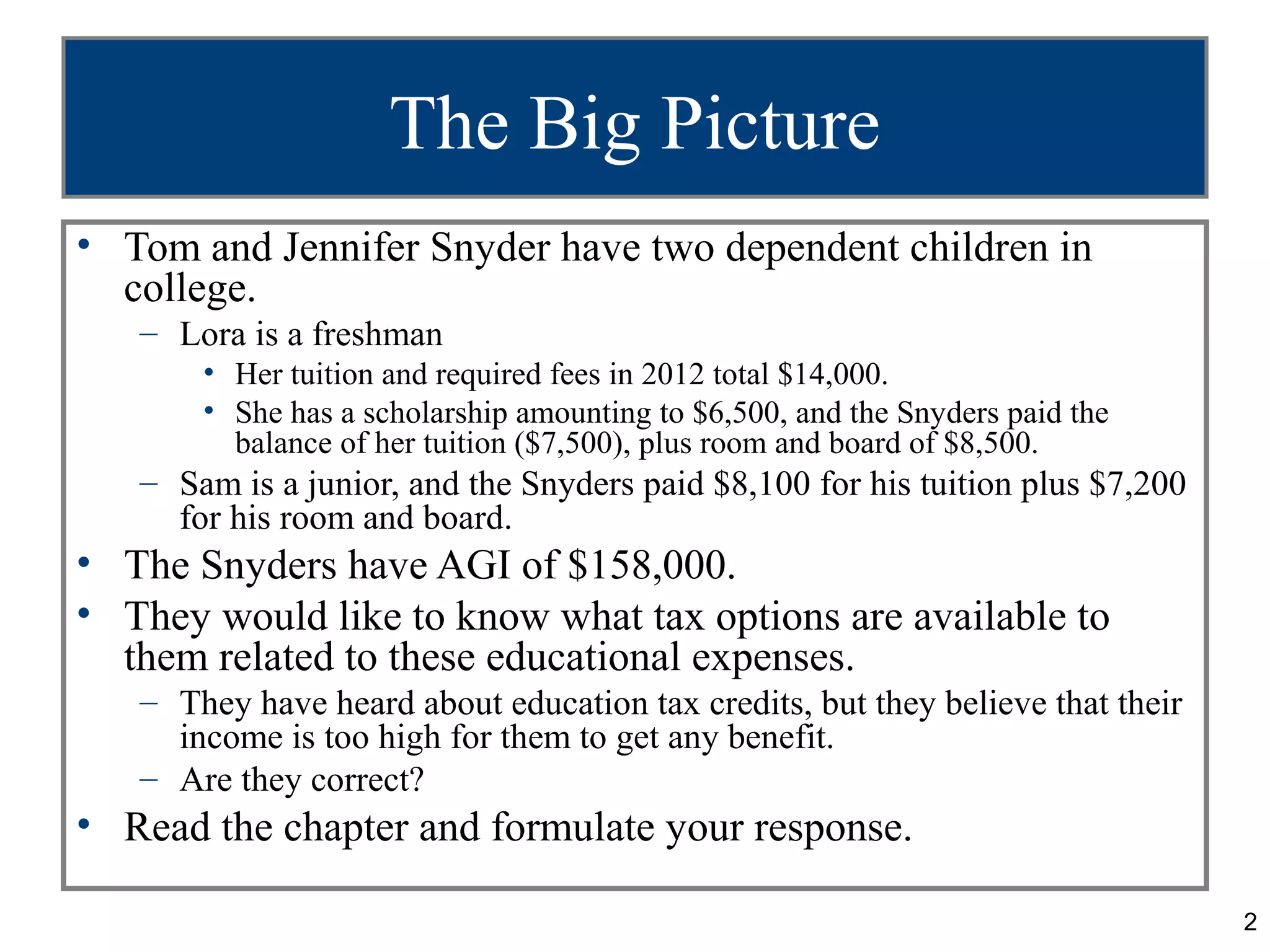
The Big Picture
• Tom and Jennifer Snyder have two dependent children in
  college.
   – Lora is a freshman
       • Her tuition and required fees in 2012 total $14,000.
       • She has a scholarship amounting to $6,500, and the Snyders paid the
         balance of her tuition ($7,500), plus room and board of $8,500.
   – Sam is a junior, and the Snyders paid $8,100 for his tuition plus $7,200
     for his room and board.
• The Snyders have AGI of $158,000.
• They would like to know what tax options are available to
  them related to these educational expenses.
   – They have heard about education tax credits, but they believe that their
     income is too high for them to get any benefit.
   – Are they correct?
• Read the chapter and formulate your response.

                                                                                2
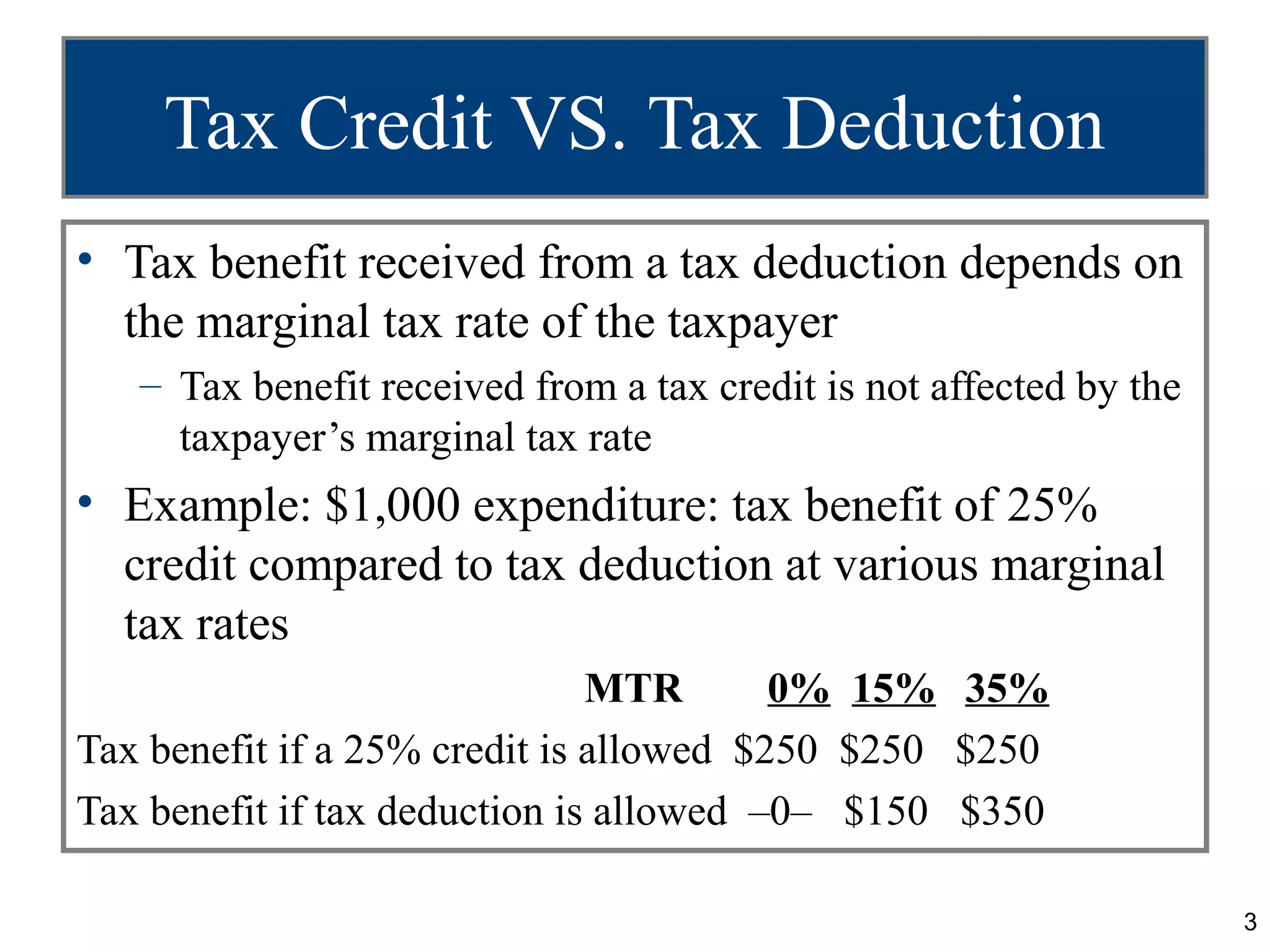
Tax Credit VS. Tax Deduction
• Tax benefit received from a tax deduction depends on
  the marginal tax rate of the taxpayer
   – Tax benefit received from a tax credit is not affected by the
     taxpayer’s marginal tax rate
• Example: $1,000 expenditure: tax benefit of 25%
  credit compared to tax deduction at various marginal
  tax rates
                               MTR       0% 15% 35%
Tax benefit if a 25% credit is allowed $250 $250 $250
Tax benefit if tax deduction is allowed –0– $150 $350

                                                                     3
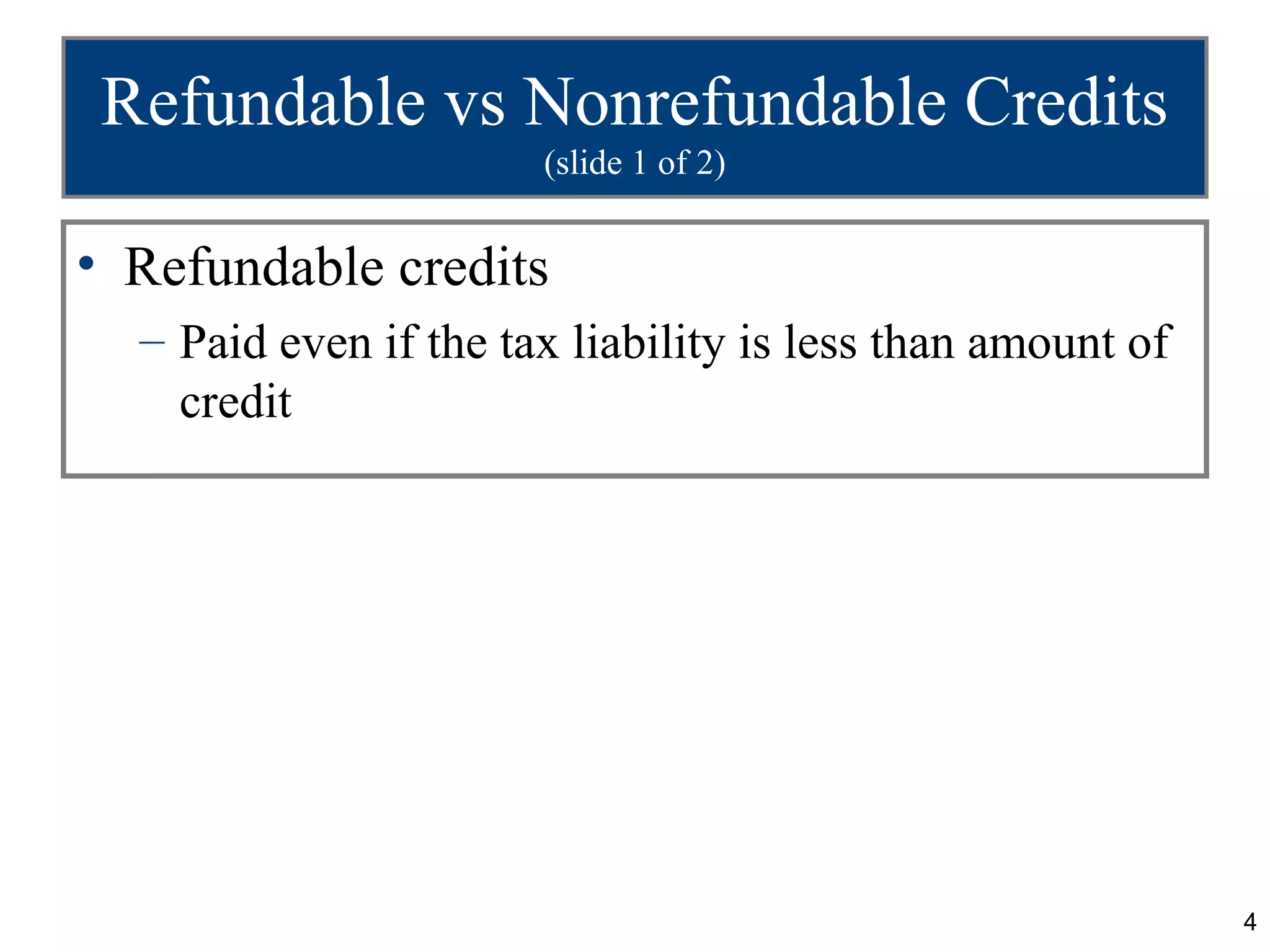
Refundable vs Nonrefundable Credits
                       (slide 1 of 2)


• Refundable credits
  – Paid even if the tax liability is less than amount of
    credit


                                                            4
Refundable vs Nonrefundable Credits
                        (slide 2 of 2)


• Nonrefundable credits
  – Credit can only be used to offset tax liability
  – If credit exceeds tax liability, excess is lost
     • Exception: some nonrefundable credits have carryover
       provisions for excess


                                                              5
General Business Credit (slide 1 of 2)
• Comprised of a number of business credits
  combined into one amount
• Limited to net income tax reduced by greater
  of:
  – Tentative minimum tax
  – 25% of net regular tax liability that exceeds
    $25,000
• Unused credit is carried back 1 year, then
  forward 20 years

                                                    6
General Business Credit (slide 2 of 2)
• Includes the following:
  – Tax credit for rehabilitation expenditures
  – Work opportunity tax credit
  – Research activities credit
  – Low-income housing credit
  – Disabled access credit
  – Credit for small employer pension plan startup
    costs
  – Credit for employer-provided child care

                                                     7
Rehabilitation Expenditure Credit
                      (slide 1 of 3)

• Credit is a percentage of expenditures made to
  substantially rehabilitate industrial and
  commercial buildings and certified historic
  structures
• Credit rate
  – 20% for nonresidential and residential certified
    historic structures
  – 10% for other structures originally placed into
    service before 1936


                                                       8
Rehabilitation Expenditure Credit
                      (slide 2 of 3)

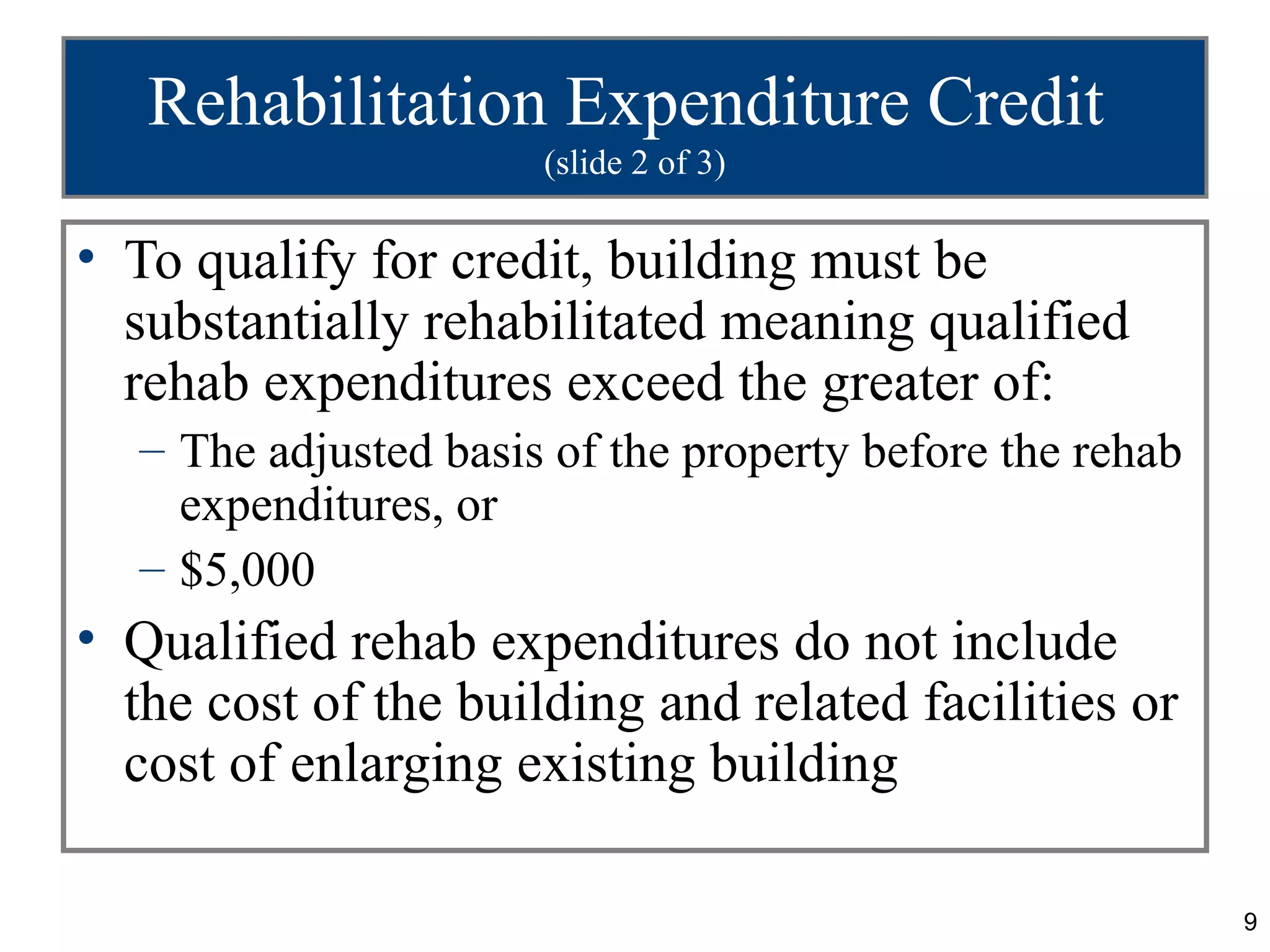
• To qualify for credit, building must be
  substantially rehabilitated meaning qualified
  rehab expenditures exceed the greater of:
  – The adjusted basis of the property before the rehab
    expenditures, or
  – $5,000
• Qualified rehab expenditures do not include
  the cost of the building and related facilities or
  cost of enlarging existing building

                                                          9
Rehabilitation Expenditure Credit
                     (slide 3 of 3)


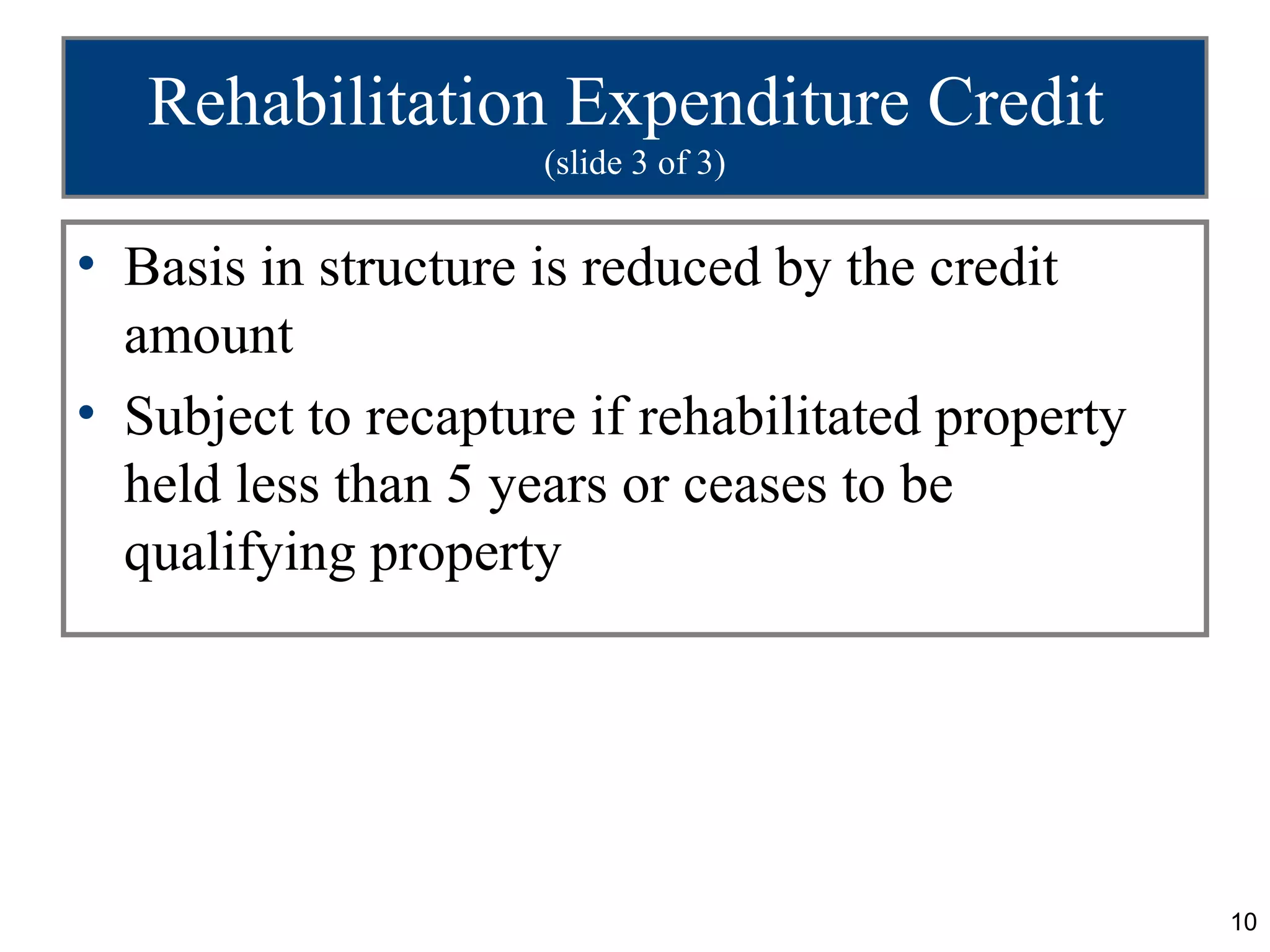
• Basis in structure is reduced by the credit
  amount
• Subject to recapture if rehabilitated property
  held less than 5 years or ceases to be
  qualifying property


                                                   10
Work Opportunity Tax Credit
                        (slide 1 of 2)


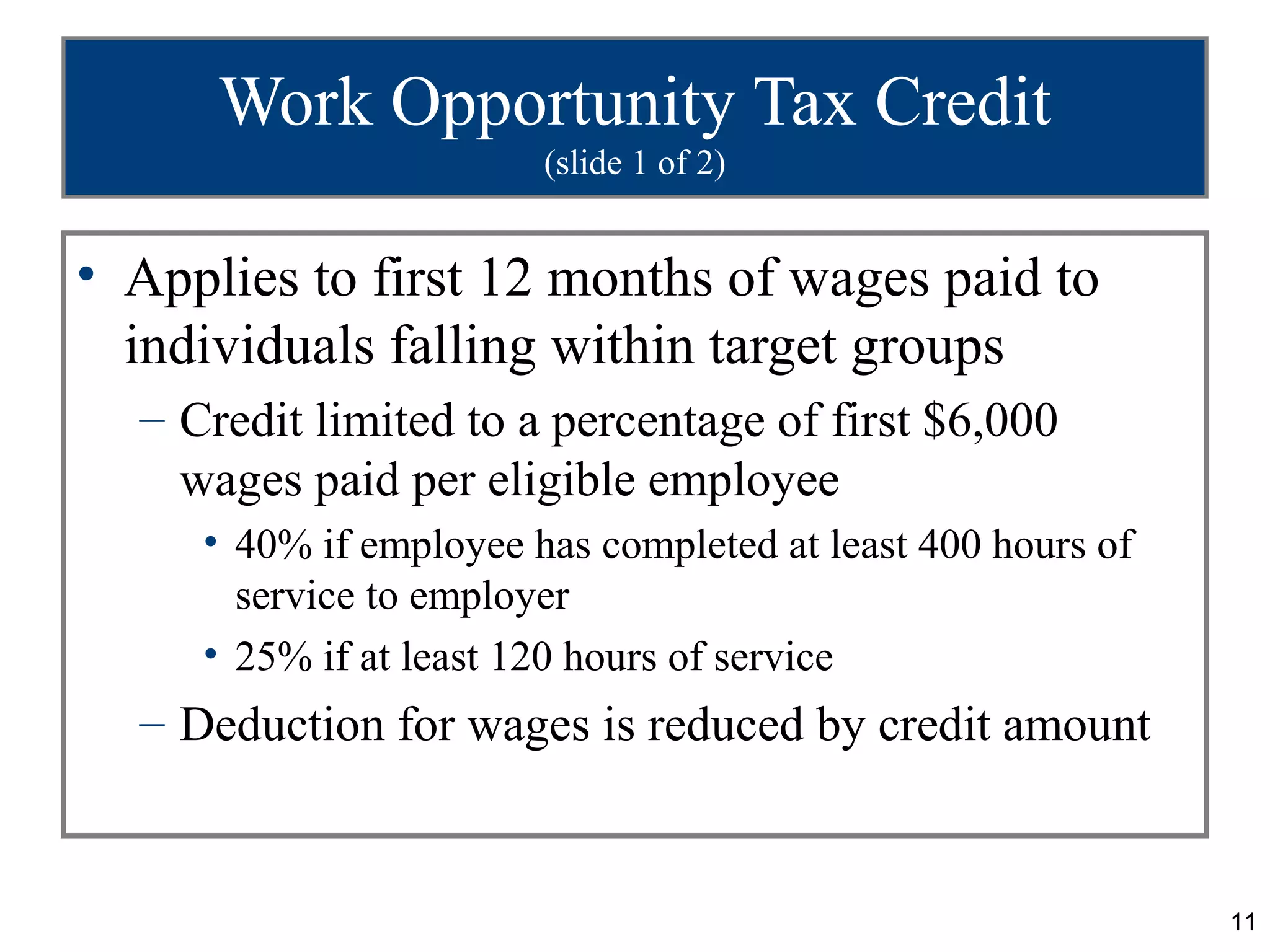
• Applies to first 12 months of wages paid to
  individuals falling within target groups
  – Credit limited to a percentage of first $6,000
    wages paid per eligible employee
     • 40% if employee has completed at least 400 hours of
       service to employer
     • 25% if at least 120 hours of service
  – Deduction for wages is reduced by credit amount


                                                             11
Work Opportunity Tax Credit
                       (slide 2 of 2)


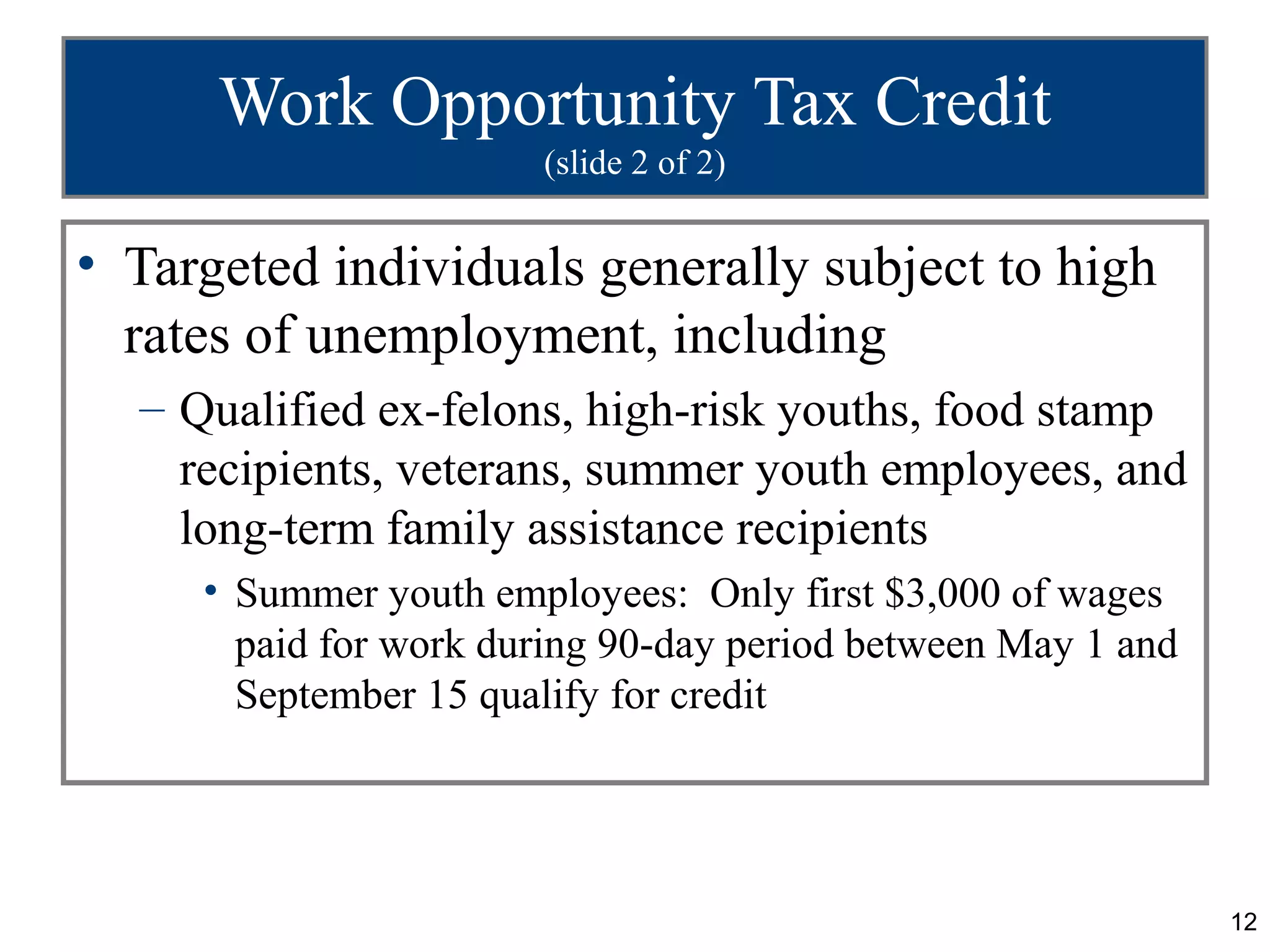
• Targeted individuals generally subject to high
  rates of unemployment, including
  – Qualified ex-felons, high-risk youths, food stamp
    recipients, veterans, summer youth employees, and
    long-term family assistance recipients
     • Summer youth employees: Only first $3,000 of wages
       paid for work during 90-day period between May 1 and
       September 15 qualify for credit


                                                              12
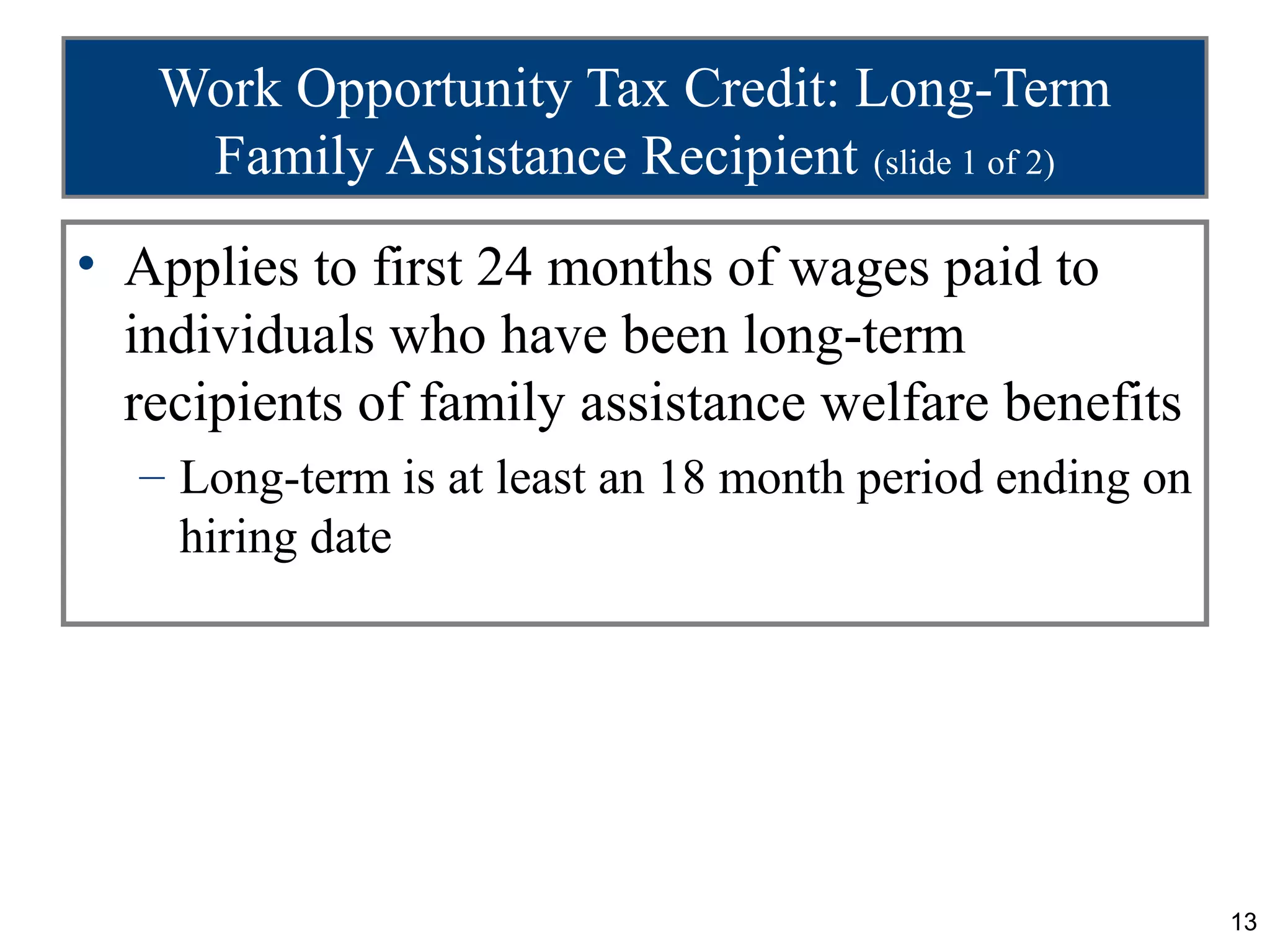
Work Opportunity Tax Credit: Long-Term
    Family Assistance Recipient (slide 1 of 2)
• Applies to first 24 months of wages paid to
  individuals who have been long-term
  recipients of family assistance welfare benefits
  – Long-term is at least an 18 month period ending on
    hiring date


                                                         13
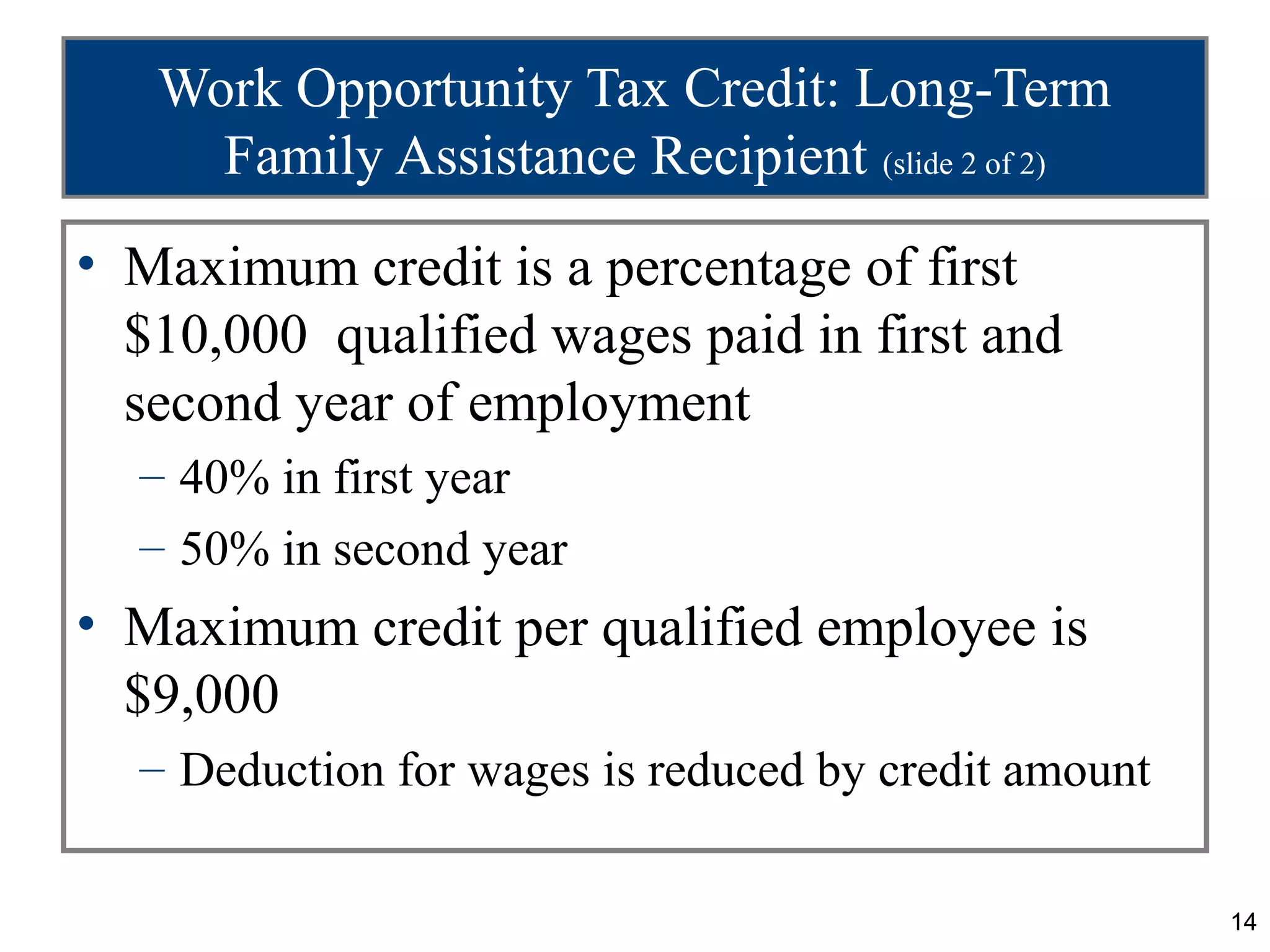
Work Opportunity Tax Credit: Long-Term
     Family Assistance Recipient (slide 2 of 2)
• Maximum credit is a percentage of first
  $10,000 qualified wages paid in first and
  second year of employment
  – 40% in first year
  – 50% in second year
• Maximum credit per qualified employee is
  $9,000
  – Deduction for wages is reduced by credit amount

                                                      14
Research Activities Credit
                       (slide 1 of 5)


• Comprised of three parts
  – Incremental research activities credit
  – Basic research credit
  – Energy research credit


                                             15
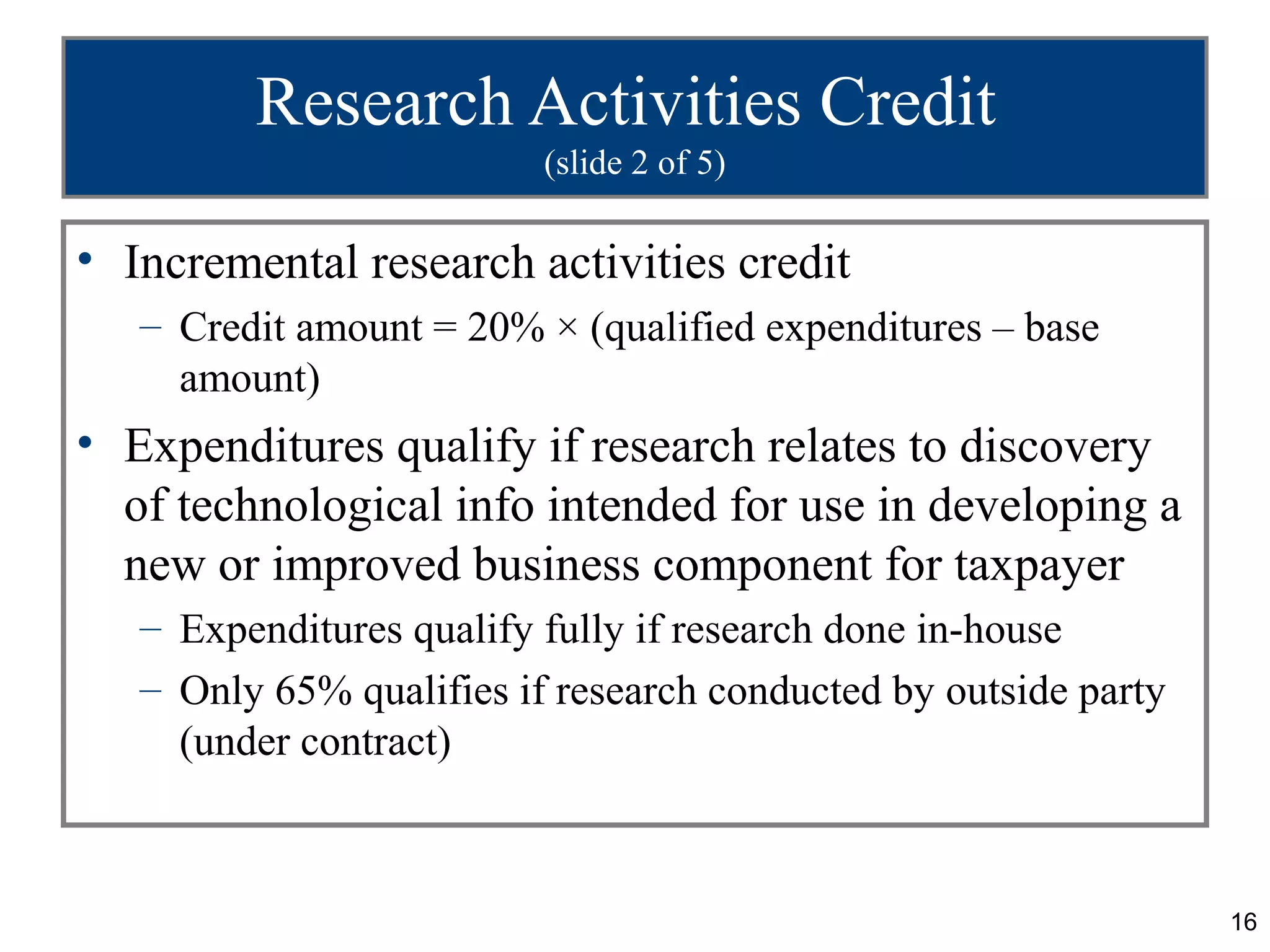
Research Activities Credit
                          (slide 2 of 5)

• Incremental research activities credit
   – Credit amount = 20% × (qualified expenditures – base
     amount)
• Expenditures qualify if research relates to discovery
  of technological info intended for use in developing a
  new or improved business component for taxpayer
   – Expenditures qualify fully if research done in-house
   – Only 65% qualifies if research conducted by outside party
     (under contract)


                                                                 16
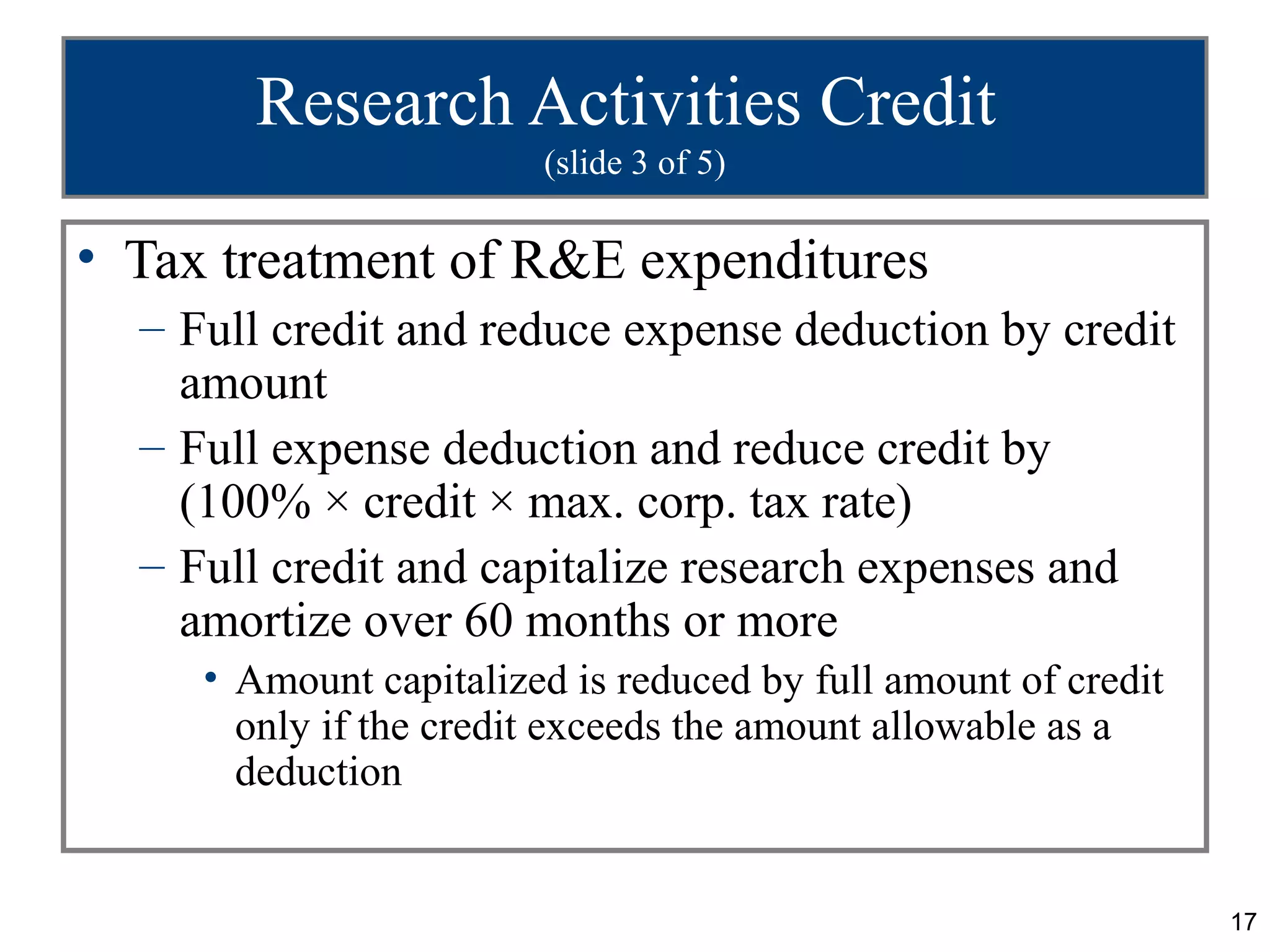
Research Activities Credit
                        (slide 3 of 5)

• Tax treatment of R&E expenditures
  – Full credit and reduce expense deduction by credit
    amount
  – Full expense deduction and reduce credit by
    (100% × credit × max. corp. tax rate)
  – Full credit and capitalize research expenses and
    amortize over 60 months or more
     • Amount capitalized is reduced by full amount of credit
       only if the credit exceeds the amount allowable as a
       deduction


                                                                17
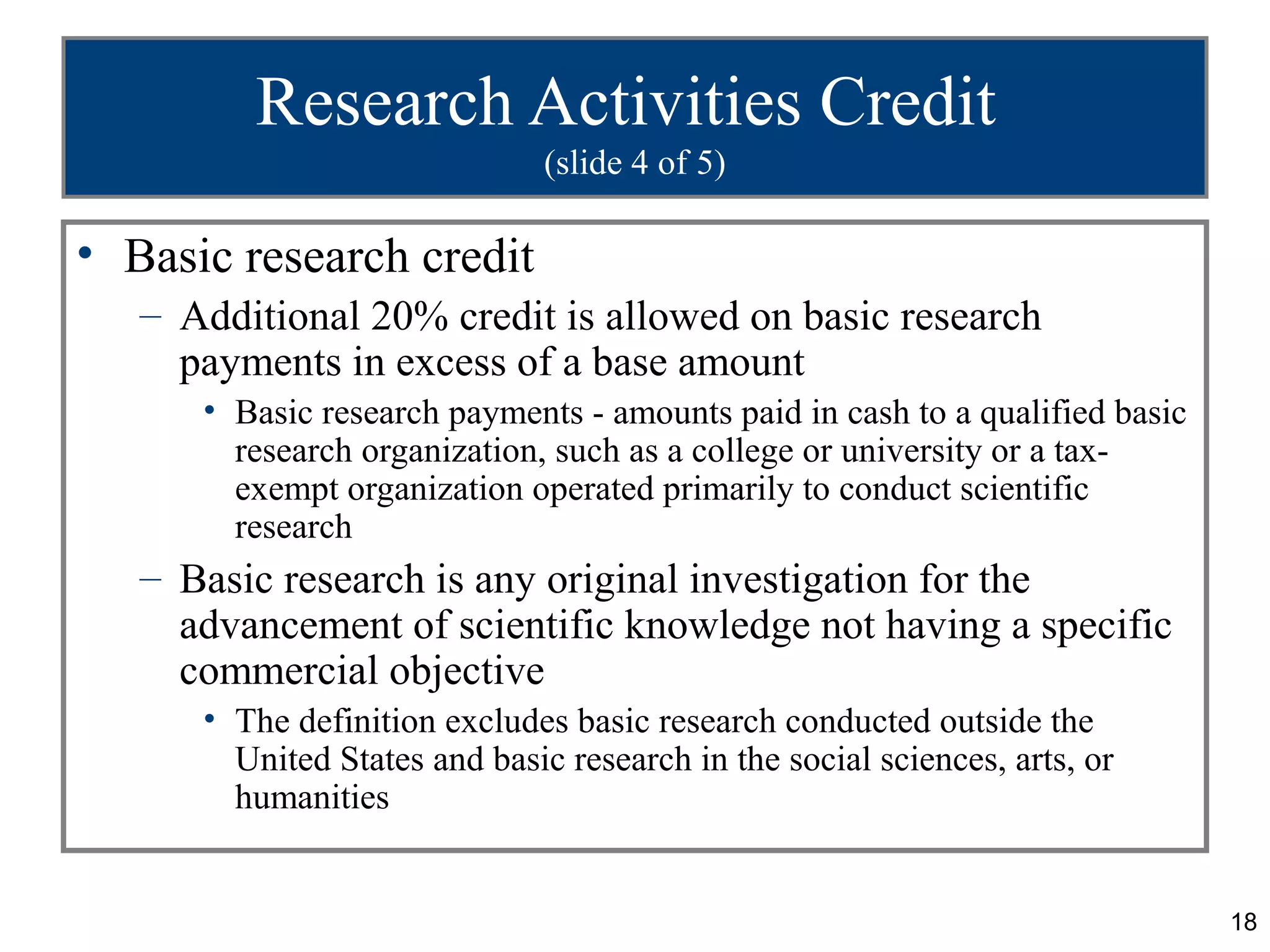
Research Activities Credit
                               (slide 4 of 5)

• Basic research credit
   – Additional 20% credit is allowed on basic research
     payments in excess of a base amount
      • Basic research payments - amounts paid in cash to a qualified basic
        research organization, such as a college or university or a tax-
        exempt organization operated primarily to conduct scientific
        research
   – Basic research is any original investigation for the
     advancement of scientific knowledge not having a specific
     commercial objective
      • The definition excludes basic research conducted outside the
        United States and basic research in the social sciences, arts, or
        humanities


                                                                              18
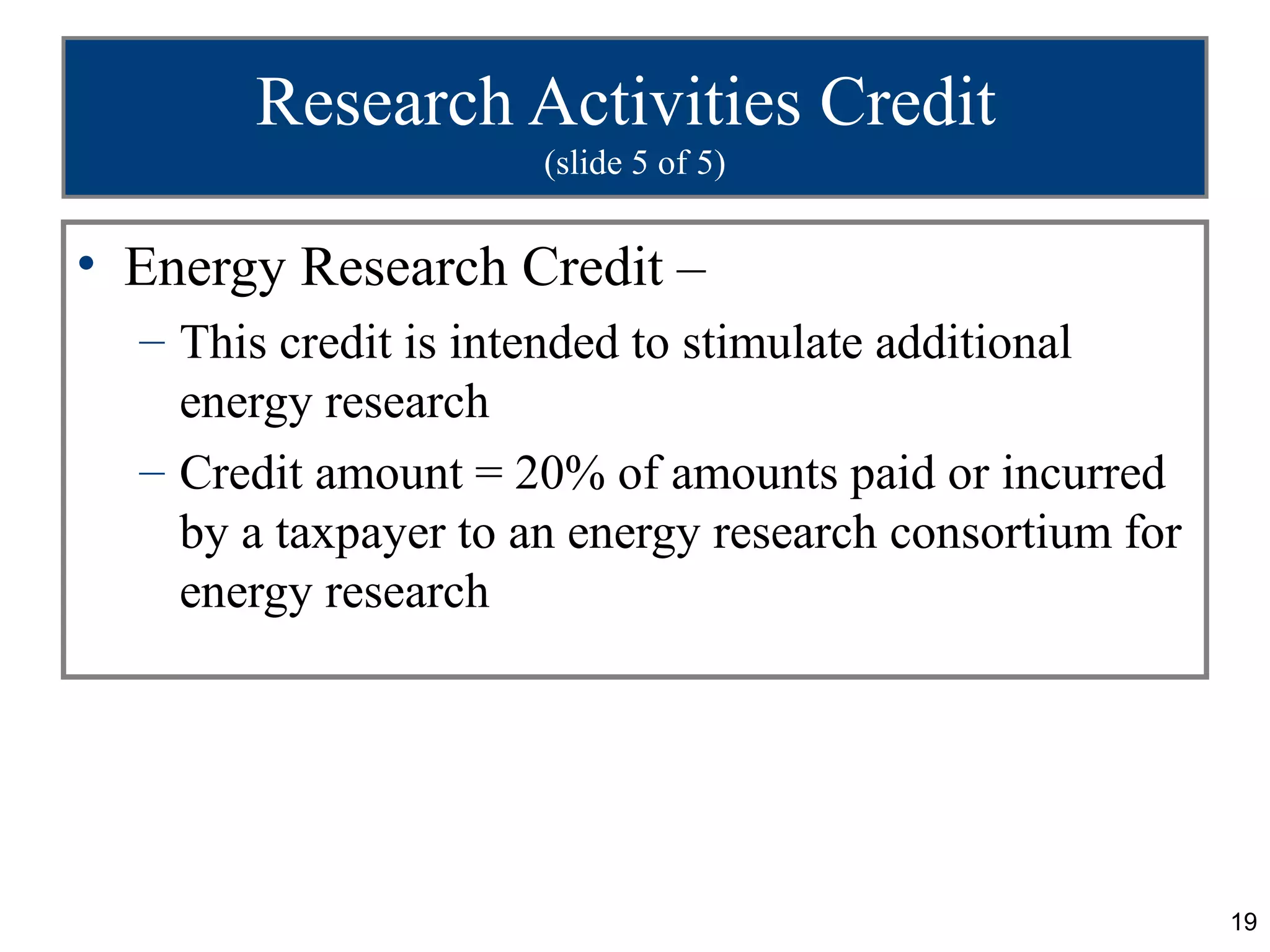
Research Activities Credit
                      (slide 5 of 5)


• Energy Research Credit –
  – This credit is intended to stimulate additional
    energy research
  – Credit amount = 20% of amounts paid or incurred
    by a taxpayer to an energy research consortium for
    energy research


                                                         19
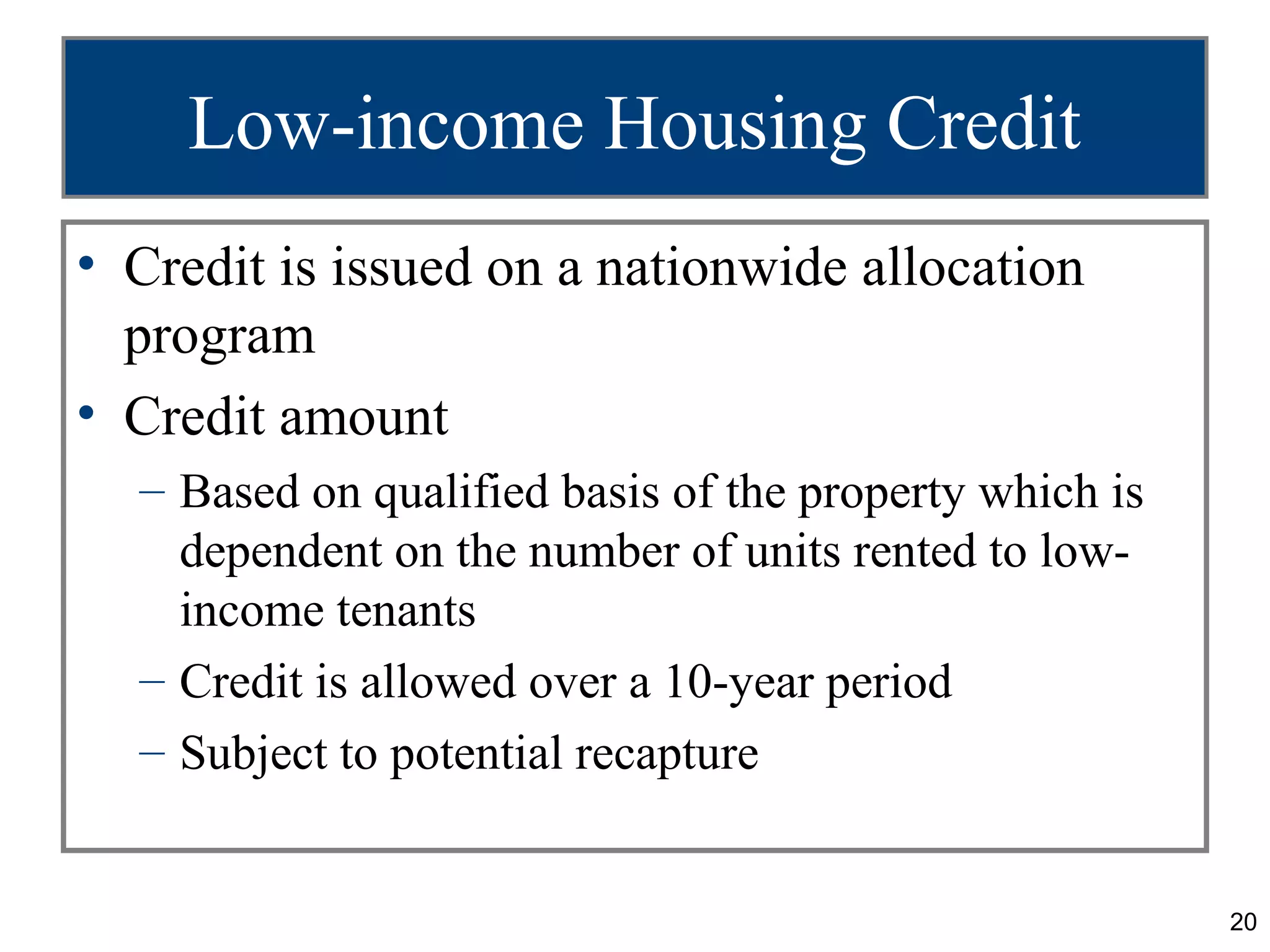
Low-income Housing Credit
• Credit is issued on a nationwide allocation
  program
• Credit amount
  – Based on qualified basis of the property which is
    dependent on the number of units rented to low-
    income tenants
  – Credit is allowed over a 10-year period
  – Subject to potential recapture


                                                        20
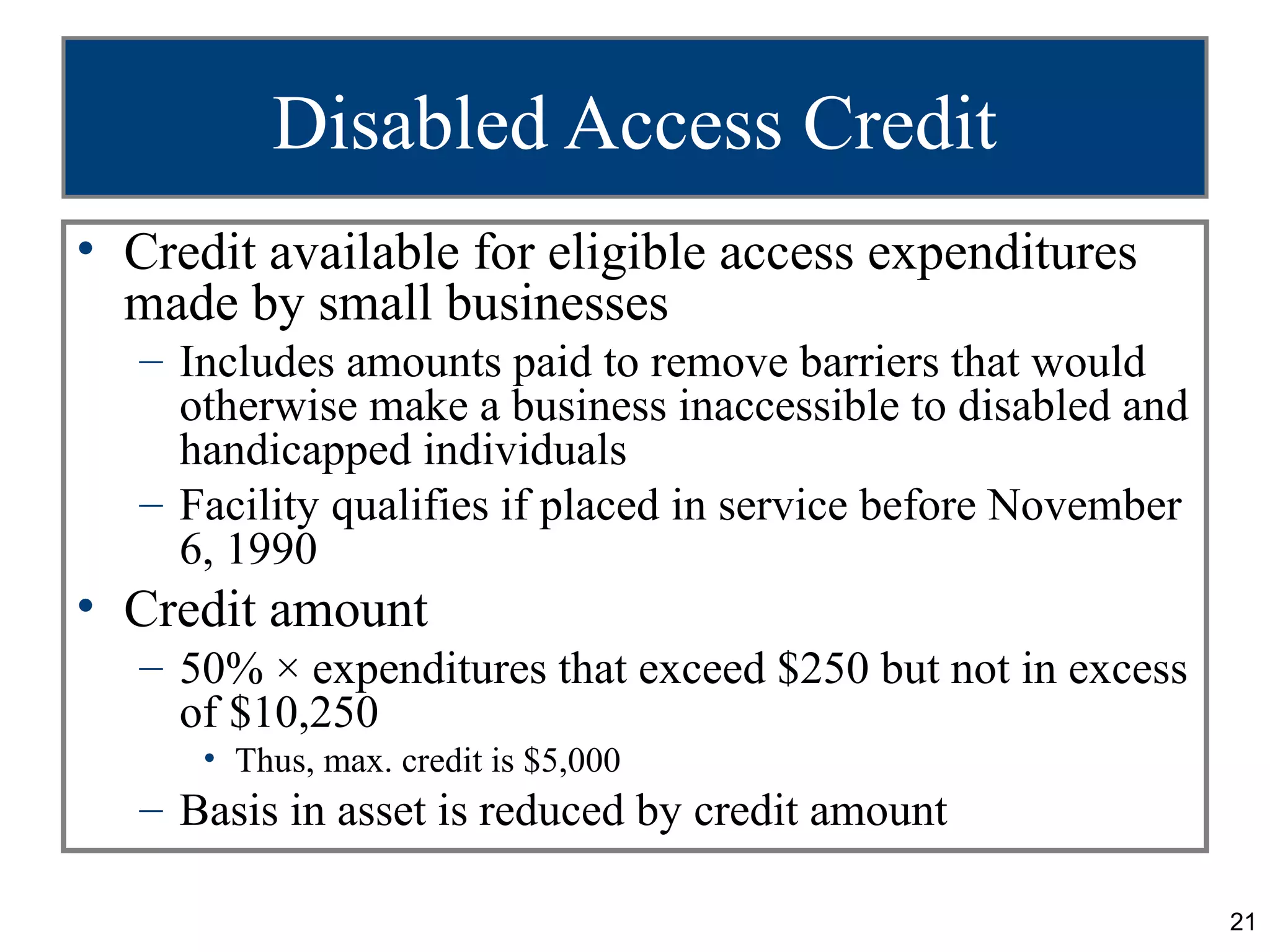
Disabled Access Credit
• Credit available for eligible access expenditures
  made by small businesses
   – Includes amounts paid to remove barriers that would
     otherwise make a business inaccessible to disabled and
     handicapped individuals
   – Facility qualifies if placed in service before November
     6, 1990
• Credit amount
   – 50% × expenditures that exceed $250 but not in excess
     of $10,250
      • Thus, max. credit is $5,000
   – Basis in asset is reduced by credit amount

                                                               21
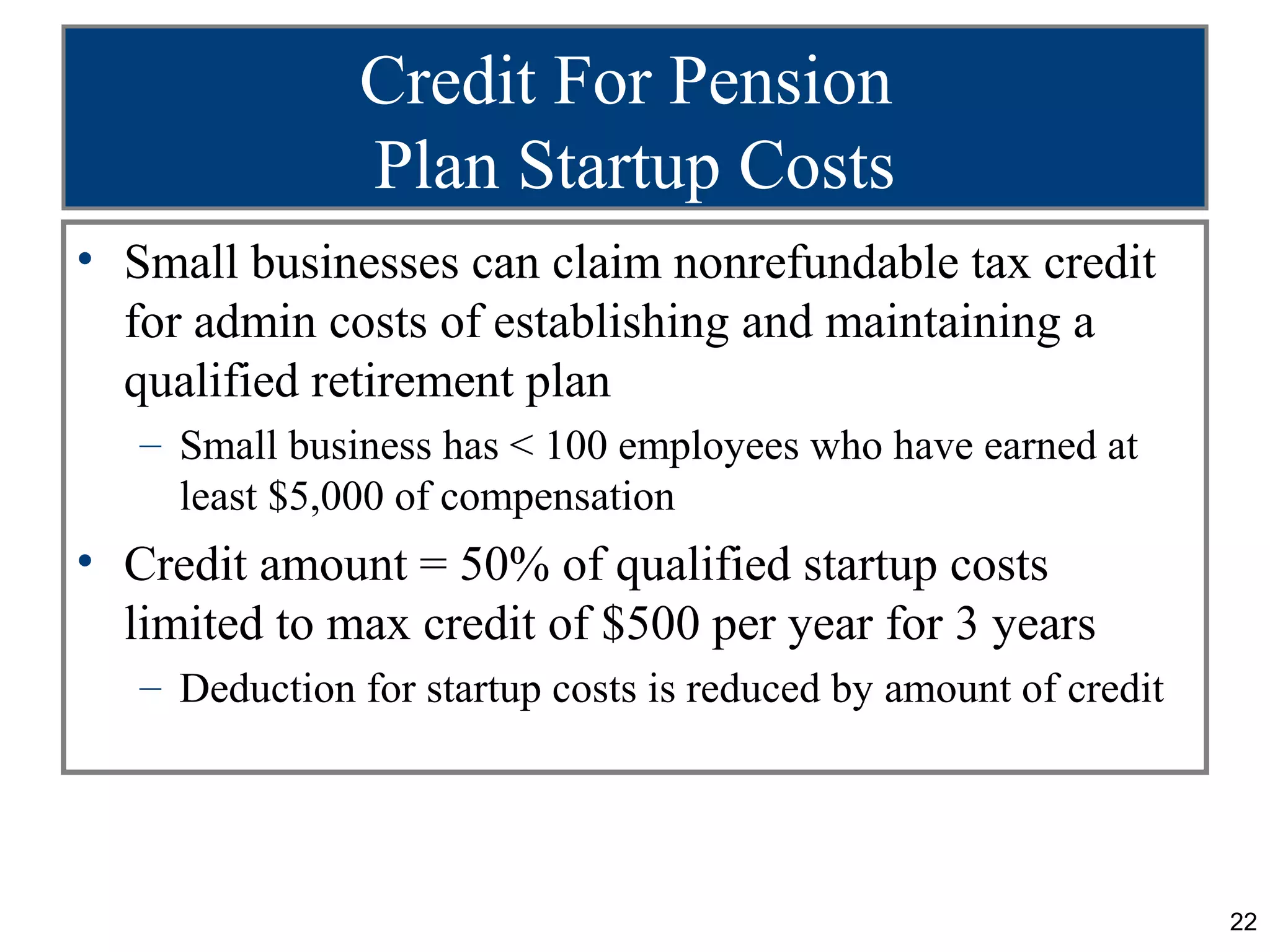
Credit For Pension
               Plan Startup Costs
• Small businesses can claim nonrefundable tax credit
  for admin costs of establishing and maintaining a
  qualified retirement plan
   – Small business has < 100 employees who have earned at
     least $5,000 of compensation
• Credit amount = 50% of qualified startup costs
  limited to max credit of $500 per year for 3 years
   – Deduction for startup costs is reduced by amount of credit


                                                                  22
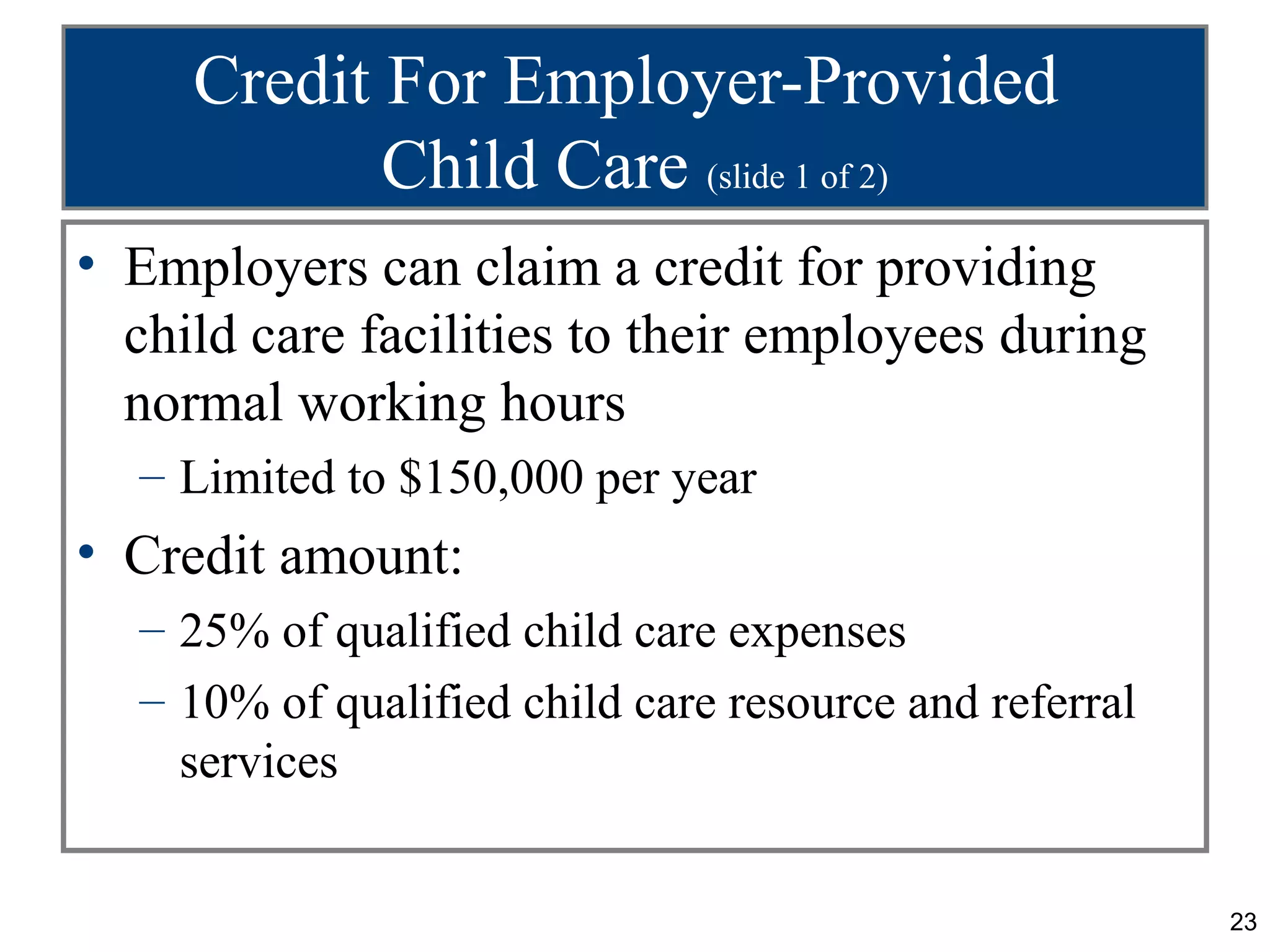
Credit For Employer-Provided
            Child Care (slide 1 of 2)
• Employers can claim a credit for providing
  child care facilities to their employees during
  normal working hours
  – Limited to $150,000 per year
• Credit amount:
  – 25% of qualified child care expenses
  – 10% of qualified child care resource and referral
    services


                                                        23
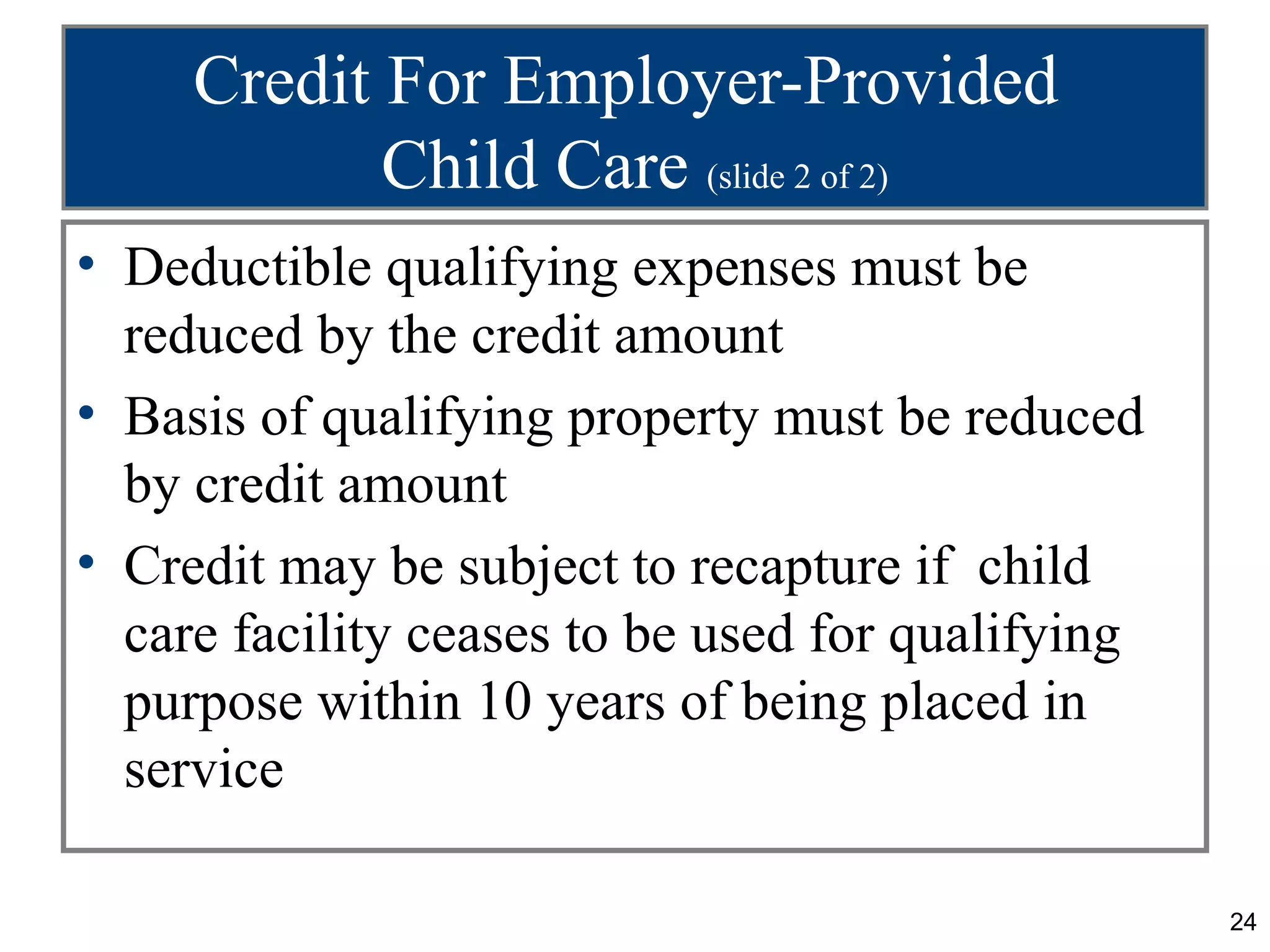
Credit For Employer-Provided
            Child Care (slide 2 of 2)
• Deductible qualifying expenses must be
  reduced by the credit amount
• Basis of qualifying property must be reduced
  by credit amount
• Credit may be subject to recapture if child
  care facility ceases to be used for qualifying
  purpose within 10 years of being placed in
  service

                                                   24
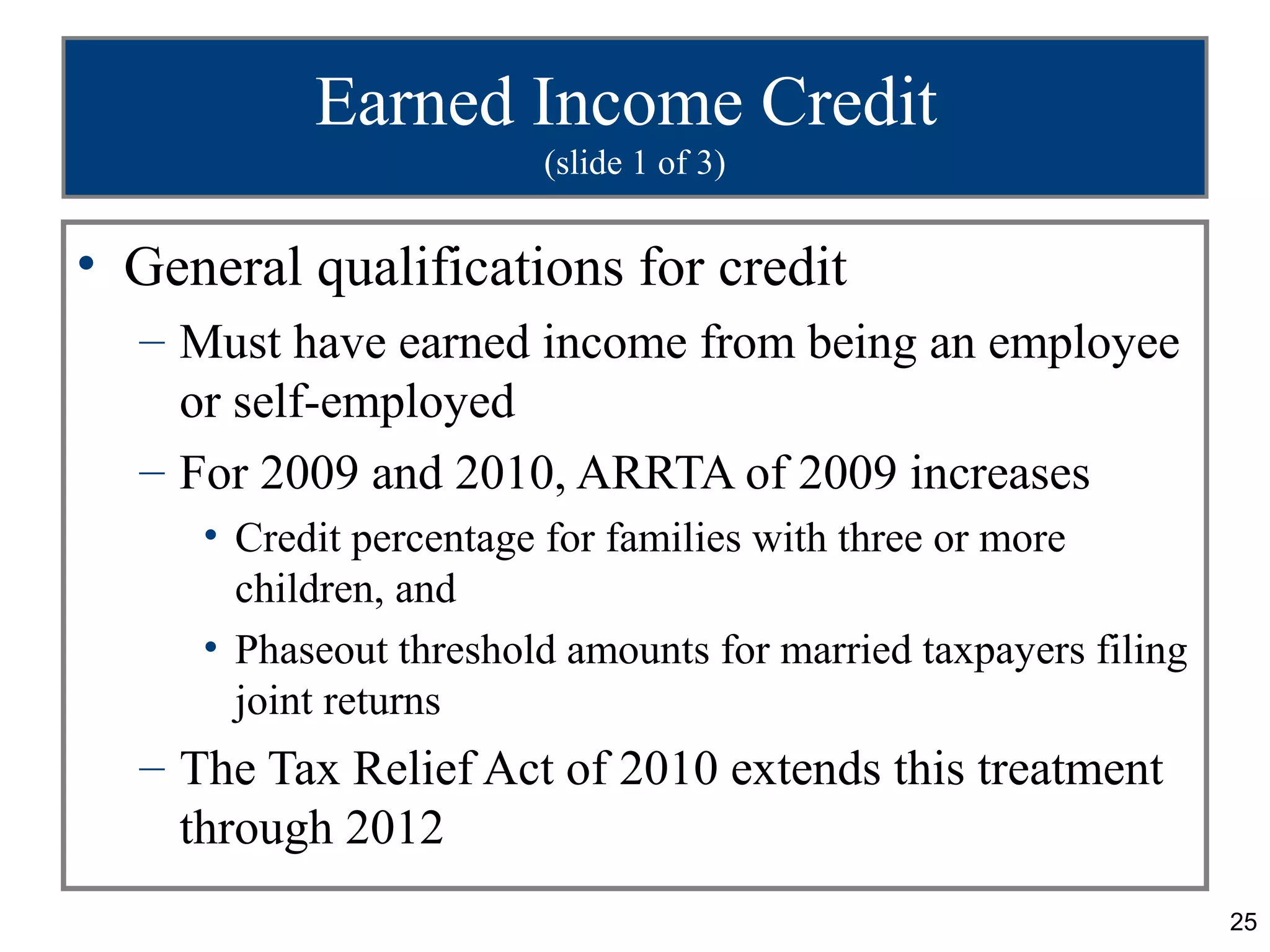
Earned Income Credit
                        (slide 1 of 3)


• General qualifications for credit
  – Must have earned income from being an employee
    or self-employed
  – For 2009 and 2010, ARRTA of 2009 increases
     • Credit percentage for families with three or more
       children, and
     • Phaseout threshold amounts for married taxpayers filing
       joint returns
  – The Tax Relief Act of 2010 extends this treatment
    through 2012
                                                                 25
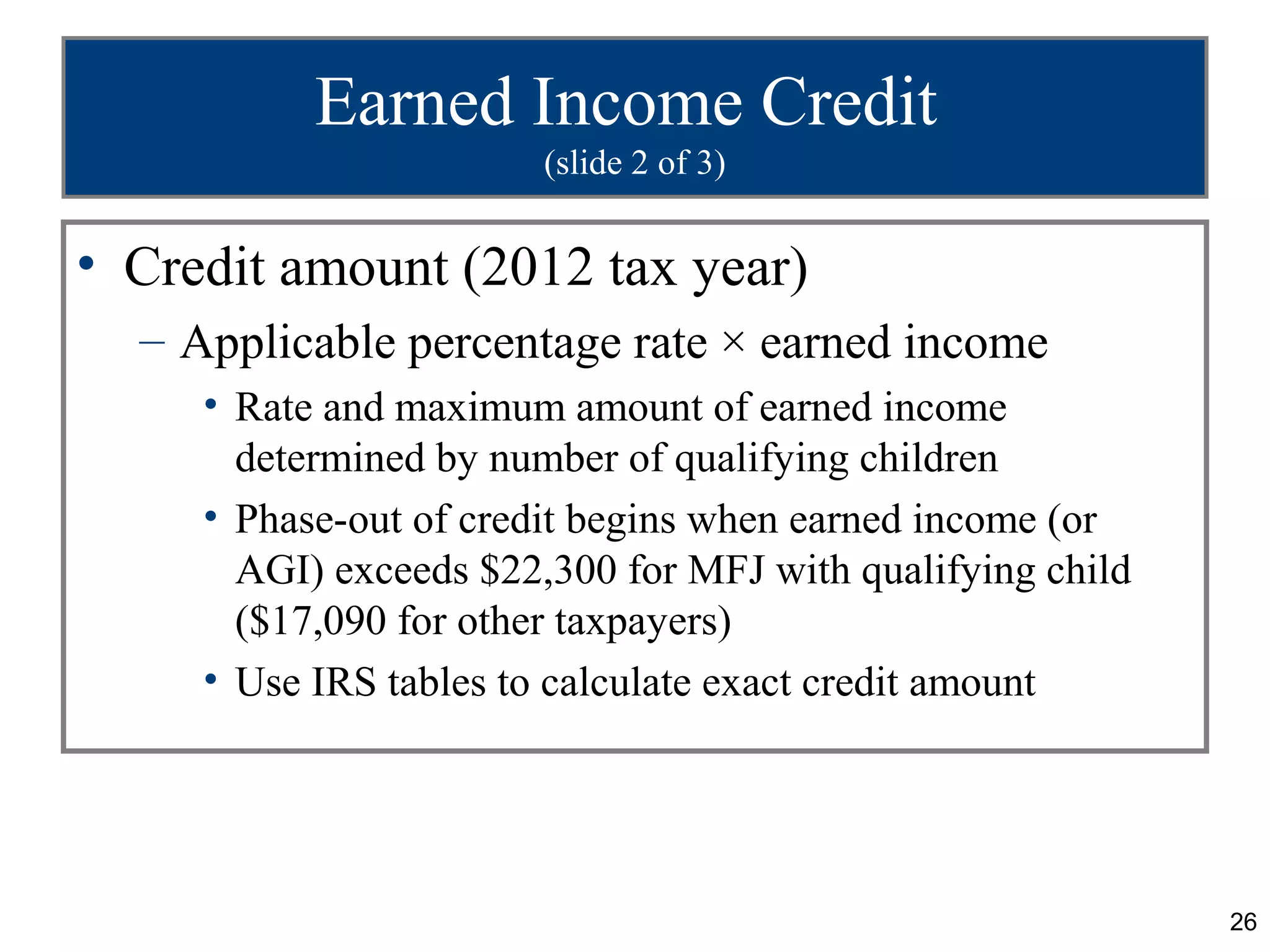
Earned Income Credit
                        (slide 2 of 3)


• Credit amount (2012 tax year)
  – Applicable percentage rate × earned income
     • Rate and maximum amount of earned income
       determined by number of qualifying children
     • Phase-out of credit begins when earned income (or
       AGI) exceeds $22,300 for MFJ with qualifying child
       ($17,090 for other taxpayers)
     • Use IRS tables to calculate exact credit amount


                                                            26
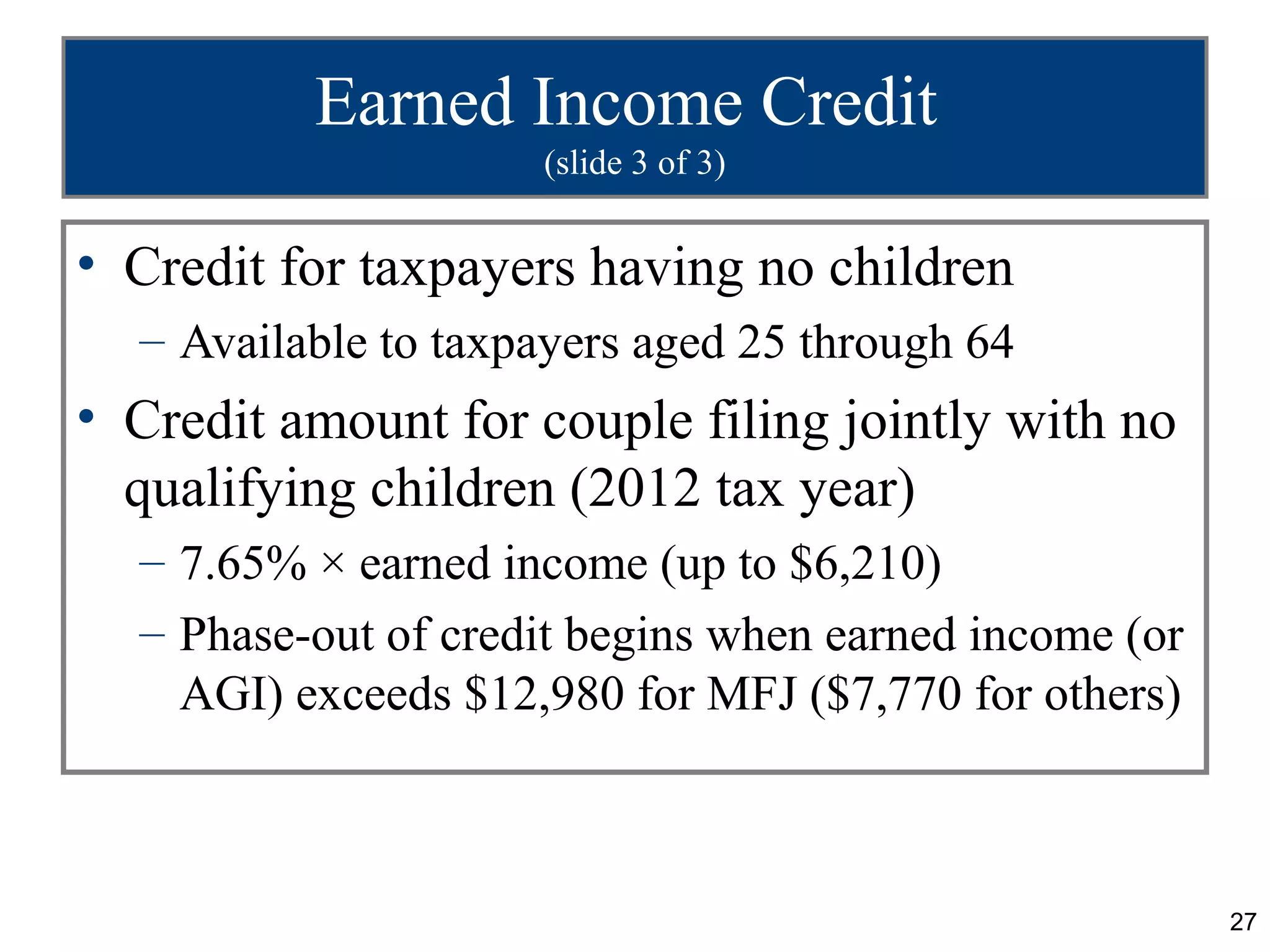
Earned Income Credit
                     (slide 3 of 3)


• Credit for taxpayers having no children
  – Available to taxpayers aged 25 through 64
• Credit amount for couple filing jointly with no
  qualifying children (2012 tax year)
  – 7.65% × earned income (up to $6,210)
  – Phase-out of credit begins when earned income (or
    AGI) exceeds $12,980 for MFJ ($7,770 for others)


                                                        27
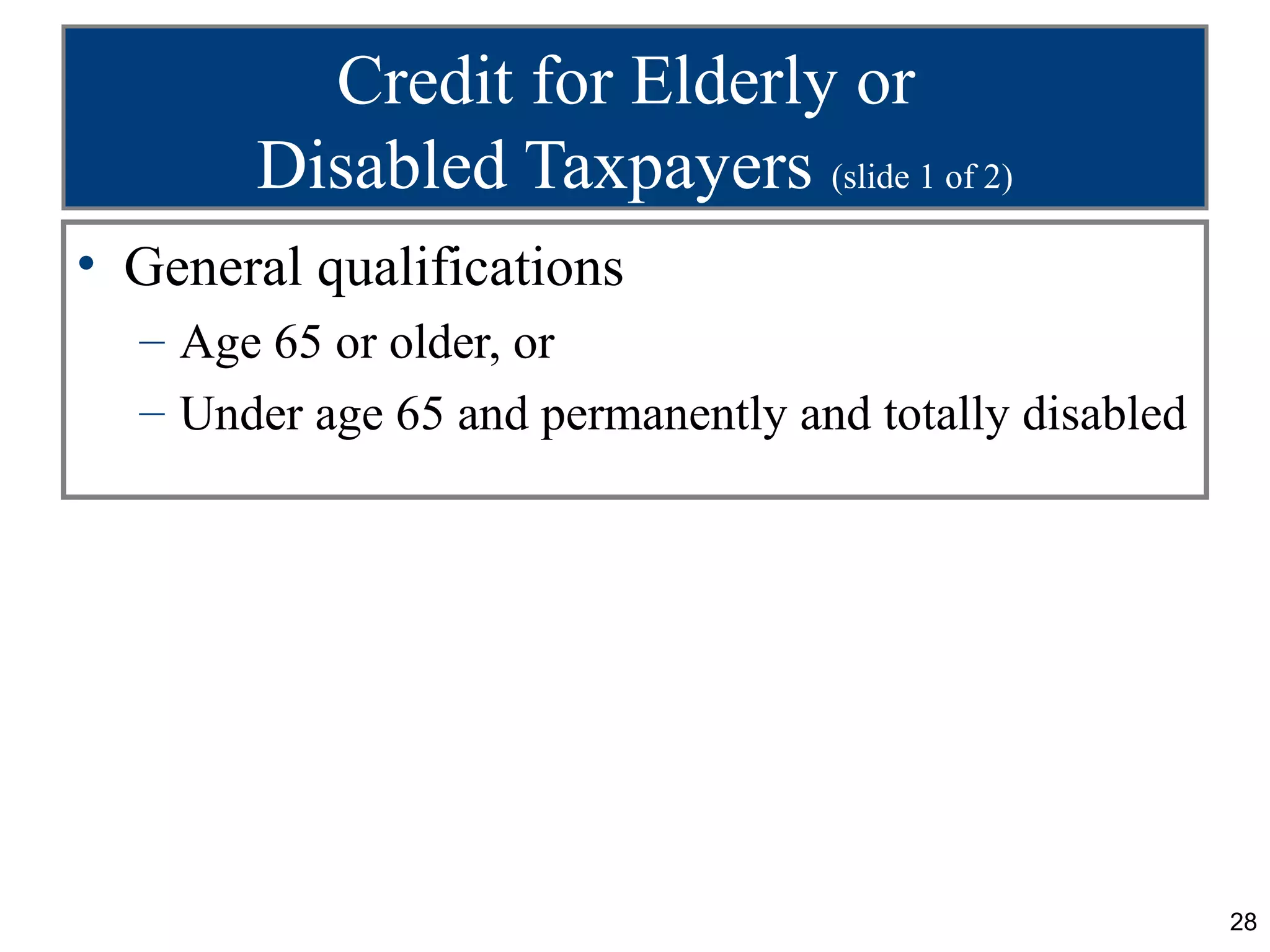
Credit for Elderly or
       Disabled Taxpayers (slide 1 of 2)
• General qualifications
  – Age 65 or older, or
  – Under age 65 and permanently and totally disabled


                                                        28
Credit for Elderly or
        Disabled Taxpayers (slide 2 of 2)
• Credit amount
  – Maximum credit = $1,125
     • Amount reduced for taxpayers with Social Security
       benefits or AGI in excess of specified amounts
  – IRS will calculate credit for taxpayer if necessary


                                                           29
Foreign Tax Credit
                      (slide 1 of 2)


• The purpose of the foreign tax credit (FTC) is
  to mitigate double taxation since income
  earned in a foreign country is subject to both
  U.S. and foreign taxes
  – Credit applies to both individuals and corporations
    that pay foreign income taxes
  – Instead of claiming a credit, a deduction may be
    claimed for the taxes paid


                                                          30
Foreign Tax Credit
                              (slide 2 of 2)

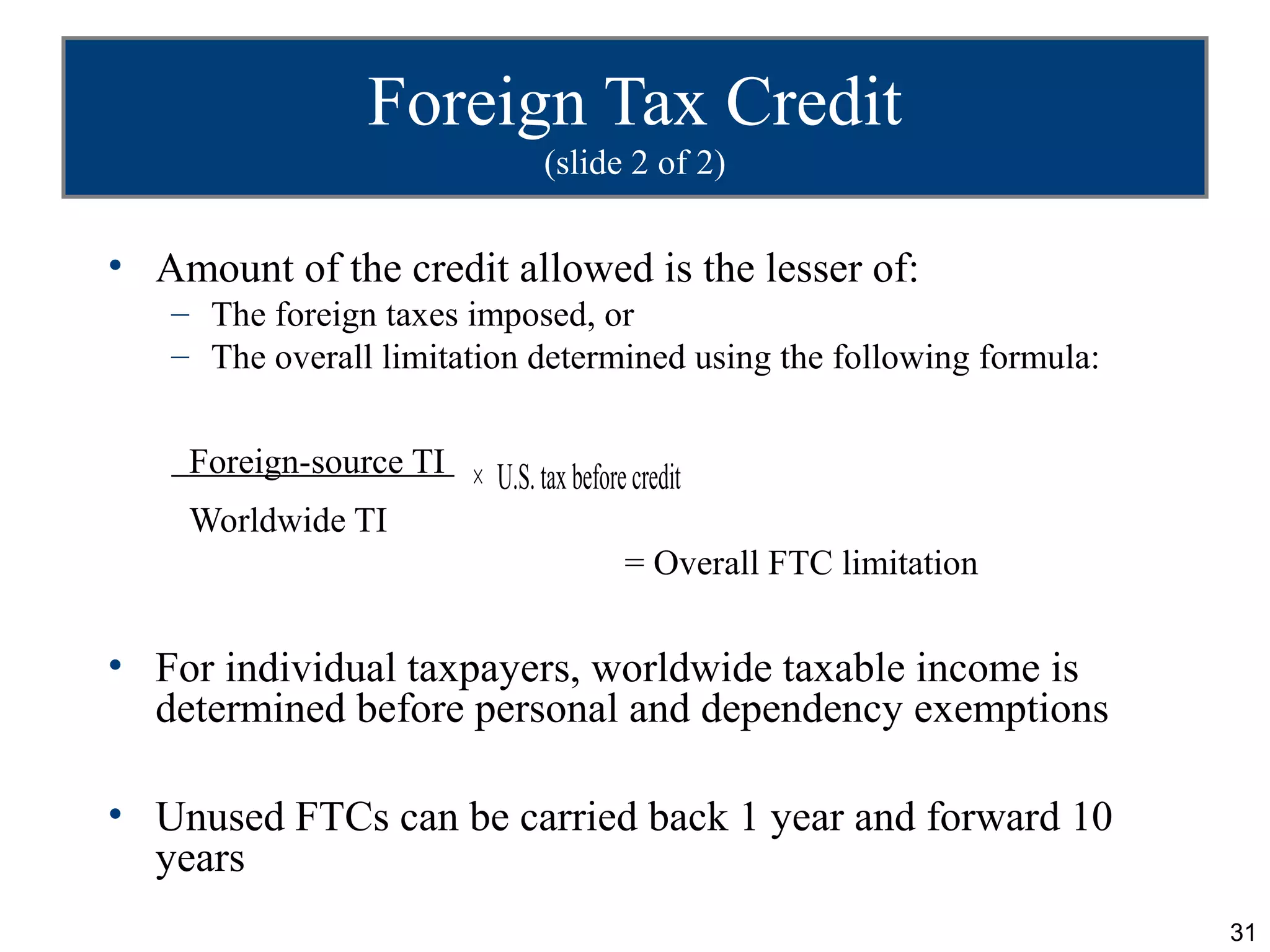
• Amount of the credit allowed is the lesser of:
   – The foreign taxes imposed, or
   – The overall limitation determined using the following formula:


    Foreign-source TI × U.S. tax before credit
    Worldwide TI
                                       = Overall FTC limitation

• For individual taxpayers, worldwide taxable income is
  determined before personal and dependency exemptions

• Unused FTCs can be carried back 1 year and forward 10
  years
                                                                      31
Adoption Expenses Credit
                      (slide 1 of 2)


• Credit for qualified adoption expenses
  incurred in adoption of eligible child
  – Examples of expenses: adoption fees, court costs,
    attorney fees
• Maximum credit is $12,650 (in 2012)
  – Credit is phased-out ratably for modified AGI
    between $189,710 and $229,710


                                                        32
Adoption Expenses Credit
                       (slide 2 of 2)


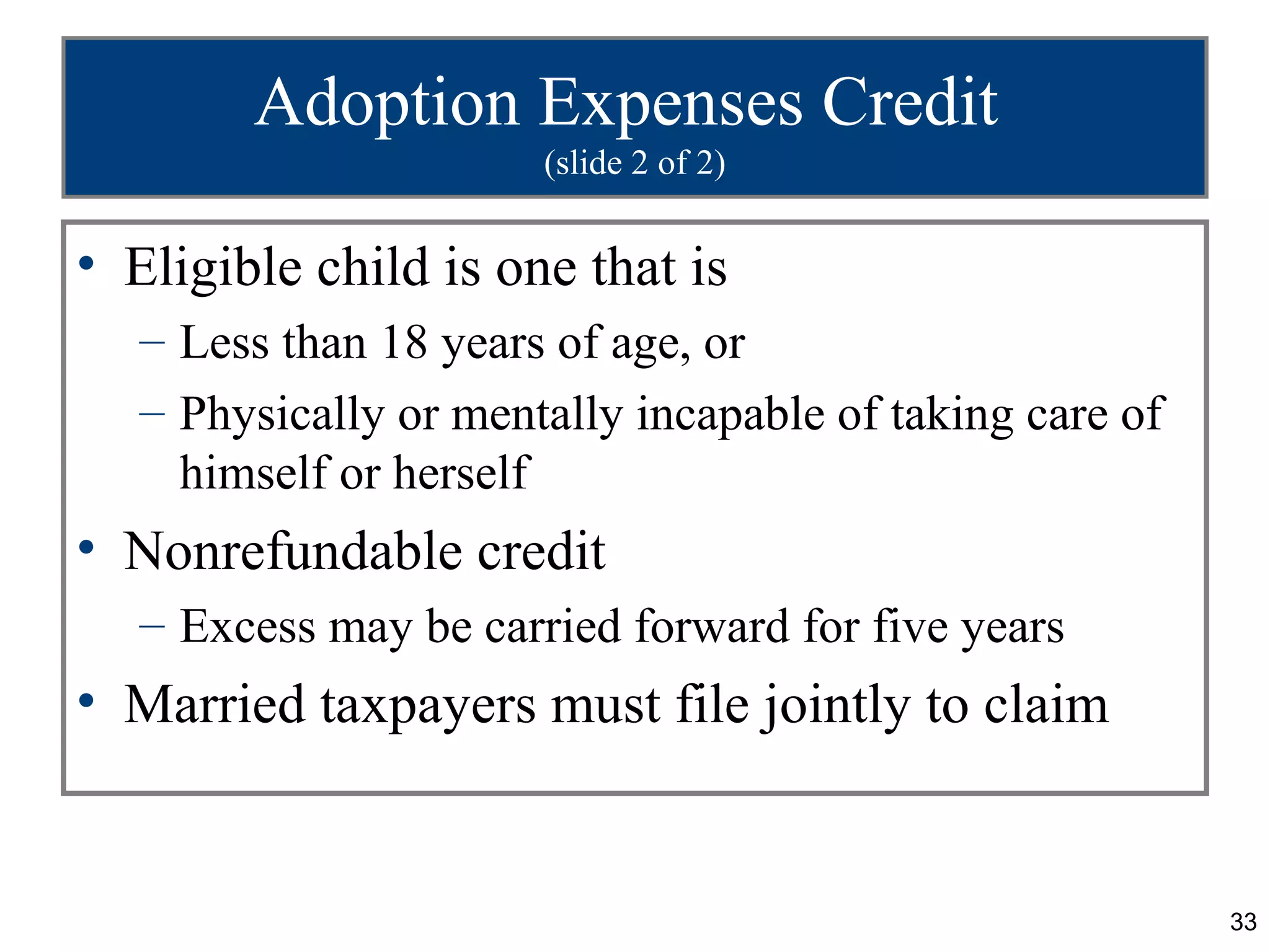
• Eligible child is one that is
   – Less than 18 years of age, or
   – Physically or mentally incapable of taking care of
     himself or herself
• Nonrefundable credit
   – Excess may be carried forward for five years
• Married taxpayers must file jointly to claim


                                                          33
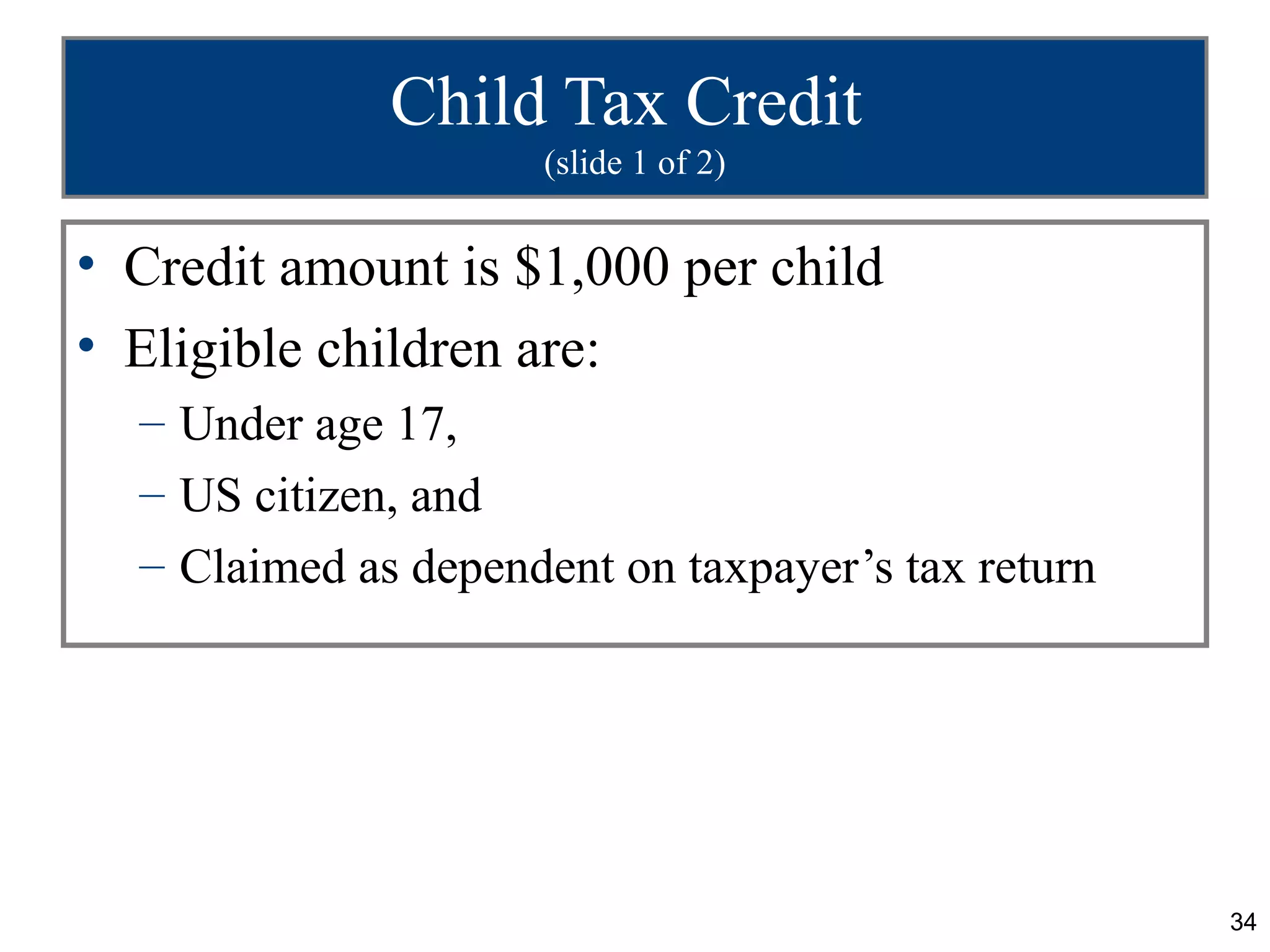
Child Tax Credit
                     (slide 1 of 2)


• Credit amount is $1,000 per child
• Eligible children are:
  – Under age 17,
  – US citizen, and
  – Claimed as dependent on taxpayer’s tax return


                                                    34
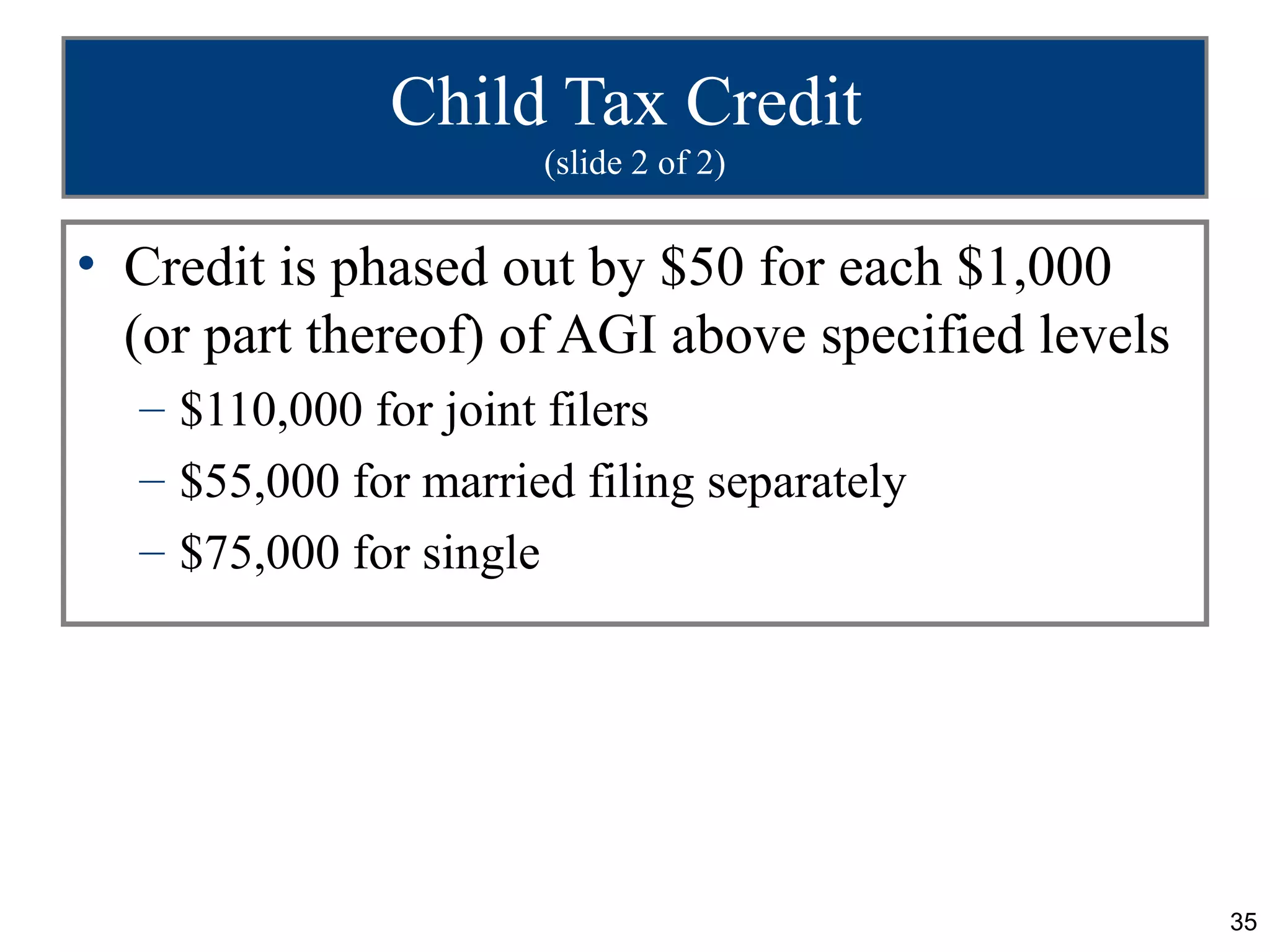
Child Tax Credit
                      (slide 2 of 2)


• Credit is phased out by $50 for each $1,000
  (or part thereof) of AGI above specified levels
  – $110,000 for joint filers
  – $55,000 for married filing separately
  – $75,000 for single


                                                    35
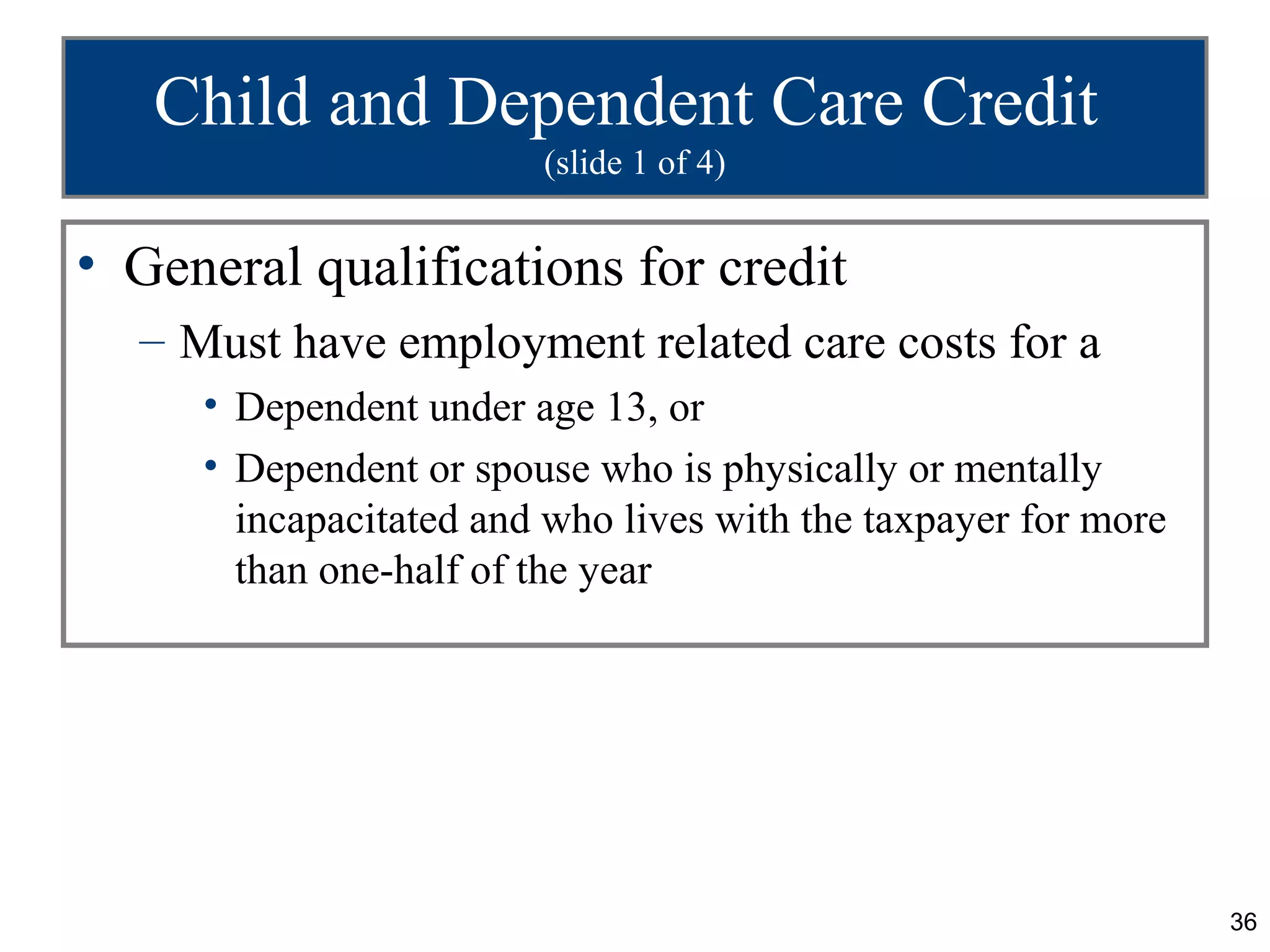
Child and Dependent Care Credit
                        (slide 1 of 4)


• General qualifications for credit
  – Must have employment related care costs for a
     • Dependent under age 13, or
     • Dependent or spouse who is physically or mentally
       incapacitated and who lives with the taxpayer for more
       than one-half of the year


                                                                36
Child and Dependent Care Credit
                     (slide 2 of 4)


• Credit amount
  – Eligible care costs × applicable percentage
  – Applicable percentage ranges from 20% to 35%
    depending on AGI
• Married taxpayers must file a joint return to
  obtain credit


                                                   37
Child and Dependent Care Credit
                        (slide 3 of 4)


• Eligible care costs defined
  – Costs for care of qualified individual within
    taxpayer’s home or outside home
     • If outside home, physically or mentally incapacitated
       dependent or spouse must spend at least 8 hours a day
       within taxpayer’s home
  – Amount of costs that qualify is the lesser of actual
    costs or $3,000 for one qualified individual, and
    $6,000 for two or more qualified individuals

                                                               38
Child and Dependent Care Credit
                     (slide 4 of 4)


• Earned income limitation
  – Amount of eligible care costs cannot exceed lower
    of taxpayer’s or spouse’s earned income
  – Full-time student or disabled taxpayer or spouse
    are deemed to have earned income up to maximum
    per month limits


                                                        39
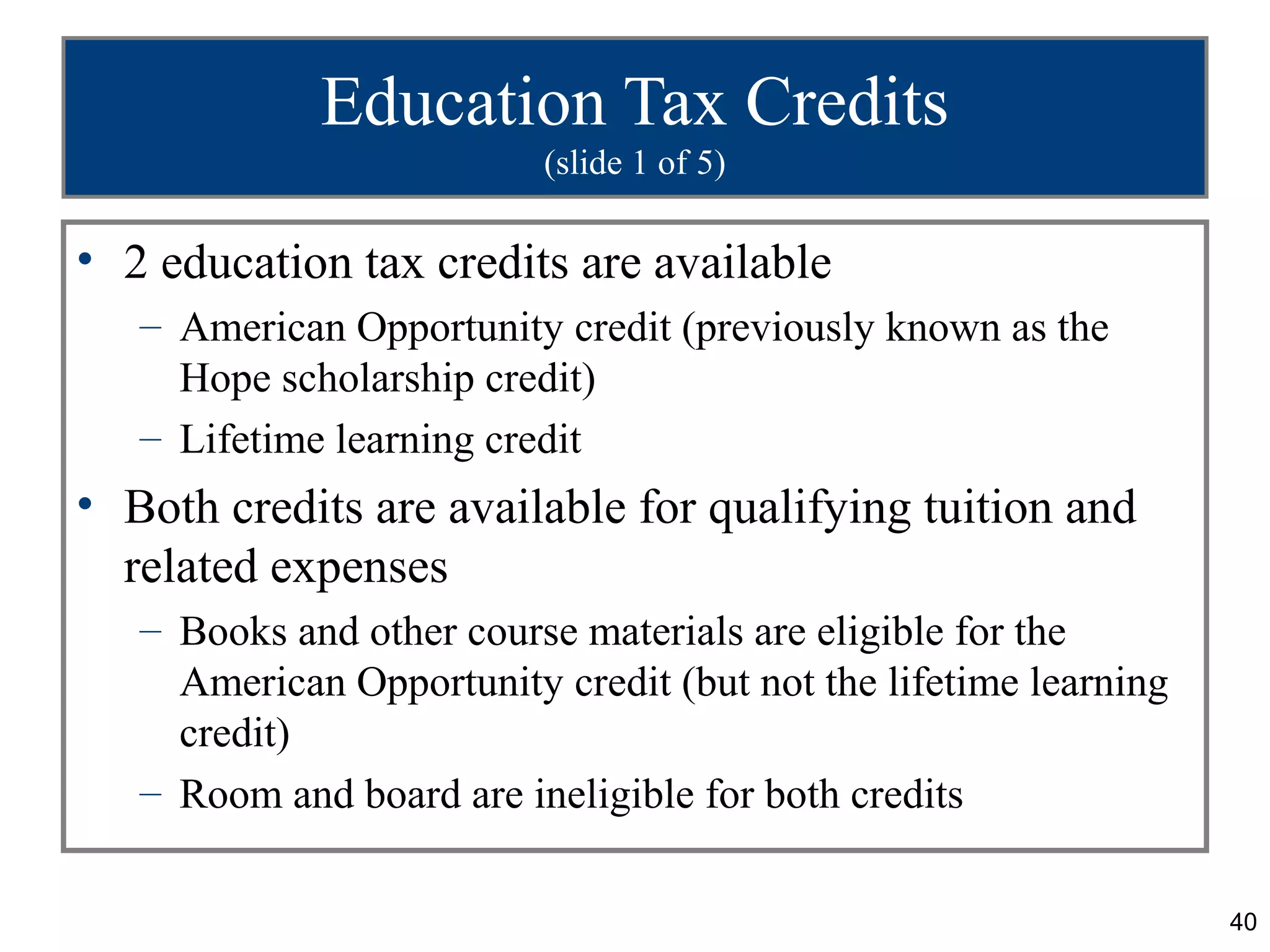
Education Tax Credits
                          (slide 1 of 5)

• 2 education tax credits are available
   – American Opportunity credit (previously known as the
     Hope scholarship credit)
   – Lifetime learning credit
• Both credits are available for qualifying tuition and
  related expenses
   – Books and other course materials are eligible for the
     American Opportunity credit (but not the lifetime learning
     credit)
   – Room and board are ineligible for both credits

                                                                  40
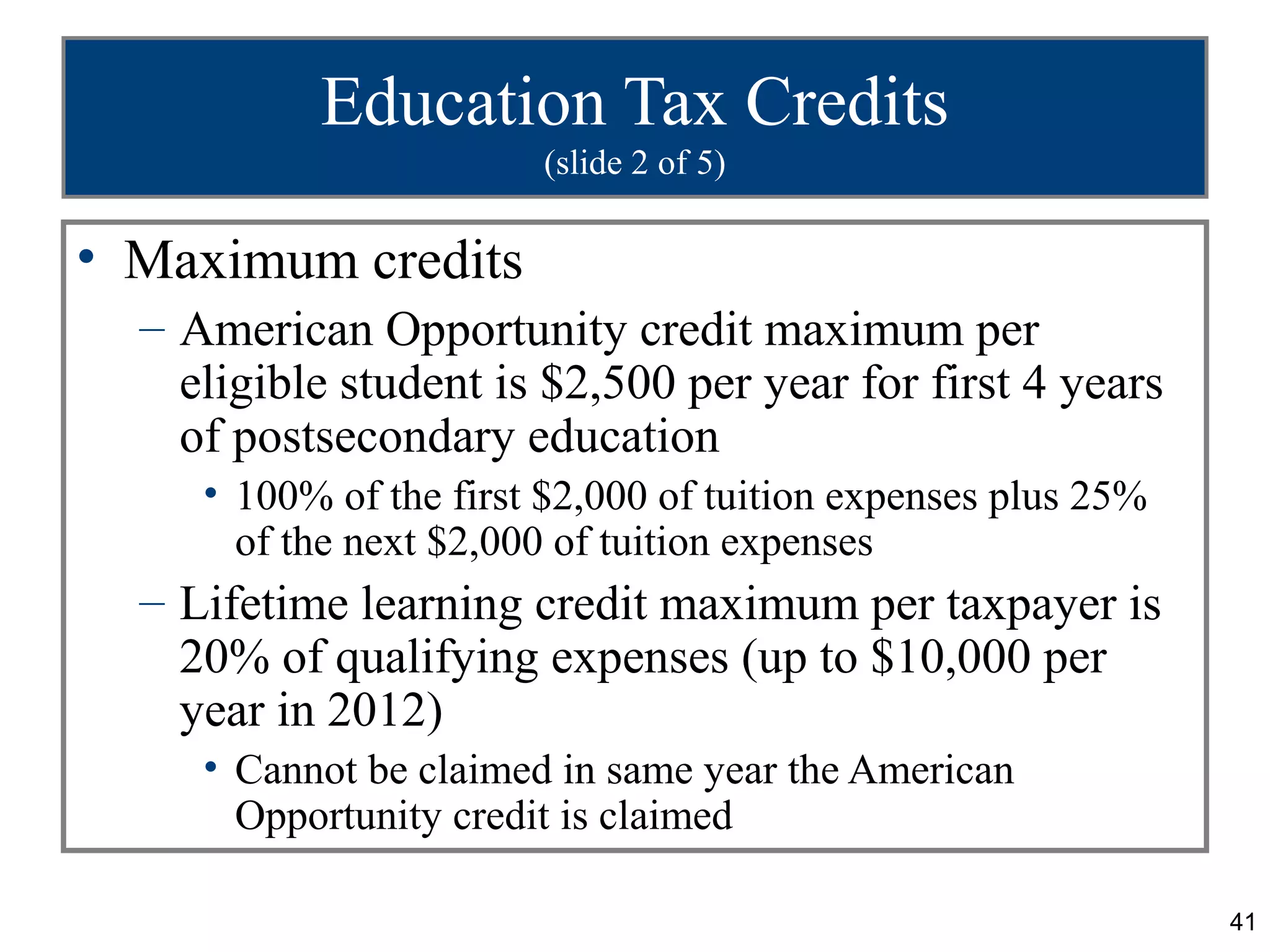
Education Tax Credits
                        (slide 2 of 5)

• Maximum credits
  – American Opportunity credit maximum per
    eligible student is $2,500 per year for first 4 years
    of postsecondary education
     • 100% of the first $2,000 of tuition expenses plus 25%
       of the next $2,000 of tuition expenses
  – Lifetime learning credit maximum per taxpayer is
    20% of qualifying expenses (up to $10,000 per
    year in 2012)
     • Cannot be claimed in same year the American
       Opportunity credit is claimed

                                                               41
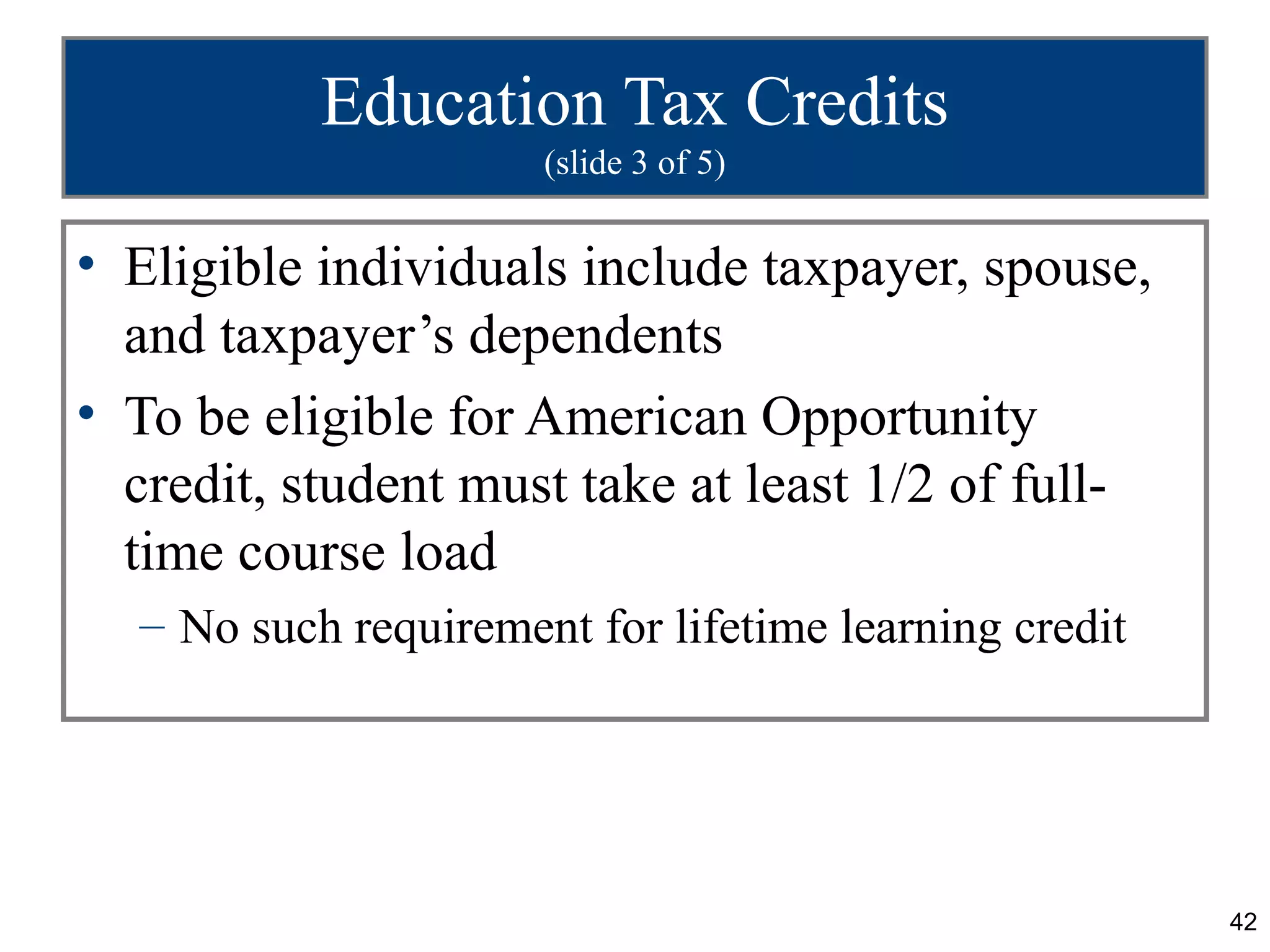
Education Tax Credits
                      (slide 3 of 5)


• Eligible individuals include taxpayer, spouse,
  and taxpayer’s dependents
• To be eligible for American Opportunity
  credit, student must take at least 1/2 of full-
  time course load
  – No such requirement for lifetime learning credit


                                                       42
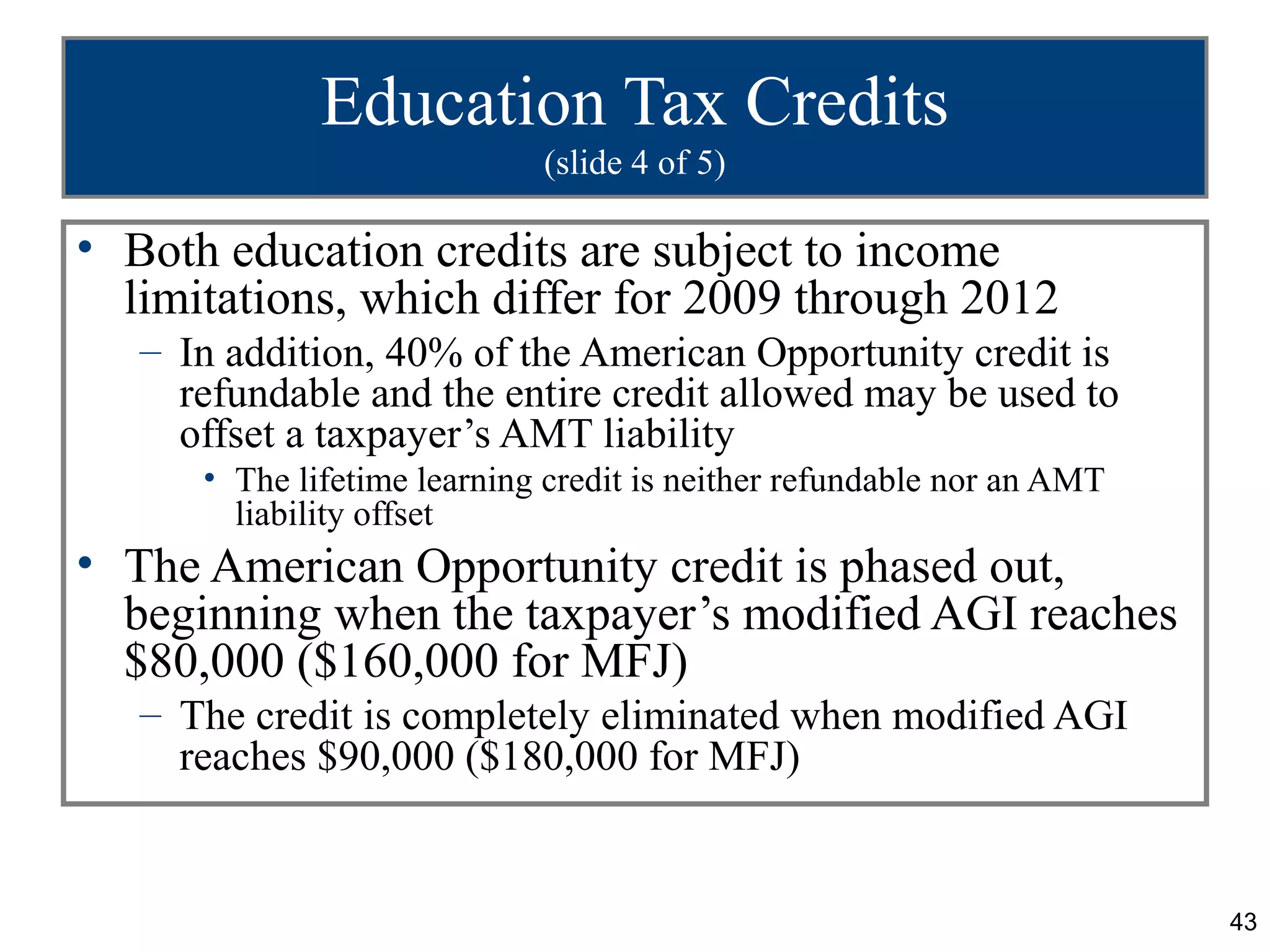
Education Tax Credits
                             (slide 4 of 5)

• Both education credits are subject to income
  limitations, which differ for 2009 through 2012
   – In addition, 40% of the American Opportunity credit is
     refundable and the entire credit allowed may be used to
     offset a taxpayer’s AMT liability
      • The lifetime learning credit is neither refundable nor an AMT
        liability offset
• The American Opportunity credit is phased out,
  beginning when the taxpayer’s modified AGI reaches
  $80,000 ($160,000 for MFJ)
   – The credit is completely eliminated when modified AGI
     reaches $90,000 ($180,000 for MFJ)


                                                                        43
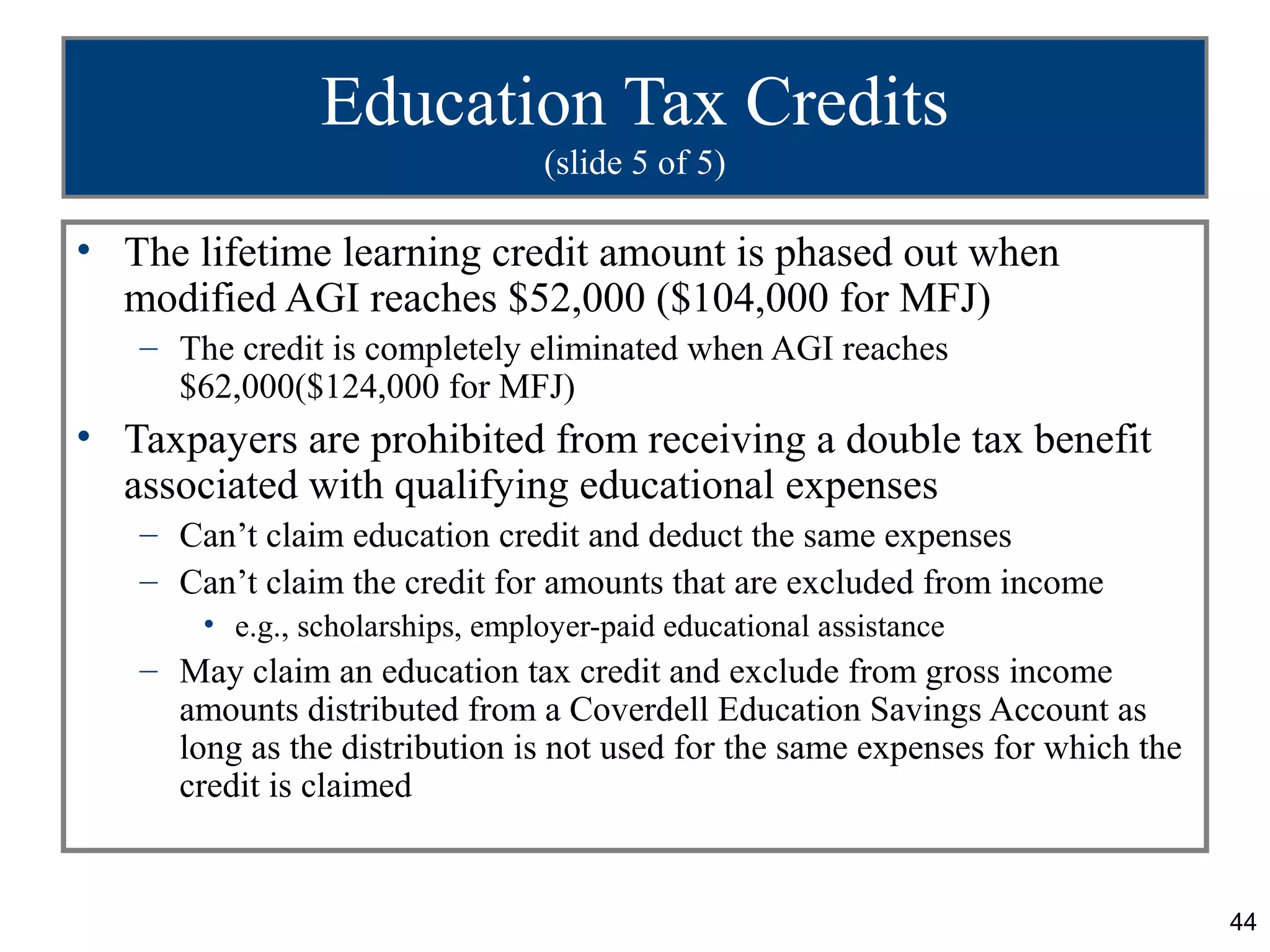
Education Tax Credits
                                 (slide 5 of 5)

• The lifetime learning credit amount is phased out when
  modified AGI reaches $52,000 ($104,000 for MFJ)
   – The credit is completely eliminated when AGI reaches
     $62,000($124,000 for MFJ)
• Taxpayers are prohibited from receiving a double tax benefit
  associated with qualifying educational expenses
   – Can’t claim education credit and deduct the same expenses
   – Can’t claim the credit for amounts that are excluded from income
       • e.g., scholarships, employer-paid educational assistance
   – May claim an education tax credit and exclude from gross income
     amounts distributed from a Coverdell Education Savings Account as
     long as the distribution is not used for the same expenses for which the
     credit is claimed


                                                                                44
The Big Picture - Example 32
           American Opportunity Credit
•   Return to the facts of The Big Picture on p. 13-1.
• Recall that Tom and Jennifer Snyder are married, file a joint
  tax return, have modified AGI of $158,000.
     – Both Lora (a freshman) and Sam (a junior) are full-time students and
       are Tom and Jennifer’s dependents.
• The Snyders paid the following education expenses.
     – $7,500 of tuition and $8,500 for room and board for Lora, and
     – $8,100 of tuition plus $7,200 for room and board for Sam.
• Lora’s and Sam’s tuition are qualified expenses for the
  American Opportunity credit.
     – For 2012, Tom and Jennifer may claim a $2,500 American Opportunity
       credit [(100% $2,000) + (25% $2,000)] for both Lora’s and Sam’s
       expenses.
     – In total, a $5,000 American Opportunity credit.


                                                                              45
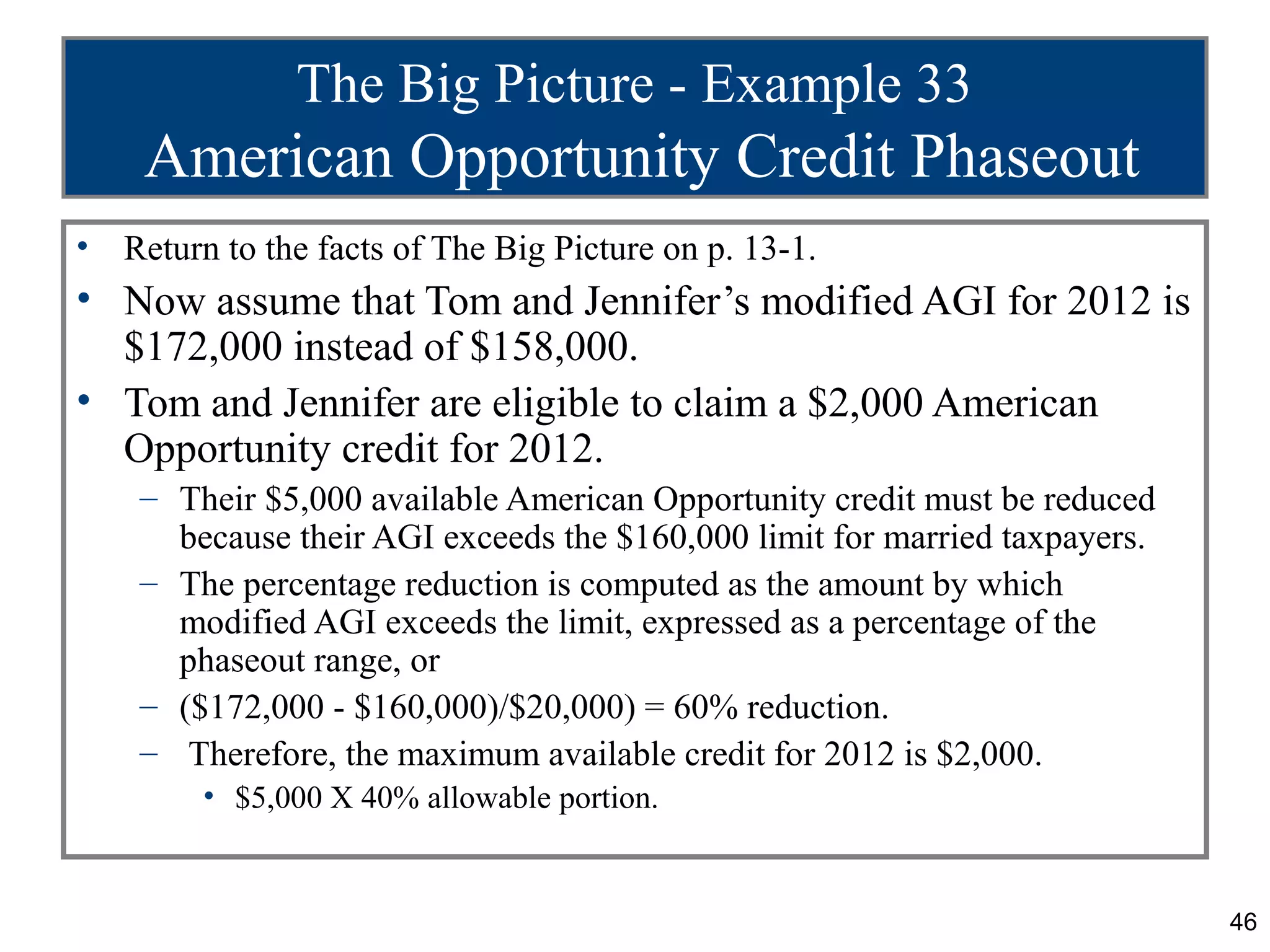
The Big Picture - Example 33
     American Opportunity Credit Phaseout
•   Return to the facts of The Big Picture on p. 13-1.
• Now assume that Tom and Jennifer’s modified AGI for 2012 is
  $172,000 instead of $158,000.
• Tom and Jennifer are eligible to claim a $2,000 American
  Opportunity credit for 2012.
     – Their $5,000 available American Opportunity credit must be reduced
       because their AGI exceeds the $160,000 limit for married taxpayers.
     – The percentage reduction is computed as the amount by which
       modified AGI exceeds the limit, expressed as a percentage of the
       phaseout range, or
     – ($172,000 - $160,000)/$20,000) = 60% reduction.
     – Therefore, the maximum available credit for 2012 is $2,000.
         • $5,000 X 40% allowable portion.


                                                                             46
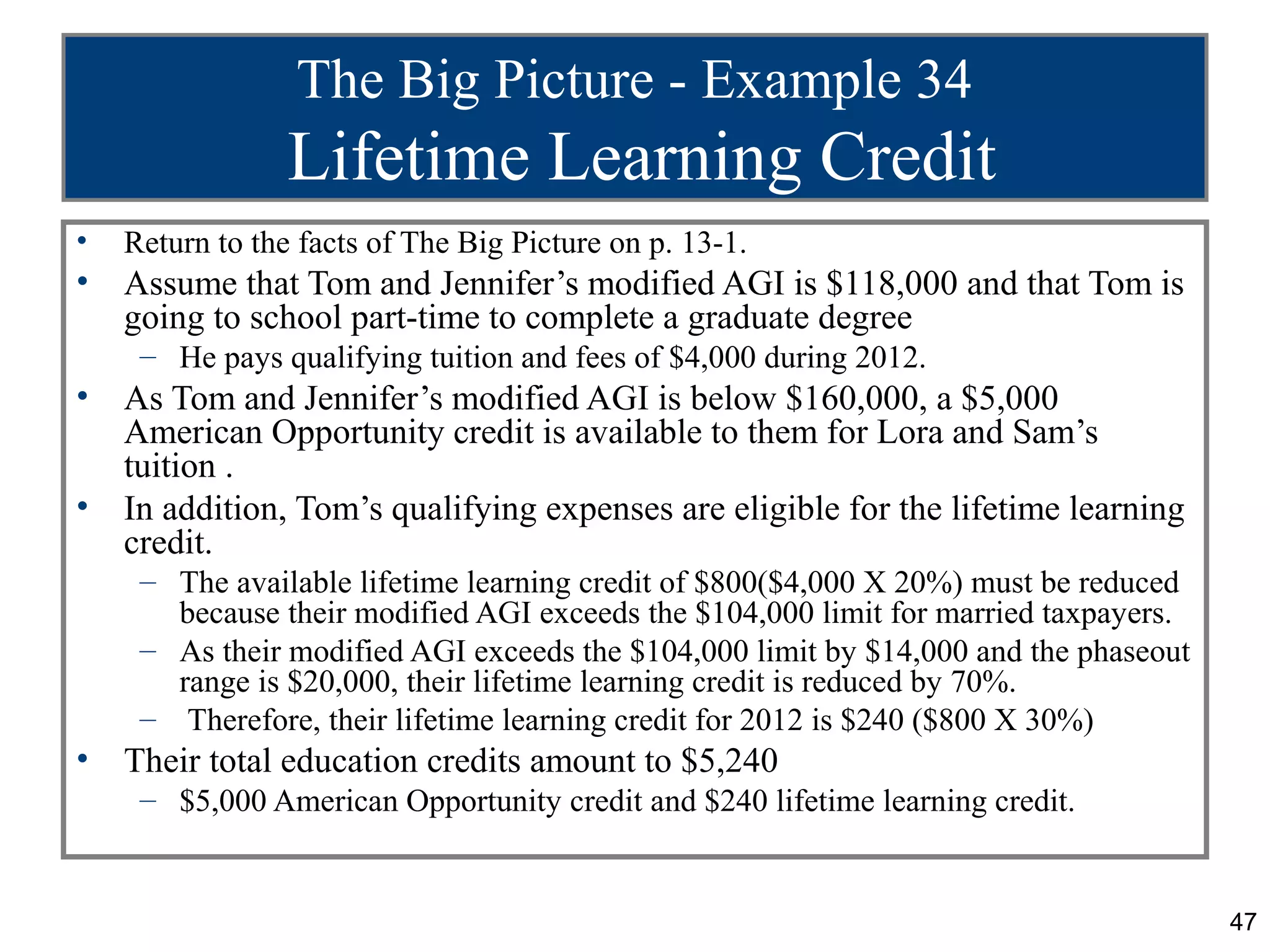
The Big Picture - Example 34
                 Lifetime Learning Credit
•   Return to the facts of The Big Picture on p. 13-1.
•   Assume that Tom and Jennifer’s modified AGI is $118,000 and that Tom is
    going to school part-time to complete a graduate degree
     – He pays qualifying tuition and fees of $4,000 during 2012.
•   As Tom and Jennifer’s modified AGI is below $160,000, a $5,000
    American Opportunity credit is available to them for Lora and Sam’s
    tuition .
•   In addition, Tom’s qualifying expenses are eligible for the lifetime learning
    credit.
     – The available lifetime learning credit of $800($4,000 X 20%) must be reduced
       because their modified AGI exceeds the $104,000 limit for married taxpayers.
     – As their modified AGI exceeds the $104,000 limit by $14,000 and the phaseout
       range is $20,000, their lifetime learning credit is reduced by 70%.
     – Therefore, their lifetime learning credit for 2012 is $240 ($800 X 30%)
•   Their total education credits amount to $5,240
     – $5,000 American Opportunity credit and $240 lifetime learning credit.


                                                                                      47
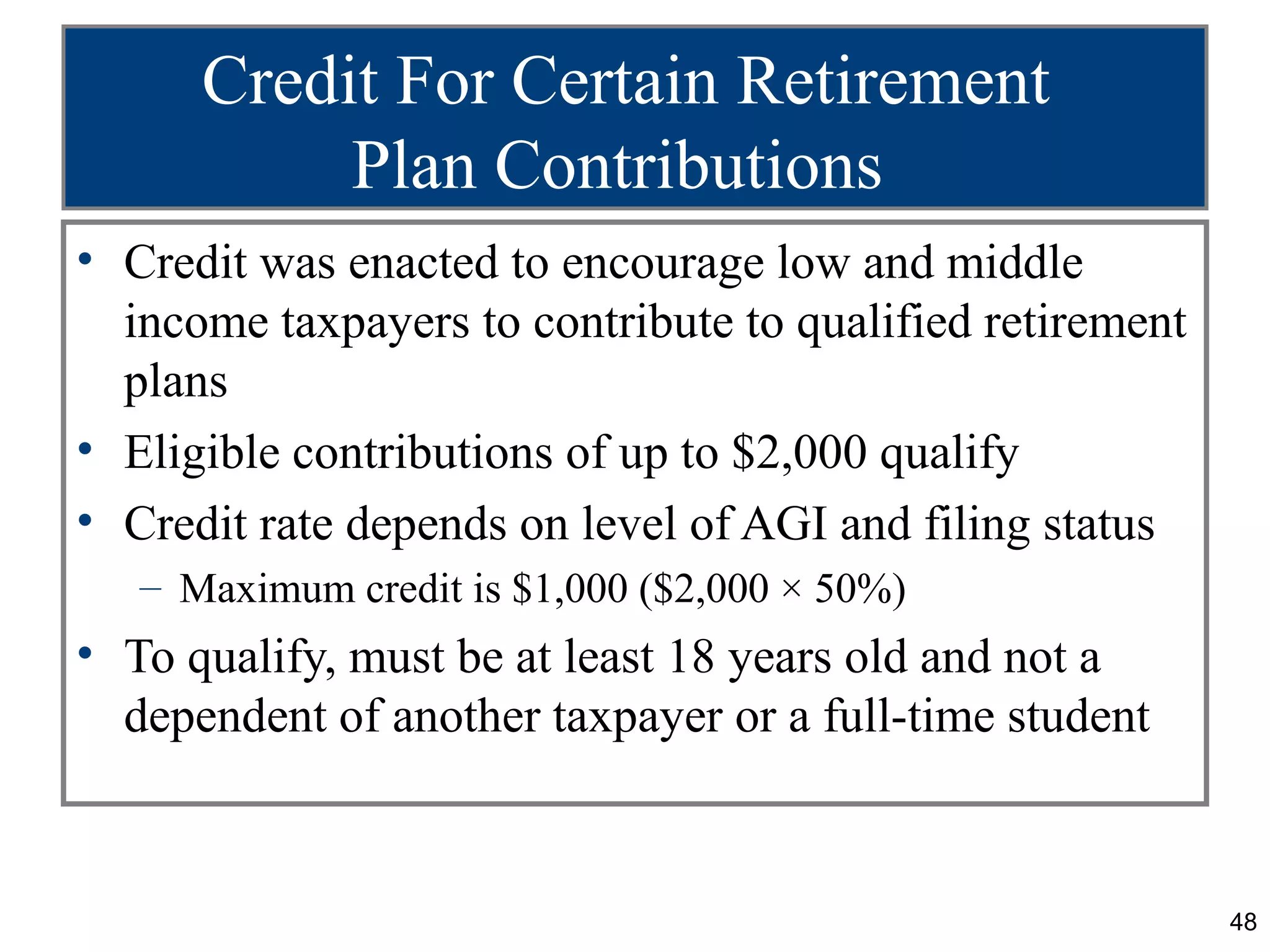
Credit For Certain Retirement
           Plan Contributions
• Credit was enacted to encourage low and middle
  income taxpayers to contribute to qualified retirement
  plans
• Eligible contributions of up to $2,000 qualify
• Credit rate depends on level of AGI and filing status
   – Maximum credit is $1,000 ($2,000 × 50%)
• To qualify, must be at least 18 years old and not a
  dependent of another taxpayer or a full-time student


                                                           48
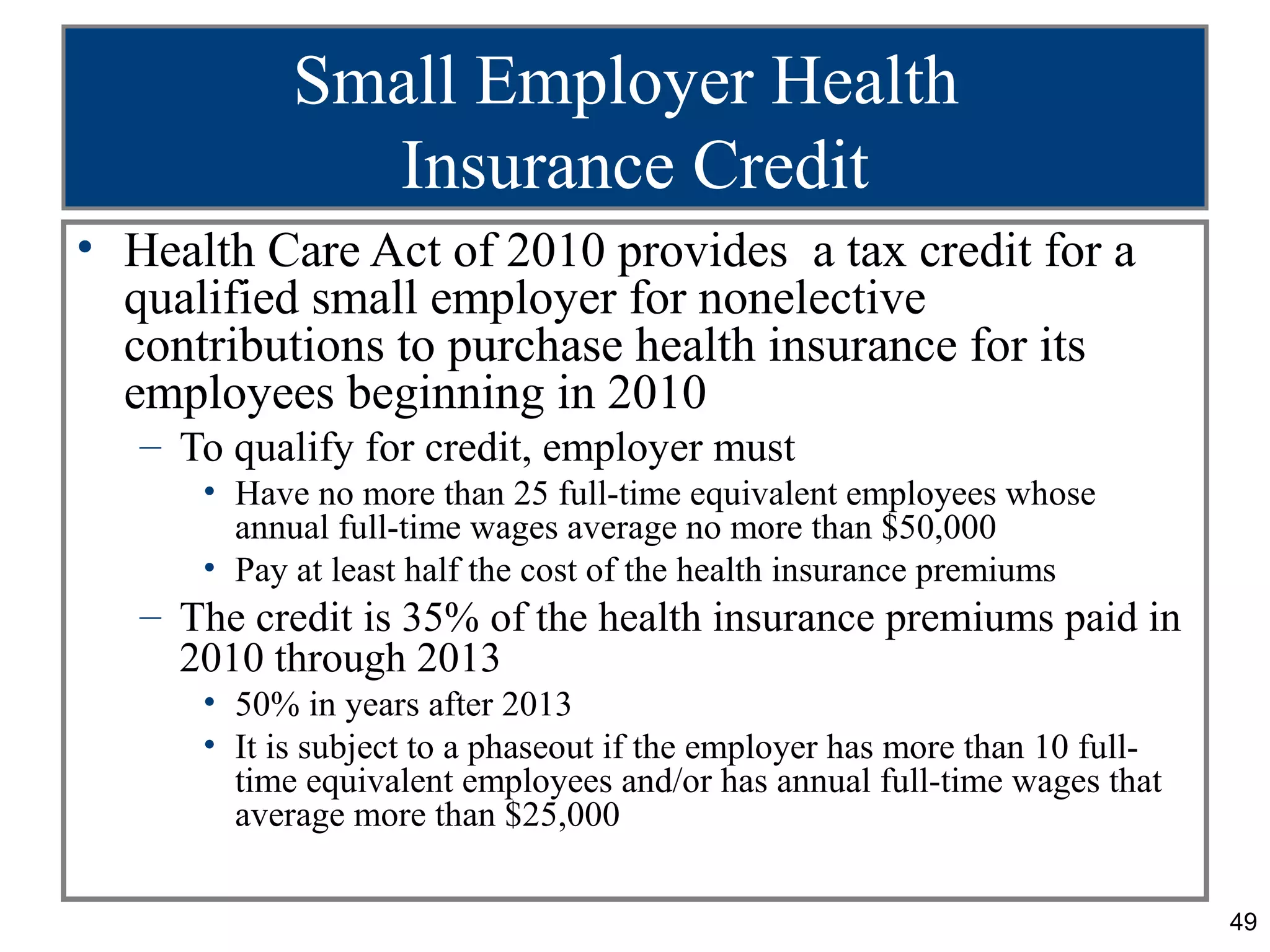
Small Employer Health
              Insurance Credit
• Health Care Act of 2010 provides a tax credit for a
  qualified small employer for nonelective
  contributions to purchase health insurance for its
  employees beginning in 2010
   – To qualify for credit, employer must
      • Have no more than 25 full-time equivalent employees whose
        annual full-time wages average no more than $50,000
      • Pay at least half the cost of the health insurance premiums
   – The credit is 35% of the health insurance premiums paid in
     2010 through 2013
      • 50% in years after 2013
      • It is subject to a phaseout if the employer has more than 10 full-
        time equivalent employees and/or has annual full-time wages that
        average more than $25,000

                                                                             49
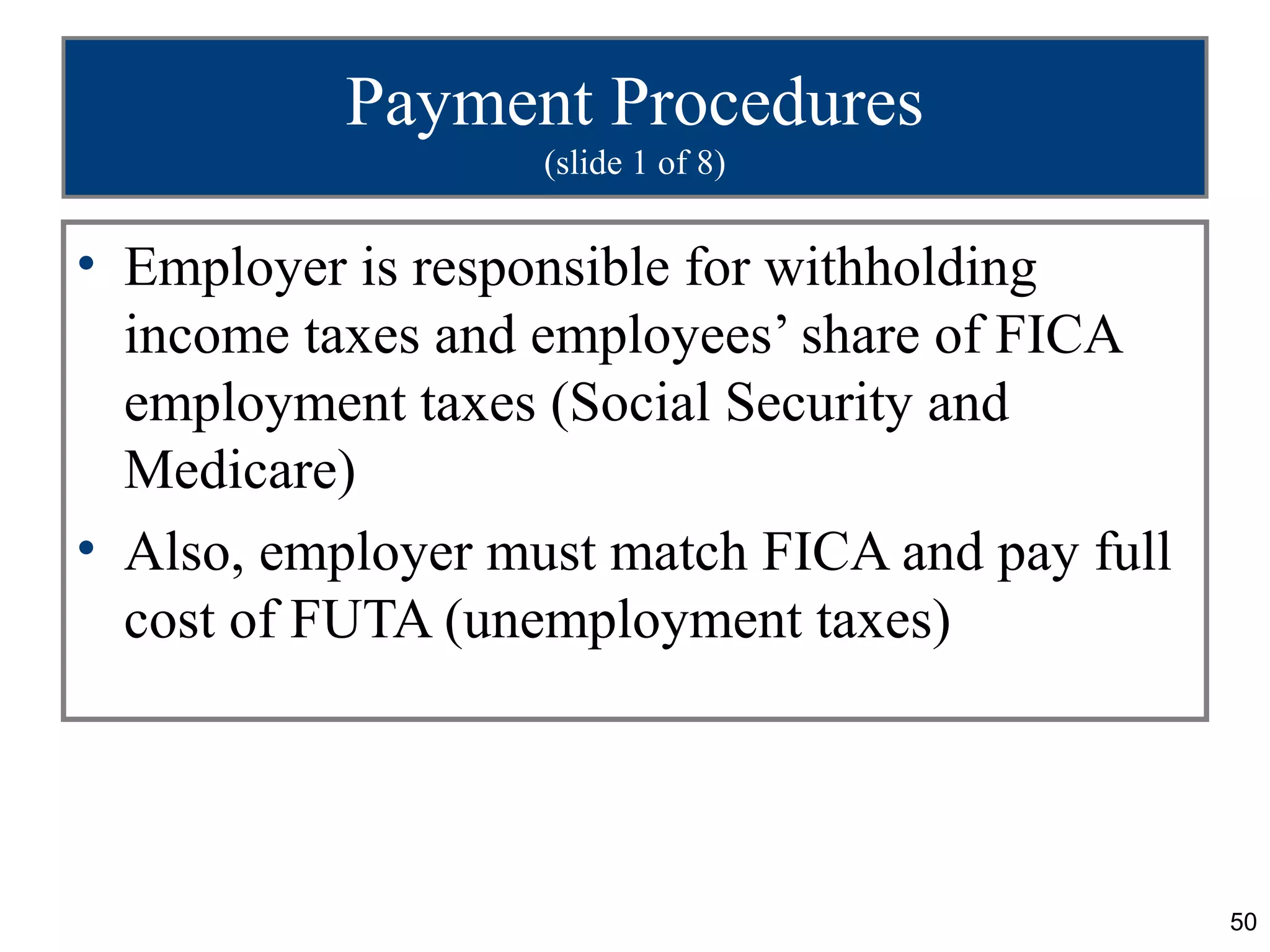
Payment Procedures
                   (slide 1 of 8)


• Employer is responsible for withholding
  income taxes and employees’ share of FICA
  employment taxes (Social Security and
  Medicare)
• Also, employer must match FICA and pay full
  cost of FUTA (unemployment taxes)


                                                50
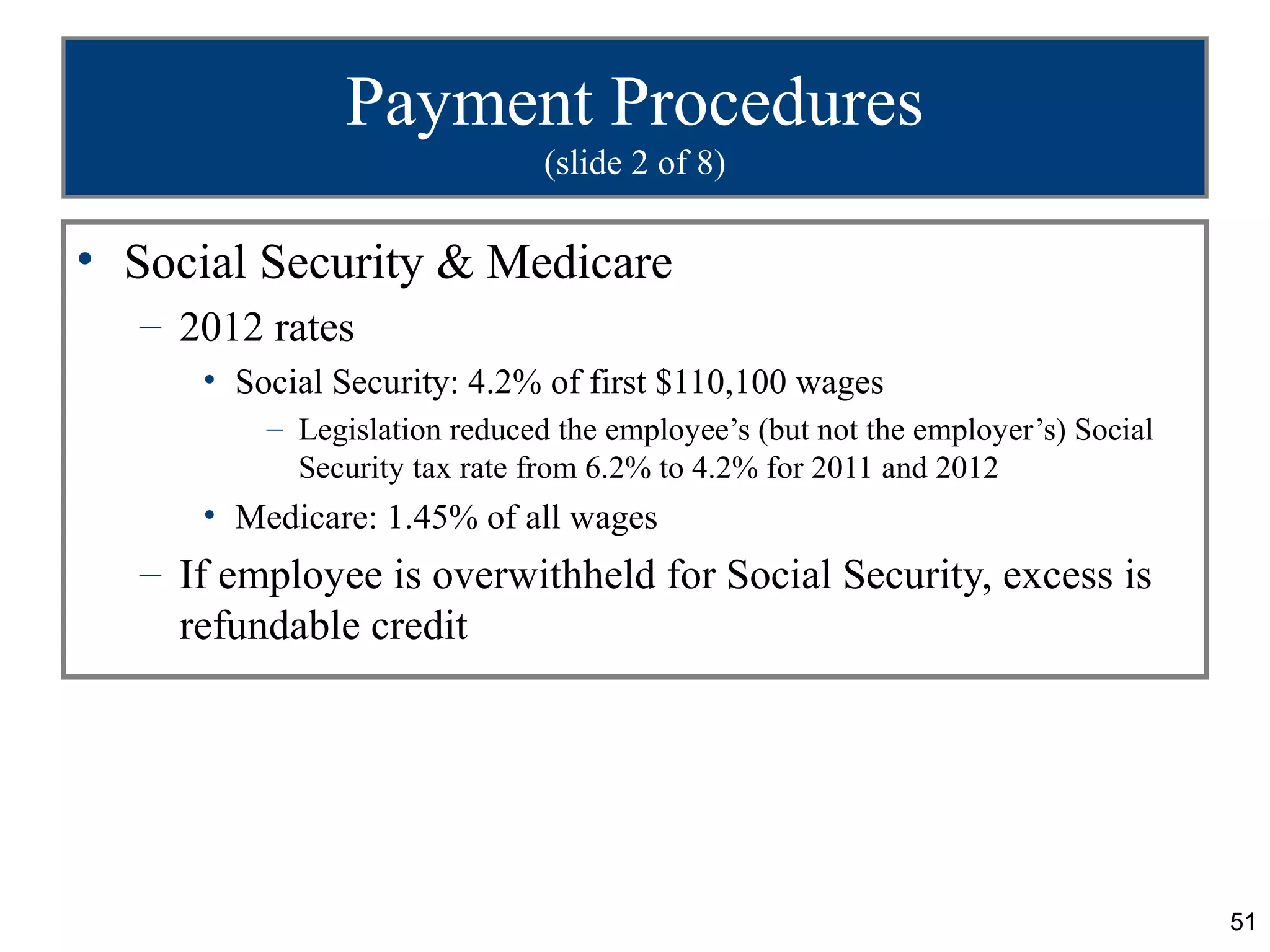
Payment Procedures
                              (slide 2 of 8)

• Social Security & Medicare
  – 2012 rates
     • Social Security: 4.2% of first $110,100 wages
         – Legislation reduced the employee’s (but not the employer’s) Social
           Security tax rate from 6.2% to 4.2% for 2011 and 2012
     • Medicare: 1.45% of all wages
  – If employee is overwithheld for Social Security, excess is
    refundable credit


                                                                                51
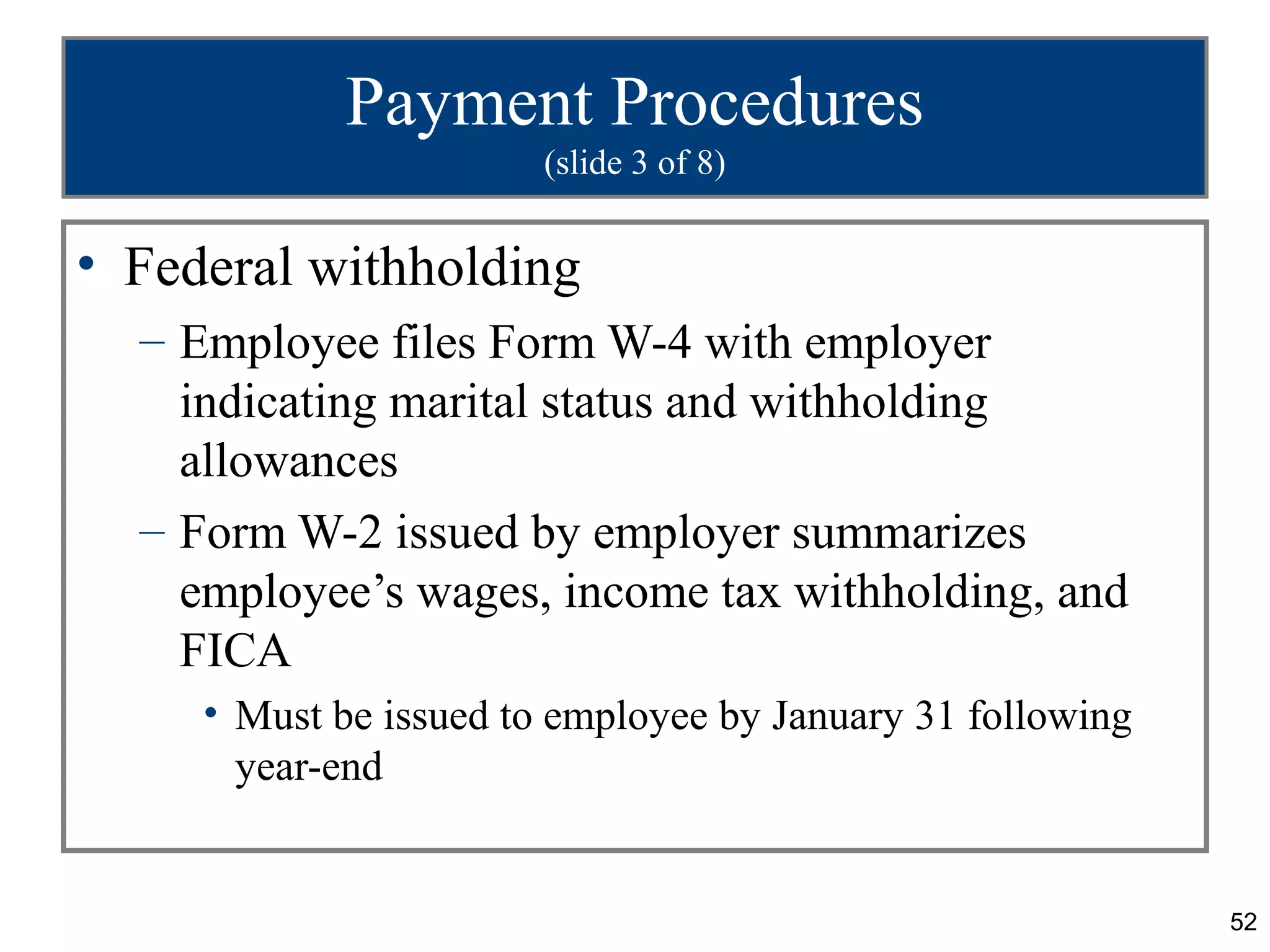
Payment Procedures
                        (slide 3 of 8)


• Federal withholding
  – Employee files Form W-4 with employer
    indicating marital status and withholding
    allowances
  – Form W-2 issued by employer summarizes
    employee’s wages, income tax withholding, and
    FICA
     • Must be issued to employee by January 31 following
       year-end


                                                            52
Payment Procedures
                       (slide 4 of 8)


• Estimated payments (ES payments)
  – Any taxpayer (employee or self-employed) who
    will owe at least $1,000 in taxes for the year (and
    meets none of the exceptions) must make ES
    payments


                                                          53
Payment Procedures
                           (slide 5 of 8)


• ES payments
  – To avoid penalties for underpayment, must
    annually pay the smaller of:
     • 90% of the current year’s tax, or
     • 100% of last year’s tax
        – Exception: Increased to 110% of last year’s tax if AGI last
          year exceeded $150,000 ($75,000 if married filing separately)


                                                                          54
Payment Procedures
                         (slide 6 of 8)


• ES payments
  – For calendar year individual taxpayer, ES
    payments of 1/4 of annual amount are due
     • April 15, June 15, and September 15 of the tax year, and
       January 15 of the following year


                                                                  55
Payment Procedures
                           (slide 7 of 8)

• Self-employment tax
  – Taxpayers with net self-employment earnings of at
    least $400 must pay self-employment tax
     • 2012 rates
        – Social Security: 10.4% of first $110,100 net self-employment
          income
            » Normally the rate is 12.4%
        – Medicare: 2.9% of all net self-employment income
     • These rates are twice what an employee pays on wages


                                                                         56
Payment Procedures
                            (slide 8 of 8)

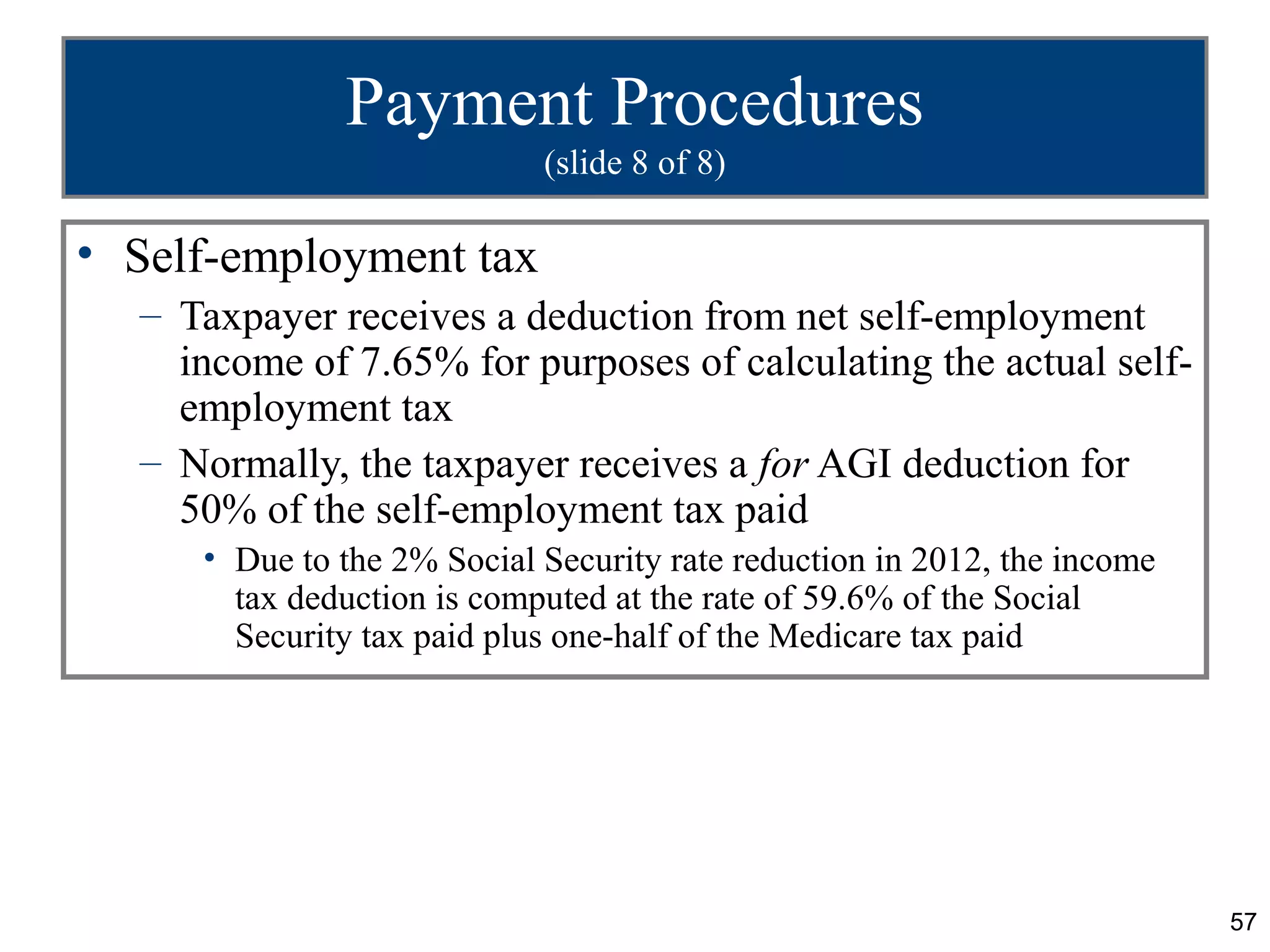
• Self-employment tax
  – Taxpayer receives a deduction from net self-employment
    income of 7.65% for purposes of calculating the actual self-
    employment tax
  – Normally, the taxpayer receives a for AGI deduction for
    50% of the self-employment tax paid
     • Due to the 2% Social Security rate reduction in 2012, the income
       tax deduction is computed at the rate of 59.6% of the Social
       Security tax paid plus one-half of the Medicare tax paid


                                                                          57
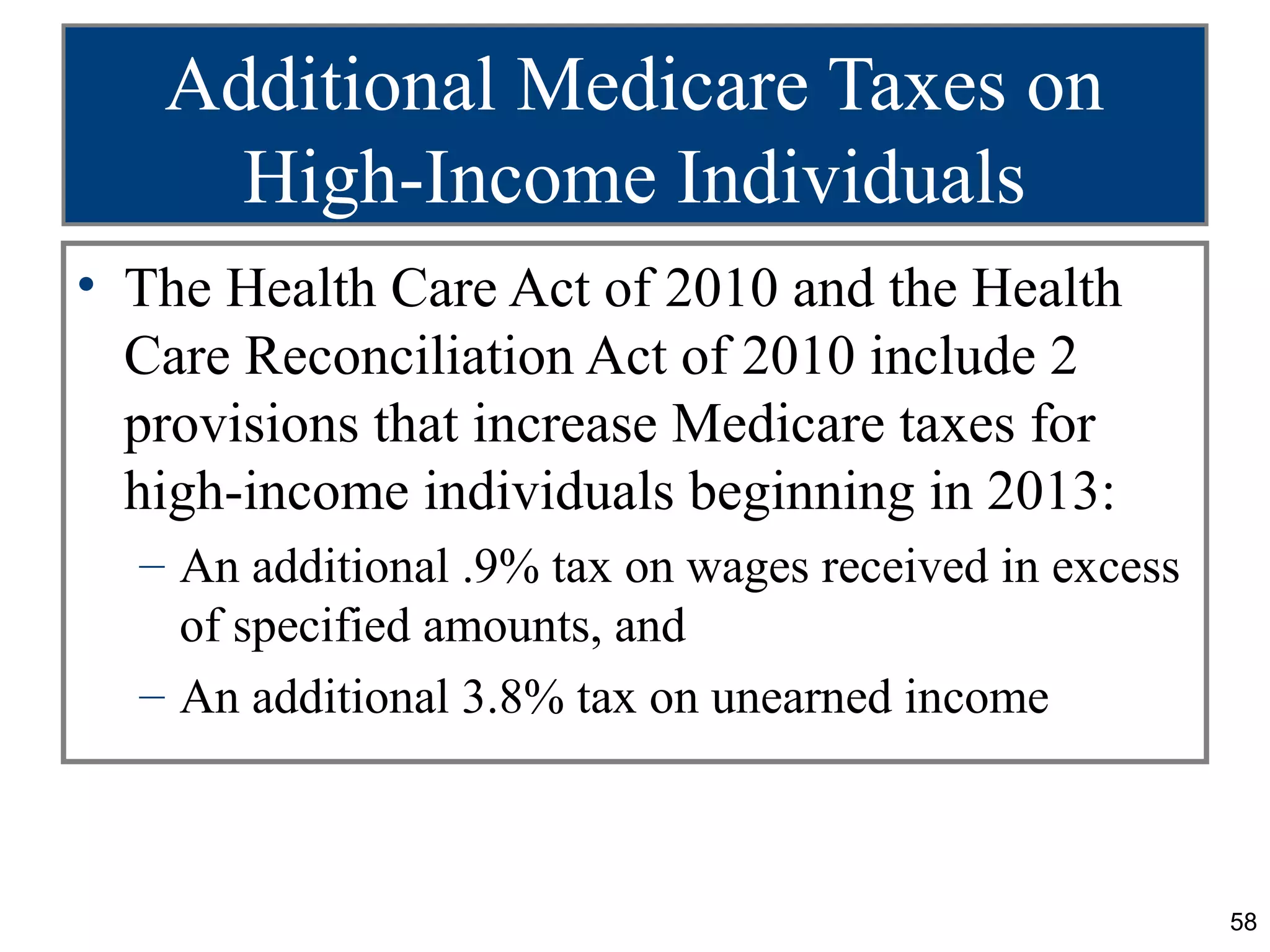
Additional Medicare Taxes on
     High-Income Individuals
• The Health Care Act of 2010 and the Health
  Care Reconciliation Act of 2010 include 2
  provisions that increase Medicare taxes for
  high-income individuals beginning in 2013:
  – An additional .9% tax on wages received in excess
    of specified amounts, and
  – An additional 3.8% tax on unearned income


                                                        58
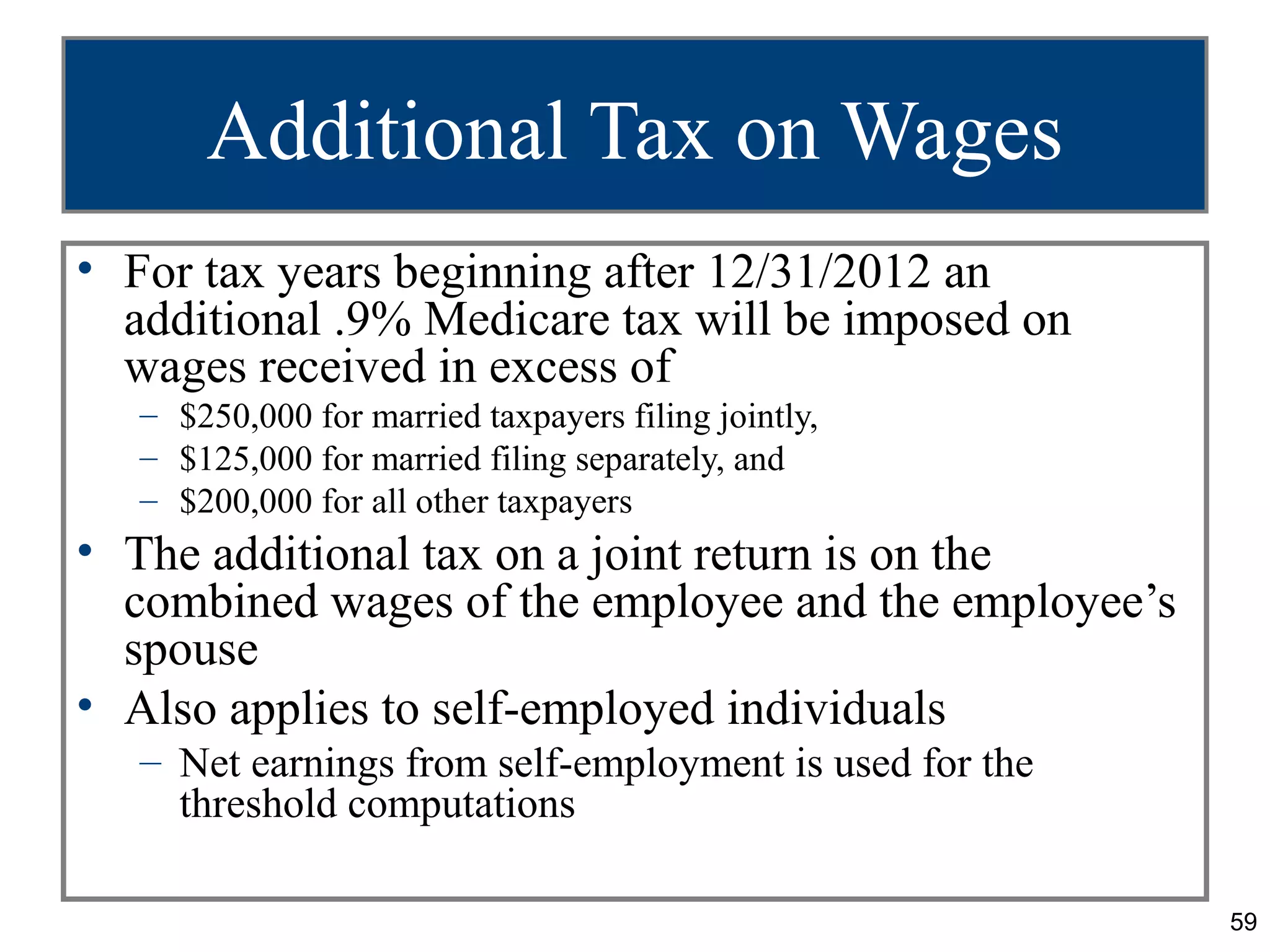
Additional Tax on Wages
• For tax years beginning after 12/31/2012 an
  additional .9% Medicare tax will be imposed on
  wages received in excess of
   – $250,000 for married taxpayers filing jointly,
   – $125,000 for married filing separately, and
   – $200,000 for all other taxpayers
• The additional tax on a joint return is on the
  combined wages of the employee and the employee’s
  spouse
• Also applies to self-employed individuals
   – Net earnings from self-employment is used for the
     threshold computations

                                                         59
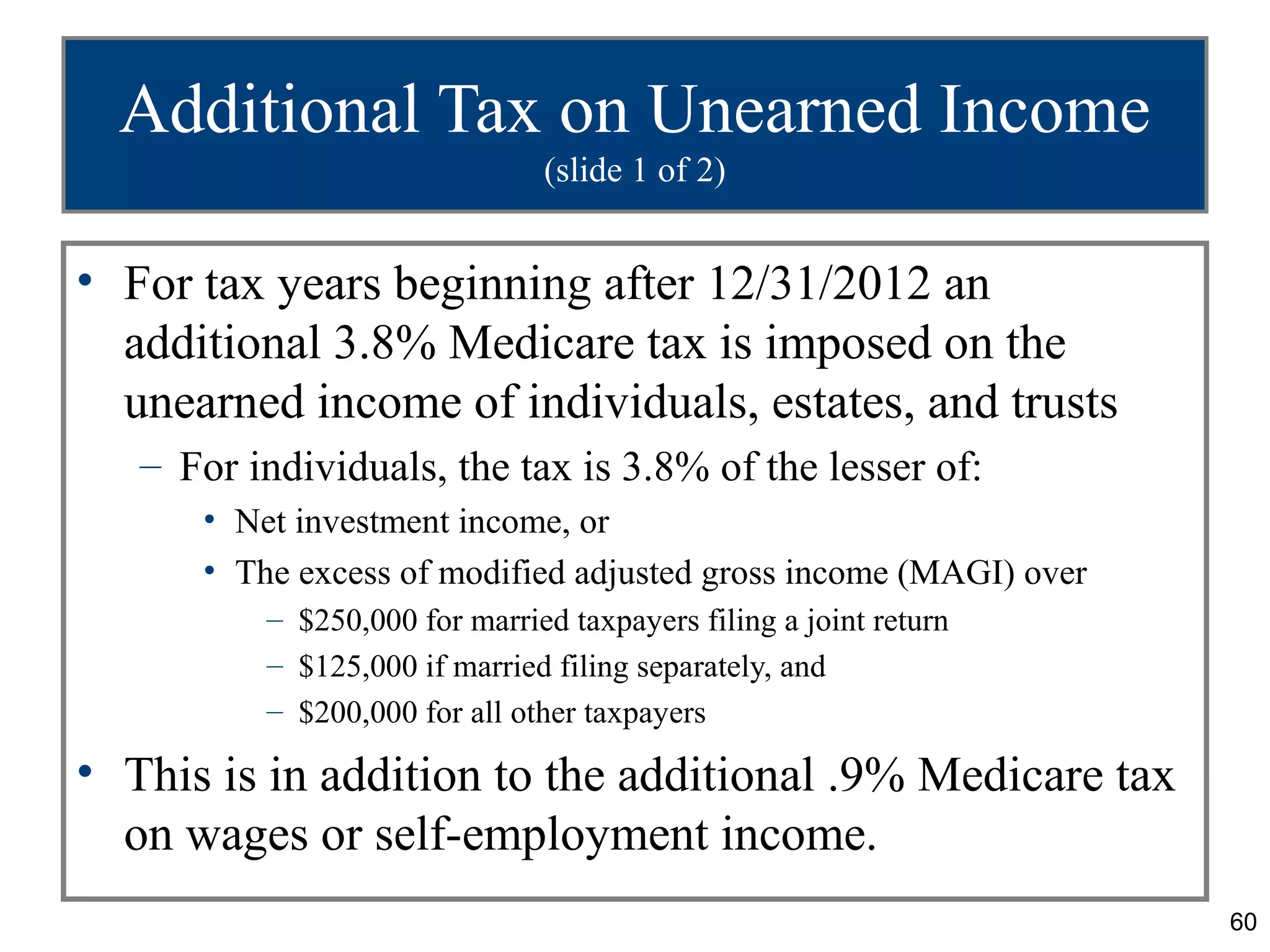
Additional Tax on Unearned Income
                               (slide 1 of 2)


• For tax years beginning after 12/31/2012 an
  additional 3.8% Medicare tax is imposed on the
  unearned income of individuals, estates, and trusts
   – For individuals, the tax is 3.8% of the lesser of:
      • Net investment income, or
      • The excess of modified adjusted gross income (MAGI) over
          – $250,000 for married taxpayers filing a joint return
          – $125,000 if married filing separately, and
          – $200,000 for all other taxpayers

• This is in addition to the additional .9% Medicare tax
  on wages or self-employment income.
                                                                   60
Additional Tax on Unearned Income
                      (slide 2 of 2)


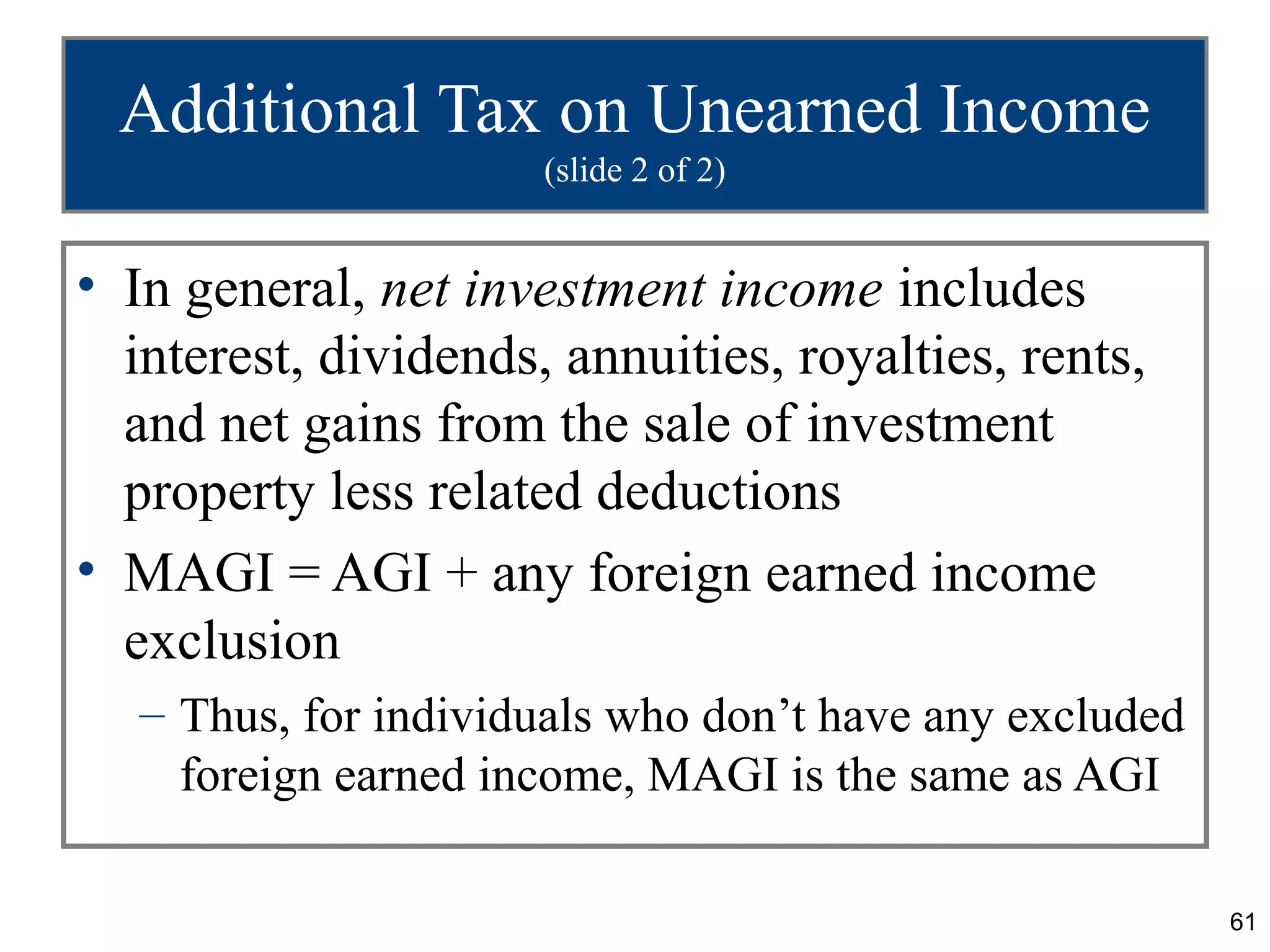
• In general, net investment income includes
  interest, dividends, annuities, royalties, rents,
  and net gains from the sale of investment
  property less related deductions
• MAGI = AGI + any foreign earned income
  exclusion
   – Thus, for individuals who don’t have any excluded
     foreign earned income, MAGI is the same as AGI

                                                         61
Refocus On The Big Picture (slide 1 of 2)
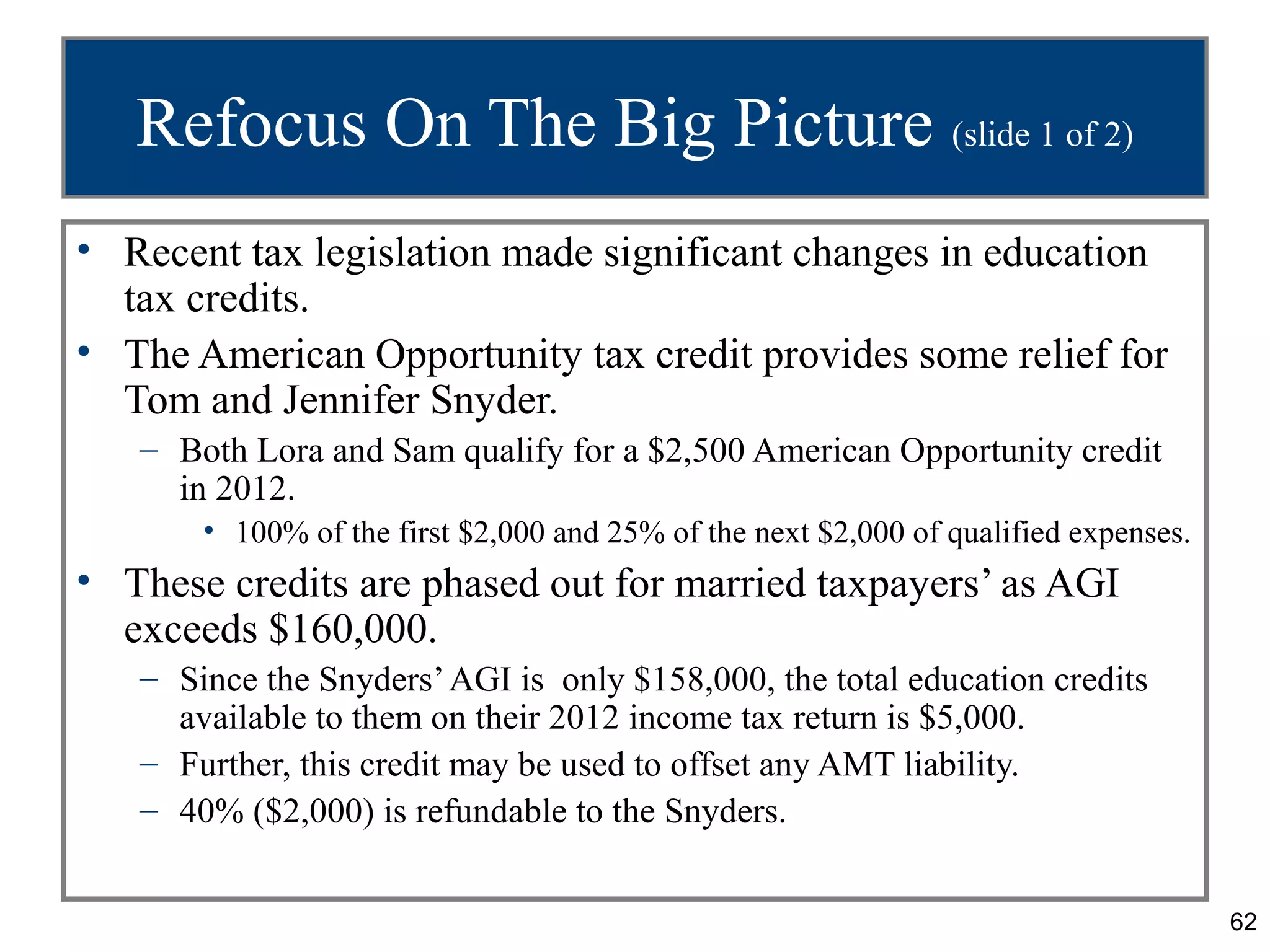
• Recent tax legislation made significant changes in education
  tax credits.
• The American Opportunity tax credit provides some relief for
  Tom and Jennifer Snyder.
   – Both Lora and Sam qualify for a $2,500 American Opportunity credit
     in 2012.
       • 100% of the first $2,000 and 25% of the next $2,000 of qualified expenses.
• These credits are phased out for married taxpayers’ as AGI
  exceeds $160,000.
   – Since the Snyders’ AGI is only $158,000, the total education credits
     available to them on their 2012 income tax return is $5,000.
   – Further, this credit may be used to offset any AMT liability.
   – 40% ($2,000) is refundable to the Snyders.


                                                                                      62
Refocus On The Big Picture (slide 2 of 2)
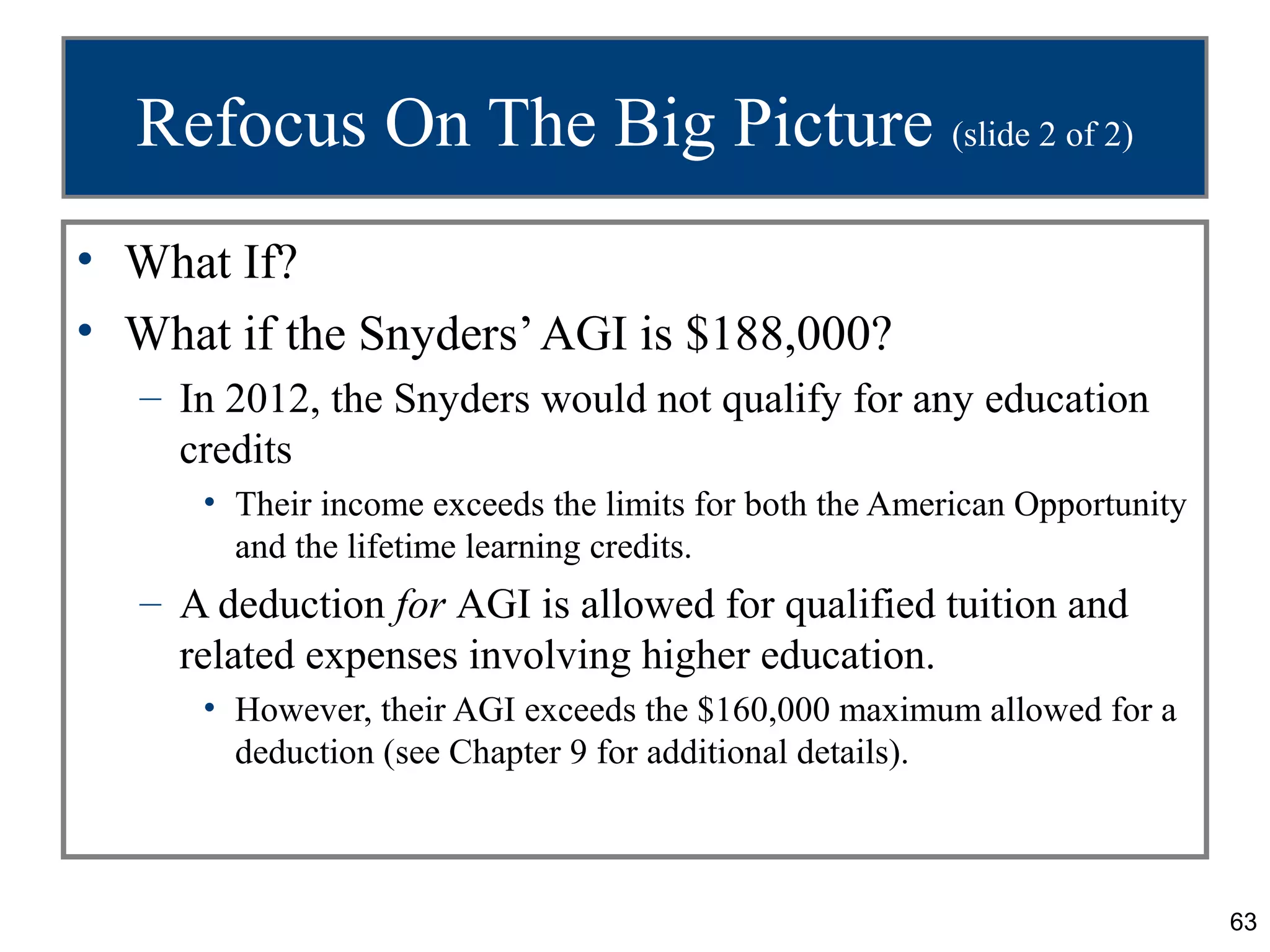
• What If?
• What if the Snyders’ AGI is $188,000?
   – In 2012, the Snyders would not qualify for any education
     credits
      • Their income exceeds the limits for both the American Opportunity
        and the lifetime learning credits.
   – A deduction for AGI is allowed for qualified tuition and
     related expenses involving higher education.
      • However, their AGI exceeds the $160,000 maximum allowed for a
        deduction (see Chapter 9 for additional details).


                                                                            63
If you have any comments or suggestions concerning this
                    PowerPoint Presentation for South-Western Federal
                    Taxation, please contact:

                                                                  Dr. Donald R. Trippeer, CPA
                                                                      trippedr@oneonta.edu
                                                                          SUNY Oneonta


© 2012 Cengage Learning. All Rights Reserved. May not be scanned, copied or duplicated, or posted to a publicly accessible website, in whole or in part.
                                                                                                                                                           64

Ppt ch 13

  • 1.
    Chapter 13 Tax Credits and Payment Procedures Individual Income Taxes © 2013 Cengage Learning. All Rights Reserved. May not be scanned, copied or duplicated, or posted to a publicly accessible website, in whole or in part. 1
  • 2.
    The Big Picture •Tom and Jennifer Snyder have two dependent children in college. – Lora is a freshman • Her tuition and required fees in 2012 total $14,000. • She has a scholarship amounting to $6,500, and the Snyders paid the balance of her tuition ($7,500), plus room and board of $8,500. – Sam is a junior, and the Snyders paid $8,100 for his tuition plus $7,200 for his room and board. • The Snyders have AGI of $158,000. • They would like to know what tax options are available to them related to these educational expenses. – They have heard about education tax credits, but they believe that their income is too high for them to get any benefit. – Are they correct? • Read the chapter and formulate your response. 2
  • 3.
    Tax Credit VS.Tax Deduction • Tax benefit received from a tax deduction depends on the marginal tax rate of the taxpayer – Tax benefit received from a tax credit is not affected by the taxpayer’s marginal tax rate • Example: $1,000 expenditure: tax benefit of 25% credit compared to tax deduction at various marginal tax rates MTR 0% 15% 35% Tax benefit if a 25% credit is allowed $250 $250 $250 Tax benefit if tax deduction is allowed –0– $150 $350 3
  • 4.
    Refundable vs NonrefundableCredits (slide 1 of 2) • Refundable credits – Paid even if the tax liability is less than amount of credit 4
  • 5.
    Refundable vs NonrefundableCredits (slide 2 of 2) • Nonrefundable credits – Credit can only be used to offset tax liability – If credit exceeds tax liability, excess is lost • Exception: some nonrefundable credits have carryover provisions for excess 5
  • 6.
    General Business Credit(slide 1 of 2) • Comprised of a number of business credits combined into one amount • Limited to net income tax reduced by greater of: – Tentative minimum tax – 25% of net regular tax liability that exceeds $25,000 • Unused credit is carried back 1 year, then forward 20 years 6
  • 7.
    General Business Credit(slide 2 of 2) • Includes the following: – Tax credit for rehabilitation expenditures – Work opportunity tax credit – Research activities credit – Low-income housing credit – Disabled access credit – Credit for small employer pension plan startup costs – Credit for employer-provided child care 7
  • 8.
    Rehabilitation Expenditure Credit (slide 1 of 3) • Credit is a percentage of expenditures made to substantially rehabilitate industrial and commercial buildings and certified historic structures • Credit rate – 20% for nonresidential and residential certified historic structures – 10% for other structures originally placed into service before 1936 8
  • 9.
    Rehabilitation Expenditure Credit (slide 2 of 3) • To qualify for credit, building must be substantially rehabilitated meaning qualified rehab expenditures exceed the greater of: – The adjusted basis of the property before the rehab expenditures, or – $5,000 • Qualified rehab expenditures do not include the cost of the building and related facilities or cost of enlarging existing building 9
  • 10.
    Rehabilitation Expenditure Credit (slide 3 of 3) • Basis in structure is reduced by the credit amount • Subject to recapture if rehabilitated property held less than 5 years or ceases to be qualifying property 10
  • 11.
    Work Opportunity TaxCredit (slide 1 of 2) • Applies to first 12 months of wages paid to individuals falling within target groups – Credit limited to a percentage of first $6,000 wages paid per eligible employee • 40% if employee has completed at least 400 hours of service to employer • 25% if at least 120 hours of service – Deduction for wages is reduced by credit amount 11
  • 12.
    Work Opportunity TaxCredit (slide 2 of 2) • Targeted individuals generally subject to high rates of unemployment, including – Qualified ex-felons, high-risk youths, food stamp recipients, veterans, summer youth employees, and long-term family assistance recipients • Summer youth employees: Only first $3,000 of wages paid for work during 90-day period between May 1 and September 15 qualify for credit 12
  • 13.
    Work Opportunity TaxCredit: Long-Term Family Assistance Recipient (slide 1 of 2) • Applies to first 24 months of wages paid to individuals who have been long-term recipients of family assistance welfare benefits – Long-term is at least an 18 month period ending on hiring date 13
  • 14.
    Work Opportunity TaxCredit: Long-Term Family Assistance Recipient (slide 2 of 2) • Maximum credit is a percentage of first $10,000 qualified wages paid in first and second year of employment – 40% in first year – 50% in second year • Maximum credit per qualified employee is $9,000 – Deduction for wages is reduced by credit amount 14
  • 15.
    Research Activities Credit (slide 1 of 5) • Comprised of three parts – Incremental research activities credit – Basic research credit – Energy research credit 15
  • 16.
    Research Activities Credit (slide 2 of 5) • Incremental research activities credit – Credit amount = 20% × (qualified expenditures – base amount) • Expenditures qualify if research relates to discovery of technological info intended for use in developing a new or improved business component for taxpayer – Expenditures qualify fully if research done in-house – Only 65% qualifies if research conducted by outside party (under contract) 16
  • 17.
    Research Activities Credit (slide 3 of 5) • Tax treatment of R&E expenditures – Full credit and reduce expense deduction by credit amount – Full expense deduction and reduce credit by (100% × credit × max. corp. tax rate) – Full credit and capitalize research expenses and amortize over 60 months or more • Amount capitalized is reduced by full amount of credit only if the credit exceeds the amount allowable as a deduction 17
  • 18.
    Research Activities Credit (slide 4 of 5) • Basic research credit – Additional 20% credit is allowed on basic research payments in excess of a base amount • Basic research payments - amounts paid in cash to a qualified basic research organization, such as a college or university or a tax- exempt organization operated primarily to conduct scientific research – Basic research is any original investigation for the advancement of scientific knowledge not having a specific commercial objective • The definition excludes basic research conducted outside the United States and basic research in the social sciences, arts, or humanities 18
  • 19.
    Research Activities Credit (slide 5 of 5) • Energy Research Credit – – This credit is intended to stimulate additional energy research – Credit amount = 20% of amounts paid or incurred by a taxpayer to an energy research consortium for energy research 19
  • 20.
    Low-income Housing Credit •Credit is issued on a nationwide allocation program • Credit amount – Based on qualified basis of the property which is dependent on the number of units rented to low- income tenants – Credit is allowed over a 10-year period – Subject to potential recapture 20
  • 21.
    Disabled Access Credit •Credit available for eligible access expenditures made by small businesses – Includes amounts paid to remove barriers that would otherwise make a business inaccessible to disabled and handicapped individuals – Facility qualifies if placed in service before November 6, 1990 • Credit amount – 50% × expenditures that exceed $250 but not in excess of $10,250 • Thus, max. credit is $5,000 – Basis in asset is reduced by credit amount 21
  • 22.
    Credit For Pension Plan Startup Costs • Small businesses can claim nonrefundable tax credit for admin costs of establishing and maintaining a qualified retirement plan – Small business has < 100 employees who have earned at least $5,000 of compensation • Credit amount = 50% of qualified startup costs limited to max credit of $500 per year for 3 years – Deduction for startup costs is reduced by amount of credit 22
  • 23.
    Credit For Employer-Provided Child Care (slide 1 of 2) • Employers can claim a credit for providing child care facilities to their employees during normal working hours – Limited to $150,000 per year • Credit amount: – 25% of qualified child care expenses – 10% of qualified child care resource and referral services 23
  • 24.
    Credit For Employer-Provided Child Care (slide 2 of 2) • Deductible qualifying expenses must be reduced by the credit amount • Basis of qualifying property must be reduced by credit amount • Credit may be subject to recapture if child care facility ceases to be used for qualifying purpose within 10 years of being placed in service 24
  • 25.
    Earned Income Credit (slide 1 of 3) • General qualifications for credit – Must have earned income from being an employee or self-employed – For 2009 and 2010, ARRTA of 2009 increases • Credit percentage for families with three or more children, and • Phaseout threshold amounts for married taxpayers filing joint returns – The Tax Relief Act of 2010 extends this treatment through 2012 25
  • 26.
    Earned Income Credit (slide 2 of 3) • Credit amount (2012 tax year) – Applicable percentage rate × earned income • Rate and maximum amount of earned income determined by number of qualifying children • Phase-out of credit begins when earned income (or AGI) exceeds $22,300 for MFJ with qualifying child ($17,090 for other taxpayers) • Use IRS tables to calculate exact credit amount 26
  • 27.
    Earned Income Credit (slide 3 of 3) • Credit for taxpayers having no children – Available to taxpayers aged 25 through 64 • Credit amount for couple filing jointly with no qualifying children (2012 tax year) – 7.65% × earned income (up to $6,210) – Phase-out of credit begins when earned income (or AGI) exceeds $12,980 for MFJ ($7,770 for others) 27
  • 28.
    Credit for Elderlyor Disabled Taxpayers (slide 1 of 2) • General qualifications – Age 65 or older, or – Under age 65 and permanently and totally disabled 28
  • 29.
    Credit for Elderlyor Disabled Taxpayers (slide 2 of 2) • Credit amount – Maximum credit = $1,125 • Amount reduced for taxpayers with Social Security benefits or AGI in excess of specified amounts – IRS will calculate credit for taxpayer if necessary 29
  • 30.
    Foreign Tax Credit (slide 1 of 2) • The purpose of the foreign tax credit (FTC) is to mitigate double taxation since income earned in a foreign country is subject to both U.S. and foreign taxes – Credit applies to both individuals and corporations that pay foreign income taxes – Instead of claiming a credit, a deduction may be claimed for the taxes paid 30
  • 31.
    Foreign Tax Credit (slide 2 of 2) • Amount of the credit allowed is the lesser of: – The foreign taxes imposed, or – The overall limitation determined using the following formula: Foreign-source TI × U.S. tax before credit Worldwide TI = Overall FTC limitation • For individual taxpayers, worldwide taxable income is determined before personal and dependency exemptions • Unused FTCs can be carried back 1 year and forward 10 years 31
  • 32.
    Adoption Expenses Credit (slide 1 of 2) • Credit for qualified adoption expenses incurred in adoption of eligible child – Examples of expenses: adoption fees, court costs, attorney fees • Maximum credit is $12,650 (in 2012) – Credit is phased-out ratably for modified AGI between $189,710 and $229,710 32
  • 33.
    Adoption Expenses Credit (slide 2 of 2) • Eligible child is one that is – Less than 18 years of age, or – Physically or mentally incapable of taking care of himself or herself • Nonrefundable credit – Excess may be carried forward for five years • Married taxpayers must file jointly to claim 33
  • 34.
    Child Tax Credit (slide 1 of 2) • Credit amount is $1,000 per child • Eligible children are: – Under age 17, – US citizen, and – Claimed as dependent on taxpayer’s tax return 34
  • 35.
    Child Tax Credit (slide 2 of 2) • Credit is phased out by $50 for each $1,000 (or part thereof) of AGI above specified levels – $110,000 for joint filers – $55,000 for married filing separately – $75,000 for single 35
  • 36.
    Child and DependentCare Credit (slide 1 of 4) • General qualifications for credit – Must have employment related care costs for a • Dependent under age 13, or • Dependent or spouse who is physically or mentally incapacitated and who lives with the taxpayer for more than one-half of the year 36
  • 37.
    Child and DependentCare Credit (slide 2 of 4) • Credit amount – Eligible care costs × applicable percentage – Applicable percentage ranges from 20% to 35% depending on AGI • Married taxpayers must file a joint return to obtain credit 37
  • 38.
    Child and DependentCare Credit (slide 3 of 4) • Eligible care costs defined – Costs for care of qualified individual within taxpayer’s home or outside home • If outside home, physically or mentally incapacitated dependent or spouse must spend at least 8 hours a day within taxpayer’s home – Amount of costs that qualify is the lesser of actual costs or $3,000 for one qualified individual, and $6,000 for two or more qualified individuals 38
  • 39.
    Child and DependentCare Credit (slide 4 of 4) • Earned income limitation – Amount of eligible care costs cannot exceed lower of taxpayer’s or spouse’s earned income – Full-time student or disabled taxpayer or spouse are deemed to have earned income up to maximum per month limits 39
  • 40.
    Education Tax Credits (slide 1 of 5) • 2 education tax credits are available – American Opportunity credit (previously known as the Hope scholarship credit) – Lifetime learning credit • Both credits are available for qualifying tuition and related expenses – Books and other course materials are eligible for the American Opportunity credit (but not the lifetime learning credit) – Room and board are ineligible for both credits 40
  • 41.
    Education Tax Credits (slide 2 of 5) • Maximum credits – American Opportunity credit maximum per eligible student is $2,500 per year for first 4 years of postsecondary education • 100% of the first $2,000 of tuition expenses plus 25% of the next $2,000 of tuition expenses – Lifetime learning credit maximum per taxpayer is 20% of qualifying expenses (up to $10,000 per year in 2012) • Cannot be claimed in same year the American Opportunity credit is claimed 41
  • 42.
    Education Tax Credits (slide 3 of 5) • Eligible individuals include taxpayer, spouse, and taxpayer’s dependents • To be eligible for American Opportunity credit, student must take at least 1/2 of full- time course load – No such requirement for lifetime learning credit 42
  • 43.
    Education Tax Credits (slide 4 of 5) • Both education credits are subject to income limitations, which differ for 2009 through 2012 – In addition, 40% of the American Opportunity credit is refundable and the entire credit allowed may be used to offset a taxpayer’s AMT liability • The lifetime learning credit is neither refundable nor an AMT liability offset • The American Opportunity credit is phased out, beginning when the taxpayer’s modified AGI reaches $80,000 ($160,000 for MFJ) – The credit is completely eliminated when modified AGI reaches $90,000 ($180,000 for MFJ) 43
  • 44.
    Education Tax Credits (slide 5 of 5) • The lifetime learning credit amount is phased out when modified AGI reaches $52,000 ($104,000 for MFJ) – The credit is completely eliminated when AGI reaches $62,000($124,000 for MFJ) • Taxpayers are prohibited from receiving a double tax benefit associated with qualifying educational expenses – Can’t claim education credit and deduct the same expenses – Can’t claim the credit for amounts that are excluded from income • e.g., scholarships, employer-paid educational assistance – May claim an education tax credit and exclude from gross income amounts distributed from a Coverdell Education Savings Account as long as the distribution is not used for the same expenses for which the credit is claimed 44
  • 45.
    The Big Picture- Example 32 American Opportunity Credit • Return to the facts of The Big Picture on p. 13-1. • Recall that Tom and Jennifer Snyder are married, file a joint tax return, have modified AGI of $158,000. – Both Lora (a freshman) and Sam (a junior) are full-time students and are Tom and Jennifer’s dependents. • The Snyders paid the following education expenses. – $7,500 of tuition and $8,500 for room and board for Lora, and – $8,100 of tuition plus $7,200 for room and board for Sam. • Lora’s and Sam’s tuition are qualified expenses for the American Opportunity credit. – For 2012, Tom and Jennifer may claim a $2,500 American Opportunity credit [(100% $2,000) + (25% $2,000)] for both Lora’s and Sam’s expenses. – In total, a $5,000 American Opportunity credit. 45
  • 46.
    The Big Picture- Example 33 American Opportunity Credit Phaseout • Return to the facts of The Big Picture on p. 13-1. • Now assume that Tom and Jennifer’s modified AGI for 2012 is $172,000 instead of $158,000. • Tom and Jennifer are eligible to claim a $2,000 American Opportunity credit for 2012. – Their $5,000 available American Opportunity credit must be reduced because their AGI exceeds the $160,000 limit for married taxpayers. – The percentage reduction is computed as the amount by which modified AGI exceeds the limit, expressed as a percentage of the phaseout range, or – ($172,000 - $160,000)/$20,000) = 60% reduction. – Therefore, the maximum available credit for 2012 is $2,000. • $5,000 X 40% allowable portion. 46
  • 47.
    The Big Picture- Example 34 Lifetime Learning Credit • Return to the facts of The Big Picture on p. 13-1. • Assume that Tom and Jennifer’s modified AGI is $118,000 and that Tom is going to school part-time to complete a graduate degree – He pays qualifying tuition and fees of $4,000 during 2012. • As Tom and Jennifer’s modified AGI is below $160,000, a $5,000 American Opportunity credit is available to them for Lora and Sam’s tuition . • In addition, Tom’s qualifying expenses are eligible for the lifetime learning credit. – The available lifetime learning credit of $800($4,000 X 20%) must be reduced because their modified AGI exceeds the $104,000 limit for married taxpayers. – As their modified AGI exceeds the $104,000 limit by $14,000 and the phaseout range is $20,000, their lifetime learning credit is reduced by 70%. – Therefore, their lifetime learning credit for 2012 is $240 ($800 X 30%) • Their total education credits amount to $5,240 – $5,000 American Opportunity credit and $240 lifetime learning credit. 47
  • 48.
    Credit For CertainRetirement Plan Contributions • Credit was enacted to encourage low and middle income taxpayers to contribute to qualified retirement plans • Eligible contributions of up to $2,000 qualify • Credit rate depends on level of AGI and filing status – Maximum credit is $1,000 ($2,000 × 50%) • To qualify, must be at least 18 years old and not a dependent of another taxpayer or a full-time student 48
  • 49.
    Small Employer Health Insurance Credit • Health Care Act of 2010 provides a tax credit for a qualified small employer for nonelective contributions to purchase health insurance for its employees beginning in 2010 – To qualify for credit, employer must • Have no more than 25 full-time equivalent employees whose annual full-time wages average no more than $50,000 • Pay at least half the cost of the health insurance premiums – The credit is 35% of the health insurance premiums paid in 2010 through 2013 • 50% in years after 2013 • It is subject to a phaseout if the employer has more than 10 full- time equivalent employees and/or has annual full-time wages that average more than $25,000 49
  • 50.
    Payment Procedures (slide 1 of 8) • Employer is responsible for withholding income taxes and employees’ share of FICA employment taxes (Social Security and Medicare) • Also, employer must match FICA and pay full cost of FUTA (unemployment taxes) 50
  • 51.
    Payment Procedures (slide 2 of 8) • Social Security & Medicare – 2012 rates • Social Security: 4.2% of first $110,100 wages – Legislation reduced the employee’s (but not the employer’s) Social Security tax rate from 6.2% to 4.2% for 2011 and 2012 • Medicare: 1.45% of all wages – If employee is overwithheld for Social Security, excess is refundable credit 51
  • 52.
    Payment Procedures (slide 3 of 8) • Federal withholding – Employee files Form W-4 with employer indicating marital status and withholding allowances – Form W-2 issued by employer summarizes employee’s wages, income tax withholding, and FICA • Must be issued to employee by January 31 following year-end 52
  • 53.
    Payment Procedures (slide 4 of 8) • Estimated payments (ES payments) – Any taxpayer (employee or self-employed) who will owe at least $1,000 in taxes for the year (and meets none of the exceptions) must make ES payments 53
  • 54.
    Payment Procedures (slide 5 of 8) • ES payments – To avoid penalties for underpayment, must annually pay the smaller of: • 90% of the current year’s tax, or • 100% of last year’s tax – Exception: Increased to 110% of last year’s tax if AGI last year exceeded $150,000 ($75,000 if married filing separately) 54
  • 55.
    Payment Procedures (slide 6 of 8) • ES payments – For calendar year individual taxpayer, ES payments of 1/4 of annual amount are due • April 15, June 15, and September 15 of the tax year, and January 15 of the following year 55
  • 56.
    Payment Procedures (slide 7 of 8) • Self-employment tax – Taxpayers with net self-employment earnings of at least $400 must pay self-employment tax • 2012 rates – Social Security: 10.4% of first $110,100 net self-employment income » Normally the rate is 12.4% – Medicare: 2.9% of all net self-employment income • These rates are twice what an employee pays on wages 56
  • 57.
    Payment Procedures (slide 8 of 8) • Self-employment tax – Taxpayer receives a deduction from net self-employment income of 7.65% for purposes of calculating the actual self- employment tax – Normally, the taxpayer receives a for AGI deduction for 50% of the self-employment tax paid • Due to the 2% Social Security rate reduction in 2012, the income tax deduction is computed at the rate of 59.6% of the Social Security tax paid plus one-half of the Medicare tax paid 57
  • 58.
    Additional Medicare Taxeson High-Income Individuals • The Health Care Act of 2010 and the Health Care Reconciliation Act of 2010 include 2 provisions that increase Medicare taxes for high-income individuals beginning in 2013: – An additional .9% tax on wages received in excess of specified amounts, and – An additional 3.8% tax on unearned income 58
  • 59.
    Additional Tax onWages • For tax years beginning after 12/31/2012 an additional .9% Medicare tax will be imposed on wages received in excess of – $250,000 for married taxpayers filing jointly, – $125,000 for married filing separately, and – $200,000 for all other taxpayers • The additional tax on a joint return is on the combined wages of the employee and the employee’s spouse • Also applies to self-employed individuals – Net earnings from self-employment is used for the threshold computations 59
  • 60.
    Additional Tax onUnearned Income (slide 1 of 2) • For tax years beginning after 12/31/2012 an additional 3.8% Medicare tax is imposed on the unearned income of individuals, estates, and trusts – For individuals, the tax is 3.8% of the lesser of: • Net investment income, or • The excess of modified adjusted gross income (MAGI) over – $250,000 for married taxpayers filing a joint return – $125,000 if married filing separately, and – $200,000 for all other taxpayers • This is in addition to the additional .9% Medicare tax on wages or self-employment income. 60
  • 61.
    Additional Tax onUnearned Income (slide 2 of 2) • In general, net investment income includes interest, dividends, annuities, royalties, rents, and net gains from the sale of investment property less related deductions • MAGI = AGI + any foreign earned income exclusion – Thus, for individuals who don’t have any excluded foreign earned income, MAGI is the same as AGI 61
  • 62.
    Refocus On TheBig Picture (slide 1 of 2) • Recent tax legislation made significant changes in education tax credits. • The American Opportunity tax credit provides some relief for Tom and Jennifer Snyder. – Both Lora and Sam qualify for a $2,500 American Opportunity credit in 2012. • 100% of the first $2,000 and 25% of the next $2,000 of qualified expenses. • These credits are phased out for married taxpayers’ as AGI exceeds $160,000. – Since the Snyders’ AGI is only $158,000, the total education credits available to them on their 2012 income tax return is $5,000. – Further, this credit may be used to offset any AMT liability. – 40% ($2,000) is refundable to the Snyders. 62
  • 63.
    Refocus On TheBig Picture (slide 2 of 2) • What If? • What if the Snyders’ AGI is $188,000? – In 2012, the Snyders would not qualify for any education credits • Their income exceeds the limits for both the American Opportunity and the lifetime learning credits. – A deduction for AGI is allowed for qualified tuition and related expenses involving higher education. • However, their AGI exceeds the $160,000 maximum allowed for a deduction (see Chapter 9 for additional details). 63
  • 64.
    If you haveany comments or suggestions concerning this PowerPoint Presentation for South-Western Federal Taxation, please contact: Dr. Donald R. Trippeer, CPA trippedr@oneonta.edu SUNY Oneonta © 2012 Cengage Learning. All Rights Reserved. May not be scanned, copied or duplicated, or posted to a publicly accessible website, in whole or in part. 64