Chapter 11 Corporate Income Tax 2011 Cengage Learning Income Tax Fundamentals  2011  Gerald E. Whittenburg  Martha Altus-Buller
Learning Objectives As pertains to corporations: Calculate tax liability using tax rates  Compute basic capital gains/losses Ascertain how special deduction may affect taxable income Identify components of Schedule M-1 Outline corporate tax return filing and estimated tax payment requirements Understand how S-Corporations operate and are taxed Understand basic tax rules when forming entity Describe accumulated earnings and personal holding company taxes Define elements of alternative minimum tax calculation 2011 Cengage Learning
Corporate Tax Rates Corporate rates are progressive  Marginal rates are from 15% to 39%, depending on taxable income There are eight brackets There are a number of ‘tax bubbles’ – these occur when tax rate schedules recaptures savings from prior brackets For corporations with large income (more than $18.33 million) the rate is a flat 35% Qualified personal service corps taxed at flat 35% Architects, CPAs, consultants, etc. 2011 Cengage Learning
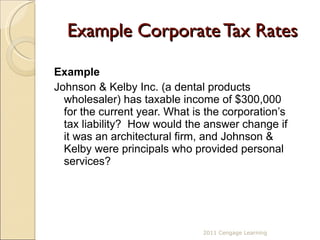
Example Corporate Tax Rates Example Johnson & Kelby Inc. (a dental products wholesaler) has taxable income of $300,000 for the current year. What is the corporation’s tax liability?  How would the answer change if it was an architectural firm, and Johnson & Kelby were principals who provided personal services? 2011 Cengage Learning
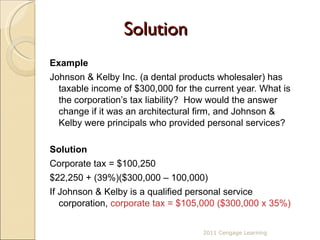
Solution Example Johnson & Kelby Inc. (a dental products wholesaler) has taxable income of $300,000 for the current year. What is the corporation’s tax liability?  How would the answer change if it was an architectural firm, and Johnson & Kelby were principals who provided personal services? Solution Corporate tax = $100,250 $22,250 + (39%)($300,000 – 100,000) If Johnson & Kelby is a qualified personal service corporation,  corporate tax = $105,000 ($300,000 x 35%)  2011 Cengage Learning
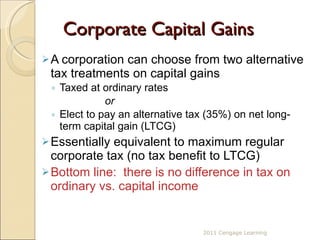
Corporate Capital Gains  A corporation can choose from two alternative tax treatments on capital gains Taxed at ordinary rates   or Elect to pay an alternative tax (35%) on net long-term capital gain (LTCG) Essentially equivalent to maximum regular corporate tax (no tax benefit to LTCG) Bottom line:  there is no difference in tax on ordinary vs. capital income 2011 Cengage Learning
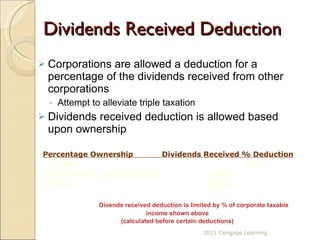
Dividends Received Deduction Corporations are allowed a deduction for a percentage of the dividends received from other corporations  Attempt to alleviate triple taxation Dividends received deduction is allowed based upon ownership   2011 Cengage Learning Percentage Ownership  Dividends Received % Deduction   < 20%     70% 20% or more, less than 80%     80% >  80%   100%   Divends received deduction is limited by % of corporate taxable income shown above (calculated before certain deductions)
Amortization of  Organizational Expenditures Examples of organizational expenditures Legal/accounting services incidental to organization Incorporation fees Organizational expenditures are capitalized and then amortized over 180 months However, can make election to deduct up to $5,000 of organization costs in the year corporation begins business $5,000 amount is reduced $1 for each $1 that organizational expenses exceed $50,000 2011 Cengage Learning
Charitable Contributions Corporations are allowed a deduction for charitable contributions Cash basis taxpayers can deduct when paid Accrual basis taxpayers have until the 15th day of the third month following year-end to contribute, as long as pledge is made by year-end Charitable contributions limited to 10% of taxable income * Carry forward unused deduction for five years *Calculated before any loss carry backs, net operating losses (NOLs)  or the dividend received deduction 2011 Cengage Learning
Example  Charitable Contributions Example Ferndale Corp. had net operating income of $400,000 for the current year and made charitable contributions of $60,000.  A dividends received deduction of $80,000 is included in the net operating income calculation.  What is Ferndale’s charitable contribution deduction; what is the charitable contribution carry forward? 2011 Cengage Learning
Solution Example Ferndale Corp. had net operating income of $400,000 for the current year and made charitable contributions of $60,000.  A dividends received deduction (DRD) of $80,000 is included in the net operating income calculation.  What is Ferndale’s charitable contribution deduction; what is the carry forward? Solution The charitable contribution deduction is $48,000 ($400,000 + 80,000) x 10% = $48,000 limit * Therefore, carry forward is $32,000 ($80,000 – 48,000) *Note: had to add back DRD first!! 2011 Cengage Learning
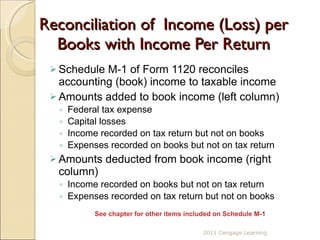
Reconciliation of  Income (Loss) per Books with Income Per Return Schedule M-1 of Form 1120 reconciles accounting (book) income to taxable income  Amounts added to book income (left column) Federal tax expense Capital losses Income recorded on tax return but not on books Expenses recorded on books but not on tax return Amounts deducted from book income (right column)  Income recorded on books but not on tax return  Expenses recorded on tax return but not on books See chapter for other items included on Schedule M-1 2011 Cengage Learning
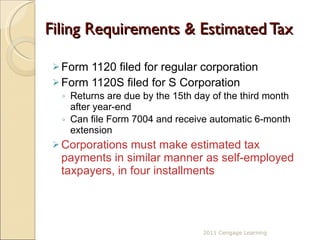
Filing Requirements & Estimated Tax Form 1120 filed for regular corporation Form 1120S filed for S Corporation Returns are due by the 15th day of the third month after year-end  Can file Form 7004 and receive automatic 6-month extension Corporations must make estimated tax payments in similar manner as self-employed taxpayers, in four installments 2011 Cengage Learning
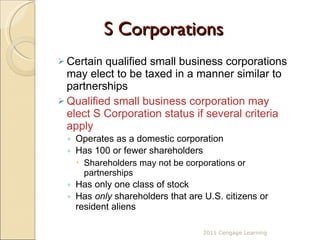
S Corporations Certain qualified small business corporations may elect to be taxed in a manner similar to partnerships Qualified small business corporation may elect S Corporation status if several criteria apply Operates as a domestic corporation Has 100 or fewer shareholders Shareholders may not be corporations or partnerships Has only one class of stock Has  only  shareholders that are U.S. citizens or resident aliens 2011 Cengage Learning
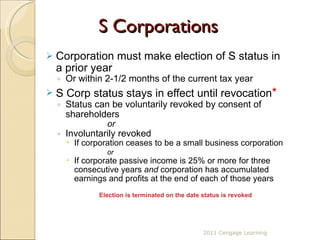
S Corporations  Corporation must make election of S status in a prior year  Or within 2-1/2 months of the current tax year S Corp status stays in effect until revocation * Status can be voluntarily revoked by consent of shareholders or Involuntarily revoked If corporation ceases to be a small business corporation or If corporate passive income is 25% or more for three consecutive years  and  corporation has accumulated earnings and profits at the end of each of those years Election is terminated on the date status is revoked 2011 Cengage Learning
Example S Corporation Election Example Swannak Electronics Corporation is a calendar year corporation that makes an S Corporation election on May 25, 2010.  In which year may the corporation first be treated as an S Corporation? 2011 Cengage Learning
Solution Example Swannak Electronics Corporation is a calendar year corporation that makes an S Corporation election on May 25, 2010.  In which year may the corporation first be treated as an S Corporation? Solution Since Swannak did not make the S Corporation election within the first 2-1/2 months of the tax year, it will be treated as a regular corporation for 2010.  It will become an S Corporation for tax year 2011. 2011 Cengage Learning
Income Reporting Must report all elements of income and expense separately on Form 1120S  Then each shareholder reports his/her share of these items of corporate income/expense on personal return K-1 takes total shareholder income/expenses and allocates each item to each shareholder based upon his/her ownership percentage  If shareholder dies, his/her portion of S Corp items  will be included in shareholder’s final return 2011 Cengage Learning
Loss Reporting Each shareholder of an S Corp may also report his/her respective share of loss Cannot take a loss in excess of adjusted basis in stock If loss exceeds adjusted basis in stock plus loans, shareholder can carry it forward If shareholder entered/departed S Corp mid-year, must allocate losses on a daily basis 2011 Cengage Learning
S Corporation  Pass Through Items Many items retain tax character when passing through to the S Corporation’s  shareholders on individual K-1  Examples of such items include Capital gains/losses §1231 gains/losses Dividend Income Charitable contributions Tax-exempt interest Most credits 2011 Cengage Learning
Special Taxes S Corporations, in general, do not pay corporate taxes on their taxable income Certain exceptions exist such as: Built-in gains tax (paid on appreciated assets that were held by corporation prior to S Corp election) Certain tax imposed if corporation has large amount of passive income, such as dividends and income  These rules are complex and will not be covered in this text 2011 Cengage Learning
Corporate Formation Shareholders often transfer high-value low-basis assets to a corporation in exchange for stock in company No tax is due on gain from transfer of appreciated assets if following conditions met Shareholder transferred cash or property   and Shareholder made transfer solely in exchange for stock * Shareholder is not providing a service and all taxpayers together own at least 80% of stock after transaction *If shareholder receives boot in addition to stock,  transaction may qualify for partial nonrecognition of gain 2011 Cengage Learning
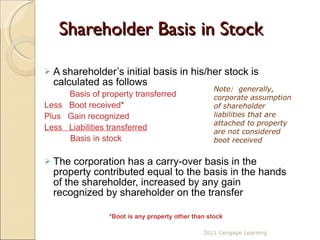
Shareholder Basis in Stock A shareholder’s initial basis in his/her stock is calculated as follows   Basis of property transferred Less  Boot received * Plus  Gain recognized Less  Liabilities transferred Basis in stock The corporation has a carry-over basis in the property contributed equal to the basis in the hands of the shareholder, increased by any gain recognized by shareholder on the transfer *Boot is any property other than stock 2011 Cengage Learning Note:  generally, corporate assumption of shareholder liabilities that are attached to property are not considered boot received
Accumulated Earnings Tax (AET) Penalty tax designed to prevent a corporation from avoiding tax by retaining earnings 15% AET imposed on “unreasonable” accumulation of earnings; this is in addition to corporate income tax Corporation may accumulate up to $250,000 a year that is exempt from AET tax or $150,000 for a service corporation May accumulate more if can prove a valid business purpose 2011 Cengage Learning
Example  Accumulated Earnings Tax Example Xinix Corporation (a medical device manufacturing firm) has accumulated earnings of $800,000.  The corporation can establish reasonable needs for $500,000 of the accumulation.  What would Xinix’ accumulated earnings tax be? 2011 Cengage Learning
Solution Example Xinix Corporation (a medical device manufacturing firm) has accumulated earnings of $800,000.  The corporation can establish reasonable needs for $500,000 of the accumulation.  What would Xinix’ accumulated earnings tax be? Solution Xinix’ AET = $45,000 ($800,000 – 500,000) x 15% Note: this is paid  in addition to  regular tax 2011 Cengage Learning
Personal Holding Company Tax Penalty tax designed to encourage Personal Holding Companies to distribute earnings to shareholders Tax is 15% on undistributed earnings Corporation is not liable for both the personal holding company tax and the AET in the same year 2011 Cengage Learning
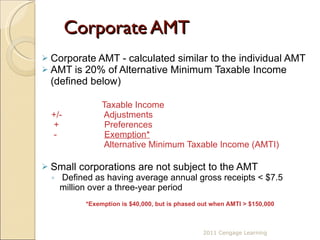
Corporate AMT Corporate AMT - calculated similar to the individual AMT AMT is 20% of Alternative Minimum Taxable Income (defined below)   Taxable Income  +/-   Adjustments  +   Preferences  -    Exemption*   Alternative Minimum Taxable Income (AMTI) Small corporations are not subject to the AMT Defined as having average annual gross receipts < $7.5 million over a three-year period *Exemption is $40,000, but is phased out when AMTI > $150,000 2011 Cengage Learning
You’re Done with Chapter 11 2011 Cengage Learning

Chapter 11

  • 1.
    Chapter 11 CorporateIncome Tax 2011 Cengage Learning Income Tax Fundamentals 2011 Gerald E. Whittenburg Martha Altus-Buller
  • 2.
    Learning Objectives Aspertains to corporations: Calculate tax liability using tax rates Compute basic capital gains/losses Ascertain how special deduction may affect taxable income Identify components of Schedule M-1 Outline corporate tax return filing and estimated tax payment requirements Understand how S-Corporations operate and are taxed Understand basic tax rules when forming entity Describe accumulated earnings and personal holding company taxes Define elements of alternative minimum tax calculation 2011 Cengage Learning
  • 3.
    Corporate Tax RatesCorporate rates are progressive Marginal rates are from 15% to 39%, depending on taxable income There are eight brackets There are a number of ‘tax bubbles’ – these occur when tax rate schedules recaptures savings from prior brackets For corporations with large income (more than $18.33 million) the rate is a flat 35% Qualified personal service corps taxed at flat 35% Architects, CPAs, consultants, etc. 2011 Cengage Learning
  • 4.
    Example Corporate TaxRates Example Johnson & Kelby Inc. (a dental products wholesaler) has taxable income of $300,000 for the current year. What is the corporation’s tax liability? How would the answer change if it was an architectural firm, and Johnson & Kelby were principals who provided personal services? 2011 Cengage Learning
  • 5.
    Solution Example Johnson& Kelby Inc. (a dental products wholesaler) has taxable income of $300,000 for the current year. What is the corporation’s tax liability? How would the answer change if it was an architectural firm, and Johnson & Kelby were principals who provided personal services? Solution Corporate tax = $100,250 $22,250 + (39%)($300,000 – 100,000) If Johnson & Kelby is a qualified personal service corporation, corporate tax = $105,000 ($300,000 x 35%) 2011 Cengage Learning
  • 6.
    Corporate Capital Gains A corporation can choose from two alternative tax treatments on capital gains Taxed at ordinary rates or Elect to pay an alternative tax (35%) on net long-term capital gain (LTCG) Essentially equivalent to maximum regular corporate tax (no tax benefit to LTCG) Bottom line: there is no difference in tax on ordinary vs. capital income 2011 Cengage Learning
  • 7.
    Dividends Received DeductionCorporations are allowed a deduction for a percentage of the dividends received from other corporations Attempt to alleviate triple taxation Dividends received deduction is allowed based upon ownership 2011 Cengage Learning Percentage Ownership Dividends Received % Deduction < 20% 70% 20% or more, less than 80% 80% > 80% 100% Divends received deduction is limited by % of corporate taxable income shown above (calculated before certain deductions)
  • 8.
    Amortization of Organizational Expenditures Examples of organizational expenditures Legal/accounting services incidental to organization Incorporation fees Organizational expenditures are capitalized and then amortized over 180 months However, can make election to deduct up to $5,000 of organization costs in the year corporation begins business $5,000 amount is reduced $1 for each $1 that organizational expenses exceed $50,000 2011 Cengage Learning
  • 9.
    Charitable Contributions Corporationsare allowed a deduction for charitable contributions Cash basis taxpayers can deduct when paid Accrual basis taxpayers have until the 15th day of the third month following year-end to contribute, as long as pledge is made by year-end Charitable contributions limited to 10% of taxable income * Carry forward unused deduction for five years *Calculated before any loss carry backs, net operating losses (NOLs) or the dividend received deduction 2011 Cengage Learning
  • 10.
    Example CharitableContributions Example Ferndale Corp. had net operating income of $400,000 for the current year and made charitable contributions of $60,000. A dividends received deduction of $80,000 is included in the net operating income calculation. What is Ferndale’s charitable contribution deduction; what is the charitable contribution carry forward? 2011 Cengage Learning
  • 11.
    Solution Example FerndaleCorp. had net operating income of $400,000 for the current year and made charitable contributions of $60,000. A dividends received deduction (DRD) of $80,000 is included in the net operating income calculation. What is Ferndale’s charitable contribution deduction; what is the carry forward? Solution The charitable contribution deduction is $48,000 ($400,000 + 80,000) x 10% = $48,000 limit * Therefore, carry forward is $32,000 ($80,000 – 48,000) *Note: had to add back DRD first!! 2011 Cengage Learning
  • 12.
    Reconciliation of Income (Loss) per Books with Income Per Return Schedule M-1 of Form 1120 reconciles accounting (book) income to taxable income Amounts added to book income (left column) Federal tax expense Capital losses Income recorded on tax return but not on books Expenses recorded on books but not on tax return Amounts deducted from book income (right column) Income recorded on books but not on tax return Expenses recorded on tax return but not on books See chapter for other items included on Schedule M-1 2011 Cengage Learning
  • 13.
    Filing Requirements &Estimated Tax Form 1120 filed for regular corporation Form 1120S filed for S Corporation Returns are due by the 15th day of the third month after year-end Can file Form 7004 and receive automatic 6-month extension Corporations must make estimated tax payments in similar manner as self-employed taxpayers, in four installments 2011 Cengage Learning
  • 14.
    S Corporations Certainqualified small business corporations may elect to be taxed in a manner similar to partnerships Qualified small business corporation may elect S Corporation status if several criteria apply Operates as a domestic corporation Has 100 or fewer shareholders Shareholders may not be corporations or partnerships Has only one class of stock Has only shareholders that are U.S. citizens or resident aliens 2011 Cengage Learning
  • 15.
    S Corporations Corporation must make election of S status in a prior year Or within 2-1/2 months of the current tax year S Corp status stays in effect until revocation * Status can be voluntarily revoked by consent of shareholders or Involuntarily revoked If corporation ceases to be a small business corporation or If corporate passive income is 25% or more for three consecutive years and corporation has accumulated earnings and profits at the end of each of those years Election is terminated on the date status is revoked 2011 Cengage Learning
  • 16.
    Example S CorporationElection Example Swannak Electronics Corporation is a calendar year corporation that makes an S Corporation election on May 25, 2010. In which year may the corporation first be treated as an S Corporation? 2011 Cengage Learning
  • 17.
    Solution Example SwannakElectronics Corporation is a calendar year corporation that makes an S Corporation election on May 25, 2010. In which year may the corporation first be treated as an S Corporation? Solution Since Swannak did not make the S Corporation election within the first 2-1/2 months of the tax year, it will be treated as a regular corporation for 2010. It will become an S Corporation for tax year 2011. 2011 Cengage Learning
  • 18.
    Income Reporting Mustreport all elements of income and expense separately on Form 1120S Then each shareholder reports his/her share of these items of corporate income/expense on personal return K-1 takes total shareholder income/expenses and allocates each item to each shareholder based upon his/her ownership percentage If shareholder dies, his/her portion of S Corp items will be included in shareholder’s final return 2011 Cengage Learning
  • 19.
    Loss Reporting Eachshareholder of an S Corp may also report his/her respective share of loss Cannot take a loss in excess of adjusted basis in stock If loss exceeds adjusted basis in stock plus loans, shareholder can carry it forward If shareholder entered/departed S Corp mid-year, must allocate losses on a daily basis 2011 Cengage Learning
  • 20.
    S Corporation Pass Through Items Many items retain tax character when passing through to the S Corporation’s shareholders on individual K-1 Examples of such items include Capital gains/losses §1231 gains/losses Dividend Income Charitable contributions Tax-exempt interest Most credits 2011 Cengage Learning
  • 21.
    Special Taxes SCorporations, in general, do not pay corporate taxes on their taxable income Certain exceptions exist such as: Built-in gains tax (paid on appreciated assets that were held by corporation prior to S Corp election) Certain tax imposed if corporation has large amount of passive income, such as dividends and income These rules are complex and will not be covered in this text 2011 Cengage Learning
  • 22.
    Corporate Formation Shareholdersoften transfer high-value low-basis assets to a corporation in exchange for stock in company No tax is due on gain from transfer of appreciated assets if following conditions met Shareholder transferred cash or property and Shareholder made transfer solely in exchange for stock * Shareholder is not providing a service and all taxpayers together own at least 80% of stock after transaction *If shareholder receives boot in addition to stock, transaction may qualify for partial nonrecognition of gain 2011 Cengage Learning
  • 23.
    Shareholder Basis inStock A shareholder’s initial basis in his/her stock is calculated as follows Basis of property transferred Less Boot received * Plus Gain recognized Less Liabilities transferred Basis in stock The corporation has a carry-over basis in the property contributed equal to the basis in the hands of the shareholder, increased by any gain recognized by shareholder on the transfer *Boot is any property other than stock 2011 Cengage Learning Note: generally, corporate assumption of shareholder liabilities that are attached to property are not considered boot received
  • 24.
    Accumulated Earnings Tax(AET) Penalty tax designed to prevent a corporation from avoiding tax by retaining earnings 15% AET imposed on “unreasonable” accumulation of earnings; this is in addition to corporate income tax Corporation may accumulate up to $250,000 a year that is exempt from AET tax or $150,000 for a service corporation May accumulate more if can prove a valid business purpose 2011 Cengage Learning
  • 25.
    Example AccumulatedEarnings Tax Example Xinix Corporation (a medical device manufacturing firm) has accumulated earnings of $800,000. The corporation can establish reasonable needs for $500,000 of the accumulation. What would Xinix’ accumulated earnings tax be? 2011 Cengage Learning
  • 26.
    Solution Example XinixCorporation (a medical device manufacturing firm) has accumulated earnings of $800,000. The corporation can establish reasonable needs for $500,000 of the accumulation. What would Xinix’ accumulated earnings tax be? Solution Xinix’ AET = $45,000 ($800,000 – 500,000) x 15% Note: this is paid in addition to regular tax 2011 Cengage Learning
  • 27.
    Personal Holding CompanyTax Penalty tax designed to encourage Personal Holding Companies to distribute earnings to shareholders Tax is 15% on undistributed earnings Corporation is not liable for both the personal holding company tax and the AET in the same year 2011 Cengage Learning
  • 28.
    Corporate AMT CorporateAMT - calculated similar to the individual AMT AMT is 20% of Alternative Minimum Taxable Income (defined below) Taxable Income +/- Adjustments + Preferences - Exemption* Alternative Minimum Taxable Income (AMTI) Small corporations are not subject to the AMT Defined as having average annual gross receipts < $7.5 million over a three-year period *Exemption is $40,000, but is phased out when AMTI > $150,000 2011 Cengage Learning
  • 29.
    You’re Done withChapter 11 2011 Cengage Learning