Forming a new business?   Some tax considerations:
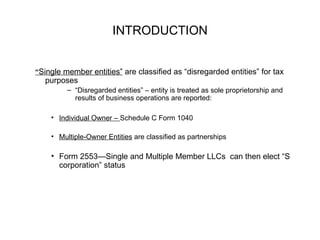
INTRODUCTION “ Single member entities”  are classified as “disregarded entities” for tax purposes “ Disregarded entities” – entity is treated as sole proprietorship and results of business operations are reported:  Individual Owner –  Schedule C Form 1040 Multiple-Owner Entities  are classified as partnerships Form 2553—Single and Multiple Member LLCs  can then elect “S corporation” status
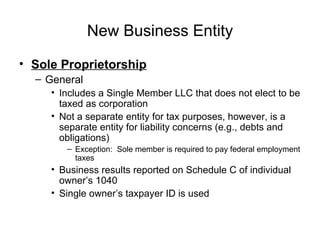
New Business Entity Sole Proprietorship General Includes a Single Member LLC that does not elect to be taxed as corporation Not a separate entity for tax purposes, however, is a separate entity for liability concerns (e.g., debts and obligations) Exception:  Sole member is required to pay federal employment taxes Business results reported on Schedule C of individual owner’s 1040 Single owner’s taxpayer ID is used
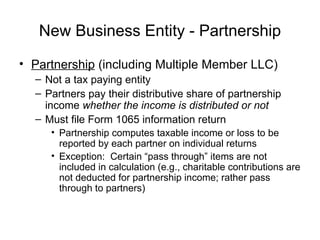
New Business Entity - Partnership Partnership  (including Multiple Member LLC) Not a tax paying entity Partners pay their distributive share of partnership income  whether the income is distributed or not Must file Form 1065 information return Partnership computes taxable income or loss to be reported by each partner on individual returns Exception:  Certain “pass through” items are not included in calculation (e.g., charitable contributions are not deducted for partnership income; rather pass through to partners)
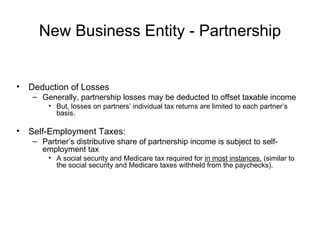
New Business Entity - Partnership Deduction of Losses Generally, partnership losses may be deducted to offset taxable income But, losses on partners’ individual tax returns are limited to each partner’s basis. Self-Employment Taxes:  Partner’s distributive share of partnership income is subject to self-employment tax A social security and Medicare tax required for  in most instances.  (similar to the social security and Medicare taxes withheld from the paychecks).
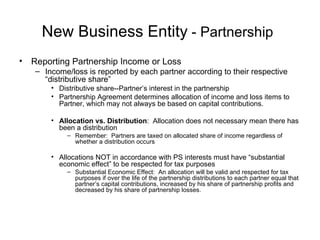
New Business Entity  - Partnership   Reporting Partnership Income or Loss Income/loss is reported by each partner according to their respective “distributive share” Distributive share--Partner’s interest in the partnership  Partnership Agreement determines allocation of income and loss items to Partner, which may not always be based on capital contributions. Allocation vs. Distribution :  Allocation does not necessary mean there has been a distribution Remember:  Partners are taxed on allocated share of income regardless of whether a distribution occurs Allocations NOT in accordance with PS interests must have “substantial economic effect” to be respected for tax purposes Substantial Economic Effect:  An allocation will be valid and respected for tax purposes if over the life of the partnership distributions to each partner equal that partner’s capital contributions, increased by his share of partnership profits and decreased by his share of partnership losses.
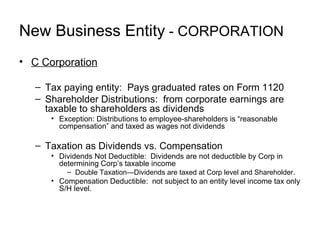
New Business Entity  - Corporation C Corporation Tax paying entity:  Pays graduated rates on Form 1120 Shareholder Distributions:  from corporate earnings are taxable to shareholders as dividends Exception: Distributions to employee-shareholders is “reasonable compensation” and taxed as wages not dividends Taxation as Dividends vs. Compensation Dividends Not Deductible:  Dividends are not deductible by Corp in determining Corp’s taxable income Double Taxation—Dividends are taxed at Corp level and Shareholder. Compensation Deductible:  not subject to an entity level income tax only S/H level.
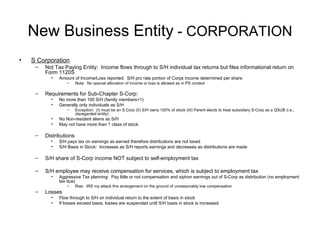
New Business Entity  - CORPORATION S Corporation Not Tax Paying Entity:  Income flows through to S/H individual tax returns but files informational return on Form 1120S Amount of Income/Loss reported:  S/H pro rata portion of Corps income determined per share Note:  No special allocation of income or loss is allowed as in PS context Requirements for Sub-Chapter S-Corp: No more than 100 S/H (family members=1) Generally only individuals as S/H Exception:  (I) must be an S Corp (II) S/H owns 100% of stock (III) Parent elects to treat subsidiary S-Corp as a QSUB (i.e., disregarded entity) No Non-resident aliens as S/H May not have more than 1 class of stock Distributions S/H pays tax on earnings as earned therefore distributions are not taxed S/H Basis in Stock:  Increases as S/H reports earnings and decreases as distributions are made S/H share of S-Corp income NOT subject to self-employment tax S/H employee may receive compensation for services, which is subject to employment tax Aggressive Tax planning:  Pay little or not compensation and siphon earnings out of S-Corp as distribution (no employment tax due) Risk:  IRS my attack this arrangement on the ground of unreasonably low compensation Losses Flow through to S/H on individual return to the extent of basis in stock If losses exceed basis, losses are suspended until S/H basis in stock is increased
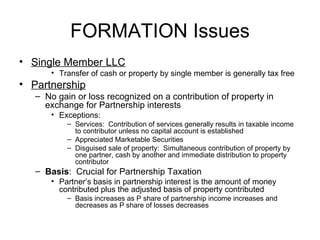
Formation Considerations Single Member LLC Transfer of cash or property by single member is generally tax free Partnership No gain or loss recognized on a contribution of property in exchange for Partnership interests Exceptions:  Services:  Contribution of services generally results in taxable income to contributor unless no capital account is established Appreciated Marketable Securities Disguised sale of property:  Simultaneous contribution of property by one partner, cash by another and immediate distribution to property contributor Basis :  Crucial for Partnership Taxation Partner’s basis in partnership interest is the amount of money contributed plus the adjusted basis of property contributed Basis increases as P share of partnership income increases and decreases as P share of losses decreases
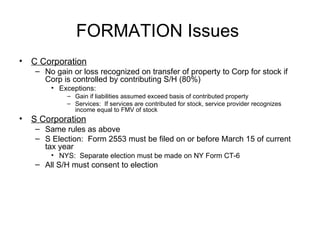
Formation Considerations  C Corporation No gain or loss recognized on transfer of property to Corp for stock if Corp is controlled by contributing S/H (80%) Exceptions:  Gain if liabilities assumed exceed basis of contributed property Services:  If services are contributed for stock, service provider recognizes income equal to FMV of stock S Corporation Same rules as above S Election:  Form 2553 must be filed on or before March 15 of current tax year NYS:  Separate election must be made on NY Form CT-6 All S/H must consent to election
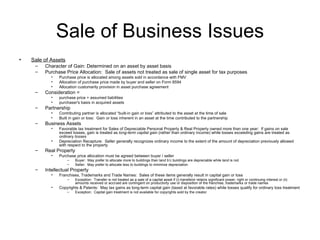
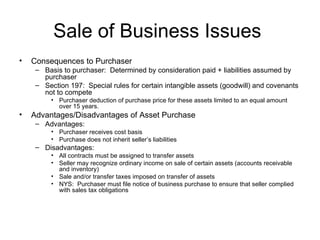
Sale of Business Issues Sale of Assets Character of Gain: Determined on an asset by asset basis Purchase Price Allocation:  Sale of assets not treated as sale of single asset for tax purposes Purchase price is allocated among assets sold in accordance with FMV Allocation of purchase price made by buyer and seller on Form 8594 Allocation customarily provision in asset purchase agreement Consideration =  purchase price + assumed liabilities purchaser's basis in acquired assets Partnership Contributing partner is allocated “built-in gain or loss” attributed to the asset at the time of sale Built in gain or loss:  Gain or loss inherent in an asset at the time contributed to the partnership Business Assets Favorable tax treatment for Sales of Depreciable Personal Property & Real Property owned more than one year:  If gains on sale exceed losses, gain is treated as  long-term capital gain  (rather than ordinary income) while losses exceeding gains are treated as  ordinary losses Depreciation Recapture:  Seller generally recognizes ordinary income to the extent of the amount of depreciation previously allowed with respect to the property Real Property Purchase price allocation must be agreed between buyer / seller Buyer:  May prefer to allocate more to buildings than land b’c buildings are depreciable while land is not Seller:  May prefer to allocate less to buildings to minimize depreciation Intellectual Property Franchises, Trademarks and Trade Names:  Sales of these items generally result in capital gain or loss Exception:  Transfer is not treated as a sale of a capital asset if (i) transferor retains significant power, right or continuing interest or (ii) amounts received or accrued are contingent on productivity use or disposition of the franchise, trademarks or trade names Copyrights & Patents:  May tax gains as long-term capital gain (taxed at favorable rates) while losses qualify for ordinary loss treatment Exception:  Capital gain treatment is not available for copyrights sold by the creator
Sale of Business Issues  Consequences to Purchaser Basis to purchaser:  Determined by consideration paid + liabilities assumed by purchaser Section 197:  Special rules for certain intangible assets (goodwill) and covenants not to compete Purchaser deduction of purchase price for these assets limited to an equal amount over 15 years. Advantages/Disadvantages of Asset Purchase Advantages: Purchaser receives cost basis Purchase does not inherit seller’s liabilities Disadvantages: All contracts must be assigned to transfer assets Seller may recognize ordinary income on sale of certain assets (accounts receivable and inventory) Sale and/or transfer taxes imposed on transfer of assets NYS:  Purchaser must file notice of business purchase to ensure that seller complied with sales tax obligations
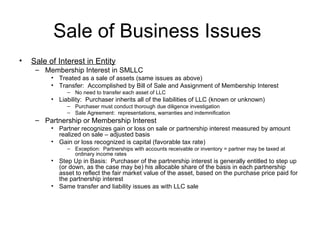
Sale of Business Issues  Sale of Interest in Entity Membership Interest in SMLLC Treated as a sale of assets (same issues as above) Transfer:  Accomplished by Bill of Sale and Assignment of Membership Interest No need to transfer each asset of LLC Liability:  Purchaser inherits all of the liabilities of LLC (known or unknown) Purchaser must conduct thorough due diligence investigation Sale Agreement:  representations, warranties and indemnification Partnership or Membership Interest Partner recognizes gain or loss on sale or partnership interest measured by amount realized on sale – adjusted basis Gain or loss recognized is capital (favorable tax rate) Exception:  Partnerships with accounts receivable or inventory = partner may be taxed at ordinary income rates Step Up in Basis:  Purchaser of the partnership interest is generally entitled to step up (or down, as the case may be) his allocable share of the basis in each partnership asset to reflect the fair market value of the asset, based on the purchase price paid for the partnership interest Same transfer and liability issues as with LLC sale
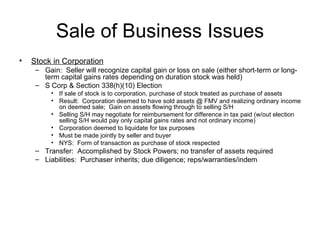
Sale of Business Issues Stock in Corporation Gain:  Seller will recognize capital gain or loss on sale (either short-term or long-term capital gains rates depending on duration stock was held) S Corp & Section 338(h)(10) Election If sale of stock is to corporation, purchase of stock treated as purchase of assets Result:  Corporation deemed to have sold assets @ FMV and realizing ordinary income on deemed sale;  Gain on assets flowing through to selling S/H Selling S/H may negotiate for reimbursement for difference in tax paid (w/out election selling S/H would pay only capital gains rates and not ordinary income) Corporation deemed to liquidate for tax purposes Must be made jointly by seller and buyer NYS:  Form of transaction as purchase of stock respected Transfer:  Accomplished by Stock Powers; no transfer of assets required Liabilities:  Purchaser inherits; due diligence; reps/warranties/indem
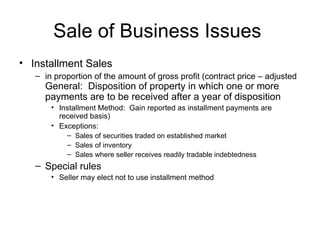
Sale of Business Issues  Installment Sales in proportion of the amount of gross profit (contract price – adjusted  General:  Disposition of property in which one or more payments are to be received after a year of disposition Installment Method:  Gain reported as installment payments are received basis) Exceptions: Sales of securities traded on established market Sales of inventory Sales where seller receives readily tradable indebtedness Special rules Seller may elect not to use installment method
PROPERTY DISTRIBUTIONS FROM CORPS & PARTNERSHIPS C Corporations Gain or loss recognized on distributing property to S/H computed based on price equal to FMV Gain is taxed @ corporate level S/H includes FMV of distributed property in income as dividend S Corporations Same as C Corp, BUT no corporate level tax Any gain flows thru to S/H who pays tax on gain and receives an increase in basis of his stock To the extent FMV of distributed property exceeds S/H’s adjusted basis in stock, excess amount is treated as gain on sale of stock Partnerships Generally, no gain or loss is recognized to partnership or partners when partnership distributes property
PROPERTY DISTRIBUTIONS FROM  CORPS & PARTNERSHIPS Estate and Gift Taxes Corporations:  Stock owned by an individual will generally be valued initially based on proportionate net underlying asset value of corp’s assets Minority interest or marketability discounts may be applied to initial value Partnerships:  Same as above Difference:  Discounts available in the partnership context generally allow for more tax-efficient transfers of family wealth than in corporate context.
Contact us to discuss these issues in more detail. Rapacki + Co. P A CPAs

New business entity

  • 1.
    Forming a newbusiness? Some tax considerations:
  • 2.
    INTRODUCTION “ Singlemember entities” are classified as “disregarded entities” for tax purposes “ Disregarded entities” – entity is treated as sole proprietorship and results of business operations are reported: Individual Owner – Schedule C Form 1040 Multiple-Owner Entities are classified as partnerships Form 2553—Single and Multiple Member LLCs can then elect “S corporation” status
  • 3.
    New Business EntitySole Proprietorship General Includes a Single Member LLC that does not elect to be taxed as corporation Not a separate entity for tax purposes, however, is a separate entity for liability concerns (e.g., debts and obligations) Exception: Sole member is required to pay federal employment taxes Business results reported on Schedule C of individual owner’s 1040 Single owner’s taxpayer ID is used
  • 4.
    New Business Entity- Partnership Partnership (including Multiple Member LLC) Not a tax paying entity Partners pay their distributive share of partnership income whether the income is distributed or not Must file Form 1065 information return Partnership computes taxable income or loss to be reported by each partner on individual returns Exception: Certain “pass through” items are not included in calculation (e.g., charitable contributions are not deducted for partnership income; rather pass through to partners)
  • 5.
    New Business Entity- Partnership Deduction of Losses Generally, partnership losses may be deducted to offset taxable income But, losses on partners’ individual tax returns are limited to each partner’s basis. Self-Employment Taxes: Partner’s distributive share of partnership income is subject to self-employment tax A social security and Medicare tax required for in most instances. (similar to the social security and Medicare taxes withheld from the paychecks).
  • 6.
    New Business Entity - Partnership Reporting Partnership Income or Loss Income/loss is reported by each partner according to their respective “distributive share” Distributive share--Partner’s interest in the partnership Partnership Agreement determines allocation of income and loss items to Partner, which may not always be based on capital contributions. Allocation vs. Distribution : Allocation does not necessary mean there has been a distribution Remember: Partners are taxed on allocated share of income regardless of whether a distribution occurs Allocations NOT in accordance with PS interests must have “substantial economic effect” to be respected for tax purposes Substantial Economic Effect: An allocation will be valid and respected for tax purposes if over the life of the partnership distributions to each partner equal that partner’s capital contributions, increased by his share of partnership profits and decreased by his share of partnership losses.
  • 7.
    New Business Entity - Corporation C Corporation Tax paying entity: Pays graduated rates on Form 1120 Shareholder Distributions: from corporate earnings are taxable to shareholders as dividends Exception: Distributions to employee-shareholders is “reasonable compensation” and taxed as wages not dividends Taxation as Dividends vs. Compensation Dividends Not Deductible: Dividends are not deductible by Corp in determining Corp’s taxable income Double Taxation—Dividends are taxed at Corp level and Shareholder. Compensation Deductible: not subject to an entity level income tax only S/H level.
  • 8.
    New Business Entity - CORPORATION S Corporation Not Tax Paying Entity: Income flows through to S/H individual tax returns but files informational return on Form 1120S Amount of Income/Loss reported: S/H pro rata portion of Corps income determined per share Note: No special allocation of income or loss is allowed as in PS context Requirements for Sub-Chapter S-Corp: No more than 100 S/H (family members=1) Generally only individuals as S/H Exception: (I) must be an S Corp (II) S/H owns 100% of stock (III) Parent elects to treat subsidiary S-Corp as a QSUB (i.e., disregarded entity) No Non-resident aliens as S/H May not have more than 1 class of stock Distributions S/H pays tax on earnings as earned therefore distributions are not taxed S/H Basis in Stock: Increases as S/H reports earnings and decreases as distributions are made S/H share of S-Corp income NOT subject to self-employment tax S/H employee may receive compensation for services, which is subject to employment tax Aggressive Tax planning: Pay little or not compensation and siphon earnings out of S-Corp as distribution (no employment tax due) Risk: IRS my attack this arrangement on the ground of unreasonably low compensation Losses Flow through to S/H on individual return to the extent of basis in stock If losses exceed basis, losses are suspended until S/H basis in stock is increased
  • 9.
    Formation Considerations SingleMember LLC Transfer of cash or property by single member is generally tax free Partnership No gain or loss recognized on a contribution of property in exchange for Partnership interests Exceptions: Services: Contribution of services generally results in taxable income to contributor unless no capital account is established Appreciated Marketable Securities Disguised sale of property: Simultaneous contribution of property by one partner, cash by another and immediate distribution to property contributor Basis : Crucial for Partnership Taxation Partner’s basis in partnership interest is the amount of money contributed plus the adjusted basis of property contributed Basis increases as P share of partnership income increases and decreases as P share of losses decreases
  • 10.
    Formation Considerations C Corporation No gain or loss recognized on transfer of property to Corp for stock if Corp is controlled by contributing S/H (80%) Exceptions: Gain if liabilities assumed exceed basis of contributed property Services: If services are contributed for stock, service provider recognizes income equal to FMV of stock S Corporation Same rules as above S Election: Form 2553 must be filed on or before March 15 of current tax year NYS: Separate election must be made on NY Form CT-6 All S/H must consent to election
  • 11.
    Sale of BusinessIssues Sale of Assets Character of Gain: Determined on an asset by asset basis Purchase Price Allocation: Sale of assets not treated as sale of single asset for tax purposes Purchase price is allocated among assets sold in accordance with FMV Allocation of purchase price made by buyer and seller on Form 8594 Allocation customarily provision in asset purchase agreement Consideration = purchase price + assumed liabilities purchaser's basis in acquired assets Partnership Contributing partner is allocated “built-in gain or loss” attributed to the asset at the time of sale Built in gain or loss: Gain or loss inherent in an asset at the time contributed to the partnership Business Assets Favorable tax treatment for Sales of Depreciable Personal Property & Real Property owned more than one year: If gains on sale exceed losses, gain is treated as long-term capital gain (rather than ordinary income) while losses exceeding gains are treated as ordinary losses Depreciation Recapture: Seller generally recognizes ordinary income to the extent of the amount of depreciation previously allowed with respect to the property Real Property Purchase price allocation must be agreed between buyer / seller Buyer: May prefer to allocate more to buildings than land b’c buildings are depreciable while land is not Seller: May prefer to allocate less to buildings to minimize depreciation Intellectual Property Franchises, Trademarks and Trade Names: Sales of these items generally result in capital gain or loss Exception: Transfer is not treated as a sale of a capital asset if (i) transferor retains significant power, right or continuing interest or (ii) amounts received or accrued are contingent on productivity use or disposition of the franchise, trademarks or trade names Copyrights & Patents: May tax gains as long-term capital gain (taxed at favorable rates) while losses qualify for ordinary loss treatment Exception: Capital gain treatment is not available for copyrights sold by the creator
  • 12.
    Sale of BusinessIssues Consequences to Purchaser Basis to purchaser: Determined by consideration paid + liabilities assumed by purchaser Section 197: Special rules for certain intangible assets (goodwill) and covenants not to compete Purchaser deduction of purchase price for these assets limited to an equal amount over 15 years. Advantages/Disadvantages of Asset Purchase Advantages: Purchaser receives cost basis Purchase does not inherit seller’s liabilities Disadvantages: All contracts must be assigned to transfer assets Seller may recognize ordinary income on sale of certain assets (accounts receivable and inventory) Sale and/or transfer taxes imposed on transfer of assets NYS: Purchaser must file notice of business purchase to ensure that seller complied with sales tax obligations
  • 13.
    Sale of BusinessIssues Sale of Interest in Entity Membership Interest in SMLLC Treated as a sale of assets (same issues as above) Transfer: Accomplished by Bill of Sale and Assignment of Membership Interest No need to transfer each asset of LLC Liability: Purchaser inherits all of the liabilities of LLC (known or unknown) Purchaser must conduct thorough due diligence investigation Sale Agreement: representations, warranties and indemnification Partnership or Membership Interest Partner recognizes gain or loss on sale or partnership interest measured by amount realized on sale – adjusted basis Gain or loss recognized is capital (favorable tax rate) Exception: Partnerships with accounts receivable or inventory = partner may be taxed at ordinary income rates Step Up in Basis: Purchaser of the partnership interest is generally entitled to step up (or down, as the case may be) his allocable share of the basis in each partnership asset to reflect the fair market value of the asset, based on the purchase price paid for the partnership interest Same transfer and liability issues as with LLC sale
  • 14.
    Sale of BusinessIssues Stock in Corporation Gain: Seller will recognize capital gain or loss on sale (either short-term or long-term capital gains rates depending on duration stock was held) S Corp & Section 338(h)(10) Election If sale of stock is to corporation, purchase of stock treated as purchase of assets Result: Corporation deemed to have sold assets @ FMV and realizing ordinary income on deemed sale; Gain on assets flowing through to selling S/H Selling S/H may negotiate for reimbursement for difference in tax paid (w/out election selling S/H would pay only capital gains rates and not ordinary income) Corporation deemed to liquidate for tax purposes Must be made jointly by seller and buyer NYS: Form of transaction as purchase of stock respected Transfer: Accomplished by Stock Powers; no transfer of assets required Liabilities: Purchaser inherits; due diligence; reps/warranties/indem
  • 15.
    Sale of BusinessIssues Installment Sales in proportion of the amount of gross profit (contract price – adjusted General: Disposition of property in which one or more payments are to be received after a year of disposition Installment Method: Gain reported as installment payments are received basis) Exceptions: Sales of securities traded on established market Sales of inventory Sales where seller receives readily tradable indebtedness Special rules Seller may elect not to use installment method
  • 16.
    PROPERTY DISTRIBUTIONS FROMCORPS & PARTNERSHIPS C Corporations Gain or loss recognized on distributing property to S/H computed based on price equal to FMV Gain is taxed @ corporate level S/H includes FMV of distributed property in income as dividend S Corporations Same as C Corp, BUT no corporate level tax Any gain flows thru to S/H who pays tax on gain and receives an increase in basis of his stock To the extent FMV of distributed property exceeds S/H’s adjusted basis in stock, excess amount is treated as gain on sale of stock Partnerships Generally, no gain or loss is recognized to partnership or partners when partnership distributes property
  • 17.
    PROPERTY DISTRIBUTIONS FROM CORPS & PARTNERSHIPS Estate and Gift Taxes Corporations: Stock owned by an individual will generally be valued initially based on proportionate net underlying asset value of corp’s assets Minority interest or marketability discounts may be applied to initial value Partnerships: Same as above Difference: Discounts available in the partnership context generally allow for more tax-efficient transfers of family wealth than in corporate context.
  • 18.
    Contact us todiscuss these issues in more detail. Rapacki + Co. P A CPAs