“Winning Business Strategies”
       Webinar Series


      What’s the right business
          entity choice?
                       Presented by:
  Michael E. Stover, CPA/ABV & Michael P. Moloney, JD, CFP®
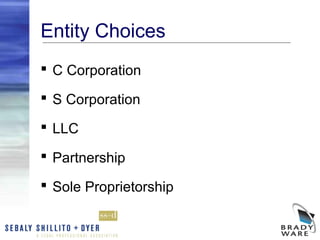
Entity Choices
 C Corporation

 S Corporation

 LLC

 Partnership

 Sole Proprietorship
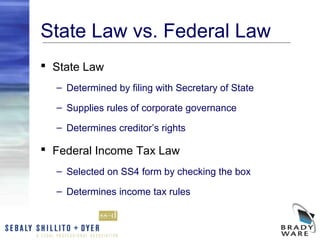
State Law vs. Federal Law
 State Law
  – Determined by filing with Secretary of State

  – Supplies rules of corporate governance

  – Determines creditor’s rights

 Federal Income Tax Law
  – Selected on SS4 form by checking the box

  – Determines income tax rules
Liability Issues
 What creditor protection does each
 form offer?
  – From the bank

  – From the landlord

  – From creditors of the entity
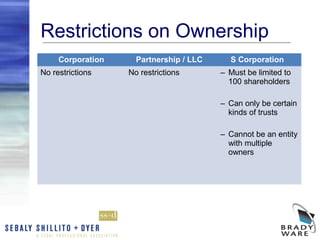
Restrictions on Ownership
     Corporation     Partnership / LLC     S Corporation
No restrictions    No restrictions       – Must be limited to
                                           100 shareholders

                                         – Can only be certain
                                           kinds of trusts

                                         – Cannot be an entity
                                           with multiple
                                           owners
Operational Tax Issues
 Income tax

 Employment tax

 Deductibility of Fringe benefits
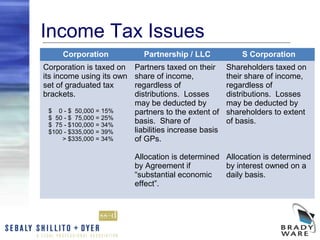
Income Tax Issues
     Corporation             Partnership / LLC              S Corporation
Corporation is taxed on    Partners taxed on their      Shareholders taxed on
its income using its own   share of income,             their share of income,
set of graduated tax       regardless of                regardless of
brackets.                  distributions. Losses        distributions. Losses
                           may be deducted by           may be deducted by
 $ 0 - $ 50,000 = 15%      partners to the extent of    shareholders to extent
 $ 50 - $ 75,000 = 25%
 $ 75 - $100,000 = 34%
                           basis. Share of              of basis.
 $100 - $335,000 = 39%     liabilities increase basis
     > $335,000 = 34%      of GPs.

                           Allocation is determined Allocation is determined
                           by Agreement if          by interest owned on a
                           “substantial economic    daily basis.
                           effect”.
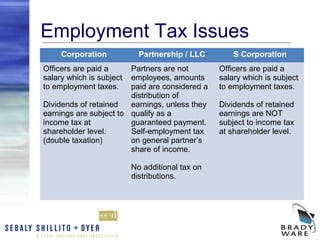
Employment Tax Issues
     Corporation            Partnership / LLC        S Corporation
Officers are paid a     Partners are not         Officers are paid a
salary which is subject employees, amounts       salary which is subject
to employment taxes.    paid are considered a    to employment taxes.
                        distribution of
Dividends of retained   earnings, unless they    Dividends of retained
earnings are subject to qualify as a             earnings are NOT
income tax at           guaranteed payment.      subject to income tax
shareholder level.      Self-employment tax      at shareholder level.
(double taxation)       on general partner’s
                        share of income.

                          No additional tax on
                          distributions.
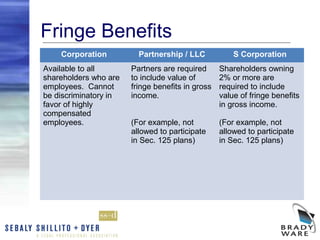
Fringe Benefits
    Corporation          Partnership / LLC            S Corporation
Available to all       Partners are required      Shareholders owning
shareholders who are   to include value of        2% or more are
employees. Cannot      fringe benefits in gross   required to include
be discriminatory in   income.                    value of fringe benefits
favor of highly                                   in gross income.
compensated
employees.             (For example, not          (For example, not
                       allowed to participate     allowed to participate
                       in Sec. 125 plans)         in Sec. 125 plans)
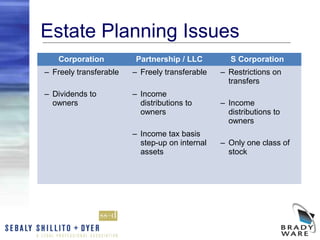
Estate Planning Issues
   Corporation           Partnership / LLC         S Corporation
– Freely transferable   – Freely transferable   – Restrictions on
                                                  transfers
– Dividends to          – Income
  owners                  distributions to      – Income
                          owners                  distributions to
                                                  owners
                        – Income tax basis
                          step-up on internal   – Only one class of
                          assets                  stock
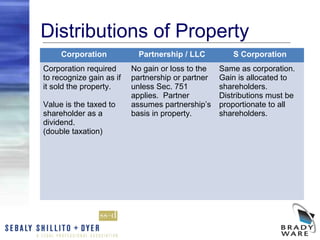
Distributions of Property
     Corporation            Partnership / LLC         S Corporation
Corporation required      No gain or loss to the   Same as corporation.
to recognize gain as if   partnership or partner   Gain is allocated to
it sold the property.     unless Sec. 751          shareholders.
                          applies. Partner         Distributions must be
Value is the taxed to     assumes partnership’s    proportionate to all
shareholder as a          basis in property.       shareholders.
dividend.
(double taxation)
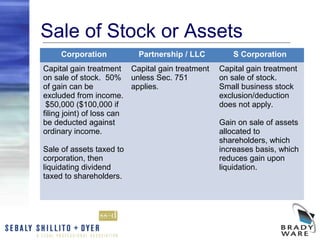
Sale of Stock or Assets
     Corporation          Partnership / LLC        S Corporation
Capital gain treatment Capital gain treatment   Capital gain treatment
on sale of stock. 50% unless Sec. 751           on sale of stock.
of gain can be            applies.              Small business stock
excluded from income.                           exclusion/deduction
 $50,000 ($100,000 if                           does not apply.
filing joint) of loss can
be deducted against                             Gain on sale of assets
ordinary income.                                allocated to
                                                shareholders, which
Sale of assets taxed to                         increases basis, which
corporation, then                               reduces gain upon
liquidating dividend                            liquidation.
taxed to shareholders.
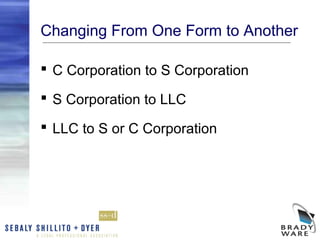
Changing From One Form to Another

 C Corporation to S Corporation

 S Corporation to LLC

 LLC to S or C Corporation
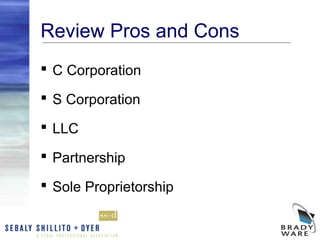
Review Pros and Cons
 C Corporation

 S Corporation

 LLC

 Partnership

 Sole Proprietorship
What’s the right business entity choice?
                               Presented by:

Michael P. Moloney, JD, CFP®                Michael E. Stover, CPA/ABV
     Sebaly Shillito + Dyer                            Brady Ware
                                      and
        (937) 222-2055                               (937) 913-2507
   mmoloney@ssdlaw.com                         mstover@bradyware.com


 IRS Circular 230 disclosure: To ensure compliance with requirements imposed
     by the IRS, we inform you that any U.S. federal tax advice contained in this
    document is not intended or written to be used, and cannot be used, for the
      purpose of (i) avoiding penalties under the Internal Revenue Code or (ii)
    promoting, marketing or recommending to another party any transaction or
                      matter that is contained in this document.

Business Entity Choice Presentation

  • 1.
    “Winning Business Strategies” Webinar Series What’s the right business entity choice? Presented by: Michael E. Stover, CPA/ABV & Michael P. Moloney, JD, CFP®
  • 2.
    Entity Choices  CCorporation  S Corporation  LLC  Partnership  Sole Proprietorship
  • 3.
    State Law vs.Federal Law  State Law – Determined by filing with Secretary of State – Supplies rules of corporate governance – Determines creditor’s rights  Federal Income Tax Law – Selected on SS4 form by checking the box – Determines income tax rules
  • 4.
    Liability Issues  Whatcreditor protection does each form offer? – From the bank – From the landlord – From creditors of the entity
  • 5.
    Restrictions on Ownership Corporation Partnership / LLC S Corporation No restrictions No restrictions – Must be limited to 100 shareholders – Can only be certain kinds of trusts – Cannot be an entity with multiple owners
  • 6.
    Operational Tax Issues Income tax  Employment tax  Deductibility of Fringe benefits
  • 7.
    Income Tax Issues Corporation Partnership / LLC S Corporation Corporation is taxed on Partners taxed on their Shareholders taxed on its income using its own share of income, their share of income, set of graduated tax regardless of regardless of brackets. distributions. Losses distributions. Losses may be deducted by may be deducted by $ 0 - $ 50,000 = 15% partners to the extent of shareholders to extent $ 50 - $ 75,000 = 25% $ 75 - $100,000 = 34% basis. Share of of basis. $100 - $335,000 = 39% liabilities increase basis > $335,000 = 34% of GPs. Allocation is determined Allocation is determined by Agreement if by interest owned on a “substantial economic daily basis. effect”.
  • 8.
    Employment Tax Issues Corporation Partnership / LLC S Corporation Officers are paid a Partners are not Officers are paid a salary which is subject employees, amounts salary which is subject to employment taxes. paid are considered a to employment taxes. distribution of Dividends of retained earnings, unless they Dividends of retained earnings are subject to qualify as a earnings are NOT income tax at guaranteed payment. subject to income tax shareholder level. Self-employment tax at shareholder level. (double taxation) on general partner’s share of income. No additional tax on distributions.
  • 9.
    Fringe Benefits Corporation Partnership / LLC S Corporation Available to all Partners are required Shareholders owning shareholders who are to include value of 2% or more are employees. Cannot fringe benefits in gross required to include be discriminatory in income. value of fringe benefits favor of highly in gross income. compensated employees. (For example, not (For example, not allowed to participate allowed to participate in Sec. 125 plans) in Sec. 125 plans)
  • 10.
    Estate Planning Issues Corporation Partnership / LLC S Corporation – Freely transferable – Freely transferable – Restrictions on transfers – Dividends to – Income owners distributions to – Income owners distributions to owners – Income tax basis step-up on internal – Only one class of assets stock
  • 11.
    Distributions of Property Corporation Partnership / LLC S Corporation Corporation required No gain or loss to the Same as corporation. to recognize gain as if partnership or partner Gain is allocated to it sold the property. unless Sec. 751 shareholders. applies. Partner Distributions must be Value is the taxed to assumes partnership’s proportionate to all shareholder as a basis in property. shareholders. dividend. (double taxation)
  • 12.
    Sale of Stockor Assets Corporation Partnership / LLC S Corporation Capital gain treatment Capital gain treatment Capital gain treatment on sale of stock. 50% unless Sec. 751 on sale of stock. of gain can be applies. Small business stock excluded from income. exclusion/deduction $50,000 ($100,000 if does not apply. filing joint) of loss can be deducted against Gain on sale of assets ordinary income. allocated to shareholders, which Sale of assets taxed to increases basis, which corporation, then reduces gain upon liquidating dividend liquidation. taxed to shareholders.
  • 13.
    Changing From OneForm to Another  C Corporation to S Corporation  S Corporation to LLC  LLC to S or C Corporation
  • 14.
    Review Pros andCons  C Corporation  S Corporation  LLC  Partnership  Sole Proprietorship
  • 15.
    What’s the rightbusiness entity choice? Presented by: Michael P. Moloney, JD, CFP® Michael E. Stover, CPA/ABV Sebaly Shillito + Dyer Brady Ware and (937) 222-2055 (937) 913-2507 mmoloney@ssdlaw.com mstover@bradyware.com IRS Circular 230 disclosure: To ensure compliance with requirements imposed by the IRS, we inform you that any U.S. federal tax advice contained in this document is not intended or written to be used, and cannot be used, for the purpose of (i) avoiding penalties under the Internal Revenue Code or (ii) promoting, marketing or recommending to another party any transaction or matter that is contained in this document.