
Moneycation
Published by Moneycation™
Newsletter: December 9, 2015
Volume 2, Issue 14
S corporation tax strategy
S corporations are legally structured in a way that allow them to
go untaxed. This is because income that is recognized by owners
is taxed at the personal level and not via the business. Moreover, an S corporation is a pass-through
or flow-through entity, which means income passes through to the shareholders. This newsletter
details tax management information and methods used by and relevant to S corporations.
The tax laws that govern pass-through entities are favorable in-and-of-themselves; this makes the
business structure choice a tax strategy decision. As implied, this type of business avoids double
taxation, but is also due to the way income is managed and distributed by the business. For
instance, the purchase of depreciable assets such as land defer federal income taxation by locking in
value within real property and adding additional taxable income reducing potential via capital
expenditures.
In addition to favorable tax classification, flow-through businesses have the same benefits of tax
accounting techniques defined by Title 26 of the U.S. Code and Statutory Accounting Principles.
This makes further tax strategy in combination with structural tax strategy possible. For example,
losses that are not deductible in fiscal year 1 of a startup pass through entity, but are carried forward
to year 2 also help reduce flow-through income tax in subsequent years with higher earnings.
Since tax is a substantial factor weighing on business financial management, any tax advantages
made possible through business structure are relevant to business functionality. This is reiterated by
in the following excerpt by Mike Trabold of “Accounting Today”:
“According to a recent survey Paychex conducted of startup businesses with fewer than 50
employees, taxes and the U.S. tax structure were identified as the biggest issue impacting
businesses this year.”
In light of the impact taxes have on business performance, the ways pass-through business are able
to manage their finances are important for competitive positioning, market share acquisition and
profit margin among other things. How S corporations help business owners optimize commercial
performance, financial management and tax strategy influences the success of those businesses and
their owners. Knowing the basics of S corporation taxation is a fundamental aspect of effectively
managing an S corporation.
S-corporations
S-corporation profits are taxable at the individual income tax level regardless of what is done with
the profit. In other words, business earnings held within the company are still taxable at an
individual tax rate. However, how these earnings are calculated and where costs are allocated have
an effect on how much taxable income is generated. In terms of company value, this opens the
possibility of growing business worth via the balance sheet without incurring tax through the
income statement, a topic addressed in the asset management section of this newsletter.
Peter J. Reilly of Forbes magazine suggests that S corporations provide business owners a good
way to avoid self-employment tax. Moreover, by converting a sole-proprietorship to an S
corporation, sole proprietor government taxes other than income tax can be bypassed in part and so
long as the business pays reasonable salaries; the net effect lowers operating costs by keeping
salaries to a minimum.
“Entrepreneurs will be inclined to heavily discount any decrease in future social security
benefits as a trade-off, so organizing as an S corporation and avoiding self-employment tax
seems like a no-brainer for a sole proprietor....What the McAlary case teaches us is not that
you can’t use an S corporation to avoid SE/payroll taxes. It teaches us that you really should
not use the strategy to avoid SE/payroll taxes entirely...If your business is reasonably
profitable, don’t even think about taking less than whatever the unemployment wage base in
your state is. That varies substantially by state ranging from $7,000 in Arizona to $39,800 in
Washington. By going below that limit you end up with another group of enforcers being
interested in you.”
The latter part of this excerpt is also observed by the U.S. Small Business Administration.
According to the SBA, S corporation distributions are taxed at a lower rate than wages. However,
there is also a reasonable income requirement that states salary distributions go hand-in-hand with
profitability. They describe this financial planning variable as follows:
“A shareholder must receive reasonable compensation. The IRS takes notice of shareholder
red flags like low salary/high distribution combinations, and may reclassify your
distributions as wages. You could pay a higher employment tax because of an audit with
these results.”
Even if zero wages are paid to a shareholder for strategic business reasons, this IRS expectation has
the potential of getting in the way via audit signals or red flags. Carefully considering owner-
salaries as a function of overall revenue, cost and profit helps align IRS income tax hopes with S
corporation operability and functionality.
Income recognition
Before jumping on to the obvious advantages of pass-through entities, a closer look at the process
of reaping such rewards warrants a closer look. Income recognition is a good place to start as
several pre-requisite requirements are needed to determine actual taxability. This is apparent in an
American Institute of CPAs publication on the matter, a part of which is quoted below:
“Integral to determining the taxability of an S corporation’s distributions are two
shareholder-level attributes—stock basis and previously taxed income—and two corporate-
level attributes—earnings and profits (E&P) and the accumulated adjustments account
(AAA). Failure to fully grasp the role each plays in determining the taxability of a
distribution adds needless complexity to the process and often results in an incorrect
conclusion.”
In other words, to avoid overpaying or underpaying tax on S corporation income distributions, it is
essential to fully understand the underlying tax rules. Sometimes, these accounting rules are about
as clear as mud and seem more like a one-shoe party than a logical set of rules, but as the AICPA
notes, the intent behind the rules helps clarify them.
In this case, the intent is to avoid double taxation via income and capital gains tax. To illustrate, a
return-on-investment via pass-through income and capital gains is taxed twice; S corporations avoid
this by increasing the cost basis of equity to equal business income as reflected in appreciated stock
price i.e. stock basis or cost of stock is increased to match its new value so that it is only taxed once
under section 1367 of the U.S. Tax Code.
Since S corporations are subject to pass-through income tax, withholding more from employee's
salaries reduces the income tax paid on that extra withholding. For instance, Individual Retirement
Account or 401(k) distributions are taken out of gross salary, thereby becoming a tax deferred
expense.
By matching retirement contributions, the amount by which taxable corporate profits are taxable are
further reduced. Moreover, since S corporations are designed to avoid double taxation, paying a
corporate or individual tax on the revenue not distributed to a sole employee and owner as salary,
but rather a pension contribution, would contradict the tax code. This underlying principle about
the taxability of S corporation income distributions is implicit in the following Forbes excerpt by
tax contributor Tony Nitti:
S corporations, however, are intended to be subject to only a single level of taxation. Thus,
when an S corporation generates income, the corporation generally does not pay tax on that
income at the entity level (subject to the notable exceptions of Sections 1374 and 1375).
Instead, the income is divvied up among and allocated to the corporation’s shareholders, who
report the income and pay the corresponding tax on their individual returns.
The tax advantages of S corporations do not stop at business expensing, the continue on to the
individual. In other words, just as income is passed through to the individual, so are individual tax
techniques and strategy. Any individual tax strategy or tax management method that reduces
taxable income is a potential S corporation advantage in terms of reducing overall costs.
Losses
When calculating deductibility of some capital losses, they are also subject to different calculations
than capital gains in some instances. These details are typically sorted out by accountants, but may
also be automated via tax accounting software. Due to these differences in rules and tax rates the
following listed techniques should help reduce taxable income:
• Hold assets for more than 12 months
• Fully depreciate assets to maximize cost basis
• Apply allowable expensing limits and bonus depreciation
• Reduce income with carried over capital losses
• Purchase assets with shorter depreciation periods
Losses are limited by at-risk loss limitations, rules that require recorded losses to reflect actual
money invested into an S corporation. According to the Journal of Accountancy, these regulations
include Temporary Treasury Regulation section 1.469-2T (d)(6), IRC section 1366(d), at risk
limitations of IRC section 465 and the passive activity loss limitation of IRC section 469. An
interesting stipulation among these rules is that non-recourse loans based on pledged property that
is not actually invested into an S corporation is deductible as a loss; these possible losses do not
necessarily involve personal contributions or direct investment. The Journal of Accountancy
describes this as follows:
“In the case of non-recourse borrowings secured by pledged property, the at-risk amount is
limited to the net fair market value of the taxpayer’s interest in the pledged property.”
Another interesting loss involves owner activities in other companies via the general aggregation
rule. Under this rule, shareholder activities can be combined to determine at-risk losses. In other
words, if multiple S corporations are owned by the shareholder, then the losses from business B can
be included in the loss of the business A via aggregation rules.
“...grouping trade or business activities in which a shareholder actively participates or a
QSub election can help where loss recognition by one activity or S corporation is limited but
another is not.”
This is a substantial tax strategy because it helps maximize total revenue deductibility and minimize
overpayment of tax. For example, if company A has high profit and limited loss, but company B
does not, then transferring losses via the aggregation rule helps reduce taxable income for company
B. Even though the amount of the loss remains the same, the tax effect is not necessarily equal due
to the application of other tax rules such as tax bracket thresholds.
Cost recognition
Business costs reduce taxable income, but if they increase company net worth at the same time,
then the overall benefit of realizing costs is worthwhile in some cases. A common example is
depreciation; when depreciation is expensed, it lowers income, but also reduces the potential capital
gains tax on asset sales while preserving intrinsic value. Effectively managing cost may mean less
profit margin in the short-term, but can also lead to higher business valuation later on. If the the rise
in business valuation is greater than the loss to profit margin, then cost recognition may be
worthwhile. Additional ways to increase cost that also benefit owners are listed below:
• Shareholder loans to S corporation
• Fringe benefits ex. Achievement awards
• Leasing property from shareholders for 14 days or less
Cost recognition can be structured so that a transfer of property in exchange for services is
deductible to the amount of that transfer's value provided that property be recorded as income by
the recipient. For example, if company A exchanges a property licensed software package at no
cost in exchange for accounting consultancy services, then the value recorded as received by
Company B is deductible by Company A. The IRS describes this process in the following way:
“An employer that transfers property for services may take a deduction equal to the amount
required to be included in the recipient’s income. The service provider must include the fair
market value of the property in income in the first year the rights are either transferable by
the recipient or not subject to substantial risk of forfeiture.”
A form of cost recognition that is considered illegal by the Internal Revenue Service is the use of
personal expenditures as business expense deductions. In effect, this is tax evasion, but in reality, it
happens, and sometimes without audit. The use of dividend distributions instead of salary payments
is another method used to reduce taxable pass-through income. This is because dividend taxes are
often lower than income taxes. As noted earlier, dividends are not illegal, but replacing 100% of
salary with them is, and that high imbalance of payment is considered a red flag to the IRS.
Cost basis is an advantage to S corporations in the sense that income is reducible by the money
owners put into the company. Moreover, the higher the cost basis is, the less taxable profits there
are since cost basis is subtracted from taxable profit. Consequently, lending money to the S
corporation or investing more into the company is a way to offset earnings since it raises cost basis.
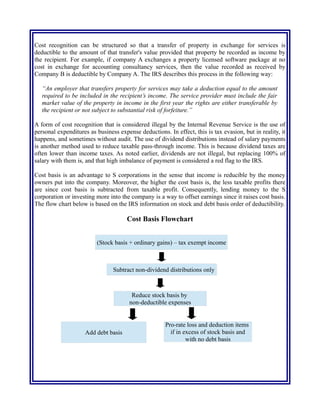
The flow chart below is based on the IRS information on stock and debt basis order of deductibility.
Cost Basis Flowchart
(Stock basis + ordinary gains) – tax exempt income
Subtract non-dividend distributions only
Reduce stock basis by
non-deductible expenses
Add debt basis
Pro-rate loss and deduction items
if in excess of stock basis and
with no debt basis
Asset management
An important aspect of business financial management involves asset use. Assets provide S
corporation owners a method to increase tax deductible operating costs without necessarily gaining
new debt. How assets are acquired, the asset class, depreciation method, holding period and return
on assets are all influential on the overall tax benefit they provide. The cost basis, rules governing
cost recognition, and selling price also affect taxability. Utilizing an effective asset management
strategy via tactical business techniques helps optimize asset management for the financial benefit
of a company and its owners.
When asset purchases are restricted, alternative tax strategy exists. For instance, certain acquisitions
are able to recognize stock as assets. According to Alvarez & Marsal Holdings, LLC., this is
referred to as a Section 338 (h) (10) Election. This is a reference to section 338 of the U.S. tax code,
otherwise known as Title 26 of the U.S. Code.
“In situations where the purchase of assets is not practical (e.g., regulatory or license/title
transfer issues, etc.), and the parties do not otherwise wish to do a forward cash merger, the
parties may consider making a joint Section 338 election to treat the sale of at least 80
percent of the target S corporation’s stock as a sale of assets. To qualify for a Section 338(h)
(10) election on the purchase of S corporation stock, certain requirements must be met...”
This option allows a buyer to treat a corporate-level strategic acquisition as an asset purchase,
which in terms of business-level strategy allows accounting options that influence taxes. For
example, a portion of company stock that is classified as goodwill can be amortized, which is a tax
deductible expense. This tax strategy has several pre-requisites included seller agreement and
depending on state law, may end up incurring asset sale taxes per Find Law. Keeping mind of and
accounting for the transaction by comparing present values should help determine whether or not a
Section 338 Election is a good tax strategy.
Asset classification, gains and losses
Asset classification is used when determining allowable depreciation methods and durations. It also
influences how each item is taxed after revenue realization. This is because some assets qualify for
a capital gains tax rate, which is divided between short-term and long-term capital gains tax rates.
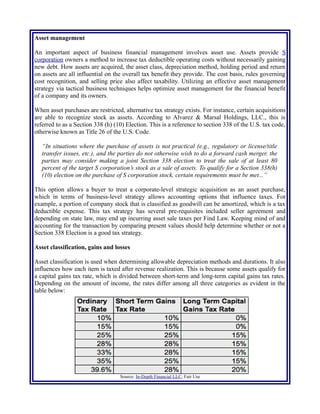
Depending on the amount of income, the rates differ among all three categories as evident in the
table below:
Source: In-Depth Financial LLC; Fair Use
Considering the above table, the most ideal income is long-term capital gains since they are taxed at
the lowest rate. In order to qualify for long-term capital gains rates, one of the criteria is that the
asset be held for at least 12 months before being sold. Depending on the asset class, other rules
involving depreciation recapture, exchanges, asset use and ownership may also apply. For example,
property acquired as a gift is subject to different cost deduction rules than property that has been
purchased.
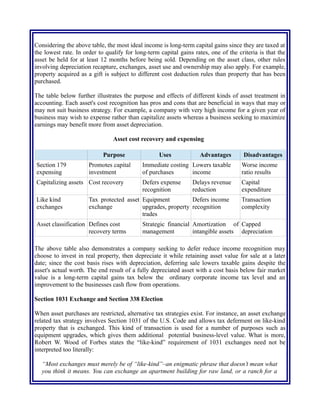
The table below further illustrates the purpose and effects of different kinds of asset treatment in
accounting. Each asset's cost recognition has pros and cons that are beneficial in ways that may or
may not suit business strategy. For example, a company with very high income for a given year of
business may wish to expense rather than capitalize assets whereas a business seeking to maximize
earnings may benefit more from asset depreciation.
Asset cost recovery and expensing
Purpose Uses Advantages Disadvantages
Section 179
expensing
Promotes capital
investment
Immediate costing
of purchases
Lowers taxable
income
Worse income
ratio results
Capitalizing assets Cost recovery Defers expense
recognition
Delays revenue
reduction
Capital
expenditure
Like kind
exchanges
Tax protected asset
exchange
Equipment
upgrades, property
trades
Defers income
recognition
Transaction
complexity
Asset classification Defines cost
recovery terms
Strategic financial
management
Amortization of
intangible assets
Capped
depreciation
The above table also demonstrates a company seeking to defer reduce income recognition may
choose to invest in real property, then depreciate it while retaining asset value for sale at a later
date; since the cost basis rises with depreciation, deferring sale lowers taxable gains despite the
asset's actual worth. The end result of a fully depreciated asset with a cost basis below fair market
value is a long-term capital gains tax below the ordinary corporate income tax level and an
improvement to the businesses cash flow from operations.
Section 1031 Exchange and Section 338 Election
When asset purchases are restricted, alternative tax strategies exist. For instance, an asset exchange
related tax strategy involves Section 1031 of the U.S. Code and allows tax deferment on like-kind
property that is exchanged. This kind of transaction is used for a number of purposes such as
equipment upgrades, which gives them additional potential business-level value. What is more,
Robert W. Wood of Forbes states the “like-kind” requirement of 1031 exchanges need not be
interpreted too literally:
“Most exchanges must merely be of “like-kind”–an enigmatic phrase that doesn’t mean what
you think it means. You can exchange an apartment building for raw land, or a ranch for a
strip mall. The rules are surprisingly liberal. You can even exchange one business for
another. But again, there are traps for the unwary.”
The definition and traps of like-kind exchange are further clarified by the IRS itself:
“The exchange can include like-kind property exclusively or it can include like-kind property
along with cash, liabilities and property that are not like-kind. If you receive cash, relief from
debt, or property that is not like-kind, however, you may trigger some taxable gain in the year
of the exchange. There can be both deferred and recognized gain in the same transaction
when a taxpayer exchanges for like-kind property of lesser value.”
Another option to direct asset purchases involves a re-classification of stock as assets. According to
Alvarez & Marsal Holdings, LLC., this is referred to as a Section 338 (h) (10) Election. This is a
reference to section 338 of the U.S. tax code, otherwise known as Title 26 of the U.S. Code.
“In situations where the purchase of assets is not practical (e.g., regulatory or license/title
transfer issues, etc.), and the parties do not otherwise wish to do a forward cash merger, the
parties may consider making a joint Section 338 election to treat the sale of at least 80
percent of the target S corporation’s stock as a sale of assets. To qualify for a Section 338(h)
(10) election on the purchase of S corporation stock, certain requirements must be met...”
This option allows a buyer to treat a corporate-level strategic acquisition as an asset purchase,
which in terms of business-level strategy allows accounting options that influence taxes. For
example, a portion of company stock that is classified as goodwill can be amortized, which is a tax
deductible expense. This tax strategy has several pre-requisites included seller agreement and
depending on state law, may end up incurring asset sale taxes per Find Law. Keeping mind of and
accounting for the transaction by comparing present values should help determine whether or not a
Section 338 Election is a good tax strategy.
Accumulated adjustments accounts
An accumulated adjustments account (AAA) is used in S corporation bookkeeping to keep track of
taxed earnings or taxed retained earnings from a previous point in time. So long as S corporation
shareholders agree on the purpose of the retained earnings in an AAA and sufficient financial
resources exist to retain the earnings within the S corporation, an AAA is beneficial for more than
one reason. First, it improves company financials by raising shareholder equity and second it
protects assets from being liquidated for tax purposes in future years.
If assets are used to fund cash flow, an AAA also assists in preventing unnecessary revolving credit
or other cash flow funding expenses. Another benefit of AAAs are dividend distributions, which are
taxable at a lower rate than salary income depending on tax bracket. In other words, by distributing
dividends to shareholders rather than salary, they are in effect, lowering taxes if their tax bracket is
lower than the dividend tax rate.
State taxes
The location an S corporation is registered influences cost as well. This is because state taxes vary
and some states are more favorable in terms of taxation. Several of these states are fully exempt S
corporations from having to pay tax at all, which is a substantial benefit in a competitive business
environment. These states include Colorado, Connecticut and Delaware; for a complete list, please
consult source number 20 at the end of this newsletter.
Carefully considering the impact state laws and registration has on revenue, operating costs and
profit margin is a strategic decision that affects each business differently. For example, a goods
supply company that performs transactions across state lines may save more money on logistics
costs by locating closer to the state of highest revenue rather than seeking out the best state from a
taxation perspective. Moreover, if a business saves 40% in operating costs versus 35% in tax, the
former choice is ideal, especially if projected financial data indicates ongoing savings.
If doubling down on a state with no income tax and no S corporation tax more than offsets out-of-
state operation costs, then doing so is quite possibly a good idea as this limits a substantial
percentage of tax related costs. Alaska, Nevada, Washington and Wyoming are examples of states
without S corporation tax and personal income tax.
Cash versus accrual accounting
Some variations in tax accounting apply to both cash and accrual accounting. Companies that do
not hold inventory and that have annual revenue under $5 million have the choice between cash and
accrual accounting for an S corporation. An immediate benefit of cash accounting is simpler
bookkeeping since revenue and cost of goods sold will not be recorded until a cash exchange has
taken place. This lack of complexity makes cash accounting simpler, allows a greater emphasis to
be placed on servicing receivables accounts and makes real time valuation more possible.
There are also operational advantages to cash accounting. For example, potential in-house banking
to avoid financial service fees. According to the U.S. Small Business Administration, cash
accounting provides more accurate indication of cash flow. This is because cash going into or out of
a corporation is actually there or not there unlike accrual accounting where the revenue might be on
the books without cash. However, in the case of bad debt, cash method accounting is not allowed to
expense the write off for tax purposes. Cash accounting is also non-congruent with generally
accepted accounting principles since income and expenses are not as easily reconciled together.
S corporation investments
S corporations have an opportunity to invest in financial instruments that pay non-taxable or tax
deferred income. For example, a company that buys life insurance policies for its employees and
makes itself the beneficiary will out some point receive tax free death benefits if the policy is not
cancelled or terminated. Additional tax deferred and tax free investments and investment
management techniques are listed below:
• Tax exempt mutual funds
• Acquisition of a qualified non-profit subsidiary
• Purchase of offshore businesses
• Offsetting capital gains with capital losses
• Tax sheltered retirement accounts
Capital gains on real property that has depreciated in value also has tax protection under Section
1250 of the tax code. Alternatively, tax free municipal bonds provide a higher return that some
corporate bonds of similar risk due to the reduction in cost basis from tax exempt income from the
municipal bonds. This is evident in the following equation and example solution:
Municipal bond yield rate = X (1 – personal income tax rate)
Solution with a municipal bond rate of 6% and a tax rate of 25%
6% = X (1 – 25%)
X= 6%/(1-25%)
X = .06/.75=.08 or 8%
Since the municipal bond yields tax free income at the federal level, but the corporate bond does
not, the taxable amount is added back to the bond coupon rate. If the formula does not include the
state rate in addition to the federal tax rate, then the actual return will be larger than what the
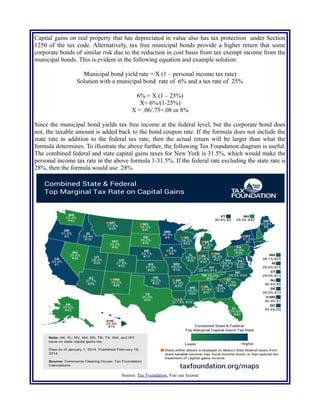
formula determines. To illustrate the above further, the following Tax Foundation diagram is useful.
The combined federal and state capital gains taxes for New York is 31.5%, which would make the
personal income tax rate in the above formula 1-31.5%. If the federal rate excluding the state rate is
28%, then the formula would use .28%.
Source: Tax Foundation, Fair use license
Since some states do not have income tax, S corporation tax or capital gains tax, the stacking of
these tax benefits has considerable potential. For example, Alaska, Nevada, Washington and
Wyoming do not have any of these three taxes. The tax benefits of registering an S corporation in
one of these states should also be weighed against differences in licensing, registration and other
operational fees to properly evaluate the financial value of out-of-state incorporation or relocation.
Offshore inversions
Offshore inversion means a company is re-located to another jurisdiction with lower corporate tax
rates. S-corporations that choose to invert are making a large, and sometimes impractical decision
for the sake of lowering taxes. Depending on how easy and cost effective remote management of an
offshore company is, an inversion does have considerable tax advantages.
In September of 2014, the U.S. Treasury Department and IRS issues regulations that make
inversions more complicated. These new regulations do not eliminate the option to invert, but
require greater scrutiny and examination of the process. This is due in part to the greater hurdle of
meeting the 80% ownership test. Some of these restrictions are listed below:
• Qualified property changes that reduce recognized ownership
• Adjustment to substantiality requirements i.e. Equal FMV of assets prior to transfer
• Disqualifying stock transfer rules
• Accrual recognition of pre-inversion earnings obtained after inversion
Additional pending legislation seeks to further reduce the tax benefit of inversions. This bill was
introduced by Senator Carl Levin under the premise that the aforementioned Treasury Department
limitations are not enough. According to Bloomberg, the bill will probably not become law in 2014
and unlikely to pass in 2015 due to a Republican led Congress.
Individual tax deductions and credits
Since income from pass-through entities is taxable at the individual level, personal tax strategy is
important in minimizing this tax. For the majority of tax payers, personal income tax rates are lower
than the corporate tax rate of 35%, which makes an individual tax rate favorable a lot of the time.
Specifically, since the median U.S. Income around $51,000 per year, half of income earners have a
maximum tax rate of 25% in 2014. Moreover, an additional 18% or so of American income earners
do so with less than $75,000 per year, still within the 25% rate regardless of whether of that income
is gross or adjusted. Additionally, since pass through entities structured similarly to S-corporations
avoid self-employment tax, avoidance of add on taxes helps keep annual cash flow higher.
Tax credits are also worth noting as they directly reduce tax rather than taxable income. For
example, a tax credit of $50 lowers $1,000 of tax due to $950 whereas a deduction up to 10% of the
cost of a qualifying expense only lowers taxable income by the percentage amount of the expense.
Of the tax credits for individuals, the ones available to investors include a saver's credit for money
placed into a qualifying account. Childcare expenses are also recored on IRS Form 2441 for the
purpose of claiming a tax credit.
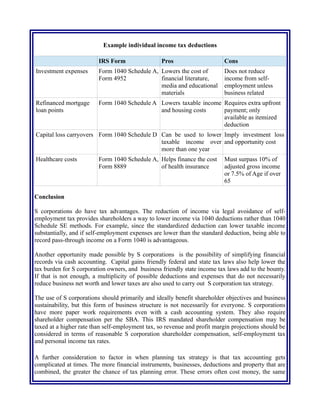
Example individual income tax deductions
IRS Form Pros Cons
Investment expenses Form 1040 Schedule A,
Form 4952
Lowers the cost of
financial literature,
media and educational
materials
Does not reduce
income from self-
employment unless
business related
Refinanced mortgage
loan points
Form 1040 Schedule A Lowers taxable income
and housing costs
Requires extra upfront
payment; only
available as itemized
deduction
Capital loss carryovers Form 1040 Schedule D Can be used to lower
taxable income over
more than one year
Imply investment loss
and opportunity cost
Healthcare costs Form 1040 Schedule A,
Form 8889
Helps finance the cost
of health insurance
Must surpass 10% of
adjusted gross income
or 7.5% of Age if over
65
Conclusion
S corporations do have tax advantages. The reduction of income via legal avoidance of self-
employment tax provides shareholders a way to lower income via 1040 deductions rather than 1040
Schedule SE methods. For example, since the standardized deduction can lower taxable income
substantially, and if self-employment expenses are lower than the standard deduction, being able to
record pass-through income on a Form 1040 is advantageous.
Another opportunity made possible by S corporations is the possibility of simplifying financial
records via cash accounting. Capital gains friendly federal and state tax laws also help lower the
tax burden for S corporation owners, and business friendly state income tax laws add to the bounty.
If that is not enough, a multiplicity of possible deductions and expenses that do not necessarily
reduce business net worth and lower taxes are also used to carry out S corporation tax strategy.
The use of S corporations should primarily and ideally benefit shareholder objectives and business
sustainability, but this form of business structure is not necessarily for everyone. S corporations
have more paper work requirements even with a cash accounting system. They also require
shareholder compensation per the SBA. This IRS mandated shareholder compensation may be
taxed at a higher rate than self-employment tax, so revenue and profit margin projections should be
considered in terms of reasonable S corporation shareholder compensation, self-employment tax
and personal income tax rates.
A further consideration to factor in when planning tax strategy is that tax accounting gets
complicated at times. The more financial instruments, businesses, deductions and property that are
combined, the greater the chance of tax planning error. These errors often cost money, the same
money that could go to a tax accountant to lower taxes even more that the cost of tax strategy
errors. In any case, business owners have many variables to account for when planning and should
at least have a good idea of the primary or main tax advantages and disadvantages that S
corporations and other structures and tax techniques allow. This is because a businesses vision,
development, revenue growth and competitiveness all rely on or are linked to tax strategy.
Sources:
1. “Accounting Today”; Tax Strategy: Pass-Through Entity Simplification”; George G. Jones and Mark A. Luscombe;
May 1, 2013
2. “Accounting Today”; Businesses Owners Need to Keep an Eye on Potential U.S. Tax Changes; Mike Trabold; July
16, 2014
3. "Forbes”; S Corporation SE Avoidance Still a Solid Strategy; Peter J Reilly; August 25, 2013
4. “Turbo Tax”; 6 Ways To Pay As Little Self-Employment Tax As Legally Necessary; Josh Ritchie; June 14, 2010
5. “U.S. Internal Revenue Service”; Appeals Pass-Through Entity Handbook; IRS Revenue Manual: Part 8, Chapter 19
6. “American Institute of CPAs”; Determining the Taxability of S-corporation Distributions Part I; Tony Nitti; January
1, 2014
7. “Cornell University Law School”; 26 CFR 1.1368-2 Accumulated Adjustments Account (AAA); U.S. Code
8. “Leading Edge Alliance”; Strategical Edge
9. “Life Health Pro”; Using Distributions From S Corps to Fund Life Insurance Premiums; Russell E. Towers; March
21, 2014
10. “Journal of Accountancy”; Taking the “Sting” Out of S Corporations' Earnings and Profits; Sydney S. Traum;
January 2011
11. “Journal of Accountancy”; Matching Deductions to Payments: Payer/payee rules are not always clear; Larry Maples
and Mark Turner; October 2006
12. “Entrepreneur”; S Corporation Basics; June 1, 2005
13. “Forbes”; Determining A Shareholder's Basis in S Corporation Stock and Debt; Tax Geek Tuesday; Tony Nitti;
May 6, 2014
14. “Nolo”; Top Ten Tax Deductions for Landlords
15. “Foster Swift Collins & Smith PC”; “S” Corporations + ESOP: A Powerful Tax Advantaged Exit Strategy; Foster,
Swift Employment, Labor and Benefits Quarterly; July 2009
16. “Jeramiah K. Murphy CPA”; Tax Strategies For “S” Corporations And Their Owners
17. “U.S. Internal Revenue Service”; S Corporation Stock and Debt Basis
18. “American Bar Association”; S Corporation Trusts: What Types of Trusts Are Permitted Shareholders of an S
Corporation?; Laura Howell-Smith
19. “Small Business Administration”; S Corporation
20. “Morgan Lewis”; A State-by-State Analysis of S Corporation Tax Treatment; Renee Lewis
21. “Journal of Accountancy”; Multistate Tax Considerations for S Corporations; C. Andrew Lafond and Jeffrey J.
Schrader; February 2011
22. “Intuit Inc./Turbo Tax”; Top 10 Tax Deductions You Are Not Taking; 2013
23. “H&R Block”; Medical and Dental Expenses
24. “Stephen Nelson”; How To Save Taxes With An S Corporation;
25. “Cornell University Law School”; 26 U.S. Code § 179 – Election To Expense Certain Depreciable Business Assets
26. “Journal of Accountancy”; Managing S Corporation At-Risk Loss Limitations; Elizabeth Murphy; February 2010
27. “Cornell University Law School”; 26 U.S. Code § 1250-Gain From Disposition of Certain Depreciable Realty
28. “U.S. Small Business Administration”; Cash Versus Accrual Accounting For Taxable Income And Expenses;
Christine L; February 12, 2010
29. “Alvarez & Marsal Holdings, LLC”; Expecting A Step-Up On Your S-Corporation Acquisition? Structure
Carefully; September 15, 2011
30. “Cornell University Law School”; 26 U.S. Code § 1031 – Exchange of Property Held For Productive Use or
Investment
31. “Cornell University Law School”; 26 U.S. Code § 338 – Certain Stock Purchases Treated as Asset Acquisitions
32. “Forbes”; Ten Things to Know About 1031 Exchanges; Robert W. Wood; January 26, 2010
33. “U.S. Internal Revenue Service”; Like-Kind Exchanges Under Internal Revenue Code Section 1031; February 2008
34. “Bloomberg”; Anti-Inversion Tax Bill Raises 72% More Than Prior Estimate; Richard Rubin; December 3, 2014
35. “American Institute of CPAs”; Details of Proposed Anti-Inversion Rules are Revealed; September 23, 201436.
Disclaimer: The content in this newsletter is for informational purposes only, and does not constitute financial planning
or any other kind of advice, and should not be construed as such. Any opinions or statements expressed by cited third
parties do not necessarily reflect those of Moneycation™. All information within this newsletter is to be used or not
used at the sole discretion of the reader and its authenticity and accuracy are not guaranteed. The author of this
newsletter assumes no liability for actions, decisions or events relating in any way to this newsletter's content.
Copyright © 2014 Moneycation™; All Rights Reserved

S corporation tax strategy

  • 1.
    Moneycation Published by Moneycation™ Newsletter:December 9, 2015 Volume 2, Issue 14 S corporation tax strategy S corporations are legally structured in a way that allow them to go untaxed. This is because income that is recognized by owners is taxed at the personal level and not via the business. Moreover, an S corporation is a pass-through or flow-through entity, which means income passes through to the shareholders. This newsletter details tax management information and methods used by and relevant to S corporations. The tax laws that govern pass-through entities are favorable in-and-of-themselves; this makes the business structure choice a tax strategy decision. As implied, this type of business avoids double taxation, but is also due to the way income is managed and distributed by the business. For instance, the purchase of depreciable assets such as land defer federal income taxation by locking in value within real property and adding additional taxable income reducing potential via capital expenditures. In addition to favorable tax classification, flow-through businesses have the same benefits of tax accounting techniques defined by Title 26 of the U.S. Code and Statutory Accounting Principles. This makes further tax strategy in combination with structural tax strategy possible. For example, losses that are not deductible in fiscal year 1 of a startup pass through entity, but are carried forward to year 2 also help reduce flow-through income tax in subsequent years with higher earnings. Since tax is a substantial factor weighing on business financial management, any tax advantages made possible through business structure are relevant to business functionality. This is reiterated by in the following excerpt by Mike Trabold of “Accounting Today”: “According to a recent survey Paychex conducted of startup businesses with fewer than 50 employees, taxes and the U.S. tax structure were identified as the biggest issue impacting businesses this year.” In light of the impact taxes have on business performance, the ways pass-through business are able to manage their finances are important for competitive positioning, market share acquisition and profit margin among other things. How S corporations help business owners optimize commercial performance, financial management and tax strategy influences the success of those businesses and their owners. Knowing the basics of S corporation taxation is a fundamental aspect of effectively managing an S corporation.
  • 2.
    S-corporations S-corporation profits aretaxable at the individual income tax level regardless of what is done with the profit. In other words, business earnings held within the company are still taxable at an individual tax rate. However, how these earnings are calculated and where costs are allocated have an effect on how much taxable income is generated. In terms of company value, this opens the possibility of growing business worth via the balance sheet without incurring tax through the income statement, a topic addressed in the asset management section of this newsletter. Peter J. Reilly of Forbes magazine suggests that S corporations provide business owners a good way to avoid self-employment tax. Moreover, by converting a sole-proprietorship to an S corporation, sole proprietor government taxes other than income tax can be bypassed in part and so long as the business pays reasonable salaries; the net effect lowers operating costs by keeping salaries to a minimum. “Entrepreneurs will be inclined to heavily discount any decrease in future social security benefits as a trade-off, so organizing as an S corporation and avoiding self-employment tax seems like a no-brainer for a sole proprietor....What the McAlary case teaches us is not that you can’t use an S corporation to avoid SE/payroll taxes. It teaches us that you really should not use the strategy to avoid SE/payroll taxes entirely...If your business is reasonably profitable, don’t even think about taking less than whatever the unemployment wage base in your state is. That varies substantially by state ranging from $7,000 in Arizona to $39,800 in Washington. By going below that limit you end up with another group of enforcers being interested in you.” The latter part of this excerpt is also observed by the U.S. Small Business Administration. According to the SBA, S corporation distributions are taxed at a lower rate than wages. However, there is also a reasonable income requirement that states salary distributions go hand-in-hand with profitability. They describe this financial planning variable as follows: “A shareholder must receive reasonable compensation. The IRS takes notice of shareholder red flags like low salary/high distribution combinations, and may reclassify your distributions as wages. You could pay a higher employment tax because of an audit with these results.” Even if zero wages are paid to a shareholder for strategic business reasons, this IRS expectation has the potential of getting in the way via audit signals or red flags. Carefully considering owner- salaries as a function of overall revenue, cost and profit helps align IRS income tax hopes with S corporation operability and functionality. Income recognition Before jumping on to the obvious advantages of pass-through entities, a closer look at the process of reaping such rewards warrants a closer look. Income recognition is a good place to start as several pre-requisite requirements are needed to determine actual taxability. This is apparent in an American Institute of CPAs publication on the matter, a part of which is quoted below:
  • 3.
    “Integral to determiningthe taxability of an S corporation’s distributions are two shareholder-level attributes—stock basis and previously taxed income—and two corporate- level attributes—earnings and profits (E&P) and the accumulated adjustments account (AAA). Failure to fully grasp the role each plays in determining the taxability of a distribution adds needless complexity to the process and often results in an incorrect conclusion.” In other words, to avoid overpaying or underpaying tax on S corporation income distributions, it is essential to fully understand the underlying tax rules. Sometimes, these accounting rules are about as clear as mud and seem more like a one-shoe party than a logical set of rules, but as the AICPA notes, the intent behind the rules helps clarify them. In this case, the intent is to avoid double taxation via income and capital gains tax. To illustrate, a return-on-investment via pass-through income and capital gains is taxed twice; S corporations avoid this by increasing the cost basis of equity to equal business income as reflected in appreciated stock price i.e. stock basis or cost of stock is increased to match its new value so that it is only taxed once under section 1367 of the U.S. Tax Code. Since S corporations are subject to pass-through income tax, withholding more from employee's salaries reduces the income tax paid on that extra withholding. For instance, Individual Retirement Account or 401(k) distributions are taken out of gross salary, thereby becoming a tax deferred expense. By matching retirement contributions, the amount by which taxable corporate profits are taxable are further reduced. Moreover, since S corporations are designed to avoid double taxation, paying a corporate or individual tax on the revenue not distributed to a sole employee and owner as salary, but rather a pension contribution, would contradict the tax code. This underlying principle about the taxability of S corporation income distributions is implicit in the following Forbes excerpt by tax contributor Tony Nitti: S corporations, however, are intended to be subject to only a single level of taxation. Thus, when an S corporation generates income, the corporation generally does not pay tax on that income at the entity level (subject to the notable exceptions of Sections 1374 and 1375). Instead, the income is divvied up among and allocated to the corporation’s shareholders, who report the income and pay the corresponding tax on their individual returns. The tax advantages of S corporations do not stop at business expensing, the continue on to the individual. In other words, just as income is passed through to the individual, so are individual tax techniques and strategy. Any individual tax strategy or tax management method that reduces taxable income is a potential S corporation advantage in terms of reducing overall costs. Losses When calculating deductibility of some capital losses, they are also subject to different calculations than capital gains in some instances. These details are typically sorted out by accountants, but may also be automated via tax accounting software. Due to these differences in rules and tax rates the following listed techniques should help reduce taxable income:
  • 4.
    • Hold assetsfor more than 12 months • Fully depreciate assets to maximize cost basis • Apply allowable expensing limits and bonus depreciation • Reduce income with carried over capital losses • Purchase assets with shorter depreciation periods Losses are limited by at-risk loss limitations, rules that require recorded losses to reflect actual money invested into an S corporation. According to the Journal of Accountancy, these regulations include Temporary Treasury Regulation section 1.469-2T (d)(6), IRC section 1366(d), at risk limitations of IRC section 465 and the passive activity loss limitation of IRC section 469. An interesting stipulation among these rules is that non-recourse loans based on pledged property that is not actually invested into an S corporation is deductible as a loss; these possible losses do not necessarily involve personal contributions or direct investment. The Journal of Accountancy describes this as follows: “In the case of non-recourse borrowings secured by pledged property, the at-risk amount is limited to the net fair market value of the taxpayer’s interest in the pledged property.” Another interesting loss involves owner activities in other companies via the general aggregation rule. Under this rule, shareholder activities can be combined to determine at-risk losses. In other words, if multiple S corporations are owned by the shareholder, then the losses from business B can be included in the loss of the business A via aggregation rules. “...grouping trade or business activities in which a shareholder actively participates or a QSub election can help where loss recognition by one activity or S corporation is limited but another is not.” This is a substantial tax strategy because it helps maximize total revenue deductibility and minimize overpayment of tax. For example, if company A has high profit and limited loss, but company B does not, then transferring losses via the aggregation rule helps reduce taxable income for company B. Even though the amount of the loss remains the same, the tax effect is not necessarily equal due to the application of other tax rules such as tax bracket thresholds. Cost recognition Business costs reduce taxable income, but if they increase company net worth at the same time, then the overall benefit of realizing costs is worthwhile in some cases. A common example is depreciation; when depreciation is expensed, it lowers income, but also reduces the potential capital gains tax on asset sales while preserving intrinsic value. Effectively managing cost may mean less profit margin in the short-term, but can also lead to higher business valuation later on. If the the rise in business valuation is greater than the loss to profit margin, then cost recognition may be worthwhile. Additional ways to increase cost that also benefit owners are listed below: • Shareholder loans to S corporation • Fringe benefits ex. Achievement awards • Leasing property from shareholders for 14 days or less
  • 5.
    Cost recognition canbe structured so that a transfer of property in exchange for services is deductible to the amount of that transfer's value provided that property be recorded as income by the recipient. For example, if company A exchanges a property licensed software package at no cost in exchange for accounting consultancy services, then the value recorded as received by Company B is deductible by Company A. The IRS describes this process in the following way: “An employer that transfers property for services may take a deduction equal to the amount required to be included in the recipient’s income. The service provider must include the fair market value of the property in income in the first year the rights are either transferable by the recipient or not subject to substantial risk of forfeiture.” A form of cost recognition that is considered illegal by the Internal Revenue Service is the use of personal expenditures as business expense deductions. In effect, this is tax evasion, but in reality, it happens, and sometimes without audit. The use of dividend distributions instead of salary payments is another method used to reduce taxable pass-through income. This is because dividend taxes are often lower than income taxes. As noted earlier, dividends are not illegal, but replacing 100% of salary with them is, and that high imbalance of payment is considered a red flag to the IRS. Cost basis is an advantage to S corporations in the sense that income is reducible by the money owners put into the company. Moreover, the higher the cost basis is, the less taxable profits there are since cost basis is subtracted from taxable profit. Consequently, lending money to the S corporation or investing more into the company is a way to offset earnings since it raises cost basis. The flow chart below is based on the IRS information on stock and debt basis order of deductibility. Cost Basis Flowchart (Stock basis + ordinary gains) – tax exempt income Subtract non-dividend distributions only Reduce stock basis by non-deductible expenses Add debt basis Pro-rate loss and deduction items if in excess of stock basis and with no debt basis
  • 6.
    Asset management An importantaspect of business financial management involves asset use. Assets provide S corporation owners a method to increase tax deductible operating costs without necessarily gaining new debt. How assets are acquired, the asset class, depreciation method, holding period and return on assets are all influential on the overall tax benefit they provide. The cost basis, rules governing cost recognition, and selling price also affect taxability. Utilizing an effective asset management strategy via tactical business techniques helps optimize asset management for the financial benefit of a company and its owners. When asset purchases are restricted, alternative tax strategy exists. For instance, certain acquisitions are able to recognize stock as assets. According to Alvarez & Marsal Holdings, LLC., this is referred to as a Section 338 (h) (10) Election. This is a reference to section 338 of the U.S. tax code, otherwise known as Title 26 of the U.S. Code. “In situations where the purchase of assets is not practical (e.g., regulatory or license/title transfer issues, etc.), and the parties do not otherwise wish to do a forward cash merger, the parties may consider making a joint Section 338 election to treat the sale of at least 80 percent of the target S corporation’s stock as a sale of assets. To qualify for a Section 338(h) (10) election on the purchase of S corporation stock, certain requirements must be met...” This option allows a buyer to treat a corporate-level strategic acquisition as an asset purchase, which in terms of business-level strategy allows accounting options that influence taxes. For example, a portion of company stock that is classified as goodwill can be amortized, which is a tax deductible expense. This tax strategy has several pre-requisites included seller agreement and depending on state law, may end up incurring asset sale taxes per Find Law. Keeping mind of and accounting for the transaction by comparing present values should help determine whether or not a Section 338 Election is a good tax strategy. Asset classification, gains and losses Asset classification is used when determining allowable depreciation methods and durations. It also influences how each item is taxed after revenue realization. This is because some assets qualify for a capital gains tax rate, which is divided between short-term and long-term capital gains tax rates. Depending on the amount of income, the rates differ among all three categories as evident in the table below: Source: In-Depth Financial LLC; Fair Use
  • 7.
    Considering the abovetable, the most ideal income is long-term capital gains since they are taxed at the lowest rate. In order to qualify for long-term capital gains rates, one of the criteria is that the asset be held for at least 12 months before being sold. Depending on the asset class, other rules involving depreciation recapture, exchanges, asset use and ownership may also apply. For example, property acquired as a gift is subject to different cost deduction rules than property that has been purchased. The table below further illustrates the purpose and effects of different kinds of asset treatment in accounting. Each asset's cost recognition has pros and cons that are beneficial in ways that may or may not suit business strategy. For example, a company with very high income for a given year of business may wish to expense rather than capitalize assets whereas a business seeking to maximize earnings may benefit more from asset depreciation. Asset cost recovery and expensing Purpose Uses Advantages Disadvantages Section 179 expensing Promotes capital investment Immediate costing of purchases Lowers taxable income Worse income ratio results Capitalizing assets Cost recovery Defers expense recognition Delays revenue reduction Capital expenditure Like kind exchanges Tax protected asset exchange Equipment upgrades, property trades Defers income recognition Transaction complexity Asset classification Defines cost recovery terms Strategic financial management Amortization of intangible assets Capped depreciation The above table also demonstrates a company seeking to defer reduce income recognition may choose to invest in real property, then depreciate it while retaining asset value for sale at a later date; since the cost basis rises with depreciation, deferring sale lowers taxable gains despite the asset's actual worth. The end result of a fully depreciated asset with a cost basis below fair market value is a long-term capital gains tax below the ordinary corporate income tax level and an improvement to the businesses cash flow from operations. Section 1031 Exchange and Section 338 Election When asset purchases are restricted, alternative tax strategies exist. For instance, an asset exchange related tax strategy involves Section 1031 of the U.S. Code and allows tax deferment on like-kind property that is exchanged. This kind of transaction is used for a number of purposes such as equipment upgrades, which gives them additional potential business-level value. What is more, Robert W. Wood of Forbes states the “like-kind” requirement of 1031 exchanges need not be interpreted too literally: “Most exchanges must merely be of “like-kind”–an enigmatic phrase that doesn’t mean what you think it means. You can exchange an apartment building for raw land, or a ranch for a
  • 8.
    strip mall. Therules are surprisingly liberal. You can even exchange one business for another. But again, there are traps for the unwary.” The definition and traps of like-kind exchange are further clarified by the IRS itself: “The exchange can include like-kind property exclusively or it can include like-kind property along with cash, liabilities and property that are not like-kind. If you receive cash, relief from debt, or property that is not like-kind, however, you may trigger some taxable gain in the year of the exchange. There can be both deferred and recognized gain in the same transaction when a taxpayer exchanges for like-kind property of lesser value.” Another option to direct asset purchases involves a re-classification of stock as assets. According to Alvarez & Marsal Holdings, LLC., this is referred to as a Section 338 (h) (10) Election. This is a reference to section 338 of the U.S. tax code, otherwise known as Title 26 of the U.S. Code. “In situations where the purchase of assets is not practical (e.g., regulatory or license/title transfer issues, etc.), and the parties do not otherwise wish to do a forward cash merger, the parties may consider making a joint Section 338 election to treat the sale of at least 80 percent of the target S corporation’s stock as a sale of assets. To qualify for a Section 338(h) (10) election on the purchase of S corporation stock, certain requirements must be met...” This option allows a buyer to treat a corporate-level strategic acquisition as an asset purchase, which in terms of business-level strategy allows accounting options that influence taxes. For example, a portion of company stock that is classified as goodwill can be amortized, which is a tax deductible expense. This tax strategy has several pre-requisites included seller agreement and depending on state law, may end up incurring asset sale taxes per Find Law. Keeping mind of and accounting for the transaction by comparing present values should help determine whether or not a Section 338 Election is a good tax strategy. Accumulated adjustments accounts An accumulated adjustments account (AAA) is used in S corporation bookkeeping to keep track of taxed earnings or taxed retained earnings from a previous point in time. So long as S corporation shareholders agree on the purpose of the retained earnings in an AAA and sufficient financial resources exist to retain the earnings within the S corporation, an AAA is beneficial for more than one reason. First, it improves company financials by raising shareholder equity and second it protects assets from being liquidated for tax purposes in future years. If assets are used to fund cash flow, an AAA also assists in preventing unnecessary revolving credit or other cash flow funding expenses. Another benefit of AAAs are dividend distributions, which are taxable at a lower rate than salary income depending on tax bracket. In other words, by distributing dividends to shareholders rather than salary, they are in effect, lowering taxes if their tax bracket is lower than the dividend tax rate. State taxes The location an S corporation is registered influences cost as well. This is because state taxes vary
  • 9.
    and some statesare more favorable in terms of taxation. Several of these states are fully exempt S corporations from having to pay tax at all, which is a substantial benefit in a competitive business environment. These states include Colorado, Connecticut and Delaware; for a complete list, please consult source number 20 at the end of this newsletter. Carefully considering the impact state laws and registration has on revenue, operating costs and profit margin is a strategic decision that affects each business differently. For example, a goods supply company that performs transactions across state lines may save more money on logistics costs by locating closer to the state of highest revenue rather than seeking out the best state from a taxation perspective. Moreover, if a business saves 40% in operating costs versus 35% in tax, the former choice is ideal, especially if projected financial data indicates ongoing savings. If doubling down on a state with no income tax and no S corporation tax more than offsets out-of- state operation costs, then doing so is quite possibly a good idea as this limits a substantial percentage of tax related costs. Alaska, Nevada, Washington and Wyoming are examples of states without S corporation tax and personal income tax. Cash versus accrual accounting Some variations in tax accounting apply to both cash and accrual accounting. Companies that do not hold inventory and that have annual revenue under $5 million have the choice between cash and accrual accounting for an S corporation. An immediate benefit of cash accounting is simpler bookkeeping since revenue and cost of goods sold will not be recorded until a cash exchange has taken place. This lack of complexity makes cash accounting simpler, allows a greater emphasis to be placed on servicing receivables accounts and makes real time valuation more possible. There are also operational advantages to cash accounting. For example, potential in-house banking to avoid financial service fees. According to the U.S. Small Business Administration, cash accounting provides more accurate indication of cash flow. This is because cash going into or out of a corporation is actually there or not there unlike accrual accounting where the revenue might be on the books without cash. However, in the case of bad debt, cash method accounting is not allowed to expense the write off for tax purposes. Cash accounting is also non-congruent with generally accepted accounting principles since income and expenses are not as easily reconciled together. S corporation investments S corporations have an opportunity to invest in financial instruments that pay non-taxable or tax deferred income. For example, a company that buys life insurance policies for its employees and makes itself the beneficiary will out some point receive tax free death benefits if the policy is not cancelled or terminated. Additional tax deferred and tax free investments and investment management techniques are listed below: • Tax exempt mutual funds • Acquisition of a qualified non-profit subsidiary • Purchase of offshore businesses • Offsetting capital gains with capital losses • Tax sheltered retirement accounts
  • 10.
    Capital gains onreal property that has depreciated in value also has tax protection under Section 1250 of the tax code. Alternatively, tax free municipal bonds provide a higher return that some corporate bonds of similar risk due to the reduction in cost basis from tax exempt income from the municipal bonds. This is evident in the following equation and example solution: Municipal bond yield rate = X (1 – personal income tax rate) Solution with a municipal bond rate of 6% and a tax rate of 25% 6% = X (1 – 25%) X= 6%/(1-25%) X = .06/.75=.08 or 8% Since the municipal bond yields tax free income at the federal level, but the corporate bond does not, the taxable amount is added back to the bond coupon rate. If the formula does not include the state rate in addition to the federal tax rate, then the actual return will be larger than what the formula determines. To illustrate the above further, the following Tax Foundation diagram is useful. The combined federal and state capital gains taxes for New York is 31.5%, which would make the personal income tax rate in the above formula 1-31.5%. If the federal rate excluding the state rate is 28%, then the formula would use .28%. Source: Tax Foundation, Fair use license
  • 11.
    Since some statesdo not have income tax, S corporation tax or capital gains tax, the stacking of these tax benefits has considerable potential. For example, Alaska, Nevada, Washington and Wyoming do not have any of these three taxes. The tax benefits of registering an S corporation in one of these states should also be weighed against differences in licensing, registration and other operational fees to properly evaluate the financial value of out-of-state incorporation or relocation. Offshore inversions Offshore inversion means a company is re-located to another jurisdiction with lower corporate tax rates. S-corporations that choose to invert are making a large, and sometimes impractical decision for the sake of lowering taxes. Depending on how easy and cost effective remote management of an offshore company is, an inversion does have considerable tax advantages. In September of 2014, the U.S. Treasury Department and IRS issues regulations that make inversions more complicated. These new regulations do not eliminate the option to invert, but require greater scrutiny and examination of the process. This is due in part to the greater hurdle of meeting the 80% ownership test. Some of these restrictions are listed below: • Qualified property changes that reduce recognized ownership • Adjustment to substantiality requirements i.e. Equal FMV of assets prior to transfer • Disqualifying stock transfer rules • Accrual recognition of pre-inversion earnings obtained after inversion Additional pending legislation seeks to further reduce the tax benefit of inversions. This bill was introduced by Senator Carl Levin under the premise that the aforementioned Treasury Department limitations are not enough. According to Bloomberg, the bill will probably not become law in 2014 and unlikely to pass in 2015 due to a Republican led Congress. Individual tax deductions and credits Since income from pass-through entities is taxable at the individual level, personal tax strategy is important in minimizing this tax. For the majority of tax payers, personal income tax rates are lower than the corporate tax rate of 35%, which makes an individual tax rate favorable a lot of the time. Specifically, since the median U.S. Income around $51,000 per year, half of income earners have a maximum tax rate of 25% in 2014. Moreover, an additional 18% or so of American income earners do so with less than $75,000 per year, still within the 25% rate regardless of whether of that income is gross or adjusted. Additionally, since pass through entities structured similarly to S-corporations avoid self-employment tax, avoidance of add on taxes helps keep annual cash flow higher. Tax credits are also worth noting as they directly reduce tax rather than taxable income. For example, a tax credit of $50 lowers $1,000 of tax due to $950 whereas a deduction up to 10% of the cost of a qualifying expense only lowers taxable income by the percentage amount of the expense. Of the tax credits for individuals, the ones available to investors include a saver's credit for money placed into a qualifying account. Childcare expenses are also recored on IRS Form 2441 for the purpose of claiming a tax credit.
  • 12.
    Example individual incometax deductions IRS Form Pros Cons Investment expenses Form 1040 Schedule A, Form 4952 Lowers the cost of financial literature, media and educational materials Does not reduce income from self- employment unless business related Refinanced mortgage loan points Form 1040 Schedule A Lowers taxable income and housing costs Requires extra upfront payment; only available as itemized deduction Capital loss carryovers Form 1040 Schedule D Can be used to lower taxable income over more than one year Imply investment loss and opportunity cost Healthcare costs Form 1040 Schedule A, Form 8889 Helps finance the cost of health insurance Must surpass 10% of adjusted gross income or 7.5% of Age if over 65 Conclusion S corporations do have tax advantages. The reduction of income via legal avoidance of self- employment tax provides shareholders a way to lower income via 1040 deductions rather than 1040 Schedule SE methods. For example, since the standardized deduction can lower taxable income substantially, and if self-employment expenses are lower than the standard deduction, being able to record pass-through income on a Form 1040 is advantageous. Another opportunity made possible by S corporations is the possibility of simplifying financial records via cash accounting. Capital gains friendly federal and state tax laws also help lower the tax burden for S corporation owners, and business friendly state income tax laws add to the bounty. If that is not enough, a multiplicity of possible deductions and expenses that do not necessarily reduce business net worth and lower taxes are also used to carry out S corporation tax strategy. The use of S corporations should primarily and ideally benefit shareholder objectives and business sustainability, but this form of business structure is not necessarily for everyone. S corporations have more paper work requirements even with a cash accounting system. They also require shareholder compensation per the SBA. This IRS mandated shareholder compensation may be taxed at a higher rate than self-employment tax, so revenue and profit margin projections should be considered in terms of reasonable S corporation shareholder compensation, self-employment tax and personal income tax rates. A further consideration to factor in when planning tax strategy is that tax accounting gets complicated at times. The more financial instruments, businesses, deductions and property that are combined, the greater the chance of tax planning error. These errors often cost money, the same
  • 13.
    money that couldgo to a tax accountant to lower taxes even more that the cost of tax strategy errors. In any case, business owners have many variables to account for when planning and should at least have a good idea of the primary or main tax advantages and disadvantages that S corporations and other structures and tax techniques allow. This is because a businesses vision, development, revenue growth and competitiveness all rely on or are linked to tax strategy. Sources: 1. “Accounting Today”; Tax Strategy: Pass-Through Entity Simplification”; George G. Jones and Mark A. Luscombe; May 1, 2013 2. “Accounting Today”; Businesses Owners Need to Keep an Eye on Potential U.S. Tax Changes; Mike Trabold; July 16, 2014 3. "Forbes”; S Corporation SE Avoidance Still a Solid Strategy; Peter J Reilly; August 25, 2013 4. “Turbo Tax”; 6 Ways To Pay As Little Self-Employment Tax As Legally Necessary; Josh Ritchie; June 14, 2010 5. “U.S. Internal Revenue Service”; Appeals Pass-Through Entity Handbook; IRS Revenue Manual: Part 8, Chapter 19 6. “American Institute of CPAs”; Determining the Taxability of S-corporation Distributions Part I; Tony Nitti; January 1, 2014 7. “Cornell University Law School”; 26 CFR 1.1368-2 Accumulated Adjustments Account (AAA); U.S. Code 8. “Leading Edge Alliance”; Strategical Edge 9. “Life Health Pro”; Using Distributions From S Corps to Fund Life Insurance Premiums; Russell E. Towers; March 21, 2014 10. “Journal of Accountancy”; Taking the “Sting” Out of S Corporations' Earnings and Profits; Sydney S. Traum; January 2011 11. “Journal of Accountancy”; Matching Deductions to Payments: Payer/payee rules are not always clear; Larry Maples and Mark Turner; October 2006 12. “Entrepreneur”; S Corporation Basics; June 1, 2005 13. “Forbes”; Determining A Shareholder's Basis in S Corporation Stock and Debt; Tax Geek Tuesday; Tony Nitti; May 6, 2014 14. “Nolo”; Top Ten Tax Deductions for Landlords 15. “Foster Swift Collins & Smith PC”; “S” Corporations + ESOP: A Powerful Tax Advantaged Exit Strategy; Foster, Swift Employment, Labor and Benefits Quarterly; July 2009 16. “Jeramiah K. Murphy CPA”; Tax Strategies For “S” Corporations And Their Owners 17. “U.S. Internal Revenue Service”; S Corporation Stock and Debt Basis 18. “American Bar Association”; S Corporation Trusts: What Types of Trusts Are Permitted Shareholders of an S Corporation?; Laura Howell-Smith 19. “Small Business Administration”; S Corporation 20. “Morgan Lewis”; A State-by-State Analysis of S Corporation Tax Treatment; Renee Lewis 21. “Journal of Accountancy”; Multistate Tax Considerations for S Corporations; C. Andrew Lafond and Jeffrey J. Schrader; February 2011 22. “Intuit Inc./Turbo Tax”; Top 10 Tax Deductions You Are Not Taking; 2013 23. “H&R Block”; Medical and Dental Expenses 24. “Stephen Nelson”; How To Save Taxes With An S Corporation; 25. “Cornell University Law School”; 26 U.S. Code § 179 – Election To Expense Certain Depreciable Business Assets 26. “Journal of Accountancy”; Managing S Corporation At-Risk Loss Limitations; Elizabeth Murphy; February 2010 27. “Cornell University Law School”; 26 U.S. Code § 1250-Gain From Disposition of Certain Depreciable Realty 28. “U.S. Small Business Administration”; Cash Versus Accrual Accounting For Taxable Income And Expenses; Christine L; February 12, 2010 29. “Alvarez & Marsal Holdings, LLC”; Expecting A Step-Up On Your S-Corporation Acquisition? Structure Carefully; September 15, 2011 30. “Cornell University Law School”; 26 U.S. Code § 1031 – Exchange of Property Held For Productive Use or Investment 31. “Cornell University Law School”; 26 U.S. Code § 338 – Certain Stock Purchases Treated as Asset Acquisitions 32. “Forbes”; Ten Things to Know About 1031 Exchanges; Robert W. Wood; January 26, 2010 33. “U.S. Internal Revenue Service”; Like-Kind Exchanges Under Internal Revenue Code Section 1031; February 2008 34. “Bloomberg”; Anti-Inversion Tax Bill Raises 72% More Than Prior Estimate; Richard Rubin; December 3, 2014 35. “American Institute of CPAs”; Details of Proposed Anti-Inversion Rules are Revealed; September 23, 201436.
  • 14.
    Disclaimer: The contentin this newsletter is for informational purposes only, and does not constitute financial planning or any other kind of advice, and should not be construed as such. Any opinions or statements expressed by cited third parties do not necessarily reflect those of Moneycation™. All information within this newsletter is to be used or not used at the sole discretion of the reader and its authenticity and accuracy are not guaranteed. The author of this newsletter assumes no liability for actions, decisions or events relating in any way to this newsletter's content. Copyright © 2014 Moneycation™; All Rights Reserved