Preparing	your	source	code	for	distribu3on
www.triplecheck.net
About	the	presenter	
Nuno	Brito	
l  Former	licensing	coordinator,	European	Space	Agency	(contractor)	
l  Master	of	So?ware	Engineering	(Carnegie	Mellon	University,	2009)	
l  Volunteer	at	Free	So?ware	Founda3on,	hHp://fsf.org/licensing/
team	and	Linux	Founda3on,	hHp://spdx.org	
			
			
About	TripleCheck	
					Tools	for	license	compliance	and	plagiarism	detec3on
The	problem	
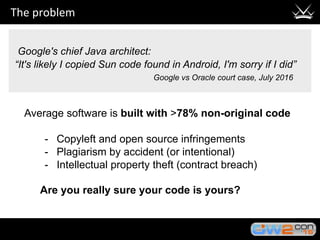
Average software is built with >78% non-original code
-  Copyleft and open source infringements
-  Plagiarism by accident (or intentional)
-  Intellectual property theft (contract breach)
Are you really sure your code is yours?
Google's chief Java architect:
“It's likely I copied Sun code found in Android, I'm sorry if I did”
Google vs Oracle court case, July 2016
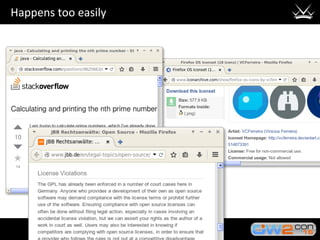
Happens	too	easily
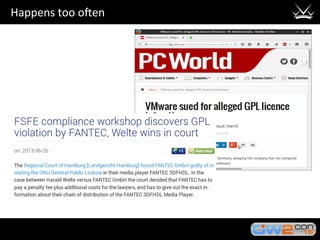
Happens	too	o?en
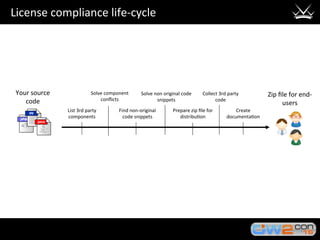
License	compliance	life-cycle	
Zip	le	for	end-
users	
Your	source	
code	
List	3rd	party	
components	
Solve	component	
conflicts	
Find	non-original	
code	snippets	
Solve	non	original	code	
snippets	
Prepare	zip	le	for	
distribu3on	
Collect	3rd	party	
code	
Create	
documenta3on
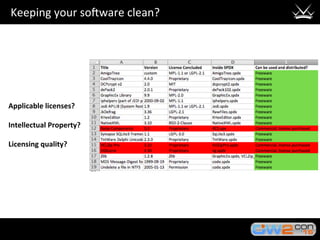
Keeping	your	so?ware	clean?	
	
Applicable	licenses?	
	
Intellectual	Property?	
	
Licensing	quality?
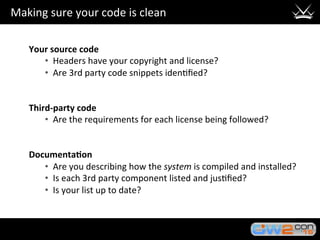
Making	sure	your	code	is	clean	
	
Your	source	code	
•  Headers	have	your	copyright	and	license?	
•  Are	3rd	party	code	snippets	iden3fied?	
	
	
Third-party	code	
•  Are	the	requirements	for	each	license	being	followed?	
	
	
DocumentaBon	
•  Are	you	describing	how	the	system	is	compiled	and	installed?	
•  Is	each	3rd	party	component	listed	and	jus3fied?		
•  Is	your	list	up	to	date?
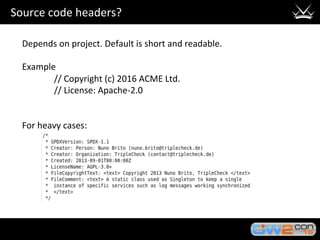
Source	code	headers?	
Depends	on	project.	Default	is	short	and	readable.	
	
Example	
//	Copyright	(c)	2016	ACME	Ltd.	
//	License:	Apache-2.0	
	
	
For	heavy	cases:
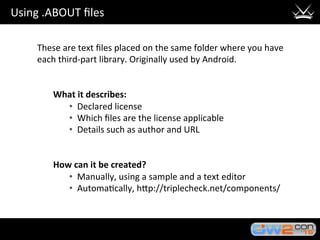
Using	.ABOUT	les	
These	are	text	les	placed	on	the	same	folder	where	you	have	
each	third-part	library.	Originally	used	by	Android.	
	
	
What	it	describes:	
•  Declared	license	
•  Which	files	are	the	license	applicable	
•  Details	such	as	author	and	URL		
	
	
How	can	it	be	created?	
•  Manually,	using	a	sample	and	a	text	editor	
•  Automa3cally,	hHp://triplecheck.net/components/
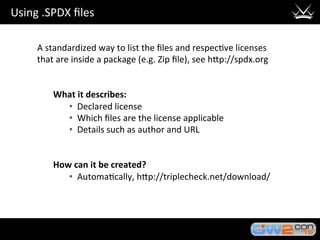
Using	.SPDX	les	
A	standardized	way	to	list	the	les	and	respec3ve	licenses	
that	are	inside	a	package	(e.g.	Zip	le),	see	hHp://spdx.org	
	
	
What	it	describes:	
•  Declared	license	
•  Which	files	are	the	license	applicable	
•  Details	such	as	author	and	URL		
	
	
How	can	it	be	created?	
•  Automa3cally,	hHp://triplecheck.net/download/
Standardiza3on	
Without	clarity,	we	can’t	automate	nor	understand	what	is	meant.	
Specify	without	ambiguity	the	licenses	and	3rd	party	so?ware	you	use.	
	
	
Include	version	number	
•  Different	versions	may	have	different	licenses	
•  Not	adding	a	version	forces	end-users	to	inves3gate	
	
	
Use	standard	license	names,	don't	invent	new	ones	
•  Use	the	iden3fiers	from	hHp://spdx.org/licenses		
•  Make	it	easy	for	everyone	to	understand
Include	with	each	project	
LICENSE	
•  Full	legal	terms	for	declared	licenses	
	
	
README	
•  Describe	the	project	and	list	licenses	in	readable	text	
	
	
AUTHOR	
•  Lists	the	authors	and	company	that	wrote	the	so?ware
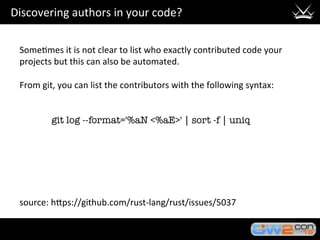
Discovering	authors	in	your	code?	
Some3mes	it	is	not	clear	to	list	who	exactly	contributed	code	your	
projects	but	this	can	also	be	automated.	
	
From	git,	you	can	list	the	contributors	with	the	following	syntax:	


git log --format='%aN <%aE>' | sort -f | uniq


source:	hHps://github.com/rust-lang/rust/issues/5037
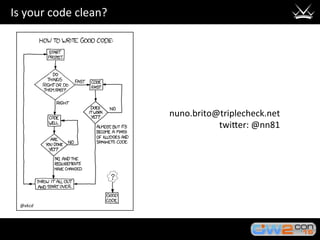
Is	your	code	clean?	
nuno.brito@triplecheck.net	
twiHer:	@nn81		
@xkcd

Preparing your source code for distribution, OW2con'16, Paris.